Biodiversity Heritage Library - Program news and collection highlights from BHL
  • Home
  • News
  • Featured Books
    • All Featured Books
    • Book of the Month Series
    • BHL at 20
  • User Stories
  • Campaigns
    • Fossil Stories
    • Garden Stories
    • Monsters Are Real
    • Page Frights
    • Her Natural History
    • Earth Optimism 2020
  • Tech Blog
  • Visit BHL
Home
News
Featured Books
    All Featured Books
    Book of the Month Series
    BHL at 20
User Stories
Campaigns
    Fossil Stories
    Garden Stories
    Monsters Are Real
    Page Frights
    Her Natural History
    Earth Optimism 2020
Tech Blog
Visit BHL
  • Home
  • News
  • Featured Books
    • All Featured Books
    • Book of the Month Series
    • BHL at 20
  • User Stories
  • Campaigns
    • Fossil Stories
    • Garden Stories
    • Monsters Are Real
    • Page Frights
    • Her Natural History
    • Earth Optimism 2020
  • Tech Blog
  • Visit BHL
Biodiversity Heritage Library - Program news and collection highlights from BHL
Blog Reel, Featured Books

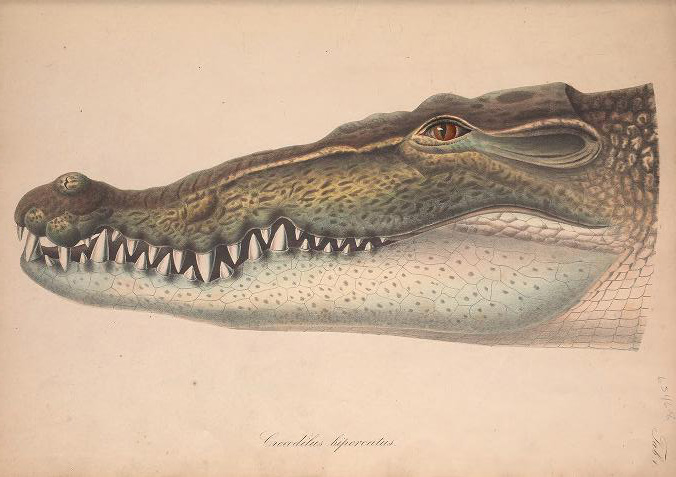
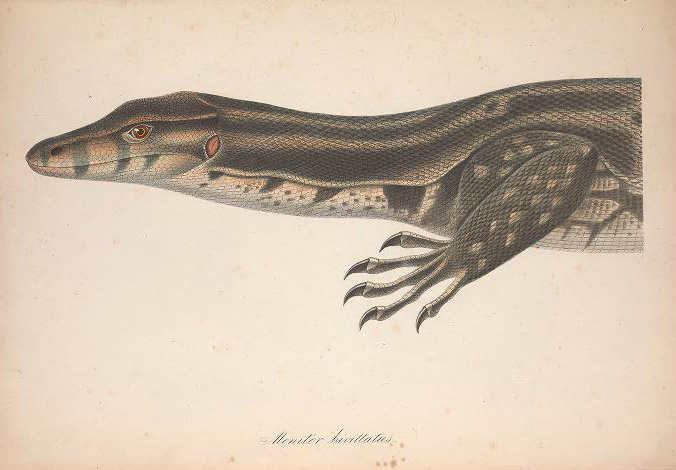
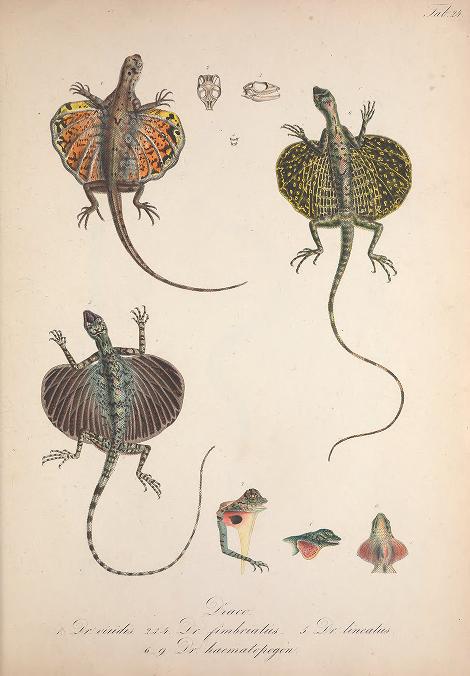
The Art of Herpetology: Schlegel’s Reptiles and Amphibians

Schlegel, H. (Hermann). Abbildungen neuer oder unvollständig bekannter Amphibien. 1837-1844. Atlas digitized by Smithsonian Libraries. http://s.si.edu/2AYBgPF.

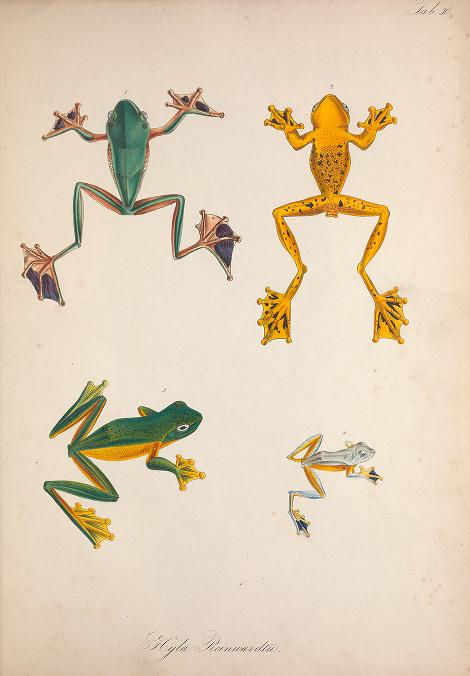
German ornithologist and herpetologist Hermann Schlegel hoped that the publication of good illustrations would stimulate public interest in reptiles and amphibians. Thus, he produced Abbildungen neuer oder unvollständig bekannter Amphibian (1837-44).

Schlegel, H. (Hermann). Abbildungen neuer oder unvollständig bekannter Amphibien. 1837-1844. Atlas digitized by Smithsonian Libraries. http://s.si.edu/2jLkYGC.

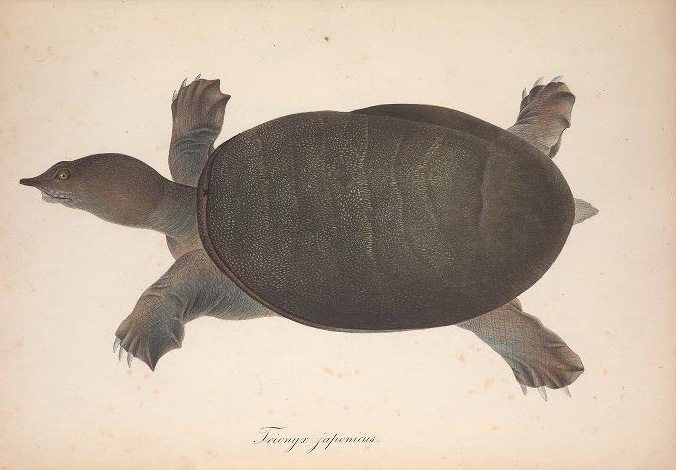
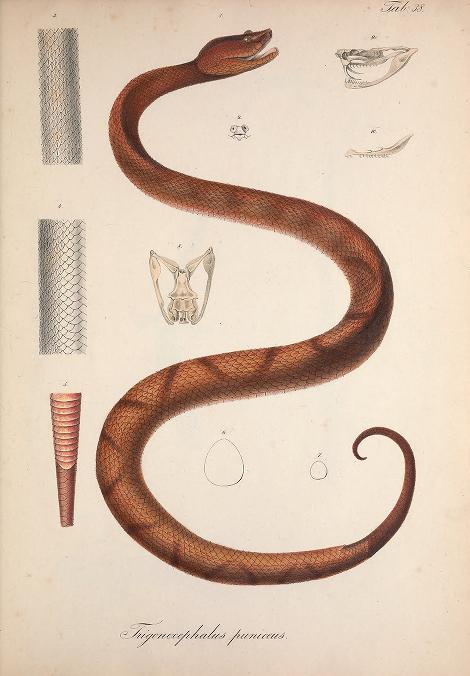
Schlegel, who eventually became director of the National Museum of Natural History in Leiden (Rijksmuseum van Natuurlijke Historie), is best-known for his research on birds, but his initial interest was in herpetology. Inspired by other beautifully-illustrated natural history books that had aroused public interest in their subjects, Schlegel compiled this work comprised of an atlas of 50 color plates and a short volume of text. Although the title mentions only amphibians, it describes and illustrates many reptile species as well.

It is unclear why the book’s title does not also mention reptiles. It has been suggested that the work’s original scope may have intended to cover only amphibians, and that the title was not adjusted after the scope broadened. This, however, is merely conjecture.

Schlegel, H. (Hermann). Abbildungen neuer oder unvollständig bekannter Amphibien. 1837-1844. Atlas digitized by Smithsonian Libraries. http://s.si.edu/2jcxafn.

Unfortunately, the names of the artists who produced the drawings upon which these plates are based are unknown. Schlegel mentioned only that he received the illustrations from painters working in India.

Schlegel, H. (Hermann). Abbildungen neuer oder unvollständig bekannter Amphibien. 1837-1844. Atlas digitized by Smithsonian Libraries. http://s.si.edu/2zaEmj2.

The text volume of this work was digitized by Ernst Mayr Library of the Museum of Comparative Zoology, Harvard University. The atlas was digitized by Smithsonian Libraries.

Schlegel, H. (Hermann). Abbildungen neuer oder unvollständig bekannter Amphibien. 1837-1844. Atlas digitized by Smithsonian Libraries. http://s.si.edu/2hQxOmb.


Schlegel, H. (Hermann). Abbildungen neuer oder unvollständig bekannter Amphibien. 1837-1844. Atlas digitized by Smithsonian Libraries. http://s.si.edu/2jcoLbU.


Reference:
Stiassny, Melanie L.J. (2014). Schlegel’s Guide to Amphibians. Natural Histories Opulent Oceans: Extraordinary Rare Book Selections from the American Museum of Natural History Library. New York: Sterling Publishing.

November 30, 2017by michelle.underhill
Blog Reel, Featured Books

Notes from William Brewster: The Evolving Field of Zoology

As a part of the Field Notes Project, the Ernst Mayr Library is digitizing the journals, correspondences and photographs of William Brewster (1851-1919), a self-trained ornithologist and specimen curator at Harvard’s Museum of Comparative Zoology (MCZ), the first president of the Massachusetts Audubon Society, and a co-founder and president of the American Ornithologists’ Union.

Brewster recorded a lifetime of observations on wildlife and plants, changing landscapes, and daily weather, making his notes a valuable resource for modern scientists studying ecological change. After working as an animal specimen curator for the MCZ for many years, he also bequeathed his personal collection of birds and other animals to the museum.

As I’ve worked to digitize and transcribe the Brewster collection, I’ve been periodically sharing interesting finds in a blog post series on the Mayr Library website. These posts highlight entertaining animal encounters, beautiful descriptions, letters, and more.

View Full Size Image
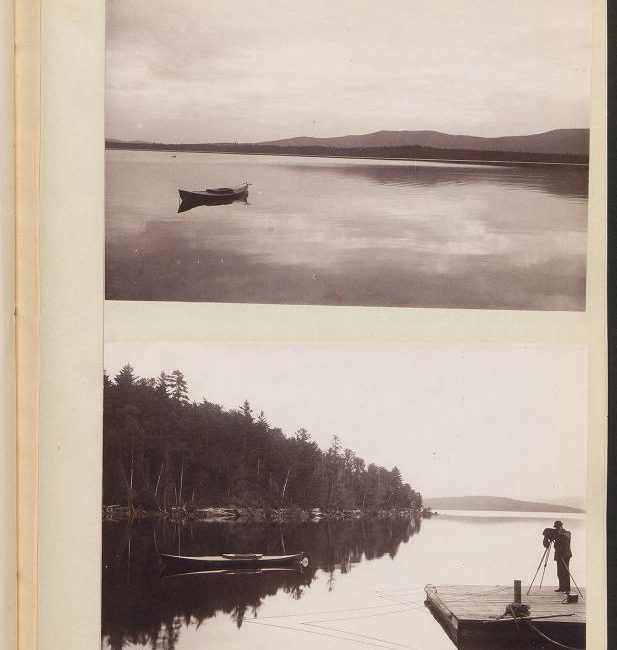
Lower image: Portrait of Brewster with his camera at
Lake Umbagog, Maine, likely captured by his assistant, Gilbert.
Journals of William Brewster, 1871-1919 (inclusive). (1898). http://biodiversitylibrary.org/page/45105729

I’ve been especially fascinated to track the development of Brewster’s thoughts on scientific collecting. I touched on this subject in a post on the Biodiversity Heritage Library blog, “Digging into the writings of a 19th century ornithologist”. As I’ve continued to scan and transcribe the Brewster collection, an interesting story has emerged. It was a complex job to juggle the hats of museum curator, scientific collector, and bird-lover.

In an 1886 letter, Brewster scoffed at the assertion that “the best was to study bird was with an opera glass!”[1] This was one decade before the Massachusetts Audubon Society for the Protection of Birds was founded, with Brewster as its first president. Despite his earlier reservations, journals from the 1890s show Brewster embracing new methods of data collection using binoculars and cameras, and reflecting critically on the future methods and goals in zoology.

While he continued to advocate for the importance of collecting wildlife specimens, Brewster increasingly felt that humans had an ethical responsibility to carefully mitigate human impact on wildlife – and this responsibility belonged to scientists, too.

View Full Size Image
Brewster returned for many years to make observations at Lake Umbagog, Maine, sometimes staying in his specially built house-boat.
The person standing on deck is probably his assistant, Gilbert. Journals of William Brewster, 1871-1919 (inclusive). (1898). http://biodiversitylibrary.org/page/45105746

In the 1890s Brewster began to consistently document a deep conflict between his desire to study nature and his desire to leave wildlife untouched. Because his field notes are typically more focused on data than on personal details, these comments really do stand out and signal that this became a matter of great concern to him. In 1892, he observes:

As on several former occasions when I have seen a Hawk catch a smaller bird and have listened to its expiring cries I was moved by deep pity and fierce wrath to an extent surprising on the part of one who, like myself, has killed thousands of birds without suffering more than an occasional slight qualm. But there is something peculiarly moving and piteous in the voice of a bird in the clutches of a Hawk – a quality of mingled pain and apprehension which the grasp of the human hand seldom or never elicits. [2]

Over the next few years, we find that he has gone from those aforementioned “occasional slight qualm[s]” to a daily struggle to complete his work. In 1896 he refers to collecting birds as “a most painful task”[3], and writes that he is sometimes “quite unable to bring [himself] to the point of doing it.” [4]

View Full Size Image
Close-up of a female moose Brewster sketched at Lake Umbagog, Maine. Journals of William Brewster, 1871-1919 (inclusive). (1896). http://biodiversitylibrary.org/page/44924677

It’s clear that Brewster saw a need for some change in the current scientific practices. Birds were generally being over-harvested, for fashion but also for science. And not only was nature conservation on his mind, but it seems that he felt personally dissatisfied by the limited scope of zoology. Brewster saw the need to legitimize observational studies of animal behavior in a scientific community that was focused primarily on taxonomy and building large collections. While he wrote many letters to colleagues debating the species and subspecies designation of specimens, his journals are brimming with descriptions and speculations about animal behaviors.

From his correspondences, we can see that his thinking was encouraged by Frank Michler Chapman, a younger friend and colleague working at the American Museum of Natural History. In 1890, Chapman had written to Brewster to express his concern that specimen collecting was destructively out of control:

This miserable collecting. It is the cause of all higher failing, it lowers a true love of nature through a desire for gain. I don’t mean a specimen here and there, but this shooting right and left, this boasting of how many skins have been made in a day or season. We are becoming pot-hunters. We proclaim how little we know of the habits of birds and then kill them at sight. Sometimes I am completely disgusted with our ways and myself in particular… I long for an outing where the gun will be secondary, recorded observations primary, where I shall be entirely alone or with a companion whose object is my object. 

We expect too much, that’s the trouble. Collecting, we have at the end of each day some tangible result to show for the day’s work. But it is useless to expect some novel or interesting incident for every day[‘]s observation. But listen to this final result: If I had gone down the Suwanee [River] to record what I saw, I could now have written a more or less interesting paper, as it is I have nothing to say, but I have a hundred or so skins. The question with me is, how am I going to change this? …We have degenerated to ‘gunners’; our success in the field is estimated by the size of our collections. 

… Will you embark with me on a novel ornithological expedition, whose aim shall be to really observe birds to learn something of them. Where the gun shall be a servant, not a master, where days may pass without a skin being made, where there will be time to speculate and discuss the habits of birds observed, where systematic observation of certain phaenomena may be attempted… Returning we could write a paper. How do you suppose this paper would compare with the ones we have to-day, where after a trip[‘]s experience all we can say concerning a given species is: Common, arrived ___.

Such a paper with your name attached to it would start a new epoch in the study of American birds. Imagine any one now-a-days making an extended trip for the sole purpose of observing birds. I know, I have several papers in mind which approach this – yours are nearest. Do you suppose we can reach that condition of mind where one good observation will be considered worth fifty skins, – as it really is. [Line breaks and emphasis added.] [5]

View Full Size Image
A page from William Brewster’s journal. Illustration reads “Made by Mr. Chapman from the feather of the ivory-bill shot March 24 and sent to me as a Christmas mount Dec. 25 1890.”
Journals of William Brewster, 1871-1919 (inclusive). (1890). http://biodiversitylibrary.org/page/44690675

Brewster was too busy with travel and fieldwork to respond directly (in writing, at least) to Chapman’s proposition, but he did reply a few weeks later, “I have been off in my canoe along the ‘South Shore’ of Mass for the past month & have made a good many valuable notes… I left the gun at home for the first time in my life and did not once regret it, either!” [6]

How amazing it was to find, in writing, a proposal to launch “a new epoch in the study of American birds”! While specimen collections are an important part of modern scientific work, it’s true that the study of zoology does look very different today than it did in the 19th century, and here we see the seeds of that change.

It would be easiest to paint Brewster as simply a taxidermist, or as an environmentalist, but as usual we find that the scientist was about as complex as the subjects he studied. Just as Brewster’s careful notes on species abundance and daily temperature are an invaluable resource for researchers, it’s enriching from a humanities perspective to uncover the personal stories that drove a major paradigm shift in the study and stewardship of natural world. While nothing quite compares to studying old documents in a quiet room, it’s exciting to be widening accessibility to these data and historical insights.

The BHL Field Notes Project is funded by the Council on Library and Information Resources (CLIR).
Images used in this post were previously digitized with funds from IMLS.

Citations:
[1] Correspondences, Letter to George Sennet, March 7, 1886. Soon to be available in BHL
[2] July 28. Journals of William Brewster, 1871-1919 (inclusive). (1892). http://biodiversitylibrary.org/page/44790847
[3] July 3. Journals of William Brewster, 1871-1919 (inclusive). (1896). http://biodiversitylibrary.org/page/44924596
[4] July 9. Journals of William Brewster, 1871-1919 (inclusive). (1896). http://biodiversitylibrary.org/page/44924608
[5] Correspondences, Frank Michler Chapman to William Brewster, June 15, 1890. Soon to be available in BHL
[6] Correspondences, William Brewster to Frank Michler Chapman, August 8, 1890. Soon to be available in BHL

Additional Resources:
To read more about Brewster’s encounter with the moose, read ‘Notes from William Brewster: Moose!‘
To learn more about how scientists use specimen collections today read ‘Natural history collections – why are they relevant?’ on The Guardian, or visit the page ‘Why Collections Matter’ on the Society for the Preservation of Natural History Collections’ website.

To learn more about the origins of the Massachusetts Audubon Society, read ‘Hats off to Audubon’ in Audubon Magazine, and the ‘History of Mass Audubon’ page on the society’s website.

April 6, 2017by lmyrick
BHL News, Blog Reel

‘What’s in a Name?’ Launched at Harvard Museum of Natural History

Why are names important in science? What is the difference between scientific names (also known as Latin names or taxonomic names) and common names? Why do some species have multiple names? The grant project team for What’s in a Name, supported by the Institute of Museum and Library Services (IMLS), set out to find answers and develop exhibits and other ways for anyone to explore this phenomenon. With millions of different species to identify and understand, the process of naming organisms helps scientists organize and understand the tree of life. The physical and virtual results of this exploration creatively demonstrate how scientists identify and name species, how names relate to scientific research and the progression of knowledge, and how museum specimen collections play a crucial role in the process of naming.

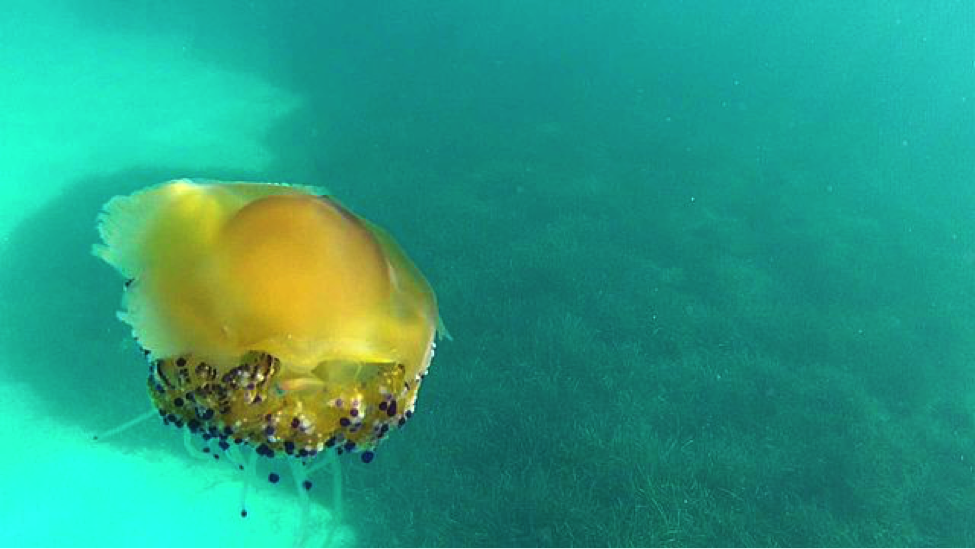
Why would something be called “Fried Egg jelly fish”, and also be known as Phacellophora camtschatica?

View Full Size Image
Image of the Fried Egg Jelly courtesy of gpapadop79 – Own work, CC BY-SA4.0, https://commons.wikimedia.org/w/index.php?curid=45347541.

Scientific names take the form of “Genus species”. Scientific names serve to distinctively identify an organism and also to show evolutionary relationships. The genus links the organism to its evolutionary relatives while the species name demonstrates its uniqueness (not unlike the family and first name convention of many people in North America). Organisms also have common names. Common names can be confusing—for instance a “Robin” in the United States is a completely different bird than a “Robin” in Europe, but if the scientific name is used, confusion can be reduced via the name unique to the organism.

The system of binomial nomenclature is used to assign species with their two-part Latin names. Carl von Linné (1707 – 1778) established a system of tiered taxonomic classification, which assigned species formal names, in the 18th century. His classification is outlined in his book, Systema Naturae. His purpose was to reduce confusion from the proliferation of common names by supplying a unique name to each organism that also displayed potential relationships with other organisms. The names were formulated from Latin words. Linné even Latinized his own name and is now best known by that name: Carolus Linnaeus.

View Full Size Image
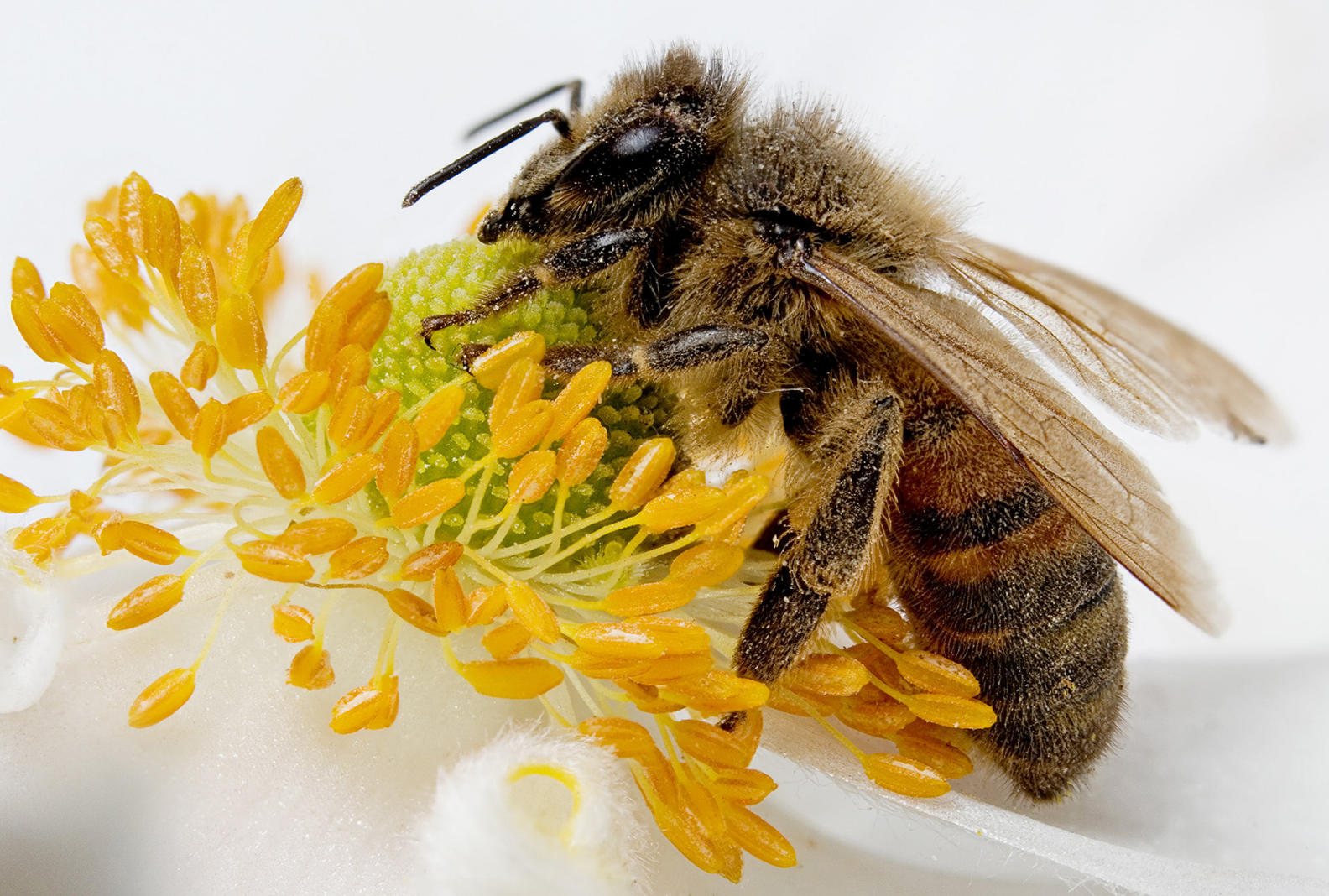
From the What’s In a Name PDF, page 32: “Carl Linnaeus gave the European Honeybee its name, Apis mellifera, which is Latin for “honey-bearing bee.” By some accounts, Linnaeus later became dissatisfied with the name he bestowed and argued to change it from Apis mellifera, to Apis mellifica, or “honey-making bee.” His mistake, he argued, was that bees make honey within the hive; they do not bear it from the flower. His argument was presumably unsuccessful as the bee still bears the erroneous name.” Image: A European Honeybee, Apis mellifera, visiting a flower that is dusting it with pollen. (JJ Harrison, CC BY-SA 3.0).

Species may be discovered by scientists poring over specimens in a museum or someone exploring an area rich in biodiversity. It is not necessary to be a scientist to name a new species but scientific names must conform to rules laid out by the International Code of Zoological Nomenclature and the International Code for Nomenclature for algae, fungi and plants. Names can reflect a characteristic of a species (Peromyscus leucopus-white-footed mouse) or can be named after a person or location (Mandelia microcornata-a nudibranch named for Nelson Mandela). Sometimes, scientists display a sense of humor when naming: Agra phobia and Agra vation are the scientific names of South American beetles. A hungry entomologist (Neal Evenhuis) named a series of flies (genus) Pieza and most notably, a species Pieza pi.

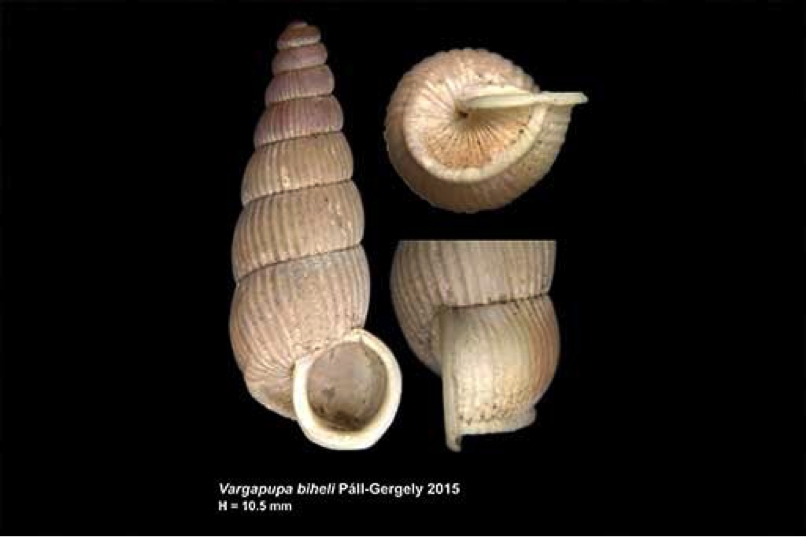
The results from the work of What’s in a Name? include four interactive exhibit stations at the Harvard Museum of Natural History on Honeybees, the extinct Dimetrodon, Jellies and Poison Ivy. There are also free online resources, including a website and a 60-page free e-book. The online resources include eight more species stories that feature images and references from the Biodiversity Heritage Library (BHL) and include familiar organisms like the dodo and sugar maple, as well as our favorite, the snail Vargapupa biheli named after BHL!

View Full Size Image
Vargapupa biheli. Image courtesy Dr. Barna Páll-Gergely.

Featured in the exhibit display on Dimetrodon, Stephanie Pierce, Assistant Professor of Vertebrate Paleontology, Harvard University, describes research being done right now on specimens of the fossil species Dimetrodon milleri, in the Museum of Comparative Zoology collection:

The What’s in a Name? project is a partnership between Harvard Museums of Science and Culture (HMSC), the Encyclopedia of Life (EOL), and the BHL, as represented by the Ernst Mayr Library of the Museum of Comparative Zoology at Harvard University. This project was made possible by IMLS.

For more information about scientific names and naming, check out the following sources

  • Bright, M. 2012. The Frog with Self-cleaning Feet: And Other Extraordinary Tales From the Animal World. Biteback Publishing. 304 pages.
  • Evenhuis, N. L.2002. Pieza, a new genus of microbombyliids from the New World (Diptera: Mythicomyiidae). Zootaxa 36(1). DOI: http://dx.doi.org/10.11646/zootaxa.36.1.1
  • Freeland, C. 2008. On Name Finding in the BHL. BHL Blog, March. https://goo.gl/wJIOWC
  • Greenstein, B. 2016. How’s your fern and bird coverage, BHL? BHL Blog, August.
  • Harvard Museums of Science and Culture. 2017, “What’s in a Name?.” http://whatsinaname.hmnh.harvard.edu/files/imls/files/_whatsinaname_.pdf
  • Judd, W. 2014.Weirdest species names. Australian Geographic. March 2014. https://goo.gl/UQ3xMA
  •  Zielinski, S. 2009. The World’s Strangest Scientific Names. Smithsonian Magazine. https://goo.gl/D3aMbb
February 14, 2017by ulib-libraryjobs
Blog Reel, Campaigns, Featured Books

Color Our Collections: The Art of Woodcuts

View Full Size Image

This year for Color Our Collections, we’ve produced a coloring book with illustrations from books that represent the evolution of the art of printing. This week on our blog, we’ll explore the books featured in the coloring book and the printing techniques used for the illustrations.

You can download our 2017 Color Our Collections coloring book here.

Learn more about Color Our Collections here.

The Art of Woodcuts

In the woodcut printing technique, the image (and sometimes text) is carved into the surface of a wood block. A knife and/or chisel is used to remove the wood surrounding the image, so that only the image lines remain raised or flush with the wood block surface. The block is then inked and pressed against paper to transfer the image. The resulting image is a reverse of that on the wood block.

The earliest known complete and dated printed book, the Diamond Sūtra dated 868 AD, was produced using wood block printing. The work, a Chinese translation of a Buddhist text, can be viewed online thanks to the British Library.

This video from the Victoria and Albert Museum demonstrates the woodcut printing process:

The Woodcuts of Pierre Belon

View Full Size Image
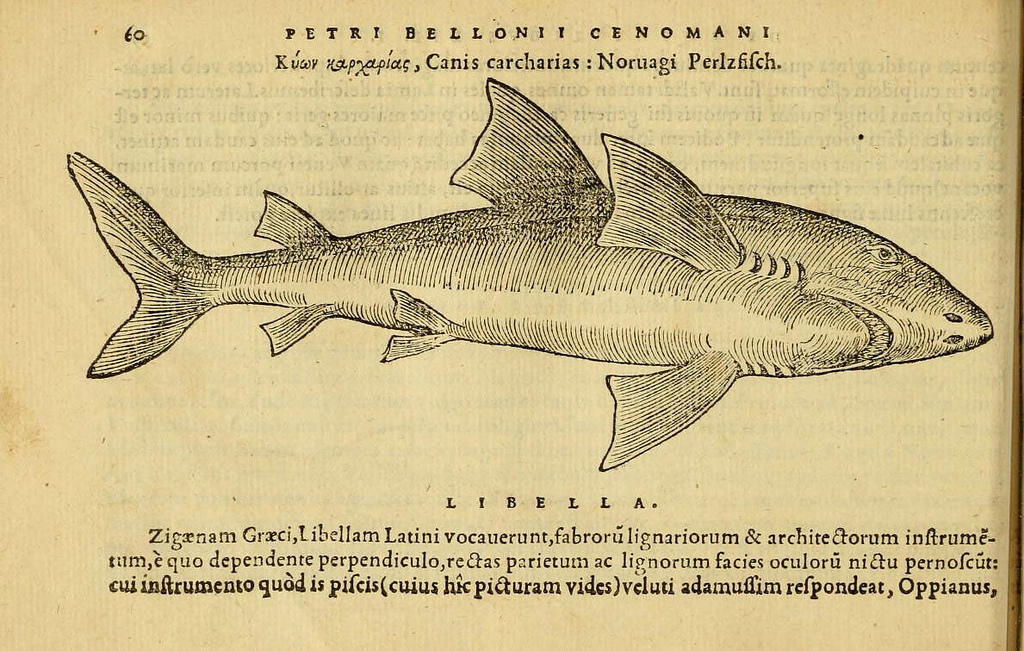
Earliest known published illustration of a great white shark. Illustrated by woodcut. Belon, Pierre. De aquatilibus. 1553. http://biodiversitylibrary.org/page/4770204. Digitized by Harvard University, Ernst Mayr Library, Museum of Comparative Zoology.

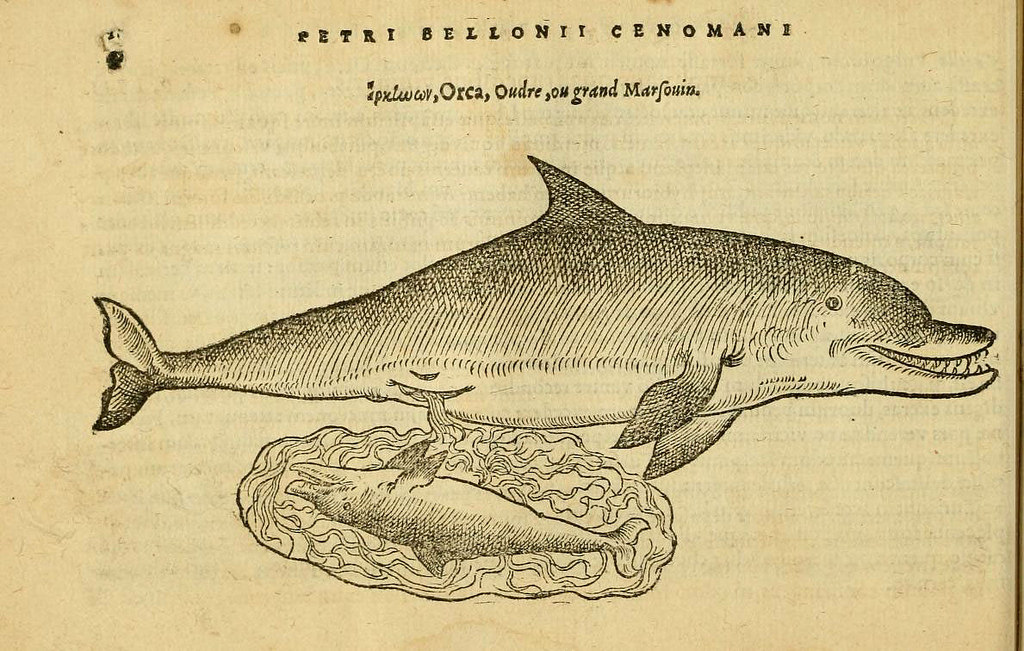
Pierre Belon was a French naturalist who started practice as an apothecary, studied medicine, and later undertook many travels that fueled his interest in natural history. In 1553, he published De aquatilibus, describing over 100 fish, sharks, and rays, as well as many marine mammals. The work is illustrated with woodcuts, and some copies are also hand colored.

Belon details the outward characteristics of the species he depicts and classifies his divisions of aquatic animals by size, skeletal structure, mode of propagation, number of limbs, form of the body, and habitat. As such, De aquatilibus is considered by many to be the beginning of modern ichthyology. The work also includes detailed descriptions of dolphins and their embryos and reproductive anatomy, and thus it is also considered the start of modern embryology.

View Full Size Image
Belon portrayed many dolphins, their embryos, and reproductive anatomy within De aquatilibus, marking the beginning of modern embryology. Illustrated by woodcut. Belon, Pierre. De aquatilibus. 1553. http://www.biodiversitylibrary.org/page/4770162. Digitized by Harvard University, Ernst Mayr Library, Museum of Comparative Zoology.

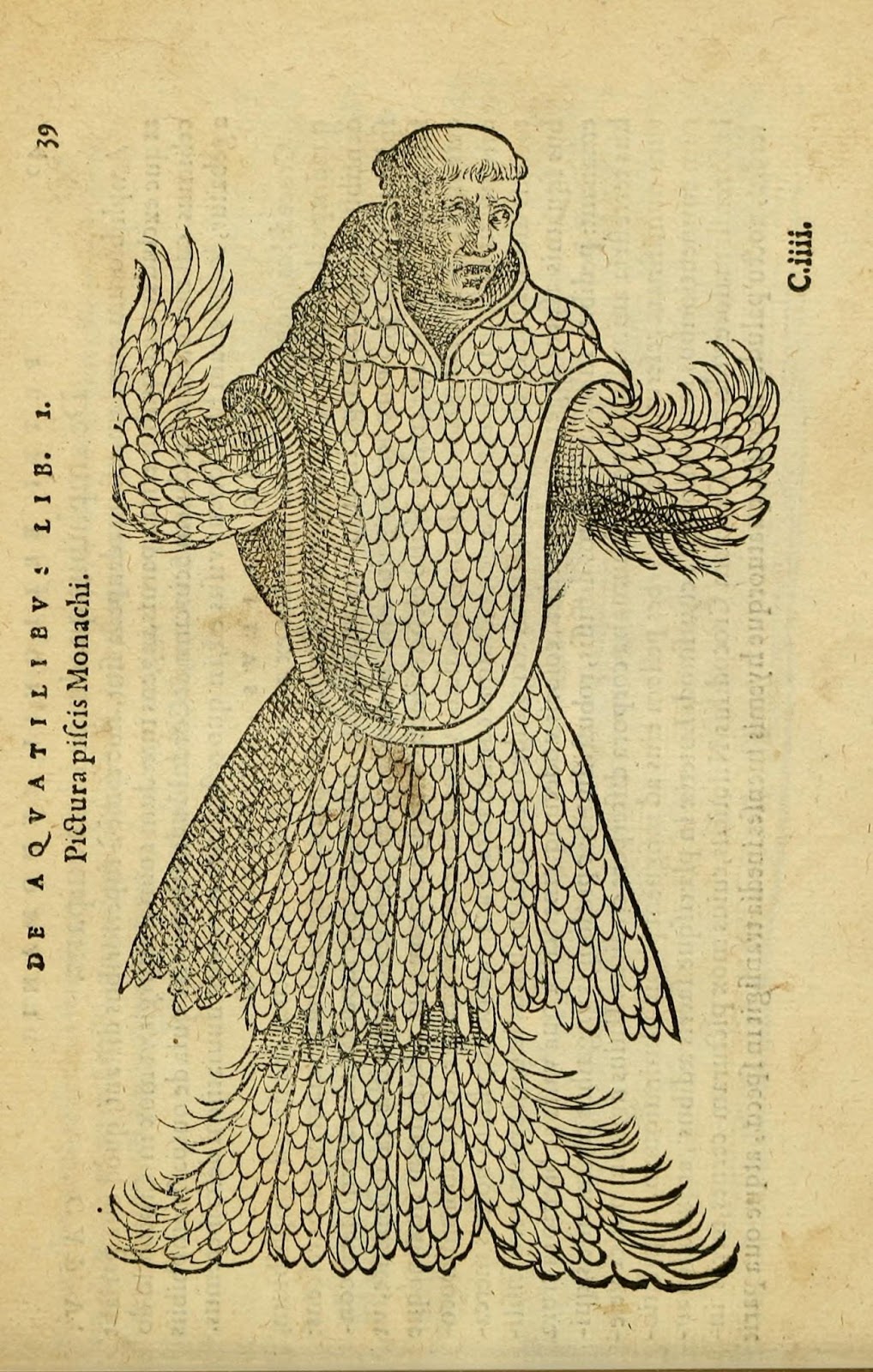
Belon stressed the importance of observation in scientific study and communication, chastising those who simply relied on and proliferated historic accounts stemming from the titans of antiquity. However, despite this charge, Belon does include some fantastical creatures within his book, including the “sea monk” and “web-footed horse of Neptune.”

View Full Size Image
Mythical “sea-monk,” possibly based on a stranded squid. Illustrated by woodcut. Belon, Pierre. De aquatilibus. 1553. http://biodiversitylibrary.org/page/4770183. Digitized by Harvard University, Ernst Mayr Library, Museum of Comparative Zoology.

Sadly, Belon’s life was cut tragically short. He was murdered by unknown assailants in the Bois de Boulogne in 1564 at the age of 47.

De aquatilibus was digitized in BHL by Harvard University, Ernst Mayr Library, Museum of Comparative Zoology.

References

Steins, John. Woodblock Printing. http://www.johnsteins.com/woodblock-printing.html.
Stiassny, Melanie. Natural Histories: Opulent Oceans. New York: Sterling Publishing, 2014. Print.

February 6, 2017by michelle.underhill
Blog Reel, Featured Books

Renard’s Book of Fantastical Fish

View Full Size Image
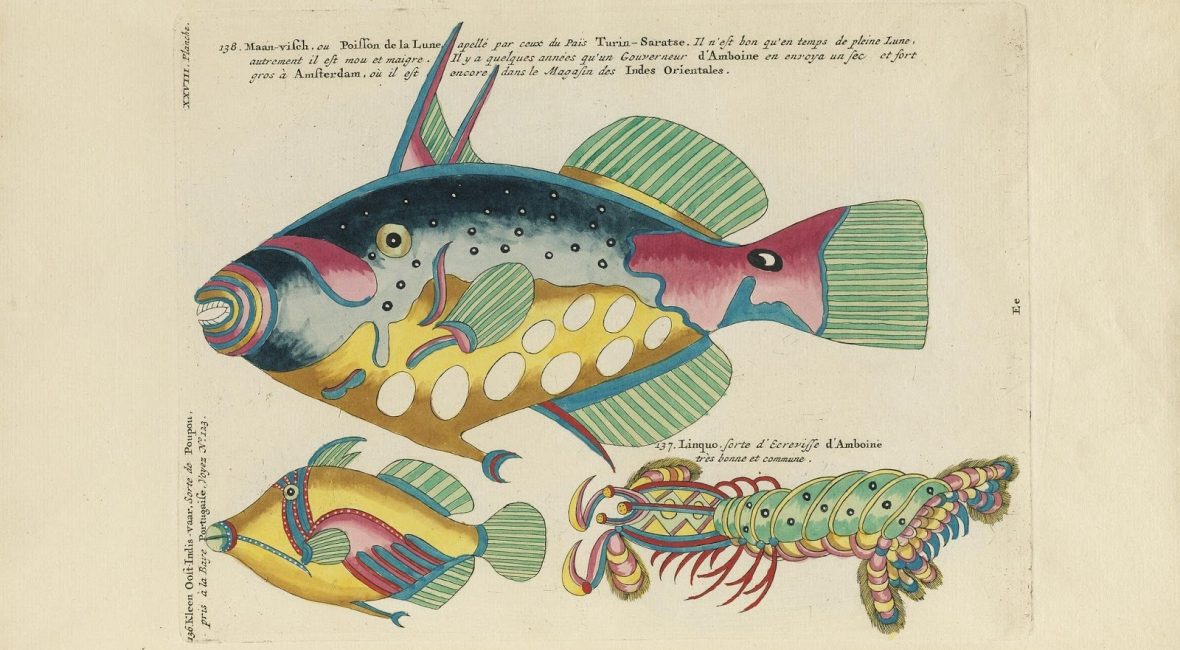
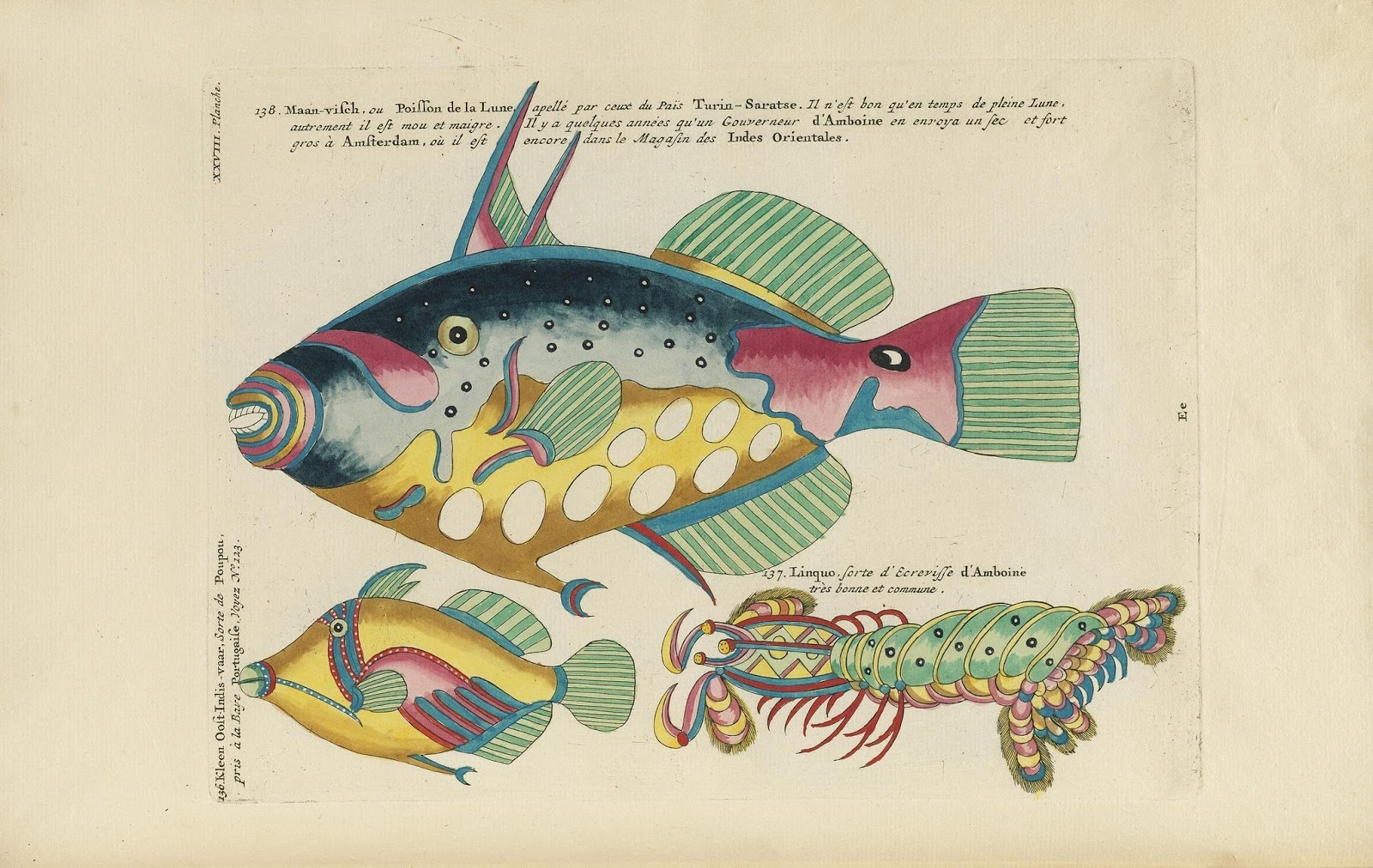
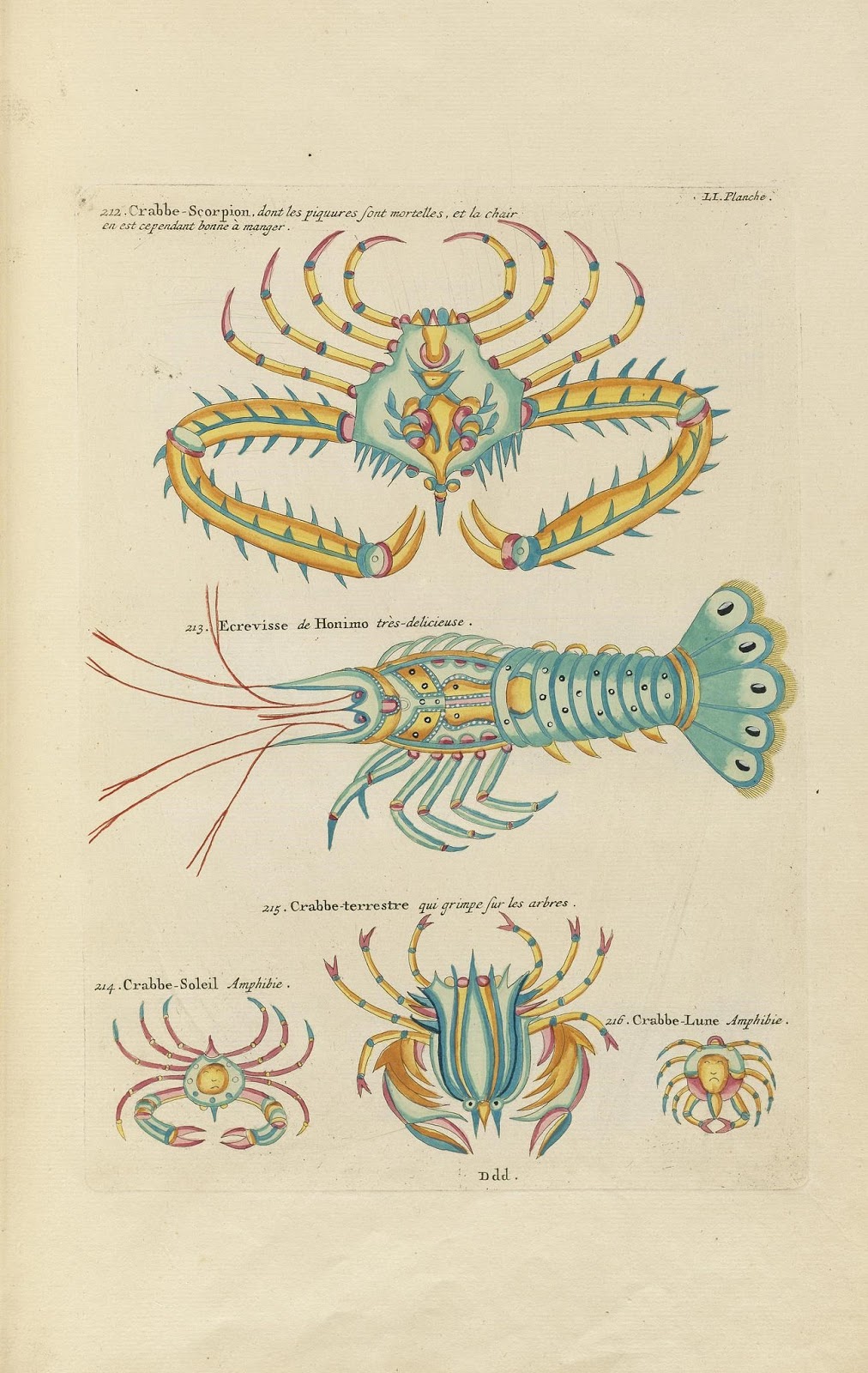
Renard, Louis. Poissons, ecrevisses et crabes. 1754. Digitized by the Ernst Mayr Library, Museum of Comparative Zoology, Harvard University. http://biodiversitylibrary.org/page/50095135.

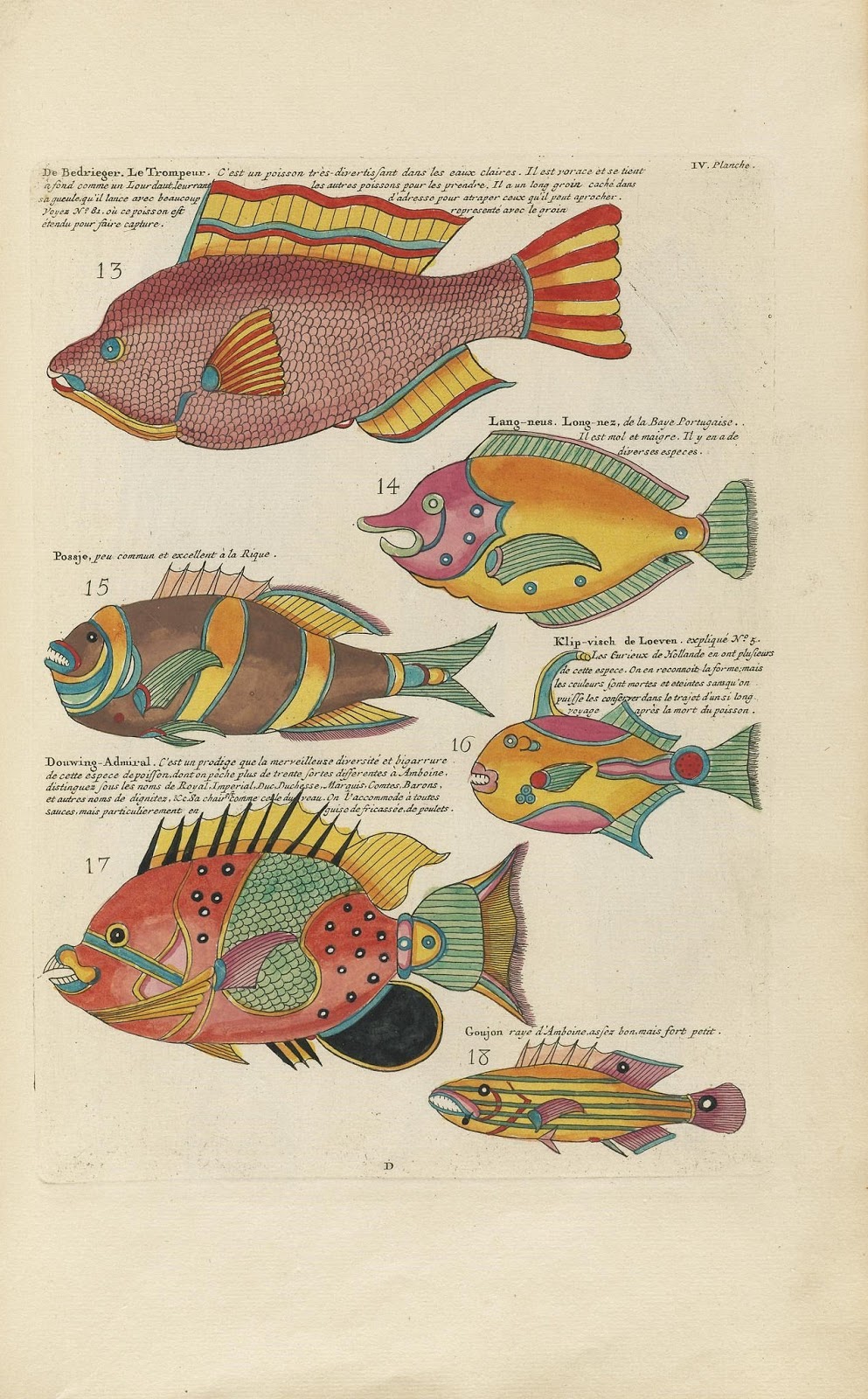
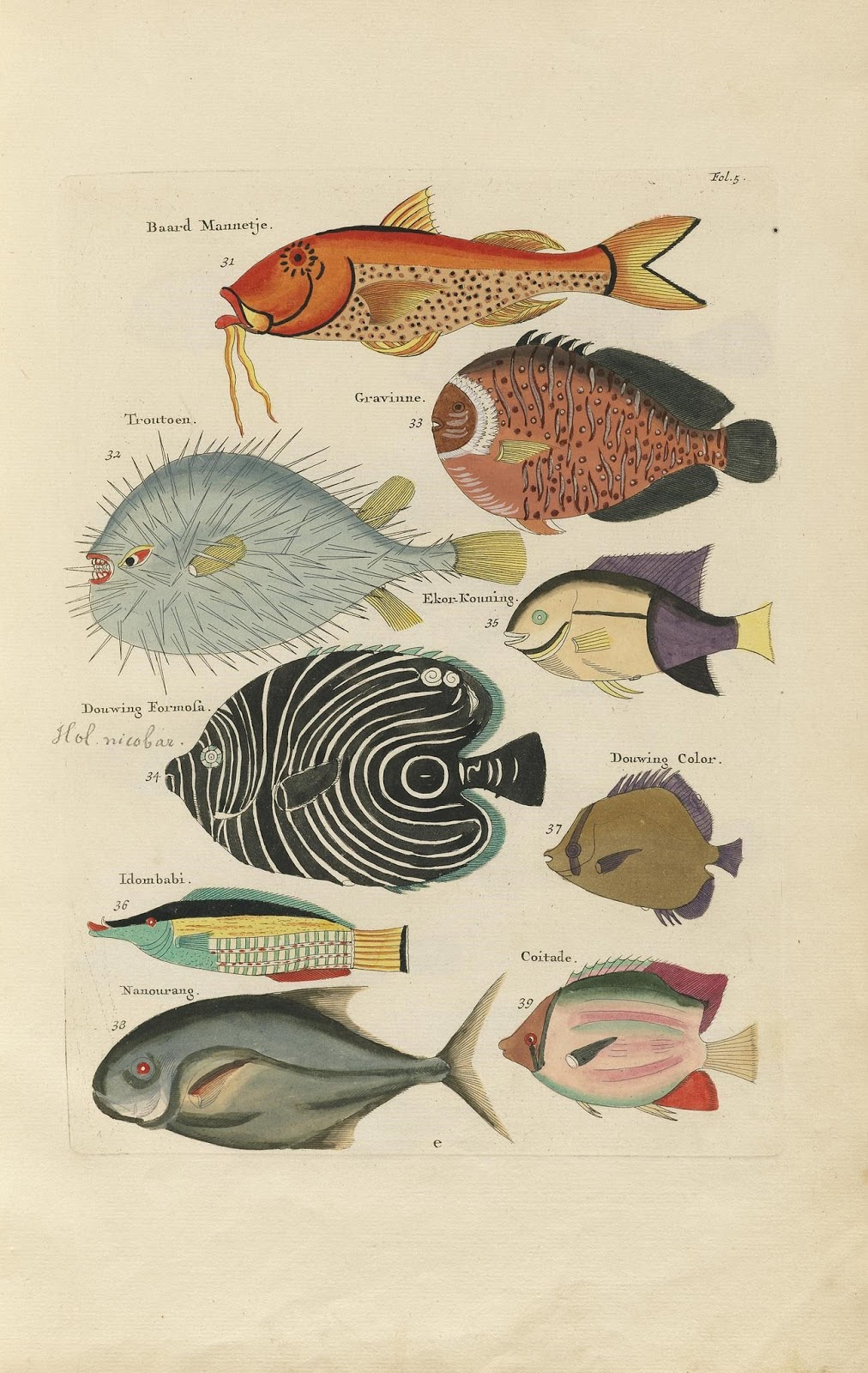
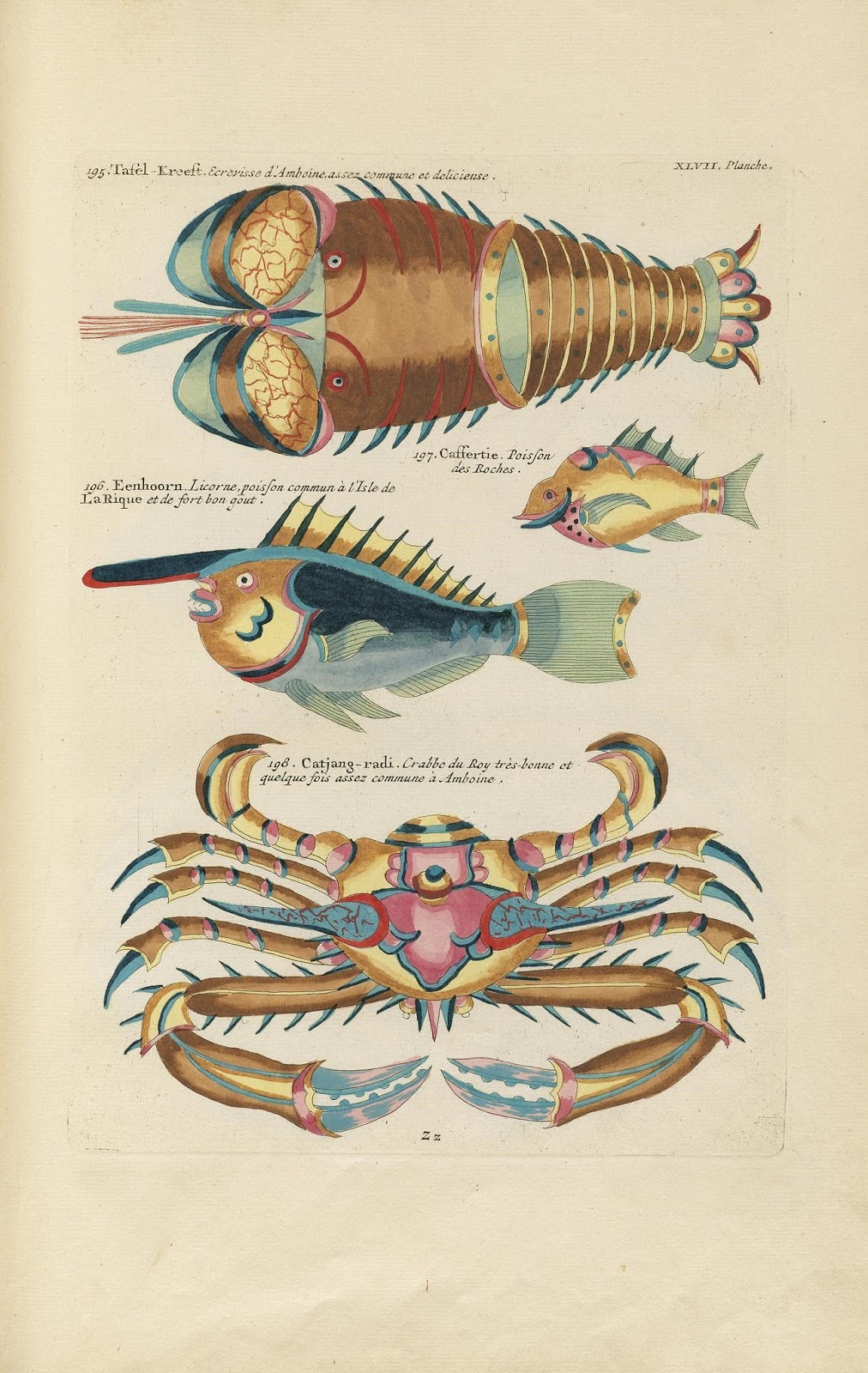
You may not recognize all (or even many) of the East Indian marine species portrayed in the first known book on fish to be published in color. Don’t worry. It’s not a lack of ichthyological proficiency on your part. Rather, it’s because all of the species depicted in Louis Renard’s Poissons, ecrevisses et crabes received some level of artistic embellishment – and approximately 9% are completely fantastical.

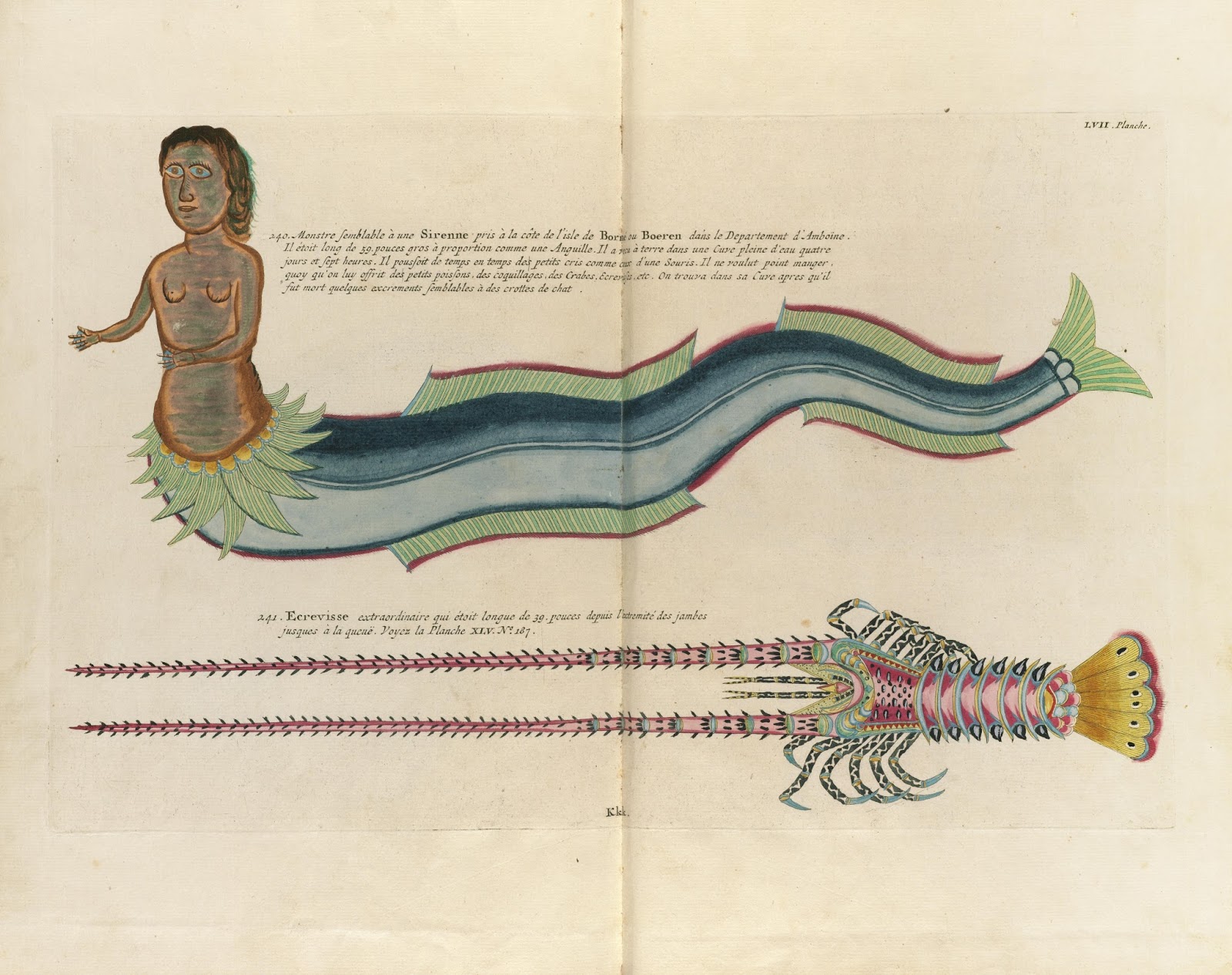
If that’s not strange enough, the work is produced by a man who identified himself as a “secret agent on behalf of the British Crown” and contains a portrait of a mermaid.

View Full Size Image
Renard, Louis. Poissons, ecrevisses et crabes. 1754. Digitized by the Ernst Mayr Library, Museum of Comparative Zoology, Harvard University. http://biodiversitylibrary.org/page/50095087.

These facts might lead you to conclude that Poissons, ecrevisses et crabes, de diverses couleurs et figures extraordinaires, que l’on trouve autour des isles Moluques et sur les côtes des terres Australes has little scientific value. But in that assumption, you’d be wrong.

Besides being the first published book in color about fish, in a 2012 article published in Natural Histories, Mai Reitmeyer, Research Services Librarian at the American Museum of Natural History, writes that this work is “an important part of the scientific literature of the eighteenth century, the new Age of Enlightenment” (Reitmeyer, 33).

According to Theodore W. Pietsch, an ichthyologist who conducted an examination of the title in the late twentieth century and whom Reitmeyer quotes in her article, Renard’s publication “gives us an intriguing glimpse of what science was like in the late seventeenth and early eighteenth centuries” and thus “to cast the work off as being without scientific merit is to greatly underestimate its value” (Reitmeyer, 34). What’s more, since the waters surrounding Ambon Island in Indonesia, where many of the depicted species were found, is now a heavily polluted ecosystem, it’s likely that the biodiversity in the area has changed since Renard’s publication. Thus, the fauna depicted in Poissons, ecrevisses et crabes, around 90% of which, according to Pietsch, can be identified down to the species, genus, or family level, can offer an important historical perspective on marine diversity in the region (Barley, 2010).

View Full Size Image
Renard, Louis. Poissons, ecrevisses et crabes. 1754. Digitized by the Ernst Mayr Library, Museum of Comparative Zoology, Harvard University. http://biodiversitylibrary.org/page/50095031.

As Reitmeyer recounts in her article, Renard was born in France sometime around 1678 but, to escape religious persecution, immigrated to the Netherlands with his family around the turn of the century and eventually became a citizen of Amsterdam. Encouraged by his father-in-law, Renard became a book dealer and publisher and, in 1718 or 1719, produced the first volume of the first edition of his most famous work, Poissons, ecrevisses et crabes, the full title of which translates to “Fishes, crayfishes and crabs, of diverse colors and extraordinary forms, which are found around the islands of the Moluccan and on the coasts of southern lands.”

While the work may depict over 450 fish and crustacean species from the East Indies, Renard published the work without ever leaving the Netherlands. Instead, he copied drawings by other artists to create the 100 plates, representing 460 hand-colored copper engravings, for his publication.

View Full Size Image
Renard, Louis. Poissons, ecrevisses et crabes. 1754. Digitized by the Ernst Mayr Library, Museum of Comparative Zoology, Harvard University. http://biodiversitylibrary.org/page/50095173.

Dutch artist Samuel Fallours, a soldier stationed in Ambon with the Dutch East India Company, painted a great many of the drawings that Renard copied for this work. During his time in Ambon, Fallours created many drawings of East Indian marine life that later appeared in several eighteenth century publications, including Renard’s.

According to Pietsch, Fallours likely included elements of the fantastical in his drawings in order to attract the European collectors who purchased his works (Barley, 2010). These embellishments ranged from artificially bright and randomly applied colors to total fabrications, including a portrait of a mermaid, which also appeared amongst an arrangement of exotic East Indian biodiversity published in Francois Valentijn’s Oud en Nieuw Oost-Indien (1724−1726).

View Full Size Image
Portrait of a mermaid by Samuel Fallours. Renard, Louis. Poissons, ecrevisses et crabes. 1754. Digitized by the Ernst Mayr Library, Museum of Comparative Zoology, Harvard University. http://biodiversitylibrary.org/page/50095192.

Poissons, ecrevisses et crabes was published in three different editions. Only sixteen copies of the first, published in 1718 or 1719, are known to exist. Thirty-four copies are known of the second edition, published in 1754. The rarest edition, with only six known copies, is the third, published in 1782 but never completed (Reitmeyer, 33).

Thanks to Ernst Mayr Library of the Museum of Comparative Zoology at Harvard University, you can view the second edition of Renard’s work for free in BHL. And if this article hasn’t piqued your curiosity quite enough to click on the link, let’s not forget the “secret agent” aspect mentioned earlier!

In what was likely a marketing ploy to boost sales, the dedication statement within Poissons, ecrevisses et crabes identifies Renard as a “secret agent on behalf of the British Crown.” What’s the story behind this claim? According to Reitmeyer, Renard was employed by George I and George II to search “ships leaving Amsterdam to prevent arms from reaching James Stuart, the Roman Catholic ‘Old Pretender’ to the British throne” (Reitmeyer, 33).

Fantasy, intrigue, and science. What’s not to love about Poissons, ecrevisses et crabes?

View Full Size Image
Renard, Louis. Poissons, ecrevisses et crabes. 1754. Digitized by the Ernst Mayr Library, Museum of Comparative Zoology, Harvard University. http://biodiversitylibrary.org/page/50095181.

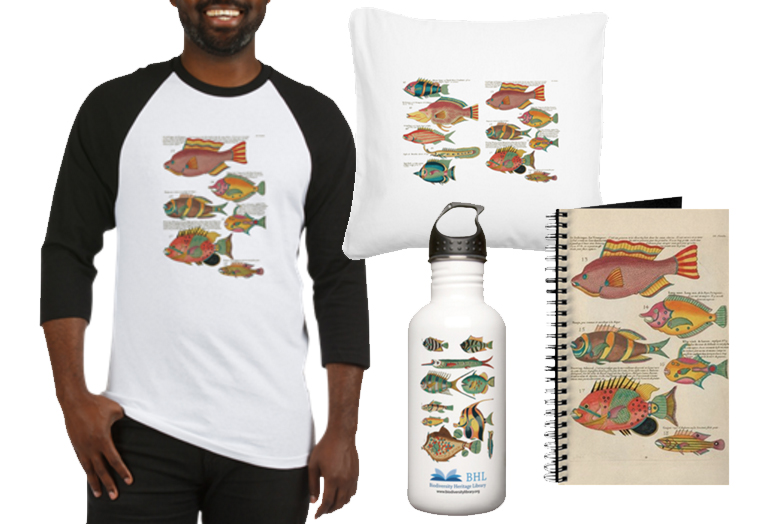
You can view the images from this work in Flickr. You can also find products featuring images from this title in our CafePress store. 100% of the proceeds will be used to digitize more books for BHL. Start shopping today!

View Full Size Image
Selection of products in the BHL CafePress featuring images from Renard’s Poissons, ecrevisses et crabes.  100% of proceeds will be used to digitize more books for BHL.

REFERENCES

  • Reitmeyer, Mai Qaraman (2012). Louis Renard and His Book of Extraordinary Creatures. Natural Histories: Extraordinary Rare Book Selections from the American Museum of Natural History Library (pp. 33-34). New York: Sterling Publishing.
  • Barley, Shanta (2010). Samuel Fallours and His Fantasy Fish. New Scientist: Culture Lab. https://www.newscientist.com/blogs/culturelab/2010/06/samuel-fallours-and-his-fantasy-fish.html. Accessed 29 July 2016.
August 4, 2016by ulib-libraryjobs
Blog Reel, Featured Books

Digging into the personal writings of a 19th century ornithologist

Tuesday, June 12, 1866 
A.M. pleasant P.M. cloudy. Studied part of P.M. Went to circus in evening & saw a hippopotamus for the first time. Got four warbling vireos before breakfast. The algebra is now rather hard. 
(Diaries of William Brewster). 

View Full Size Image
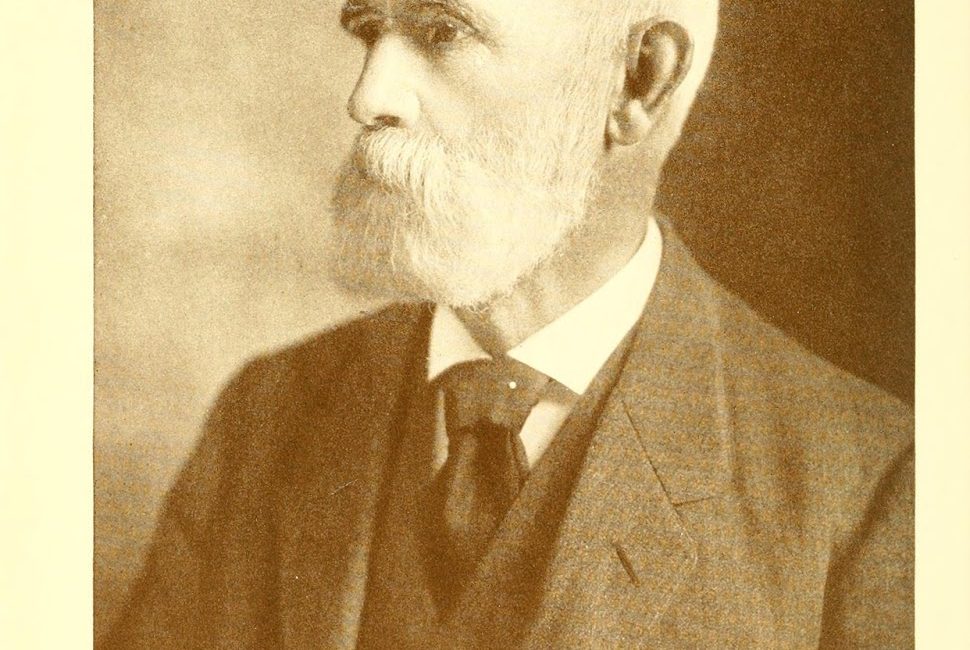
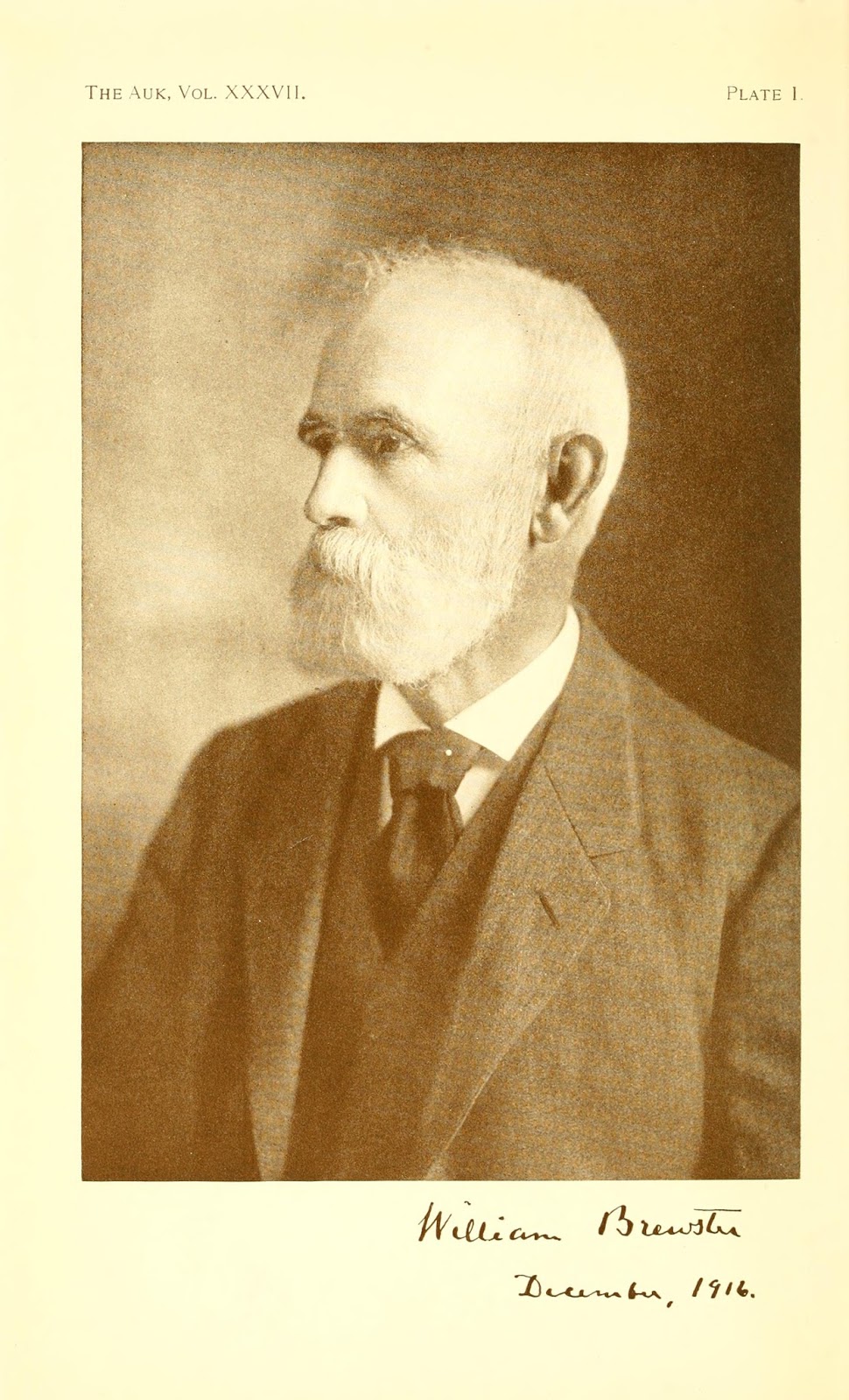
William Brewster. The Auk. v. 37 (1920). Digitized by Smithsonian Libraries. http://biodiversitylibrary.org/page/15938473

As a teen in Cambridge, Massachusetts during the 1860s, William Brewster (1851-1919) woke up early to collect birds before school, practiced taxidermy with friends, and carefully noted the dates when local plants flowered and produce ripened in the family garden.

His early fascination for birds and his observant note-taking laid the groundwork for his career as a prominent amateur ornithologist. He would become the first president of the Massachusetts Audubon Society and a co-founder and president of the American Ornithologists’ Union.

An ongoing project at the Ernst Mayr Library of Harvard University’s Museum of Comparative Zoology has been the digitization and transcription of Brewster’s diaries, field journals, and correspondences. Some of these journals and diaries are available to read on the Biodiversity Heritage Library, and we are working toward making all his notes and correspondences digitally accessible for study.

Over the course of his life, Brewster saw Massachusetts landscape and ecology change dramatically. Cambridge developed from farmland to urban city, and House Sparrows introduced from Europe decimated the farmers’ beloved Eastern Bluebirds. These kinds of observations about land use and animal presence, as well as his notes on plants and weather, make the Brewster collection a valuable resource for scientists studying ecological change.

Brewster published articles prolifically in scientific publications such as the ornithological journal, the Auk. In his field notes and journals, we can find the stories that lie behind those scientific papers: they document the development of a scientist, professionally and personally. They reveal his relationships with other scientists, document in detail what a typical day’s work looked like, and are sprinkled with amusing observations, beautiful scenes, and personal insights that would not necessarily be documented in a scientific publication.

These three bird stories illustrate the value of records where the scientific and the personal overlap.

Pine Grosbeak: Nature Writing and Scientific Work

View Full Size Image
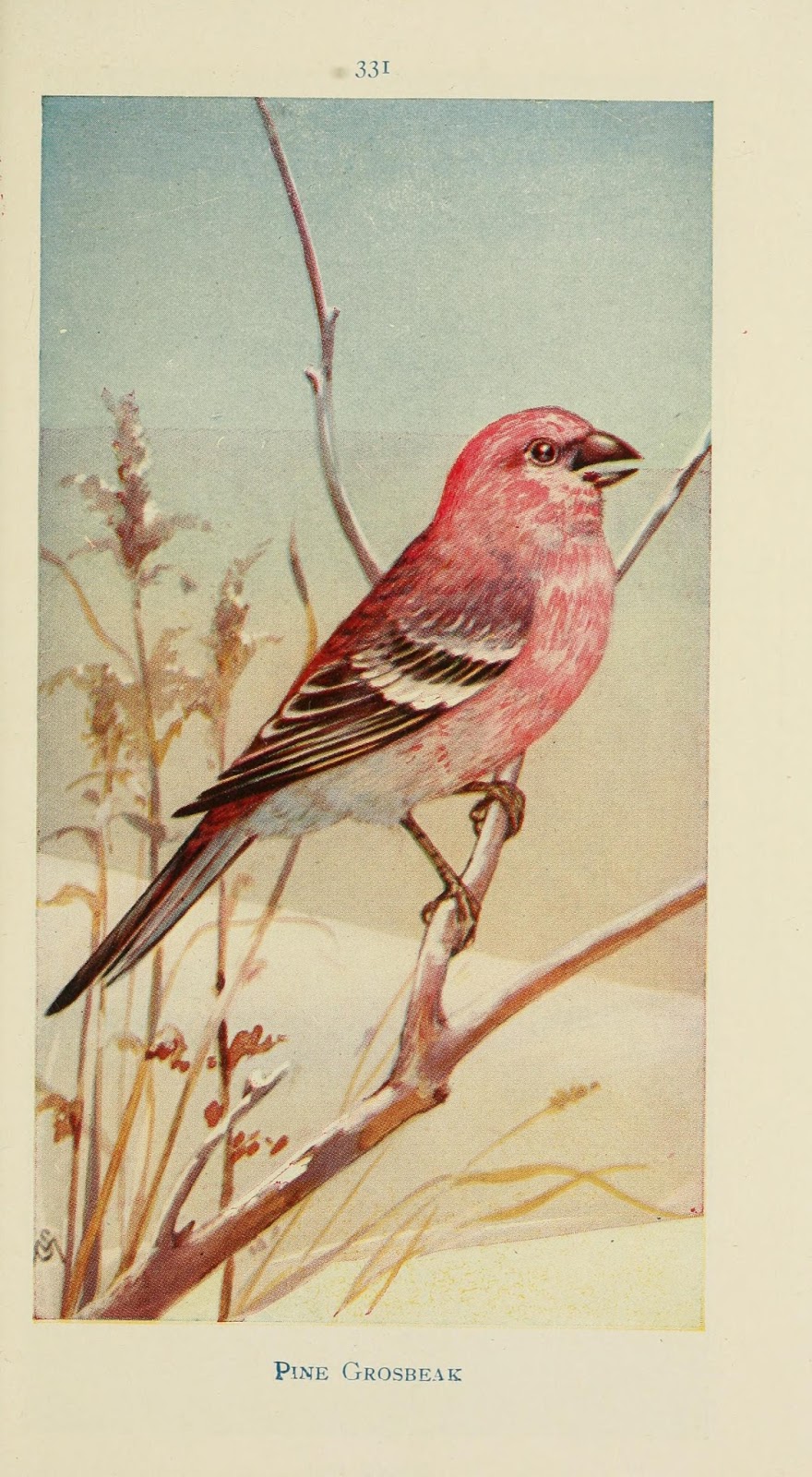
Pine Grosbeak illustration from Field book of wild birds and their music. London, G.P. Putnam’s Sons [c1921]. Digitized by Smithsonian Libraries. biodiversitylibrary.org/page/13653735

For a few days in January of 1893, Cambridge and Boston were abuzz with an unfamiliar sight: hundreds of red and gold birds that drew lots of attention from residents.

Brewster recognized them as Pine Grosbeaks. In the winter, large foraging flocks of Pine Grosbeaks often strip entire trees of their fruits, crushing through pulp and seeds and moving on when the food source has been exhausted.

Brewster observes:

“There were a good many Pine Grosbeaks scattered along the line of ashtrees on the ridge to my left and as I approached Mt. Auburn Street their numbers increased until upon reaching Mr. Hayes’s place I found the trees literally alive with them. 

Soon after I stopped to look at them they began flying from every direction into a large white ash which stands near the foot of the avenue. This tree was loaded with fruit and with snow clinging to the fruit clusters and to every twig. In a few minutes it supported also more than a hundred Grosbeaks which distributed themselves quite evenly over every part from drooping lower to the upright upper branches and began shelling out and swallowing the seeds.

The rejected wings floated down in showers and soon began to give the surface of the snow beneath a light brownish tinge.The snow clinging to the twigs and branches was also quickly dislodged by the movements, of the active, heavy birds and for the first few minutes it was continually flashing out in puffs like steam from a dozen different points at once. The finer particles, sifting slowly down, filled the still air and enveloped the entire tree in a gauzy veil or mist tinted, where the sun-beams pierced it, with rose, salmon and orange, elsewhere of a soft, dead white and of incredible delicacy and beauty, truly a fitting drapery for this winter picture- the hardy Grosbeaks at their morning meal. 

They worked in silence when undisturbed and so very busily that at the end of an hour they had actually eaten or shaken off nearly half the entire crop of seeds. Some men employed in a marble cutter’s shop near the tree were neglecting their tasks to watch and discuss them. One of these men told me that a few Grosbeaks were seen in the tree late yesterday afternoon.” (Cambridge, January 10, 1893.) [Edited with paragraph breaks and punctuation for readability.] 

A sudden, unexpected appearance of a large flock non-resident birds is known in the ornithological world as an irruption. (In recent years in Massachusetts, we’ve often heard the word irruption used to describe an unexpected influx of snowy owls that aren’t our usual residents.) Details on a historical irruption of Pine Grosbeaks may be of value to modern day scientists looking back in time for trends.

But while Brewster often recorded bird sightings as lists or in simple, factual paragraphs, some of the scientific observations are rendered with an artistry that carries them into the genre of nature writing. The image of the tree alive with birds, the rosy quality of light in the snowy air, and the excitement of the marble cutters makes these bird notes especially memorable.

The journal entries for these days form the basis of an article he had published in the Auk two years later, ‘A remarkable flight of Pine Grosbeaks (Pinicola enucleator)’. While Brewster’s article reads as somewhat more fact-driven, it’s written as a personal narrative that draws heavily on his notes, and it contains a condensed version of the visual description shared above.

It seems to be fairly normal at that time for published scientific work to include personal narrative and assertions which we would edit out today. But letters between Brewster and ornithologist friends reveal that they critiqued each other’s work not only on the reliability of their data but also on the style of their prose. Brewster’s scientific journals suggest that personal note-taking was a crucial opportunity to practise the art of writing, and digging into these journal entries allows us a glimpse into a scientist’s thinking and writing process.

American Robin: Personal Musings and Anthropomorphization
View Full Size Image
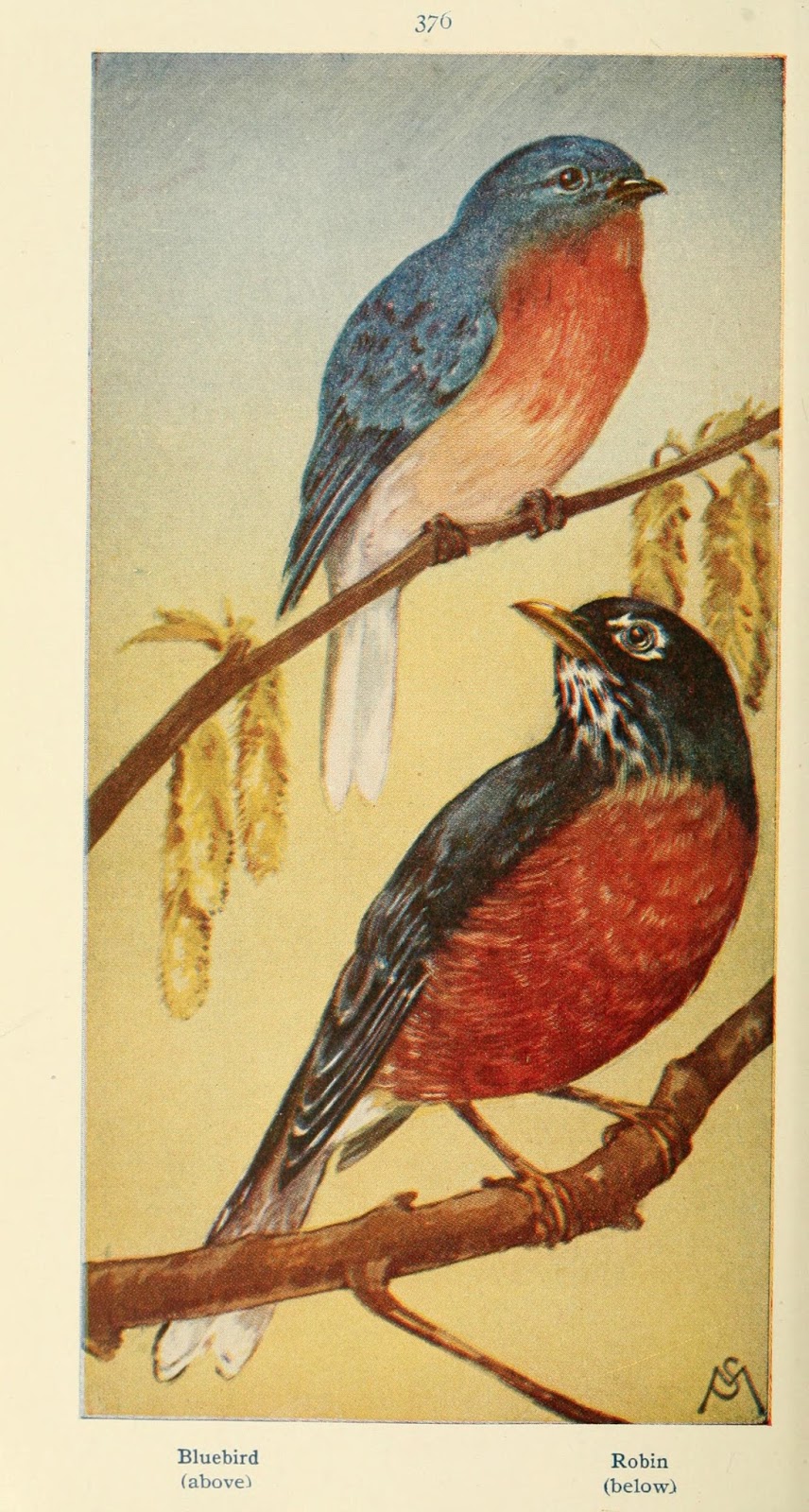
Bluebird and American Robin illustration from Field book of wild birds and their music. London, G.P. Putnam’s Sons [c1921]. Digitized by Smithsonian Libraries. biodiversitylibrary.org/page/13653780

Brewster carefully documented wild encounters with blow-by-blow details about animals’ behavior. Beyond behavioral data, his personal writings also include his interpretations of animal ‘personalities’ that reveal both his scientific perspective on animal cognition, and his personal feelings about interactions with animals.

Take for example this short but resonant excerpt from a letter penned to a friend:

“It is sunset and as I sit in my study in the Museum a Robin is singing in an elm in the garden. What a hopeful, earnest strain! It always cheers and encourages me. Our Robin must have a brave heart and a pure conscience.” (William Brewster, March 26, 1893. Cambridge, Mass. in correspondence to his friend, ornithologist Frank Michler Chapman.) 

His comment on the “brave heart and a pure conscience” certainly isn’t a piece of scientific data (it’s anthropomorphization, an interpretation of animal behaviors using the logic of human emotions) –but it unearths a very human part of the story to consider how a natural scientist reacted emotionally to his subjects in daily life.

Toucan: Perspectives on Scientific Collecting

View Full Size Image
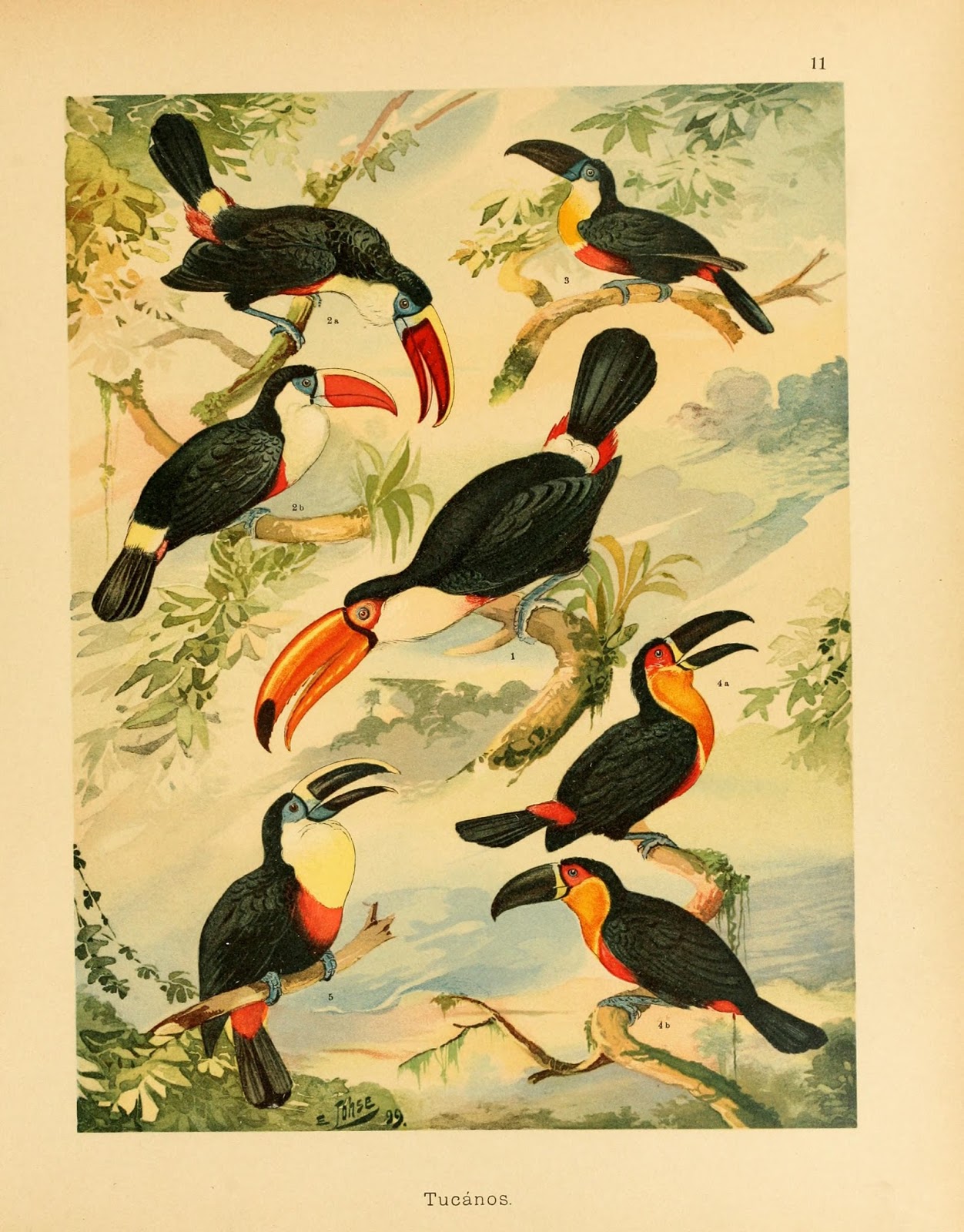
Toucan illustration from Album de aves amazonicas. Zürich: Impressão do Instituto Polygraphico a.g., 1900-06. Digitized by Smithsonian Libraries. biodiversitylibrary.org/page/13804665

If you’ve ever browsed the galleries at Harvard’s Museum of Natural History, then you’ve passed by Brewster’s life’s work. After working as an animal specimen curator for the museum for many years, he also bequeathed his personal collection of birds and other animals to the museum.

Taxidermy collections like Brewsters’ are the foundation of zoology and are invaluable for scientific researchers today. For example, scientists can analyse DNA samples from historic specimens to track evolutionary changes, and look for traces of environmental chemicals such as pesticides to learn more about their ecological impact. (These are just two of many ways that collections can be used for beneficial research–to learn more, read ‘Natural history collections – why are they relevant?’ on The Guardian, or visit the page ‘Why Collections Matter?’ on the Society for the Preservation of Natural History Collections’ website.)

While Brewster strongly advocated for the importance of scientific collecting, his journals also illustrate changes in his collecting practices over time, including the adoption of complementary methods like photography.

In March 1886, just a month after the Massachusetts Audubon Society for the Protection of Birds had organized, Brewster wrote three letters to an ornithologist friend, describing an early attempt to pass bird protection legislation in Massachusetts. Brewster advocated in court for a bill that would ban the hunting of birds for decorative use on women’s hats, but allow scientific collection by permit-holders.

In one of these letters, he scoffs at the idea of only studying birds observationally:

“One of these [Fish & Game Commissioners]… announced at the beginning that he considered Science a humbug and that the best was to study bird was with an opera glass!” (Cambridge, March 7, 1886. Letter to George Sennet.) 

However, his journals reveal that around the 1890s he seems to have developed some mindfulness of how damaging over-hunting could be for animal populations. Around this time he began to collect birds more sparingly and took up the challenge of wildlife photography in the field.

An interesting example of this shift in his attitude occurred during an 1894 collecting trip to the tropics:

“I started out early this morning with the express intention of shooting a toucan. Rather curiously I had at once an opportunity which I did not improve and shortly afterwards a experience which is probably rare for Mr. Chapman [Frank Chapman] has seen nothing of the kind, nor has Mr. Carr either for that matter. 

It all happened in this [way]. I went first to the ajoupa to get my collecting basket and while there heard a toucan calling apparently at a considerable distance. I started in the direction of the sound but I had gone scarce twenty yards when I became conscious that it came from nearly over head. 

Looking up I at once saw the beautiful great bird sitting in the top of a bois immortel its breast turned towards the rising sun which brought out the brilliant colouring of the plumage, the shining black of the large bill and the blue of the bare skin about the eyes with the greatest distinctness. 

Here was my chance for the bird was not thirty yards off but I simply stood and stared at him with speechless wonder and admiration until he finally flew, when the dense cacao foliage prevented my getting a shot. 

Clearly a case of Toucan “fever” but I did not regret the episode.” (Trinidad, March 20, 1894.) [Edited with paragraph breaks and punctuation for readability.] 

* * *

The Brewster collection, and other field journals and notes, contain a wealth of information beyond useful scientific data. They reveal scientific paradigms, study methods and reasoning; information about working relationships between scientists; and historical and biographical information, including personal thoughts and feelings. Some sections can be fairly dry, but some make for pretty good reading.

If you’ve enjoyed these excerpts, an ongoing blog post series on Mayr Library blog highlights interesting tidbits from Brewster’s writing as we continue to digitize and transcribe the collection.

July 1, 2016by ulib-libraryjobs
BHL News, Blog Reel

Expanding Access Training Workshop

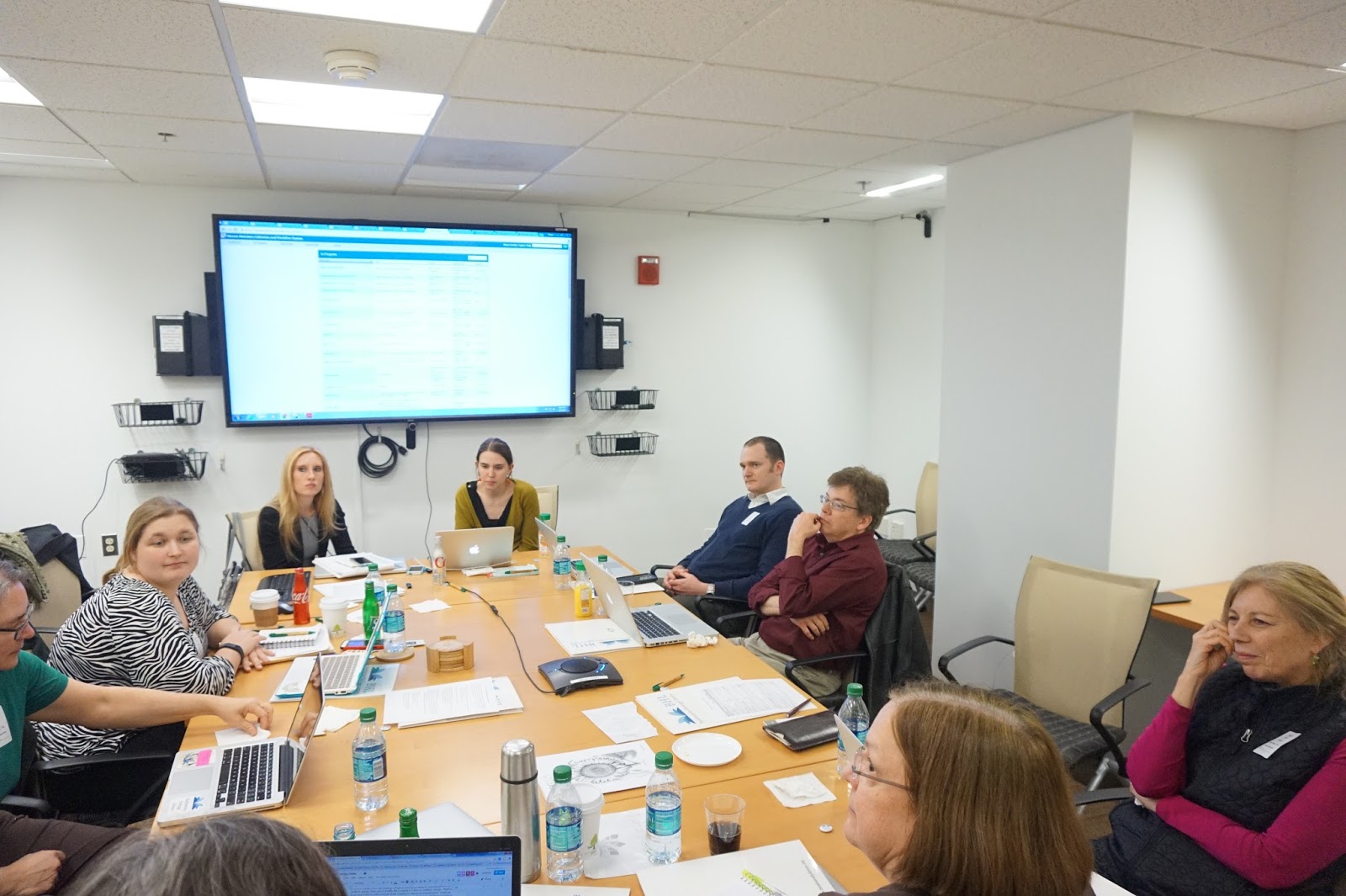
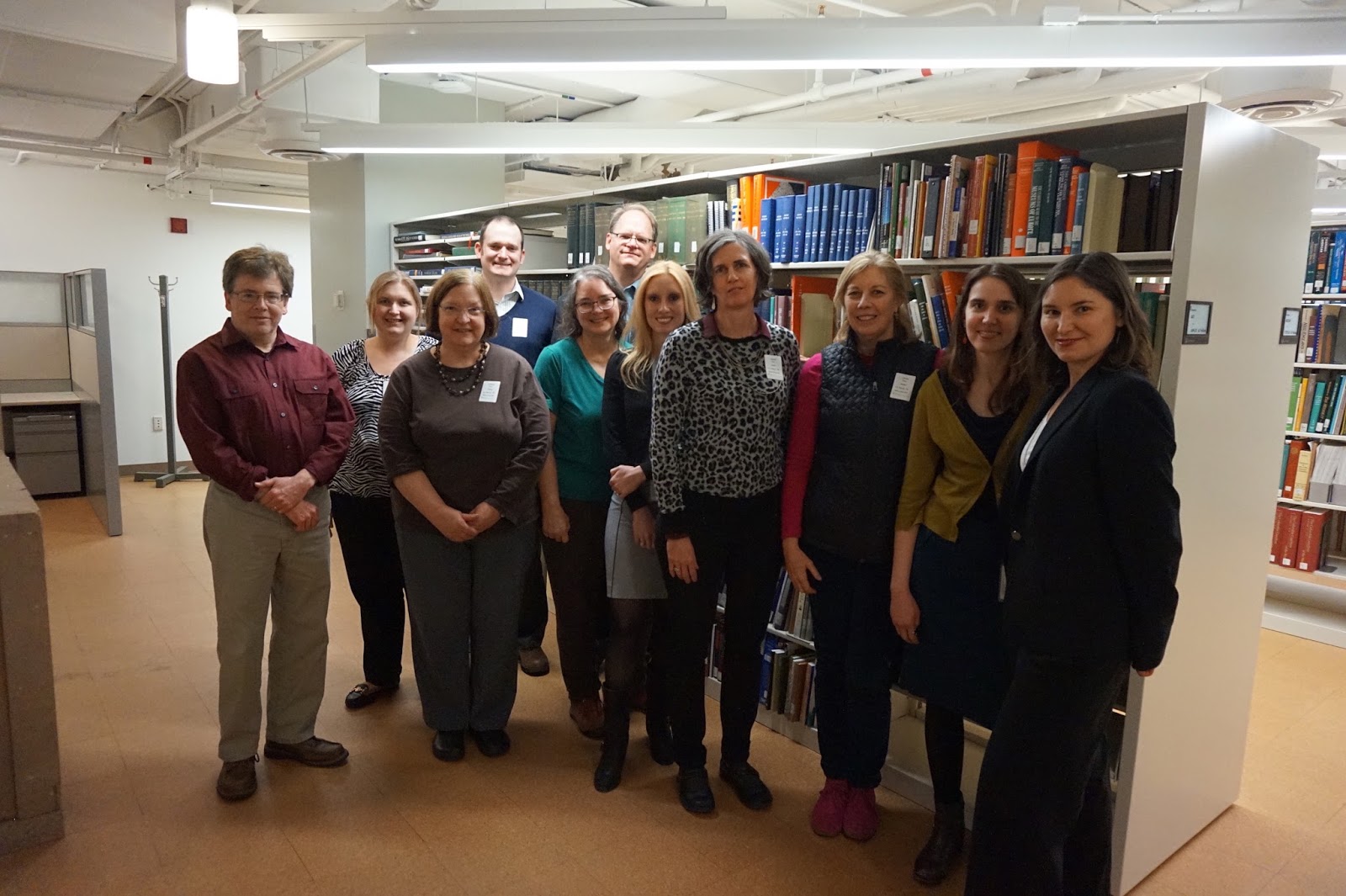
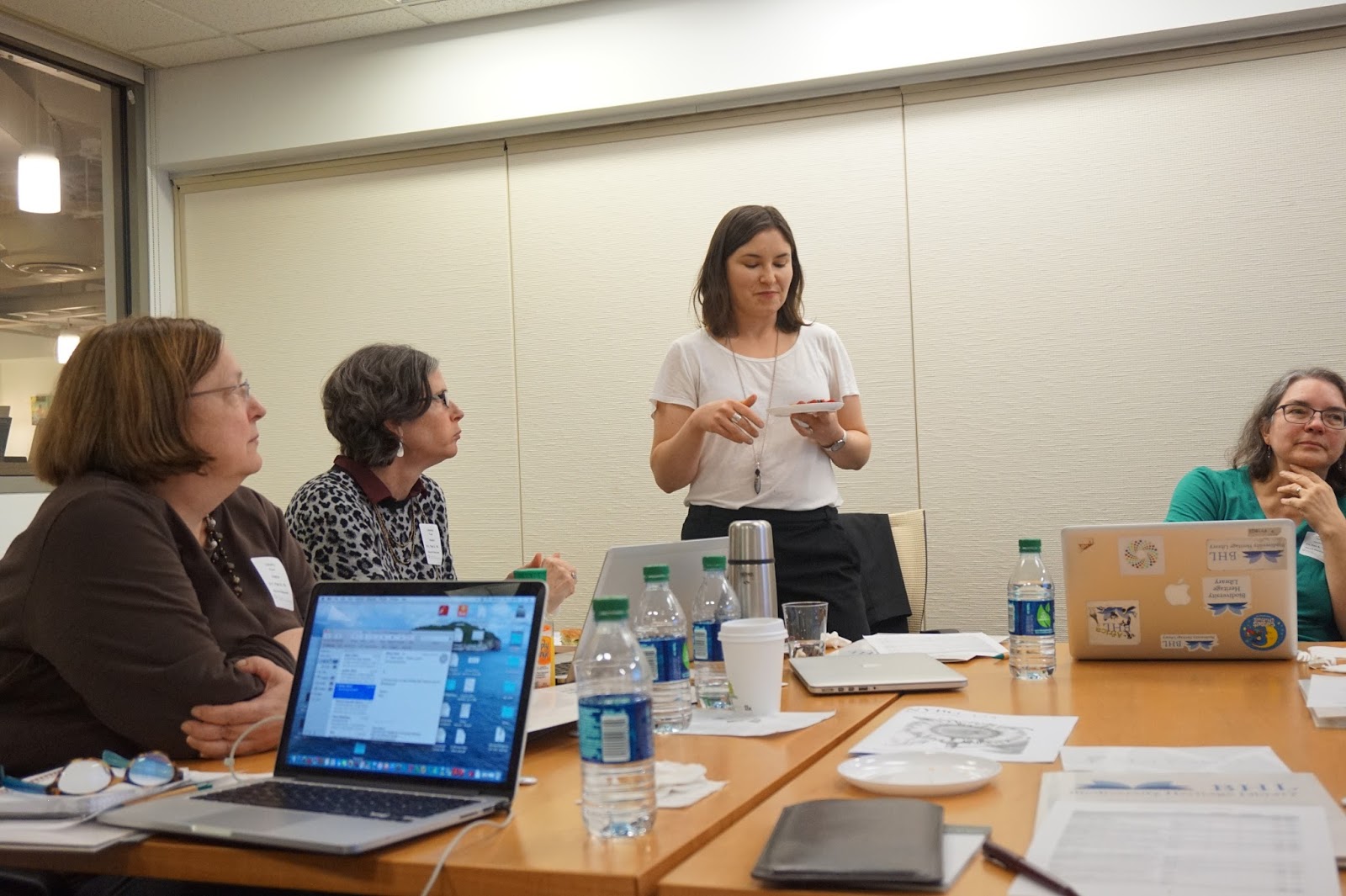
On February 4-5, 2016, Smithsonian Libraries hosted staff from the New York Botanical Garden, the Museum of Comparative Zoology (Harvard University), and the Missouri Botanical Garden as part of a training workshop for the New York Botanical Garden’s IMLS-funded grant, Expanding Access to Biodiversity Literature.
View Full Size Image

The BHL Secretariat staff (Carolyn Sheffield, BHL Program Manager; Bianca Crowley, BHL Collections Manager; Grace Costantino, BHL Communications and Outreach Manager; and BHL Program Director, Martin Kalfatovic) conducted the two day workshop based on previous workshops for BHL Africa and BHL Mexico. The workshop provided an intense overview of the methodologies for partnering with institutions not currently participating in the BHL in order to add new content to BHL and the Digital Public Library of America (DPLA).

Participating staff included:

New York Botanical Garden, LuEsther T. Mertz Library

  • Susan Fraser (Director of the NYBG LuEsther T. Mertz Library, Project Director)
  • Susan Lynch (Systems Librarian, Data Manager)
  • Mariah Lewis (Metadata Specialist – and former Smithsonian Libraries’ intern)

View Full Size Image

Ernst Mayr Library, Museum of Comparative Zoology, Harvard University

  • Constance Rinaldo (Librarian of the Ernst Mayr Library of the MCZ/Harvard University)
  • Joe deVeer (Project Manager and Museum Liaison for the Ernst Mayr Library of the MCZ/Harvard University)
  • Patrick Randall (Community Manager)

View Full Size Image

Missouri Botanical Garden, Center for Biodiversity Informatics

  • Trish Rose-Sandler (Digital Projects Coordinator, Center for Biodiversity Informatics, Missouri Botanical Garden and Data Analyst for BHL)

View Full Size Image

Thanks to the staff from the Smithsonian Libraries’ Natural History Library for hosting the event in their training room.

If you would like to learn more about Expanding Access to Biodiversity Literature, please visit the project’s wiki page.

February 16, 2016by [email protected]
Page 2 of 3«123»

Help Support BHL

BHL's existence depends on the financial support of its patrons. Help us keep this free resource alive!

search

About BHL

The Biodiversity Heritage Library (BHL) is the world’s largest open access digital library for biodiversity literature and archives. BHL operates as a worldwide consortium of natural history, botanical, research, and national libraries working together to digitize the natural history literature held in their collections and make it freely available for open access as part of a global “biodiversity community.”

Join Our Mailing List

Sign up to receive the latest news, content highlights, and promotions.

Subscribe Now

Subscribe to Blog via Email

Enter your email address to subscribe to this blog and receive notifications of new posts by email.

Join 319 other subscribers

Subscribe to Blog Via RSS

Subscribe to the blog RSS feed to stay up-to-date on all the latest BHL posts.

Access RSS Feed

Inspiring Discovery through Free Access to Biodiversity Knowledge.

The Biodiversity Heritage Library makes it easier than ever for you to access the information you need to study and explore life on Earth…for free, anytime, anywhere.


64+ Million Pages of
Biodiversity Literature Online.

EXPLORE

Tools and Services
to Transform Research.

EXPLORE

300,000+
Illustrations on Flickr.

EXPLORE

ABOUT | HARMFUL CONTENT | PRIVACY | SITE MAP | TERMS OF USE