

This is the second of a joint blog series by the Field Book Project (FBP) and the Biodiversity Heritage Library (BHL), showcasing examples of digital connections between collectors, field book catalog records, and the resulting publications of collecting events.
The first post in this series about organizations discussed the nascence of the US Biological Survey. It seems appropriate to follow with the story of the US Bureau of Fisheries. “Why?” you might ask. Simple! These two organizations later merged and formed the US Fish and Wildlife Service! The Bureau was primarily shaped while it was still known as the US Commission of Fisheries. It would become the Bureau in 1903. To understand its development, one must look at the years prior to 1903.
 |
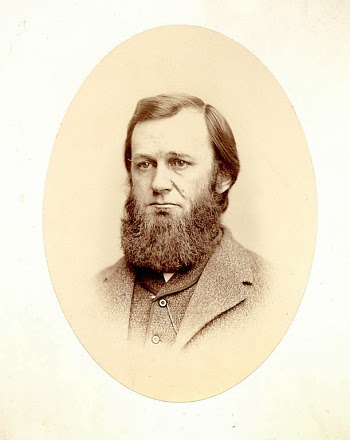
| Portrait of Spencer Fullerton Baird, by Bell, William, January 10, 1867, Smithsonian Archives. SIA2004-60740. |
In the 1870’s the US saw a noticeable decline in the Southern New England fisheries. The US knew little about the fishing grounds off its own coasts. Spencer F. Baird, a respected naturalist and a Smithsonian secretary, had a background in ichthyology and was approached by Congress about these issues. He recognized an important opportunity to promote the scientific study of the US’s marine natural resources in an effort to help the US economically. In 1871, he convinced Congress to establish the Commission on Fish and Fisheries. He served as the first commissioner. In the Commission’s early years, completing field work was a challenge, since it had no vessels and little funding of its own. Staffing and research (collecting and surveying) was completed in conjunction with the Smithsonian. This is one of the reasons Smithsonian Institution Archives has so many of the organization’s early records. The Commission often had to utilize ships supplied by the Revenue Service and US Navy. It was not until the 1880’s that they were able to procure their own research vessels.
When the Commission finally obtained the funds to acquire their own, they didn’t just go with any ship. They hired builders to design and construct some of the first ships dedicated solely for marine research. Each of these vessels enabled the Bureau to substantially increase their efficiency and research output. Additionally these vessels were used in the field for decades and were pivotal in assuring the quality and quantity of research data the Commission/Bureau could provide. Unlike research completed aboard another agency’s vessel, these were designed for research, and research staff didn’t have to worry about competing missions while at sea. Even the ship’s logbooks demonstrate this vividly. When scientists were aboard another agency’s vessels, their specimen collecting data was usually recorded in a journal separate from the logbook. US Fisheries vessels’ purpose was to enable the research, so the collected information was part of the ship’s logbook contents.
These ships were important tools for the numerous collectors the Commission sent into the field. Unlike Vernon Bailey who both collected and published widely over the years, several of the Commission’s collectors like William W. Welsh, focused on the field work and left the publishing to others. Ship’s logbooks, in their brevity often left little room for recording who did the research/work. Luckily, Commission and Bureau field documentation also included personal field books which document another important part of the Commission’s field work–interviewing local inhabitants for their knowledge of local fishing conditions and good fishing grounds. The field books (such as SIA RU007187) include surprisingly detailed interviews with locals about their lives, work, and personal knowledge of the habitat. Frequently the Commission’s publications are the synopsis of field work. These publications are often most easily located through the name of the vessel on which the staff worked, like the Fish Hawk (1880), Albatross (1883), and Grampus (1885).
We encourage you to take a look at the logbooks from these ships, now available in digital format through the Smithsonian, and compare to their resulting publications available through BHL. Learn more about the interviews completed by Commission staff that augmented knowledge gained by collecting.
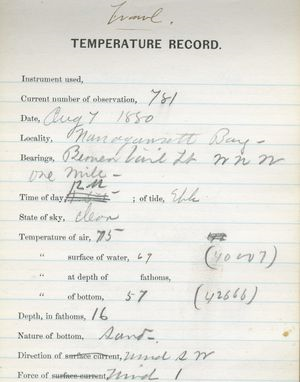 |
| R/V Fish Hawk logbook excerpt, August 7, 1880. Smithsonian Institution Archives, RU7184, box 9, folder 3. |
Field book (logbooks) through FBP:
Publications available through BHL: