Biodiversity Heritage Library - Program news and collection highlights from BHL
  • Home
  • News
  • Featured Books
    • All Featured Books
    • Book of the Month Series
    • BHL at 20
  • User Stories
  • Campaigns
    • Fossil Stories
    • Garden Stories
    • Monsters Are Real
    • Page Frights
    • Her Natural History
    • Earth Optimism 2020
  • Tech Blog
  • Visit BHL
Home
News
Featured Books
    All Featured Books
    Book of the Month Series
    BHL at 20
User Stories
Campaigns
    Fossil Stories
    Garden Stories
    Monsters Are Real
    Page Frights
    Her Natural History
    Earth Optimism 2020
Tech Blog
Visit BHL
  • Home
  • News
  • Featured Books
    • All Featured Books
    • Book of the Month Series
    • BHL at 20
  • User Stories
  • Campaigns
    • Fossil Stories
    • Garden Stories
    • Monsters Are Real
    • Page Frights
    • Her Natural History
    • Earth Optimism 2020
  • Tech Blog
  • Visit BHL
Biodiversity Heritage Library - Program news and collection highlights from BHL
Blog Reel, Featured Books

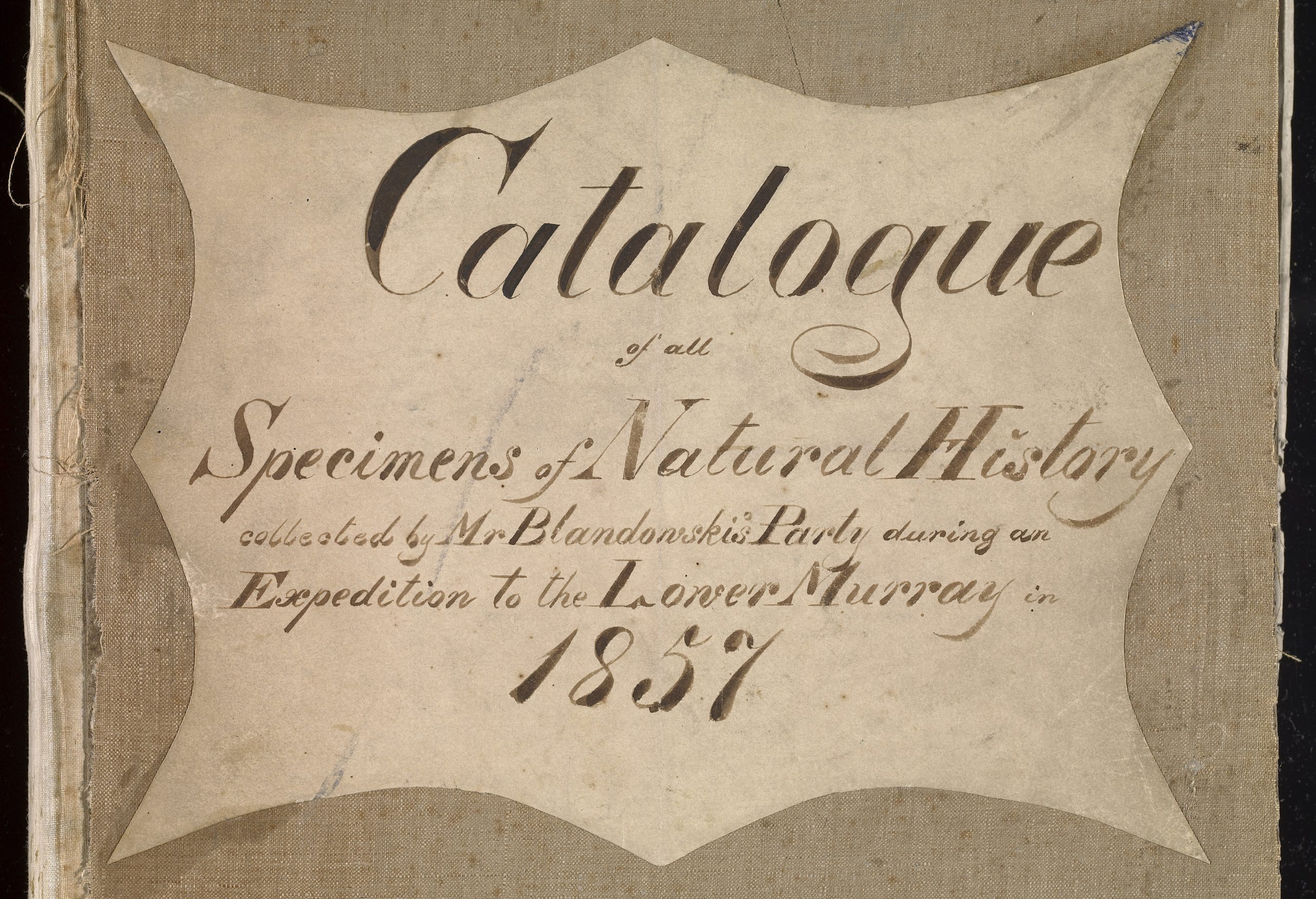
Catalogue of All Specimens of Natural History Collected by Mr Blandowski’s Party During an Expedition to the Lower Murray in 1857

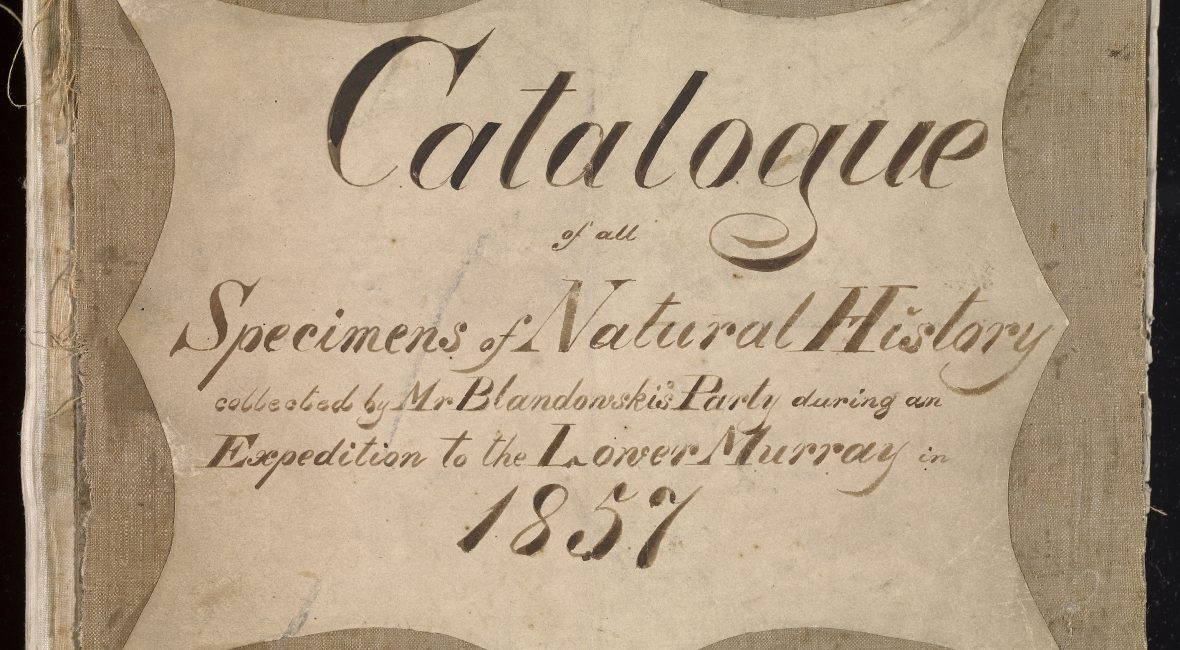
Front cover of 'Catalogue of all Specimens on Natural History collected by Mr Blandowski's Party during an Expedition to the Lower Murray in 1857' by Gerard Krefft

Cropped image of Gerard Krefft’s handwritten cover of Catalogue of all Specimens of Natural History collected by Mr Blandowski’s Party during an Expedition to the Lower Murray in 1857 [referred to as Blandowski’s Catalogue]. Source: Museums Victoria Archives, ARCHIVE-784. Photographer: David Paul.
Blandowski’s Catalogue is one of the most precious items held by the Museums Victoria Archives. It documents natural history specimens collected by William Blandowski (1822-1878) and Gerard Krefft (1830-1881) and colleagues working with First Peoples communities for the National Museum of Victoria (predecessor of Museums Victoria) during an expedition along the Lower Murray and Darling River from December 1856 to December 1857. Murray fishes listed in the Catalogue were later controversially used to describe prominent members of the Philosophical Institute in Blandowski’s 1858 paper Recent Discoveries in Natural History on the Lower Murray. Blandowski refused to hand-over to Professor Frederick McCoy, the National Museum of Victoria’s first Director, many of the specimens collected on the expedition, and associated research notes and illustrations, causing further controversy. Blandowski’s Catalogue has recently been digitised by BHL Australia and is now available to view online.

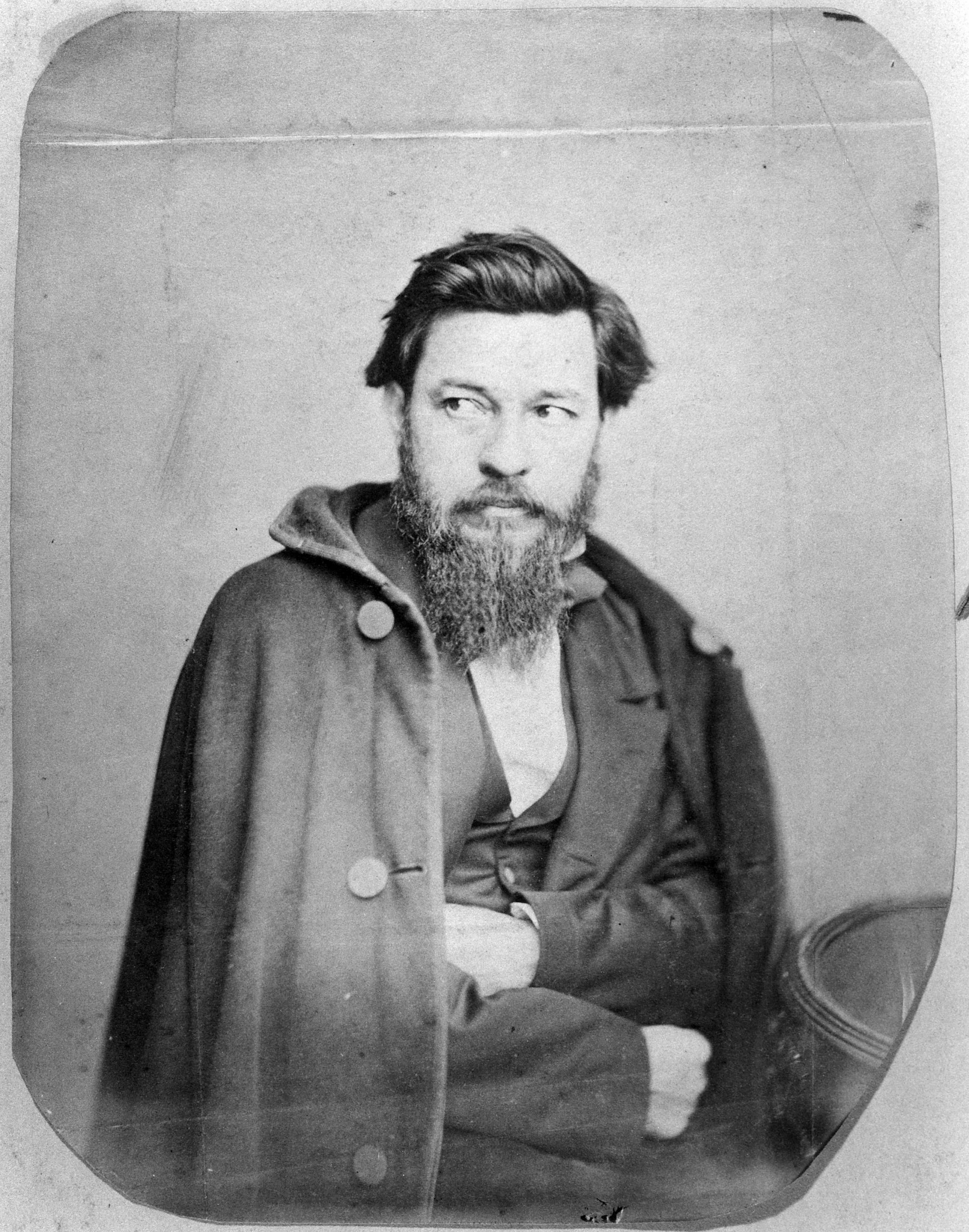
Black and white photograph of bearded man in overcoat, seated

Self portrait of William Blandowski, 1860. Source: National Gallery of Victoria. Photographer: William Blandowski.
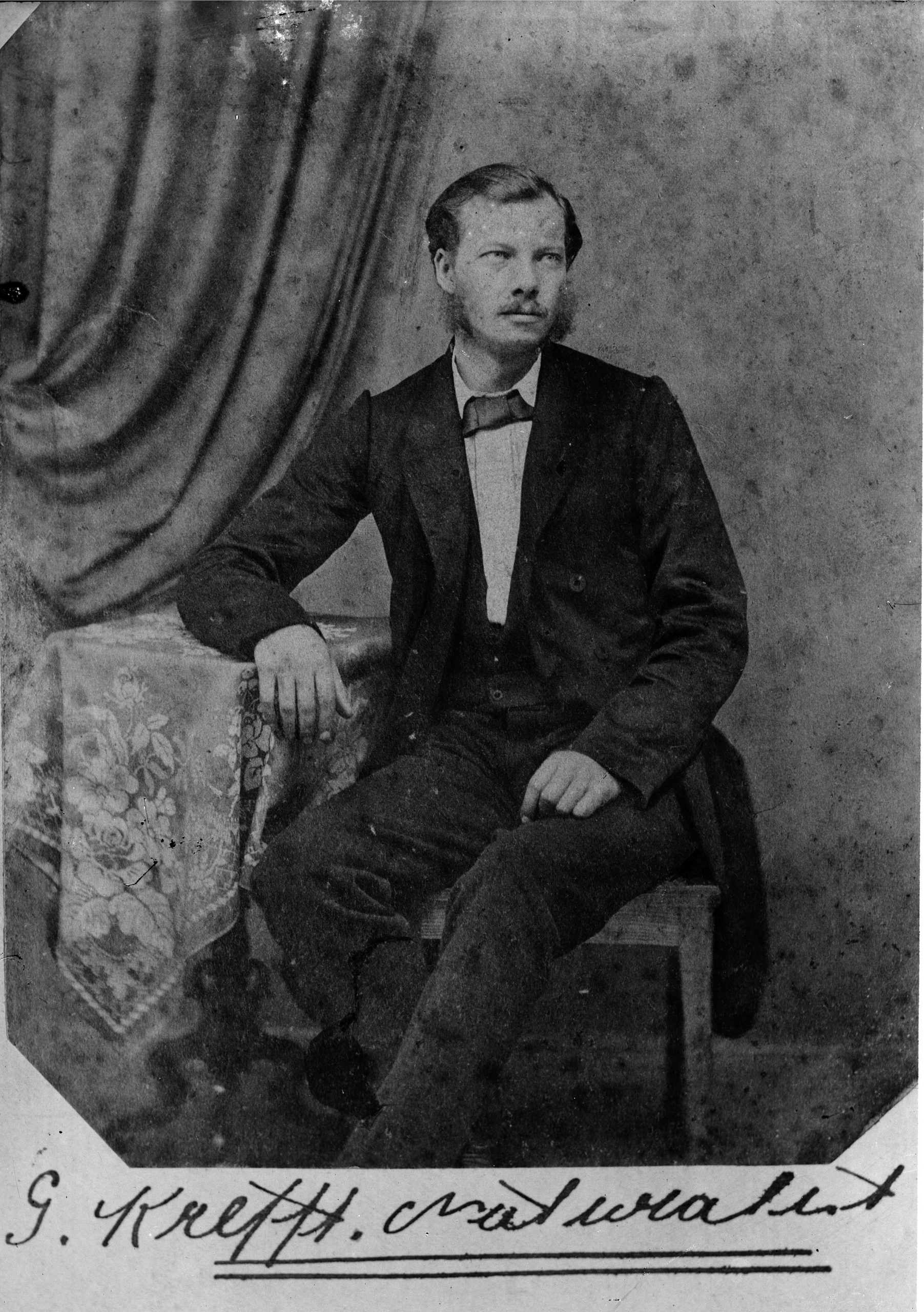
Portrait of a man seated in a suit

Portrait of Gerard Krefft, 1855. Source: Australian Museum. Photographer: unknown.

Blandowski was appointed Government Zoologist in 1854 when the Museum of Natural and Economic Geology (precursor to the National Museum of Victoria, and Museums Victoria) was founded. He had migrated from the Kingdom of Prussia (now Poland) to Adelaide in 1849, then on to the goldfields of Victoria in 1851. Krefft, originally from Duchy of Brunswick (now Germany), immigrated to New York City circa 1850, then to Australia and the Victorian goldfields in 1852. Blandowski was entrusted with an expedition to the Lower Murray; a previous expedition in 1849 had failed under the leadership of Surveyor Edward White. Blandowski had several assistants to accompany him on the expedition, including Gerard Krefft and later James Manson, who joined the expedition in February 1857. Krefft was hired as an artist on the Lower Murray Expedition but also worked on labelling specimens and adding information to Blandowski’s Catalogue, and subsequently employed by McCoy in February 1858 to select specimens to be kept by the National Museum of Victoria.
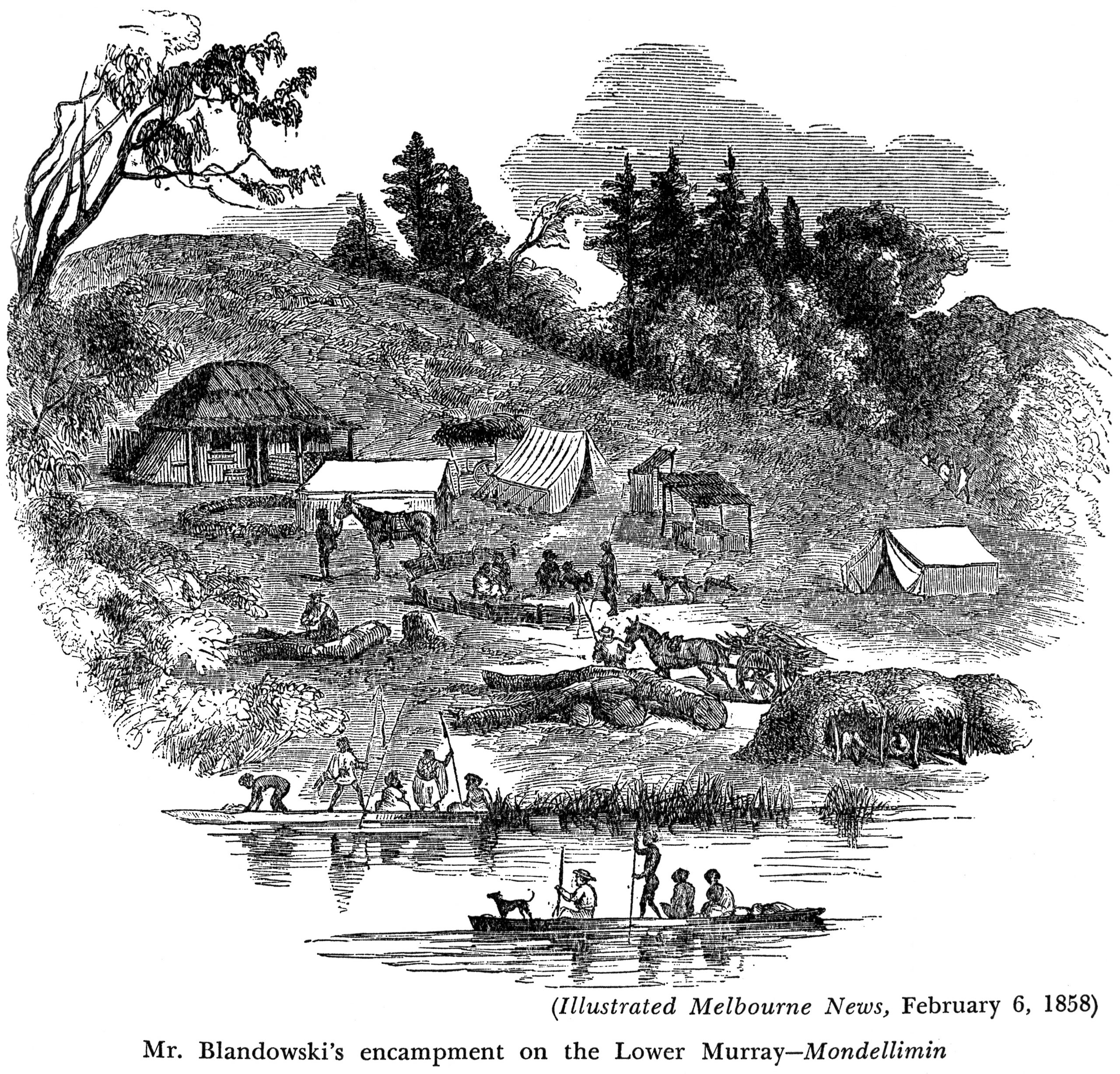
Encampment on a river with tents and other structures

Illustration of Blandowski’s expedition camp on the Murray River, Mondellimin, also known as Chaffey Landing at Merbein, Victoria, Australia, on the New South Wales border, 6 February 1858. Source: Museums Victoria reproduced from Illustrated Melbourne News.

Mondellimin, name derived from Mondellunddellun used by the local Yarree community, about 480 kilometres from Melbourne, also known as Chaffey Landing at Merbein, near Mildura, was the permanent campsite for the expedition from April to December 1857. “On the 6th of August he [Blandowski] left the camp in charge of Krefft and Manson and proceeded towards Melbourne with his valuable collections of specimens of natural history, which had been accumulating in his tent during his long sojourn at Mondellimin, to the extent of 28 boxes and parcels, containing in all about 16,000 specimens” (South Australian Register, 15 October 1857, p.3). Part of the collection had already shipped from Echuca, and specimens collected after Blandowski returned to Melbourne, came back with Krefft in December 1857. Blandowski attributed the specimens acquired largely due to the collecting skills of the local Indigenous peoples and acknowledged the taxidermy work of Krefft and Manson.

Blandowski’s Catalogue lists 17,434 specimens were collected, under 3389 catalogue numbers. Krefft catalogued specimens 1 to 3389, leaving some lines blank, recording specimen number, name of specimen, description of the specimen (although this was mostly left blank), number of specimens, locality whence obtained, donor’s name (also left blank), and remarks. Each specimen has general locality information allowing scientists to estimate where the specimen occurred at a point in time.

Blandowski’s infamous Murray fishes are described in the Transactions of the Philosophical Institute of Victoria. Figure 19 (N) Brosmius Bleasdalii named after a very prominent member of the Philosophical Institute Council, the Reverend Bleasdale: “A slimy, slippery fish. Lives in the mud. Is of a violent bluish colour on the belly. The whole upper surface is of a dirty olivish-green colour, with numerous irregular dark patches.” Figure 4 (B) Cernua Eadesii named after another very prominent member of the Council, Dr Eades: “A fish easily recognised by its low forehead, big belly and sharp spine.”
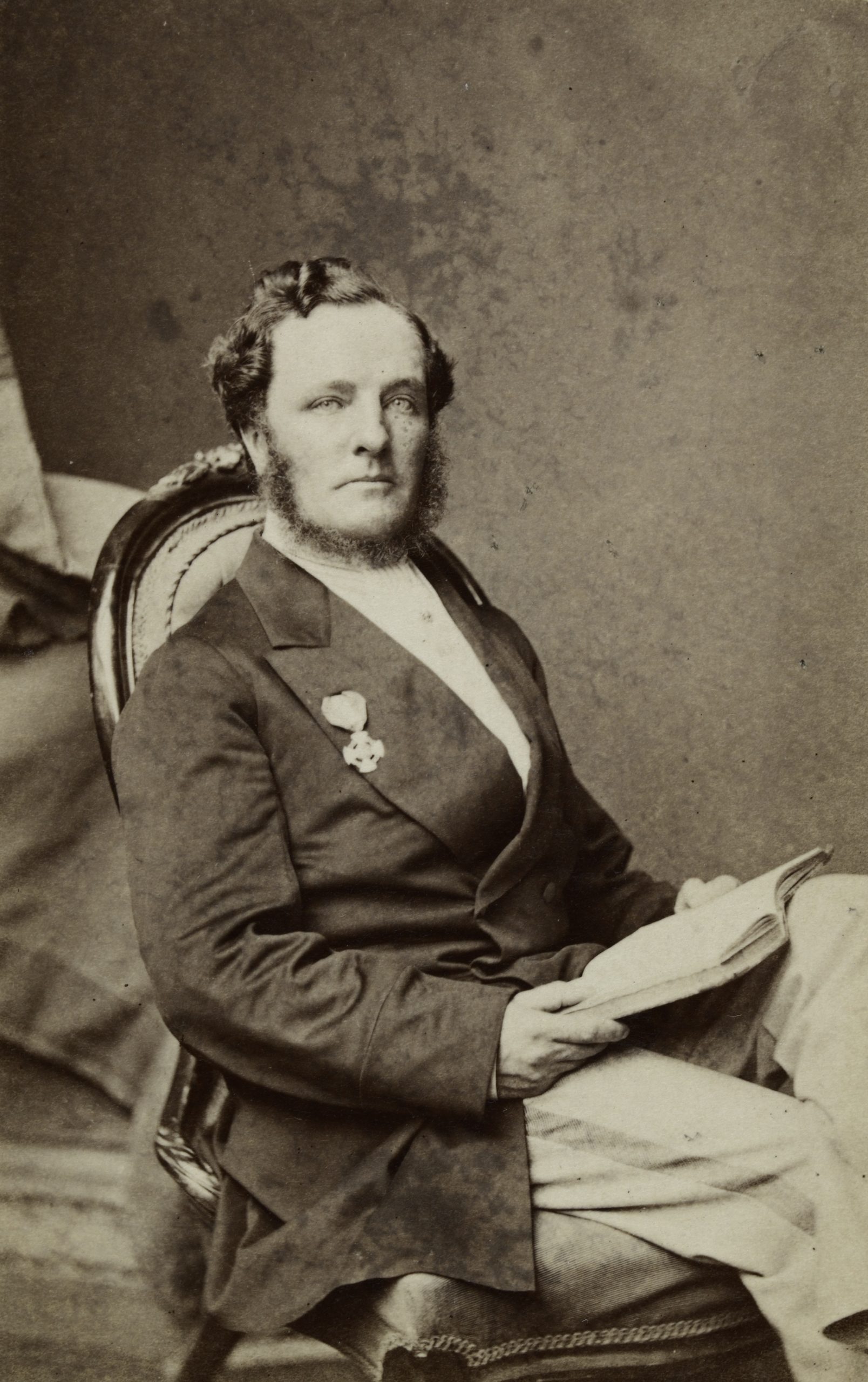
Portrait of a bearded man, seated with a book open in his lap

Portrait of Sir Frederick McCoy, c.1870. Source: Museums Victoria, H29553. Photographer: Johnstone, O’Shannessy & Co. Studio.

Blandowski returned to Melbourne from the expedition in August 1857, four months before the rest of the party. To McCoy’s outrage, Blandowski did not return to the National Museum of Victoria (then located at the University of Melbourne, Parkville campus), and held on to field notes, many of the specimens collected on the expedition, and illustrations from the expedition. The matter was brought before the Board of Science, McCoy wrote to the Chief Secretary on 28 April 1858 (MV Archives OS~04400): “…Mr Blandowski should be compelled to give up at once all specimens, books, journals and field observations, and the portfolio of several hundred drawings made by the party under his orders, and all illustrative lists and memoranda connected with the Public Collections, the property of the Victorian Government.”

Eventually all the specimens collected were returned to the Museum, however McCoy exchanged or donated many of the specimens with other museums and many were destroyed by insects over time, leaving about 15% of the total specimens collected on the expedition in Museums Victoria State Collection to this day. To view some of the specimens online, visit Museums Victoria Collections website.


Editor’s Note

This post has been edited to add further details of the expedition, including the roles of participants and more specific dates of their participation in the expedition.
February 24, 2022by [email protected]
Blog Reel, Featured Books

Two Hand-Painted Volumes of Coleoptera Illustrated by Francis du Boulay

twelve colorful hand-drawn beetles

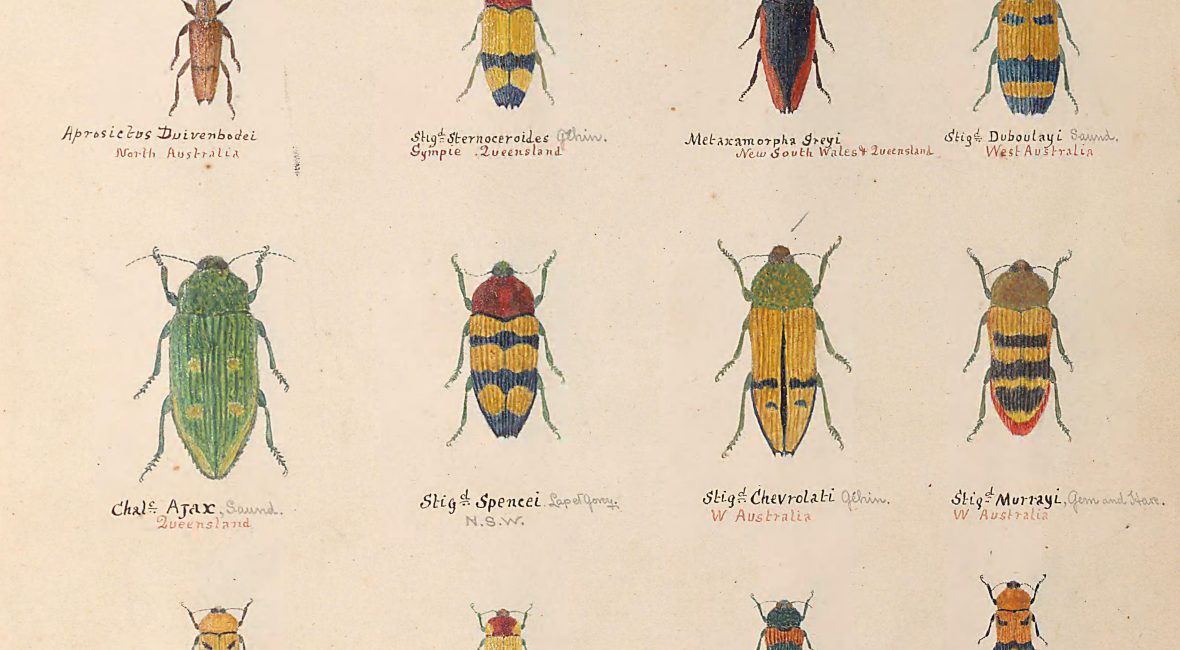
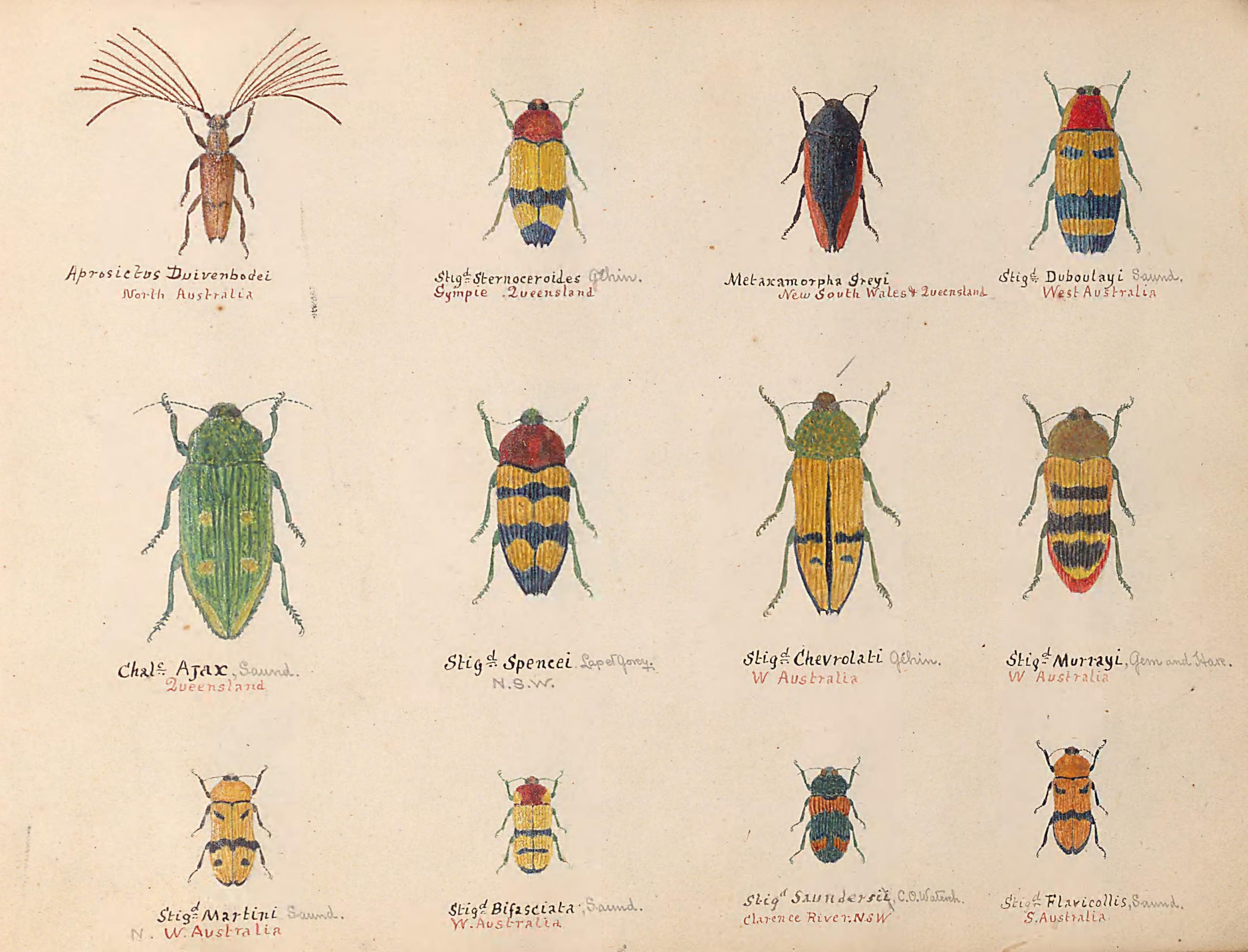
Seventh page of illustrations in volume one of a hand-painted volume of Coleoptera illustrated by Francis du Boulay, c.1880 – 1890 / Collection: OLDERSYSTEM~03048, Museums Victoria Archives / Source: Biodiversity Heritage Library.

Earlier this year Dr. Simon Leslie, Francis Houssemayne du Boulay’s great-grandson, contacted Melbourne Museum about accessing du Boulay’s hand-painted Coleoptera volumes, held in the Museums Victoria Archives. Dr. Leslie and family accessed the physical volumes in February 2020. While I carefully supervised flipping through the pages of these volumes, I was intrigued by their aesthetic, and scientific and historic, value. Since then, the volumes have been digitised by Biodiversity Heritage Library (BHL) Australia.

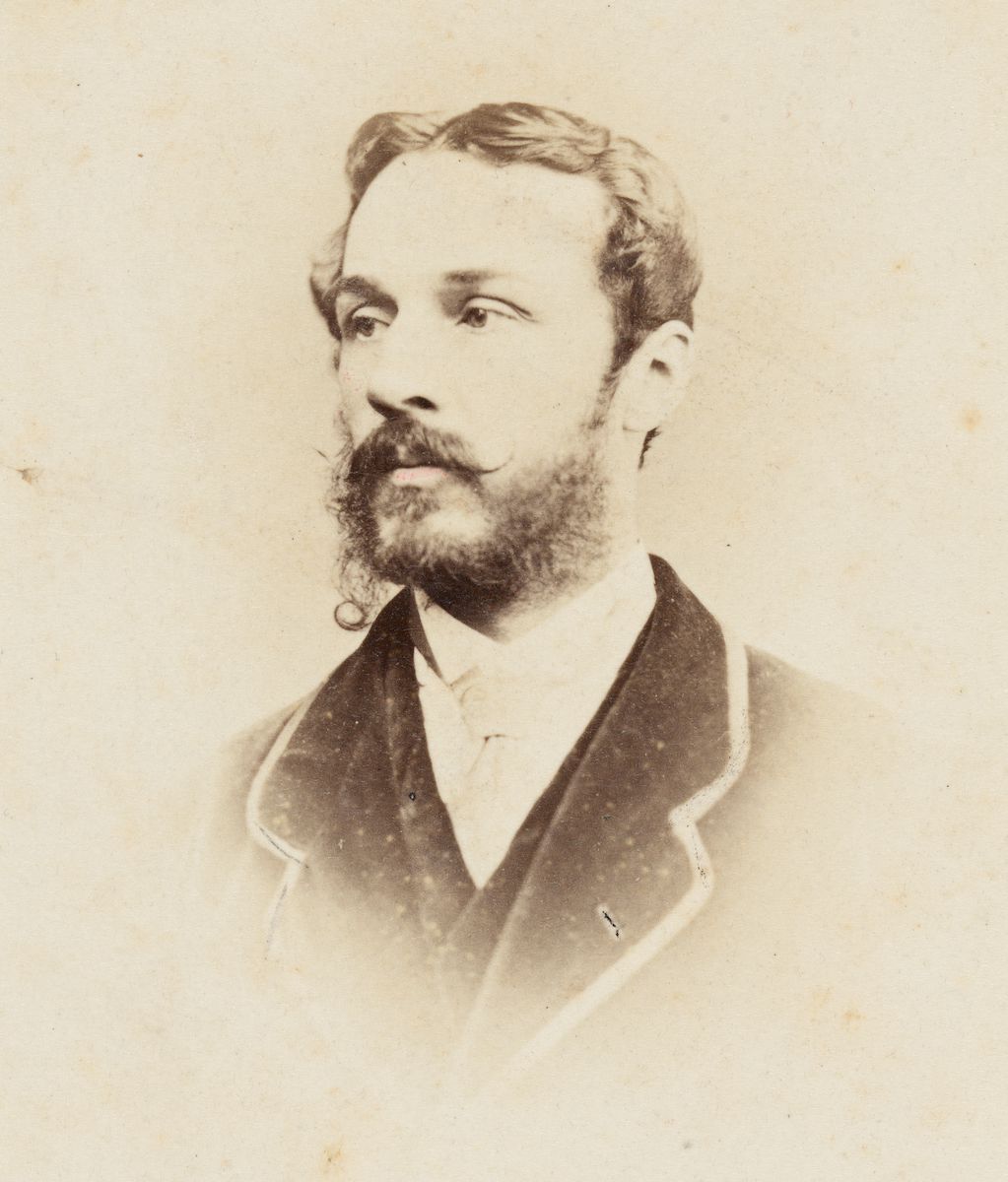
black and white portrait of a person with a short beard.

Portrait of Francis Houssemayne du Boulay, n.d. / Photographer: J. Fisher / Source: Accession number 2009.75, National Portrait Gallery, Australia.

Francis Houssemayne du Boulay was born in Sandgate, Kent, on 24 January 1837. As a young man in his early 20s, he migrated to Perth (c.1858). A scientist, entomologist, natural history artist, and Coleoptera (beetle) collector, du Boulay began to collect specimens in locations around Western Australia, Queensland, New South Wales, Victoria, and other parts of Australia. He settled in Beechworth, Victoria, where he lived out the rest of his life; du Boulay passed away on 12 January 1914.

In volume one of du Boulay’s hand-painted Coleoptera volumes, inside the front cover, is a handwritten inscription in ink, “F. H. Du Boulay 1880”. Du Boulay commenced work on the volume in 1880; however, it is likely that the work continued for several years. The cover also features a note handwritten in pencil, “Names in lead pencil inserted by H. M. Giles W. Australia (Du Boulay)”. Annotations inscribed in pencil are corrections by Henry Murray Giles, who assisted du Boulay in identifying scientific names of specimens. Giles worked as a Resident Keeper (1898) and later Head Keeper (1909 – 1910) at the Zoological Gardens, South Perth, Western Australia. Giles wrote an article in the Western Australian Year-Book for 1900-01 entitled “A Glimpse of Western Australian Entomology” (see pp. 285-297).

A total of 179 Coleoptera specimens are illustrated in volume one. Locations are noted where the specimens occur; however, the locations often only indicate the state where they were collected, for example New South Wales, Victoria, Queensland, Western Australia, South Australia; or a town or city, for example Cape York, Cardwell, Rockhampton, Brisbane. Some specimens identify the sex. It would be interesting to note if the colours used are scientifically accurate. Are the specimens drawn to scale? This would require the physical volume and specimens for comparison.

On the back of the volume is a sketch, in pencil, of a childlike illustration of a man, which is accompanied by an inscription, “W. Du Boulay”. This is an illustration of Francis du Boulay’s brother William, who was a fellow naturalist and collector. The yellow cover of the volume inscribed “DRAWING BOOK E. R. COLE BOOKSELLER AND STATIONER, SYDNEY” is well used, worn and has many inkblots. It has evidence of accompanying du Boulay in the field on his collecting trips around Australia.

Volume two is also well worn with inkblots on the cover. It has a leather-bound spine and leather corners protect the cover; otherwise the volume has no distinguishing features or title page. As in volume one, the specimen illustrations are printed, then hand coloured. Not all of the specimens are identified with their scientific names. The illustrations appear to be to scale. Specimens are illustrated from a dorsal perspective. Locations of where the specimens were collected are sometimes documented. Again as in volume one, the location is only noted from which state, for example, Queensland, Western Australia, Northern Territory, South Australia, New South Wales; or towns, cities, waterways or mountain ranges, for example Blue Mountains, Richmond River, Ropes Creek, Thompson River, Cairns, Coopers Creek, Cape York, Cooktown, Princess Charlotte Bay, Cleveland Bay, Port Mackay. The sex of the specimen is also sometimes identified.

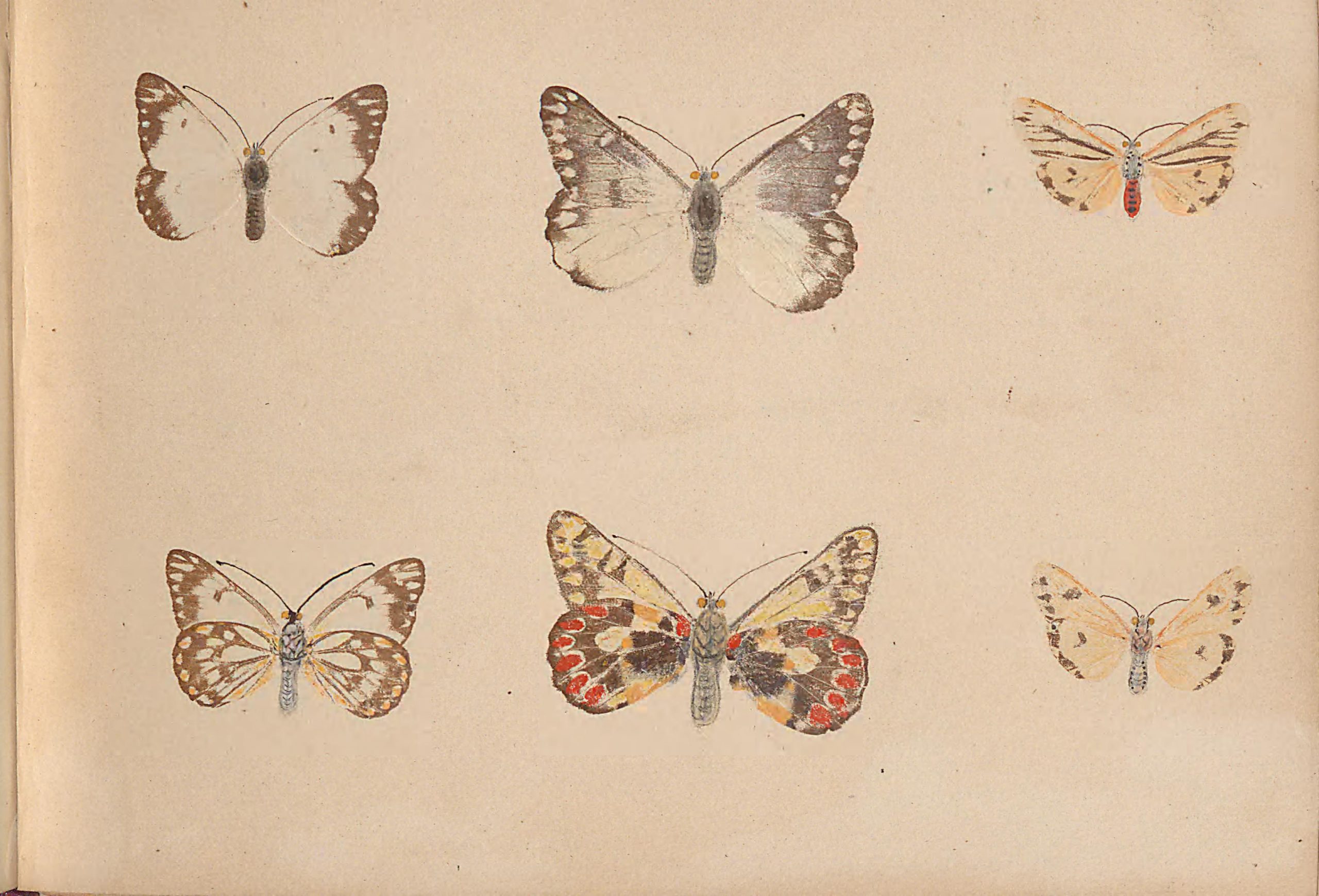
six hand-drawn butterfly illustrations

Twelfth page of illustrations in volume two of a hand-painted volume of Coleoptera illustrated by Francis du Boulay, c.1880 – 1890 / Collection: OLDERSYSTEM~03048, Museums Victoria Archives / Source: Biodiversity Heritage Library.

While carefully presenting these volumes to Dr. Leslie, we were both surprised to come across several pages in the second volume containing beautiful Lepidoptera illustrations. Twenty-one Lepidoptera specimens are beautifully illustrated, but unfortunately do not include their scientific names or the locations where they were collected. Simon Hinkley, Collection Manager in Entomology at Museums Victoria, noted that the “Lepidoptera illustrated are detailed enough for identification purposes, for instance, the bottom left corner [see above] is a Caper White and the bottom middle specimen is a Spotted Jezebel.”

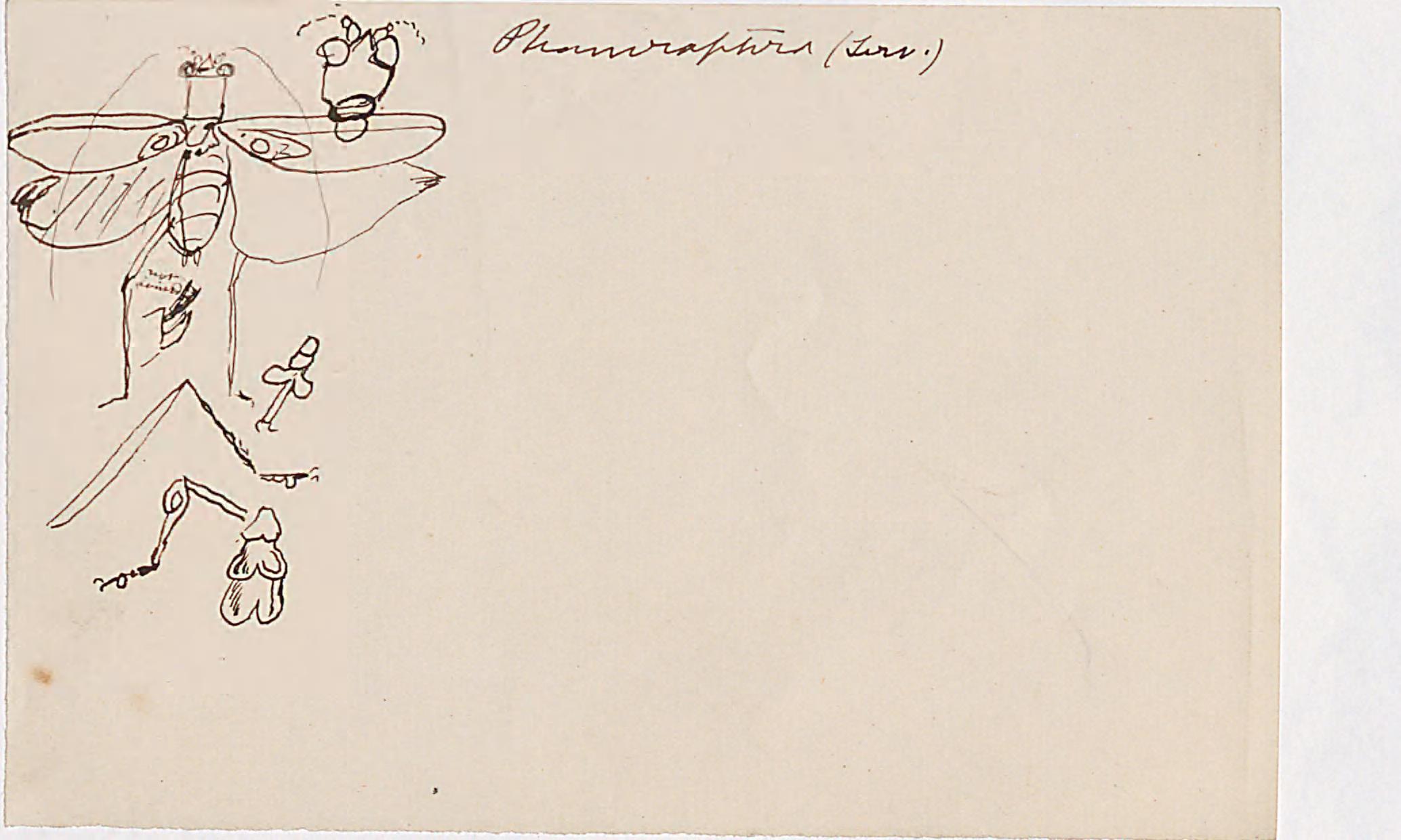
rough black ink line drawing of beetles

Fifteenth page, loose rough sketch and inscription by Professor Frederick McCoy, first director of the National Museum of Victoria, interleafed in volume two of a hand-painted volume of Coleoptera illustrated by Francis du Boulay, c.1880 – 1890 / Collection: OLDERSYSTEM~03048, Museums Victoria Archives / Source: Biodiversity Heritage Library.

Dr. Thomas Darragh, Curator Emeritus at Museums Victoria, identified the loose sheet of paper interleafed in volume two, see above, as Professor Frederick McCoy’s handwriting. McCoy was the first director of the National Museum of Victoria, predecessor of Museums Victoria (1854 – 1899). While not an entomologist, he was a paleontologist, geologist, zoologist, academic and keen collector for the National Museum of Victoria, and he was clearly interested in this volume, enough to incorporate a rough sketch of a “Phaneroptera (Serv)”. Simon Hinkley noted the Phaneroptera is an old genus name of katydids in the subfamily Phaneropterinae and was described by Jean Guillaume Audinet-Serville in 1831.

Volume two includes a loose letter with illustrations of beetles from “Mr. Span, Rooke’s Farm, West Drayton, Middlesex”. The letter includes illustrations of two specimens from North Queensland—one from New South Wales and one from the “Interior of Continent.” An inscription below the address on the letter, written in pencil, “Compared with British Mus. Specimens by Mr Span for Mr Du Boulay”, notes that specimens held by the British Museum have been compared with specimens collected by du Boulay. A few pages following the loose letter is a specimen that has been hand-drawn from the dorsal and cross section with inscription “Schizorhina Mnizechii Larry” (an unpublished name), and beside this is an inscription, “Drawings by Mr Span from originals in Brit. Museum”.

Some of the specimen illustrations in volume two include cross-sections of the heads and magnified studies of the legs. Volume two has a total of 220 Coleoptera and 21 Lepidoptera illustrations, compared to a total of 179 Coleoptera specimens illustrated in volume one.

The National Museum of Victoria purchased several Coleoptera specimens from Francis du Boulay and his brother William (1880-1912), such as the beautiful Castiarina erasma (Carter, 1935), Dilochrosis atripennis (Macleay, 1863), and Castiarina balteata (Saunders, 1869).

Du Boulay’s Coleoptera volumes are significant documents of historical collecting with important scientific information for contemporary scientists. Now that the volumes are available on the BHL website, scientists can benefit from the historical and scientific data on Coleoptera collected by Francis du Boulay from locations across Australia in the late nineteenth century.

September 24, 2020by Joel Richard

Help Support BHL

BHL's existence depends on the financial support of its patrons. Help us keep this free resource alive!

search

About BHL

The Biodiversity Heritage Library (BHL) is the world’s largest open access digital library for biodiversity literature and archives. BHL operates as a worldwide consortium of natural history, botanical, research, and national libraries working together to digitize the natural history literature held in their collections and make it freely available for open access as part of a global “biodiversity community.”

Join Our Mailing List

Sign up to receive the latest news, content highlights, and promotions.

Subscribe Now

Subscribe to Blog via Email

Enter your email address to subscribe to this blog and receive notifications of new posts by email.

Join 319 other subscribers

Subscribe to Blog Via RSS

Subscribe to the blog RSS feed to stay up-to-date on all the latest BHL posts.

Access RSS Feed

Inspiring Discovery through Free Access to Biodiversity Knowledge.

The Biodiversity Heritage Library makes it easier than ever for you to access the information you need to study and explore life on Earth…for free, anytime, anywhere.


64+ Million Pages of
Biodiversity Literature Online.

EXPLORE

Tools and Services
to Transform Research.

EXPLORE

300,000+
Illustrations on Flickr.

EXPLORE

ABOUT | HARMFUL CONTENT | PRIVACY | SITE MAP | TERMS OF USE