Biodiversity Heritage Library - Program news and collection highlights from BHL
  • Home
  • News
  • Featured Books
    • All Featured Books
    • Book of the Month Series
    • BHL at 20
  • User Stories
  • Campaigns
    • Fossil Stories
    • Garden Stories
    • Monsters Are Real
    • Page Frights
    • Her Natural History
    • Earth Optimism 2020
  • Tech Blog
  • Visit BHL
Home
News
Featured Books
    All Featured Books
    Book of the Month Series
    BHL at 20
User Stories
Campaigns
    Fossil Stories
    Garden Stories
    Monsters Are Real
    Page Frights
    Her Natural History
    Earth Optimism 2020
Tech Blog
Visit BHL
  • Home
  • News
  • Featured Books
    • All Featured Books
    • Book of the Month Series
    • BHL at 20
  • User Stories
  • Campaigns
    • Fossil Stories
    • Garden Stories
    • Monsters Are Real
    • Page Frights
    • Her Natural History
    • Earth Optimism 2020
  • Tech Blog
  • Visit BHL
Biodiversity Heritage Library - Program news and collection highlights from BHL
BHL News, Blog Reel

Facebook Live Event 24 March: Celebrating Gesner

Portrait version of the Biodiversity Heritage Library logo.

View a recording of Celebrating Gesner on Facebook.

———————-

View Full Size Image

Conrad Gesner (1516-1565) was a Swiss naturalist whose Historia Animalium is considered the starting point of modern zoology. 26 March is the anniversary of his birth, and institutions around the world will celebrate #GesnerDay by highlighting his publications and contributions on social media.

In anticipation of this event, join us for a Facebook Live broadcast as we go behind-the-scenes at the Smithsonian Libraries with Leslie Overstreet, Curator of Natural-History Rare Books, who will tell us more about Gesner and showcase some of his amazing publications from the collections of the Smithsonian’s Joseph F. Cullman 3rd Rare Book Library of Natural History.

Many of Gesner’s works have also been digitized for BHL. Browse them here.

Celebrating Gesner Facebook Live Event

When? 24 March, 2017 at 1:30pm ET
Where? www.facebook.com/biodivlibrary

March 15, 2017by michelle.underhill
Blog Reel, Featured Books

The Walrus as you Never Knew Him

View Full Size Image
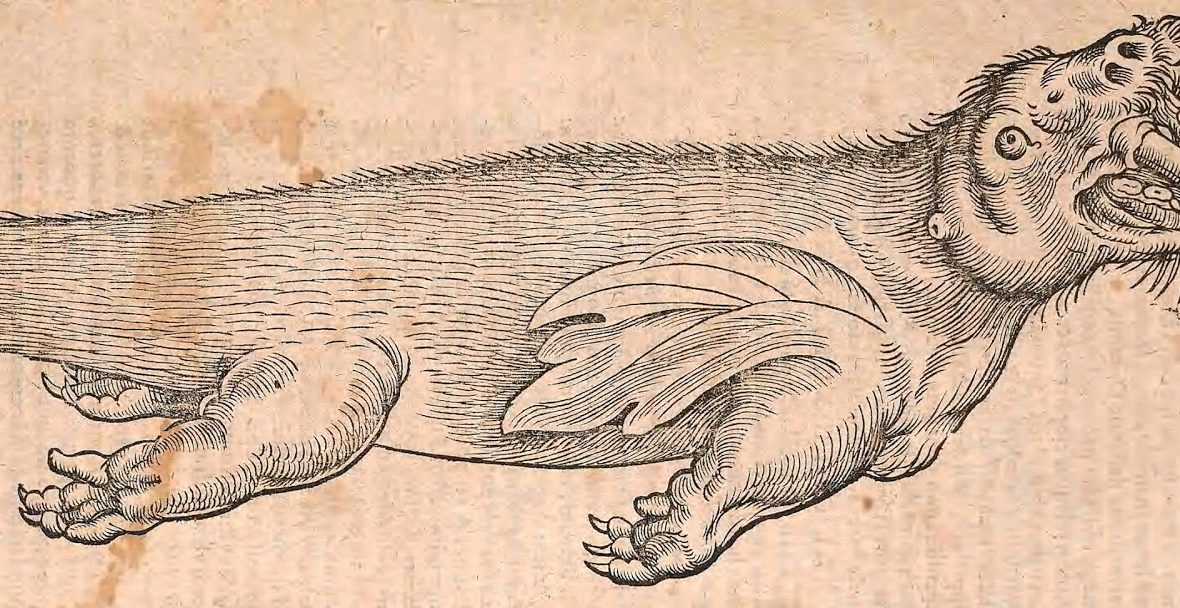
Conrad Gessner’s Walrus. 1558. Historia Animalium. http://biodiversitylibrary.org/page/42165842

Conrad Gessner desired to reconcile ancient knowledge about the animal kingdom with the modern discoveries of the Renaissance. This endeavor spurred him to produce his magnificent Historia Animalium, a work synonymous with the beginning of modern zoology. This five-volume masterpiece covered the subjects of “live-bearing four footed animals” (mammals), “egg-laying quadrupeds” (crocodiles and lizards), birds, fish and sea creatures, and a fifth posthumous volume on snakes and scorpions.

Compiling knowledge from Old Testament, Greek, Hebrew and Latin sources, Animalium boasts a rich collection of woodcut illustrations – something uncommon in other contemporary natural history publications. Gessner repurposed images from many famous researchers of his time, including Olaus Magnus, Guillaume Rondelet, Pierre Belon, Ulisse Aldrovandi, and Albrecht Durer. Their existing images were carved into woodblocks by craftsmen, which were used to “stamp” the reproductions onto designated pages within the text blocks.

Though Gessner intended to produce an authoritative encyclopedia of scientific knowledge about the natural world, his five volumes do include mythical beasts and fancifully-rendered factual creatures. Many of the more exotic of the species he depicted were based on textual or second-hand accounts, explaining the sometimes substantial divergence from reality.

Case in point: The Walrus.

View Full Size Image
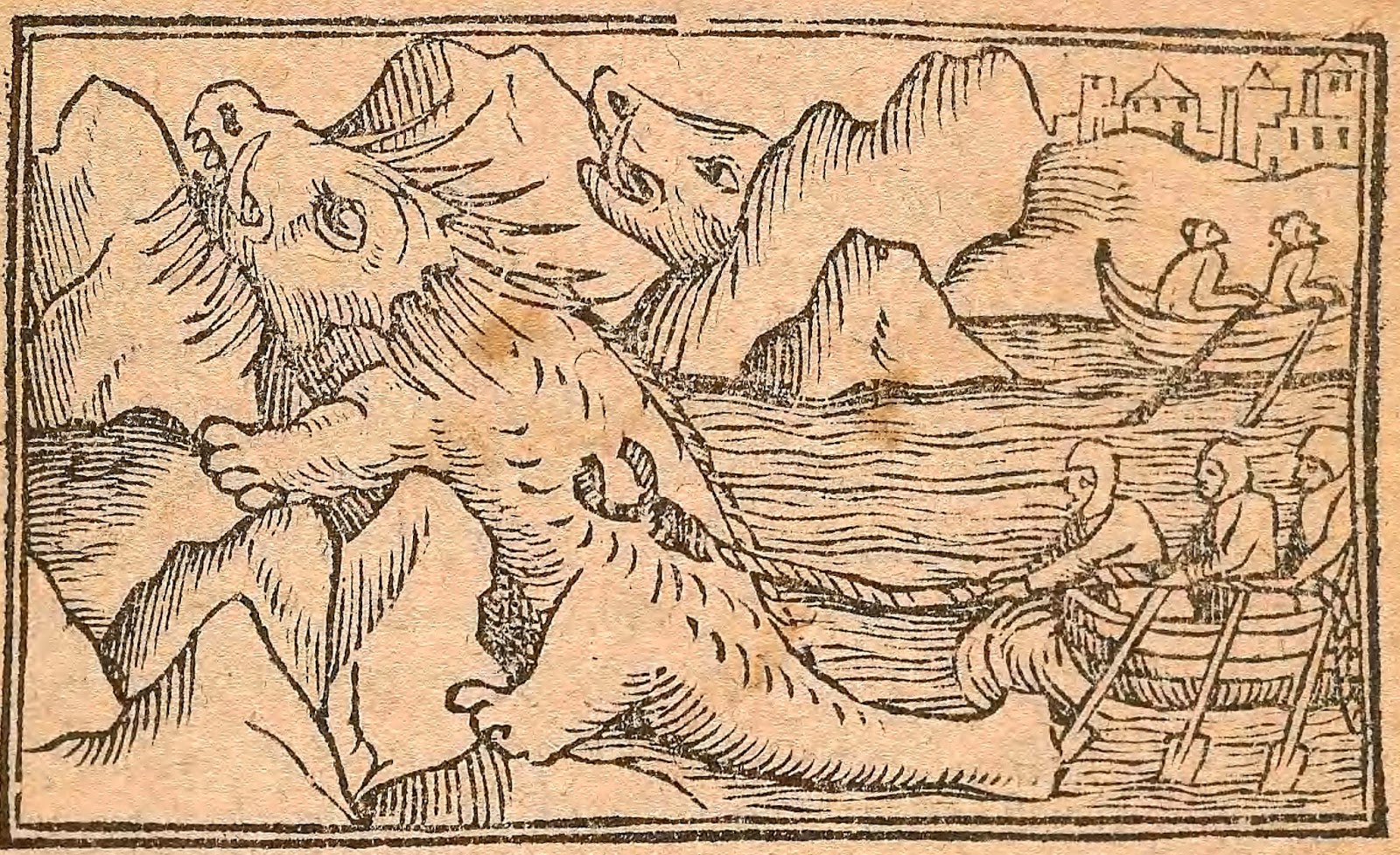
Olaus Magnus’ Walrus. 1555.  
Historia de Gentibus Septentrionalibus.
http://biodiversitylibrary.org/page/41862934

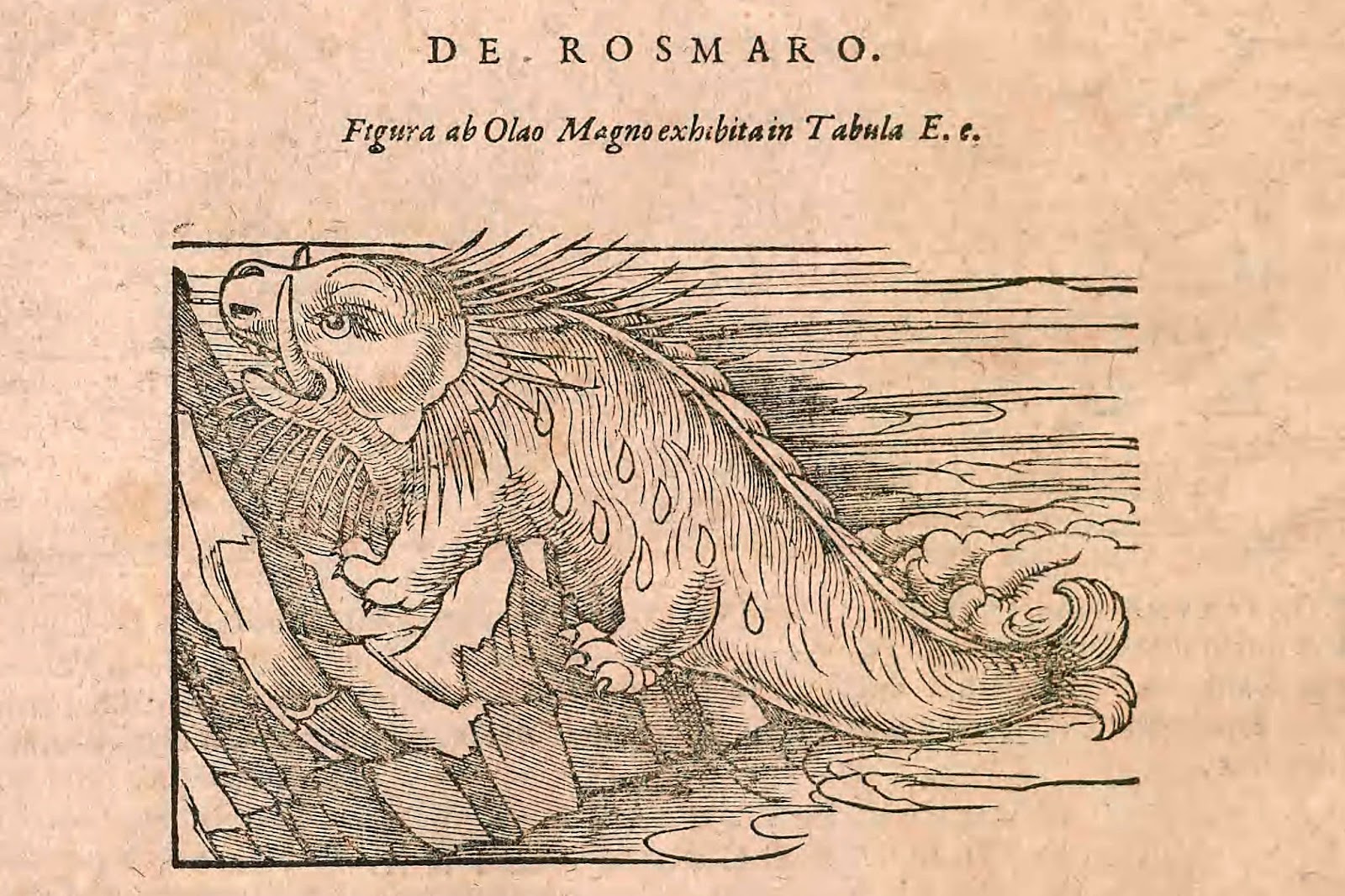
Gessner’s Walrus comes from descriptions by Olaus Magnus in his work on the northern European ocean: Historia de Gentibus Septentrionalibus (1555). Basing his description on Albertus Magnus’ thirteenth century accounts of walrus hunting and reports from two more recent travelers to Russia (Maciej z Miechowa, 1517, and Paolo Giovio, 1525), Olaus recounted the walrus as “a mighty fish, as big as an elephant, called morse or rosmari” that was capable of climbing mountains. The rendering he provided for the creature depicted a beast with legs and tusks in its lower jaw.

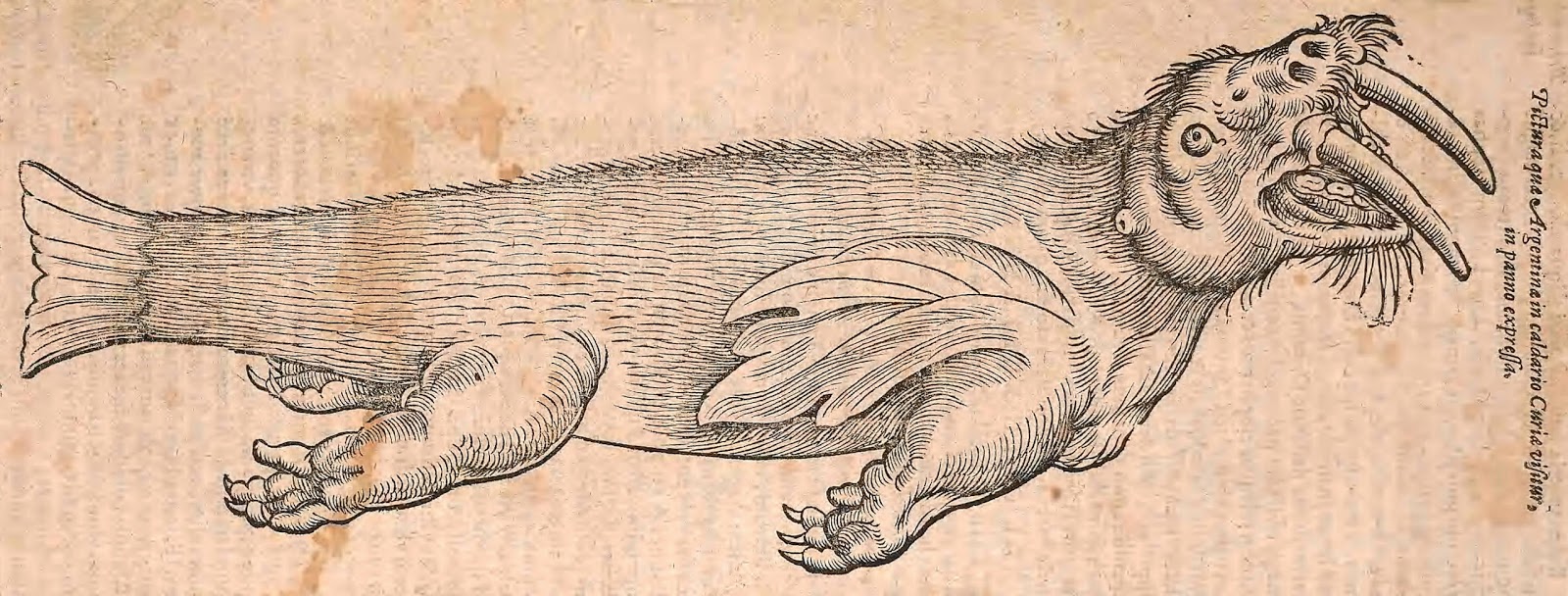
Gessner voiced some hesitations about Magnus’ representation of the Walrus. Writing that he believed Olaus based many of his creatures on sailors’ accounts rather than life studies, Gessner reasoned that “fish don’t have feet.” Since common wisdom of the day, and even Olaus himself, grouped Walrus with fish, it was an understandable concern. Nevertheless, Olaus was a well-respected authority, with a good family lineage and a travel resume that had brought him further north than any of his intellectual European contemporaries. Thus, Gessner included two illustrations in his work, one closely resembling Olaus’ beast and another more recognizable as the pinniped we know today.

View Full Size Image
Gessner Walrus, resembling Magnus’ image. 1558. Historia Animalium. http://biodiversitylibrary.org/page/42165841

The inaccurate renderings of Magnus and Gessner’s Walrus, and many other Walrus depictions of the time, may have originated in part from confused reports on ivory sources. The ivory trade in China consisted of a combination of elephant, walrus, and narwhal tusks. Practically no documentation was kept regarding the source of the ivory, and while the European ivory trade was more segmented among source types, the Scandinavians, Russians, and Nenets that supplied the western trade did not share information readily. Thus, natural historians like Olaus Magnus likely tailored their depictions to reconcile the vague second-hand accounts they received with the appearance of other animals they knew produced ivory tusks – elephants. Indeed, many other Walrus portraits of the day (such as those by Waldseemüller and Fries) portray the animal in a much more elephant-like manner, complete with long legs, floppy ears, and, in the case of Fries, even a trunk.

Thus, all things considered, though we today may look at Gessner’s Walrus and giggle, his was actually a much more accurate representation of the animal than many alternative sources in his time. Despite the factual deviations it may contain, “for an understanding of the history of zoology and a peek at some truly fascinating and five-hundred-year-old illustrations, there is no better historical guide than Conrad Gessner’s Historia Animalium.” (Ellis, pg. 2).

And, come on, Gessner’s Walrus is pretty adorable!

Sources:

  • Ellis, Richard. “The First Animal Book.” Natural Histories. Ed. Thomas Baione. New York: Sterling Publishing, 2012. pg. 1-2.
  • McKay, John. “The White Elephant of Rucheni.” Scientific American Blog. Scientific American, 25 July, 2014. http://blogs.scientificamerican.com/guest-blog/2011/11/22/the-white-elephant-of-rucheni/
  • Scott, Michon. “Sea Monsters.” Strange Science. 25 July, 2014. http://www.strangescience.net/stsea2.htm


July 31, 2014by ulib-libraryjobs

Help Support BHL

BHL's existence depends on the financial support of its patrons. Help us keep this free resource alive!

search

About BHL

The Biodiversity Heritage Library (BHL) is the world’s largest open access digital library for biodiversity literature and archives. BHL operates as a worldwide consortium of natural history, botanical, research, and national libraries working together to digitize the natural history literature held in their collections and make it freely available for open access as part of a global “biodiversity community.”

Join Our Mailing List

Sign up to receive the latest news, content highlights, and promotions.

Subscribe Now

Subscribe to Blog via Email

Enter your email address to subscribe to this blog and receive notifications of new posts by email.

Join 319 other subscribers

Subscribe to Blog Via RSS

Subscribe to the blog RSS feed to stay up-to-date on all the latest BHL posts.

Access RSS Feed

Inspiring Discovery through Free Access to Biodiversity Knowledge.

The Biodiversity Heritage Library makes it easier than ever for you to access the information you need to study and explore life on Earth…for free, anytime, anywhere.


64+ Million Pages of
Biodiversity Literature Online.

EXPLORE

Tools and Services
to Transform Research.

EXPLORE

300,000+
Illustrations on Flickr.

EXPLORE

ABOUT | HARMFUL CONTENT | PRIVACY | SITE MAP | TERMS OF USE