Biodiversity Heritage Library - Program news and collection highlights from BHL
  • Home
  • News
  • Featured Books
    • All Featured Books
    • Book of the Month Series
    • BHL at 20
  • User Stories
  • Campaigns
    • Fossil Stories
    • Garden Stories
    • Monsters Are Real
    • Page Frights
    • Her Natural History
    • Earth Optimism 2020
  • Tech Blog
  • Visit BHL
Home
News
Featured Books
    All Featured Books
    Book of the Month Series
    BHL at 20
User Stories
Campaigns
    Fossil Stories
    Garden Stories
    Monsters Are Real
    Page Frights
    Her Natural History
    Earth Optimism 2020
Tech Blog
Visit BHL
  • Home
  • News
  • Featured Books
    • All Featured Books
    • Book of the Month Series
    • BHL at 20
  • User Stories
  • Campaigns
    • Fossil Stories
    • Garden Stories
    • Monsters Are Real
    • Page Frights
    • Her Natural History
    • Earth Optimism 2020
  • Tech Blog
  • Visit BHL
Biodiversity Heritage Library - Program news and collection highlights from BHL
Blog Reel, Featured Books

Book of the Week: Adventures on the North Sea

The North Sea—at least according to Walter Wood—was awash in blood and fish. Thus, the title of this week’s Book of the Week “North Sea fishers and fighters,” equates men drawn to the sea for the allure of earning a living and trawling to those drawn to battle for the allure of adventure and bloodshed.

Like a modern-day documenter of “The Deadliest Catch,”Wood himself was drawn to recreating the adventure of deep sea fishing during the turn of the century, writingseveralbookswith a central metaphor of fisherman as warriors. By Wood’s account, the sheer number of fish drawn in by those who braved the stormy waters of the North Sea warranted the combative analogy:
War to-day is waged as fiercely on the North Sea as it ever was when Jutlanders and Vikings came to England. But it is another sort of fight, a battle with unnumbered hosts that dwell in gloomy waters and are seldom seen till they are conquered.
View Full Size Image
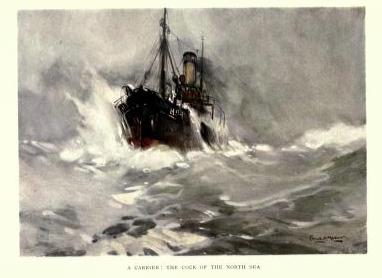
Illustration by Frank H. Masondepicting the tempestuous waters of the North Sea.
To capture the lives of the fishermen, Wood embedded himself on the boats, getting first-hand accounts of the dangers faced on a daily basis. Often the men would first have to battle the weather before they got to their ultimate adversaries—the fish. Packed into cramped spaces below deck, they had little refuge from their duties above board. The fishermen hoped for good luck while at sea but it was difficult to avoid injury. In the year witnessed by Wood, more than 15,000 patients were medically or surgically treated for everything from minor burns to broken limbs to severe head trauma, and available treatment was far from topnotch.
I heard a North Sea skipper tell how […] he severely injured his arm. For sixteen weeks he remained at sea, with no opportunity of getting the wound treated, except in the roughest fashion; there was not time when he came ashore to cure it, and he had to go back to the fleet, a helpless youngster, and let chance do the healing. This is merely one—and not a lurid—instance of the neglect and suffering […] when a mixture of turpentine and treacle was reckoned an efficient medicine.
View Full Size Image
Another color illustration by Frank H. Mason with a lifeboat coming to the rescue of a ship in distress.
To Wood, despite the danger, there was something that drew men to sea, and “North Sea fishers and fighters” primarily focuses on the opportunity for fishermen to test their mettle far from shore. Though, not least of these motivations are the treasures contained within the water’s depths. Wood recounts the riches fishermen braved treacherous conditions to capture—the copious amounts of fish just below the surface of the raging water.
If the North Sea waters were translucent, what a wondrous sight would be presented to the voyagers upon its surface! Countless myriads of fishes find existence […] an almost solid moving dark or silver mass. […] Rich hauls of gold have been taken by sinking shafts; but hauls of silver fish, as precious, have been made from the prolific waters of the Bank […] a region which, in its way, has been as profitable as some of the goldfields of Australia.
View Full Size Image
Illustration from Neal Green with fishermen sorting through the trawl.
Wood was not a naturalist by any means, preferring instead to capture the inner workings of the fishing vessel. But the fish are what drove the men to battle, and Wood couldn’t help but be captivated by the crowded masses, shown here in his depiction of the sheer tonnage hauled in by each ship: “It was not uncommon for 3 tons of fish to be caught at a time, […] I have seen one of the old beam-trawls so crammed with haddock that it could not be hauled; as a matter of fact, the net burst and the dead haddock were as thick on the surface of the water as an icefloe (sic).”
This freight would be a huge payload for the North Sea fisheries and crew. “During 1910 there were landed 141,246 tons of fish, of the value of £1,300,000.” The varieties of fish brought to port on an average day would contain soles, haddock, plaice, whiting, and—with any luck—turbot, brill, and cod.
View Full Size Image
Several fish varieties found in the North Sea.
“Brilliant” and “abundant” is how Wood characterized the supply of fish he witnessed during his travels. To this day, fishing in the North Sea remains a significant industry, but the fishing practices known by Wood are no longer sustainable. Over-fishinghas become a concern in many areas, including the North Sea, as mature fishes are fewer and annual catches continue to decline. It is unlikely Wood could recognize the regulation required of modern fishermen as they incorporate preservation into their industry, though he would definitely still detect a certain allure of adventure—and especially danger—in today’s fishers and fighters of the North Sea.
References:
  •  Britain: Catching a cold; fishing. (2002, Nov 09). The Economist, 365, 28-60. Retrieved from http://search.proquest.com/docview/224037153?accountid=14784
  •  Green, Neal. Fisheries of the North Sea, by Neal Greet. With two illustrations and a map. London: Methuen & Co. Ltd., 1918.
  •  Wood, Walter. North Sea fishers and fighters, by Walter Wood. With colour and pencil illustrations by Frank H. Mason and photographs by the author. London: K. Paul, Trench, Trübner & Co., Ltd., 1911.
August 8, 2013by LANL_RL

Help Support BHL

BHL's existence depends on the financial support of its patrons. Help us keep this free resource alive!

search

About BHL

The Biodiversity Heritage Library (BHL) is the world’s largest open access digital library for biodiversity literature and archives. BHL operates as a worldwide consortium of natural history, botanical, research, and national libraries working together to digitize the natural history literature held in their collections and make it freely available for open access as part of a global “biodiversity community.”

Join Our Mailing List

Sign up to receive the latest news, content highlights, and promotions.
Subscribe Now

Subscribe to Blog via Email

Enter your email address to subscribe to this blog and receive notifications of new posts by email.

Join 319 other subscribers

Subscribe to Blog Via RSS

Subscribe to the blog RSS feed to stay up-to-date on all the latest BHL posts.

Access RSS Feed

Inspiring Discovery through Free Access to Biodiversity Knowledge.

The Biodiversity Heritage Library makes it easier than ever for you to access the information you need to study and explore life on Earth…for free, anytime, anywhere.


64+ Million Pages of
Biodiversity Literature Online.

EXPLORE

Tools and Services
to Transform Research.

EXPLORE

300,000+
Illustrations on Flickr.

EXPLORE

ABOUT | HARMFUL CONTENT | PRIVACY | SITE MAP | TERMS OF USE
