

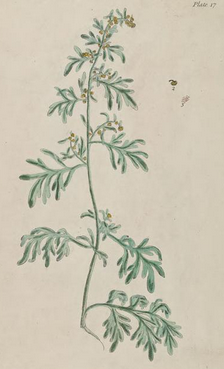
Take two of these and call in the morning. Those aren’t unusual words coming from a doctor if the “two of these” refers to some aspirin or Tylenol. It’d be a little more curious if the prescription called for two stalks of mugwort, infused with wine and a dash of salt. An interesting remedy for the common malady, but not something easily procured from the corner drug store. In the context of modern medicine this might seem an ineffective treatment, but in this week’s book of the week, “A curious herbal,” it’s the go-to recommendation for any and all disorders of the stomach, jaundice, general malaise, or swelling of the tonsils.
 |
| Blackwell’s illustration of the Artemisia absinthium, cure for the common stomachache. |
|
|
|
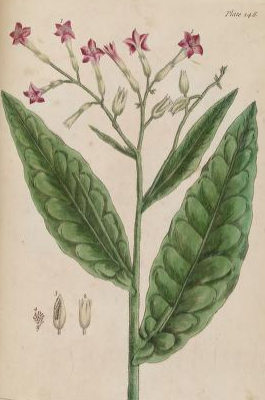
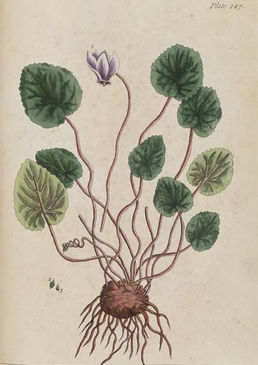
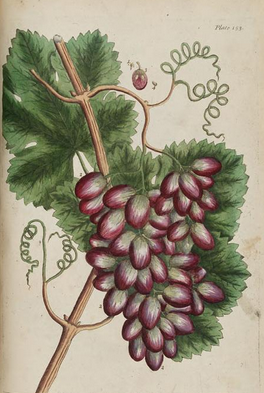
Capturing the habitats, descriptions, uses, and even the likeness of these functional plants was Elizabeth Blackwell. The legacy of Blackwell is non-existent in the history of medicine, her efforts largely dismissed as unscientific, but she was the first woman to produce an herbal, one that was innovative with an illustrated list of medicinal plants available to the medical community and the public.
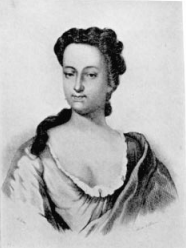 |
| Elizabeth Blackwell, herbalist and bondsman, from The British Library. |
Blackwell’s hand-drawn illustrations and engravings were prompted by a debt and a prison sentence. Her husband and second cousin, Alexander, had a somewhat loose relationship with the law. Some shady dealings and a few questionable business decisions later, and Alexander found himself in debtors’ prison, and Blackwell found herself in a position where she needed a way to make some money quickly.
At the time, botany and the natural sciences had become a worthy pursuit of proper ladies. Blackwell had training in drawing and illustrating, had access to a printing press from one of her husband’s ne’er-do-well business pursuits, and had an idea to fill what she perceived as a void in the literature. “A curious herbal: containing five hundred cuts, of the most useful plants, which are now used in the practice of physick engraved on folio copper plans, after drawings taken from the life” was the result, issued in weekly parts and later published in two volumes.
It wasn’t the quickest means to pay off Alexander’s debts, but six years later, the book was published and Alexander was out of prison. The story didn’t end well for the couple. The two were separated after Alexander found himself on the wrong side of the law yet again, he attempted to flee, but was tried and hung for treason in 1748. Blackwell, who dedicated so many years to the herbal and immediately sold the copyright to pay off her husband’s debts, never saw him again and died ten years later.
The lack of notoriety for Blackwell herself notwithstanding, “A curious herbal” drew from the works of Sir Hans Sloane, Dr. Richard Mead, Isaac Rand and Philip Miller from the Society of Apothecaries, and Maria Sibylla Merian’s “Neues Blumen Buch,” and was the most prominent herbal of the day, still acclaimed for its detailed illustrations. Blackwell was by no means a doctor, but her herbal reference work informed the doctors–and patients–in this pre-drug store era and provides some tips for future herbalists when the Tylenol just doesn’t cut it.
Interested in more natural remedies? Check out Dr. Alain Touwaide and Emanuela Appetiti’s PLANT digital library, or rather the PLantarum Aetatis Novae Tabulae, a collection of full-text books on botany and medicinal plants printed during the 1481-1650 period. Or explore the great virtual exhibit from our BHL-Europe colleagues on all the history, legends, and, most importantly, delicious recipes surrounding other multi-use herbs and spcies.
Like the illustrations from this post? Check out this collection of medicinal plant illustrations from the BHL’s Flikr account.
References:
- Beatty, K. (2013). “The Illustrated Herbal of Elizabeth Blackwell: A Curious Story.” Suite 101, retrieved from http://suite101.com/article/the-illustrated-herbal-of-elizabeth-blackwell-a-curious-story-a252195
- Madge, B. (2001). “Elizabeth Blackwell–the forgotten herbalist?” Health Information and Libraries Journal, 18, p. 144-52.
