Biodiversity Heritage Library - Program news and collection highlights from BHL
  • Home
  • News
  • Featured Books
    • All Featured Books
    • Book of the Month Series
    • BHL at 20
  • User Stories
  • Campaigns
    • Fossil Stories
    • Garden Stories
    • Monsters Are Real
    • Page Frights
    • Her Natural History
    • Earth Optimism 2020
  • Tech Blog
  • Visit BHL
Home
News
Featured Books
    All Featured Books
    Book of the Month Series
    BHL at 20
User Stories
Campaigns
    Fossil Stories
    Garden Stories
    Monsters Are Real
    Page Frights
    Her Natural History
    Earth Optimism 2020
Tech Blog
Visit BHL
  • Home
  • News
  • Featured Books
    • All Featured Books
    • Book of the Month Series
    • BHL at 20
  • User Stories
  • Campaigns
    • Fossil Stories
    • Garden Stories
    • Monsters Are Real
    • Page Frights
    • Her Natural History
    • Earth Optimism 2020
  • Tech Blog
  • Visit BHL
Biodiversity Heritage Library - Program news and collection highlights from BHL
Blog Reel, Campaigns, Earth Optimism 2020

A Forest of Knowledge: Richard Evans Schultes and the Rise of Ethnobotany

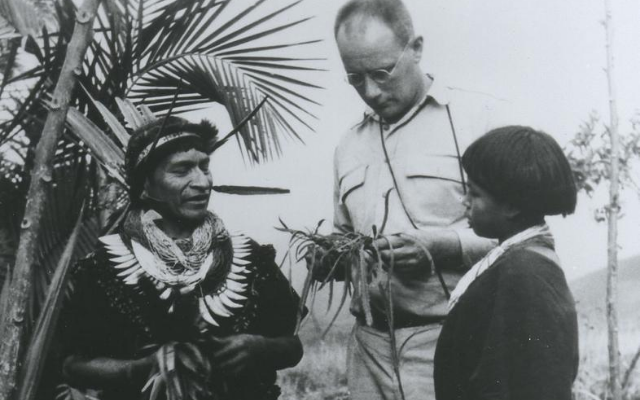
black and white photo of three people standing in a jungle looking at plant specimens

April 2020 marks the 50th anniversary of Earth Day. Organizations around the world have commemorated the occasion by participating in the global Earth Optimism movement — an initiative spearheaded by the Smithsonian to “turn the conservation conversation from doom and gloom to optimism and opportunity”.

Throughout 2020, the Biodiversity Heritage Library (BHL) and our partners are joining the movement by sharing conservation success stories from and made possible by the BHL collection. Follow our blog for conservation stories — past and present — and visit our website for more information and to explore our Earth Optimism book collection.

———————
black and white photo of three people standing in a forest looking at plant specimens

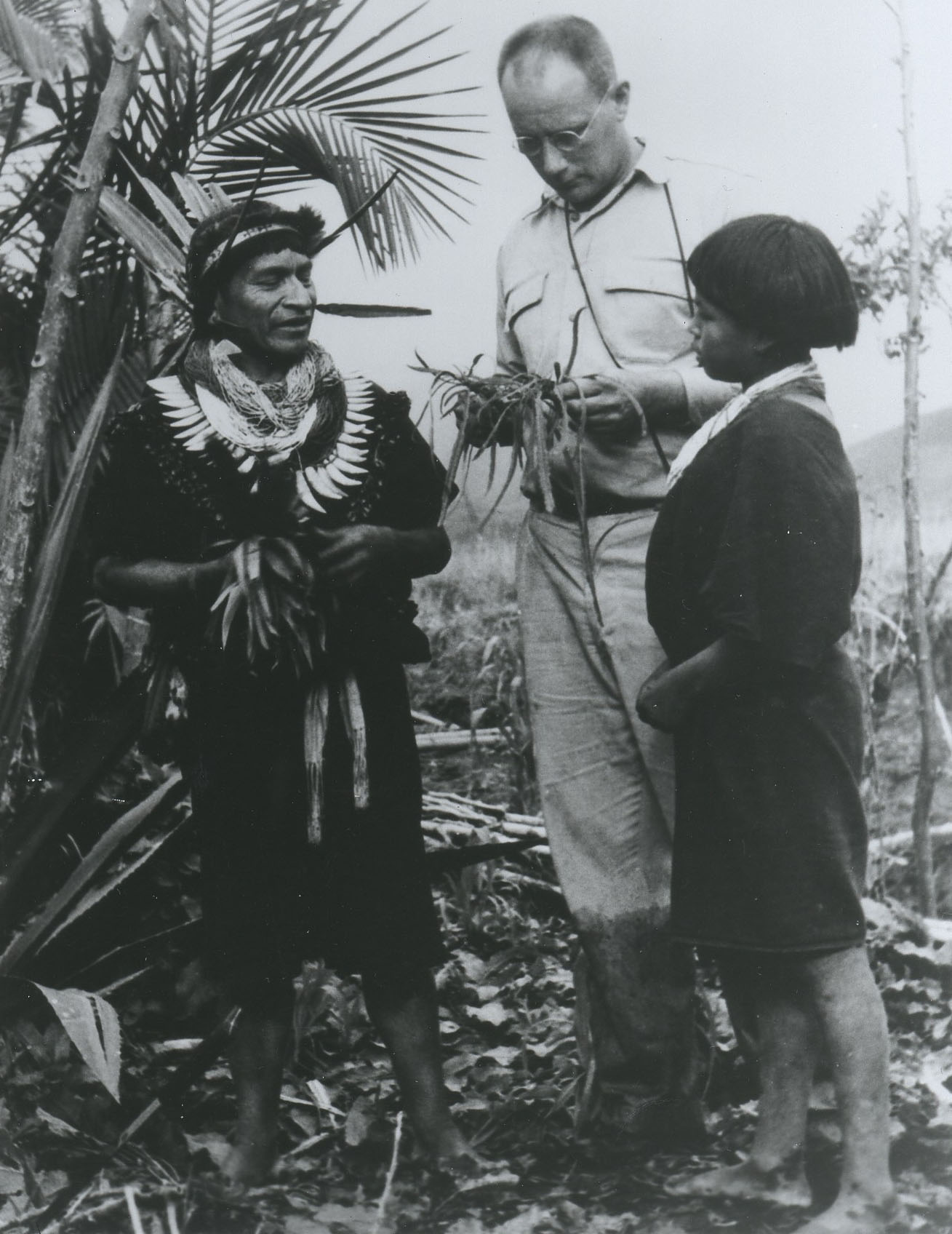
Richard Evans Schultes (center) with Salvador Chindoy (left), a renowned Kamëntsá healer from Sibundoy Valley of Colombia. The identity of the individual on the right is not recorded. The year of the photo is unknown, but is likely in the 1940s based on Schultes’ age. Photo courtesy of the Archives of the Economic Botany Library of Oakes Ames, Harvard University.

The conservation movement today encompasses more than the physical management of habitat to preserve plants and animals. Richard Evans Schultes (1915-2001) epitomized the modern conservationist by coupling his taxonomic work on plants with research on the botanical knowledge and culture of local people. Known as the “father of ethnobotany”, Schultes spent almost fourteen years deep within the rainforests of the Amazon learning from multiple Indigenous tribes about their languages, medicines, and relationships to plants.

“Richard Evans Schultes was an extraordinary ethnobotanist who devoted a large part of his professional life to studying the flora of the Amazon as well as of Asia and Europe,” says Felipe Cárdenas-Arroyo, a Colombian archaeologist researching Schultes. “For him, forests are like great libraries where knowledge is stored and available for those willing to read it. He admired and respected the Amazonian Natives because they know how to read in this library and have been its keepers for centuries. Burning down the Amazon rainforest to make room for cattle is like burning down a library to make room for a parking lot, and Schultes feared that with today’s rate of destruction ‘climax forests will turn into scrub vegetation,’ never to regain their original state” [1].

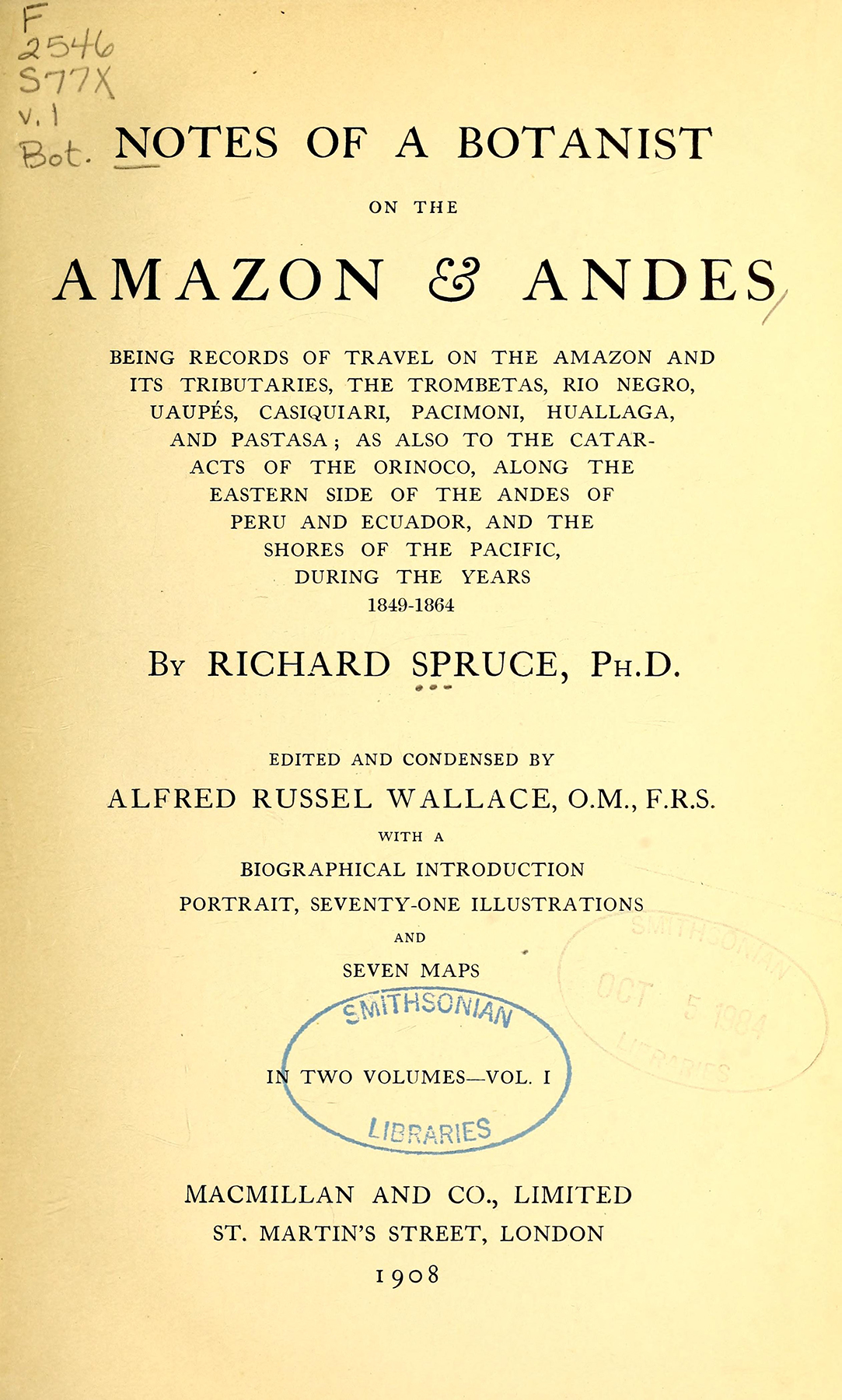
Schultes was inspired as a youth to pursue botanical research in remote areas by the book Notes of a Botanist on the Amazon & Andes by the botanist Richard Spruce.
title page of "notes of a botanist on the amazon & andes"

Title Page. Spruce, Richard. Notes of a botanist on the Amazon & Andes. v. 1 (1908). Contributed in BHL from Smithsonian Libraries.

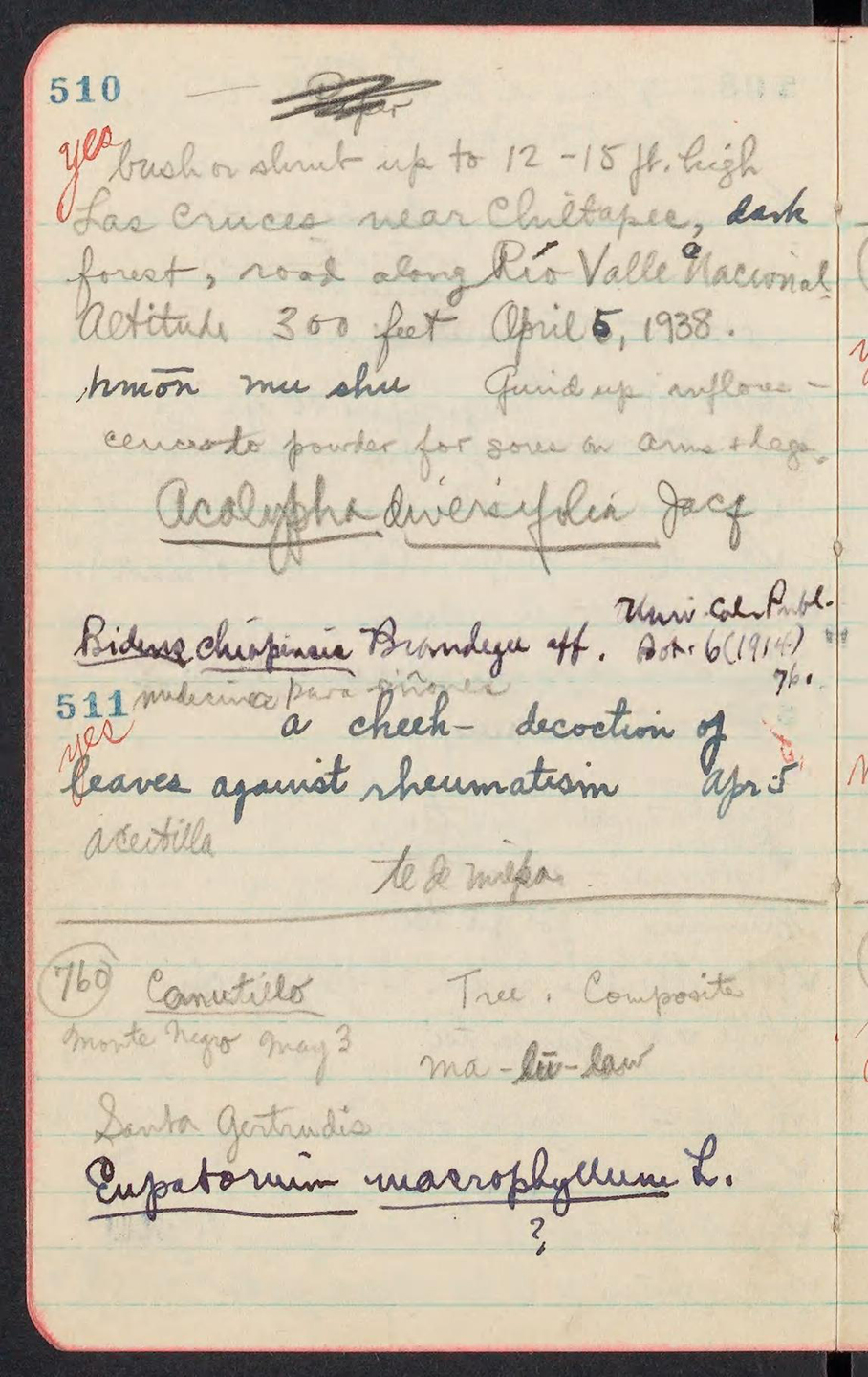
Schultes’s early research focused on peyote in the American Southwest and intoxicating mushrooms in southern Mexico. He collected specimens, identified species, and recorded local knowledge of medicinal uses and experiences.
page from a handwritten notebook

Page 10. Schultes, Richard Evans. Field notebook : Mexico, 1938. Contributed in BHL from Harvard University Botany Libraries.

After receiving his doctorate from Harvard University in 1941, Schultes began research on curare in the Amazon with the help of a 10-month travel grant from the National Research Council. He took the opportunity to collect specimens of many plants and discuss local uses with Indigenous communities.

He was in the field when the United States entered World War II and immediately joined the war effort. He was told to remain in the Amazon to try to find sources of much-needed rubber for the Allied Forces. He continued to work for the United States Department of Agriculture for the next twelve years, collecting approximately 3,500 specimens of the Hevea rubber tree. During his career in the Amazon, Schultes would collect over 24,000 botanical specimens.
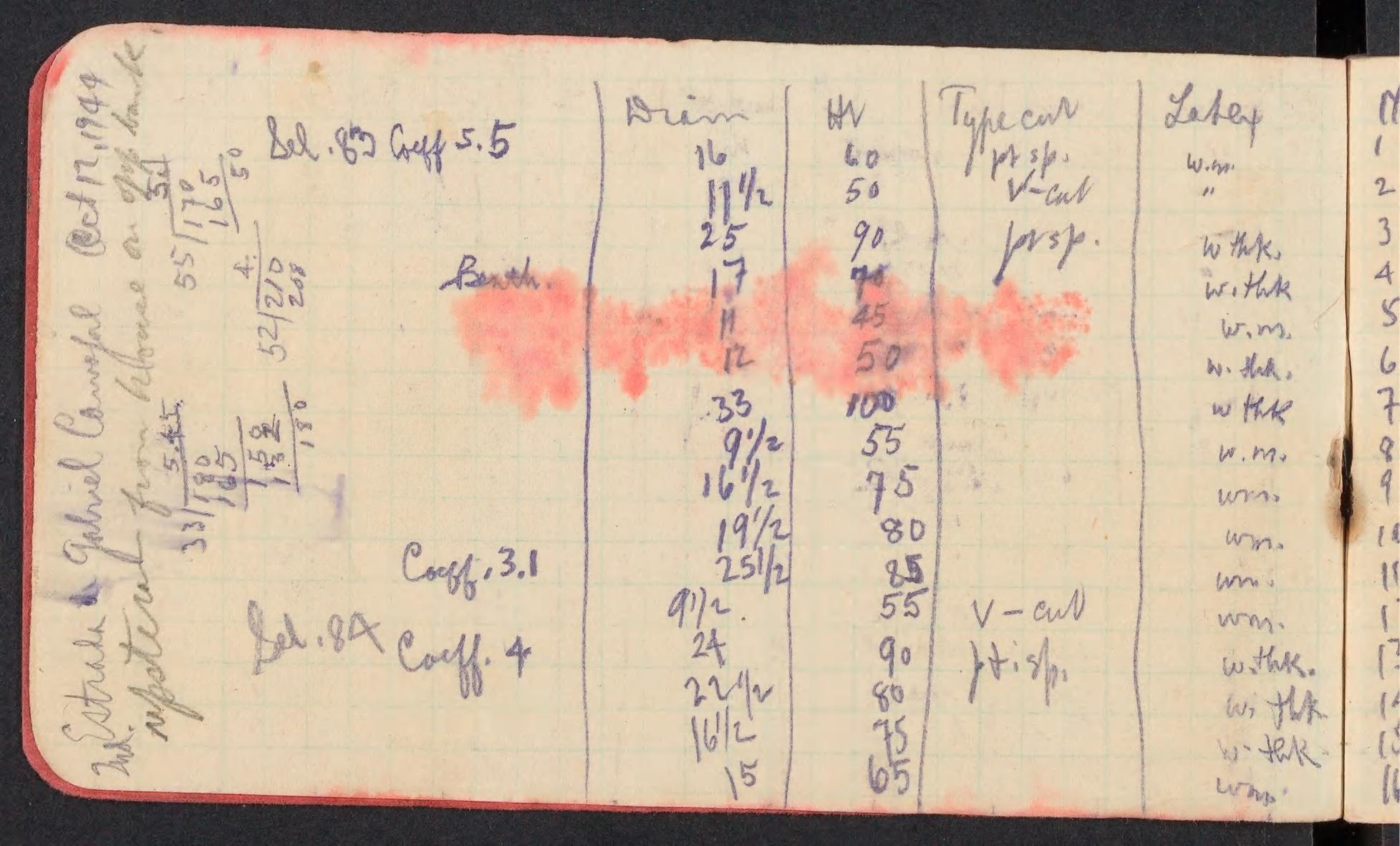
page from a handwritten notebook

Pages 2-3. Schultes, Richard Evans. Hevea yield notebook : Colombia, 1944. Contributed in BHL from Harvard University Botany Libraries.

Schultes returned to New England in 1953 and became the curator of the Oakes Ames Orchid Herbarium at Harvard University. He continued to travel extensively to the Amazon while holding a number of positions at the Harvard University Botanical Museum and was a Harvard faculty member until his retirement as Professor Emeritus in 1985.

Schultes himself defined ethnobotany as “the complete registration of the uses of and concepts about plant life in primitive societies… comprising aspects of botany, anthropology, archeology, plant chemistry, pharmacology, history, geography, and sundry other tangential fields of the sciences and arts” (Kahn, 1992). His notebooks demonstrate his commitment to documenting knowledge beyond biology. Indigenous languages are captured on the pages, including place names and common words.
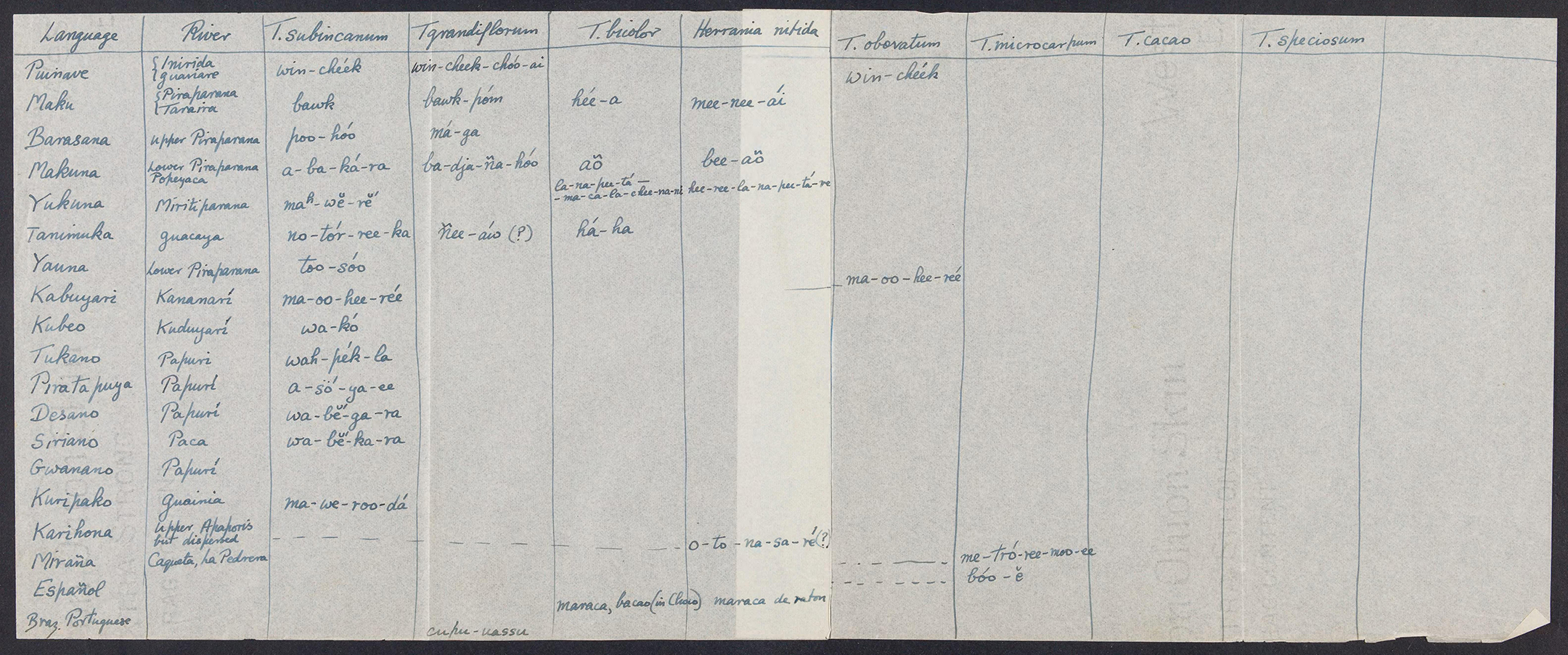
page from a handwritten notebook

List of rivers and plants in several local languages. Schultes, Richard Evans. Field notebook : Colombia, 1952. Contributed in BHL from Harvard University Botany Libraries.
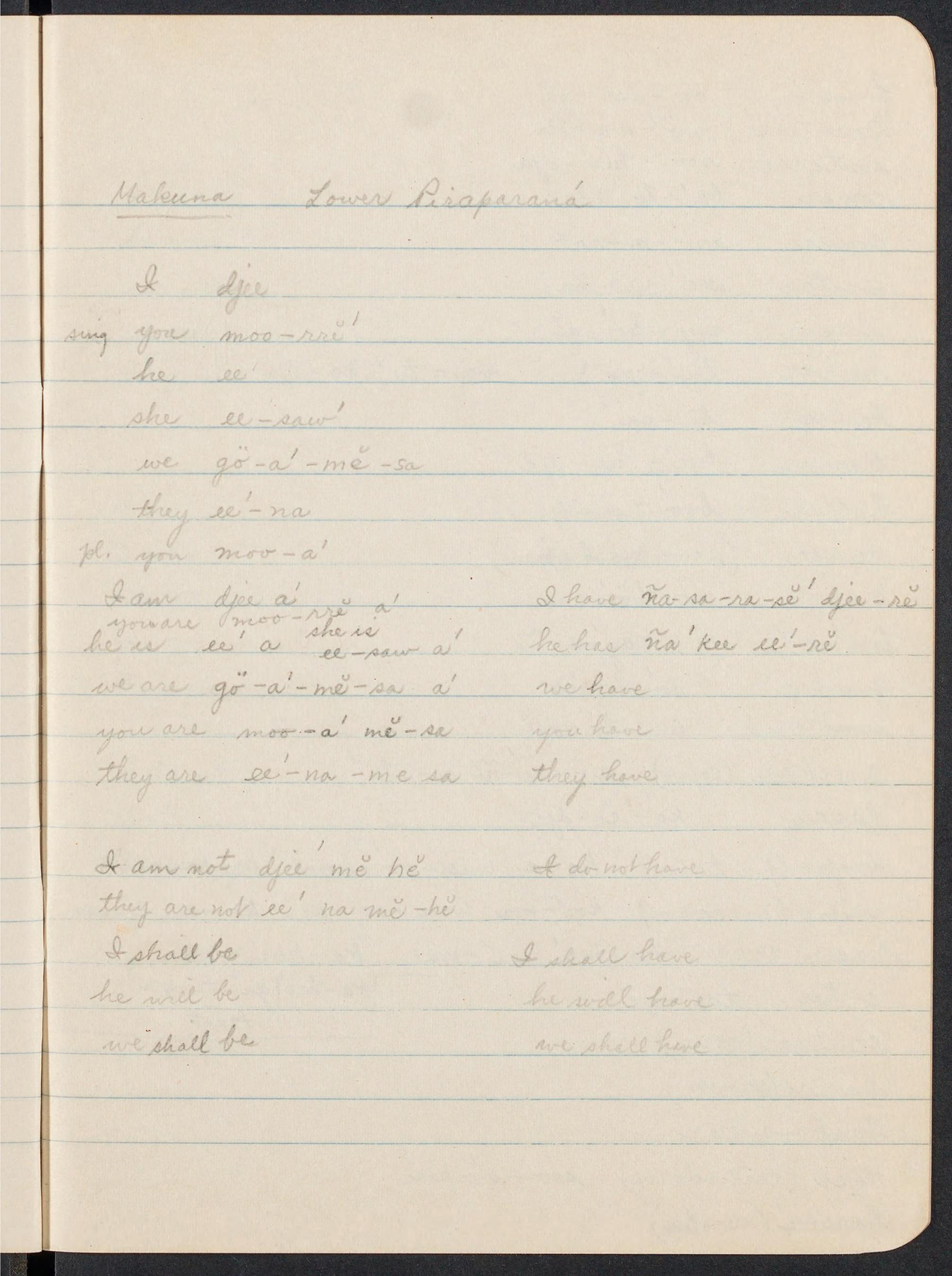
page from a handwritten notebook

Common phrases. Schultes, Richard Evans. Field notebook : Colombia, 1952 February-March. Contributed in BHL from Harvard University Botany Libraries.

Schultes’s maps, lists, and recipes are a trove of information about difficult to access areas.
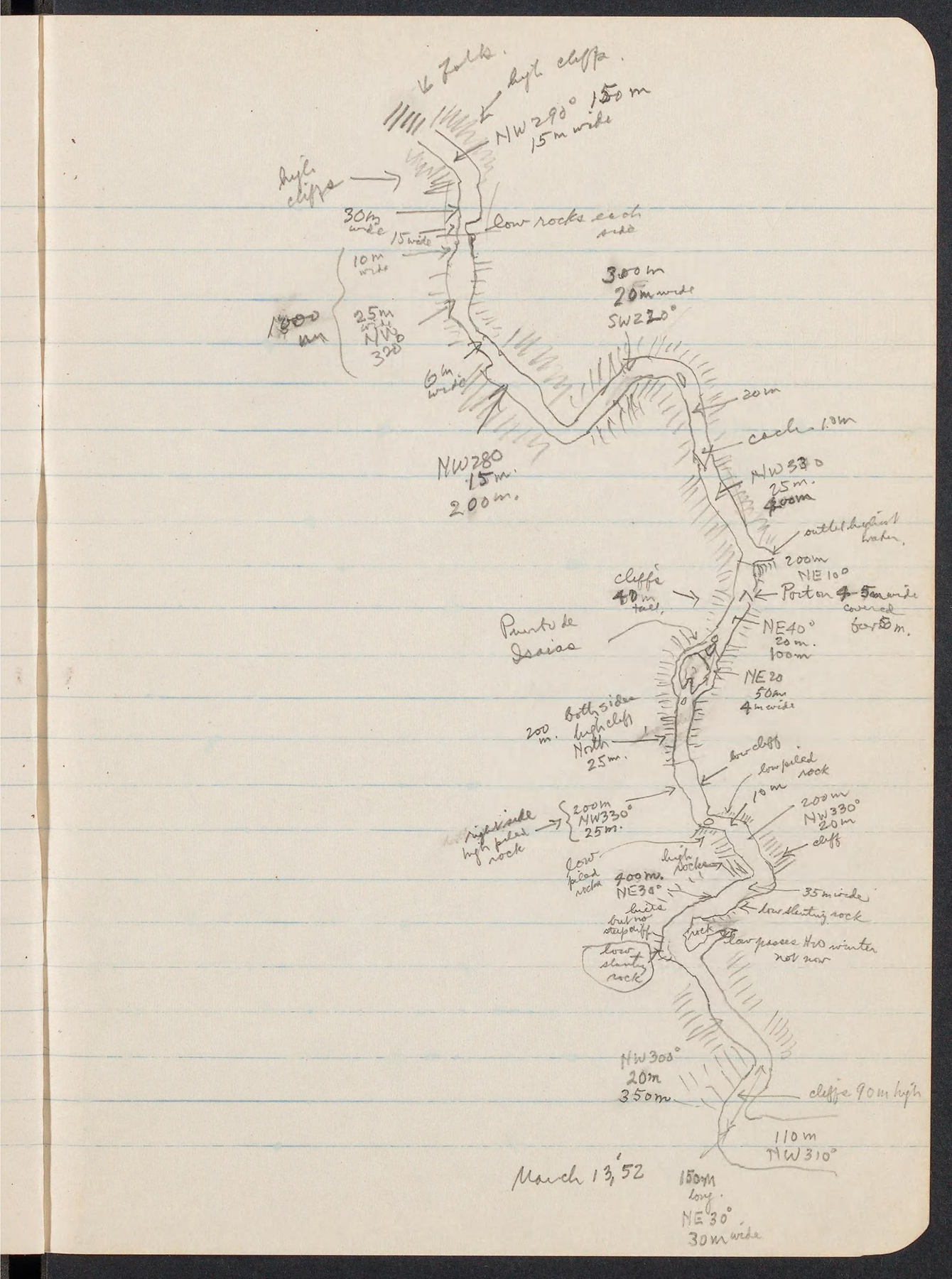
page from a handwritten notebook

Detailed river map. Schultes, Richard Evans. Field notebook : Colombia, 1952 February-March. Contributed in BHL from Harvard University Botany Libraries.
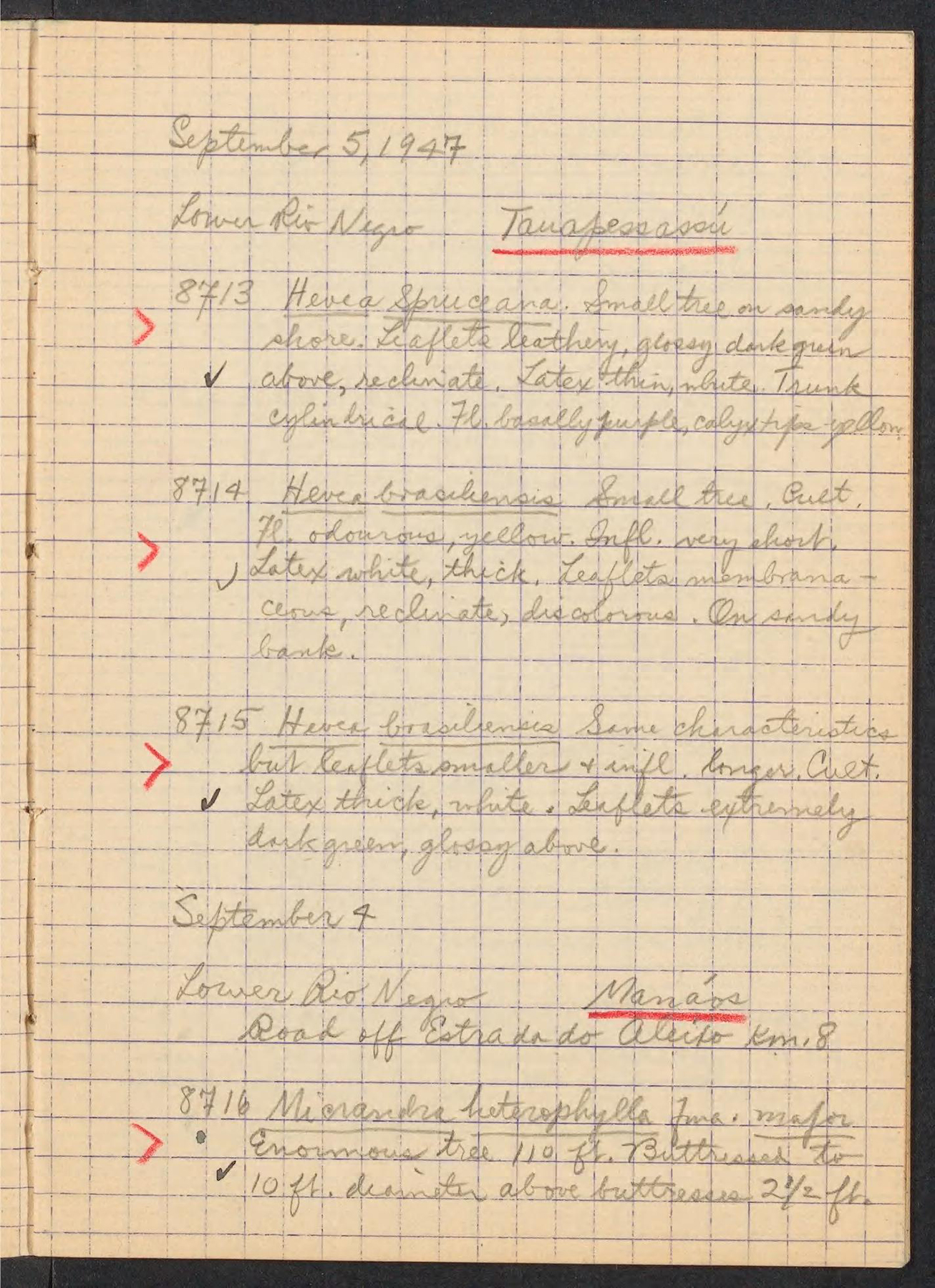
page from a handwritten notebook

Plant list. Schultes, Richard Evans. Field notebook : Rio Negro and Rio Vaupés, Amazonas, Brazil, 1947 September-November. Contributed in BHL from Harvard University Botany Libraries.
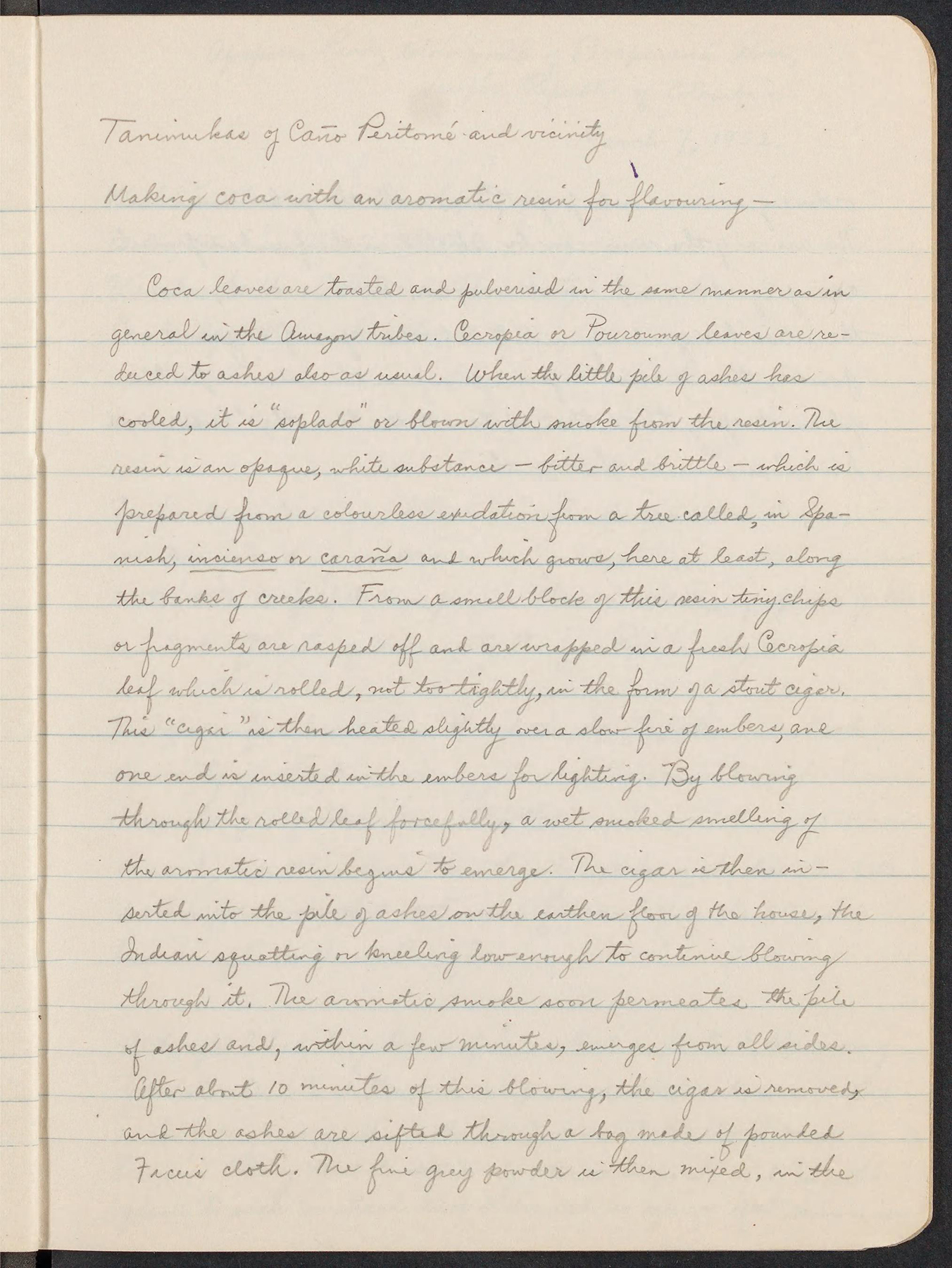
page from a handwritten notebook

Making coca with an aromatic resin for flavouring. Schultes, Richard Evans. Field notebook : Colombia, 1952 February-March. Contributed in BHL from Harvard University Botany Libraries.

Throughout his travels, Schultes documented the local medicinal uses of hundreds of plants.
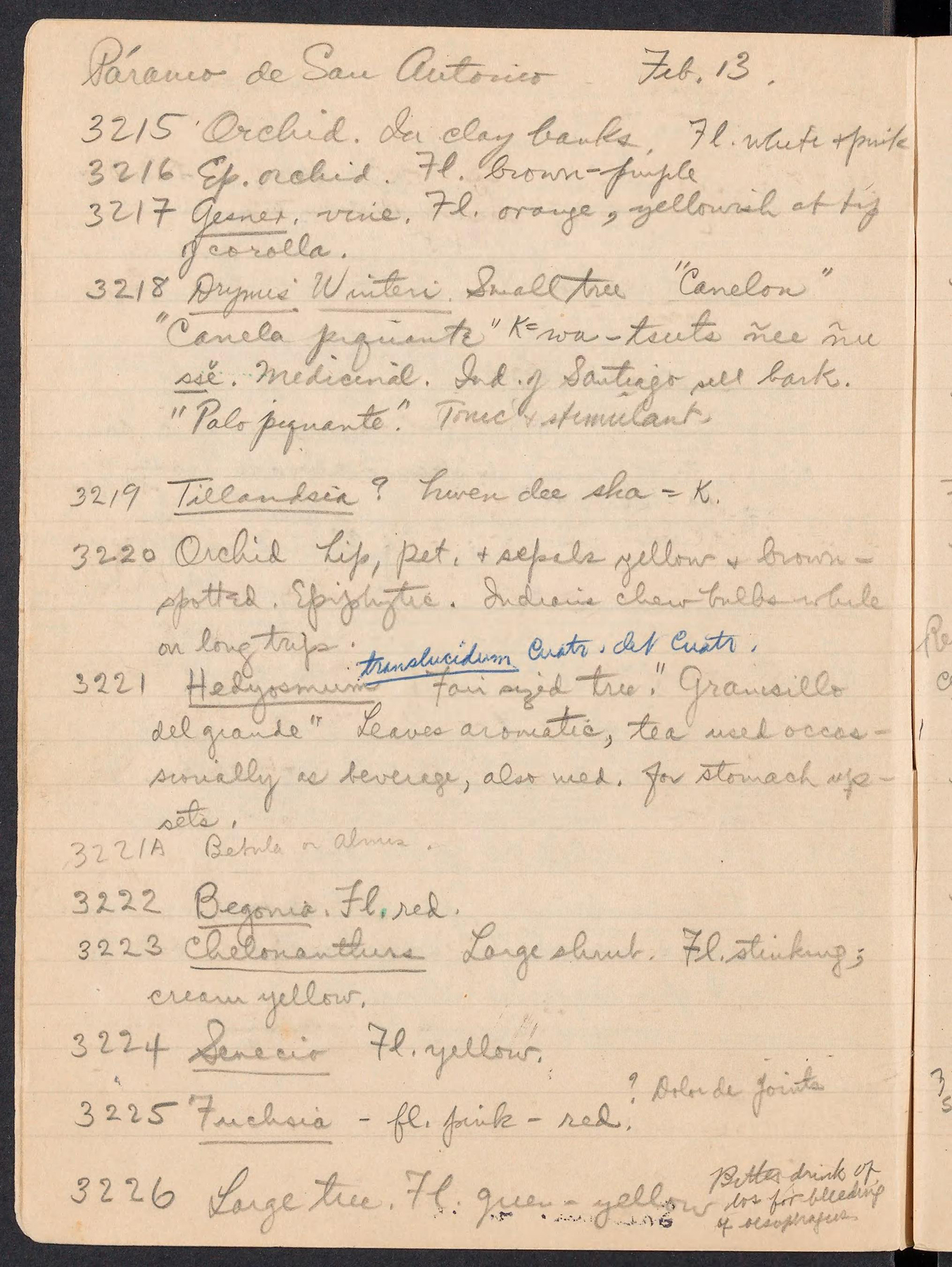
page from a handwritten notebook

Medicinal uses of plants by the Inga and Kamëntsá people of Colombia. Schultes, Richard Evans. Field notebook : Colombia, 1942 February-April. Contributed in BHL from Harvard University Botany Libraries.

Schultes was well known for being respectful of Indigenous communities. He immersed himself in the cultures, eating what was offered and participating in rituals.

“I have tried several of the Indian hallucinogens, in part because the Indians consider them sacred plants and it would have been an unpardonable rudeness to refuse them when the Indians were kind enough to offer them to me during a ceremony” (Schultes, 1994).

Schultes advocated for the conservation of habitat, species, and Indigenous knowledge but he also understood the practical and economic aspects. He encouraged research into the chemistry and uses of plants as pharmaceuticals, recognizing that the vast habitat destruction and cultural loss occurring in the Amazon could delay the development of important medicines. (An overview of the many medicinal uses of plants is central to Schultes’s 1986 paper “The Reason for Ethnobotanical Conservation”.)
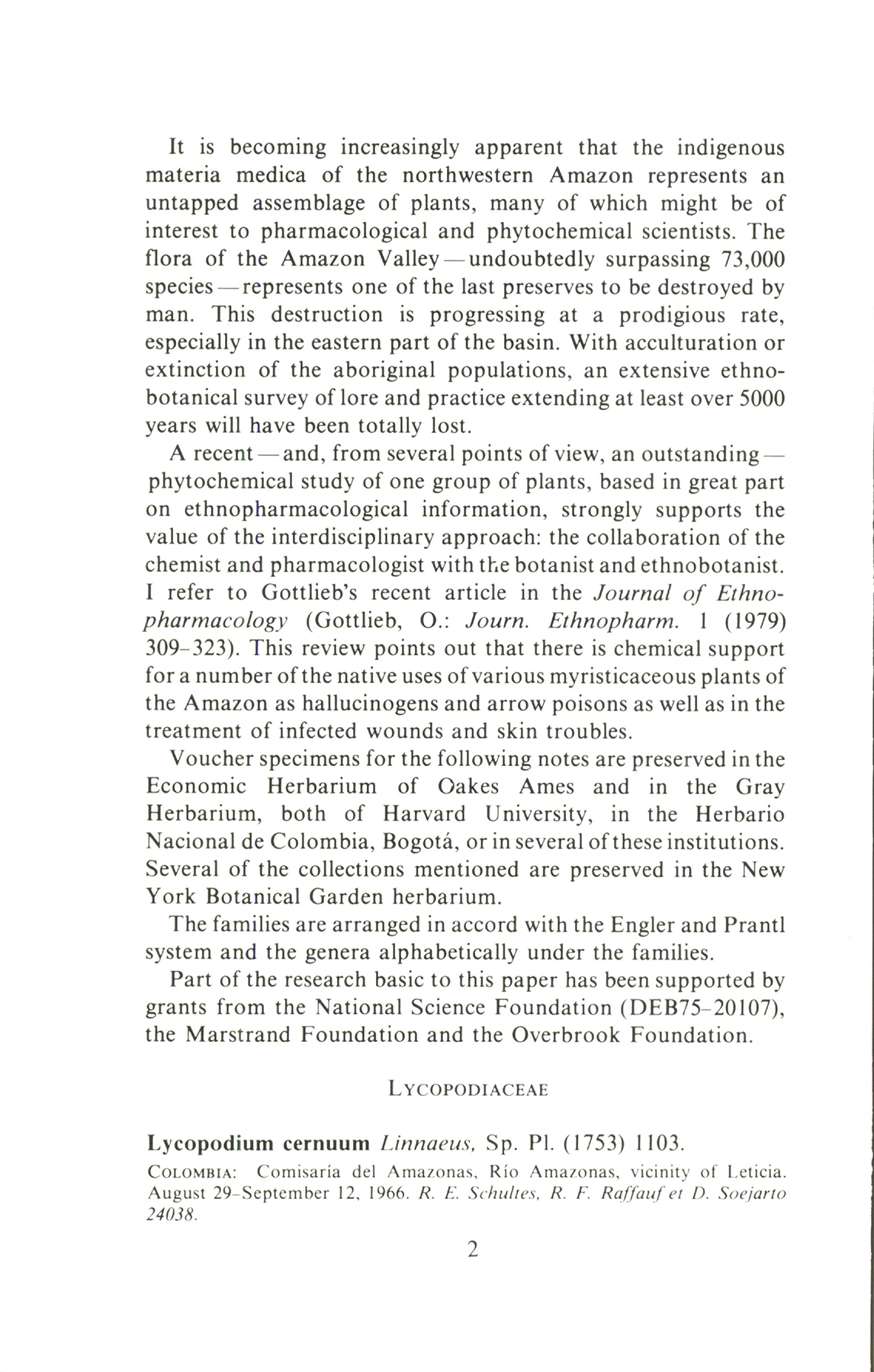
page of printed text

Page 2. Schultes, Richard Evans. “De Plantis Toxicariis E Mundo Novo Tropicale Commentationes XXVI: Ethnopharmacological Notes On The Flora Of Northwestern South America.” Botanical Museum Leaflets, Harvard University. v. 28 (1980), pgs. 1-45. Contributed in BHL from Missouri Botanical Garden with permission from Harvard University Herbaria. CC-BY-NC-SA.

In a 1994 article, he writes:

“…in many regions of the Amazon Basin, native plant and animal species are being destroyed faster than can be recorded, classified and studied…Why not regard the Indians in the Amazon Basin as a kind of phytochemical rapid-assessment team already on the ground, which could help locate the most promising plants for chemical and pharmacological evaluation?…The Indians’ botanical knowledge is disappearing even faster than the plants themselves” (Schultes 1994).

Schultes is regarded as one of the founding fathers of the international conservation movement, having advocated for conservation in developing areas since the 1940s. He mentored many graduate students, infusing them with the same respect and concern for the preservation of natural environments and local knowledge.

Schultes contributed to over 350 publications and served on editorial boards for several scientific periodicals. He also wrote and spoke to lay audiences on many occasions, always emphasizing the need to study and preserve Indigenous botanical knowledge, concluding:

“It is therefore our responsibility – nay, our duty – to put ourselves in the forefront of ethnobotanical conservation. We cannot allow such precious funds of knowledge to become extinct” (Schultes 1988b).

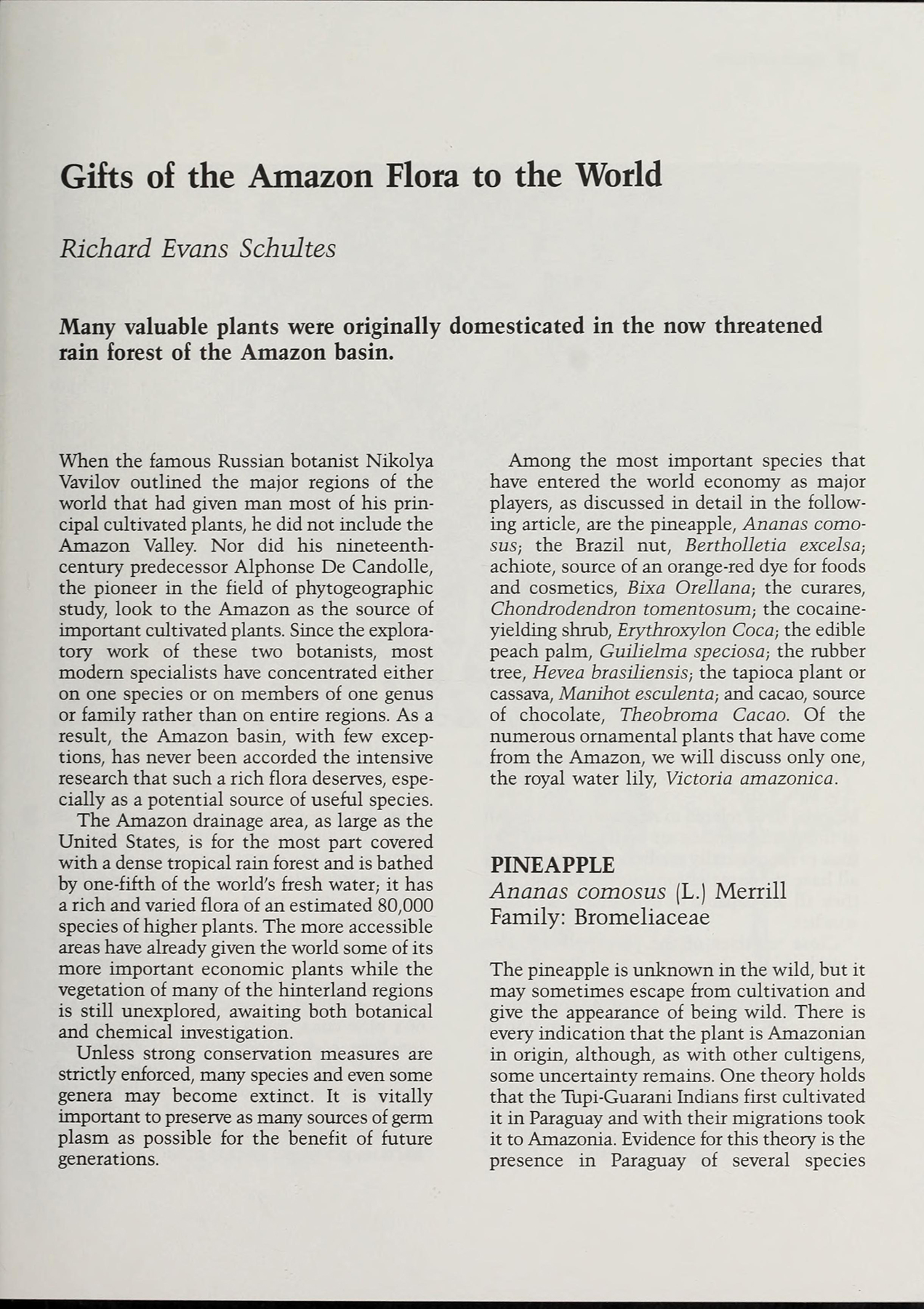
“Unless strong conservation measures are strictly enforced, many species and even some genera may become extinct. It is vitally important to preserve as many sources of germplasm as possible for the benefit of future generations” (Schultes 1990).
page of printed text

Schultes, Richard Evans. “Gifts of the Amazon Flora to the World.” Arnoldia, v. 50(2), pgs. 21-33. Contributed in BHL from Harvard University Botany Libraries with permission from The Arnold Arboretum of Harvard University. CC-BY-NC-SA.

Schultes was the recipient of the Tyler Prize for Environmental Achievement and the World Wildlife Fund Gold Medal in 1984, and the Harvard Medal and the Linnean Medal in 1992. Three genera and over 120 species bear his name. In 1986, the government of Colombia designated a 2.2 million acre protected area as “Sector Schultes” in his honor.

“Richard Evans Schultes, the great 20th century ethnobotanist, was deeply concerned with the fate of the tropical forests of the Earth,” states Felipe Cárdenas-Arroyo. “His work in search of medicinal plants was an important contribution to humanity. But in order for this work to continue, he knew that forests and the Natives who inhabit them need to be protected. Well aware that conserving both would guarantee a healthy planet for all of us, he voiced his concern for the future of the tropical forests and its people” [1].

Additional Information

The Richard Evans Schultes papers, containing Schultes’s field notes, photographs and botanical records, are held by the Botany Libraries in the Harvard University Herbaria.

Contained within the digitized materials in BHL are published articles and papers, field notebooks, lists of collected and identified plants, maps, and photographic materials. The Harvard University Herbaria contains many of the specimens collected by Schultes from North and South America.

For an interactive geospatial exhibit of Schultes’s work in Mexico and the Amazon, see The Amazonian Travels of Richard Evans Schultes.

References

Amazon Conservation Team. The Amazonian Travels of Richard Evans Schultes. https://www.banrepcultural.org/schultes/

Kahn, E. J. “Jungle Botanist [Richard Evans Schultes]”. The New Yorker. v. 68: pp. 35-58. 1992.

Sequeira, Luis. “Richard Evans Schultes : January 12, 1915-April 10, 2001”. National Academy of Sciences (U.S.). Biographical Memoirs ; v. 88. Washington, D.C.: National Academy Press, 2006.

Schultes, Richard. “Burning the Library of Amazonia.” Sciences 34, no. 2, pp. 24. 1994.

Schultes, Richard Evans. “Ethnopharmacological Conservation: A Key to Progress in Medicine.” Acta Amazonica, vol. 18, no. suppl. 1-2, pp. 393–406. 1988a.

Schultes, Richard Evans. “Gifts of the Amazon Flora to the World”. Arnoldia, vol. 50, no. 2, pp. 21-33. 1990.

Schultes, Richard Evans. “Primitive Plant Lore & Modern Conservation”. Orion Nature Quarterly ; v. 7, No. 3, Summer 1988. New York, NY: Myrin Institute, 1988b.

Schultes, Richard Evans. The Reason for Ethnobotanical Conservation. Bulletin of the Botanical Survey of India, v. 28, no.1-4, 1986, pp. 203-224. Calcutta, India: Director, Botanical Survey of India, 1986.

Tyler Prize for Environmental Achievement. https://tylerprize.org/laureates/past-laureates/1987-tyler-laureates/

[1] Cárdenas-Arroyo, Felipe. January and February 2020. Email exchange with Diane Rielinger.
August 11, 2020by michelle.underhill
Blog Reel, User Stories

Uncovering Mycological History…One Sketch at a Time

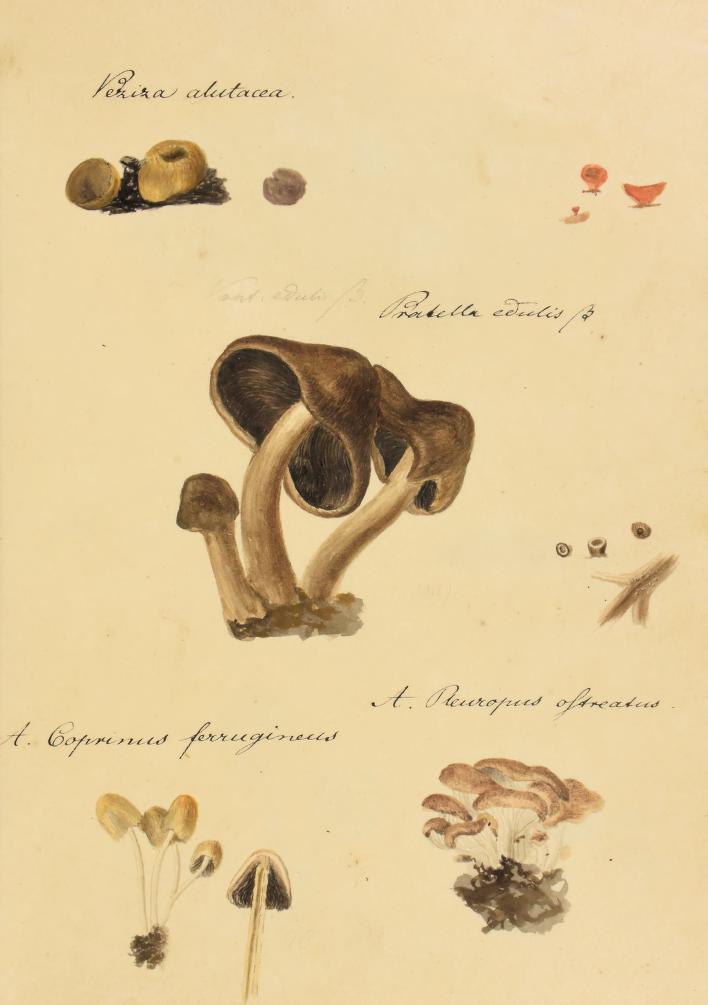
illustration of fungi

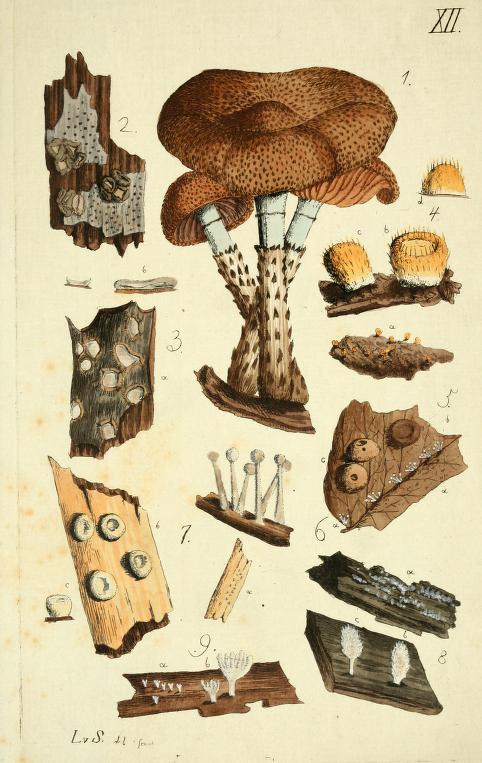
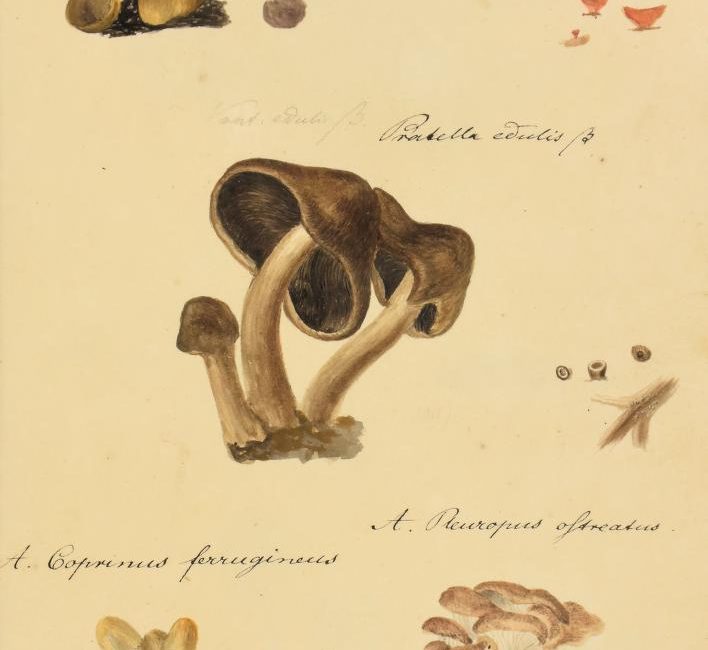
Plate 12. Schweinitz, Lewis David von. Icones fungorum Niskiensium. (ca.) 1798-1802. Contributed in BHL from Botany Libraries, Farlow Reference Library of Cryptogamic Botany, Harvard University.

In the archives of the Farlow Reference Library of Cryptogamic Botany at Harvard University, there is a curious volume of 249 original watercolors of fungi species bearing the title Icones fungorum Niskiensium.

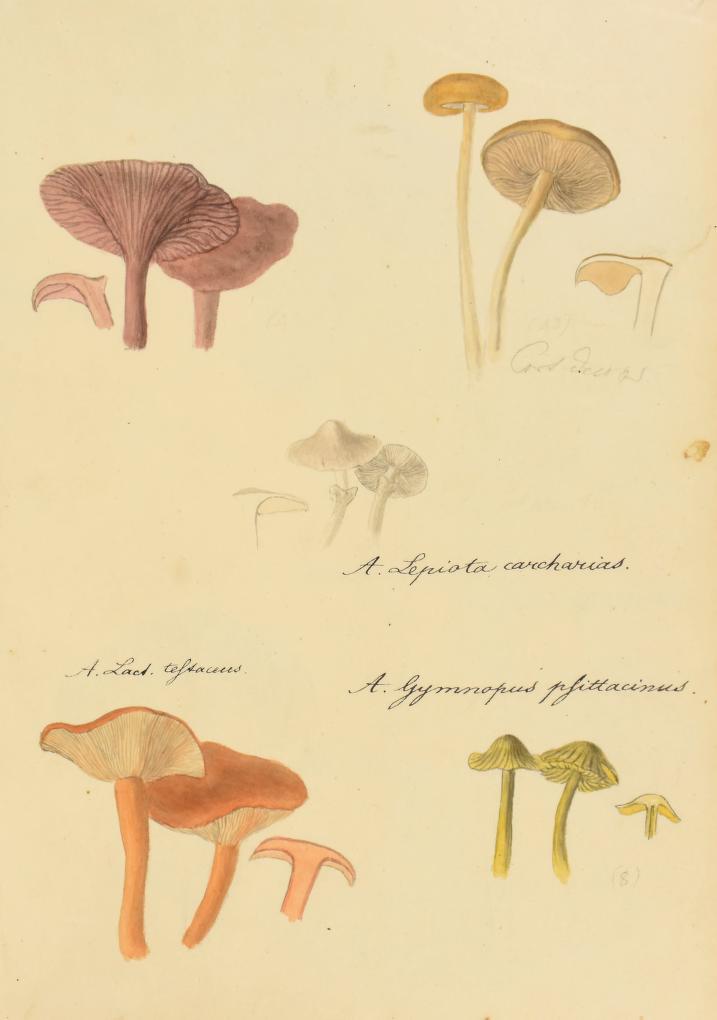
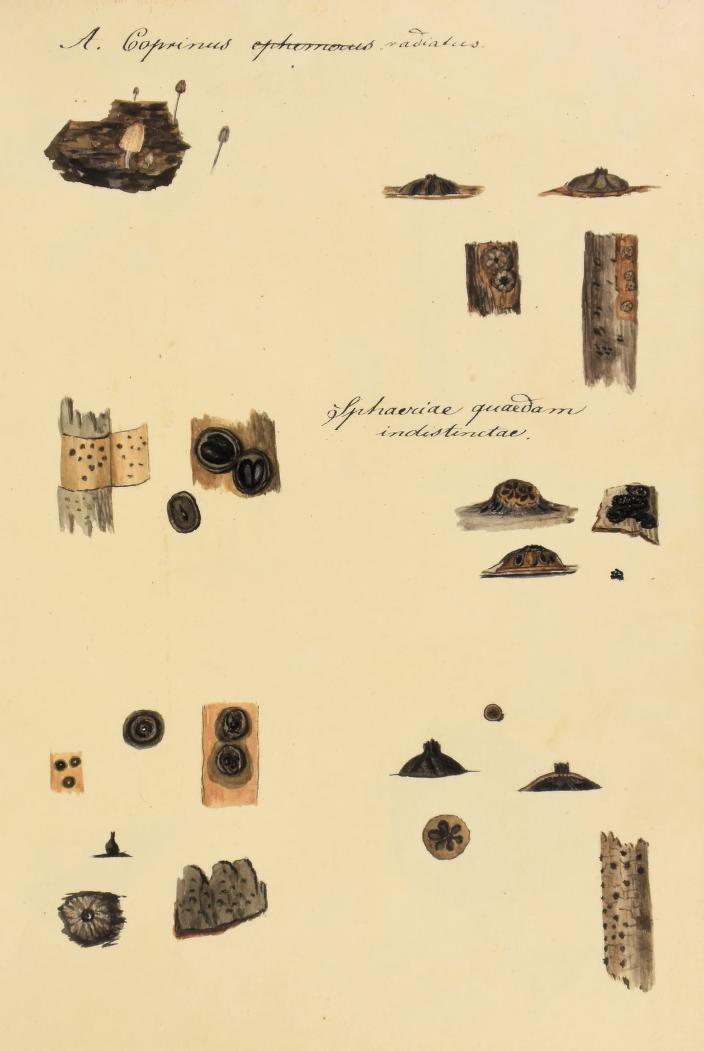
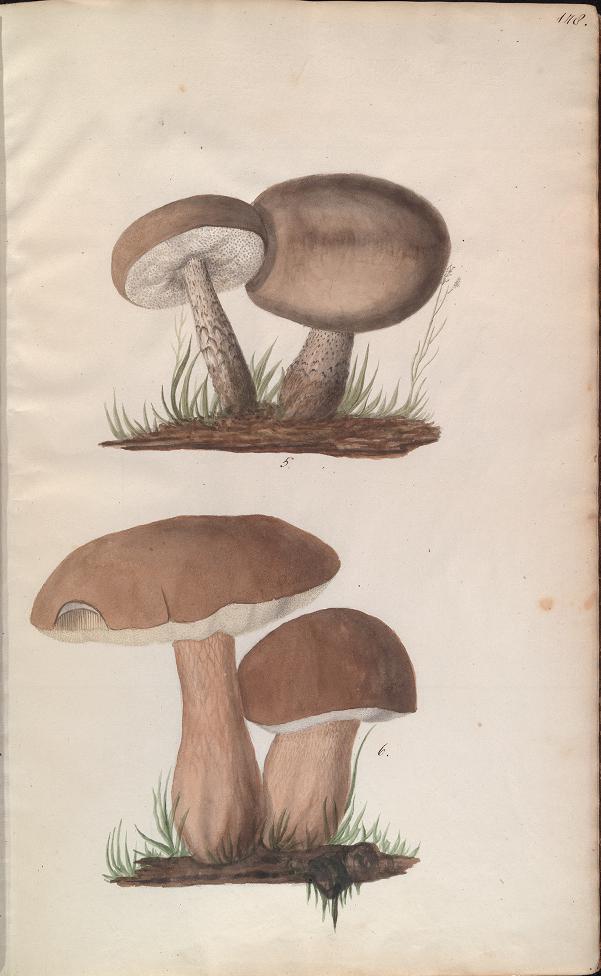
Devoid of any creator identification, the provenance and historical significance of the volume seems shrouded in mystery. A cursory examination of the work reveals a collection of charming, but often incomplete, figures and a myriad of annotations in pencil and ink, some struck through, others revealing uncertainty over species identifications or recording observations on specimen quality or coloration.

illustration of fungi

Plate 47. Schweinitz, Lewis David von. Icones fungorum Niskiensium. (ca.) 1798-1802. Contributed in BHL from Botany Libraries, Farlow Reference Library of Cryptogamic Botany, Harvard University.

In short, there is little to suggest that this sketchbook is actually an important document in the history of mycological research.

The truth, however, is that this volume is the work of the “Father of North American mycology”, Lewis David von Schweinitz (1780-1834). It served him as a sketchbook that was used to inform his monumental Conspectus fungorum in Lusatiae Superioris agro Niskiensi crescentium, e methodo Persooniana (1805), co-authored with Johannes Baptista von Albertini (1769-1831) and documenting over 1,000 species of fungi from the Niesky, Germany region, including 100 published as new-to-science. The volume is also related to a collection of six other original watercolor volumes by Schweinitz dispersed throughout several American institutions.

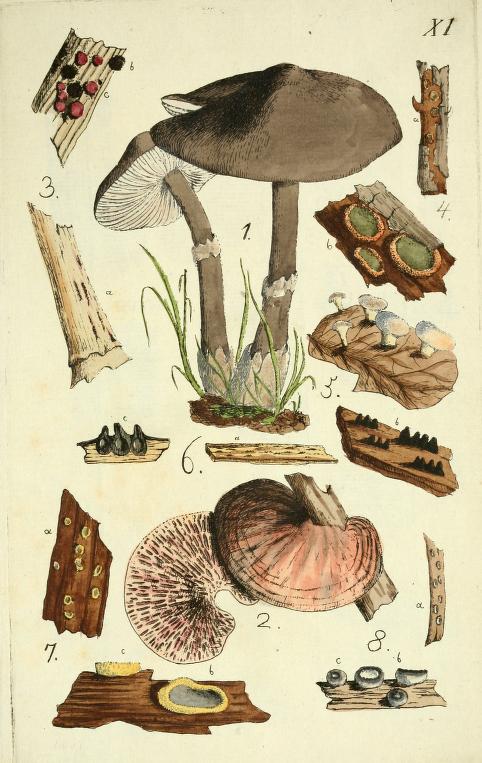
Illustration of fungi

Plate 11. Conspectus fungorum in Lusatiae Superioris agro Niskiensi crescentium, e methodo Persooniana(1805). Figures based on drawings by Schweinitz. Icones fungorum Niskiensium served as a sketchbook to inform this work. Contributed to BHL by the LuEsther T. Mertz Library of The New York Botanical Garden.

The history of this volume, dubbed the Harvard Icones, and its relationship to the Conspectus and Schweinitz’s other watercolor volumes, was recently examined in-depth within the article “New Light on the Mycological Work of Lewis David von Schweinitz” (2018) by Jason M. Karakehian, William R. Burk and Donald H. Pfister, published in IMA Fungus: 9(1). The article presents research made possible in-part thanks to the digital copies of the Harvard Icones and Schweinitz’s other works available in the Biodiversity Heritage Library.

We recently explored this fascinating history in our Book of the Month series. The findings presented by Karakehian et al. underscore the importance of the Harvard Icones to the development of Schweinitz and Albertini’s research and the progression of mycology in the early 19th century.

“Our research is important because the volumes of watercolor illustrations produced by Schweinitz have been little known to mycologists who worked with fungi described by Albertini and Schweinitz,” explains Karakehian. “These high-quality illustrations can help to inform our concepts of some of these species, as often times early nineteenth century verbal descriptions can be short and somewhat vague.”

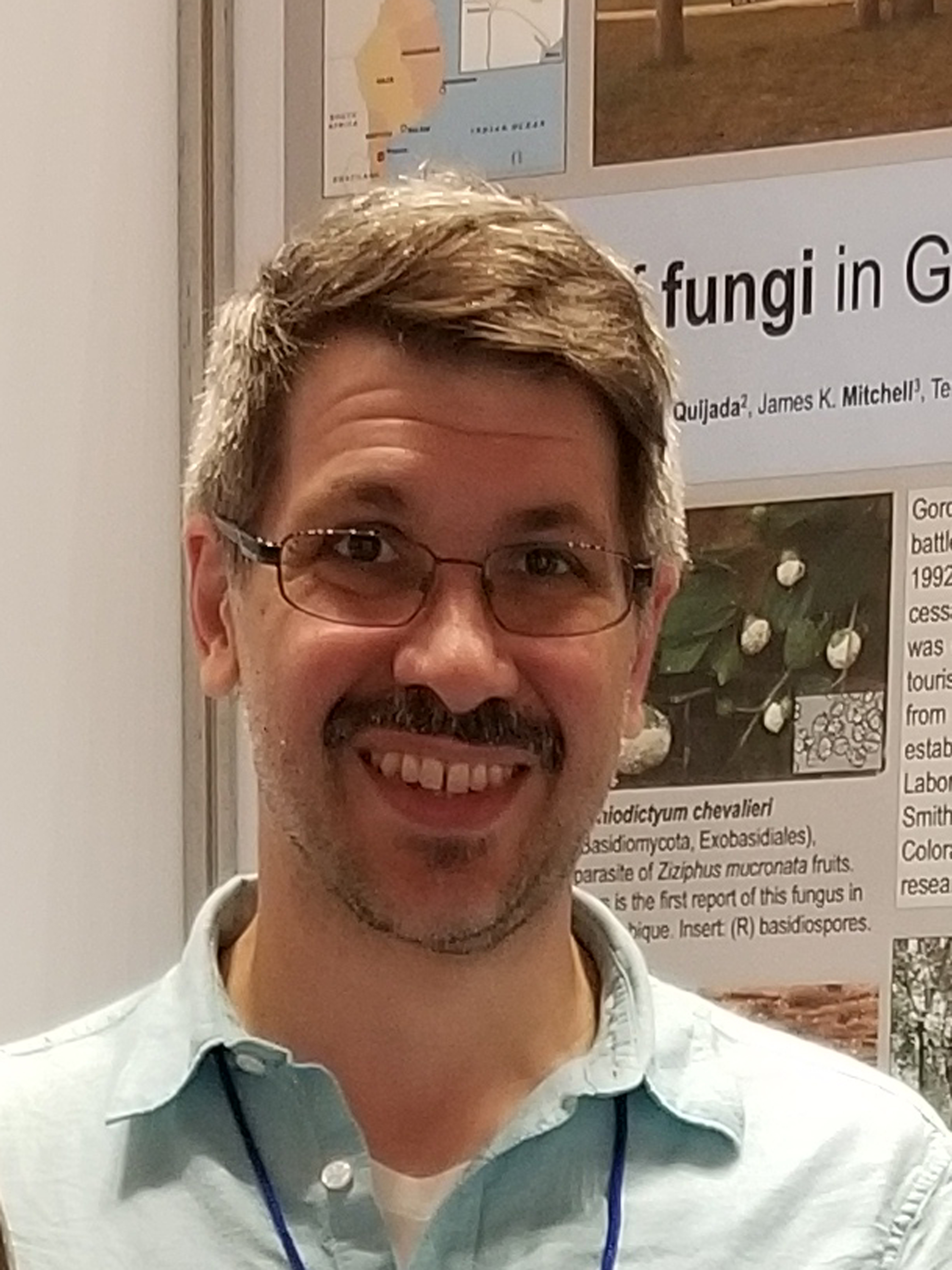
photo of a man in glasses and blue shirt

Jason M. Karakehian. Master’s degree candidate at the Harvard Extension School.

Jason M. Karakehian is a Master’s degree candidate at the Harvard Extension School, studying biology with a focus on mycology and the systematics of ascomycetes or “cup-fungi.” With a background in the visual arts, Karakehian’s interest in mycology stems from his career as an artist, when he began perusing illustrated books on fungi as a creative reference point for his large, outdoor sculptures exhibited in wooded environments. This inspired him to take a short class on fungi, join a local mycological club, and begin collecting and identifying mushrooms. Eventually, he gave up his art career and embraced mycology full-time.

Karakehian’s journey down the fungi path includes serving as the archivist for the Boston Mycological Club. The task of organizing the mass of artifacts and documents held by the archives necessitated research at other libraries and archives, such as the Reference Library of the Farlow Herbarium of Cryptogamic Botany at Harvard University. He was welcomed by the Herbarium and Library staff, including Professor Donald Pfister and Judy Warnement (Head Librarian of the Harvard Botany Libraries).

Karakehian’s work at the Boston Mycological Club and the relationships he developed as part of that process led to research on other topics in mycological history, especially Schweinitz’s fungi watercolors.

The Biodiversity Heritage Library played an essential role in that research.

“I don’t think that we could have done this work without regular access to BHL,” affirms Karakehian. “BHL is invaluable to us for the wide selection of classic mycological literature that we needed to reference in our research.”

illustration of fungi

Plate 23. Schweinitz, Lewis David von. Icones fungorum Niskiensium. (ca.) 1798-1802. Contributed in BHL from Botany Libraries, Farlow Reference Library of Cryptogamic Botany, Harvard University.

That research involved indexing the more than 1,000 species treated in the Conspectus and cross-referencing them to the species figured in Schweinitz’s watercolor volumes in order to examine the relationship between the works and understand how the archival materials informed Schweinitz’s research.

This work required regular access to Schweinitz’s Conspectus and other classic mycological publications, including Christiaan Hendrik Persoon’s Synopsis methodica fungorum (1801), which outlines a systematic framework for fungi that was employed by Schweinitz and Albertini.

“For both of these volumes, we had to go through them page by page to populate spreadsheets with data that we could then collate to make inferences about the relationship between them,” explains Karakehian. “This was greatly facilitated by having high-quality electronic versions of the volumes with OCR.”

Karakehian and his colleagues also created an index to the figures in the Harvard Icones, cross-referencing them to their treatment in the Conspectus, Persoon’s Synopsis, and Schweinitz’s six other watercolor volumes. This index was published as part of their IMA Fungus article.

illustration of fungi

Plate 41. Schweinitz, Lewis David von. Icones fungorum Niskiensium. (ca.) 1798-1802. Contributed in BHL from Botany Libraries, Farlow Reference Library of Cryptogamic Botany, Harvard University.

For Karakehian, BHL’s impact is about more than just providing online access to materials. It’s the quality of the available materials that really distinguishes BHL from other online repositories.

“BHL volumes are high-quality digitizations and I am never frustrated by missing pages, cut-off words, or poor-quality digitizations of delicate line drawings in figures,” lauds Karakehian. “I often think of BHL in contrast to Google’s digitization project that is easily searchable, but the digitizations are of such poor quality that one often needs to track down the original volume somehow to understand the print or the figure that you need.”

Karakehian and his colleagues were instrumental in advocating for Schweinitz’s archival materials to be made available online and for free to the public through BHL. This not only facilitates future research on these works, but also allows more people to explore and enjoy these archives and the history they represent.

“For us, BHL is the gold standard, and for our papers on Schweinitz’s watercolor illustrations, it was important to request that the archives holding these volumes digitize them and have them available in BHL to the public,” asserts Karakehian. “We were absolutely confident that the product would be usable and high-quality. It is a true gift that they are now freely available to users.”

illustration of fungi

Plate 13. Schweinitz, Lewis David von. Icones fungorum Niskiensium. (ca.) 1798-1802. Contributed in BHL from Botany Libraries, Farlow Reference Library of Cryptogamic Botany, Harvard University.

We are honored to host a digital copy of the Harvard Icones in BHL, and are grateful to the Botany Libraries, Farlow Reference Library of Cryptogamic Botany, Harvard University for digitizing the volume and making it freely available to the world. We’re also thrilled that Schweinitz’s other archival materials and the Conspectus are freely available in the collection, and extend our sincere thanks to the Library & Archives of the Academy of Natural Sciences of Drexel University, the Wilson Library of the University of North Carolina at Chapel Hill, and the LuEsther T. Mertz Library of The New York Botanical Garden for digitizing these works.

Thanks to these contributions from so many libraries, BHL was able to play a vital role in allowing Karakehian and his colleagues to provide new insight into the contributions of such an important figure in the history of mycology.

“Our work broadens our knowledge of the scientist and artist that Schweinitz was,” affirms Karakehian. “He was an accomplished and prolific mycological illustrator with a keen sense of depicting his subjects in ways that would convey the maximum of biologic information as well as capturing their natural beauty.”

That “natural beauty” is now freely available for everyone to enjoy through the Biodiversity Heritage Library.

November 8, 2018by michelle.underhill
Blog Reel, Featured Books

Unearthing Scientific History through Art: New Insights from the Archives of Lewis David von Schweinitz, the “Father of North American Mycology”

illustration of fungi

The information in this post is derived from the article “New Light on the Mycological Work of Lewis David von Schweinitz” (2018) by Jason M. Karakehian, William R. Burk and Donald H. Pfister, published in IMA Fungus: 9(1).

fungi illustration

Plate 12. Conspectus fungorum in Lusatiae Superioris agro Niskiensi crescentium, e methodo Persooniana (1805). Figures based on drawings by Schweinitz. Icones fungorum Niskiensium served as a sketchbook to inform this work. Contributed to BHL by the LuEsther T. Mertz Library of The New York Botanical Garden.

In 1805, the “Father of North American mycology”, Lewis David von Schweinitz (1780-1834), published an account of the fungi in Niesky, Germany with his friend and mentor, Johannes Baptista von Albertini (1769-1831). Documenting over 1,000 species, including 100 published as new-to-science, Conspectus fungorum in Lusatiae Superioris agro Niskiensi crescentium, e methodo Persooniana is still referenced to this day as a classic mycological text and ecological record.

The Conspectus is illustrated with 12 hand-colored plates based on drawings by Schweinitz, each featuring 6-10 figures of new species described. Whenever possible, Schweinitz based his drawings on fresh specimens, but when this was not an option, he referred to fungarium specimens or to a collection of earlier watercolors he’d created of representative specimens.

fungi illustrations

Plate 178. Fungorum Nieskiensium Icones. (ca.) 1802-1805. v. 3. Contributed in BHL from the Academy of Natural Sciences of Drexel University, Library & Archives.

Today, these watercolor volumes are dispersed between several American institutions and offer a wealth of insight into the history and development of the Conspectus. A five-volume set created (ca.) 1802-1805 and bearing the title Fungorum Nieskiensium Icones is distributed between the Archives of the Academy of Natural Sciences of Drexel University, Philadelphia (volumes 1-3 and 5) and the Rare Book Collection, Wilson Library, University of North Carolina, Chapel Hill (volume 4). Nearly every specimen featured in the Conspectus has a corresponding illustration in these 5-volumes.

A volume of original watercolors consisting of copies of figures from the 5-volume set, bearing the title Icones Fungorum and created (ca.) 1818-1826, is held by the Herbarium Library, University of Michigan, Ann Arbor, MI.

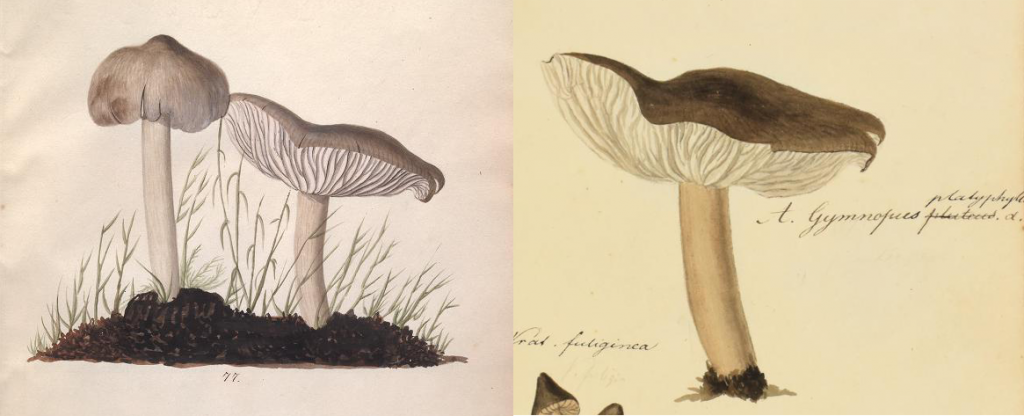
The earliest volume of original watercolors related to the Conspectus, however, is the Icones Fungorum Niskiensium, created (ca.) 1798-1802 and held in the archives of the Farlow Reference Library of Cryptogamic Botany at Harvard University. This volume (hereafter referred to as the Harvard Icones) served Schweinitz as a sketchbook of sorts, which he used to inform the final paintings in the 5-volume Fungorum Nieskiensium Icones and eventually the Conspectus itself.

fungi illustrations

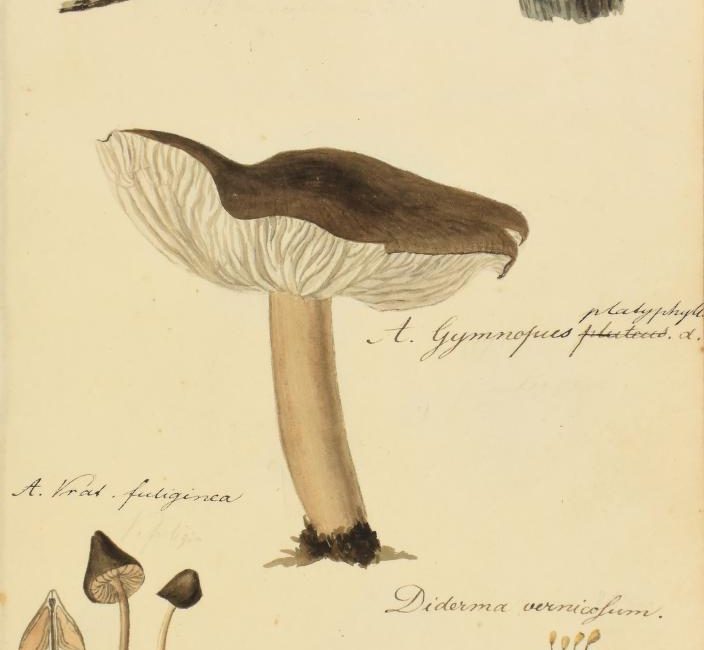
Agaricus (Gymnopus) platyphyllus. Illustration from Fungorum Nieskiensium Icones v. 2, pl. 113, fig. 77 (left) and corresponding illustration in Icones Fungorum Niskiensium, pl. 23 (right). Contributed in BHL from the Library & Archives of the Academy of Natural Sciences of Drexel University and Botany Libraries, Farlow Reference Library of Cryptogamic Botany, Harvard University.

The Harvard Icones has been digitized in the Biodiversity Heritage Library thanks to the Botany Libraries, Farlow Reference Library of Cryptogamic Botany, Harvard University, while the 5-volume set is available in BHL thanks to the Library & Archives of the Academy of Natural Sciences of Drexel University and the Wilson Library of the University of North Carolina at Chapel Hill. The Conspectus has been digitized in BHL by the LuEsther T. Mertz Library of The New York Botanical Garden.

The history of these watercolor volumes and their relationship to the Conspectus was recently examined in-depth within the article “New Light on the Mycological Work of Lewis David von Schweinitz” (2018) by Jason M. Karakehian, William R. Burk and Donald H. Pfister, published in IMA Fungus: 9(1). The article presents research made possible in-part thanks to the digital copies available in BHL.

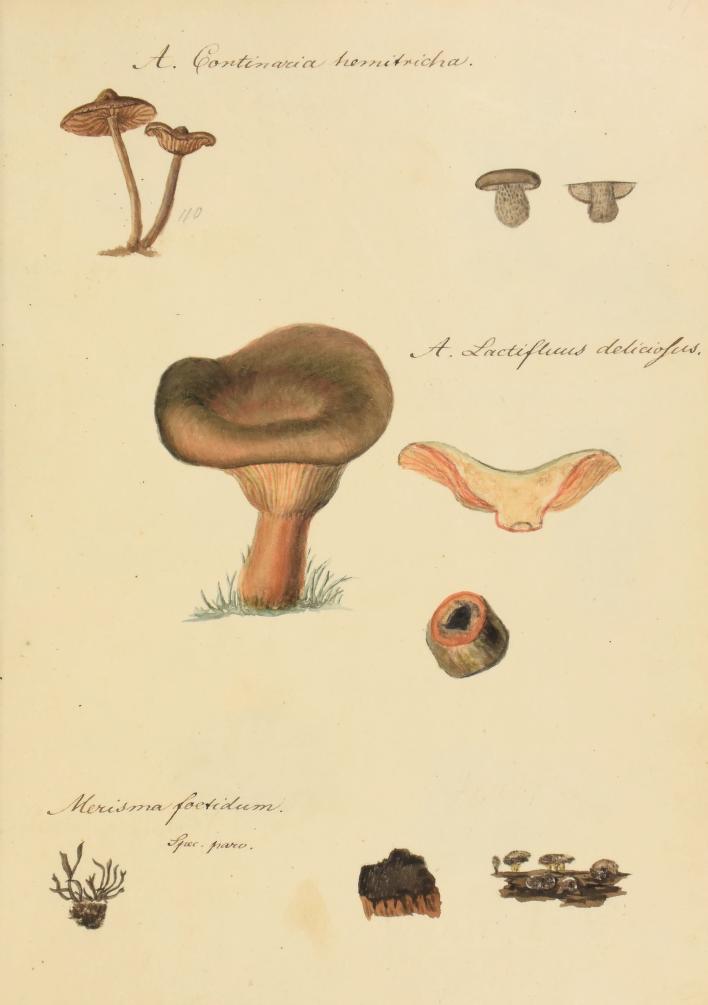
As a sketchbook, the Harvard Icones provides a unique window into the development of Schweinitz’s research on the fungal species presented in the Conspectus. The 249 watercolor figures in the the Harvard Icones depict specimens he collected and painted during his time attending a Moravian seminary in Niesky. Most figures are labeled with a binomial in ink, although edits and annotations to the names throughout the work, as well as notes on the quality of the illustrated specimen, varieties, and colorations, illustrate the working-manuscript nature of the volume.

fungi illustration

Plate 17. Merisma foetidum specimen labeled as “spec. parv.” [meager specimen]. Schweinitz, Lewis David von. Icones fungorum Niskiensium. (ca.) 1798-1802. Contributed in BHL from Botany Libraries, Farlow Reference Library of Cryptogamic Botany, Harvard University.

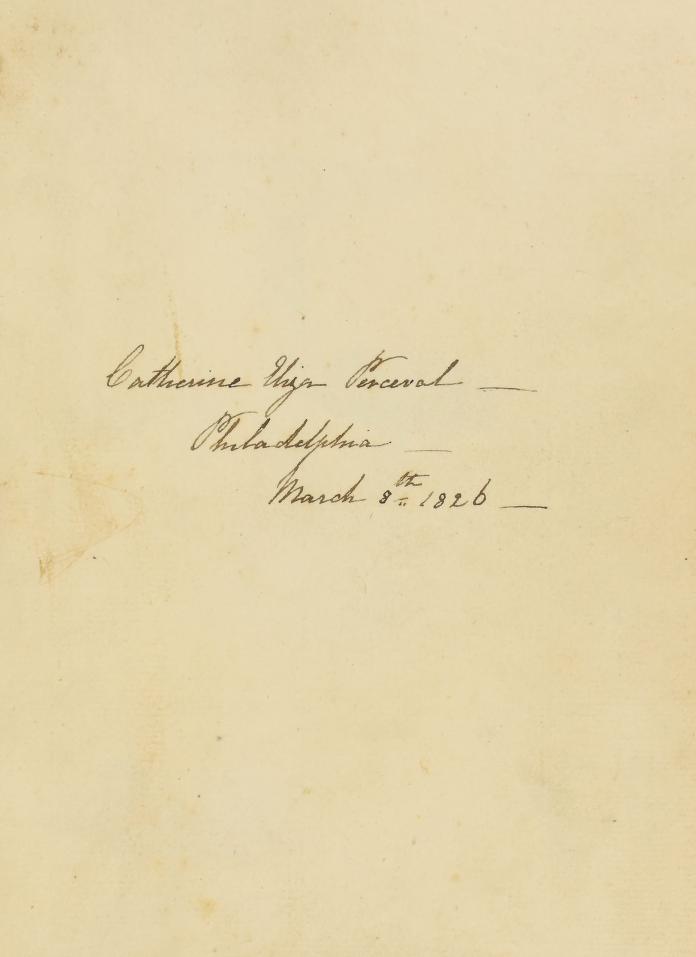
As outlined in the IMA Fungus article, the Harvard Icones has a rather convoluted history. A clue to that history can be found in the single fly-leaf bound within the volume and featuring the hand-written inscription on the recto: “Catherine Eliza Perceval — Philadelphia — March 8th 1826 —”.

fly-leaf

Fly-leaf featuring inscription for “Catherine Eliza Perceval”. Schweinitz, Lewis David von. Icones fungorum Niskiensium. (ca.) 1798-1802. Contributed in BHL from Botany Libraries, Farlow Reference Library of Cryptogamic Botany, Harvard University.

Born in Quebec in 1811, Catherine Perceval was the daughter of Anne Mary Perceval and Michael Henry Perceval. Anne had an interest in botany fueled by her association with other local female botanists, Christian Ramsay, the Countess of Dalhousie, and Harriet Campbell Sheppard. The group actively botanized together, and Anne is listed as a collector in several important botanical works of the era, including Hooker’s Flora boreali-americana ([1829]-1840) and Torrey and Gray’s A Flora of North America (1838-43).

The Harvard Icones passed into the Perceval family’s possession during a meeting in 1826 between Anne and William Darlington, a correspondent of Anne’s, at their mutual friend J. Daniel Steinhauer’s residence in Philadelphia. Schweinitz described Steinhauer as an “excellent friend…[and]…botanist”. As detailed in the IMA Fungus article, Schweinitz and Daniel Steinhauer were likely introduced by Daniel’s brother, Henry Steinhauer, who was also a friend of Schweinitz’s from his time at the Moravian seminary in Germany.

Henry had attempted to have copies made of the figures in Schweinitz’s 5-volume watercolor set, and towards this end, Schweinitz had given Henry his “Icones Fungorum Niesk’m” shortly prior to January 1818. The watercolor volume held in the Michigan Herbarium Library is the result of these endeavors. Karakehian et al. postulate that as part of this exchange the Harvard Icones may have ended up in Henry’s possession and passed to Daniel Steinhauer upon Henry’s death, after which it was passed along to Anne or directly to her daughter, Catherine (whose name is found in the Icones inscription).

fungi illustration

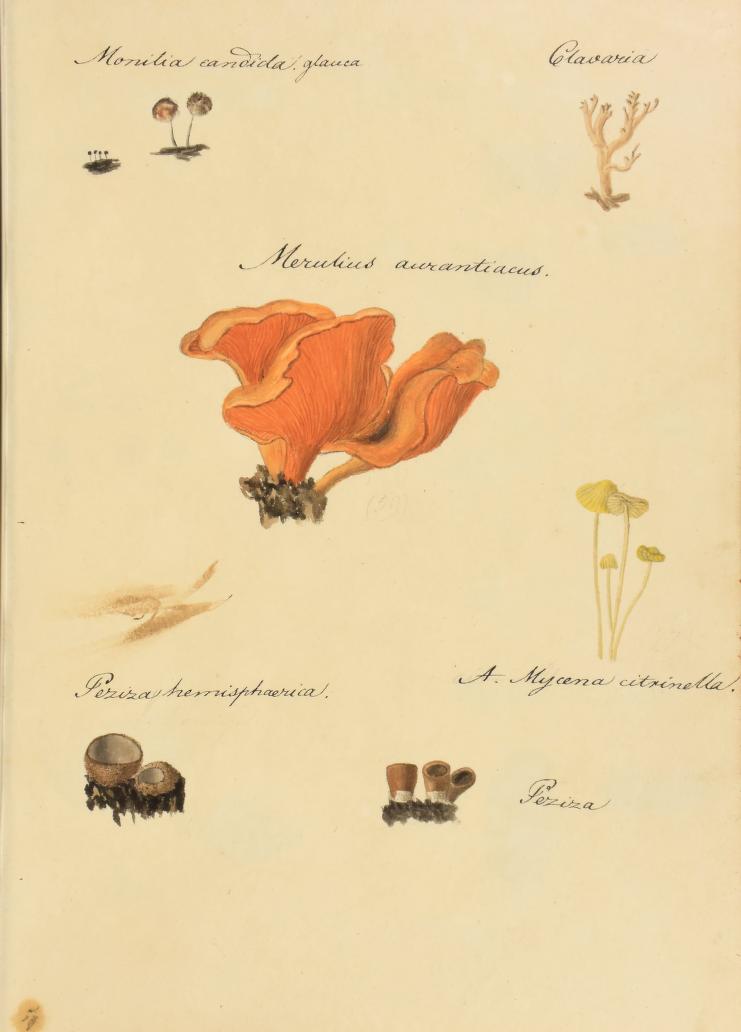
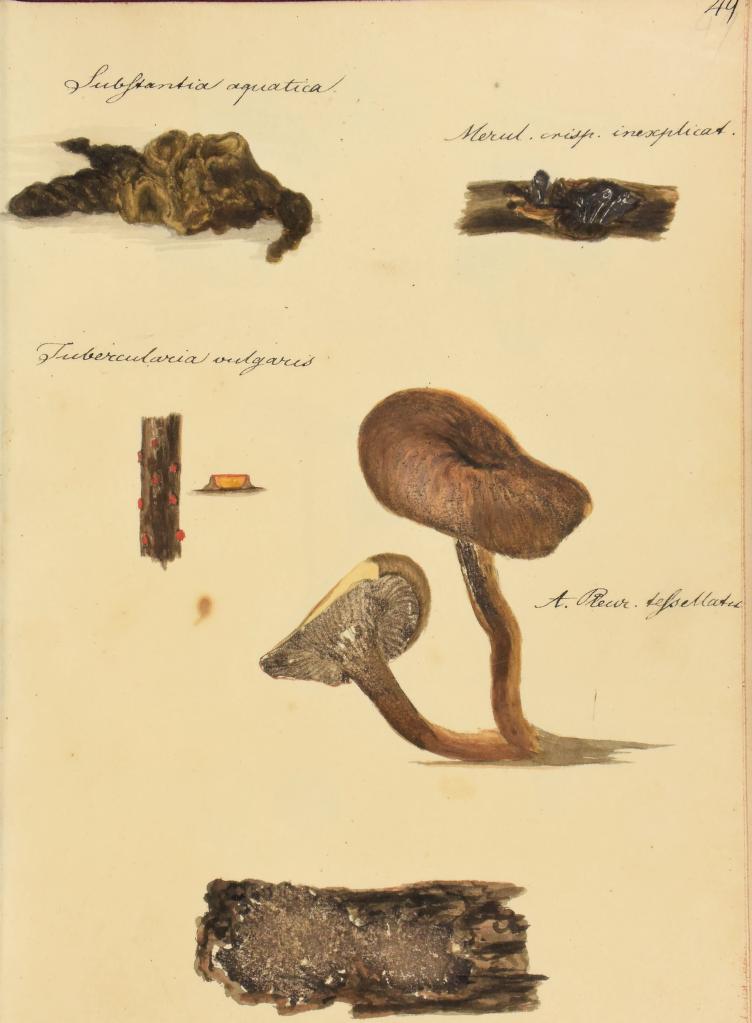
Plate 49. Merulius crispus labeled as “inexplicat[us]”, reflecting doubt as to whether the specimen was a fungus. Similarly, label of “Substantia aquatica” [watery substance]. Schweinitz, Lewis David von. Icones fungorum Niskiensium. (ca.) 1798-1802. Contributed in BHL from Botany Libraries, Farlow Reference Library of Cryptogamic Botany, Harvard University.

The volume later passed from Catherine to her son Francis Denys and eventually ended up in the possession of antiquarian book dealers and scholars William and Marianne Salloch, after whose death it was sold to a Bungay book dealer at a Christie’s auction in 1991, advertised as “Original American Watercolors” by Catherine Eliza Perceval.

Microbiologist and mycophile Elio Schaechter eventually purchased the volume from the book dealer and showed it to Donald Pfister at the Farlow Herbarium, whose research ultimately allowed him to attribute the work to Schweinitz. He also generated a manuscript index to the illustrations, which has also been digitized in BHL along with the Harvard Icones itself.

In the early 2000s, David Hewitt of the Farlow Herbarium was the first to propose that the Harvard Icones served Schweinitz as a sketchbook after comparing it to the four volumes of watercolors held at the Academy of Natural Sciences. Karakehian et al. support this conclusion, presenting further evidence within their IMA Fungus article including the incomplete quality of the sketches, the lack of any systematic arrangement of the specimens on the plates, and the annotations reflecting edits or uncertainty about species identifications, none of which are present in the five-volume set or the Conspectus.

fungi illustrations

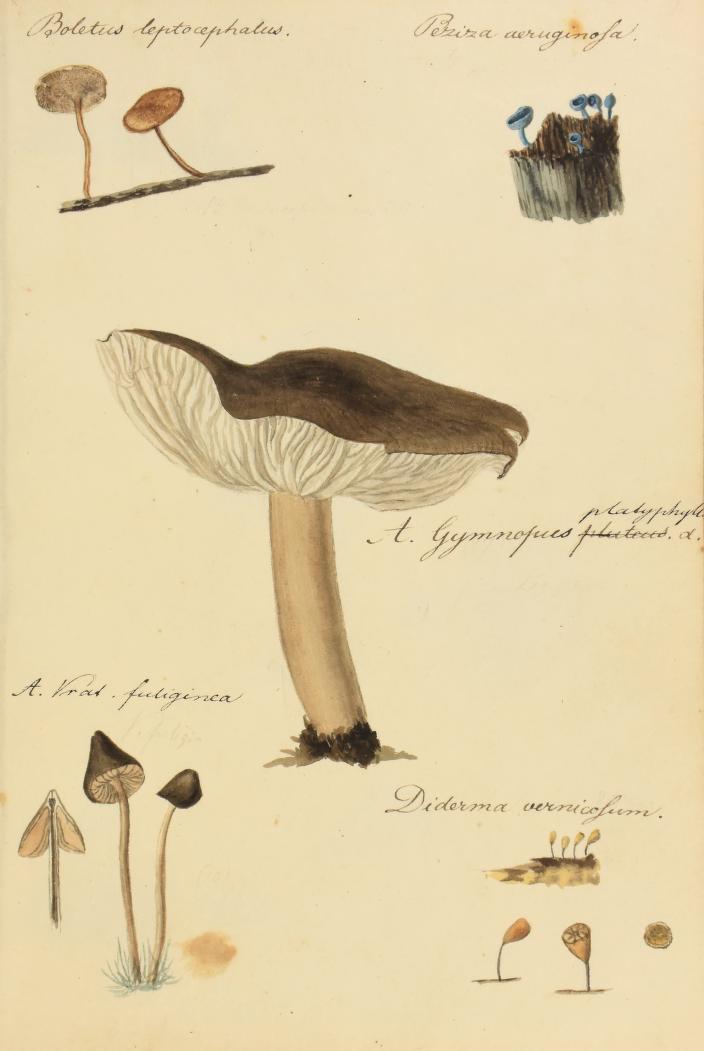
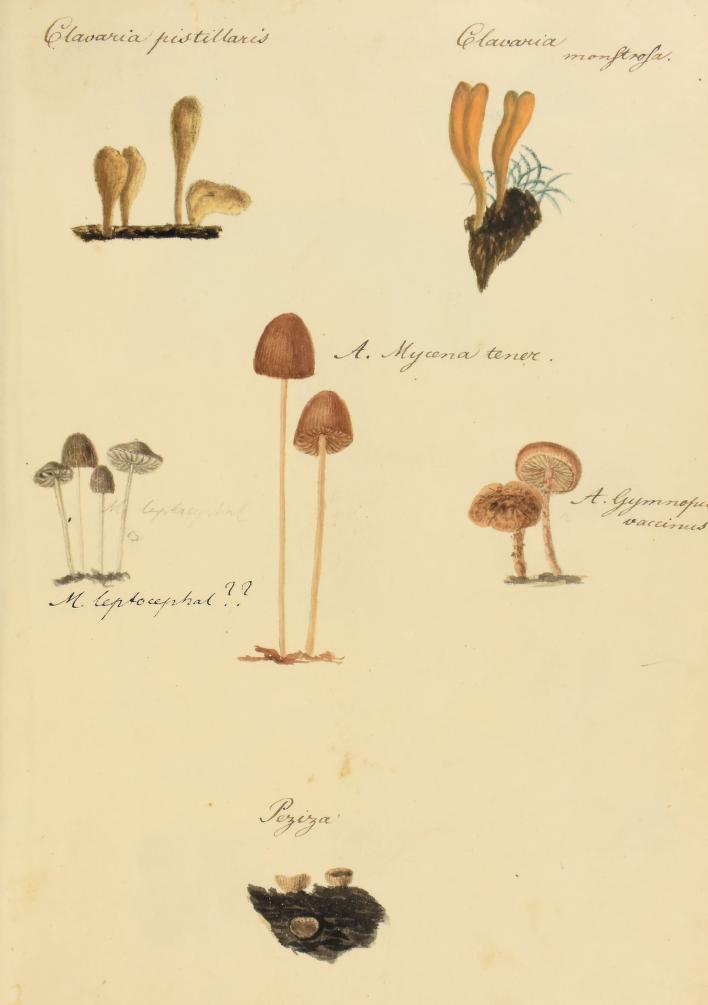
Plate 20. “Clavaria monstrosa” label indicating an anomalous specimen. Question marks indicating uncertainty over “Mycena leptocephalus” identification. Schweinitz, Lewis David von. Icones fungorum Niskiensium. (ca.) 1798-1802. Contributed in BHL from Botany Libraries, Farlow Reference Library of Cryptogamic Botany, Harvard University.

The research presented by Karakehian et al. provides novel insight into the development of a foundational mycological work. As Karakehian explains,

“These watercolor volumes are part of the knowledge-base that Schweinitz employed in his studies of American fungi. Therefore, understanding the history of these volumes is essential not only to a clearer understanding of the American mycobiota, but to an elucidation of the depth of the scientific knowledge-base at the founding of mycology in North America.”

fungi illustration

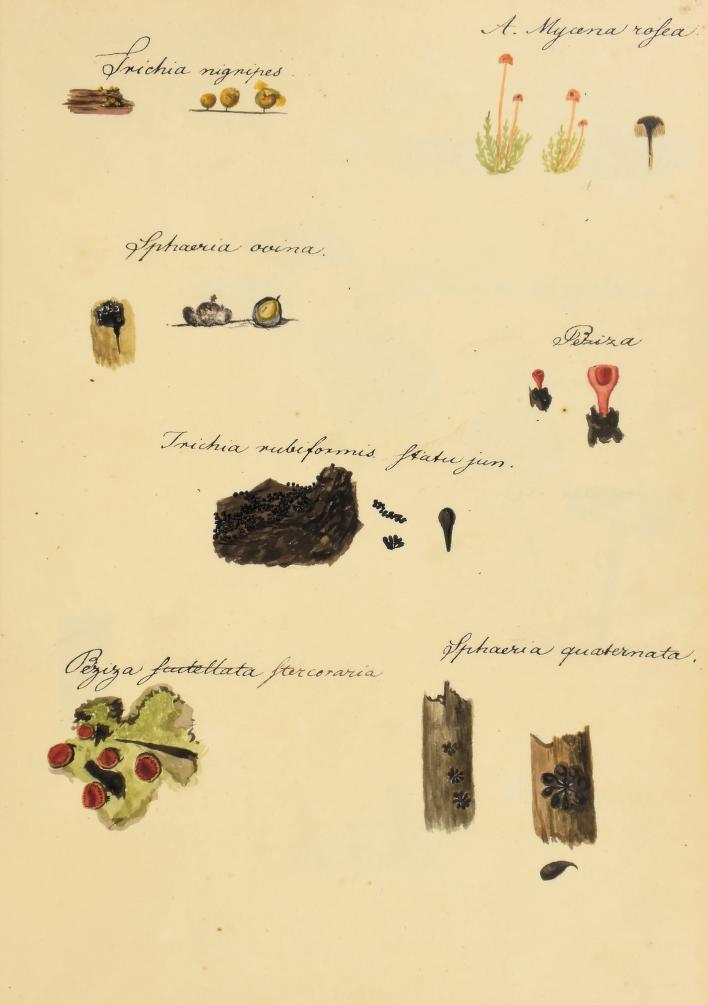
Plate 6. Trichia rubiformis labeled as “statu jun.” [immature state]. Schweinitz, Lewis David von. Icones fungorum Niskiensium. (ca.) 1798-1802. Contributed in BHL from Botany Libraries, Farlow Reference Library of Cryptogamic Botany, Harvard University.

The Harvard Icones and its related works also provide a prime example of how unprecedented research is made possible thanks to digitization initiatives like the Biodiversity Heritage Library, which allow easy reference to and comparison between volumes held in multiple institutions across the United States. As Karakehian et al. acknowledge within their paper,

“It is important to note that much of this work that resulted in this paper was made possible because archives, manuscripts and books are becoming increasingly available through digital efforts being made around the world.”

Given the unique and rare nature of the  Harvard Icones, the book was scanned at Harvard using an Internet Archive TableTop Scanner that is shared with between the Harvard Botany Libraries and the Ernst Mayr Library of the Museum of Comparative Zoology.  This mini version of an Internet Archive scribe allows Harvard librarians to scan rare or fragile materials without the wear and tear of off-site transportation. Once scanned, the Internet Archive processed the images and the final product was made accessible in the Internet Archive and BHL.  We are so grateful to the Botany Libraries, Farlow Reference Library of Cryptogamic Botany, Harvard University for all of their work to digitize the Harvard Icones in BHL and make it freely available to the world.

Similarly, we extend our sincere thanks to the LuEsther T. Mertz Library of The New York Botanical Garden, the Library & Archives of the Academy of Natural Sciences of Drexel University and the Wilson Library of the University of North Carolina at Chapel Hill, for digitizing Schweinitz’s Conspectus and other, complementary archival works, ensuring that they are also now freely available through BHL.

Take a closer look at how BHL facilitated research on these remarkable archives with our BHL User series, where Karakehian provides more insight into BHL’s impact on his work to unravel the mysteries surrounding Schweinitz’s Icones.

Post with contributions from Jason M. Karakehian (Master’s degree candidate at the Harvard Extension School), Judith A. Warnement (Librarian of Harvard University Botany Libraries), and Diane Rielinger (Digital Projects Librarian, Harvard University Herbaria & Libraries).

November 1, 2018by michelle.underhill

Help Support BHL

BHL's existence depends on the financial support of its patrons. Help us keep this free resource alive!

search

About BHL

The Biodiversity Heritage Library (BHL) is the world’s largest open access digital library for biodiversity literature and archives. BHL operates as a worldwide consortium of natural history, botanical, research, and national libraries working together to digitize the natural history literature held in their collections and make it freely available for open access as part of a global “biodiversity community.”

Join Our Mailing List

Sign up to receive the latest news, content highlights, and promotions.

Subscribe Now

Subscribe to Blog via Email

Enter your email address to subscribe to this blog and receive notifications of new posts by email.

Join 319 other subscribers

Subscribe to Blog Via RSS

Subscribe to the blog RSS feed to stay up-to-date on all the latest BHL posts.

Access RSS Feed

Inspiring Discovery through Free Access to Biodiversity Knowledge.

The Biodiversity Heritage Library makes it easier than ever for you to access the information you need to study and explore life on Earth…for free, anytime, anywhere.


64+ Million Pages of
Biodiversity Literature Online.

EXPLORE

Tools and Services
to Transform Research.

EXPLORE

300,000+
Illustrations on Flickr.

EXPLORE

ABOUT | HARMFUL CONTENT | PRIVACY | SITE MAP | TERMS OF USE