Biodiversity Heritage Library - Program news and collection highlights from BHL
  • Home
  • News
  • Featured Books
    • All Featured Books
    • Book of the Month Series
    • BHL at 20
  • User Stories
  • Campaigns
    • Fossil Stories
    • Garden Stories
    • Monsters Are Real
    • Page Frights
    • Her Natural History
    • Earth Optimism 2020
  • Tech Blog
  • Visit BHL
Home
News
Featured Books
    All Featured Books
    Book of the Month Series
    BHL at 20
User Stories
Campaigns
    Fossil Stories
    Garden Stories
    Monsters Are Real
    Page Frights
    Her Natural History
    Earth Optimism 2020
Tech Blog
Visit BHL
  • Home
  • News
  • Featured Books
    • All Featured Books
    • Book of the Month Series
    • BHL at 20
  • User Stories
  • Campaigns
    • Fossil Stories
    • Garden Stories
    • Monsters Are Real
    • Page Frights
    • Her Natural History
    • Earth Optimism 2020
  • Tech Blog
  • Visit BHL
Biodiversity Heritage Library - Program news and collection highlights from BHL
Blog Reel, Featured Books

The Last Heath Hen, and Other News From the Collecting Net In Woods Hole

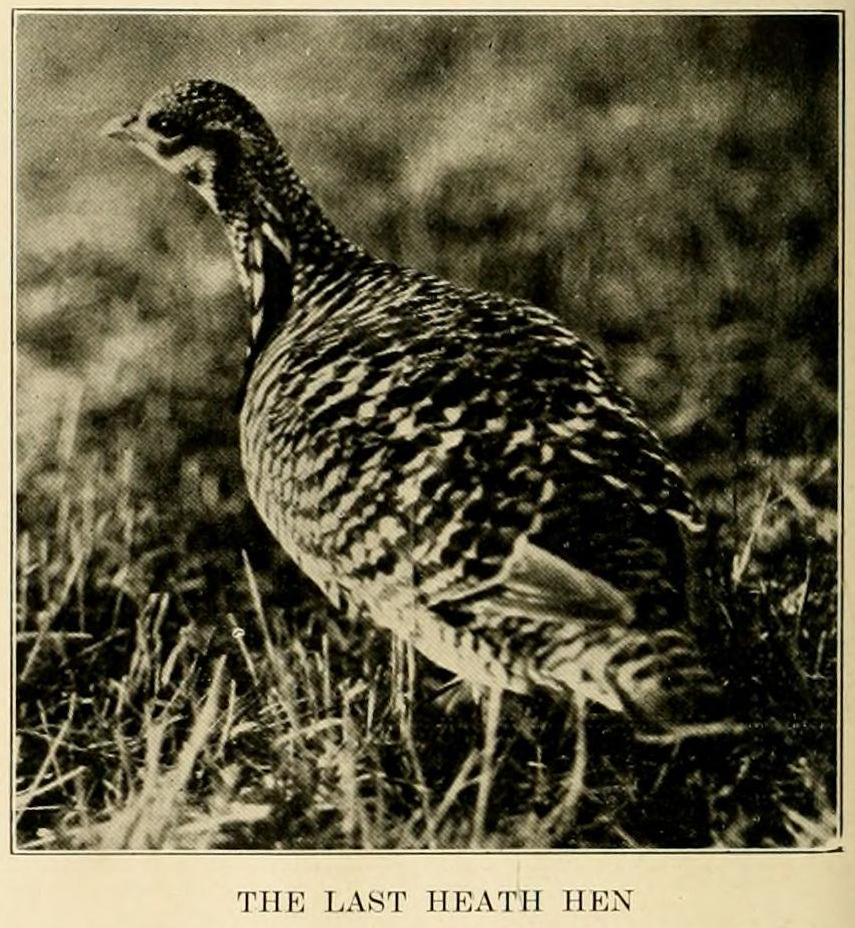
black and white photo of a bird, the heath hen

“On Martha’s Vineyard Island just across the Sound from the Marine Biological Laboratory is the home of the lone survivor of the Heath Hen. The death of this individual will also mean the death of its race, and then another bird will have taken its place among the endless array of extinct forms. The numbers of Heath Hen have been closely followed by ornithologists and since 1908 a detailed census has been taken of the birds each year. For the first time in the history of ornithology a species has been studied and photographed in its normal environment down to the very last individual.”

-Professor Alfred O. Gross, Bowdoin College, as written in The Collecting Net: Volume 5, Number 3, 12 July 1930.
black and white photo of a bird, the heath hen

“The Last Heath Hen.” Gross, Alfred O. The Collecting Net. v.5, no.33 (1930). Contributed in BHL from MBLWHOI Library. In copyright. Digitized with the permission of the rights holder. CC BY-NC-SA.

We came across a unique article, “The Last Heath Hen,” in the Biodiversity Heritage Library recently. The article from The Collecting Net newspaper is a beautifully-crafted account from 1930 of the then-last stand and near extinction of the last animal of the ground-feeding Heath Hen species (Tympanuchus cupido cupido), a member of the grouse family and subspecies of the Prairie Chicken. This species once ranged from Maine to the Carolinas in American colonial times and before but was all but extinct on the US mainland by 1870, except for it holding its own in the scrub brush, open fields, and low pine forests of Martha’s Vineyard, Massachusetts.

Historical Spotlight: Martha’s Vineyard

Martha’s Vineyard is an island about twice as long and a bit wider than the island of Manhattan, four miles across the Vineyard Sound body of water from the village of Woods Hole in the town of Falmouth on the Cape Cod peninsula.. The Aquinnah Wampanoag Tribe had lived on the Island of Martha’s Vineyard for close to 10,000 years when the island was “discovered” by English explorer Bartholomew Gosnold and named after his deceased daughter Martha in 1602.  Woods Hole (also a land of the Wampanoag Nation), “discovered” by Gosnold in 1602, is a village which in the 19th Century was a whaling port and maritime industrial center, and in the 20th Century became home to six world renowned scientific research institutions, the second oldest of which in 1888 was founded as the Marine Biological Laboratory (MBL), which published The Collecting Net.

The Collecting Net article, “The Last Heath Hen,” was written by the ornithologist Dr. Alfred Otto Gross, an MBL summer research scientist and Professor of Zoology at Bowdoin College in Maine. This story is a simple account of the prelude to the end of this species, as extinction officially occurred two years later in 1932. The Commonwealth of Massachusetts and a coalition of conservation organizations made real efforts to save the heath hen—efforts which ultimately failed, as sadly in the end disease, predators, and a forest fire in its breeding ground sealed the fate of this species. Dr. Gross writes that it was decided by conservation organizations, with respect to the last individual of this species, to allow it to live its last years in peace without interference from the government or hunters. Thus, this sensitive account by Dr. Gross, based upon his own research.

According to this undated appreciation of Dr. Gross in the Bowdoin College Daily Sun:

“Although he enjoyed teaching, Gross was a devoted researcher who contributed prolifically to the study of ornithology; he was the author of 265 scientific articles and books and was recognized as a Fellow of the American Ornithologists’ Union in 1930.”

The science history of the oldest private biological laboratory in the United States, the Marine Biological Laboratory (MBL), is well documented through thousands of publications, as well as in The Collecting Net. The venerable in-house journal of the Marine Biological Laboratory, the Biological Bulletin, has been continuously published, first by MBL and now by the University of Chicago Press, since 1890. The Archives of the MBL holds the papers of scientists, photographs, films, and the administrative records of 133 years of transformative biological science, not to mention over 15,000 rare books going back to the 1500’s, many of which are freely accessible through the BHL. While the science is well documented, getting to know the social history of this year-round (once only during the summer) seaside science mecca is assisted by examining The Collecting Net weekly newspaper, a scrappy summertime tabloid which was published by the social MBL Club from 1926-1953.
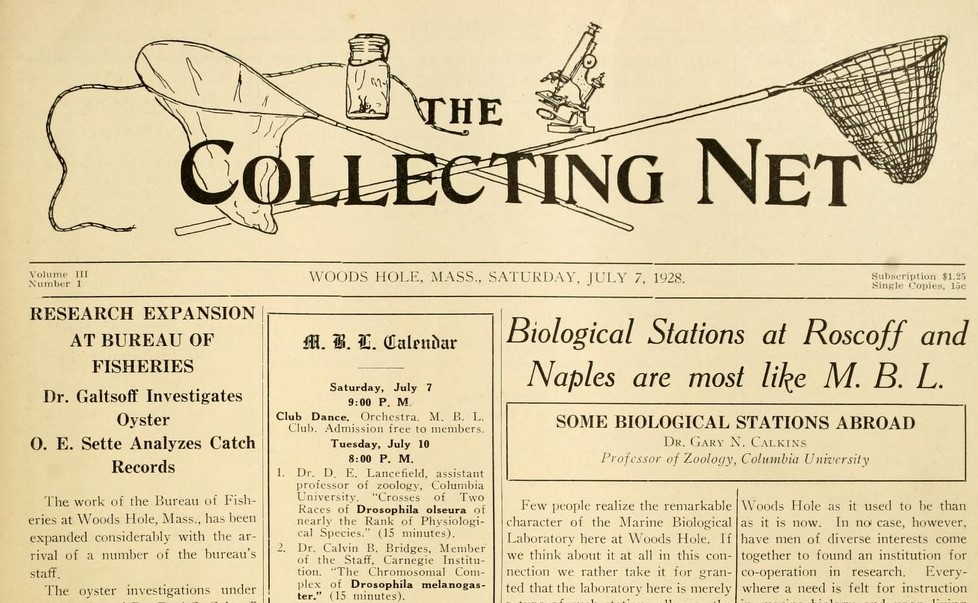
Front page of "The Collecting Net"

Front page, The Collecting Net, v.3, no.1 (1928). Contributed in BHL from MBLWHOI Library. In copyright. Digitized with the permission of the rights holder. CC BY-NC-SA.

The Collecting Net joined the science and the social going on during busy MBL summers, used advertising revenues for a scholarship fund for MBL students, and was edited by a team initially led by Ware Cattell, who later became editor of the journal Science. When the newspaper hit its weekly publishing deadline, it was loaded on a boat and motored across Buzzards Bay to New Bedford where it was typeset, printed, and returned to Woods Hole. While the more recent issues (1950’s) present official-looking administrative accounts of lectures and research, the first years of The Collecting Net offered an exciting and often humorous glimpse into the arts and sciences and lives of the people who spent their summers working at the Marine Biological Laboratory—from ferry and train schedules to Boston, New York, Martha’s Vineyard and Nantucket; to a comprehensive directory of all the employees and scientists at MBL every summer; to summer choral and drama auditions and performances; and many, many advertisements (see below an assortment of these).
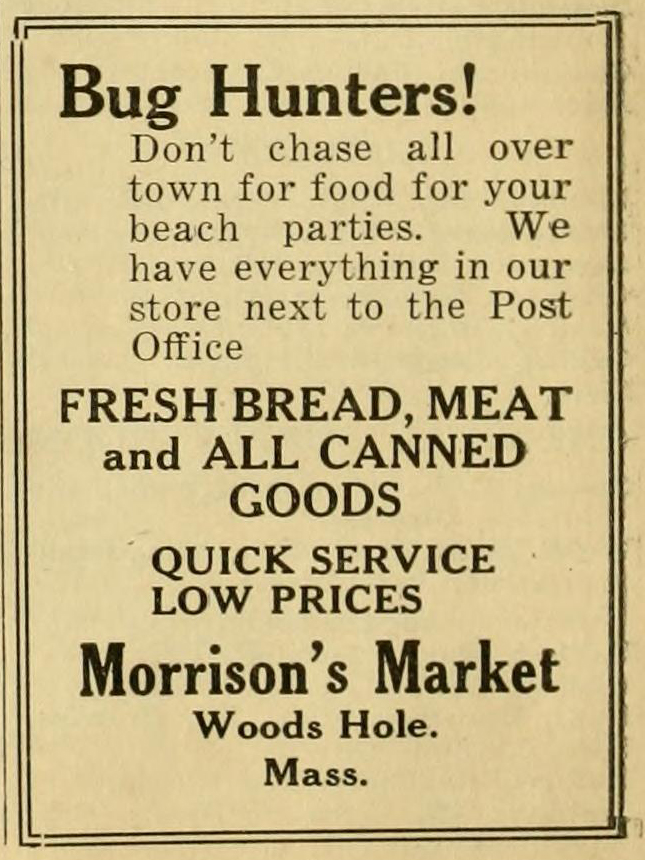
"bug hunters!"

Scientists in Woods Hole are still known as “bug hunters”! Advertisement from Morrison’s Market in The Collecting Net, v.1 (1926). Contributed in BHL from MBLWHOI Library. In copyright. Digitized with the permission of the rights holder. CC BY-NC-SA.
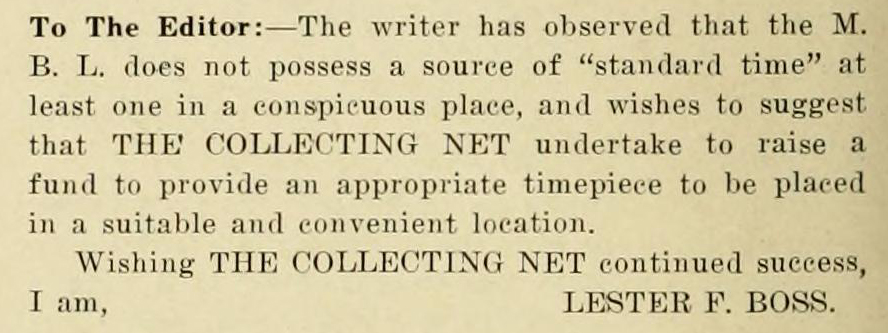
screenshot of text from a book with the "note to the editor"

A vital “Letter to the Editor”. The Collecting Net, v.5, no.33 (1930). Contributed in BHL from MBLWHOI Library. In copyright. Digitized with the permission of the rights holder. CC BY-NC-SA.
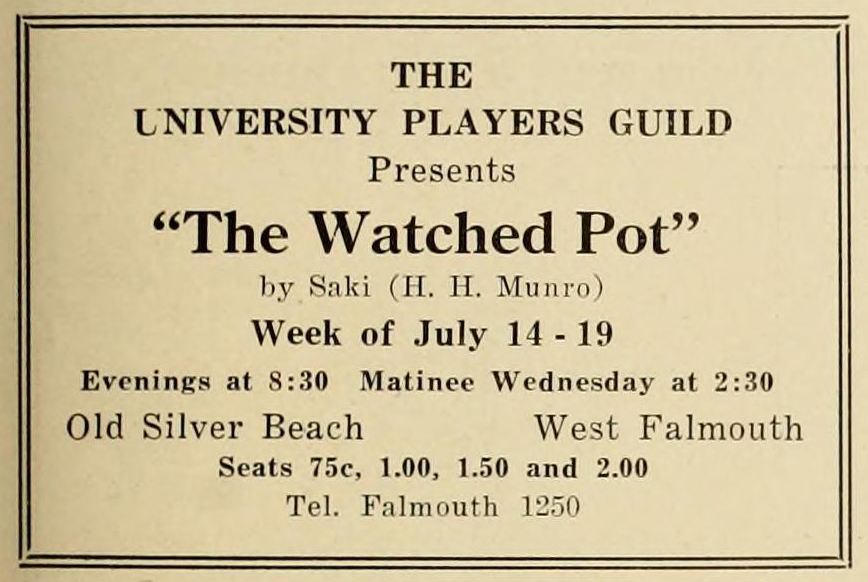
Screenshot of text, advertisement for "The University Players"

The most well known University Players were Henry Fonda and James Stewart. The University Platers Guild advertisement. The Collecting Net, v.5, no.33 (1930). Contributed in BHL from MBLWHOI Library. In copyright. Digitized with the permission of the rights holder. CC BY-NC-SA.
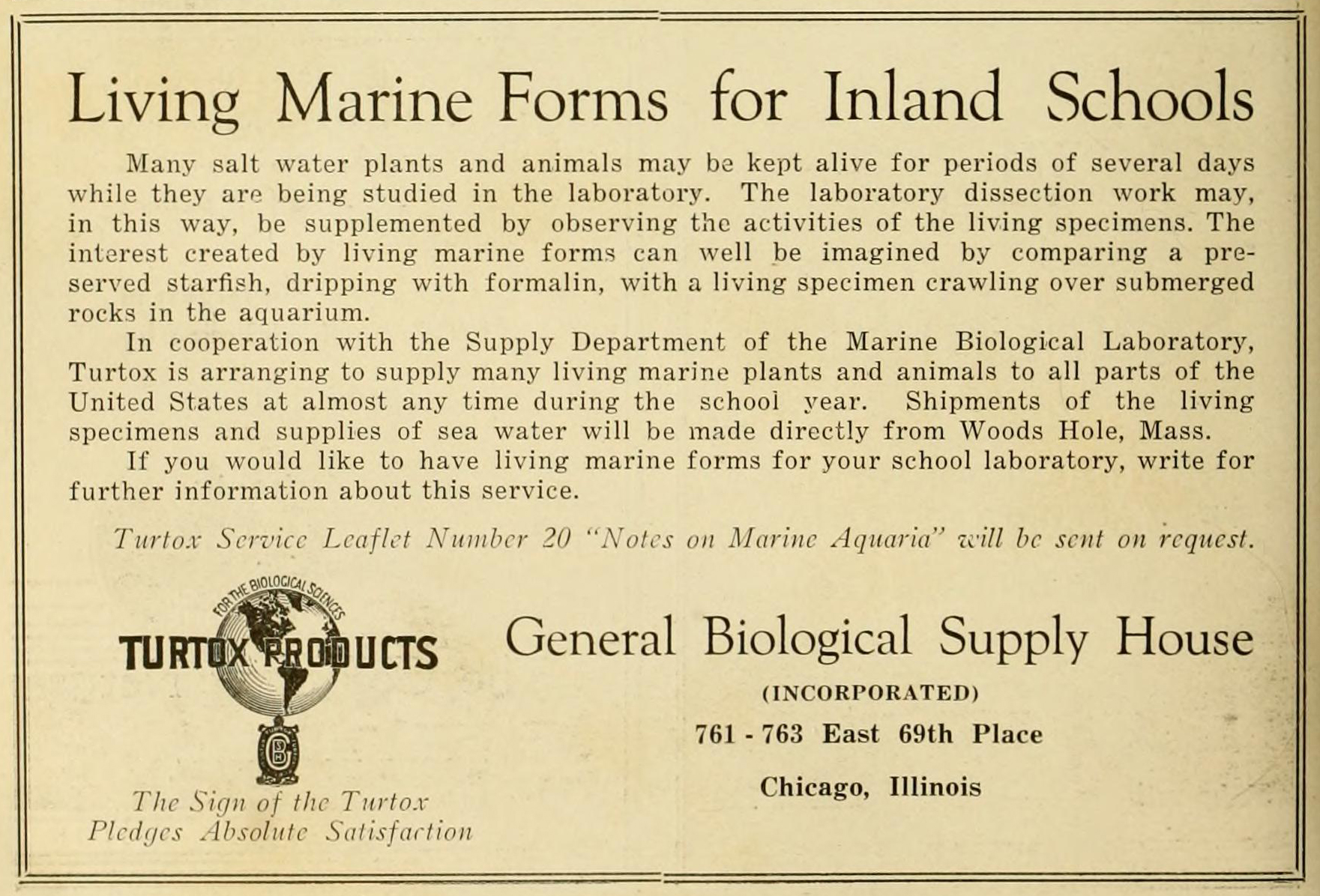
Screenshot of text, "Living Marine Forms" advertisement

Live marine specimens were locally collected and packed for the Woods Hole departing train for all points, USA. General Biological Supply House advertisement. The Collecting Net, v.5, no.33 (1930). Contributed in BHL from MBLWHOI Library. In copyright. Digitized with the permission of the rights holder. CC BY-NC-SA.

The Collecting Net masthead was “an independent publication devoted to the activities of biologists at the laboratories in Woods Hole.” One thing which The Collecting Net offered relative to the science taking place in Woods Hole during the summers was something which has always been quite important in science literature, and that is the opportunity to rapidly publish findings and new ideas. This, The Collecting Net provided, as in Dr. Ernest E. Just’s “Methods for experimental embryology…,” below, which was published so it could be used by students at MBL the next day! Dr. Alfred O. Gross’ account of the final days of the heath hen was published so the readers of the work could respond to it immediately.

One thing missing though, relative to all the current science of those times, was that The Collecting Net, when published, was not indexed for later discovery. For this reason, almost a century after the first issue was published in 1926, through the Biodiversity Heritage Library it is possible to search the full text content of the articles published within, thereby giving that science new exposure, freely accessible in Woods Hole or anywhere in the world.
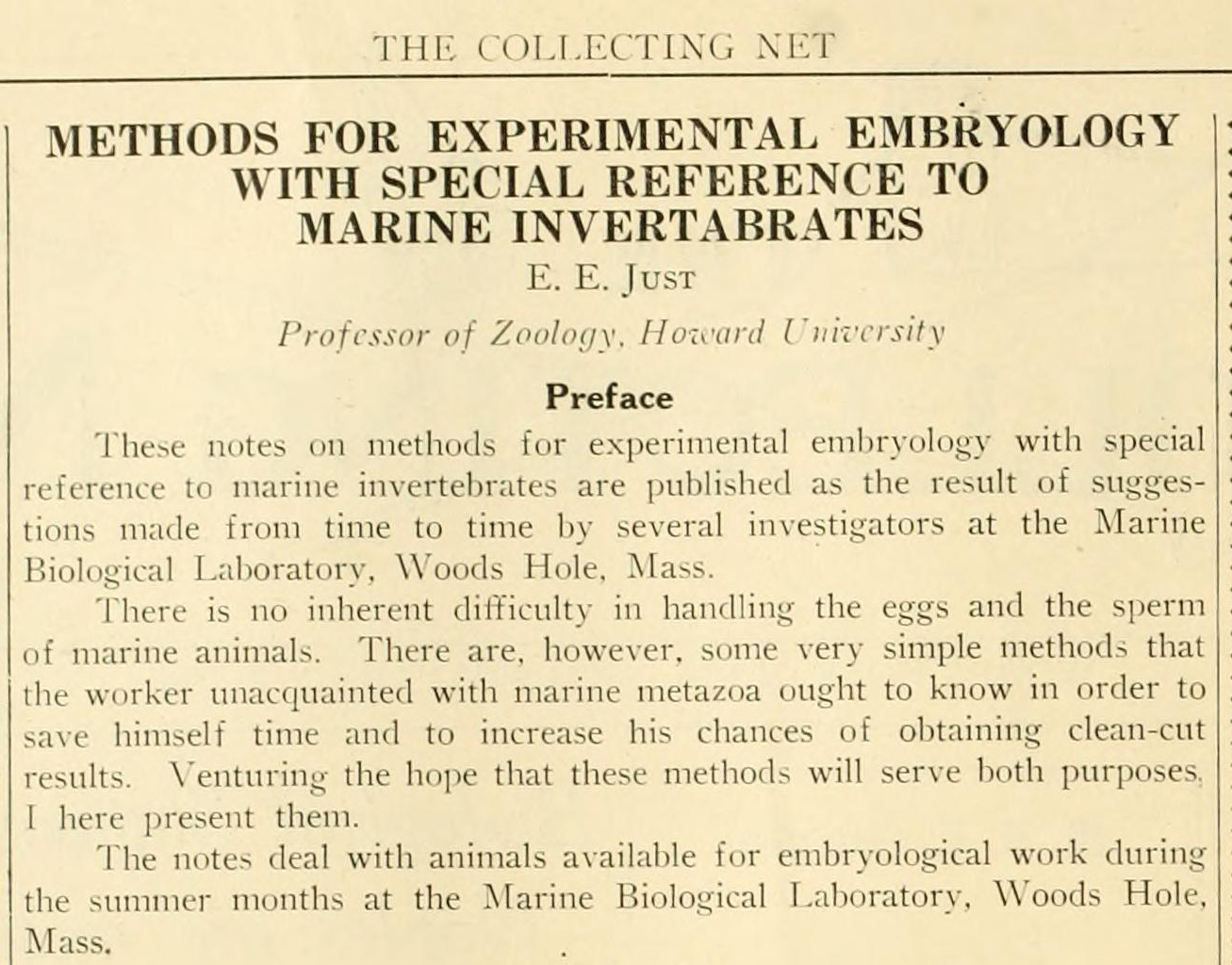
Screenshot of text, an article by E.E. Just.

Ernest E. Just, an MBL scientist, was known for his experimentation technique. He was the first African American scientist in the United States to receive a PhD in Zoology, from the University of Chicago. “Methods for Experimental Embryology with Special Reference to Marine Invertebrates.” The Collecting Net, v.3 (1928). Contributed in BHL from MBLWHOI Library. In copyright. Digitized with the permission of the rights holder. CC BY-NC-SA.
April 29, 2021by Joel Richard
Blog Reel, Campaigns, Featured Books

Once There Were Billions: Heath Hen

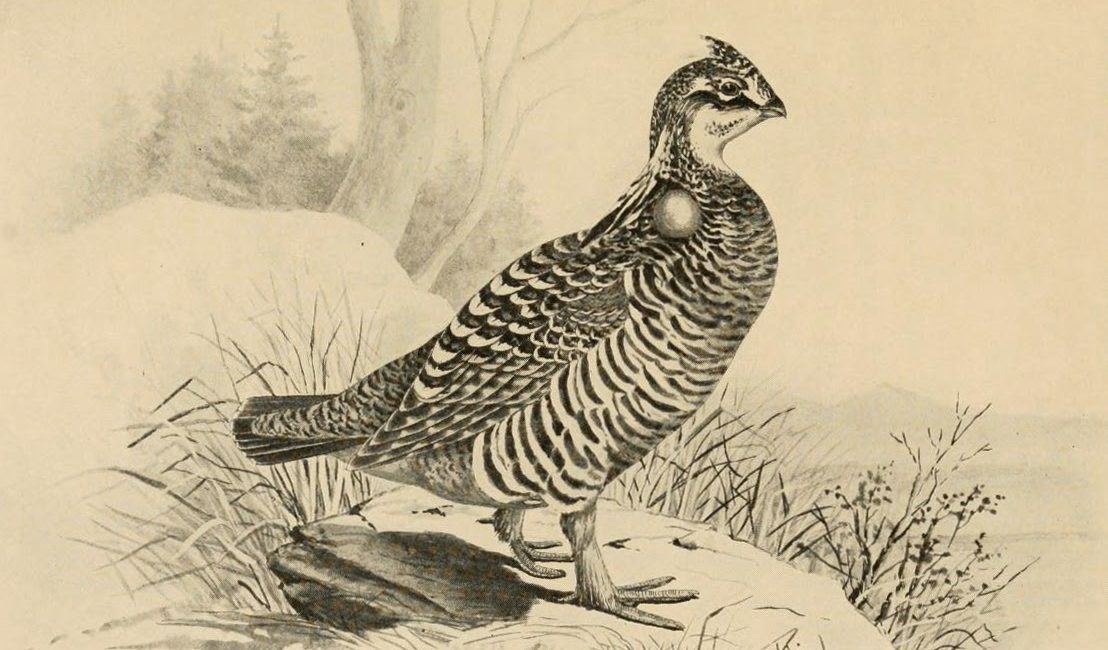
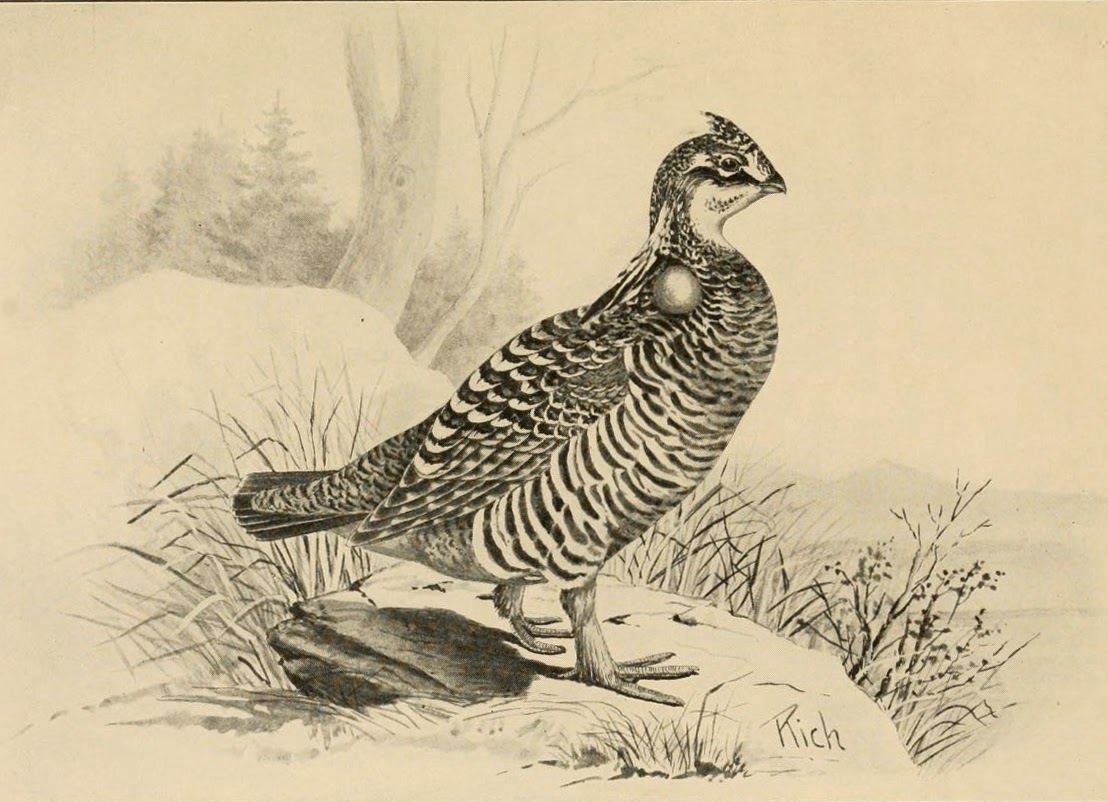
To help tell the story of four extinct bird species, BHL and the Smithsonian Libraries co-curated an exhibition–Once There Were Billions: Vanished Birds of North America–at the National Museum of Natural History.  The exhibit runs through October 2015 and provides insights into the fragile connections between species and their environment.  If you’re not in the area, you can still enjoy the online exhibit or browse digital versions of the select exhibit books in BHL. You can also follow along here on the BHL blog where we’re showcasing each of the four species, starting with the Great Auk and the Carolina Parakeet.  This week, we’re highlighting the Heath Hen.

View Full Size Image
Feathered Game of the Northeast. Walter Herbert Rich,
New York: T.Y. Crowell & Co, 1907

http://biodiversitylibrary.org/page/14460220
Heath Hen: Early Signs of Trouble

During colonial times, Heath Hens (Tympanuchus cupido cupido) flourished among the heathland barrens of coastal North America from Maine to Virginia. Tasty and easy to kill, they were popular among early settler, and their numbers quickly declined from overhunting, habitat loss, and disease.

In 1791, the New York State legislature introduced a bill calling for the preservation of Heath Hens and other game, but it couldn’t be enforced.  After the birds disappeared from the mainland, a Heath Hen sanctuary was established on Martha’s Vineyard in 1908. The sanctuary was home to the entire Heath Hen population–50 birds in all. By 1915, they numbered 2,000. But when a fire destroyed the sanctuary’s habitat in 1916, their numbers dwindled. The last one died in 1932.

Extinctions are often most visible to us when they affect a highly visible species in our communities, especially if there are repercussions for our food sources or income. But extinctions can also have far-reaching impacts that may not be as immediately visible.

Understanding Biodiversity and Supporting Research
One way to foster a better understanding of biodiversity and its significance is to support organizations like the Biodiversity Heritage Library. BHL is a global project that is changing the way research is done, by digitizing and providing open access to biodiversity literature.  BHL makes more than 44 million pages and over 90,000 scientific illustrations–of animals and plants, living and extinct–freely available to scientists and others around the world. BHL relies on donations from individuals to support scanning of the biodiversity literature held in some of the world’s most renowned natural history and botanical libraries. To learn more about how your donation supports the continued growth of BHL, please visit http://archive.constantcontact.com/fs181/1103622715135/archive/1115465985290.html.  We hope you’ll consider making a donation today!

July 9, 2014by sayeedmd
BHL News, Blog Reel, Campaigns

Breathing Life Into a Museum Exhibit About Extinction

View Full Size Image
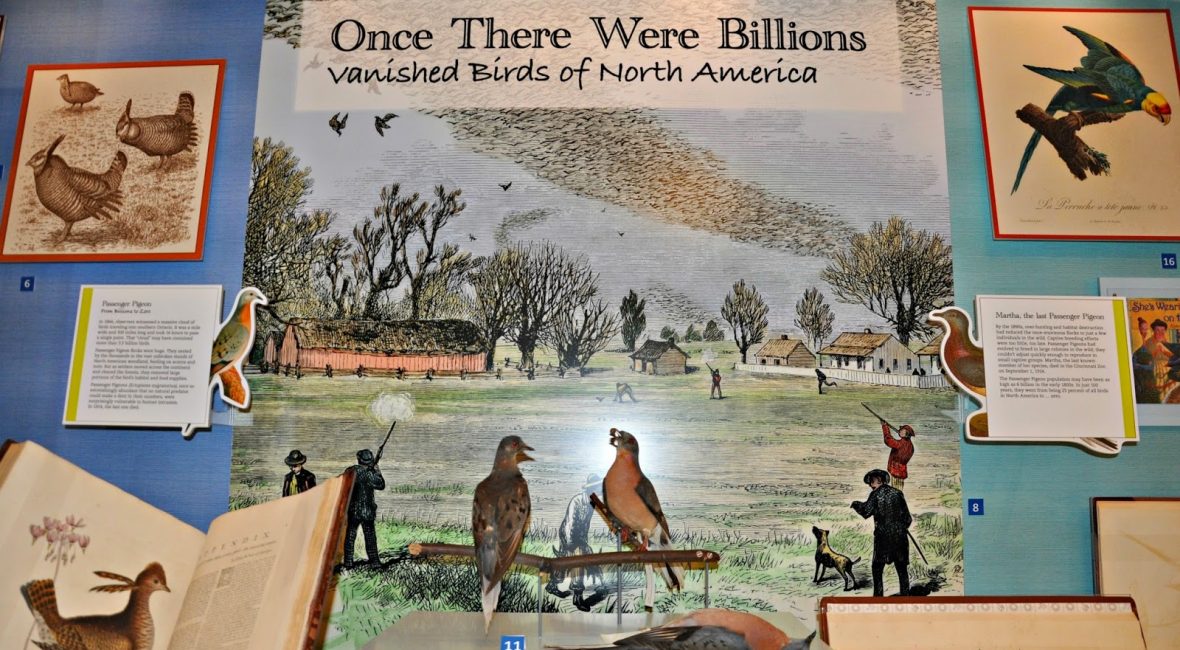
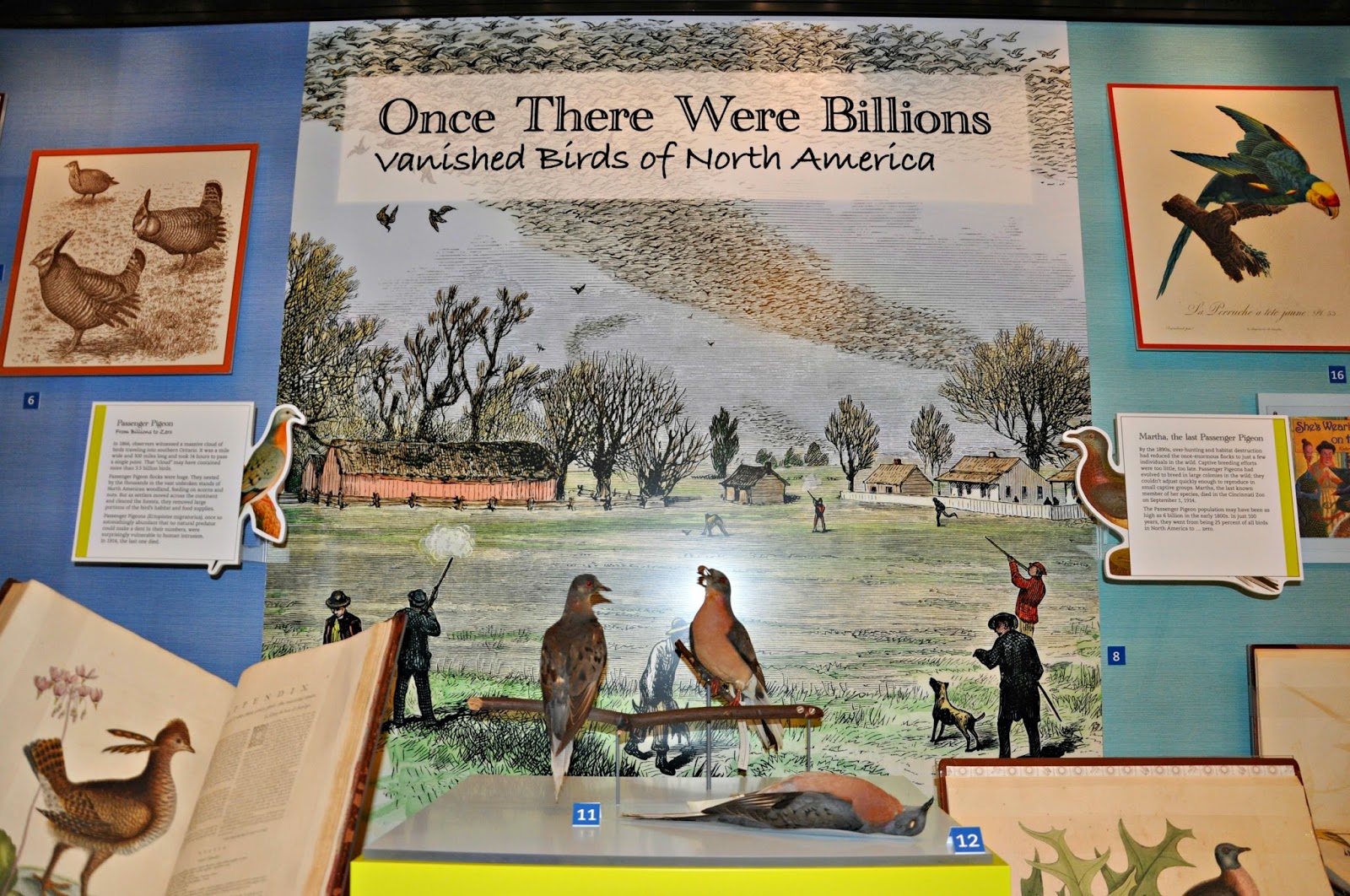
Once There Were Billions, the new Smithsonian Libraries/BHL exhibit at the National Museum of Natural History.  The Passenger Pigeon on the left, with her back to the viewer, is Martha, the last Passenger Pigeon that died 100 years ago in 1914.

You are living in the midst of earth’s sixth great extinction event. You’ve been living in it since you were born. So have your parents, your grandparents, your great-great-great-great-grandparents, and all of your ancestors for about 10,000 years. It dates back to the extinction of the mammoths and has been increasingly accelerating as human actions and climate change reshape the balance of our planet.  Within the next century, 75% of the conservatively estimated 8.75 million species on earth may be extinct.

When many of us think of extinctions, we think of the countless species disappearing in the Amazon rainforest, the ocean’s coral reefs, or the forests of South-east Asia. But the truth is that extinctions happen in every corner of the globe. Some are noticeably notorious, others occur without us even knowing that the species existed in the first place. One of the most infamous North American extinctions is the demise of the Passenger Pigeon.

By the time Europeans first came to the New World, approximately 40% of all land birds in North America were a member of the species Ectopistes migratorius, or the Passenger Pigeon. Their population numbered in the billions, and their abundance spurred intense human hunting in the mid-1800s. Less than a century later, the Passenger Pigeon was extinct.
View Full Size Image
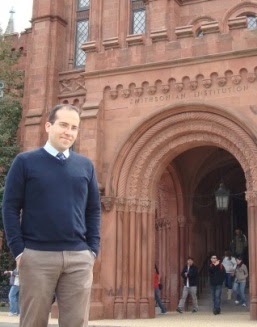
Gilbert Borrego, co-curator of the Once There Were Billions exhibit.

The fate of the Passenger Pigeon, and three other extinct North American bird species (Great Auk, Carolina Parakeet, and Heath Hen), are the focus of the new joint BHL/Smithsonian Libraries‘ exhibit at the National Museum of Natural History: Once There Were Billions.

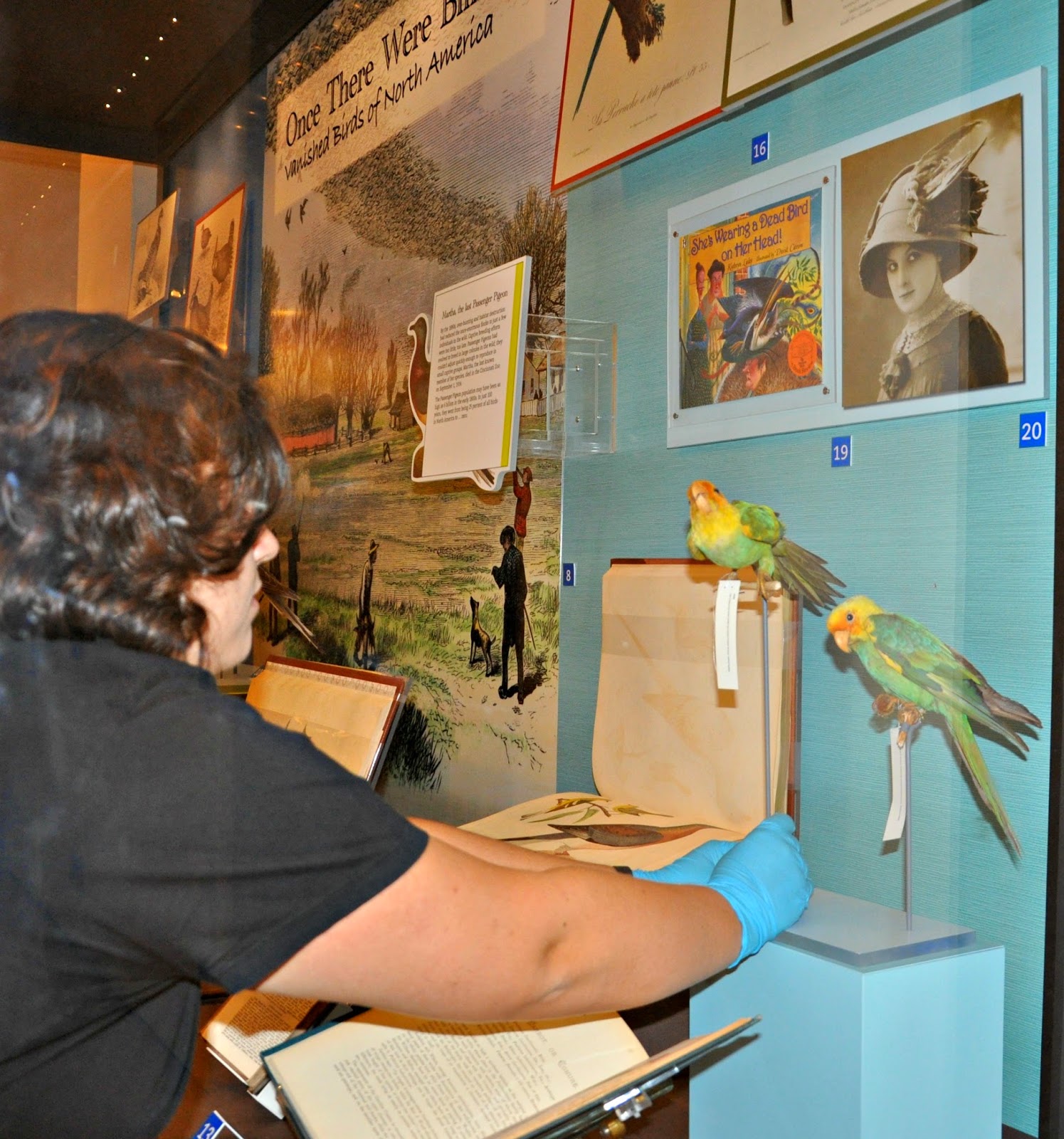
The exhibit represents the culmination of three years of work for its curators, Gilbert Borrego (former BHL Library Technician for Smithsonian Libraries) and Dr. Helen James (Curator in Charge, Division of Birds, National Museum of Natural History). The histories of these lost species are told through compelling narratives, taxidermied specimens (including Martha, the last Passenger Pigeon), books from the Smithsonian Libraries’ collection (many of which are available digitally in BHL), and images from BHL.

Most people are unaware of how involved and sometimes challenging building an exhibit can be. Several years, countless meetings, copious research, and dozens of individuals are required to bring an exhibit from conception to public launch. Sometimes the most difficult part can be simply honing in on the exact story you want to tell.

View Full Size Image
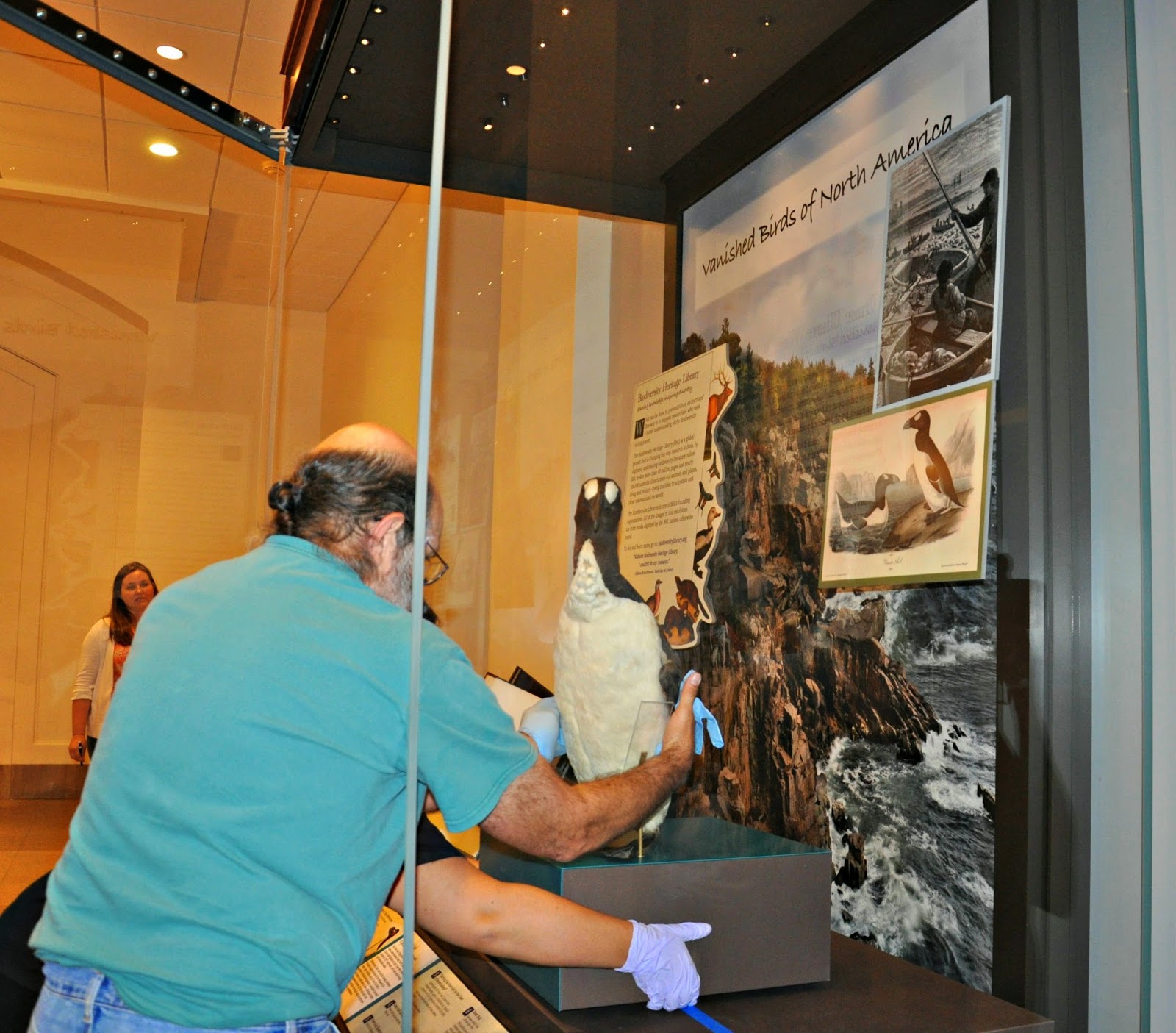
Positioning the Great Auk in the exhibit.

“The most challenging part of the exhibit was narrowing down our source material,” said Borrego. “The topic [of the exhibit] was originally much more general, focusing on extinct species. We knew Martha the Passenger Pigeon was to be included, but we looked at many other types of animals and plants before settling on the plight of birds from North America.”

Borrego first presented the proposal for “Once There Were Billions” in 2011, and since then he, James, and an army of scientists, librarians, and museum support staff defined the scope, drafted a script, selected specimens and images, and fashioned layouts for the physical and supplementary digital exhibits.
Once all the foundational work was complete, it was time to bring the exhibit to life. Plaques fresh off the press, freshly-cleaned bird specimens, and carefully conserved books were artistically arranged within two mammoth exhibit cases in the Evans Gallery on the Ground Floor of the National Museum of Natural History.
View Full Size Image
Adjusting the Carolina Parakeet specimens.

And voila! This specialized hub for extinction education opened to the public this past Monday, June 24, 2014, and will remain open until October, 2015.

If you’re visiting D.C., be sure to check out the exhibit. And if you’re an art fan, take some time to see the massive bronze sculptures of the birds crafted by artist Todd McGrain as part of “The Lost Bird Project” and situated around the Smithsonian grounds.
If you’re not in the area, you can still enjoy “Once There Were Billions” via the online exhibit, by browsing digital versions of select exhibit books in BHL, or by downloading free, spectacular illustrations of the featured species.
Educating each and every person about the plight of biodiversity on our planet, and the repercussions of doing nothing, is a critical part of ensuring that today’s species do not become just another extinction statistic. Exhibits like “Once There Were Billions” are just one way we can achieve this global awareness. But while you might not be in a position to build a museum exhibit, there are other ways you can help change the fate of doomed species. Supporting initiatives like BHL, which enable the research of scientists trying to document and conserve species around the world, helps prevent species decline.

Everyone can make a difference. What will you do to help curb the tide of the Sixth Great Extinction Event?

June 27, 2014by michelle.underhill

Help Support BHL

BHL's existence depends on the financial support of its patrons. Help us keep this free resource alive!

search

About BHL

The Biodiversity Heritage Library (BHL) is the world’s largest open access digital library for biodiversity literature and archives. BHL operates as a worldwide consortium of natural history, botanical, research, and national libraries working together to digitize the natural history literature held in their collections and make it freely available for open access as part of a global “biodiversity community.”

Join Our Mailing List

Sign up to receive the latest news, content highlights, and promotions.

Subscribe Now

Subscribe to Blog via Email

Enter your email address to subscribe to this blog and receive notifications of new posts by email.

Join 319 other subscribers

Subscribe to Blog Via RSS

Subscribe to the blog RSS feed to stay up-to-date on all the latest BHL posts.

Access RSS Feed

Inspiring Discovery through Free Access to Biodiversity Knowledge.

The Biodiversity Heritage Library makes it easier than ever for you to access the information you need to study and explore life on Earth…for free, anytime, anywhere.


64+ Million Pages of
Biodiversity Literature Online.

EXPLORE

Tools and Services
to Transform Research.

EXPLORE

300,000+
Illustrations on Flickr.

EXPLORE

ABOUT | HARMFUL CONTENT | PRIVACY | SITE MAP | TERMS OF USE