Biodiversity Heritage Library - Program news and collection highlights from BHL
  • Home
  • News
  • Featured Books
    • All Featured Books
    • Book of the Month Series
    • BHL at 20
  • User Stories
  • Campaigns
    • Fossil Stories
    • Garden Stories
    • Monsters Are Real
    • Page Frights
    • Her Natural History
    • Earth Optimism 2020
  • Tech Blog
  • Visit BHL
Home
News
Featured Books
    All Featured Books
    Book of the Month Series
    BHL at 20
User Stories
Campaigns
    Fossil Stories
    Garden Stories
    Monsters Are Real
    Page Frights
    Her Natural History
    Earth Optimism 2020
Tech Blog
Visit BHL
  • Home
  • News
  • Featured Books
    • All Featured Books
    • Book of the Month Series
    • BHL at 20
  • User Stories
  • Campaigns
    • Fossil Stories
    • Garden Stories
    • Monsters Are Real
    • Page Frights
    • Her Natural History
    • Earth Optimism 2020
  • Tech Blog
  • Visit BHL
Biodiversity Heritage Library - Program news and collection highlights from BHL
BHL News, Blog Reel

BHL at Biodiversity Next

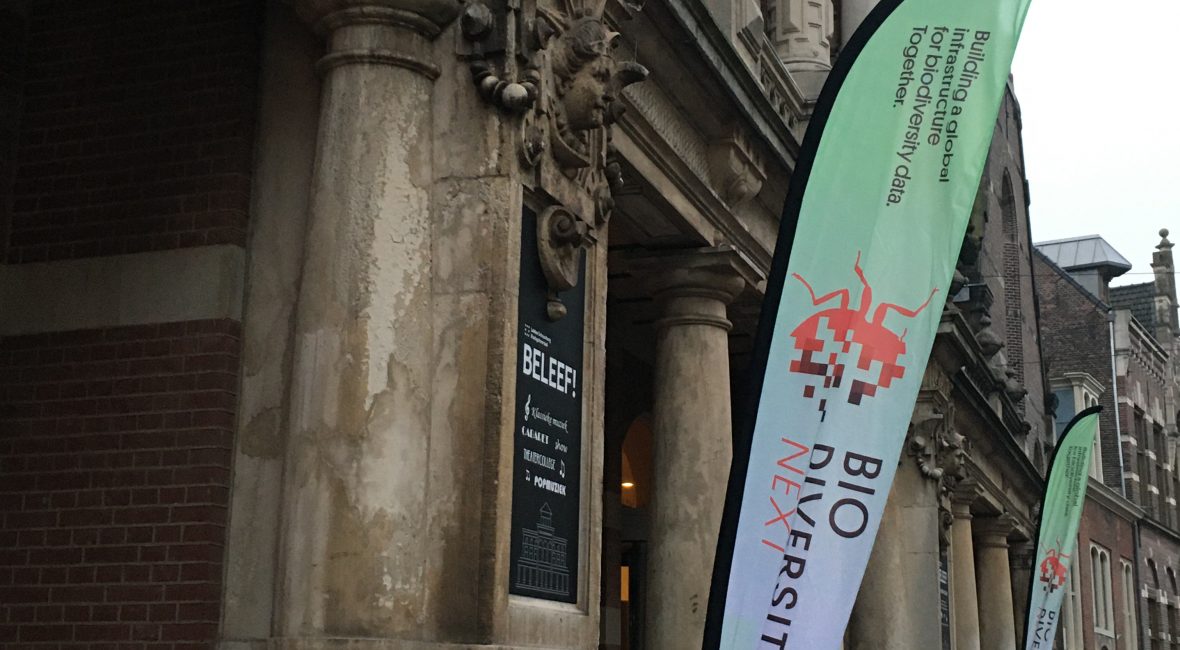
Biodiversity_Next banners

Biodiversity_Next main conference venue, Stadsgehoorzaal, in Leiden, Netherlands. Photo Credit: Grace Costantino.

In October 2019, more than 700 people from over 75 countries gathered in Leiden, the Netherlands for Biodiversity_Next, a joint conference by GBIF, DISSCo, iDigBio, CETAF, TDWG, and LifeWatch Eric. The first conference of its kind to bring together so many major international biodiversity organizations, the conference aimed to promote innovation in biodiversity and geodiversity information management and applications; encourage collaboration across these communities to enhance data standards and management practices; and foster the development of the skill sets necessary to embark on data-intensive scientific research and solutions.

Hosted by the Naturalis Biodiversity Center, a BHL Affiliate, in collaboration with the Netherlands Biodiversity Information Facility, the main conference ran from 22-25 October 2019, with pre-conference workshops occurring 20-21 October, as well as organization-specific meetings for GBIF, CETAF, and TDWG being held in conjunction with the conference.

BHL colleagues from around the world traveled to Leiden for Biodiversity_Next. Eighteen BHL-affiliated representatives from our partner community, representing 13 institutions from nine countries, attended the conference. Dr. Elycia Wallis, Engagement Manager at the Atlas of Living Australia and the BHL Member representative for BHL Australia, served as a key member of the Programme Committee.

Each conference day began with a plenary session featuring diverse speakers ranging from scientists to policy makers and even artists. From the policy perspective, Ana Maria Hernandez Salgar outlined major findings from the recent IPBESGlobal Assessment, while Jorge Soberón described efforts by the Mexican biodiversity agency CONABIO (a BHL Member) to make data useful for politicians and policy makers, and Maxwell Gomera of the UN Environment Program examined the importance of finding solutions that protect both wildlife and people and the value of using storytelling to reach policy makers in profound ways. On the science side, Paul Hebert of the International Barcode of Life Consortium described advances and ambitions in DNA barcoding and global bio-surveillance, while Carrie Seltzer spoke about the diverse and impactful ways that iNaturalist engages people in the biodiversity data system through citizen science.

The plenary sessions also brought in representatives from the world of art and design. Dutch artist Theo Jansen shared his work for the past 30 years creating “beach animals” constructed of PVC pipes that move using wind energy, while Dutch artist Jalila Essaidi described her work to create bio-art, from “bulletproof human skin” created using synthetic spider silk to clothing made from fabric produced from manure.

Beyond the plenary sessions, more than 300 speakers presented over 350 talks as part of over 60 sessions and workshops related to science, policy, standards, and infrastructure. Several major themes emerged across many of the sessions, including the importance of adopting FAIR data principles; the need to link together the many diverse biodiversity data systems; the importance of unique identifiers for data, including DOIs and ORCIDs; and the possibilities of using Wikidata as a source of and way to connect various identifiers.

BHL colleagues were very active in the conference, with 11 BHL-affiliated staff presenting or moderating 16 talks or sessions. See the full list of BHL-affiliated staff presentations at the end of this post. Additionally, members of the BHL Executive Committee (EC), including Constance Rinaldo (EC Chair, Ernst Mayr Library, Harvard University) and Martin Kalfatovic (BHL Program Director, Smithsonian Libraries), as well as colleagues from the Muséum national d’Histoire naturelle, represented BHL at the various organizational meetings, including GBIF, TDWG, and CETAF.

BHL was also highlighted frequently throughout the conference, with many talks discussing the importance of historic literature for science today, the need to integrate BHL data into other biodiversity data services like GBIF and the Catalogue of Life, and the importance of incorporating reciprocal links between BHL and these various data systems. These concepts were distinguished as a high value priority by many of the session presenters.

“Biodiversity_Next was an inspiring and exciting opportunity to hear from more than 700 colleagues representing organizations all over the world,” said Constance Rinaldo, Chair of the BHL Executive Committee. “As a representative to GBIF and TDWG and by leading a symposium, I came away fully understanding the impact of collaboration among biodiversity organizations and data integration: this is the key to the future of biodiversity science.”

BHL Symposium

The Biodiversity Heritage Library organized a Symposium as part of Biodiversity_Next. Entitled Improving Access to Hidden Scientific Data in the Biodiversity Heritage Library, the session featured presentations offering examples of and ideas about how BHL data can be used to empower research and how enhanced data delivery methods can facilitate real-time computing.

Woman standing at a podium

Constance Rinaldo introducing the BHL Symposium at Biodiversity_Next. Photo Credit: Grace Costantino.

The Symposium was moderated by Constance Rinaldo (Chair, BHL Executive Committee) and included the following presentations:

  • “Introduction to the Symposium: Improving Access to Hidden Scientific Data in the Biodiversity Heritage Library” (Presented By: Constance Rinaldo — Ernst Mayr Library, Harvard University). Abstract | Slides
  • “BioStor Next (a.k.a. Text-Mining BHL: Towards New Interfaces to the Biodiversity Literature” (Presented By: Roderic Page — University of Glasgow | BioStor). Abstract | Slides
  • “It’s Not Always FAIR: Choosing the Best Platform for Your Biodiversity Heritage Literature” (Presented By: Nicole Kearney — BHL Australia, Museums Victoria). Abstract | Slides
  • “Finding Scientific Names in Biodiversity Heritage Library, or How to Shrink Big Data” (Presented By: Dmitry Mozzherin — University of Illinois, Champaign). Abstract | Slides
  • “Extracting Data From Legacy Taxonomic Literature: Applications for Planning Field Work” (Presented By: Francisco Andres Rivera-Quiroz — Naturalis Biodiversity Center). Abstract | Slides
  • “BHL and Specimen Collection Data: The Needle in the Festuca Stack” (Presented By: Martin Kalfatovic — Smithsonian Libraries). Abstract | Slides
Woman standing at a podium.

Nicole Kearney presenting during the BHL Symposium at Biodiversity_Next. Photo Credit: Grace Costantino.

Topics covered within the Symposium presentations included exploring the types of data—from scientific names and geographic localities to species treatments and specimen codes—that can be extracted from the literature; methods to extract that data, including recent work to improve the speed and effectiveness of the Global Names algorithm for identifying taxonomic names in the BHL corpus; applications for that data, including helping to inform field work; recent work by BHL to improve access to the content in its collection, including full text search and the utilization of transcriptions for archival materials; the value of linking BHL literature collections with other databases like GBIF; and the importance of and the role BHL can play in the assignment of DOIs for historic literature.

You can explore more details about each of the presentations in this @BioDivLibrary Twitter thread.

Beyond the Conference

Beyond the sessions and workshops, there were several opportunities for networking and tours around the conference.

people gathered in a cafe

BHL colleagues gathered for the informal get-together at a local Leiden venue. Left to Right: David Iggulden (Library, Art & Archive, Royal Botanic Gardens, Kew); Clément Oury (Muséum national d’Histoire naturelle); Jiří Frank (National Museum, Prague); Chloé Besombes (Muséum national d’Histoire naturelle); Jana Hoffmann (Museum für Naturkunde Berlin); Constance Rinaldo (Ernst Mayr Library, Harvard University). Photo Credit: Martin Kalfatovic.

On Monday, 21 October, the day before the start of the main conference, BHL colleagues gathered for an informal get-together at a local Leiden venue. The gathering was an excellent opportunity for colleagues—some of which had never met in person—to connect.

large group of people at a party

Attendees at the Biodiversity_Next reception hosted in the Naturalis Biodiversity Center. Photo Credit: Grace Costantino.

Biodiversity_Next also hosted a reception the evening of the first conference day at the newly-opened Naturalis Biodiversity Center. Hundreds of attendees had a unique opportunity to explore the museum’s exhibits and network with representatives from around the world.

The Library of the Naturalis Biodiversity Center, a BHL Affiliate, also arranged tours of the general and special collections for several BHL colleagues. Godard Tweehuysen, Librarian and Information Specialist at Naturalis, showcased several special and unique items from the collection, including a copy of Les Pigeons (1808) by Coenraad Jacob Temminck (the first director of Rijksmuseum van Natuurlijke Historie—today Naturalis) with the original artwork by Pauline Courcelles and a special proofprint copy of Malacostraca Podophthalmata Brittanniae (1815-1875), which Naturalis has digitized for BHL and featured on the BHL blog.

drawing of a pigeon in a book

Original artwork from Les Pigeons (1808) in the Naturalis Library collection. Photo Credit: Grace Costantino.

drawing of a lobster in a book,

Proofprint copy of Malacostraca Podophthalmata Brittanniae (1815-1875) in the Naturalis Library collection. Photo Credit: Grace Costantino.

Looking ahead, during the Biodiversity_Next closing ceremony, conference organizers made an exciting announcement. A follow-up to the Biodiversity_Next conference will be held in Arlington, Virginia, USA in September 2020. The Biodiversity Summit is a joint meeting organized by iDigBio, GBIF, TDWG, and the Smithsonian’s National Museum of Natural History. Scheduled for 20-25 September 2020, the Summit will be an excellent opportunity to reconnect, continue the momentum fueled by Biodiversity_Next, and further strengthen collaborations to advance biodiversity information science and offer real, innovative, and attainable solutions to tackle today’s climate and environmental challenges.

We were privileged to be a part of such an exciting, constructive, and collaborative opportunity as Biodiversity_Next and look forward to coming together again in 2020 for the Biodiversity Summit! Until then, we’ll continue to work with the biodiversity community to incorporate data from the literature into the broader network of systems and services supporting the work of researchers, policy makers, citizen scientists and beyond.

Presentations and Moderated Sessions by BHL-Affiliated Staff from BHL Consortium Institutions

  • “The European Journal of Taxonomy: Enhancing Taxonomic Publications for Dynamic Data Exchange and Navigation” (Presented By: Laurence Bénichou — Muséum national d’Histoire naturelle). Abstract
  • “People of Collections: Facilitators of Interoperability?” (Presented By: Chloé Besombes — Muséum national d’Histoire naturelle). Abstract
  • “Hazards and Disasters in the Geological and Geomorphological Record: A Key to Understanding Past and Future Hazards and Disasters and Their Impact on Life” (Presented By: Jiří Frank — National Museum, Prague). Abstract
  • BHL Presentation as part of “Biodiversity Informatics 101: Preparing for Biodiversity_Next and Beyond” (Presented By: David Iggulden — Library, Art & Archives, Royal Botanic Gardens, Kew). Abstract
  • “BHL and Specimen Collection Data: The Needle in the Festuca Stack” (Presented By: Martin Kalfatovic — Smithsonian Libraries). Abstract | Slides
  • “It’s Not Always FAIR: Choosing the Best Platform for Your Biodiversity Heritage Literature” (Presented By: Nicole Kearney — BHL Australia, Museums Victoria). Abstract | Slides
  • “If Wikipedia Is the Gateway to Biodiversity Knowledge, How Do We Open the Gate?” (Presented By: Nicole Kearney — BHL Australia, Museums Victoria). Abstract | Slides
  • “Mesoamerica’s Crop Wild Relatives: A New Approach for Conservation Planning” (Presented By: Patricia Koleff — CONABIO). Abstract
  • “Planning Landscape Connectivity in Mexico Under Global Change” (Presented By: Patricia Koleff — CONABIO). Abstract
  • “Biodiversity Data Management: Regional Challenges” (Presented By: Lawrence Monday — National Museums of Kenya). Abstract
  • “Introduction to the Symposium: Improving Access to Hidden Scientific Data in the Biodiversity Heritage Library” (Presented By: Constance Rinaldo — Ernst Mayr Library, Harvard University). Abstract | Slides
  • “Lessons Learned From Managing Millions of Records to Create the World Flora Online” (Presented By: William Ulate — Missouri Botanical Garden). Abstract
  • “Sharing Species Pages in the Atlas of Living Costa Rica Using Plinian Core” (Presented By: William Ulate — Missouri Botanical Garden). Abstract
  • “Building a Global Infrastructure for Biodiversity Data. Together” — Plenary Panel Discussion (Moderated By: Elycia Wallis — BHL Australia, Atlas of Living Australia). Abstract
  • “A Fireside Chat – Reflections on the Conference” — Closing Ceremony Panel Discussion (Moderated By: Elycia Wallis — BHL Australia, Atlas of Living Australia). Abstract
  • “Contributed Papers: Data Extraction, Literature and Collections” (Moderated By: Elycia Wallis — BHL Australia, Atlas of Living Australia). Abstract
November 12, 2019by michelle.underhill
Blog Reel, User Stories

From the La Brea Tar Pits to the Biodiversity Heritage Library: Exploring Passenger Pigeon Populations in the Western United States

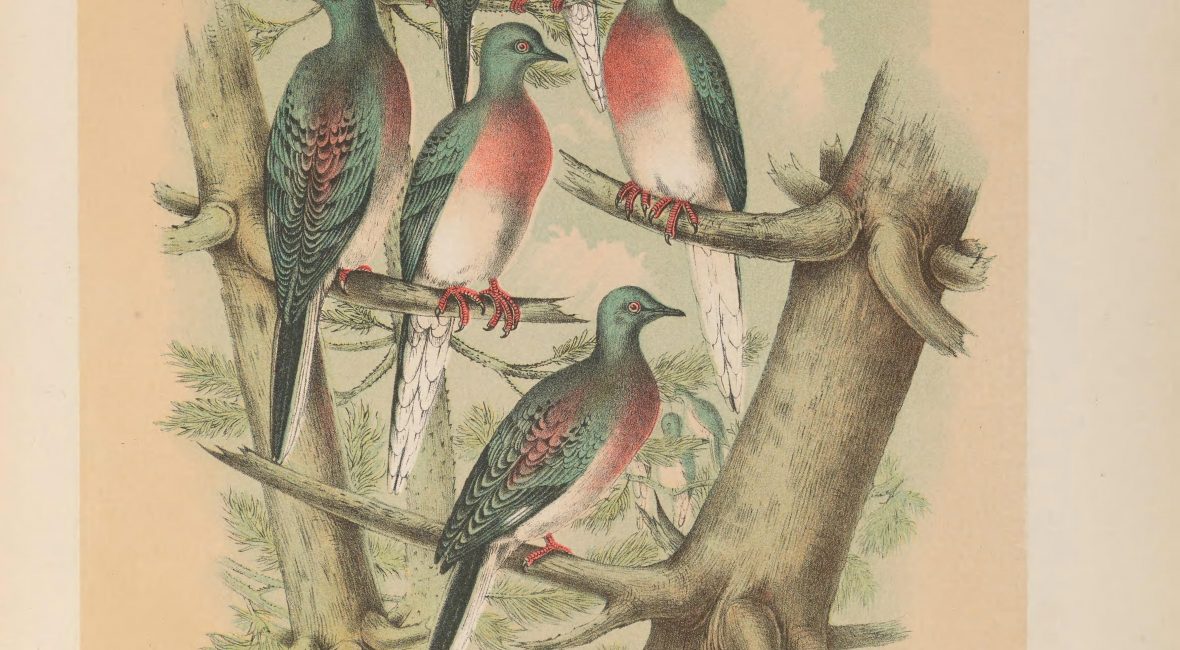
passenger pigeons sitting in a tree

Passenger pigeon (Ectopistes migratorius). The Birds of North America. 1903. Contributed in BHL from Smithsonian Libraries.

The passenger pigeon’s demise is one of the most infamous examples of human-caused extinction. Once the most abundant bird species in North America, it was hunted relentlessly, with large-scale commercial hunting facilitated by railroad distribution placing excessive pressure on the species. The population declined from billions to none in less than one hundred years.

The last passenger pigeon, Martha, died at the Cincinnati Zoological Garden at about 1pm on September 1, 1914.

While stories of passenger pigeon flocks blackening the skies underscore the species’ once staggering abundance, its distribution was concentrated in the eastern United States. But could there have been resident populations in the western U.S.?

Passenger pigeon bones uncovered from the La Brea Tar Pits in Los Angeles, California inspired Dr. Libby Ellwood to ask this very question and embark on a research project empowered by the Biodiversity Heritage Library’s collections.

woman standing in front of photos of animals

Dr. Libby Ellwood. Photo credit: Deborah Paul, Florida State University.

Ellwood has been studying ecology, and its intersection with climate change, conservation, and citizen science, for ten years. For the past year, she has been engaged as a Research Fellow at the La Brea Tar Pits & Museum. She first discovered BHL several years ago during her postdoc at iDigBio, a national resource for digitizing natural history collections and associated information. Since then, the Library has had a significant impact on her research.

“It may sound like hyperbole, but BHL truly is an invaluable resource,” lauds Ellwood. “I have used BHL to fill in datasets with historical data, to research foundational information, and, let’s be honest, just to look at the beautiful images. I have crossed paths with BHL staff and affiliates at conferences near and far and appreciate not only their digitization work, but equally their work to engage the online community in their efforts.”

When working on a research project, Ellwood sometimes accesses BHL daily for months at a time, reading publications online, taking notes and citation information as she goes, and downloading custom PDFs as needed. The Library has saved her precious time during these research projects.

“I know firsthand that weeks of travel to various libraries and special collections is resource and time-intensive,” shares Ellwood. “I have painstakingly used texts that have later been digitized by BHL. Had I to do it again, a good portion of that time and energy would be saved by using information available through BHL. All in all, I have a deep appreciation for BHL’s contributions to the digital landscape.”

Since BHL has proven to be such a valuable source of information for her research, it was the natural place for Ellwood to turn with questions surrounding the possibility of western passenger pigeon populations. In fact, as Ellwood shares, “In this particular case, the text and images in BHL have not only improved my research but have even driven it.”

Ellwood shared her preliminary research findings at the 2018 BHL Annual Meeting during an evening reception hosted by the Natural History Museum of Los Angeles County.

What did she find?

Read on to explore Ellwood’s account of her research to date and topics for further investigation.

Passenger pigeons of the western US – accident or resident?

By Dr. Libby Ellwood

Soon after starting my current position, I learned of the passenger pigeon bones we have in our collections at La Brea Tar Pits. While I might normally have considered this just another in a long list of cool fossils that we have in our collections, the relatively recent extinction of passenger pigeons got me thinking a little more deeply about it. More specifically, were there resident populations of passenger pigeons in southern California, or were these birds accidental visitors?

passenger pigeon bones

Three of the passenger pigeon bones found at La Brea Tar Pits, Howard, Hildegarde. “A Pleistocene record of the Passenger Pigeon in California.” The Condor 39.1 (1937): 12-14.

The La Brea Tar Pits fossils inform us that tens of thousands of years ago passenger pigeons were in what is now Los Angeles, California, though the extent of their range and population size at that time remain unknown. Passenger pigeons are a species that was so abundant in the eastern U.S. that their flocks would darken the skies…at least that was the case until we hunted them to extinction just over a hundred years ago.

While I might not be able to reconstruct tens of thousands of years of passenger pigeon abundance data in the western U.S., just how much information is out there about western populations of passenger pigeons? Is there information from the near historical past that could provide more information about this species’ distribution?

Enter BHL.

To cut to the chase, using documents accessed through BHL, I found numerous accounts of passenger pigeons west of the Rocky Mountains in the 1800s. Some accounts point to numerous birds, perhaps even resident populations of the species, while other accounts portray sightings of a lone individual, likely far from its intended route. My research using BHL has not yet been able to solidly answer whether or not passenger pigeons were ever residents of the western U.S., but it does open the possibility more widely.

map with locations of passenger pigeon localities

Map of passenger pigeon localities from a variety of sources. The western BHL points are the ones added through this current research. Image credit: Libby Ellwood.

With BHL, I added five additional points to the passenger pigeon range map. Where only one poor data point of modern-day western passenger pigeon sightings existed in the past, now there are six. And with this we now have an even more compelling reason to keep digging into this story. If in fact passenger pigeons lived in the western U.S. in some abundance, how far back do those populations go? Or, looking at it from the opposite direction, if there’s a possibility that the La Brea Tar Pits fossil specimens represent resident populations, for how long did those populations persist?

From here, I will continue this investigation by compiling more information about passenger pigeon fossil specimens as well as the more recent historical information to see if I can more deeply piece together a timeline of occurrence and abundance of this once common species.

————————————————-

Thank you, Dr. Ellwood, for sharing your research findings at our 2018 Annual Meeting and as part of our BHL User series! We look forward to learning more as your research progresses, and are thrilled to know that BHL is helping to paint a fuller picture of the passenger pigeon’s story.

May we learn from our past to make better decisions in the future and support a healthy, biodiverse planet.

September 13, 2018by michelle.underhill
BHL News, Blog Reel

Report from the Digital Data in Biodiversity Research Conference, University of Michigan

View Full Size Image
University of Michigan

The Digital Data in Biodiversity Research Conference was sponsored by iDigBio, the University of Michigan Herbarium, the University of Michigan Museum of Paleontology, and the University of Michigan Museum of Zoology. The conference was attended by about 185 people from a variety of institutions. I attended to participate in the GBIF North American Nodes Workshop and was joined by Alicia Esquivel (BHL NDSR Resident based at the Chicago Botanic Garden).

After a welcome from Dean Andrew D. Martin of the College of Literature, Science, and the Arts, the opening series of plenary talks began with Stephen Smith (University of Michigan) speaking on “The Utility of Large-scale Phylogenetic Analyses for Understanding the Evolution of Biodiversity.” The detailed talk covered the promise of a comprehensive view of the tree of life, whether for a particular clade or the entire tree of life which has been a major motivation of the systematics community for decades. Smith described new efforts and new ways for combining the resources from the Open Tree of Life with other phylogenetic analyses to construct a dated and comprehensive tree and discussed construction of a comprehensive tree for seed plants containing 80,037 taxa from GenBank and 356,807 total taxa.

View Full Size Image
Maureen Kearney

Maureen Kearney, Associate Director for Science, National Museum of Natural History (Smithsonian Institution) spoke next. Kearney’s talk, “Expanding the Power of Natural History Knowledge: Frontiers in Research and Collections at the Smithsonian’s National Museum of Natural History,” was an inspiring overview of the role of natural history museums in this era of rapid global change to mobilize collections data and natural history knowledge for science and society.

Kearney spoke of how natural history scientists help us comprehend the fundamental nature of the planet, of organisms (including humans), and of evolutionary and ecological interactions throughout the history of life on Earth. Enormous potential exists for natural history museums in the 21st century if they highlight their unique niche as irreplaceable research and data centers for the study of global change. Kearney also noted that this can only be realized if museums build large-scale pipelines and open-source, dynamic platforms to digitize, structure, link, and share our natural history data and knowledge. She spoke of key partners inside the National Museum of Natural History (such as the Global Genomics Initiative and the Encyclopedia of Life) and other partners at the Smithsonian, including the Biodiversity Heritage Library and the Smithsonian’s Digitization Program Office and its 3D imaging team.

View Full Size Image
Donald Hobern

Donald Hobern, GBIF Executive Secretary, spoke on “Preserving Evidence of Biodiversity Patterns: GBIF and Persistent Biodiversity Data Management.” Hobern gave an overview of GBIF as well as the goals of the GBIF implementation plan, which include simplifying and supporting data publishing and assisting with delivery of the most detailed version possible for each data source.

Other plenary talks included:

  • “Linking Heterogeneous Data in Biodiversity Research” by Pam Soltis, Florida Museum of Natural History, University of Florida
  • “Using ‘Digital Specimens’ to explore the behavioral phenotype” by Mike Webster, Cornell Laboratory of Ornithology
View Full Size Image
Dan Fisher

DAY 1: CONCURRENT SESSIONS
Full abstracts and details of the Concurrent Sessions are online. Sessions attended were:

  • 3D Surface Models in Paleontology and Archaeology by Dan Fisher, University of Michigan Museum of Paleontology. Used the Buesching mastodon (now at University of Michigan) as a case study for the talk. Walked through the excavation and the 3D imaging process. Digital data on the external form of specimens are central to many paleontological and archaeological analyses. Digital models minimize handling of fragile and/or heavy specimens, facilitate access and collaboration, allow complex measurements, enhance visualization of surface topography, and simplify inspection of multi-object assemblies.
  • Paleobiology Database: A Community Based Data Service for Research, Education, and Museums by Mark Uhen, George Mason University
  • MorphoSource: A Virtual Museum and Digital Repository for 3D Specimen Data by Doug Boyer, Duke University
  • ePANDDA: enhancing Paleontological and Neontological Data Discovery API by Susan Butts, Yale University; Seth Kaufman, Whirligig Inc.
  • The Importance and Challenges of Database Integration: MorphoBank, MorphoSource, and the Paleobiology Database by Julie Winchester, Duke University


View Full Size Image
Macklin, Hanner, Bruneau

AFTERNOON WORKSHOP
In the afternoon, the meeting offered focused workshops. The Biodiversity Heritage Library was invited to participate in the Digital Data and the North American Nodes of the Global Biodiversity Information Facility session led by Bob Hanner, Stinger Guala, and James Macklin. A goal of the workshop was to discuss the current status of the GBIF North American Nodes, current activities and collaborations.

Attended by about 50 participants, the presentations at the workshop included:

  • National and Regional Coordination Roles within GBIF (Donald Hobern)
  • Biodiversity Information Serving Our Nation (BISON): Connections and Cooperation (Stinger Guala)
  • The Canadian Biodiversity Information Facility (CBIF) (James Macklin)
  • Canadensys: revealing the biodiversity of Canada (Anne Bruneau)
  • Overview of the Biodiversity Heritage Library Recent Activities (Martin Kalfatovic)
  • The Catalogue of Life: Infrastructure for Science (Tom Orrell)
  • Global Genome Biodiversity Network – Infrastructure for Genomic Research (Jon Coddington)
  • iDigBio, National Coordinating Center for NSF’s ADBC Program (Larry Page)
View Full Size Image

The BHL talk, “Overview of the Biodiversity Heritage Library: Recent Activities” covered:

As the world’s largest open access digital library for biodiversity literature, the Biodiversity Heritage Library (BHL) is an unparalleled resource that has forever changed the way researchers around the globe understand, describe, and conserve life on Earth. BHL has become not only a model for digital libraries but also a fundamental resource for taxonomic literature aggregation, discovery, and presentation by engaging the taxonomic community and responding to user needs. To achieve this, BHL relies on many standards and tools, such as Digital Object Identifiers (DOIs), Application Programming Interfaces (APIs), and Global Names Architecture (GNA). These standards and tools help ensure that data in and about the literature matches the needs and expectations of the scientific community and is readily available for widespread reuse. To meet the evolving needs and expectations of researchers, we must continually innovate and adapt to the changing technological landscape.  BHL is in the process of organizing widespread user needs analysis and an environmental scan of information resources to define requirements for a next generation digital library.

The presentations were followed by a panel discussion and a conversation with the audience.

EVENING RECEPTION AND TOUR OF THE RESEARCH MUSEUMS CENTER
After the day’s meetings, attendees were bused to the Research Museums Center, located about 7.5 kilometers from the center of the University of Michigan campus. Participants were given the opportunity of guided tours of the University of Michigan Herbarium, collections areas of the Museum of Paleontology, and the wet and dry collections of the Museum of Zoology.

View Full Size Image View Full Size Image


View Full Size Image
Adam Summers

DAY 2: PLENARY TALKS
The second day again opened with plenary talks which included:

  • Big Data, Museum Specimens, Access and Archiving – Lessons from #scanAllFish by Adam Summers, University of Washington. Amazing high energy talk about Summers’ project #scanAllFish, over 1,991 species, 3,094 specimens from 109 collections. Expects to store over half a petabyte of data for 30,000 vertebrates. Storing and backing these data up is an issue. It is also interesting to consider what collections plan to do when these data are returned to them with the specimens.
  • Video Data and Motion Analysis in Comparative Biomechanics Research by Beth Brainerd, Brown University. “Film or video recordings have long been important primary data for research in comparative biomechanics. Innovations have included the use of two or more cameras to capture 3D motion, and the use of two X-ray video cameras (fluoroscopes) to capture 3D motion of bones in vivo. Over the past decade we have developed X-ray Reconstruction of Moving Morphology (XROMM), which combines  dual-fluoroscopy with bone models from CT scans to produce accurate animations of 3D bones moving in 3D space.”
  • The PREDICTS Project: Projecting Responses of Ecological Diversity In Changing Terrestrial Systems by Adriana De Palma, Natural History Museum, London. “PREDICTS is a collaborative project that aims to produce global models of how local biodiversity responds to land use and related human impacts, in order to make projections under possible future scenarios.”
  • Field Collections to Digital Data: A Workflow for Fossils and the Use of Digital Data for Reconstructing Ancient Forests by Dori Contreras, University of California Museum of Paleontology. “The integration of curation and digitization with project-focused data collection is a key component to performing time-efficient studies from new fossil collections. Standard workflows for processing fossil specimens starting from initial field collection and continuing through digital analysis/measurement are not widely established. Here I present my workflow for reconstruction of a diverse Late Cretaceous flora from plant macrofossils preserved in an extensive recrystallized volcanic ashfall deposit.”
  • Natural History Data Pipelines: The Good, the Bad, and the Ugly by Andy Bentley, University of Kansas Biodiversity Institute. “Collections, aggregators, data re-packagers, publishers, researchers, and external user groups form a complex web of data connections and pipelines that form the natural history knowledge base essential for collections use by an ever increasing and diverse external user community.  We have made great strides in developing the individual parts of this knowledge base and we are now well poised to integrate these capabilities to address big picture questions.  Although we need to continue work on the individual pieces, the focus now needs to be on integration of these disparate sources of data that create the pipeline.”
View Full Size Image
Esquivel

DAY 2: CONCURRENT SESSIONS
Sessions attended included:

  • Using Statistical Analysis to Calculate the Size of Biodiversity Literature by Alicia Esquivel, Chicago Botanic Garden
  • Illustrating Value Added in Databasing Historical Collections: Entered, Proofed, and Done (or Not!) by Tony Reznicek, University of Michigan Herbarium
  • The Encyclopedia of Life v3: constructing a linked data model by Jennifer Hammock, National Museum of Natural History, Encyclopedia of Life, Smithsonian Institution
  • Encyclopedia of Life Version 3: New Tools for the Exploration of Biodiversity Knowledge by Katja Schulz, National Museum of Natural History, Encyclopedia of Life, Smithsonian Institution
  • How do People see Biodiversity? Using a Digital Identification Key in a Citizen Science Program by Mathilde Delaunay, Muséum national d’Histoire naturelle, Paris, France
  • Taxonomic Data Quality in GBIF: A Case Study of Aquatic Macroinvertebrate Groups by Joan Damerow, Field Museum of Natural History
  • Hole-y Plant Databases! Understanding and Preventing Biases in Botanical Big Data by Katelin D. Pearson, Florida State University
View Full Size Image

Alicia Esquivel’s talk was an excellent overview of the BHL NDSR Resident program and the important work being done by the group as BHL looks forward to BHL Version 2. Esquivel’s work focuses on looking for gaps in the BHL collections and other collections analysis. In addition to her talk, she also presented a poster (co-authored by Constance Rinaldo, BHL Chair / Museum of Comparative Zoology, Harvard University).

CAPSTONE SESSION

  • Prospects for the Use of Digitized Specimens in Studies of Plant Diversity and Evolution by Michael Donoghue, Yale University
  • A Vision for a National Cyberinfrastructure for Biodiversity Research and what NSF can do Enable it by Peter McCartney, National Science Foundation

OTHER RESOURCES

  • Link to Abstracts for Plenary Talks | Concurrent Sessions | GBIF Workshop | Poster Sessions
  • Conference Information Page | Conference Wiki Page
  • iDigBio Blog Post
  • Link to Twitter Hashtag: #digibiodata
View Full Size Image
Research Museums Center, University of Michigan
June 14, 2017by
BHL News, Blog Reel

While standing on the shoulders of giants…

Learning lessons from the CITScribe Hackathon participation

Two members of BHL’s Technical Advisory Group (TAG), BHL Technical Director William Ulate from Missouri Botanical Garden and Joe deVeer, Head of Technical Services of the Ernst Mayr Library at the Museum of Comparative Zoology, Harvard, “virtually” attended the CITSCribe Hackathon in Gainesville, Florida from Dec. 16 to 20, 2013.

The hackathon was co-organized by iDigBio (www.idigbio.org) and Zooniverse’s Notes from Nature Project (www.notesfromnature.org). Led by the co-organizers Rob Guralnick (University of Colorado, Boulder) and Austin Mast (Florida State University), the objective of the hackathon was to further enable public participation in the online transcription of biodiversity specimen labels and to produce new functionality and interoperability for Zooniverse’s Notes from Nature and similar transcription tools.  The event started by focusing on four areas of development, progressively addressed throughout the week: (1) interoperability betweenpublic participation tools and biodiversity data systems, (2) transcriptionquality assessment/quality control (QA/QC) and the reconciliation of replicatetranscriptions, (3) integration of optical character recognition (OCR) into thetranscription workflow, and (4) user engagement.

View Full Size Image
The LI LI Hackathon subgroup working on the integration of OCR.

For a while now, the BHL Technical Advisory Group (TAG) has been participating in the events of iDigBio, particularly on the Augmenting OCR Working Group, under Deb Paul and Bryan Heidorn’s guidance.  One of our BHL colleagues and TAG members, John Mignault from New York Botanical Garden, also participated last year at iDigBio’s previous hackathon which primarily focused on parsing OCR output to standard darwin core.

This time, we had a presentation by Cody Meche, an Agile trainer who gave some useful directions and tips on how to approach our hackathon to use our time as efficiently as possible while following an agile development process.  Alex Thompson, from iDigBio, presented on the digital resources that could allow programmers to run a copy of the web interface of Notes for Nature on their local machines using Vagrant and Virtualbox.  Paul Kimberly also presented the Smithsonian transcription project (transcription.si.edu) and Yonggang Liu talked about iDigBio’s image ingestion tool, useful for getting images into the iDigBio cloud.  Laura Whyte, Director of Citizen Science at Adler Planetarium joined us virtually at the Hackathon to talk about Zooniverse and citizen science.

I also had a chance to present shortly about our approach to OCR and Transcription with in our Purposeful Gaming project funded by the Institute of Museum and Library Services (IMLS). Basically, we intended to leverage iDigBio’s knowledge while tackling the challenge of improving the existing BHL OCR through Purposeful Gaming.  Our interest was mainly two-fold: on one side we wanted to learn from the amazing cumulative experience and skills that iDigBio comprises and the tools that are being adapted, built and used to generate the OCR and transcribe the text of their specimen labels; a challenge very similar to our own issues with OCR of books and journals in BHL.  On the other hand, we wanted to learn from their workflow definition to improve the OCR generation process, the incorporation of their transcription outputs and the reconciliation of the existing versions into a single one (for example, read about using sequence aligning methods on this recent blogpost by Rob Guralnick), while at the same time taking advantage of the citizen scientists’ help in an efficient manner that copes with the scale of the challenge.

View Full Size Image
High level workflow proposed for the Purposeful Gaming project

Specifically, our short term goals include incorporating recommendations and adapting existing tools developed by many of the participants in the past two hackathons: Jason Best’s DarwinScore, Ben W. Brumfield’s work on QC for Collaborative (Crowdsourced) Manuscript Transcription, the QA/QC track developments to take outputs from the citizen science transcription products and assure the highest quality end result, are just some among many other outputs and suggestions from these activities that can be incorporated to our process of improving the OCR texts in BHL.  And if you have more ideas, I would definitely like to hear about them…

For more information on the recent CITScribe Event read this iDigBio’s blogpost, Austin Mast’s detailed blog post or consult directly the Hackathon wikipage.

You can access all information and results about iDigBio in their home page and follow our own BHL developments from the webpage of the Purposeful Gaming project, made possible in part by the Institute for Museum and Library Services [Grant number LG-05-13-0352-13].

View Full Size Image

January 23, 2014by Joanne A. Schneider

Help Support BHL

BHL's existence depends on the financial support of its patrons. Help us keep this free resource alive!

search

About BHL

The Biodiversity Heritage Library (BHL) is the world’s largest open access digital library for biodiversity literature and archives. BHL operates as a worldwide consortium of natural history, botanical, research, and national libraries working together to digitize the natural history literature held in their collections and make it freely available for open access as part of a global “biodiversity community.”

Join Our Mailing List

Sign up to receive the latest news, content highlights, and promotions.

Subscribe Now

Subscribe to Blog via Email

Enter your email address to subscribe to this blog and receive notifications of new posts by email.

Join 319 other subscribers

Subscribe to Blog Via RSS

Subscribe to the blog RSS feed to stay up-to-date on all the latest BHL posts.

Access RSS Feed

Inspiring Discovery through Free Access to Biodiversity Knowledge.

The Biodiversity Heritage Library makes it easier than ever for you to access the information you need to study and explore life on Earth…for free, anytime, anywhere.


64+ Million Pages of
Biodiversity Literature Online.

EXPLORE

Tools and Services
to Transform Research.

EXPLORE

300,000+
Illustrations on Flickr.

EXPLORE

ABOUT | HARMFUL CONTENT | PRIVACY | SITE MAP | TERMS OF USE