
Biodiversity Heritage Library - Program news and collection highlights from BHL
  • Home
  • News
  • Featured Books
    • All Featured Books
    • Book of the Month Series
    • BHL at 20
  • User Stories
  • Campaigns
    • Fossil Stories
    • Garden Stories
    • Monsters Are Real
    • Page Frights
    • Her Natural History
    • Earth Optimism 2020
  • Tech Blog
  • Visit BHL
Home
News
Featured Books
    All Featured Books
    Book of the Month Series
    BHL at 20
User Stories
Campaigns
    Fossil Stories
    Garden Stories
    Monsters Are Real
    Page Frights
    Her Natural History
    Earth Optimism 2020
Tech Blog
Visit BHL
  • Home
  • News
  • Featured Books
    • All Featured Books
    • Book of the Month Series
    • BHL at 20
  • User Stories
  • Campaigns
    • Fossil Stories
    • Garden Stories
    • Monsters Are Real
    • Page Frights
    • Her Natural History
    • Earth Optimism 2020
  • Tech Blog
  • Visit BHL
Biodiversity Heritage Library - Program news and collection highlights from BHL
BHL News, Blog Reel

BHL at the 2nd Global Biodiversity Informatics Conference

As part of BHL’s mission to ‘improve research methodology by making biodiversity literature openly available to the world as part of a global biodiversity community’, the BHL Secretariat and Partners regularly participate in meetings and initiatives centered on collaborating with other biodiversity organizations throughout the world. One such recent event was the 2nd Global Biodiversity Informatics Conference (GBIC2) held in Copenhagen from 24-27 July 2018.

Organized by the Global Biodiversity Information Facility (GBIF), the meeting convened stakeholders from across the biodiversity informatics community to explore a model for coordinating across geographic and political boundaries to share and link data managed by various biodiversity infrastructures. GBIC2 was organized to build on outcomes and recommendations from the first GBIC meeting held in 2012. The Global Biodiversity Informatics Outlook (GBIO) framework (pictured below), developed as part of that first GBIC meeting, served as a foundation for exploring various considerations–from the cultural to the technological–involved in managing and sharing resources related to biodiversity data, evidence, and understanding.
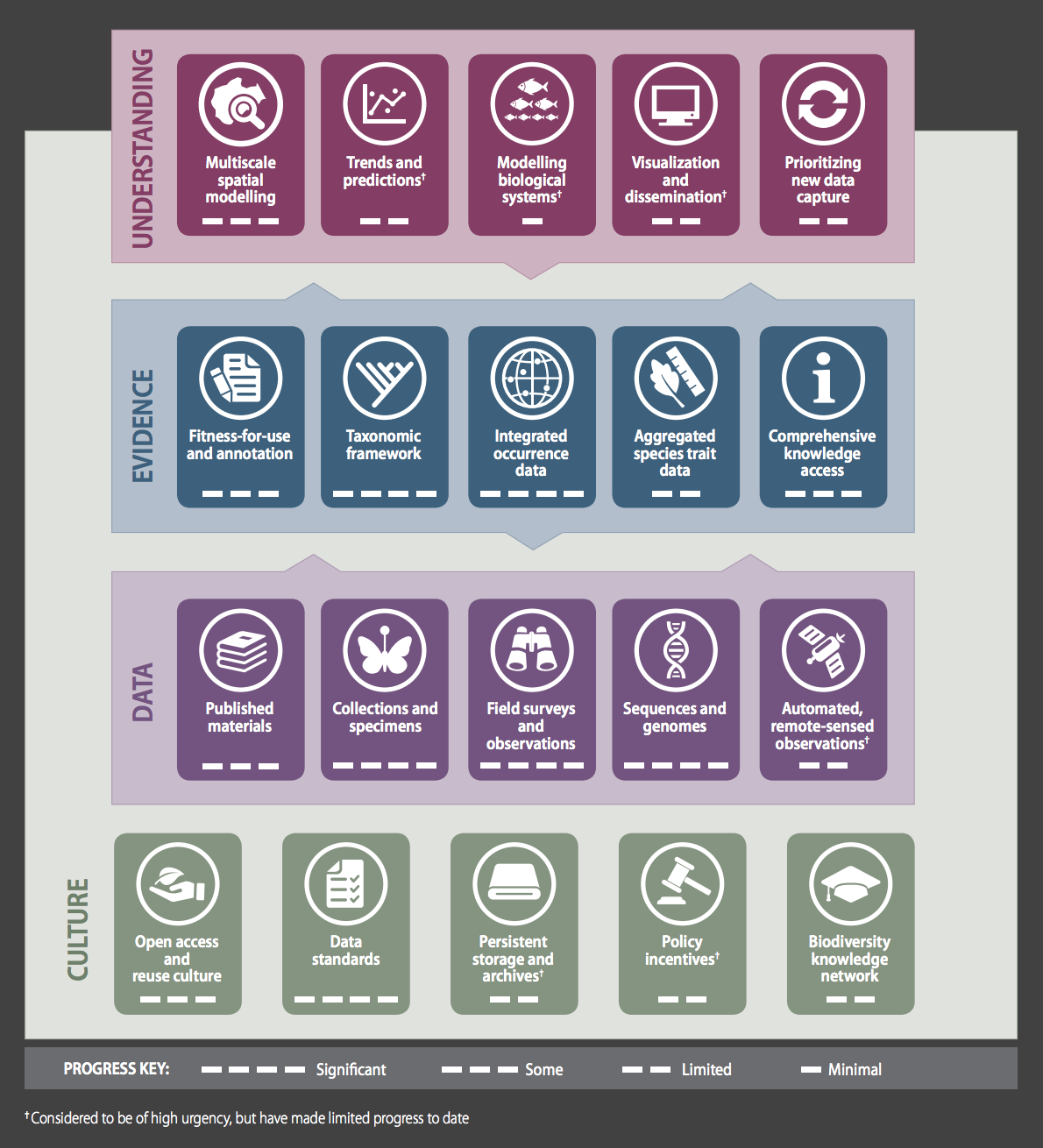
GBIO.png

Global Biodiversity Informatics Outlook (GBIO) framework.

The meeting kicked off with three plenary presentations followed by an interactive exercise to illustrate some of the key components of the current biodiversity informatics landscape. The presentations provided various perspectives from within and beyond the immediate biodiversity informatics. Topics covered experiences in other scientific domains on coordinating international collaboration, perspectives of funding agencies, and background on the GBIO framework and the high-level vision for a coordinating mechanism that would help guide discussions through the rest of the meeting. Speakers included Robert Hanisch, Director of the Office of Data and Informatics in the Material Measurement Laboratory at NIST; Maria Uhle, Program Director for International Activities at the National Science Foundation; and Donald Hobern, Executive Secretary of GBIF.

Following the presentations, the professional consultant firm Taylor + Tyler conducted an exercise with Donald Hobern, Executive Secretary of GBIF, to identify overarching goals, key stakeholders, and the connections as well as challenges between those, all through an interactive use of various toys and bits and other representative figurines. The resulting candidate model was used as a starting point for discussions on global coordination of biodiversity knowledge management, notably in ways that might help inform decisions and policies to protect biodiversity, particularly as related to Aichi Targets and Sustainable Development Goals (SDGs).

On the second day, conference attendees broke out into four groups and held parallel sessions, each organized around one of the following four GBIO components: Biodiversity Knowledge Network; Published Materials; Integrated Occurrence Data; Trends and Predictions. Each of these four groups was co-facilitated by GBIF staff with an invited representative. BHL’s Program Manager, Carolyn Sheffield, worked with GBIF Science Communications Coordinator, Daniel Noesgaard, to facilitate the Published Materials group. Approximately twenty attendees participated in this group, including several of our BHL colleagues from BHL Partner institutions including Patricia Koleff (CONABIO/BHL Mexico), Nicole Kearney (Museums Victoria/BHL Australia), and Lawrence Monda (National Museums of Kenya/BHL Africa). In addition, other participants also hailed from BHL Partner institutions (e.g., Harvard University and Museum National d’Histoire Naturelle), and while they themselves may not be directly involved in BHL, it was a pleasure to have the opportunity to meet and work with them.

The four groups participated in a series of exercises throughout the day to identify challenges facing the component areas, define sample investments for addressing those challenges, and then rank those investments according to criteria such as cost and value. Breakout groups were encouraged to consider not just technical challenges but also social and cultural challenges.

Some themes that emerged in the Published Materials Group included connecting taxon names to literature, assigning and appropriately managing DOIs for historic literature, and enabling more robust linkages between the literature and other biodiversity resources. The day concluded with a discussion of the process as a potential operating model for a coordinating mechanism for globally collaborative initiatives around sharing and linking about biodiversity data.

On the third day, all participants reconvened to debrief. Paul Taylor (of Taylor + Tyler) facilitated a discussion with the session leads to reflect on the experiences of the four groups. All told, the consensus seemed to be that while there were undoubtedly elements that couldn’t be addressed in a day-long exercise, the overall model was one that could be expanded and scaled up.

The report-outs were followed by two plenary presentations on governance models adopted by the intergovernmental organization ELIXIR and the Apache Software Foundation. Jerry Lanfear, Chief Technology Officer of ELIXIR, presented on their collaborative infrastructure and governance for coordinating life science resources across Europe. Ismaël Mejía, Member of the Apache Software Foundation, presented on the values that underlie the distributed network of programmers that form Apache. Specifically, he highlighted the commitment to open source development and merit-based opportunities. The day concluded with open discussions on the models presented and their potential applications for coordinated efforts across the wider biodiversity community.

The final day of the conference provided opportunities for further discussion on the proposed establishment of a coordinating mechanism. Participants reflected on the types of goals that might be achieved—and the types of coordination that might be required—by establishing a coordinated approach to biodiversity data sharing and linking. The group revisited the significance of extending beyond short-term, locally-based project initiatives to seek more globally coordinated opportunities in order to contribute to high impact outcomes such as those outlined in the Aichi Targets and Sustainable Development Goals (SDGs). All told, participants reached consensus on the value of establishing a “light weight coalition” and called on GBIF to take the lead.

The GBIC2 Organizing Committee is now in the process of producing consultation documents outlining a path forward and plans to make these available in multiple languages, including the 6 UN languages. In addition, information from the meeting has already been shared via two sessions at the recent SPNHC-TDWG 2018 Conference in Dunedin, New Zealand:

• W05 – Developing a mechanism to coordinate planning and investment in biodiversity informatics. Organiser – Donald Hobern.

• W05 – Developing a mechanism to coordinate planning and investment in biodiversity informatics. Organisers – Donald Hobern, Rebecca Snyder and Thomas Orrell. Moderator – Rebecca Synder Castle B (32)

We look forward to the forthcoming report and continued developments and opportunities for working with our colleagues across the global biodiversity informatics landscapes. Learn more about GBIC2.

September 12, 2018by brooksm
BHL News, Blog Reel, Tech Updates

Revised BHL Architecture

Portrait version of the Biodiversity Heritage Library logo.

A revised diagram & description of the BHL hardware architecture is available at:

http://www.slideshare.net/chrisfreeland/bhl-architecture-july-2008/

July 22, 2008by [email protected]
BHL News, Blog Reel, Tech Updates

On Name Finding in the BHL

Portrait version of the Biodiversity Heritage Library logo.

An important feature of the Biodiversity Heritage Library that sets it apart from other mass digitization projects is our incorporation of algorithms and services to mine taxonomically-relevant data from of the 2.9 million (as of the date of this posting) pages digitized through our partnership with the Internet Archive. These services, including TaxonFinder, developed by partners at uBio.org, allow BHL to identify words in digitized literature that match the characteristics of latin-based scientific names, then verify accuracy of the word or words being a scientific name by comparing them to NameBank, uBio.org’s repository of more than 10.7 million recorded scientific names and their variants. The resulting index of names found throughout these historic texts is an incredibly valuable dataset, whose richness and use has just begun development.

The massive index and interfaces to it are new (from development to production within 8 weeks), so the BHL Development Team has been gathering feedback from users, evaluating usage statistics, and working with both librarians and scientists to determine what is working with the interface and what needs refinement. The following issues have been identified:

1. Volume and scalability
BHL currently manages 2.9 million pages in its database, with each page equating to an image & its derivatives stored on a filesystem at the Internet Archive. Using uBio’s services, we’ve located a total of 14.7 million name strings across texts, with 10.4 million of those verified to an entry in NameBank.

Scalability quickly becomes an issue as BHL expects to digitize 60 million pages within 5 years. Faced with hundreds of millions of name occurrences, the challenge becomes how to efficiently store and query this dataset. BHL data are currently stored in SQL Server 2005, which can scale to expected volumes and contains tools for load balancing and clustering. Ultimately, though, these issues of volume and scalability are resolvable as the dataset is not excessively complicated in structure. With enterprise-level hardware, optimized code and data access layers, and intelligent cacheing (all of which are currently in use), BHL can efficiently store and provide access to the vast index of scientific names identified through algorithmic means.

2. OCR
Commercial Optical Character Recognition (OCR) programs, such as ABBY FineReader or PrimeOCR, work very well for texts printed after the advent of industrialized and standardized printing techniques (loosely since the late 1800’s). Unfortunately the OCR programs are considerably less accurate on texts that match the characteristics of much of what BHL is scanning, including texts printed with irregular typeface and typesetting, and texts printed in multiple languages, including Latin.

The impact here is that if the texts are not accurately recognized, the names contained within can’t be identified. The accuracy of the OCRed text is therefore incredibly important, and unfortunately nearly impossible to improve through automated means as OCR technology has not really changed much since the mid-1980’s. Alternatives such as offshore rekeying or volunteer text conversion through the Distributed Proofreaders or other crowdsourcing projects are either prohibitively expensive or would require enormous effort above and beyond what could be volunteered given BHL’s estimated page count. BHL is not alone in facing this problem; every initiative that OCRs historic texts has encountered this unfortunate gap in accuracy. If you are aware of any new efforts to improve OCR, please use the comment form below.

3. False positives
As BHL was indexing botanical texts repeated occurrences of “Ovarium” were being located; an unusual result as Ovarium is both an echinoderm (marine invertibrate) as well as a term used in botany to describe the lower part of the pistil or female organ of the flower. After reviewing the page occurrences it became clear that the TaxonFinder algorithm was accurately identifying a word and making a match to an entry in NameBank, but in this case the context was off. In nearly every entry, the word “ovarium” was not used to describe the marine invertebrate, but rather to describe the form of a flower in a taxonomic description. Similar false positives exist, such as Capsula and Fructus.

Upon further review the problem is most prevalent with names used at higher classification levels; results for “Genus species”, such as Carcharodon carcharias (Great white shark) are much less likely to be false positives. Clearly more evaluation is needed to understand the true magnitude of the problem, hopefully resulting in refinement of the TaxonFinder algorithm.

4. Usability
Gregory Crane of Tufts University asked, in an oft-cited paper, “What Do You Do With a Million Books?” The challenge facing BHL Developers (and users) is more along the lines of “What do you do with 19,000 pages containing Hymenoptera?”

Because the BHL names index is growing rapidly, the methods of viewing and filtering results in a meaningful way becomes challenging. It’s clear that a user isn’t going to manually sift through and review every one of those pages. We can facilitate downloading the results in standard forms for reference management software, such as Zotero or EndNote, but how does BHL introduce relevancy rankings or other metrics for refining results – what exactly defines relevancy for occurrences of a name throughout scientific literature?

5. Accuracy and completeness
And now for a reality check. BHL text will never be 100% accurate, and our names index will never be 100% complete. We’re using automated software and services to process the millions of pages in the BHL collection because to do anything but an automated analysis simply won’t scale. The names index and the services that support its creation and display are modular – should radically new character or word recognition software come along, the scanned images can be reprocessed and reindexed using TaxonFinder. And should a better taxonomic name finding algorithm emerge, it can replace TaxonFinder in our application. As technologies emerge to improve text transcription and indexing, BHL will evaluate them and deploy them with our app is they prove effective.

Future work
It’s clear that we’ve identified enhancements needed in TaxonFinder to reduce the number of false positives. How best to implement those enhancements is yet to be determined, but at least we have data to guide us. We also plan to enhance the interface used for the discovered bibliographies, as the current implementation is not performant for large result sets. Further, we expect to facilitate downloading of the results in a standard format, such as BibTeX.

In closing, BHL is currently employing emerging technologies to transcribe and index a large collection of digitized scientific literature, and providing innovative interfaces into the data mined from it. These interfaces are rapidly evolving to meet user needs, based on user feedback, so if you have a suggestion for improvement please provide it via our Feedback form or on the comments below.

–

March 4, 2008by oneclickorders
BHL News, Blog Reel, Tech Updates

Senior Programmer needed to assist BHL development

Portrait version of the Biodiversity Heritage Library logo.

The Missouri Botanical Garden (MOBOT), located in St. Louis, MO, is seeking to hire a Senior Programmer Analyst to work on several large biodiversity informatics projects, including the Biodiversity Heritage Library (BHL) online at www.biodiversitylibrary.org.

Primary responsibilities for this position include leading the development effort for MOBOT’s LAMP-based applications, complementing the existing .Net team. Up first on the development schedule is the instantiation of Fedora (www.fedora-commons.org) at MOBOT as a repository layer in our multi-platform, SOA-based infrastructure, then refactoring applications and building new ones to utilize Fedora. Future projects include enhancement of the BHL GUI and development of tools for managing digital library content.

Qualifications include a BS in Computer Science or related field, 5 years experience developing enterprise-level applications, and 2 years experience leading a development team. Experience managing data and applications in an open source environment (LAMP and its variants) required. Experience managing biodiversity and/or library datasets preferred, but not required.

To apply online, please visit:
http://www.mobot.org/jobs/mbgjobs.asp#H005

January 4, 2008by [email protected]
Blog Reel

Eggplant Leafroller Moth reared on Potatoes

Portrait version of the Biodiversity Heritage Library logo.

The following page from Biologia Centrali Americana, Insecta Lepidoptera-Heterocera v. 4 shows an interesting example of a proximity search we’d like to support with BHL Name Services – “find species x within n characters/words of species y.”

View Full Size Image

http://www.biodiversitylibrary.org/page/593637

Halfway through the entry for Lineodes integra you’ll see a character that looks like a crosshair, followed by “Solanum spp. 4-5,8, S. radula4-5, S. jasminifolium4-5, S. tuberosum (=Potato)8.” According to Wolfram Mey, the leading lepidopterist of the Museum of Natural History (MfN), Berlin:

The symbol means that the species has been reared from/on the particular plant. The symbol has been in use particularly by the old British authors, particularly Lord Walsingham, and is also used on the labels attached to the specimens. (translation by Dr. Michael Ohl)

What this tells us is Lineodes integra (Eggplant Leafroller Moth) is reared on a variety of Solanum species, including Solanum tuberosum (Potato). This example was uncovered during a Name search for Solanum tuberosum; the resulting bibliography included a link to this volume on insects from the Biologia Centrali-Americana, which seemed unusual given the search was for a plant species. This demonstrates why we’d want to facilitate proximity searches, so that users could find pages where both Lineodes integra and Solanum tuberosum occurred to aid in the discovery of predator-prey, plant-pollinator, or other coevolutionary relationships.

This example also suggests that our OCR algorithms are woefully inadequate to infer these kinds of relationships through automated means; the crosshair symbol was identified as ©.

December 18, 2007by [email protected]
BHL News, Blog Reel, Tech Updates

BHL Name Services v.1.0 released

Portrait version of the Biodiversity Heritage Library logo.

Name Services

Last updated: January 28, 2008 Mike Lichtenberg

Overview

The name services are XML-based web services that can be invoked via SOAP or HTTP GET/POST requests. Responses can be received in one of three formats: XML wrapped in a SOAP envelope, XML, or JSON.

If you want to use SOAP to invoke the service methods, you can navigate to http://www.biodiversitylibrary.org/services/name/NameService.asmx to view the available methods. From that page, you can view the WSDL document for the web service, or click on each method to see detailed information about invoking the method and about the data that is returned.

If you are using HTTP to invoke the methods, the services are located at http://www.biodiversitylibrary.org/services/name/NameService.ashx. Note the difference in the extension on the service URL: ASHX for HTTP vs. ASMX for SOAP.

Descriptions of each service, as well as more details on invoking the methods via HTTP follow.

Methods

NameCount

Returns the number of unique confirmed names in the BHL database.

If the optional start and end dates are specified, then only names added or updated between the dates are counted.

Requests
SOAP:

 NameCount()

 NameCountBetweenDates(“01/01/2008”, “01/31/2008”)

HTTP returning XML:

http://www.biodiversitylibrary.org/services/name/NameService.ashx?op=NameCount&format;=xml

http://www.biodiversitylibrary.org/services/name/NameService.ashx?op=NameCount&startDate;=01/01/2008&endDate;=01/31/2008&format;=xml/services/name/NameService.ashx?op=NameCount&startDate;=01/01/2008&endDate;=01/31/2008&format;=xml

HTTP returning JSON (with and without a user-specified callback):

http://www.biodiversitylibrary.org/services/name/NameService.ashx?op=NameCount&format;=json

http://www.biodiversitylibrary.org/services/name/NameService.ashx?op=NameCount&startDate;=01/01/2008&endDate;=01/31/2008&format;=json

http://www.biodiversitylibrary.org/services/name/NameService.ashx?op=NameCount&format;=json&callback;=MyCallback

http://www.biodiversitylibrary.org/services/name/NameService.ashx?op=NameCount&startDate;=01/01/2008&endDate;=01/31/2008&format;=json&callback;=MyCallback

Responses

XML:

http://www.w3.org/2001/XMLSchema-instance" xmlns:xsd="http://www.w3.org/2001/XMLSchema">

 ok

 436445

JSON:

{

  "Status":"ok",

  "ErrorMessage":null,

  "NameResult":436445

}

These responses show that there are 436445 unique names.

NameList

Returns a list of unique names from the BHL database.

There are two required parameters. “startRow” identifies the first name to return, and “batchSize” indicates how many names to return. The maximum allowed “batchSize” is 1000.

Optionally, “startDate” and “endDate” parameters can also be specified. If the dates are specified, then only names added or updated between the dates are returned.

Each of the following request and response examples assumes a startRow value of 1 and a batchSize value of 5.

Requests
SOAP:

 NameList(“1”, “5”)

 NameListBetweenDates(“1”, “5”, “01/01/2008”, “01/31/2008”)

HTTP returning XML:

http://www.biodiversitylibrary.org/services/name/NameService.ashx?op=NameList&startRow;=1&batchSize;=5&format;=xml

http://www.biodiversitylibrary.org/services/name/NameService.ashx?op=NameList&startRow;=1&batchSize;=5&startDate;=01/01/2008&endDate;=01/31/2008&format;=xml

HTTP returning JSON (with and without a user-specified callback):

http://www.biodiversitylibrary.org/services/name/NameService.ashx?op=NameList&startRow;=1&batchSize;=5&format;=json

http://www.biodiversitylibrary.org/services/name/NameService.ashx?op=NameList&startRow;=1&batchSize;=5&startDate;=01/01/2008&endDate;=01/31/2008&format;=json

http://www.biodiversitylibrary.org/services/name/NameService.ashx?op=NameList&startRow;=1&batchSize;=5&format;=json&callback;=MyCallback

http://www.biodiversitylibrary.org/services/name/NameService.ashx?op=NameList&startRow;=1&batchSize;=5&startDate;=01/01/2008&endDate;=01/31/2008&format;=json&callback;=MyCallback

Responses

XML:

http://www.w3.org/2001/XMLSchema-instance" xmlns:xsd="http://www.w3.org/2001/XMLSchema">

 ok


3456919

 Aalius


8498321

 Aamia


1803753

 Aaronsohnia


4053043

 Ababactus


240834

 Abacina

JSON:

{  

   "Status":"ok",

   "ErrorMessage":null,

   "NameResult":[  

      {  

         "NameBankID":3456919,

         "NameConfirmed":"Aalius",

         "Titles":null

      },

      {  

         "NameBankID":8498321,

         "NameConfirmed":"Aamia",

         "Titles":null

      },

      {  

         "NameBankID":1803753,

         "NameConfirmed":"Aaronsohnia",

         "Titles":null

      },

      {  

         "NameBankID":4053043,

         "NameConfirmed":"Ababactus",

         "Titles":null

      },

      {  

         "NameBankID":240834,

         "NameConfirmed":"Abacina",

         "Titles":null

      }

   ]

}

Calling this method repeatedly, you can parse the entire list of names. Here is an example of how that might be accomplished:

x = 1;

numberOfNames = BHLService.NameCount();

while (x <= numberOfNames) {

  // Get the next 1000 names

  Names = BHLService.NameList(x, 1000);

  //do something with Names…

  x += 1000;

}

In this example, “BHLService.NameCount()” and “BHLService.NameList()” represent calls to the Name Service methods. Implementation details for these will vary depending on the toolset (PHP, Java, .NET or other) and method (SOAP or HTTP) used to interact with the web service.

NameSearch

Returns a list of names that match exactly or start with the specified name.

The required “name” parameter identifies the name for which to search.

Each of the following request and response examples assumes a name search for “zea mays”.

Requests
SOAP:

 NameSearch("zea mays")

HTTP returning XML:

http://www.biodiversitylibrary.org/services/name/NameService.ashx?op=NameSearch&name;=zea+mays&format;=xml

HTTP returning JSON (with and without a user-specified callback):

http://www.biodiversitylibrary.org/services/name/NameService.ashx?op=NameSearch&name;=zea+mays&format;=json

http://www.biodiversitylibrary.org/services/name/NameService.ashx?op=NameSearch&name;=zea+mays&format;=json&callback;=MyCallback

Responses

XML:

http://www.w3.org/2001/XMLSchema-instance" xmlns:xsd="http://www.w3.org/2001/XMLSchema">

 ok


3875305

 Zea mays


5416258

 Zea mays ceratina


5416273

 Zea mays convar. ceratina


5416702

 Zea mays convar. mays


5416216

 Zea mays subsp mays


5416216

 Zea mays subsp. mays

JSON:

{  

   "Status":"ok",

   "ErrorMessage":null,

   "NameResult":[  

      {  

         "NameBankID":3875305,

         "NameConfirmed":"Zea mays",

         "Titles":null

      },

      {  

         "NameBankID":5416258,

         "NameConfirmed":"Zea mays ceratina",

         "Titles":null

      },

      {  

         "NameBankID":5416273,

         "NameConfirmed":"Zea mays convar. ceratina",

         "Titles":null

      },

      {  

         "NameBankID":5416216,

         "NameConfirmed":"Zea mays subsp mays",

         "Titles":null

      },

      {  

         "NameBankID":5416216,

         "NameConfirmed":"Zea mays subsp. mays",

         "Titles":null

      },

      {  

         "NameBankID":5416232,

         "NameConfirmed":"Zea mays tunicata",

         "Titles":null

      }

   ]

}

NameGetDetail

Returns the publication details for the specified NameBankID.

The required “nameBankID” parameter identifies the NameBankID for which to retrieve publication details.

Requests
SOAP:

 NameGetDetail("4906323")

HTTP returning XML:

http://www.biodiversitylibrary.org/services/name/NameService.ashx?op=NameGetDetail&nameBankID;=4906323&format;=xml

HTTP returning JSON (with and without a user-specified callback):

http://www.biodiversitylibrary.org/services/name/NameService.ashx?op=NameGetDetail&nameBankID;=4906323&format;=json

http://www.biodiversitylibrary.org/services/name/NameService.ashx?op=NameGetDetail&nameBankID;=4906323&format;=json&callback;=MyCallback

Responses
XML:


http://www.w3.org/2001/XMLSchema-instance" xmlns:xsd="http://www.w3.org/2001/XMLSchema">

 ok


4906323

 Ternatea


340

 b11931073

 Bulletin of the Torrey Botanical Club.

 New York : Torrey Botanical Club, 1870-

 284.15

 8194

 Bull. Torrey Bot. Club

 http://www.biodiversitylibrary.org/title/b11931073%3C/TitleUrl>


8004

 21753000029560

 i12323901

 QK1 .B9673

 1899 v. 26

 http://www.biodiversitylibrary.org/item/21753000029560%3C/ItemUrl>


710633

 1899

 26

 12

 Page

 658

 http://www.biodiversitylibrary.org/page/710633%3C/PageUrl>

 http://images.mobot.org/viewer/viewerthumbnail.asp?cat=botanicus7&client;=b11931073/21753000029560/jp2ℑ=21753000029560_0774.jp2%3C/ThumbnailUrl>

 http://images.mobot.org/viewer/vieweronly.asp?cat=botanicus7&client;=b11931073/21753000029560/jp2ℑ=21753000029560_0774.jp2%3C/ImageUrl>


Text


Index

JSON:

{  

   "Status":"ok",

   "ErrorMessage":null,

   "NameResult":{  

      "NameBankID":4906323,

      "NameConfirmed":"Ternatea",

      "Titles":[  

         {  

            "TitleID":340,

            "MarcBibID":"b11931073",

            "PublicationTitle":"Bulletin of the Torrey Botanical Club.",

            "PublicationDetails":"New York : Torrey Botanical Club, 1870-",

            "Author":null,

            "BPH":"284.15",

            "TL2":null,

            "Abbreviation":"Bull. Torrey Bot. Club",

            "TitleUrl":"http://www.biodiversitylibrary.org/title/b11931073",

            "Items":[  

               {  

                  "ItemID":7997,

                  "BarCode":"31753002261557",

                  "MarcItemID":"i12323834",

                  "CallNumber":"QK1 .B9673",

                  "VolumeInfo":"1892 v. 19",

                  "ItemUrl":"http://www.biodiversitylibrary.org/item/31753002261557",

                  "Pages":[  

                     {  

                        "PageID":653636,

                        "Year":"1892",

                        "Volume":"19",

                        "Issue":"2",

                        "Prefix":"Page",

                        "Number":"56",

                        "PageUrl":"http://www.biodiversitylibrary.org/page/653636",

                        "ThumbnailUrl":"http://images.mobot.org/viewer/viewerthumbnail.asp?cat=botanicus6&client;=b11931073/31753002261557/jp2ℑ=31753002261557_0083.jp2",

                        "ImageUrl":"http://images.mobot.org/viewer/vieweronly.asp?cat=botanicus6&client;=b11931073/31753002261557/jp2ℑ=31753002261557_0083.jp2",

                        "PageTypes":[  

                           {  

                              "PageTypeName":"Text"

                           }

                        ]

                     }

                  ]

               },

               {  

                  "ItemID":8004,

                  "BarCode":"21753000029560",

                  "MarcItemID":"i12323901",

                  "CallNumber":"QK1 .B9673",

                  "VolumeInfo":"1899 v. 26",

                  "ItemUrl":"http://www.biodiversitylibrary.org/item/21753000029560",

                  "Pages":[  

                     {  

                        "PageID":710633,

                        "Year":"1899",

                        "Volume":"26",

                        "Issue":"12",

                        "Prefix":"Page",

                        "Number":"658",

                        "PageUrl":"http://www.biodiversitylibrary.org/page/710633",

                        "ThumbnailUrl":"http://images.mobot.org/viewer/viewerthumbnail.asp?cat=botanicus7&client;=b11931073/21753000029560/jp2ℑ=21753000029560_0774.jp2",

                        "ImageUrl":"http://images.mobot.org/viewer/vieweronly.asp?cat=botanicus7&client;=b11931073/21753000029560/jp2ℑ=21753000029560_0774.jp2",

                        "PageTypes":[  

                           {  

                              "PageTypeName":"Text"

                           },

                           {  

                              "PageTypeName":"Index"

                           }

                        ]

                     }

                  ]

               }

            ]

         }

      ]

   }

}
December 5, 2007by oneclickorders

Help Support BHL

BHL's existence depends on the financial support of its patrons. Help us keep this free resource alive!

search

About BHL

The Biodiversity Heritage Library (BHL) is the world’s largest open access digital library for biodiversity literature and archives. BHL operates as a worldwide consortium of natural history, botanical, research, and national libraries working together to digitize the natural history literature held in their collections and make it freely available for open access as part of a global “biodiversity community.”

Join Our Mailing List

Sign up to receive the latest news, content highlights, and promotions.

Subscribe Now

Subscribe to Blog via Email

Enter your email address to subscribe to this blog and receive notifications of new posts by email.

Join 319 other subscribers

Subscribe to Blog Via RSS

Subscribe to the blog RSS feed to stay up-to-date on all the latest BHL posts.

Access RSS Feed

Inspiring Discovery through Free Access to Biodiversity Knowledge.

The Biodiversity Heritage Library makes it easier than ever for you to access the information you need to study and explore life on Earth…for free, anytime, anywhere.


64+ Million Pages of
Biodiversity Literature Online.

EXPLORE

Tools and Services
to Transform Research.

EXPLORE

300,000+
Illustrations on Flickr.

EXPLORE

ABOUT | HARMFUL CONTENT | PRIVACY | SITE MAP | TERMS OF USE
