 |
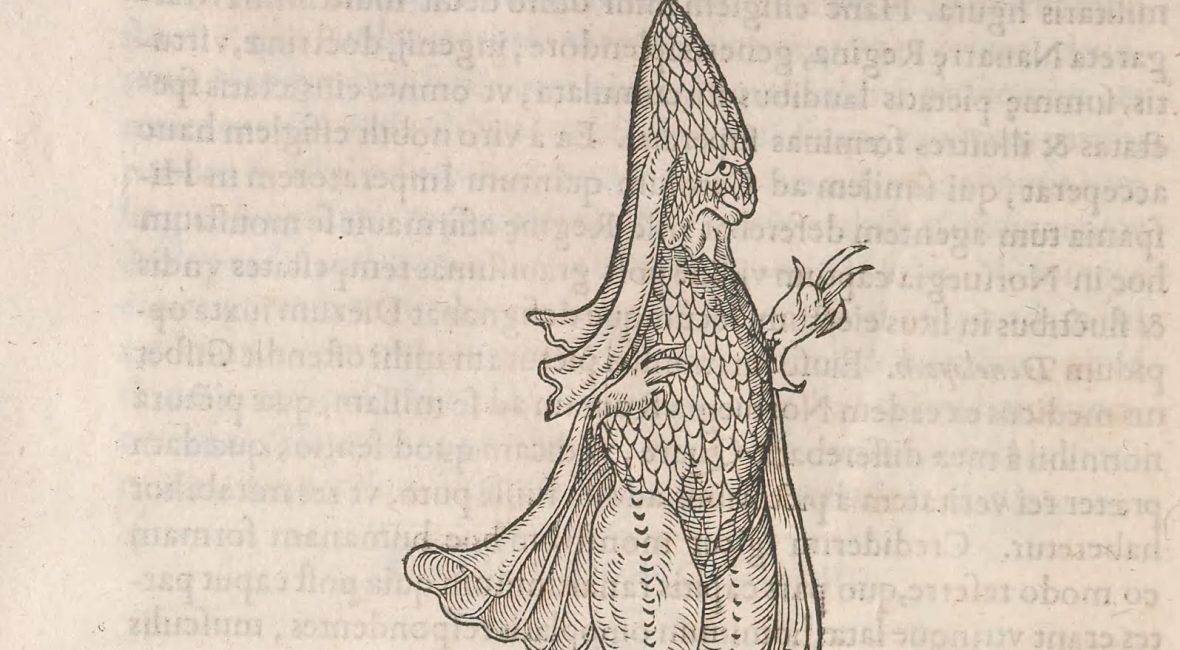
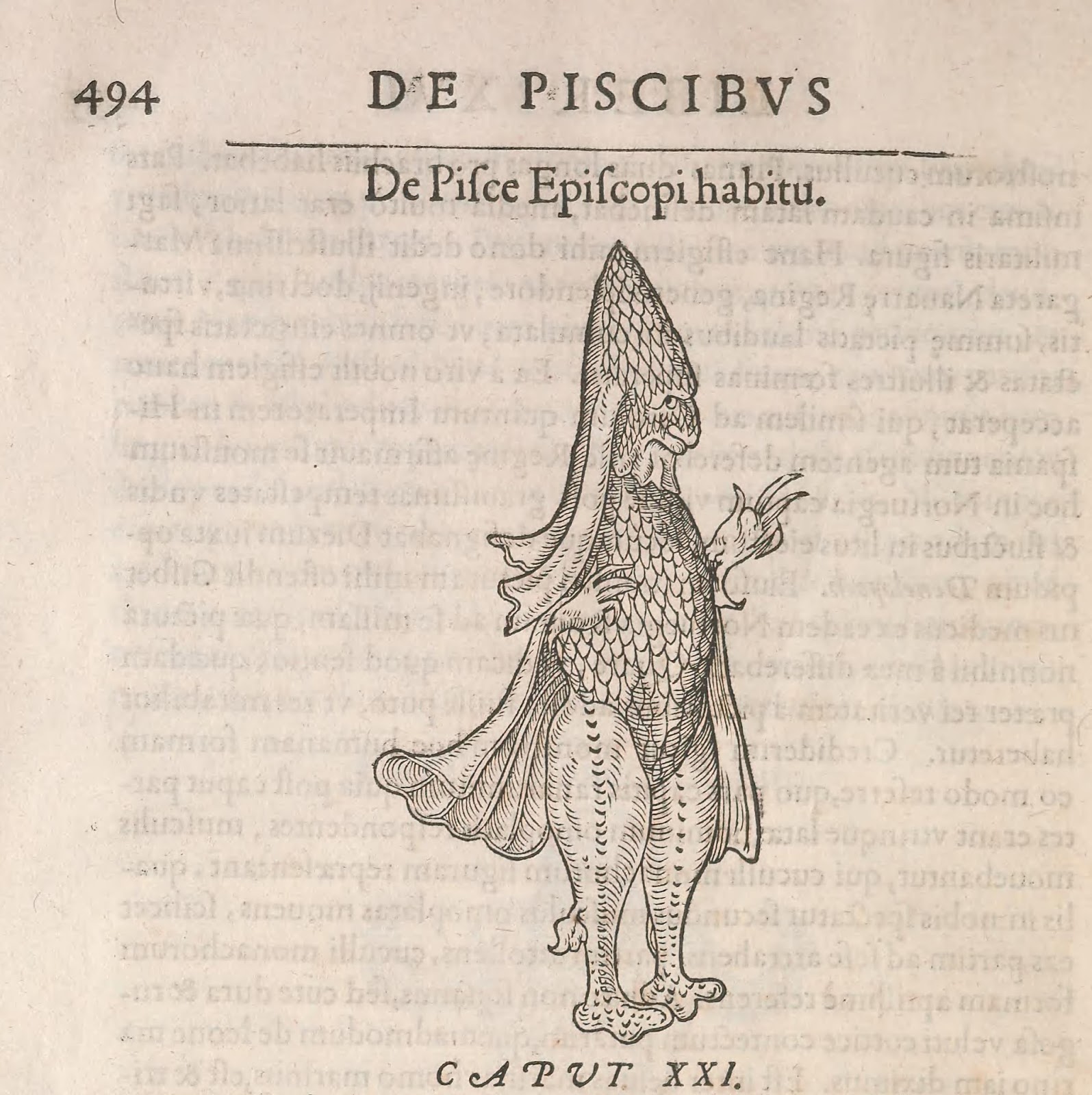
| The ‘bishop fish’. Rondelet, Guillaume. Libri de Piscibus Marinis. 1554. http://biodiversitylibrary.org/page/42089973. Digitized by Smithsonian Libraries. |
Apparently, clergymen in the 16th century had a lot of extra time on their hands to masquerade as sea monsters and make their marks on the annals of natural history as sea monks and bishop fish.
All this month, we’ve been exploring curious creatures in natural history as part of Page Frights. Today being Halloween, we thought we’d continue the fun by highlighting another “clergyman monster in disguise,” the bishop fish!
Earlier this month, we highlighted the ‘sea monk,’ or Piscis monachi habitu (“Fish with the habit of a monk”), a specimen of which was reportedly caught in the seas between Sweden and Denmark in the 1540s. The creature was said to resemble a monk, with “a human head and face, resembling in appearance the men with shorn heads.” The sea monk made its way into many natural history books of the era, including Belon’s De Aquatilibus (1553), Rondelet’s Libri de Piscibus Marinis (1554), and Gessner’s Historia Animalium (1558).
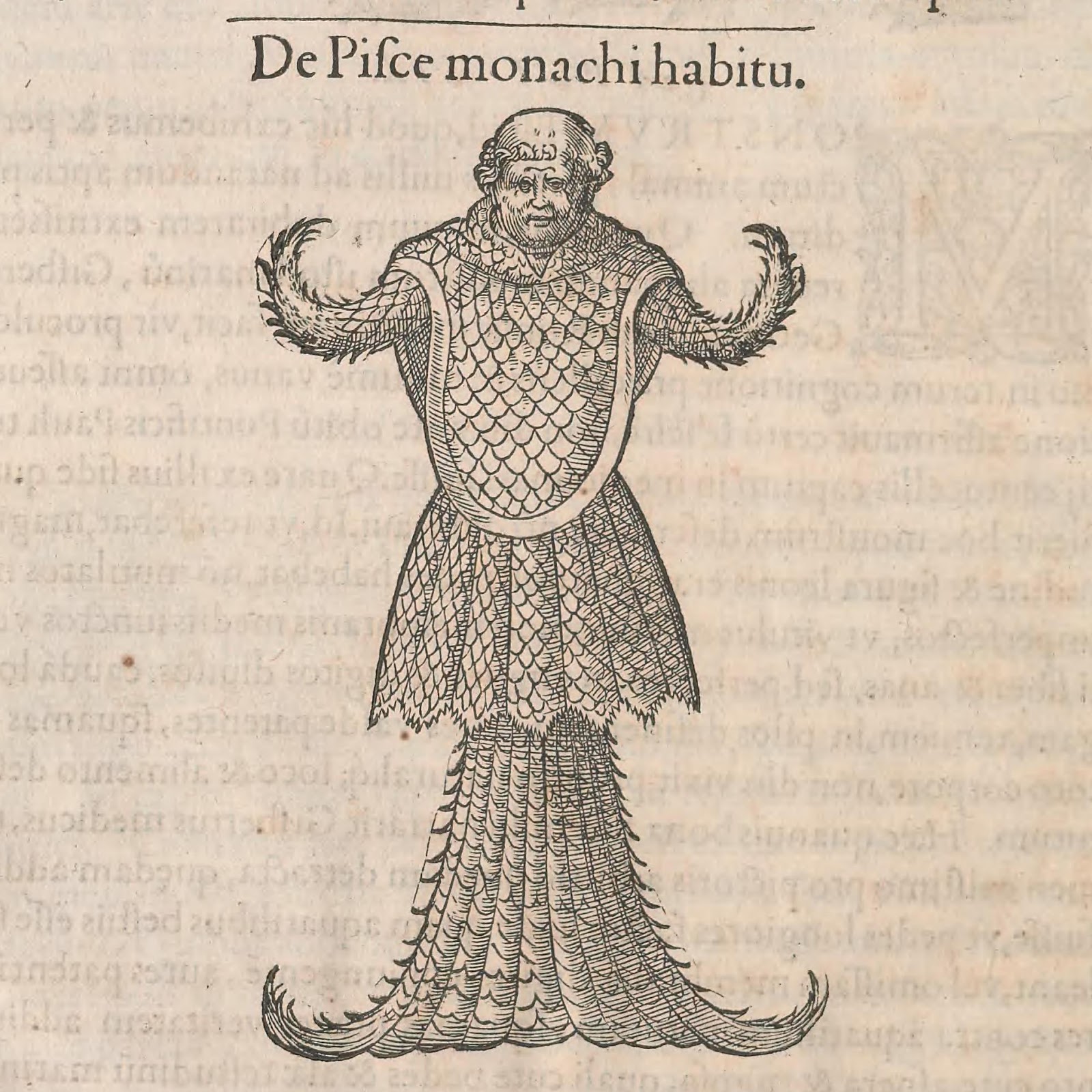 |
| Piscis monachi habitu, “fish with the habit of a monk”. Rondelet, Guillaume. Libri de Piscibus Marinis. 1554. http://biodiversitylibrary.org/page/42089971. Digitized by Smithsonian Libraries. |
Rondelet and Gessner also depict another similar monster: the ‘bishop fish’ or “monstre marin en habit d’évêque.” The monster was said to have two projections resembling claws in place of pectoral fins, tail fins resembling legs, and a projection resembling a bishop’s miter on its head. In his Libri de Piscibus Marinis, Rondelet writes that,
“I have seen a portrait of another sea-monster at Rome, whither it had been sent with letters that affirmed for certain that in 1531 one had seen this monster in a bishop’s garb, as here portrayed, in Poland. Carried to the king of that country, it made certain signs that it had a great desire to return to the sea. Being taken thither it threw itself instantly into the water” (translation David Starr Jordan)
Some researchers have postulated, as with the monk fish, that legends of the bishop fish may have been inspired by giant squids. In v. 5 of his General Zoology, George Shaw suggested that the northern chimaera (Chimaera monstrosa) may have been responsible for the myth. He writes,
“I have sometimes found it not improbable that the Bishop-Fish, described and figured in the works of Rondeletius, may have taken its rise from distorted preparations of the upper part of this animal, with the addition of some other articles to form the lower part.”
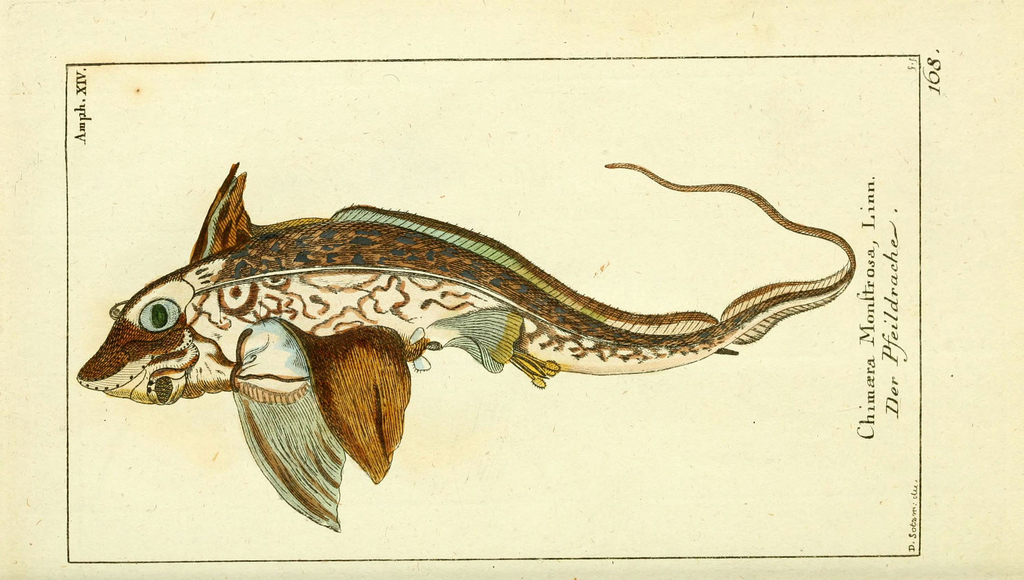 |
| Could Chimaera monstrosa have been the inspiration for the bishop fish? Borowski, Georg Heinrich. Gemeinnüzzige Naturgeschichte des Thierreichs. Bd. 4, plates (1783). http://biodiversitylibrary.org/page/28346493. Digitized by Smithsonian Libraries. |
Rondelet’s Libri de Piscibus Marinis (literally “Book of Marine Fish”) described nearly 250 marine animals, including fish, whales, marine invertebrates, and seals (all of which were referred to as fish), and was the standard ichthyological reference work for over a century. Given the importance of this title, it is not surprising that the legend of the bishop fish was perpetuated throughout many future natural history publications.
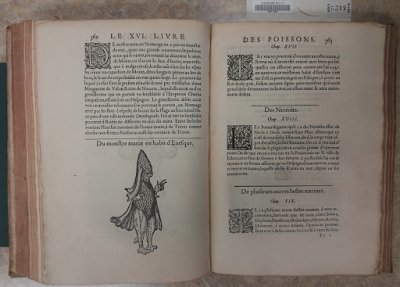 |
| Bishop fish in the Canadian Museum of Nature’s copy of the French edition (1558, Histoire Entière des Poissons) of Rondelet’s Libri de Piscibus Marinis. This copy will be digitized for BHL. |
BHL’s first Canadian partner, the Canadian Museum of Nature, holds the French edition (1558) of Rondelet’s Libri de Piscibus Marinis, which will be digitized for inclusion in BHL. Roberto Lima, Acquisitions and Cataloguing Officer in the museum’s library, provides some insight on the publication and the museum’s copy.
“The exact provenance of our copy of Rondelet’s Histoire entière des poissons is as intriguing as the depicted bishop fish itself, which makes it even more relevant for Halloween! We believe we acquired it through inheritance from the Geological Survey of Canada, the country’s oldest scientific agency. The copy still shows the now dissolved National Museums of Canada Library stamp, which reflects both the item’s as well as the Canadian Museum of Nature’s history within the Government of Canada. Mysterious as it may be as far as its actual origin goes, the presence of this item in the GSC collections is no surprise if one considers the importance of this publication. This is also why this book is on our priority list for digitisation in the context of the Biodiversity Heritage Library. It is appealing to think that this 1558 French translation will rejoin its 1554-5 Latin counterpart in the BHL’s digital space, similar to what happened during the XVI century when both works saw the light of the day in the print world.”
We too look forward to comparing the different versions of these works, and the curious creatures they depict, in BHL’s digital space. You can subscribe to BHL’s RSS feed of recent additions to be notified when this and other interesting titles are added to BHL.
So, as you don your Halloween costumes today, give a thought to the mysterious clerical sea monsters of bygone centuries. Perhaps the clergymen of the era had an affinity for costumes as well…. 😉
Happy Halloween!