Biodiversity Heritage Library - Program news and collection highlights from BHL
  • Home
  • News
  • Featured Books
    • All Featured Books
    • Book of the Month Series
    • BHL at 20
  • User Stories
  • Campaigns
    • Fossil Stories
    • Garden Stories
    • Monsters Are Real
    • Page Frights
    • Her Natural History
    • Earth Optimism 2020
  • Tech Blog
  • Visit BHL
Home
News
Featured Books
    All Featured Books
    Book of the Month Series
    BHL at 20
User Stories
Campaigns
    Fossil Stories
    Garden Stories
    Monsters Are Real
    Page Frights
    Her Natural History
    Earth Optimism 2020
Tech Blog
Visit BHL
  • Home
  • News
  • Featured Books
    • All Featured Books
    • Book of the Month Series
    • BHL at 20
  • User Stories
  • Campaigns
    • Fossil Stories
    • Garden Stories
    • Monsters Are Real
    • Page Frights
    • Her Natural History
    • Earth Optimism 2020
  • Tech Blog
  • Visit BHL
Biodiversity Heritage Library - Program news and collection highlights from BHL
Blog Reel, Featured Books

Bone Wars: Book of the Week

Building on the previous BHL Blog post by Clare Flemming, on the controversial and vitriol-laced “Bone Wars” between well respected paleontologists Edward Drinker Cope and Othniel Charles Marsh, the Book of the Week this week actually focuses on two items. To be more exact, two versions of the same item.

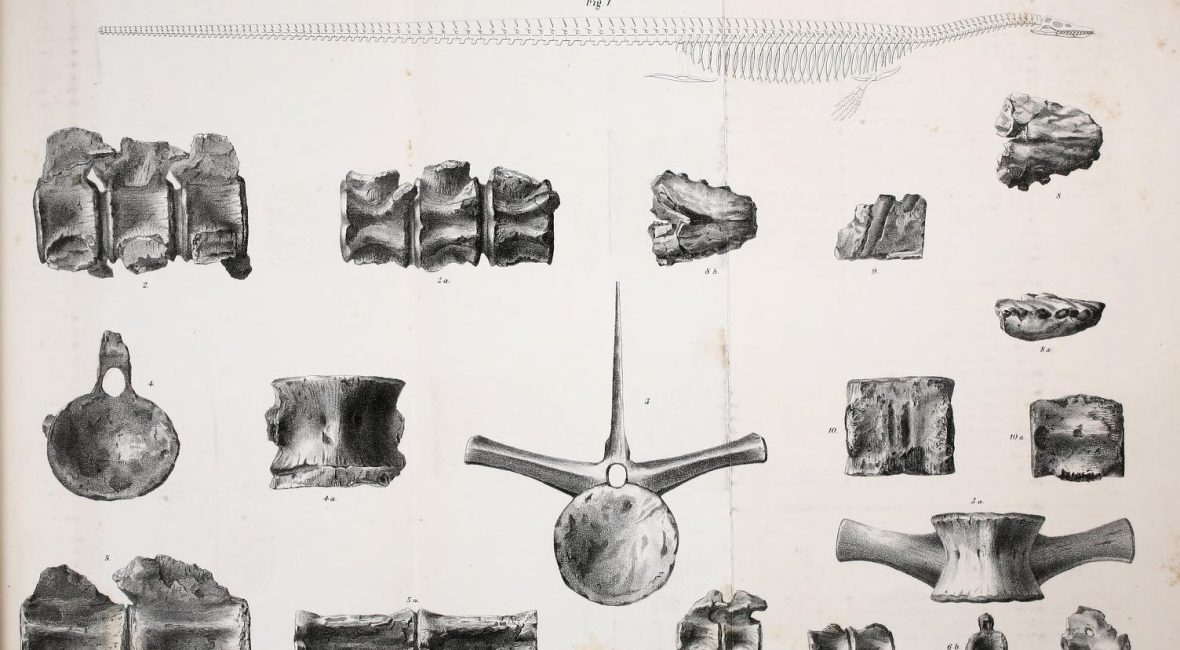
Synopsis of the Extinct Batrachia, Reptilia and Aves of North America by Edward Cope, published in Volume 14 of the Transactions of the American Philosophical Society, is arguably the most famous item either paleontologist published, not due to its academic qualities but because it exemplifies and magnifies how the competition between the two men and the rush to publish led to major errors by both. Here is how Plate II from the Synopsis of the Extinct Batrachia… was first printed:

View Full Size Image
http://biodiversitylibrary.org/item/123123#page/113/mode/1up

This is how it was re-printed after an error was discovered:
View Full Size Image
http://biodiversitylibrary.org/item/123170#page/117/mode/1up

Do you see the difference?

How about now?

View Full Size Image
View Full Size Image 

That’s right, Cope’s reconstruction of the plesiosaur Elasmosaurus has the head on the wrong end of the dinosaur! Marsh pointed out the error soon after Cope had (too quickly) published his results. Cope and Marsh, in order to settle their argument asked, Joseph Leidy, the Father of American Vertebrate Paleontology himself, to examine the fossils and he declared that Marsh was most likely correct that Elasmosaurus has a long neck and a short tail, not the other way around as Cope had proposed. Cope was so utterly humiliated that he attempted to purchase every copy of the journal he could hunt down with the incorrect illustration and to release an updated version with the correct head placement. However, he couldn’t get his hands on all of the original erred copies (Marsh, of course, had his own copy) and the error was publicized, surely to the great satisfaction of Marsh.

Thus, the Bone Wars had begun as the rivalry between the two men continued to intensify and only ended after the death of Cope in 1897.

The rivalry between the two men showed both sides of the academic coin in the field of paleontology at that time. While both men succeeded in advancing the field of paleontology, they also produced a negative reputation in the eye of the public that witnessed the ugly rivalry unfold in the pages of newspapers and scientific journals across the country.

Check out the images from the first copy of Synopsis of the Extinct Batrachia, Reptilia and Aves of North America at BHL Flickr. Also, take a look at all the items available at BHL authored or coauthored by Cope or Marsh in the BHL Bone Wars Collection and a select collection of books by Marsh and Cope at the new Bone Wars iTunes U Collection!

We hope you enjoyed this post. Interested in guest-blogging for BHL? We’d love that! Natural history, biodiversity and conservation topics are especially welcomed. Email us your ideas at [email protected].

November 15, 2012by jjdipasquale
Blog Reel, Featured Books

This Means War! A History of the Bone Wars

View Full Size Image
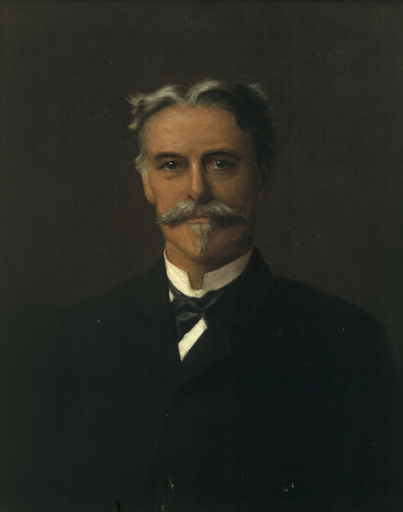
Edward Drinker Cope

Here at the Academy of Natural Sciences of Drexel University in Philadelphia, the story of the so-called Bone Wars is well known.

In short, the Academy’s Edward Drinker Cope (1840-1897), also affiliated with U. Penn, and Yale University’s Othniel Charles Marsh (1831-1899), also affiliated with the United States Geological Survey, were both prolific, well respected paleontologists. Both unearthed, described, and published their finds of fossil fauna in the post-Civil War era when the discipline of vertebrate paleontology was quite young in the U.S.

Though the two initially enjoyed each others’ company, a scientific rivalry kicked in whose results were protracted and nasty. Each scientist ridiculed the other’s published works; each endeavored to damage the other’s reputation; each supposedly sent thugs to the other’s fossil-bone quarries to raid, if not destroy, what lay therein.

But why? Briefly, it was all about priority: who had the published privilege to name which species first. In the end, all this rushing and competitiveness resulted, according to Jaffe (2000: 100) in, for example, at least 16 taxonomic names for the same extinct mammal Uintathere. Quoting the current analysis of Walter Wheeler, Jaffes (ibid) reported, “Neither [Cope nor Marsh] paid any attention to the priority of the other’s scientific names, and they both virtually ignored the priority of Leidy’s. The result was nomenclatural chaos.”

View Full Size Image
Othniel Charles Marsh

Fortunately much has been published about the intellectual combats between Cope and Marsh, yet the public never seems to tire of the Bone Wars. Science writer Mark Jaffe (2000) in his comprehensive The Gilded Dinosaur described Marsh and Cope as writing rebuttals to rebuttals within the pages of The American Naturalist. For several seasons the pages of that journal, whose gentle appellation is An Illustrated Magazine of Natural History, were replete with both paleontologists’ accusations of blunders, errors, and recklessness. Buckets of ink were spilled on their defenses, disputes, rejections, ridicules, taunts, and vengeances.

Finally the editors of this had had enough (June 1873), informing subscribers:

WE regret that Professors Marsh and Cope have considered it necessary to carry their controversy to the extent that they have. Wishing to maintain the perfect independence of the NATURALIST in all matters involving scientific criticism, we have allowed both parties to have their full say, but feeling that now the controversy between the authors in question has come to be a personal one and that the NATURALIST is not called upon to devote further space to its consideration, the continuance of the subject will be allowed only in the form of an appendix at the expense of the author.

That expensive appendix followed (June 1873) as Marsh’s Reply to Professor Cope’s Explanation, whose opening lines indicate the flavor of his nine-page thesis:

THE May NATURALIST (p. 290) contains Professor Cope’s long promised “explanation” of the many errors and false dates in his recent publications, and a most remarkable document this explanation is. As a sleight-of-hand performance with names and dates, it shows practice, and is amusing; but to those familiar with the subject, and to moralists, it suggests sad reflections. [et cetera, et cetera, et cetera…]

Cope chimed in again (July 1873) with On Professor Marsh’s Criticisms:

THE recklessness of assertion, the erroneousness of statement, and the incapacity of comprehending our relative positions, on the part of Professor Marsh, render further discussion of the trivial matters -upon which we disagree unnecessary; and my time is too fully occupied on more important subjects to permit me to waste it upon personal affairs which are already sufficiently before the public. Professor M. has recorded his views “cgre perenne,” and may continue to do so without personal notice by E. D. COPE.

Nearly 20 years after these words were published, the bitter battle for buried treasure between two 19th century vertebrate paleontologists continued to have all the intrigues of tabloid magazines today, only based on fossil finds and published claims instead of Hollywood machinations.

After all, when’s the last time you read a newspaper article began with SCIENTISTS WAGE BITTER WARFARE followed by eight subtitles? That’s what readers of the New York Herald encountered when they opened its pages on Sunday, January 21, 1890:

View Full Size Image
Page from New York Herald

SCIENTISTS WAGE BITTER WARFARE.
—
Prof. Cope of the University of Pennsylvania, Brings Serious Charges
Against Director Powell and Prof. Marsh, of the Geological Survey.
—
CORROBORATION IN PLENTY.
—
Learned Men Come to the Pennsylvanian’s Support with Allegations of Ignorance, Plagiarism and Incompetence Against the Accused Officials.
—
IMPORTANT COLLATERAL ISSUE.
—
The National Academy of Sciences, of Which Professor Marsh is President, is Charged with being Packed in the Interests of the Survey.
—
RED HOT DENIALS PUT FORTH.
—
Heavy Blows Dealt in Attack and Defence (sic) and Lots of Hard Nuts Provided for Scientific Digestion
—
WILL CONGRESS INVESTIGATE?

View Full Size Image
Joseph Leidy

Things got so bad that the pre-eminent natural historian of the day, the Academy of Natural Sciences’ Joseph Leidy (1823-1891), the Father of American Vertebrate Paleontology himself, decided to step out of the discipline he helped to found. This was saying a lot: among Leidy’s famous firsts he described Deinondon horridus, the first dinosaur discovered in the new world — a handful of teeth found by the Survey near the source of the Missouri River in 1856 — and Hadrosaurus folkii, the first articulated dinosaur ever — a nearly complete specimen unearthed in Haddonfield, NJ, in 1858. The remains of both of these animals are carefully curated under lock and key in the Academy’s Vertebrate Paleontology Department to this day.

Despite the intervening 140 years since the Bone Wars raged, the topic has been the Number One subject of Academy Archives researchers in recent years. That research resulted recently in an engaging documentary film in the new series O’Hanlon’s Heroes (see http://programma.vpro.nl/ohanlonshelden/afleveringen/de-bottenoorlog.html), just one example.

In 2012, the Bone Wars has been eclipsed only by Samuel G. Morton (1799-1851) as the most requested archival subject for researchers at the Academy Archives. Morton, certainly deserving of his own blog post, is renowned for having amassed the largest collection of human crania in the 19th century (see Morton, 1839). Like others in this story, Morton was a giant at the Academy of Natural Sciences, serving as its President from 1849 until his death. His skull collection now resides in good hands at the U. Penn Museum of Archeology and Anthropology.

View Full Size Image
1870s exterior of the Academy of Natural Sciences, Philadelphia
View Full Size Image
1901 interior of the Academy of Natural Sciences, Philadelphia

We here in the Academy Library & Archives are fortunate to be able to walk up to the stacks, survey entire runs of the American Naturalist, Transactions of the American Philosophical Society, Proceedings of the Academy of Natural Sciences, where the Bone Wars played out in print, among 250,000 other titles on site.

Thanks to the efforts of the Biodiversity Heritage Library, you can access — free — any of 57,000+ titles from the comfort of your own space. See what discoveries you might ignite as you browse the virtual pages at www.biodiversitylibrary.org.

We hope you will enjoy the selection of BHL-digitized works presented in the Bone Wars Collection. You can also download select books by Marsh and Cope for free from within the iTunes environment through our new Bone Wars iTunes U collection!

References and Further Reading

  • American Naturalist, An Illustrated Magazine of Natural History. 1873: Vol 7. Salem, MA: Peabody Academy of Sciences.
  • Cope, E. D., 1870. Synopsis of the Extinct Batrachia, Reptilia and Aves of North America. Transactions of the American Philosophical Society, New Series, Vol. 14, No. 1, pp. 1-252+i-viii
  • Jaffe, M. 2000. The Gilded Dinosaur: The Fossil War Between E. D. Cope and O. C. Marsh and the Rise of American Science. New York: Crown Publishers, 424 pp.
  • Leidy, J., 1860. Extinct Vertebrate from the Judith River and Great Lignite Formations of Nebraska. Transactions of the American Philosophical Society, New Series, Vol. 11, pp. 139-154.
  • Morton, S. G., 1839. Crania Americana ; or, a comparative view of the skulls of various aboriginal nations of North and South America. J. Dobson, [and] Simpkin, Marshall & co: Philadelphia, London.
November 13, 2012by ulib-libraryjobs

Help Support BHL

BHL's existence depends on the financial support of its patrons. Help us keep this free resource alive!

search

About BHL

The Biodiversity Heritage Library (BHL) is the world’s largest open access digital library for biodiversity literature and archives. BHL operates as a worldwide consortium of natural history, botanical, research, and national libraries working together to digitize the natural history literature held in their collections and make it freely available for open access as part of a global “biodiversity community.”

Follow BHL

  • Bluesky logo
  • Instagram logo
  • Facebook logo
  • Flickr logo
  • Twitter logo

Join Our Mailing List

Sign up to receive the latest news, content highlights, and promotions.

Subscribe Now

Subscribe to Blog via Email

Enter your email address to subscribe to this blog and receive notifications of new posts by email.

Join 319 other subscribers

Subscribe to Blog Via RSS

Subscribe to the blog RSS feed to stay up-to-date on all the latest BHL posts.

Access RSS Feed


64+ Million Pages of
Biodiversity Literature Online.

EXPLORE

Tools and Services
to Transform Research.

EXPLORE

300,000+
Illustrations on Flickr.

EXPLORE

ABOUT | HARMFUL CONTENT | PRIVACY | SITE MAP | TERMS OF USE