Biodiversity Heritage Library - Program news and collection highlights from BHL
  • Home
  • News
  • Featured Books
    • All Featured Books
    • Book of the Month Series
    • BHL at 20
  • User Stories
  • Campaigns
    • Fossil Stories
    • Garden Stories
    • Monsters Are Real
    • Page Frights
    • Her Natural History
    • Earth Optimism 2020
  • Tech Blog
  • Visit BHL
Home
News
Featured Books
    All Featured Books
    Book of the Month Series
    BHL at 20
User Stories
Campaigns
    Fossil Stories
    Garden Stories
    Monsters Are Real
    Page Frights
    Her Natural History
    Earth Optimism 2020
Tech Blog
Visit BHL
  • Home
  • News
  • Featured Books
    • All Featured Books
    • Book of the Month Series
    • BHL at 20
  • User Stories
  • Campaigns
    • Fossil Stories
    • Garden Stories
    • Monsters Are Real
    • Page Frights
    • Her Natural History
    • Earth Optimism 2020
  • Tech Blog
  • Visit BHL
Biodiversity Heritage Library - Program news and collection highlights from BHL
Blog Reel, Featured Books

Earth Day 2021: Exploring Earth’s Biodiversity through Books

background of yellow, white and red flowers with text "Happy Earth Day 2021"

Since its inaugural event on 22 April 1970, Earth Day has grown into an international annual celebration of the Earth and a movement to raise awareness about and support for environmental protection. This year’s theme, Restore Our Earth, emphasizes that, “As the world returns to normal, we can’t go back to business-as-usual.” As we face widespread climate change and unprecedented biodiversity declines—with one million species threatened with extinction—immediate, online access to essential literature is ever-more important, allowing scientists to conduct research more quickly and efficiently and improving our ability to respond to these crises. For fifteen years, the Biodiversity Heritage Library (BHL) has worked as a global consortium to provide this vital access, empower research, and make a real difference in our ability to improve the health of our planet for every species that calls it home.

This year, several of our global partners have selected a few titles from the BHL collection to commemorate Earth Day. From exploring Asia’s vast and unique biodiversity to inspiring conservation through a popular publication on birds, providing practical methods for conducting surveys and using the data to support conservation practices, and marveling at the extraordinary biodiversity of past ages, these titles highlight the richness of our planet’s biodiversity and remind us of the importance of protecting the wonderful, wild, and beautiful life on Earth.
Asian Biodiversity: An Essential Contributor to Our Beautiful Earth

By Zheping Xu, Xuejuan Chen, and Tian Jiang (National Science Library, Chinese Academy of Sciences)

Biodiversity is essentially everywhere, ubiquitous on Earth’s surface and in every drop of its bodies of water [1]. Biodiversity conservation makes great contributions to the restoration of the earth.

As a continent with the largest area and the most population, Asia holds vast biodiversity, from the equatorial region to the Arctic area, and from the coast of the western Pacific to the borders of Europe and Africa. Here, we introduce several books that review Asian biodiversity, from mammals and insects to some distinctive species from the continent.

Mammals of Eastern Asia (1947) is the first general work on mammals of eastern Asia [2]. The book’s carefully prepared chapters and fine original pen sketches are interesting, useful and invaluable to the amateur as well as the professional zoologist regarding the habitats, relationships, life histories and idiosyncrasies of the widely diversified faunas.

Map of Eastern Asia and pen sketches of some mammals.

Map of Eastern Asia and pen sketches of some mammals. Source: Tate, G. H. H. (George Henry Hamilton). Mammals of Eastern Asia. 1947. Contributed in BHL from MBLWHOI Library.

Cerambycidae of Northern Asia (1988) describes the morphology, geographic distribution, and biology of cerambycid beetles in Northern Asia of four sub­families (Prioninae, Disteniinae, Lepturinae, and Aseminae), comprising 124 species. Many cerambycid species are invasive pests of environmental concern, causing severe damage to forests and crops. Long-term field investigations were conducted on the composition and biology of cerambycids in different parts of northern Asia. Tens of thousands of larvae, pupae, and adult insects were raised in the laboratory for experiments. Keys to taxa of the family Cerambycidae based on different developmental stages are presented in this work for the first time. This book provides important information for informing broad theoretical principles and in resolving practical problems of pest infestation in forests.

Cerambycidaes: adult insects with their larvas and pupas.

Cerambycidaes: adult insects with their larvas and pupas. Source: Cherepanov, A. I. (Aleksei Ignatevich). Cerambycidae of Northern Asia. 1988. Contributed in BHL from Smithsonian Libraries and Archives. CC-BY-NC-SA.

Asia is home to endemic and highly distinctive focal species. Tracking tigers (Published in 1998) gives a comprehensive overview of the wild status of the Tiger, Asian Elephant, Gaur and Banteng in Indochina. On this basis, it recommends future survey and management needs, and provides background discussion on issues to be addressed by national action plans. The Philippines’ fauna is characterized by large numbers of endemic and highly distinctive species. During the 1980s, the extent of rain-forest habitat destruction became apparent and underscored the need for extensive and detailed documentation of biological diversity to guide development and conservation for the benefit of both wildlife and the human population of the Philippines. The Mammals and birds of Camiguin Island, Philippines, a distinctive center of biodiversity (published in 2006) presents studies of Camiguin Island, a small island province in the Philippines and an ideal natural laboratory in which to investigate many aspects of the evolution and conservation of biological diversity.

photo of a tiger and illustration of green and red birds and brown rodents

Left: The tiger in Indochina. Source: Duckworth, William and S. Hedges. Tracking tigers. 1998. Contributed in BHL from Smithsonian Libraries and Archives. CC-BY-NC. Right: “Two species of mammals and one species of bird live only on Camiguin Island: Apomys sp. ([…] center left), Bullimus gamay ([…] lower right), and Loriculus sp. ([…] upper center). The distinctive volcanic peaks of Camiguin form the background.” Source: Heaney, Lawrence R. The Mammals and birds of Camiguin Island, Philippines, a distinctive center of biodiversity. 2006. Contributed in BHL from University Library, University of Illinois Urbana Champaign. CC-BY-NC-SA.

Biological species in Asia are important components of Earth’s biodiversity. Biodiversity is closely related to human well-being, but human activities caused rapid changes in biodiversity over the past decades. To restore our Earth, we must identify and assess drivers of biodiversity loss, including habitat change, climate change, invasive alien species, overexploitation, and pollution [1].

[1] Duraiappah, A. K., Naeem, S., Agardy, T., Ash, N. J., Cooper, H. D., Diaz, S., Faith, D. P., Mace, G., McNeely, J. A., Mooney, H. A., Oteng-Yeboah, A. A., Pereira, H. M., Polasky, S., Prip, C., Reid, W. V., Samper, C., Schei, P. J., Scholes, R., Schutyser, F., & Van Jaarsveld, A. (2005). Ecosystems and human well-being: biodiversity synthesis; a report of the Millennium Ecosystem Assessment. World Resources Institute. http://www.millenniumassessment.org/documents/document.354.aspx.pdf.

[2] -S., T. Mammals of Eastern Asia. Nature 161, 188 (1948). https://doi.org/10.1038/161188e0.

Our Southern Birds and Emma Bell Miles: Inspiring Appreciation for and Protection of Birds

By Tomoko Y. Steen, Ph.D. and Alison Kelly, MLIS (Science, Technology & Business Division, Library of Congress)

Illustrated book cover featuring two birds and title "Our Southern Birds"

Cover. Miles, Emma Bell. Our Southern Birds. Copyright 1919. Contributed in BHL from Library of Congress.

Emma Bell Miles (1879-1919) was a talented artist, writer and naturalist whose writings reflect her love of the Tennessee mountains where she spent most of her life. In Our Southern Birds, copyrighted in 1919, she recorded her detailed observations and knowledge of the birds of Appalachia, an area that had received little attention in the popular publications on birds until that time. Through this and her other works capturing the essence of natural life in the Southern mountains, Emma Bell Miles drew attention to the importance of preserving biodiversity and habitat.

colored illustration of a bird, fox sparrow, brown with blue head and cream belly sitting on branch with green leaves

Fox sparrow. Miles, Emma Bell. Our Southern Birds. Copyright 1919. Art by Miles. Contributed in BHL from Library of Congress.

In the introduction to this, her last book, she stated:

…while the scientific study of birds is beyond most of us, yet an intimate understanding of them and their ways is within reach of everyone, and may enrich life with a new depth of interest… Go out alone in early morning, keep the sun at your back, be careful to do nothing that will startle these timid creatures, and see what you will see.

Our Southern Birds includes many beautiful illustrations by Miles, who, as a young woman, left her home in the mountains to study art in St. Louis. Plagued by homesickness for the mountains, she returned to Appalachia after two years and married a mountaineer. Their marriage was a difficult one, marked by poverty and illness, and she was often the sole supporter of the family by selling her writings, art and poetry.

Written for all levels of readers, this engaging book will appeal to anyone with an interest in birds. Part of the genius of Emma Bell Miles’ work is that she succeeds in presenting not only a careful description of over 100 birds and their habitats, but captures the individual personalities and demeanor of any given species through words and pictures. Her desire to recruit readers to active birdwatching is shown in the inclusion of blank pages for recording observations.

black and white illustration of a bird, chuckwill's widow, hiding within foliage

Chuckwill’s widow. Miles, Emma Bell. Our Southern Birds. Copyright 1919. Art by Miles. Contributed in BHL from Library of Congress.

“Shadows from the Past,” the final chapter of the book, mentions several species that are extinct or close to extinction. “Let the disappearance of these winged lives from their one-time haunts lead us to set a higher value on those that remain,” she writes. In poetic language she goes on to describe the tragic extinction of the passenger pigeon, concluding with an appeal that we can learn from the past: “…it is not too late to learn from the mistakes of our fathers, and though we have lost some valuable species, we may yet save others that are following these to extinction”.

In celebration of Earth Day we want to shine a light on Emma Bell Miles, whose skills in observing and recording the natural world around her will inspire readers to appreciate and preserve biodiversity in their own special place on Earth.

Environmental Evaluations Using Birds and Their Habitats

By Samantha Lindgren (University Library, University of Illinois Urbana-Champaign)

A blue and white bird sitting on a birdhouse roof with a background of trees.

A female Belted Kingfisher. Courtesy of Tyler Ingram, CC BY-NC-ND.

In their 1976 book, Environmental Evaluations Using Birds and Their Habitats, Jean and Richard Graber offer practical methods for surveying birds in Illinois with the purpose of curating data for environmental impact statements. Published as one of the Illinois Natural History Survey’s Biological Notes, the book details the data they have collected from these methods, including bird populations and habitat acreage. Throughout the book are also tables, graphs, and images supporting their methods and findings. While the book was published 45 years ago, it came at a time when concerns for environmental protection was just beginning to affect change, and it remains relevant in its advocacy for environmental conservation and restoration.

Earth Day 2021’s theme is Restore Our Earth. This theme resounds throughout the book in details of habitat surveying and restoration. As the authors posit, Illinois is a large state with diverse habitats and niches, some of which are difficult to redevelop once they are threatened. The authors discuss seven categories of gross habitats found throughout the state: forest, shrub, marsh, residential, grassland, small-grain fields, and row-crop fields. Some of these habitat types are more specific to regions of Illinois than others—such as natural marshes occurring most frequently in northeastern Illinois—however each mention comes with information on habitat replacement cost (the time required for restoration of a habitat or community), acreage data, and associated flora and fauna. Alongside this information, the authors also describe their experimental surveying methods. Through these factors, the authors garner concern for habitat conservation and restoration.

black and white aerial photo

“Fig. 8 – Aerial photograph showing a portion of the experimental impact area used to test the method presented in this paper.” Graber, Jean W. and Richard R. Environmental evaluations using birds and their habitats. 1976. Contributed in BHL from University Library, University of Illinois Urbana Champaign. CC BY-NC.

The methods discussed for collecting data on bird populations garner this concern as well. As the authors state, “…in the conservation of species we must be concerned for the welfare of all the populations that comprise the species” (11). In the context of this book, this means assigning a fair value to birds when applying an avifaunal index during surveying. However, this sentiment can be applied to Earth Day 2021 as well; in the restoration of our Earth, we must be concerned with the welfare of all aspects of Earth. Moreover, the authors supplement discussions of how and why to collect data on bird populations by speaking in-depth about the derivation of their models, and using them in practice. In this way, the authors are not only advocating for conservation and restoration, they are also providing tangible means to implement conservation and restoration practices.

Environmental Evaluations Using Birds and Their Habitats is a great representation of how to turn concern for Earth’s restoration into meaningful action, and should serve as an example that all levels of skills and fields of interest can be utilized to help Restore Our Earth.

Description of the Skeleton of an Extinct Gigantic Sloth

By Cat O’Carroll (Natural History Museum Library & Archives, London)

Side-view of the skeleton of the Mylodon robustus

Plate One. Side-view of the Mylodon robustus. Owen, Richard. Description of the skeleton of an extinct gigantic Sloth, Mylodon robustus, Owen, with observations on … Megatherioid quadrupeds in general. 1842. Contributed in BHL from the Natural History Museum Library & Archives.

In the year 1841, a discovery by M.Pedro de Angelis in Argentina unearthed the skeletal remains of a long extinct species……

Following on from the theme of Earth Day 2021 to Restore Our Earth, and raising issues of climate change, I’ve reflected on a title which highlighted a once extraordinary species which used to roam the earth, Description of the skeleton of an extinct gigantic Sloth, Mylodon robustus, Owen, with observations on … Megatherioid quadrupeds in general by Richard Owen (1842).

Owen, once curator at the Hunterian Museum, Royal College of Surgeons, was later in his career put in charge of the British Museum (Natural History) collections. As a result, he campaigned that a new building was needed to house the ever-expanding collections, which later built in 1881, became the Natural History Museum (NHM) in London as we know it today.

After exhuming the finds of the Mylodon robustus, it was then purchased by the Royal College of Surgeons and shipped over to London. In November 1841, it arrived in many pieces and fragile, in need of much restoring. Fossils discovered by Charles Darwin indicated several species of large quadrupeds had become extinct in South America. Owen compares descriptions of fossil remains of the Mammalia, which were collected by Charles Darwin during the voyage of the Beagle and accounted in The zoology of the voyage of H.M.S. Beagle … during the years 1832-1836.

Side-view of the skull of the Mylodon robustus, natural size

Plate Two. Side-view of the skull of the Mylodon robustus, natural size. Owen, Richard. Description of the skeleton of an extinct gigantic Sloth, Mylodon robustus, Owen, with observations on … Megatherioid quadrupeds in general. 1842. Contributed in BHL from the Natural History Museum Library & Archives.

Megatherium (so named and described by Cuvier, 1795), discovered in the 18th century, was shipped to the Museo Nacional de Ciencias in Madrid. However, if you happen to walk down Fossil Way at the Natural History Museum today, you cannot miss the full Megatherium skeleton cast which stands on display. In terms of scale, Owen compares some of the bones of the Mylodon to that of Megatherium and a full-sized elephant.

Comparison of certain bone size between Mylodon, Megatherium and an Indian Elephant

Comparison of certain bone size between Mylodon, Megatherium and an Indian Elephant, page 176. Owen, Richard. Description of the skeleton of an extinct gigantic Sloth, Mylodon robustus, Owen, with observations on … Megatherioid quadrupeds in general. 1842. Contributed in BHL from the Natural History Museum Library & Archives.

The Life of Richard Owen (1894), by his Grandson Rev. Richard Owen, summarizes how Owen was puzzled by the habits of these extinct creatures: “Their teeth showed, by their simple structure, that they lived on vegetable food, and probably on the leaves or tender twigs of trees”. It was hard to see how, like sloths today, they could possibly adapt to climbing trees given their sheer size and weight. Owen conjectured that they may have pulled the branches down from the trees instead of climbing them. Mylodon was also furnished with a “long tongue like a giraffe’s, which would help it to reach its leafy food”.

Upper, or anconal surface of the bones of the left fore-foot

Plate Fifteen. Upper, or anconal surface of the bones of the left fore-foot. Owen, Richard. Description of the skeleton of an extinct gigantic Sloth, Mylodon robustus, Owen, with observations on … Megatherioid quadrupeds in general. 1842. Contributed in BHL from the Natural History Museum Library & Archives.

The NHM Library & Archives holds a large collection of natural history drawings and original artworks amongst its collections. In November of 2019, the Images of Nature Gallery saw the installation of George Johann Scharf’s (1786-1860) watercolour drawing of a Megatherium on full display. Completed in 1842, this one drawing comprises of fourteen sheets approximately 2463 x 5745 mm which Scharf completed for Owen. A MEGA task in itself!

George Johann Scharf (1786-1860) Watercolour drawing of a Megatherium. N.p., 1842.

George Johann Scharf (1786-1860). Watercolour drawing of a Megatherium. N.p., 1842. Print. From the Library and Archives, Natural History Museum, London.

April 22, 2021by michelle.underhill
Blog Reel, Campaigns, Earth Optimism 2020

George Perkins Marsh: Man and Nature: Or, Physical Geography as Modified by Human Action

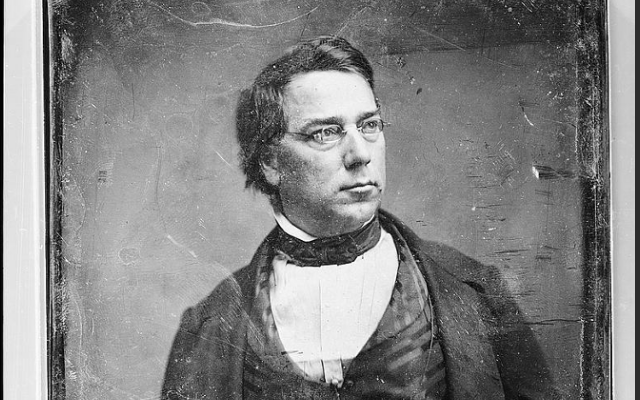
George Perkins Marsh, half-length portrait, head three-quarters to right, with spectacles

April 2020 marks the 50th anniversary of Earth Day. Organizations around the world have commemorated the occasion by participating in the global Earth Optimism movement — an initiative spearheaded by the Smithsonian to “turn the conservation conversation from doom and gloom to optimism and opportunity”.

Throughout 2020, the Biodiversity Heritage Library (BHL) and our partners are joining the movement by sharing conservation success stories from and made possible by the BHL collection. Follow our blog for conservation stories — past and present — and visit our website for more information and to explore our Earth Optimism book collection.

———————

George Perkins Marsh, half-length portrait, head three-quarters to right, with spectacles https://lccn.loc.gov/2004664024

George Perkins Marsh, half-length portrait. ca. 1850. Mathew B. Brady, photographer. Library of Congress, Prints & Photographs Division. https://www.loc.gov/item/2004664024/.

George Perkins Marsh (1801-1882) was a talented linguist, scholar, and diplomat. He served as a member of the U.S. House of Representatives from Vermont’s 3rd district from 1843-1849, and, in 1850, went on to become United States Minister to the Ottoman Empire. In 1861 he was appointed by President Lincoln as the first Ambassador to the Kingdom of Italy, where he served until his death at Vallombrosa in 1882. A Vermonter raised close to the forests of the Adirondack Mountains, Marsh is remembered today chiefly for his role as an early and influential pioneer of the conservation movement in the United States. His book Man and Nature:Or, Physical Geography as Modified by Human Action, published in 1864, is recognized for his early recognition of the interdependency of the natural world, the effects that human actions can have upon it, and the responsibilities that humans bear for those actions.

“The importance of the restoration of disturbed harmonies…” (Preface)

The publication of Marsh’s book followed a celebrated lecture which he gave before the Agricultural Society of Rutland County, Vermont in 1847. This lecture is often pointed to as a remarkably early warning about humankind’s ability to affect the climate of the Earth. What stands out in Marsh’s book is his argument that human activities can have far-reaching effects far beyond what is immediately observable. Felling a forest, far beyond just cutting trees, can disturb an entire ecosystem. In his Preface, Marsh advocates for the “restoration of disturbed harmonies” through a combination of wilderness preservation and enlightened practices for forest management.

“But man is everywhere a disturbing agent. Wherever he plants his foot, the harmonies of nature are turned to discords…” (pg. 36)

Man and Nature looks at various ways man has transformed the environment, affecting both major and minor components of the earth’s overall systems in comprehensive and unforeseen ways. Forests, rivers and waterways, sand dunes and soil are all interconnected in a greater ecological system that supports life on the Earth. Marsh paints a picture of overall interconnection between living things: trees, scrub, sea cows, worms, wild trout and “minute organisms.”

Still, it should be noted that Marsh was not categorically opposed to human actions that produce change. Rather, he was a pioneering advocate for sustainable development and of well-considered improvements based on observation and scientific knowledge. His chapter on Geographical Changes expresses mixed admiration for some engineering feats such as the Suez Canal, but in general his assessments of the long-term effects of human improvements to nature carried out in Europe, and even in the Ancient World, are mixed.

“I have spoken of the needs of agriculture as a principal cause of the destruction of the forest…” (pg. 325)

Marsh also discusses agricultural cattle and the ways in which “the extent of cleared ground required for agriculture use depends very much on the number and kinds of cattle bred.” When heritage cattle, traditionally foragers able to survive in rugged environments, are replaced with less robust hybrids that must be sheltered and fed with cultivated cereal grasses, there is a heavy toll on the environment. In addition, large-scale agricultural operations were already in place in Marsh’s time, with cotton, tobacco and feed grains for cattle taking up large swathes of cleared and tilled land. This monocropping trend continued into the 20th century; by 1950, the number of farms was the smallest ever enumerated by the Census, while the acreage was the largest on record.

View of the pogue, looking west and illustrating the relation of this mountain pond to the surrounding forest slopes of the Mt. Tom Forest. Marsh-Billings-Rockefeller National Historical Park, boyhood home of George Perkins Marsh. Historic American Landscape Survey, Library of Congress Prints & Photographs Division. image link: https://cdn.loc.gov/service/pnp/habshaer/vt/vt0100/vt0131/color/218497cv.jpg Record link: https://www.loc.gov/item/vt0131/

View of the pogue, looking west and illustrating the relation of this mountain pond to the surrounding forest slopes of the Mt. Tom Forest. Marsh-Billings-Rockefeller National Historical Park, boyhood home of George Perkins Marsh. Historic American Landscape Survey, Library of Congress Prints & Photographs Division. Image link: https://cdn.loc.gov/service/pnp/habshaer/vt/vt0100/vt0131/color/218497cv.jpg. Record link: https://www.loc.gov/item/vt0131/.

“With the disappearance of the forest, all is changed” (pg. 214)

Marsh also looks to the influence of the forest on water systems and the many ways in which forests regulate natural springs and waterways. Cleared land, he writes, especially arable land, is prone to flooding and erosion – events that would naturally be controlled by forest management. Forests control flooding naturally: “the surface of a forest in its natural condition can never pour forth such deluges of water as flow from cultivated soil.” Flooding, soil compaction, aridity, runoff, erosion: all are deleterious effects of deforestation and interference with natural processes.

He also discusses the influence of the forest on temperature; cleared land is warmer than forest and “we must conclude that the forests in Northern America exert a refrigerating influence”. Forests are made up not only of trees, but of mosses and fungi, among other organisms, as well as animals, soil and water, and these all play a role in regulating moisture and temperature.

“It is time for some abatement in the restless love of change which characterizes us, and makes us almost a nomadic rather than a sedentary people. We have now felled forest enough everywhere, in many districts far too much. Let us restore this one element of material life to its normal proportions, and devise means for maintaining the permanence of its relations to the fields, the meadows, and the pastures, to the rain and the dews of heaven, to the springs and rivulets with which it waters the earth.” (pg. 328)

This impassioned plea, central to the chapter titled Instability of American Life, and to the entire book itself, follows a lengthy, sometimes rambling but painstakingly detailed, investigation of the interconnectedness of life on Earth. Marsh’s chief message is his repeated call for humans to accept their responsibilities as stewards of the Earth, and especially as stewards of the forests. He calls for humans to re-examine their relationship with nature and their too-often destructive actions.

Marsh’s advocacy for a new understanding of forestry systems and implementation of human responsibility in forest management practices resulted in Marsh’s work contributing greatly to the conservation movement and the creation of one of the earliest forest preserves in America, Adirondack Park. His book ends with the statement that there is nothing small in nature:

“…in the vocabulary of nature little and great are terms of comparison only; she knows no trifles, and her laws are as inflexible in dealing with an atom as with a continent or planet.” (pg. 548)

George P. Marsh, three-quarter length portrait, standing, facing left, holding hat Brady, Mathew B., approximately 1823-1896, photographer. [George P. Marsh, three-quarter length portrait, standing, facing left, holding hat] [graphic] / Brady, N.Y. [between 1855 and 1865, printed later] https://lccn.loc.gov/96509698

Hon. George Perkins Marsh of Vermont. Between 1855 and 1865. Library of Congress Prints & Photographs Division. https://www.loc.gov/item/2017895581/.

George Perkins Marsh family. Marsh seated beside a table with tablecloth, on the left, his head turned to the right, wearing spectacles, his wife seated on the right, her hand on his, her head slightly to the left, both holding papers; Caroline's sister, Lucy Crane, standing behind and between them, her hands on her brother-in-law's shoulder, her head three-quarters to the right] https://lccn.loc.gov/2004664023

George Perkins Marsh family. Marsh seated on the left, his wife, Caroline (Crane) Marsh, seated on the right; Caroline’s sister, Lucy Crane, standing behind and between them. Between 1844 and 1849. Mathew B. Brady, photographer. Library of Congress Prints & Photographs Division. https://www.loc.gov/item/2004664023/.

More information

George Perkins Marsh correspondence, 1851. LCCN: https://lccn.loc.gov/mm79005905.

William Slade correspondence, 1845-1848, LCCN: https://lccn.loc.gov/mm79001310.

Report made under authority of the legislature of Vermont, on the artificial propagation of fish, by George P. Marsh. LCCN: https://lccn.loc.gov/06012522. BHL: https://www.biodiversitylibrary.org/bibliography/34497.

August 20, 2020by michelle.underhill
Blog Reel, Featured Books

Charles Lathrop Pack: Pioneering the Idea of the “Victory Garden” in the United States

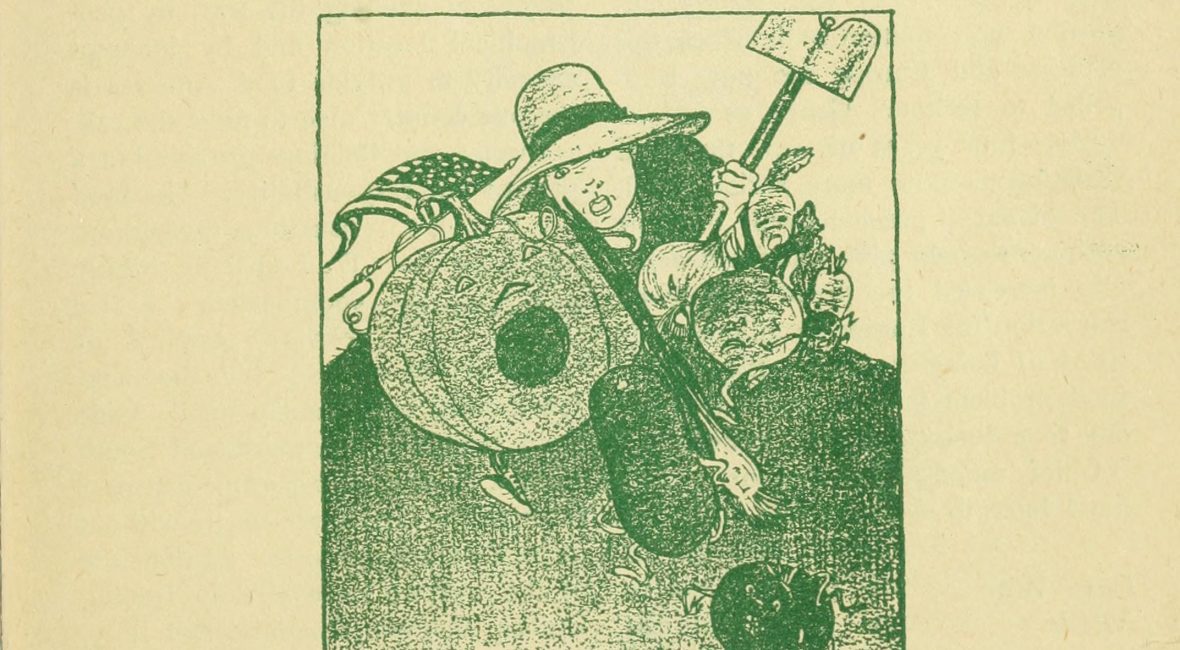
Illustrated cover of the manual "Victory Gardens Feed the Hungry".
Black and white photograph of an elderly man

Charles Lathrop Pack, President, U.S. National War Garden Commission. Source: https://loc.gov/pictures/resource/hec.08264/.

Charles Lathrop Pack (May 7, 1857 – June 14, 1937) was a forestry expert and third-generation businessman. Both his father, George Willis Pack, and grandfather, George Pack, Jr., were in the forestry business. Charles continued this successful forestry dynasty by investing in the timber business as well as banking and real estate. By the time World War I started in Europe, he was a multi-millionaire and was named one of the five wealthiest men in America.

Black and white photograph of a group of men standing on steps.

War Memorial Committee. Source: https://loc.gov/pictures/resource/npcc.01780/.

In addition to being an outstanding businessman, Charles Pack was keen about public education and wrote several instructional books and manual. During World War I, he was eager to promote the importance of self-sustainability of food supplies in the United States and went on to become the President of the U.S. National War Garden Commission.

Pack was a principal organizer of the Victory Garden movement. Victory gardens, war gardens, or, as they were sometimes called, “food gardens for defense,” are gardens meant to be supplement and even improve upon the food supply in times of shortage and rationing due to war, providing a variety of home-grown vegetables, fruits, and herbs. Not limited to typical farming areas or countryside, Victory Gardens were planted in urban areas as well. They sprang up at private homes and in public parks and allotments in the United States, the United Kingdom, Canada, Australia, and Germany during World War I and again in World War II.

Charles Pack helped to promote the understanding that the war efforts were not just frontline battles, but that it is crucial to strengthen the home front of the country by producing healthy food to feed the nation — a concept that has endured into the present.

Illustrated cover of the manual "Victory Gardens Feed the Hungry".

Pack, Charles Lathrop. Victory Gardens Feed the Hungry. c1919. Contributed in BHL from The Library of Congress.

The highlighted book, Victory gardens feed the hungry: the needs of peace demand the increased production of food in America’s victory gardens, is one of the leading monographs in the campaign for the Victory Garden program. In it, Pack also talks about the unfortunate conditions in some European countries (Ex. Belgium and France) due to the ongoing war and the need for Americans to come to their aid by providing seeds for food products and trees.

Black and white photograph of three men, one holding a sack of seeds with the text "American seeds to reforest France and Great Britain."

American seeds to reforest France and Great Britain. Source: https://loc.gov/pictures/resource/cph.3c33281/.

A statement at the bottom of the cover page of Victory gardens feed the hungry sums up his philosophy: “The Seeds of Victory Insure the Fruits of Peace.”

If you are in Washington, please visit the Library of Congress and see the “Victory Garden” at the side of the James Madison Building on First Street between C Street and Independence Ave.

Referenced Works

Victory gardens feed the hungry: the needs of peace demand the increased production of food in America’s victory gardens. By Pack, Charles Lathrop, 1857-1937 National war garden commission. Washington: National War Garden Commission, 1919. Holding Institution: Library of Congress. DOI: https://doi.org/10.5962/bhl.title.41724

The school book of forestry, By Pack, Charles Lathrop, Washington, D.C., The American Tree Association [1922]. Holding Institution: Library of Congress. DOI: https://doi.org/10.5962/bhl.title.49097.

July 2, 2019by michelle.underhill
Blog Reel, Campaigns, Featured Books, Her Natural History

General Instructions for Rearing Silkworms: Louise Rienzi and California’s Silk Industry

Title page. Rienzi, Louise. General instructions for rearing silkworms. 1887. Contributed in BHL from the Library of Congress.

When Louise Rienzi wrote her guide on General Instructions for Rearing Silkworms, in 1887, she was part of a movement attempting to establish a viable silk industry for the United States. The epicenter of the new industry was California, where Louis Prevost, a French botanist, was the first to grow silkworms and produce cocoons, in 1860. The physical environment was favorable, and the industry saw some success before it eventually faded.

Several groups were formed to promote the industry, including the State Board of Silk Culture in San Jose. This organization was responsible for printing and distributing Louise Rienzi’s sericultural manual in the late 1880s.  Louise Rienzi also served as Secretary of the State Board and issued official reports on the monthly and annual meetings as well as the contributions of various committees, such as the Committee on Mulberry Trees, Eggs and Cocoons.

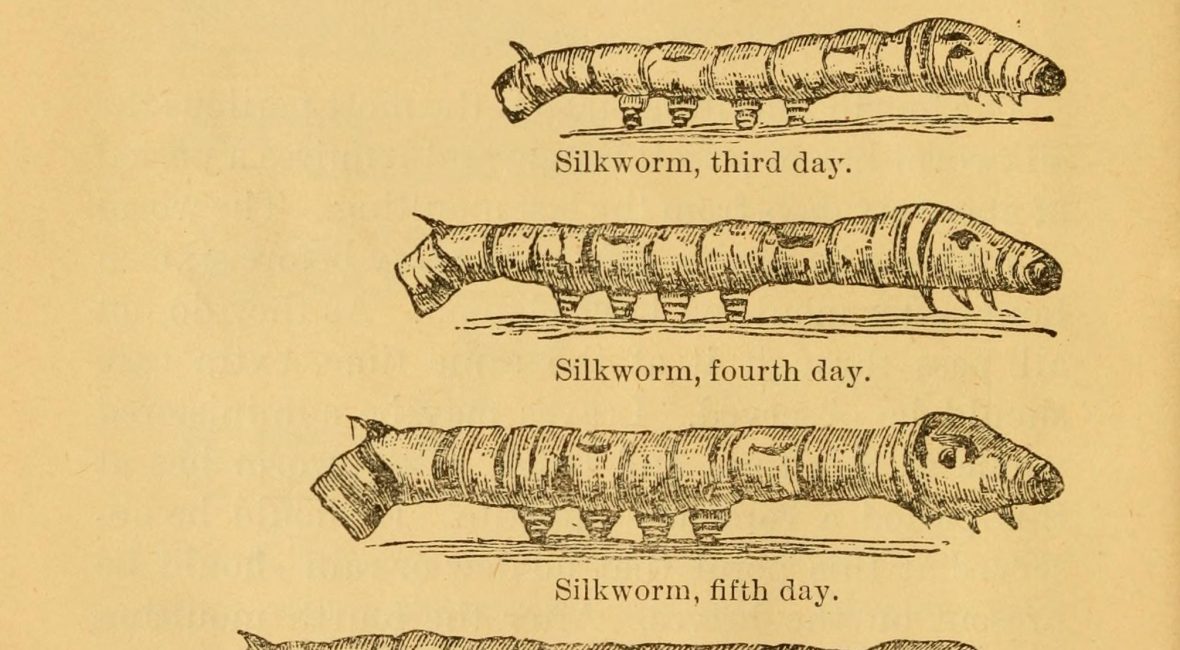
“Fifth stage of silkworms”. Rienzi, Louise. General instructions for rearing silkworms. 1887. Contributed in BHL from the Library of Congress.

General Instructions for Rearing Silkworms is a straightforward and detailed guide to the practicalities of raising silkworms. Instructions for successful cocooneries include descriptions of the types of trays, rack, and shelves needed, methods for keeping the air pure and clean, and instructions for feeding the worms. There is also a lengthy section titled Treatise on the Selection of Healthy Silkworm Eggs, which gives instructions for microscopic examination of the eggs and blood of the chrysalis. The entire manual is illustrated with numerous sketches of the equipment needed and the various stages of the eggs, worms, and moths themselves.

Raising silkworms according to this manual is very much a labor-intensive undertaking. To start, a constant supply of fresh mulberry leaves must be available to the silkworm rearer.  Rienzi states that “the worms from an ounce of eggs will consume from twelve hundred to thirteen hundred pounds of mulberry leaves.”  At first, the worms must be fed every few hours with fresh leaves.  The worms go through four moultings, each lasting about a week, and throughout this time period, the temperature, cleanliness and general welfare of the silkworms must be closely monitored.

Mulberry leaves. Rienzi, Louise. General instructions for rearing silkworms. 1887. Contributed in BHL from the Library of Congress.

Rienzi includes detailed descriptions of the changes in appearance which worms and eggs go through as they mature. Her practical advice for what to watch for also gives color to this business-like black-and-white manual: the silkworm egg itself is “the color of ash wood, and of the form of a lentil,” and a “pale lavender” hue to the eggs indicates that they will soon hatch, while a mature silkworm that is ready to spin will stop eating and take on a “golden, transparent color.”

Despite her detailed knowledge of silkworm rearing and enthusiastic support of the California silk industry, the value of Rienzi’s work seems to have been overlooked for some time. It was not until 1895 that the California legislature voted to appropriate funds for the pay claim of Louise Rienzi “for services rendered the State Board of Silk Culture as Secretary, Instructress, and Silk Expert, from December 12, 1885- to April 2, 1887”. Her compensation was set at $87.50 per month.

Further Readings

Klose, Nelson. California’s Experimentation in Sericulture. In Pacific Historical Review, v. 30 (Aug. 1961) 213-227

Klose, Nelson. Sericulture in the United States. Agriculture History, Vol. 37, No. 4 (Oct. 1963), 225-234.

Klose, Nelson. Louis Prevost and the Silk Industry at San Jose. In California Historical Society Quarterly, v.43 (Dec. 1964) 309-317

Mason, Frank R. The American Silk Industry and the Tariff.  American Economic Association Quarterly, 3rd Series, Vol. 11, No. 4 (Dec. 1910) 1-182

Onaga, Lisa. Silkworm, Science, And Nation: A Sericultural History Of Genetics In Modern Japan.  Dissertation: Cornell University, 2012. (https://hdl.handle.net/1813/29385)

Wyceoff, William C. Review: The Silk Industry in the United States. Science. Vol. 3, No. 57 (Mar. 7, 1884), pp. 290-292

The Journal of the Assembly during the Thirty-first Session of the Legislature of the State of California, 1895   (GoogleBooks)

March 25, 2019by Joel Richard
Blog Reel, Featured Books

Galen Clark: The Guardian of Yosemite

When Galen Clark’s The Big Trees of California, their History and Characteristics, was published, in 1907, he was 93 years old. It had been 50 years since he first came to live in the Mariposa Grove in Yosemite Valley. He had spent most of those years in the midst of the giant sequoias, serving as a guide and educator, and fighting for the protection of these natural wonders.

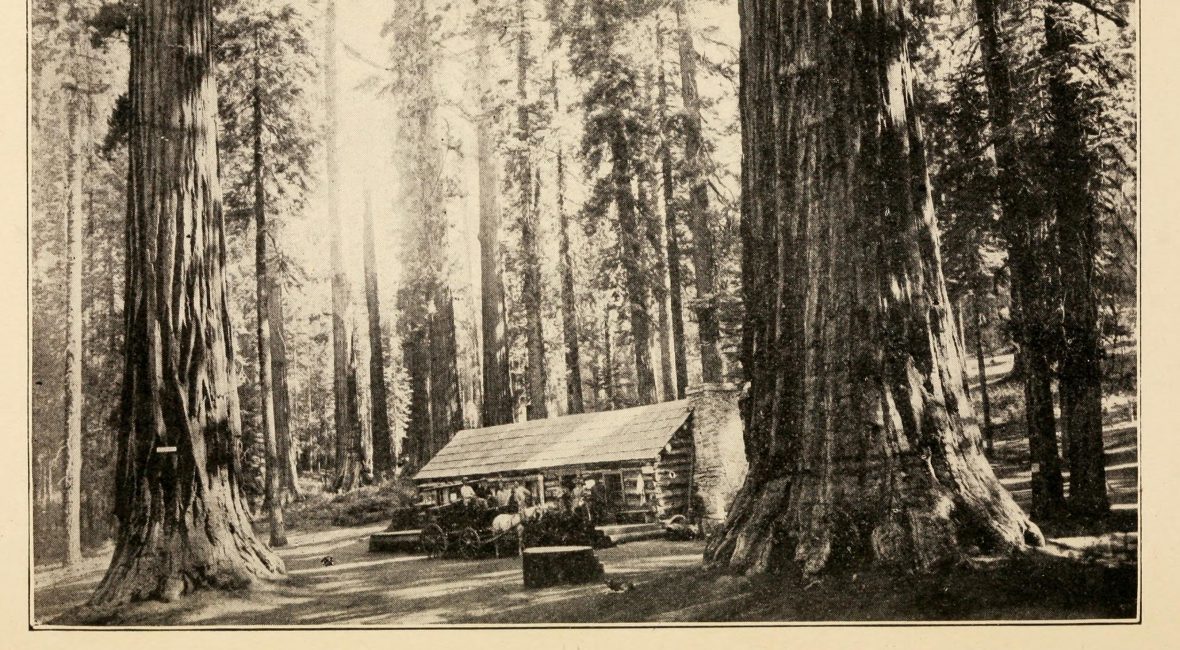
“Guardian’s Cabin. Mariposa Grove.” Clark, Galen. The big trees of California, their history and characteristics. 1907. Contributed in BHL from Library of Congress.

The noted naturalist and conservationist John Muir met Galen Clark on his first visit to Yosemite, and later, in his writing on The Yosemite, called him “the best mountaineer I ever met, and one of the kindest and most amiable of all my mountain friends.” Along with Muir, Clark was instrumental in Yosemite’s preservation and development as a national park.

Born in Canada 1814, Galen Clark migrated westward at an early age. In 1857, suffering from severe lung illness, he moved to Wawona, California for the mountain air. Although he engaged in several modest business enterprises, including running a hotel and serving as a professional guide, Clark was never successful as an entrepreneur. During much of his life he was consistently short of funds, but his accomplishments as an explorer and mountaineer, as well as his influence as a champion of forest and wilderness conservation, were widely recognized.

Galen Clark was an influential contributor to the original movement for the protection of Yosemite as a park. When President Abraham Lincoln signed the Yosemite Grant in 1864, setting aside the Mariposa Grove and Yosemite Valley as protected areas “for public use, resort, and recreation,” Clark was named the first Guardian of Yosemite. He served as Guardian for the next 24 years and lived to see Yosemite National Park established—as the third national park—in 1890. His influence and contributions were acknowledged when an iconic mountain peak was re-named Mt. Galen Clark in his honor.

Photo of Galen Clark. Clark, Galen. The big trees of California, their history and characteristics. 1907. Contributed in BHL from Library of Congress.

The Big Trees of California has a generous number of full-page photographs, including some taken by the Yosemite photographer George Fiske. Many of the bigger named trees are included, and there are also images of the Guardian’s Cabin nestled in the Mariposa Grove, and of the Wawona hotel (now Big Trees Lodge).

Within the free-flowing border of green foliage and cones that decorates each page of text, Clark touches on most aspects of the history, biology, and geography of these fantastic trees. He discusses cones and seeds, and gives tips for testing seed viability.  He also provides an overview of the distribution of big trees in California’s other major sequoia groves—although his main focus is on the Mariposa Grove.

In discussing the sequoia’s origins, Clark shares his awe for this “ancient order of forest trees … contemporaneous with such huge animals as the dinotherium, megatherium mammoth, and monster reptiles long since extinct.” Clark talks about the difficulties of determining the age of any particular sequoia—as even fallen trees, where the rings are easily examined, exhibit many irregularities and variations in ring growth. However,  he does speculate that some of the older trees may have been at least several thousands of years old.

Galen Clark’s love of the giant trees consistently shines through in this book. Despite the inclusion of a number of strictly factual portions—such as a detailed chemical analysis of the gum from a sequoia cone, along with a report supplied by supplied by Professor H. W. Wiley, Chief of the Bureau of Chemistry at the United States Department of Agriculture—this book comes across as an ode to the sequoias. In the section on “Habits and Characteristics,” for example, Clark sets out to provide some strictly factual botanical descriptions of branching and leaf types, but soon segues into a lyrical description:

The bright cinnamon color of their immense fluted trunks, in strong contrast to the green foliage, and dark hues of the surrounding forest makes them all the more conspicuous and impressive. In their sublime presence, a person is apt to be filled with a sense of awe and veneration as if treading on hallowed ground.

“Wawona Tree, Mariposa Grove.” Clark, Galen. The big trees of California, their history and characteristics. 1907. Contributed in BHL from Library of Congress.

A highlight of the book is the listing and description of some of the biggest of the big trees in California–and it is good to know that, more than 100 years later, many of his “celebrated specimens” are still standing.

The General Sherman Tree: This giant is still standing and has earned the title of World’s Largest Tree (by volume).  It stands 275 feet (83m) tall and is over 36 feet (11m) in diameter at its base. It is now estimated that this tree is somewhere around 2,000 years old.

The Grizzly Giant: Clark names this old sequoia “the Patriarch of the Mariposa Grove.” He speculates that, despite the extensive damage it has sustained, the Grizzly Giant may be “not just the oldest living tree, but also the oldest living thing on earth.”

The General Grant Tree: Named after Ulysses S. Grant, this tree is slightly smaller than the General Sherman.  In 1926, President Coolidge designated the General Grant as the Nation’s Christmas Tree, and annual ceremonies continue to be held at its base.  This tree is also notable for being designated as a National Shrine by President Eisenhower, in 1956.

The Boole Tree: This tree was left standing alone in the Sanger Lumber Company’s logging camp after surrounding trees were cut for lumber, in about 1895.  Clark predicted a swift death for this isolated and unprotected giant tree, but it still survives on what is now U.S. Forest Service land in Sequoia National Forest.

Sadly, another giant, the Mother of the Forest, in Calaveras Grove, was killed in the 1850s, when its bark was stripped and reassembled for display at various exhibitions in the United States and Europe. It was already dead, though not yet entirely destroyed by fire when The Big Trees of California was written.

Tunnel Trees: Clark writes that riding through the tunnel trees “in a six-horse stage, or any conveyance, is a great novelty and should not be missed.”  The famous Wawona Tunnel Tree of Mariposa Grove was a favorite until it fell under a heavy load of snow in February 1969. Another tunnel tree, Pioneer Cabin, which Clark mentions briefly, came down during a winter storm in 2017.

Further Reading

The Boole Tree, from the USDA Forest Service
https://www.fs.usda.gov/recarea/sequoia/recarea/?recid=79961

Forest atlas of the national forests of the United States. Sequoia folio. By United States. Forest Service. Pinchot, Gifford, Smith, George Otis. Washington, D.C.: U.S. Department of Agriculture, Forest Service, 1909. DOI: https://doi.org/10.5962/bhl.title.119298.

Mariposa grove of big trees: a short history of the Mariposa big trees & the Yosemite Valley.  By: Leitch, B. M. Wawona Calif: B.M. Leitch ?, 1910. DOI: https://doi.org/10.5962/bhl.title.30311.

Muir, John. South of Yosemite. Edited and with a foreword by Frederic R. Gunsky. Garden City, NY, Published for the American Museum of Natural History, by the Natural History Press, 1968.

Sequoia Research, Yosemite, from the National Park Service:
https://www.nps.gov/yose/learn/nature/sequoia-research.htm

Vischer’s views of California: the mammoth tree grove, Calaveras County, California, and its avenues. By: Vischer, Edward. San Francisco: Edward Vischer, 1862. DOI: https://doi.org/10.5962/bhl.title.50746.

Yosemite nature notes. United States. National Park Service. Yosemite Natural History Association, Yosemite Naturalist Department. Yosemite National Park Calif, Yosemite Natural History Association, 1922. Volume: 35 no.6. BHL:  item/70374.

February 21, 2019by Joel Richard
Blog Reel, Campaigns, Featured Books

Cats & Women: Why the Connection?

This blog post incorporates research conducted for an upcoming digital exhibition called “Wild Mouser to Household Pet: A History of Cats in Science and Society, 1858 to 1922.” Click here to check out the exhibition and book collection! 

Cats and women have long been connected in the public imagination. From ancient Egypt, to the Middle Ages, to the turn of the twentieth century, to the present – there has been an association between felines and femininity.

View Full Size Image
Gos., De Voogt. Our Domestic Animals: Their Habits, Intelligence, and Usefulness (1907). Painting by Henriette Ronner-Knip. Digitized by the Library of Congress.

Pronouns

One of the most glaring examples of this connection is the choice of pronouns used to describe cats. These examples from nineteenth and early twentieth century books illustrate the tendency to use feminine pronouns for cats:

“If a cat is seen to wash her face with vigor, it is going to be stormy, and if she sits with her back to the fire, it predicts cold weather.” [1]

“The cat has been called the ‘perfect pet,’ and not without justice. Pussy has always had her friends and her foes; her ardent admirers and her extreme detestors. Faults she has, no doubt, but the lack of an affectionate regard for the person who befriends her is not, as has been alleged, one of them. Though less demonstrative than the dog, the quiet rubbing of her fur against one’s person is no less indicative of supreme regard.” [2]

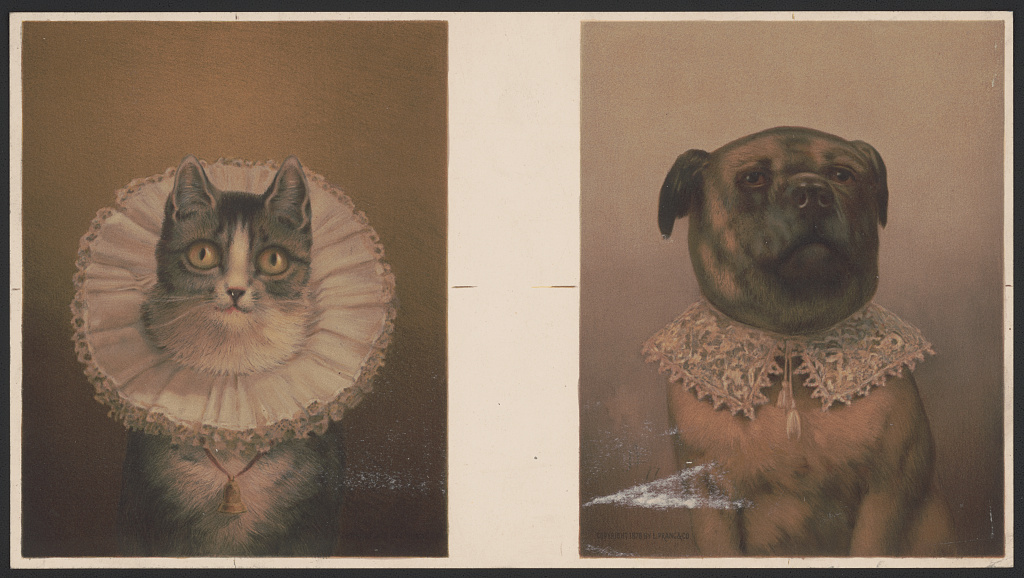
Conversely, dogs were usually referred to with masculine pronouns.

“Crazy Cat Lady” Trope

Another example of the link between cats and women is in the ‘crazy cat lady’ trope. In Our Domestic Animals, Their Habits, Intelligence, and Usefulness (1907), the phenomenon is described:

“Yet in certain cities of every country we find persons who push their passion for cats to excess; generally, it must be said, they are elderly dames [women], who establish asylums where neglected, lost, or sick cats may find a refuge. Sometimes these asylums are organized in a practical and sufficient manner, in which case the motive that provided them is laudable; but often they are mere nests of disease and objects of scandal to the neighborhood.” [3]

This ‘crazy cat lady’ troupe is linked to earlier beliefs in the connection between femininity, witchcraft, and cats. The tradition has also continued on into the twenty-first century: it is common for people to joke about single women who live with cats as crazy or scandalous.

View Full Size Image
James, Robert Kent. The Angora Cat; How to Breed, Train and Keep It. (1898). Digitized by the Library of Congress.

Cat Shows

View Full Size Image
Evening public ledger. (Philadelphia [Pa.]), 12 Dec. 1921. Chronicling America: Historic American Newspapers. Lib. of Congress.

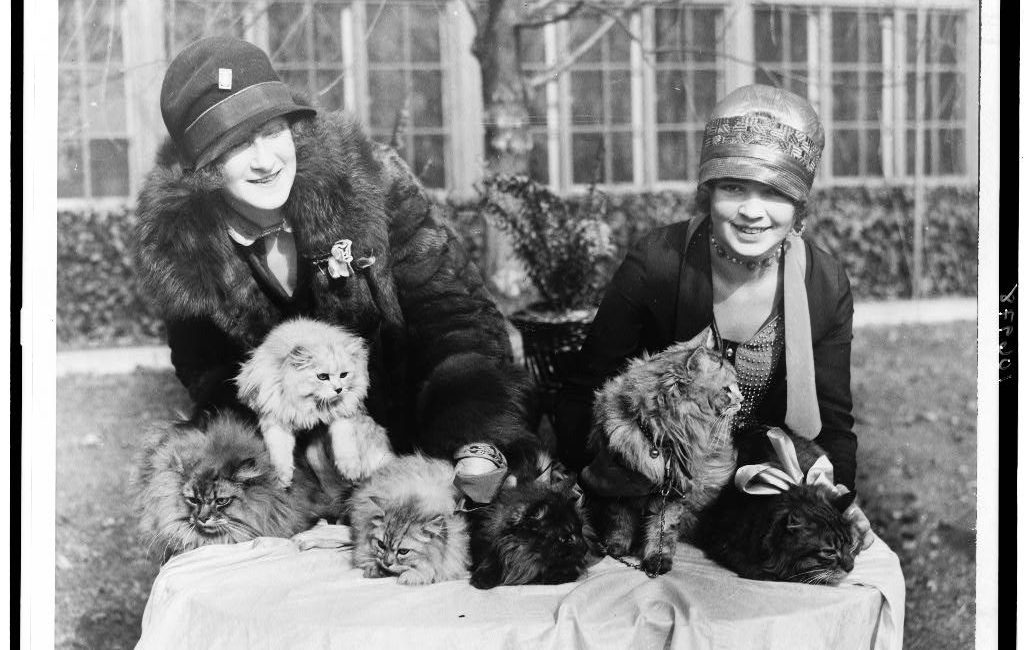
On the other side of the spectrum, women have also been associated with cat shows. The first United States National Cat Show took place in 1871. Women’s societies organized cat shows to raise money for charities, often animal welfare organizations. Newspaper articles from the time announce the upcoming shows and list the names of the exhibitors and organizers, who were mainly women. These shows also incorporated new scientific theories about heredity and breeding, as cat enthusiasts sought to selectively breed cats to develop particular traits, especially coat length and color.

View Full Size Image
Edna B. Doughty and Louise Grogan with Persian cats. 1920s. Library of Congress Prints and Photographs Division. https://lccn.loc.gov/93502603.
View Full Size Image
Mrs. A.McAllister and “Smoke Persian” cat. Ca. 1910-1915. Library of Congress Prints and Photographs Division. http://www.loc.gov/pictures/item/ggb2005018109/.

Another interesting visual representation of the connection between women and cats comes in the photography of Arnold Genthe (1869-1942). In the early twentieth-century, Genthe photographed many celebrities in his studio, posing them with his cat Buzzer. Click here to check out more photographs of Buzzer.

View Full Size Image
Miss Anna Holch with Buzzer the cat, portrait photograph. Ca 1913. Library of Congress Prints and Photographs Division. http://www.loc.gov/pictures/item/agc1996003492/PP/.

But why was there a connection between women and cats?

In his book, The Cat: An Introduction to the Study of Backboned Animals, Especially Mammals (1881), St. George Jackson Mivart shares one theory:

“The cat also is favoured by that half of the human race which is the more concerned with domestic cares; for it is a home-loving animal and one exceptionally clean and orderly in its habits, and thus naturally commends itself to the good will of the thrifty housewife.” [4]

He highlights aspects of cat’s behavior that are seen as feminine in his day: domestic tendencies and cleanliness.

Another possible interpretation involves the intelligence and disposition of cats. In her text, Everybody’s Cat Book (1909), Dorothy Bevill Champion hints at a relationship between women and cats. She writes:

“Cats are very sensitive in disposition, and can easily be frightened by harsh treatment…” [5]

This description would have been in line with stereotypical descriptions of women. On that same page she writes:

“After the many cases I have seen of cat intelligence, I can only say, if a cat is stupid it is want of education.” [6]

Reading these two quotes together, we see that Champion is making a claim about both cats and women. A central debate of the women’s movement during this time was whether women were as intelligent as men. Many argued that women’s shortcomings were due to less access to education, and not because they were less intelligent. Champion’s claim can therefore be read as a defense of both women and cats.

View Full Size Image
James, Robert Kent. The Angora Cat; How to Breed, Train and Keep It. (1898). Digitized by the Library of Congress.

Also, cats and women tended to be linked and compared with dogs and men.

“I class the Cat and the Dog to be as distinct in their individuality and with as much difference as you see existing between man and woman.” [7]

For more information about comparisons between cats and dogs, see this blog post.

In the end, these examples show that by the start of the twentieth century, the connection between women and cats was prevalent.

Here are some books about cats written by women in the nineteenth and early twentieth centuries. They are digitized on the Biodiversity Heritage Library.

  • Lucy Ellen Guernsey. Meat-Eater: With Some Account of Their Haunts and Habits. 1858.
  • Harriet Mann Miller. Funny Friends; or, Queens Pets at Marcy’s. 1892.
  • Helen M. Winslow. Concerning Cats; My Own and Some Others. 1907.
  • Dorothy Bevill Champion. Everybody’s Cat Book; Containing Chapters on “colour breeding”, “showing”, “conditioning”, “judging”, “diseases and their treatment”, “how to raise and treat the show and pet cat”, and Many Valuable Prescriptions. 1909.
  • Jeanie Oliver Davidson Smith. The Story of Zephyr; A Christmas Story. 1917.
  • Ellen Celty and Anna Ray. Feeding and Care of the Domestic and Long-haired Cat. 1922.

*For more information about domestic cats in the nineteenth and early twentieth centuries, see the digital exhibition “Wild Mouser to Household Pet: A History of Cats in Science and Society, 1858 to 1922.” 

[1] Jacob Biggle. Biggle Pet Book: A Collection of Information for Old and Young Whose Natural Instincts Teach Them to be Kind to All Living Creatures. 1900. Page 56.
[2] Thomas Earl. Pets of the Household; Their Care in Health and Disease. 1895. Page 155.
[3] Gos. De. Voogt. Our Domestic Animals, Their Habits, Intelligence and Usefulness. 1907. Page 83.
[4] St. George Jackson Mivart. The cat: an introduction to the study of backboned animals, especially mammals. 1881. Page 1.
[5] Dorothy Bevill Champion. Everybody’s Cat Book. 1909. Page 15.
[6] Dorothy Bevill Champion. Everybody’s Cat Book. 1909. Page 15.
[7] Marvin Clark. Pussy and her language. 1895. Page 51.

July 26, 2017by ulib-libraryjobs
Blog Reel, Campaigns, Featured Books

Cats & Dogs: Nineteenth and Early Twentieth Century Perspectives

This blog post incorporates research conducted for the digital exhibition, “Wild Mouser to Household Pet: A History of Cats in Science and Society, 1858 to 1922.” Click here to check out the exhibition and book collection!

View Full Size Image
Dielman, Frederick. “Uncle Tobey and the widow.” Library of Congress Prints & Photographs. http://www.loc.gov/pictures/item/2016652317/.

In the nineteenth and early twentieth centuries in the United States and Europe, cats were just beginning to be seen as household pets. Previously, they were viewed as biological specimens for medical study, muses for literature, and mousers that roamed around killing rodents. The way that people saw cats often involved a comparison with dogs. But how different are these two species? How did people perceive of those differences and similarities in the nineteenth and early twentieth centuries?

Usefulness

View Full Size Image
Gos., De Voogt. Our Domestic Animals: Their Habits, Intelligence, and Usefulness (1907). Digitized by the Library of Congress.

Authors compared cats and dogs in order to claim their favorite as superior. For example, in Domesticated Animals, Their Relation to Man and His Advancement in Civilization (1895), Nathaniel Southgate Shaler wrote:

Cats deserve some mention for the reason, that, while they are the least essential, and on the whole the least interesting, of domesticated animals, they have had a certain place in civilization. They afford, moreover, a capital foil by which to set off the virtues of the dog [1].

Clearly, Shaler is fond of dogs. He highlights one of the starkest differences between cats and dogs: their usefulness. While dogs were domesticated by humans to perform a variety of tasks such as hunting, cats never had much of a purpose beyond “mousing” (catching rodents, especially on farms with grain storages). This limited purpose led to less variation in cat breeding. However, cat enthusiasts still did breed and exhibit purebred cats.

View Full Size Image
Huidekoper, Rush Shippen. The Cat: A Guide to the Classification and Varieties of Cats and a Short Treatise Upon Their Care, Diseases, and Treatment (1895). Digitized by the Library of Congress.
View Full Size Image
Mrs. A. McAllister and Smoke Persian Cat, Bain news Service Publisher, ca.1910-1915. http://www.loc.gov/pictures/item/ggb2005018109/.

Intelligence

Another point of dissention between cat and dog fans was which was more intelligent. Most believed that dogs were smarter. Author Dorothy Champion sums up the common beliefs and her take:

How often one hears the remark, ‘How stupid cats are!’ or, ‘Cats cannot compare with dogs for cleverness.’ This is a point on which many people make a great mistake… I have come to the conclusion that an uneducated cat has far more brains than an uneducated dog. Doubtless the dog is easier to teach, as he can be made to do things, whereas the cat is of an independent disposition [2].

Those trying to counter the belief that dogs were smarter had to fiercely defend the intellect of the cat and provide examples to bolster their claim. A common way to do so was to cite their ability to remember how to get from one location to another, even across long distances. However this ability was also turned into a fault, with some authors claiming that cats are more attached to locations than they are to people.

View Full Size Image
Biggle, Jacob. Biggle Pet Book: A Collection of Information for Old and Young Whose Natural Instincts Teach Them to be Kind to All Living Creatures (1900). Digitized by the Library of Congress.

Domestication

Another element of comparison between cats and dogs was the extent of their domestication. There are a few ways to approach this topic. One way is to go back and study their original shift from wild to domesticate. New scientific studies using ancient DNA are uncovering clues about the origins of this shift [3]. While the exact details are debated, everyone agrees that cats were domesticated more recently than dogs. In fact, twentieth century authors questioned whether or not cats really have been domesticated at all:

He never was but half-domesticated at best, and while he is a universal favorite with children because of his furry coat and look of seeming intelligence, he is yet essentially a wild animal, almost incapable of true domestication. He has lost little of his innate savagery, and as a relentless foe of birds he has really become an enemy to our civilization[4].

While this account is definitely one of the more severe critiques of cats, the sentiment that cats remained wild and were posing a threat to wildlife was gaining popularity in the beginning of the 1900s.

Another way to approach the topic of domestication has to do with nineteenth century conceptions of domesticity. Cats were believed to have a particular affinity for the home, and became associated with the household, and by extension, women. Conversely, dogs were known to travel outside with their owners, tagging along for masculine activities like hunting.

For more information on the link between cats and women in this time period, see this blog post.

View Full Size Image
Gos., De Voogt. Our Domestic Animals: Their Habits, Intelligence, and Usefulness (1907). Digitized by the Library of Congress. (Look carefully to see the small kitten curled up beside the large dog).

By comparing their usefulness, intelligence, and domestication, nineteenth and early twentieth century authors debated the merits of cats and dogs in very similar ways that we do today.

Click the links below to access fully digitized volumes of the books mentioned in this post:

  • Biggle, Jacob. Biggle Pet Book: A Collection of Information for Old and Young Whose Natural Instincts Teach Them to be Kind to All Living Creatures (1900).
  • Champion, Dorothy Bevill. Everybody’s Cat Book (1909).
  • Davenport, Eugene. Domesticated Animals and Plants: A Brief Treatise (1910).
  • Forbush, Edward Howe. The domestic cat; bird killer, mouser and destroyer of wild life (1916).
  • Shaler, Nathaniel Southgate. Domesticated Animals, Their Relation to Man and His Advancement in Civilization (1895).
View Full Size Image
Frees, Harry Whittier. “A joy-ride” (1914). Library of Congress Prints & Photographs Division. http://www.loc.gov/pictures/item/2013648296/.


*For more information about domestic cats in the nineteenth and early twentieth centuries, see the digital exhibition “Wild Mouser to Household Pet: A History of Cats in Science and Society, 1858 to 1922.”

[1] Nathaniel Southgate Shaler. Domesticated Animals, Their Relation to Man and His Advancement in Civilization (1895). Page 50. Emphasis added.
[2] Champion, Dorothy Bevill. Everybody’s Cat Book (1909). Page 13. Emphasis added.
[3] See for example, Ottoni, C. et al. The palaeogenetics of cat dispersal in the ancient world. Nat. Ecol. Evol. 1, 0139 (2017).
[4] Davenport, Eugene. Domesticated Animals and Plants: A Brief Treatise (1910). Page 235. Emphasis added.

July 24, 2017by ulib-libraryjobs
Page 1 of 3123»

Help Support BHL

BHL's existence depends on the financial support of its patrons. Help us keep this free resource alive!

search

About BHL

The Biodiversity Heritage Library (BHL) is the world’s largest open access digital library for biodiversity literature and archives. BHL operates as a worldwide consortium of natural history, botanical, research, and national libraries working together to digitize the natural history literature held in their collections and make it freely available for open access as part of a global “biodiversity community.”

Join Our Mailing List

Sign up to receive the latest news, content highlights, and promotions.

Subscribe Now

Subscribe to Blog via Email

Enter your email address to subscribe to this blog and receive notifications of new posts by email.

Join 319 other subscribers

Subscribe to Blog Via RSS

Subscribe to the blog RSS feed to stay up-to-date on all the latest BHL posts.

Access RSS Feed

Inspiring Discovery through Free Access to Biodiversity Knowledge.

The Biodiversity Heritage Library makes it easier than ever for you to access the information you need to study and explore life on Earth…for free, anytime, anywhere.


64+ Million Pages of
Biodiversity Literature Online.

EXPLORE

Tools and Services
to Transform Research.

EXPLORE

300,000+
Illustrations on Flickr.

EXPLORE

ABOUT | HARMFUL CONTENT | PRIVACY | SITE MAP | TERMS OF USE