Two of the most important early contributors to our understanding of orchids were the artist Franz Bauer (1758-1840) and the English botanist and gardener John Lindley (1799-1865), who was to become known as the “father of modern orchidology”. The publication of the Illustrations of Orchidaceous Plants [from sketches prepared between 1792 and 1832] between 1830 and 1838 combined Bauer’s great skill and Lindley’s knowledge and industriousness to produce an invaluable artistic and scientific work. The Natural History Museum, London (NHM) has recently uploaded their copy of this volume to sit alongside the Missouri Botanical Gardens’ own volume.
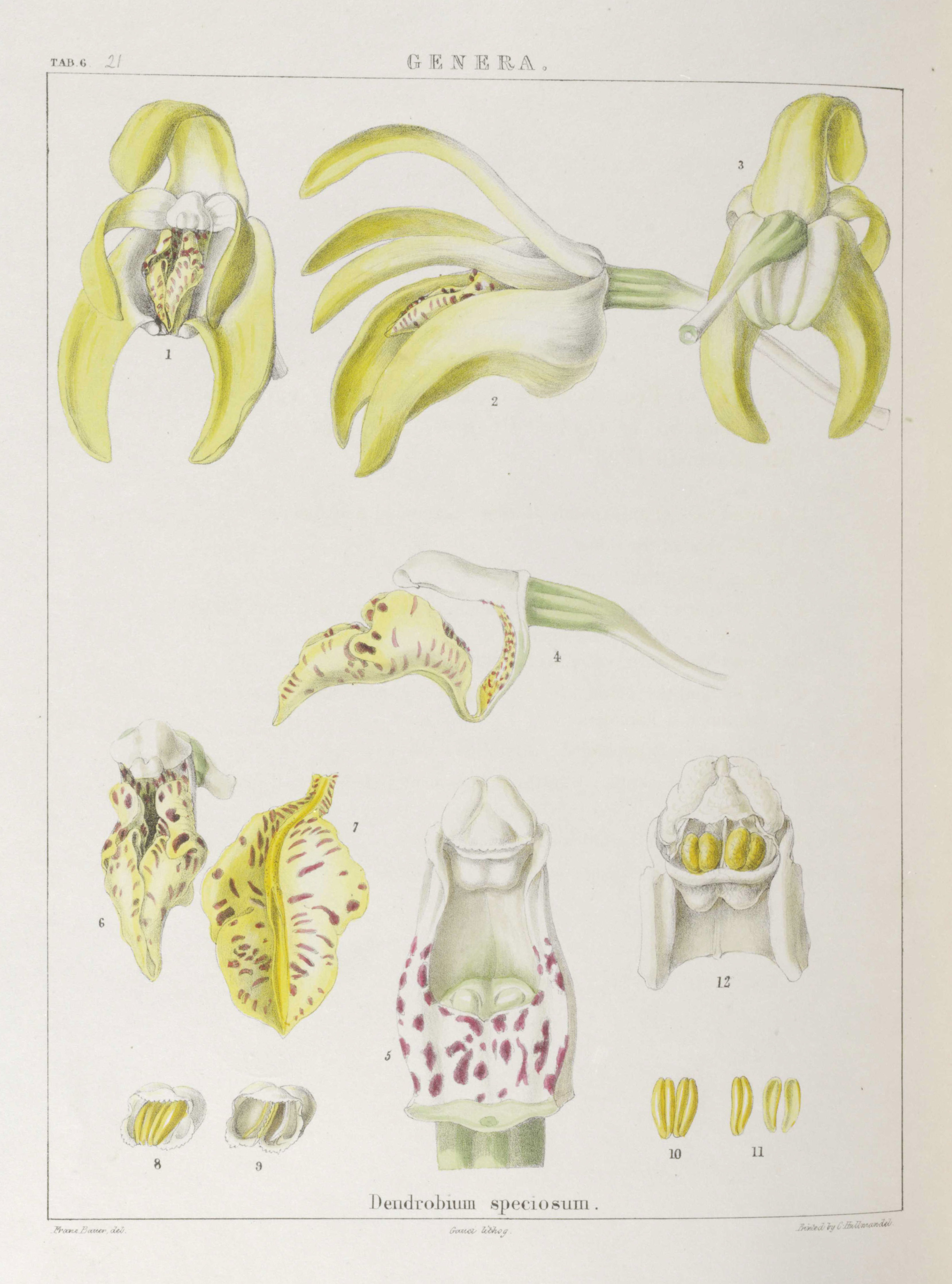
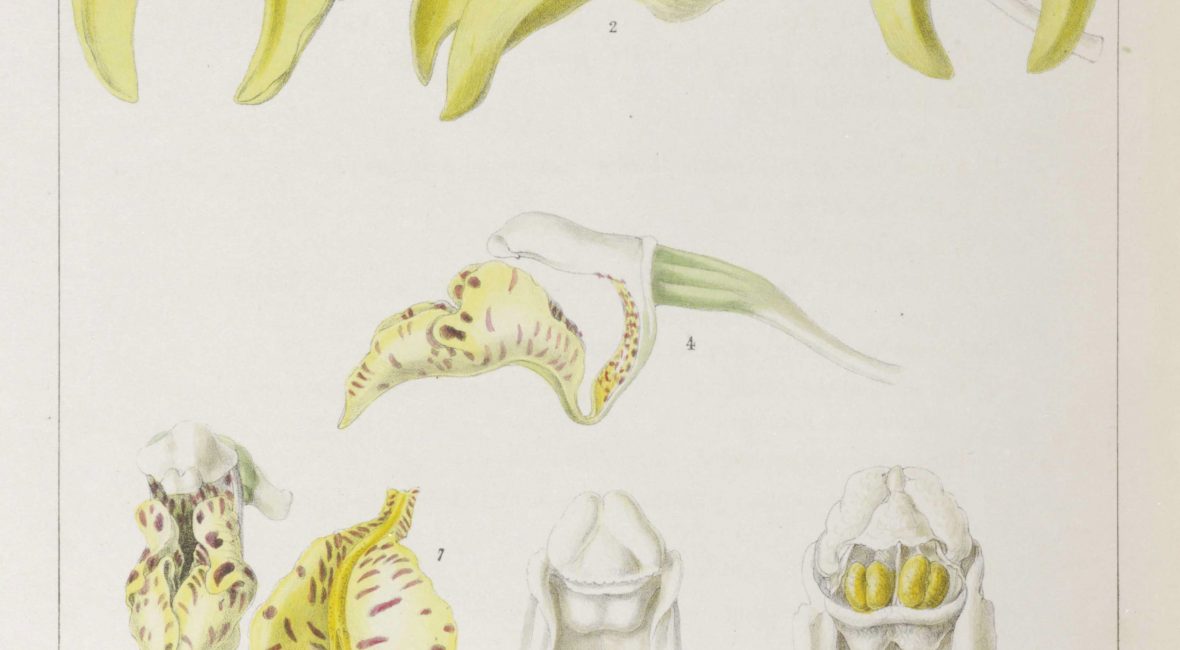
Plate 21. “The parts of fructification of Dendrobium speciosum from a sketch by Mr. Bauer in 1793”. Bauer, Franz Andreas and Lindley, John. Illustrations of Orchidaceous plants. 1830-1838. Contributed in BHL from Natural History Museum, London.
Lindley and Bauer were likely to have met in London under the patronage of Sir Joseph Banks (1743-1820). Bauer had settled in Kew by 1790 as their first artist in residence and was profiting from the technological developments in Kew’s heating of its glasshouses. The change from hot dry air and flue systems to heating by hot water circulating through cast-iron pipes enabled a better control of humidity, a prerequisite for the successful growing of tropical orchids. The following influx in orchidaceous species provided Bauer with a plethora of material to dissect and examine under a microscope and his skill in depicting scientifically accurate and aesthetically pleasing work flourished.
Lindley, on the other hand, was an assistant to Robert Brown (1773-1858) in Banks’s library and herbarium until Banks’s death in 1820. Although his life-long fascination was with orchids, he initially studied roses leading him to publish the volume A botanical history of roses, which he illustrated himself. In 1822, he was appointed by the Royal Horticultural Society as assistant secretary where he supervised their plant collections, and in 1829 he was appointed Professor of Botany at the University College, London, developing a reputation as a leading figure in orchidology and an excellent teacher. His recognition of several major groups of orchids according to the type of pollen and its arrangement on the column is still the basis of orchid classification today.
It was during this period that Lindley set about publishing Bauer’s many drawings of orchids studied under a microscope, of which Bauer had started these drawing in 1792 and continued beyond the first publication of the volume in 1832. Lindley provided the text on the organisation of Orchidaceae in his prefatory remarks, detailing many of the characteristics of orchids he had observed over his lifetime and referencing the various writings available to him at the time.
He states in his preface that “it has been found indispensable to represent Mr Bauer’s drawings by means of lithography instead of engraving on copper” and as such the final published volume contains thirty-five lithographed folio plates. Lindley was conscious of the changes he was making to Bauer’s drawings and goes on to state that he hopes “…that the defects of some of the plates as works of art will not be prejudicial to them as illustrations of science”. The plates are either un-coloured or hand-coloured with the individual components on each plate numbered with an index of what is depicted following each plate. Lindley lithographed several of Bauer’s drawings with the remaining being lithographed by Maxim Gauci (1774-1854).
The plates are based on Bauer’s drawings and illustrate various characteristics of the orchid plants, from floral structure to seeds and pollen. The plate below shows the single anther of a Bletia flower at a magnification of 100 times and a few pollen grains at a magnification of 400 times. Bauer ultimately sketched thousands of pollen grain at various magnifications, but in this example, he was able to soak the pollinia in water and thus discover the elastic tissue that connects the pollen grains together.
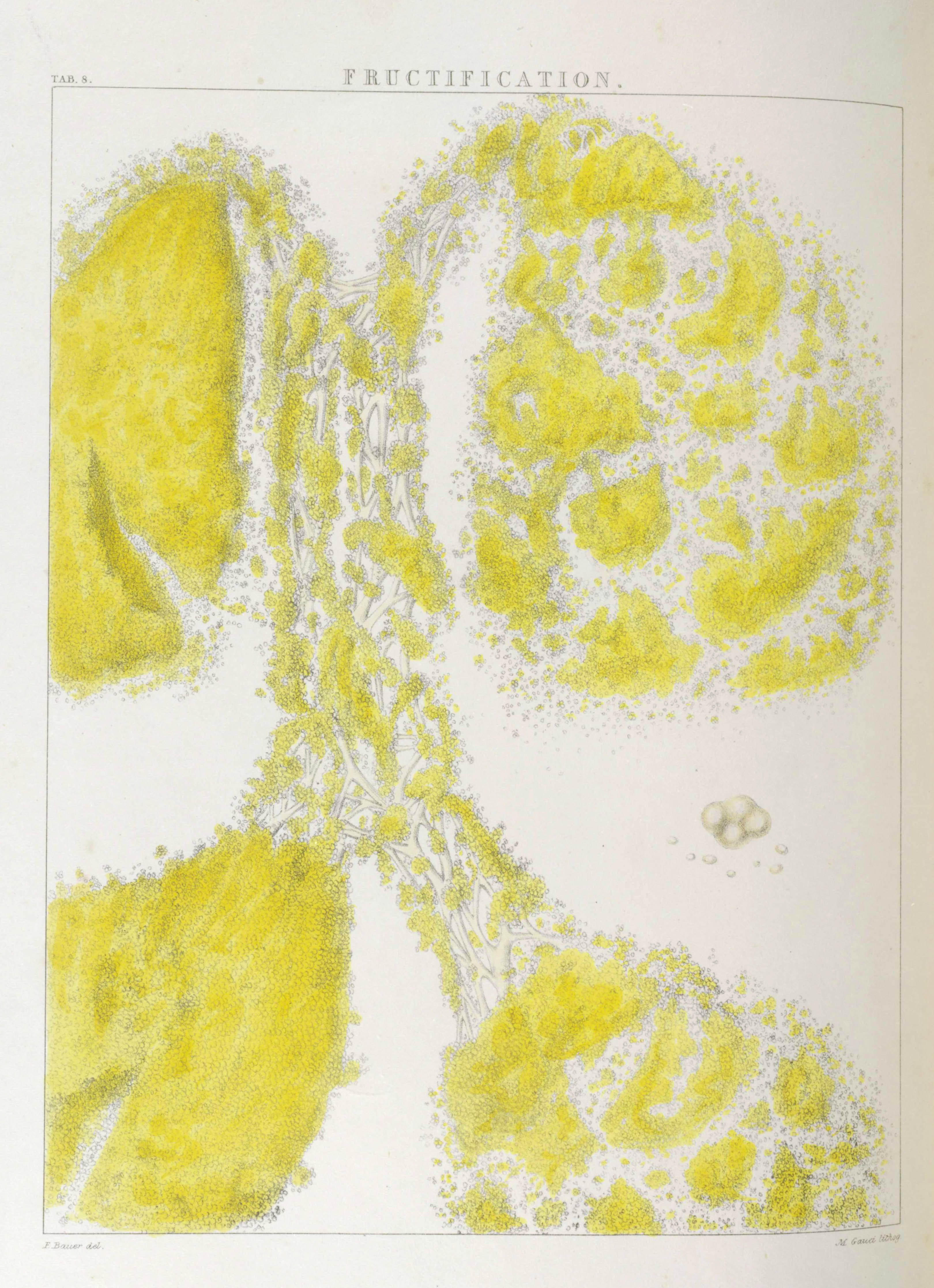
Plate 8. “A view of the pollen-masses of Bletia verecunda dissolved in water; from a sketch by Mr. Bauer in 1801”. Bauer, Franz Andreas and Lindley, John. Illustrations of Orchidaceous plants. 1830-1838. Contributed in BHL from Natural History Museum, London.
The volume recently uploaded to BHL via the Natural History Museum contains a manuscript dedication by Mr Meyer, Bauer’s friend and executor, to Franz Bauer, attached to the front flyleaf. This letter reads:
“In memory of Francis Bauer Esq.re, FRS & FLS, & c. Botanical Painter to His Majesty George 3rd. And Resident Draughtsman for fifty years to the Royal Botanic Garden at Kew, where he devoted himself to the advancement of natural science under the magnificent patronage of Sir Joseph Banks, Bart. the President of the Royal Society. In the delineation of plants he united the accuracy of the profound naturalist with the skill of the accomplished artist to a degree which has been only equaled by his brother Ferdinand and in microscopical drawing he was altogether unrivaled. In this branch of his most useful labours, the world will ever contemplate with admiration his elaborate illustrations of animal and vegetable structures, especially those which are preserved in the British Museum, and in the University of Göttingen. He was born 4th of October 1758 at Feldsperg in Austria, and came to England from Vienna with the Baron Joseph Jacquin in 1788. He settled at Kew in 1790, where he continued to live in the enjoyment of an exalted reputation, and in the affection and respect of all to whom his generous character, his unassuming manner, and his deep religious feelings were known until 11 December 1840 when he died at the age of 82. While the works of Francis Bauer are his imperishable monument friendship inscribes this record on his honored tomb. [From Mr Bauer’s friend and executor Mr Meyer, 38 Sackville Street, Piccadilly, February 26 1846, at Stanhope Cottage. Wm. Clift (Mr Meyer, Mrs Haverfield’s, Kew Green. March 3, 1846)”
Further reading:
Stewart, Joyce and Stearn, William T. (1993) The orchid paints of Franz Bauer, The Herbert Press
Cooper, Paul M. (2015) The Bauer brothers, Natural History Museum, London