

Biodiversity Heritage Library - Program news and collection highlights from BHL
  • Home
  • News
  • Featured Books
    • All Featured Books
    • Book of the Month Series
    • BHL at 20
  • User Stories
  • Campaigns
    • Fossil Stories
    • Garden Stories
    • Monsters Are Real
    • Page Frights
    • Her Natural History
    • Earth Optimism 2020
  • Tech Blog
  • Visit BHL
Home
News
Featured Books
    All Featured Books
    Book of the Month Series
    BHL at 20
User Stories
Campaigns
    Fossil Stories
    Garden Stories
    Monsters Are Real
    Page Frights
    Her Natural History
    Earth Optimism 2020
Tech Blog
Visit BHL
  • Home
  • News
  • Featured Books
    • All Featured Books
    • Book of the Month Series
    • BHL at 20
  • User Stories
  • Campaigns
    • Fossil Stories
    • Garden Stories
    • Monsters Are Real
    • Page Frights
    • Her Natural History
    • Earth Optimism 2020
  • Tech Blog
  • Visit BHL
Biodiversity Heritage Library - Program news and collection highlights from BHL
BHL News, Blog Reel

Celebrating Linnaeus’ Birthday with iTunes U

View Full Size Image

He has been dubbed “The Father of Modern Taxonomy,” “The Father of Modern Ecology,” Princeps botanicorum (Prince of Botanists), “The Pliny of the North,” and “The Second Adam.” He is credited with creating the classification schema known as binomial nomenclature, and today, he turns 305 years old. Of course, we’re talking about Carl Linnaeus, and we’re celebrating his birthday with the release of our latest iTunes U collection dedicated to him.

Carl Linnaeus was born May 23rd, 1707, in Småland, Sweden. As evidenced by his later publications, his first and primary passion was botany. At an early age, he took an interest in plants, eventually coming under the tutelage of Johan Rothman, the state doctor of Småland. Linnaeus first learned to classify plants under Rothman’s direction, using the system developed by Joseph Pitton de Tournefort, which, though based on artificial similarities between organisms, nevertheless was the first system to make a clear distinction between genus and species.

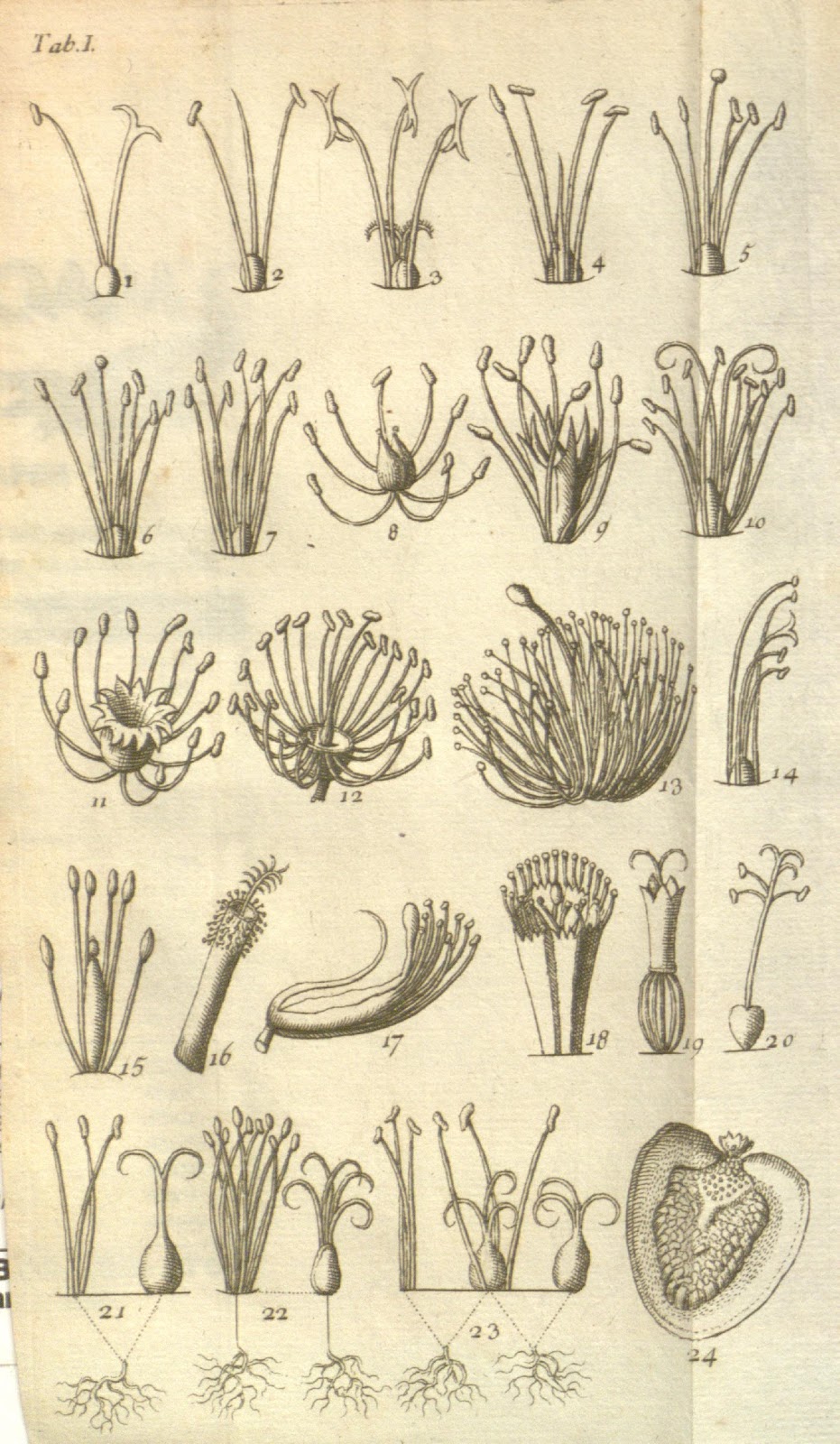
In 1728, Linnaeus enrolled at Uppsala University, where he made quick progress in the field of botany and, by only his second year, was himself giving lectures. During these years, Linnaeus began to question Tournefort’s classification system, and thus decided to develop his own. Linnaeus’ system arranged plants according to the number of stamens and pistils each possessed. This new system formed the basis of his work in the critical publication Genera Plantarum (first edition published 1737). A young German botanical draughtsman named Georg Dionys Ehret crafted a visual representation of this system, which Linnaeus included in Genera Plantarum (though without acknowledgement to Ehret). The image represents the earliest illustration of Linnaeus’ classification system for plants.
View Full Size Image
Ehret’s illustration of Linnaeus’ classification system

Linnaeus continued to revise Genera Plantarum, publishing a total of five editions (fifth edition published 1754). During the years between the publication of the first and fifth editions of this work, Linnaeus also published Species Plantarum (first edition published 1753), which arranged all plants known to him into orders, classes, and genera according to the Genera sexual system. Species Plantarum provided formal, multiple word descriptions in Latin of each species, as well as an additional epithet for easy reference. The combination of the genus and epithet quickly became a popular method by which to refer to a plant species. Species Plantarum is considered the inception of botanical nomenclature, and the use of a consistent naming structure based on the methods presented in Species and Genera was a vital step in the maturation of Linnaeus’ binomial schema.

In 1735, even before the publication of the first edition of Genera Plantarum, Linnaeus published the first edition of Systema Naturae. This first edition outlined Linnaeus’ ideas for the hierarchical arrangement of the natural world, dividing it into the animal, plant, and mineral kingdoms. His classification of the plant kingdom followed the sexual system he presented in Genera. However, it was not until the tenth edition of Systema Naturae that the binomial classification system we so readily associate with Linnaeus came into its own. While Species Plantarum had already established a binomial naming system for plants, the tenth edition of Systema Naturae (published in 1758) organized, for the first time, the animal kingdom according to this system – Kingdom, Class, Order, Genera, and Species. Thus, it represents the beginning of zoological nomenclature and, together with the first edition of Species Plantarum, is considered the starting point of binomial nomenclature.

Today, we highlight Linnaeus’ contributions to science with the release of our newest iTunes U Collection: The Carl Linnaeus Collection. The collection features 13 of Linnaeus’ publications (including the first edition of Species Plantarum, the tenth edition of Systema Naturae, and the fifth edition of Genera Plantarum), as well as two additional items about Carl Linnaeus and his sexual classification system (Carolvs Linnaevs by Edward Lee Greene and New illustration of the sexual system of Carolus von Linnaeus by Robert John Thonrton). You can download all of these titles directly onto your iPad, iPhone, or iPod Touch for free through iTunes. And, of course, you can download them directly to your computer through the BHL interface.

So Happy Birthday, Carl Linnaeus! Our present to you: Your very own iTunes U collection!
May 23, 2012by ulib-libraryjobs
Blog Reel, Featured Books

Book of the Week: The Threat to the Arctic Fox

As the planet warms, habitats for a myriad of species worldwide are changing, and perhaps those most affected are the species living in the arctic regions of the globe. These areas are seeing significant increases in average temperatures, changing the dynamics for the life found there. A poignant example of this is the Arctic Fox (Vulpes lagopus), a species whose habitat is being encroached upon by the Red Fox (Vulpes vulpes) as increasing temperatures make the arctic more habitable for the latter (see EOL’s “Threats” tab on the Arctic Fox page).

In recognition of this threat, we decided to feature the Arctic Fox in our book of the week post this week. In searching BHL for an item highlighting this species, we can across some interesting information regarding the food supply of the species in winter in Dogs, Jackals, Wolves and Foxes: A Monograph of the Canidae (1890), by St. George Mivart. This book, which contains abundant information on the species itself, also showcases the Arctic Fox’s unique food storage habits, which allow it to survive through the arctic’s prey-deficient winter months.
Scientists were long puzzled by the fox’s ability to survive through the long winter months without migrating, when a majority of its food sources had done so. As our book of the week relates, Professor Alfred Newton, in the 1863 expedition to Spitzbergen, wrote,
“What the Foxes do to get a living in winter when the birds have left the country, is one of the most curious questions that has presented itself to my mind for some time. The greater number of them are said to remain on the land, and to be as active during the long polar night as they are in summer; yet there are no berries by which they might eke out their existence, and there can be no open water, on the margin of which they might find food, within miles of their haunts. The most natural explanation which occurs to one is that they lay up a stock of provisions; but nobody, that I am aware of, has ever found such a store-closet.”
However, the supposition of “store-closets” was subsequently confirmed by H.W. Feilden during the Arctic Expedition of 1875 under Captain G.S. Nares. Feilden wrote, in reference to their discovery of Arctic Foxes during their expedition,
“…to our surprise, we discovered numerous deposits of dead Lemmings. In one out-of-the-way corner, under a rock, we pulled out a heap of over fifty dead Lemmings. We disturbed numerous ‘caches’ of twenty and thirty, and the ground was honeycombed with holes which each contained several bodies of these little animals, a small quantity of earth being placed over them. In one hole we found the major part of a hare carefully hidden away.”
The ingenuity of our Arctic Fox was thus established, revealing that, thanks to the thrifty habits of our little friend, the species is able to survive the cruel wrath of the arctic winter without having to migrate to warmer climates to follow their food sources. The competition for this food is now significantly increased, however, thanks to warming climates that allow the Arctic Fox’s competitor, the Red Fox, to encroach more and more upon their feeding grounds. We hope that through the increased availability of literature on both species through projects like BHL, and subsequently a better understanding of these animals and their natural habitats, scientists can help turn the tide for the Arctic Fox, saving this glamorous canine for future generations.
This week’s book of the week, Dogs, Jackals, Wolves and Foxes: A Monograph of the Canidae (1890), by St. George Mivart, was contributed by the University of California.
See the first description of the Arctic Fox in v. 1, pg. 40 of Systema Naturae per Regna Tria Naturae: Secundum Classes, Ordines, Genera, Species, Cum Characteribus, Differentiis, Synonymis, Locis (1758) by Carl von Linné.
April 14, 2011by ulib-libraryjobs
Blog Reel

The Sun Parakeet and the World Checklist of Threatened Birds

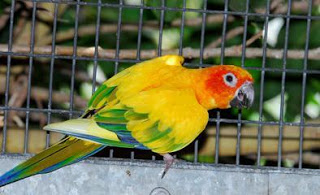
View Full Size ImageThe concept of threatened and endangered species is not a new idea for most of the world. Most are now well aware of the shadow that looms over so much of the magnificent life on our planet. While many efforts are underway around the globe to protect the species that are threatened, it is important to continue to raise awareness of the plight faced by so many of the creatures that share our planet. So, in an effort to do so, we highlight this week the Sun Parakeet, or the Aratinga solstitialis, one of the many species of threatened birds listed in this week’s book of the week, The World Checklist of Threatened Birds (1990).

The Sun Parakeet is native to northeastern South America, particularly in “the north Brazilian state of Roraima, Southern Guyana, extreme southern Suriname, and southern French Guiana.” Recent surveys revealing that the species may now be extirpated from Southern Guyana and rare in Roraima have excited recent discussions over the threatened status of this bird, and it is now listed as “Endangered” in the 2008 IUCN Red List. Deforestation, hunting, poaching, and capture for sale in the pet trade are the greatest threats facing this species.

The taxanomic history of this bird is interesting, beginning with its first description by Linnaeus in volume 1 of his 1758 work Systema Naturae. In this publication, Linnaeus situated the Sun Parakeet in the genus Psittacus. However, this genus is now reserved solely for the type species with which it is associated, the African Grey Parrot, and Aratinga solstitialis is now found in the genus Aratinga. Besides being known by the common name of Sun Parakeet, Aratinga solstitialis is also called the Sun Conure.

Aratinga solstitialis is a complex species, containing what have long been considered three sub-species: the Jandaya Parakeet, the Golden-capped Parakeet, and the Sulphur-breasted Parakeet. Recent discussions, however, have suggested that these sub-species are in fact separate species, or that the “Sun Parakeet and the Sulphur-breasted Parakeet represent one species, while the Jandaya Parakeet and Golden-capped Parakeet represent a second.” However, these species will interbreed in captivity (with the exception of the Sulphur-breasted Parakeet, of which, since it was only recently discovered in 2005, it is suspected but not confirmed that successful interbreeding with the three other mentioned species can occur).

The Sun Parakeet is among those bird species listed in The World Checklist of Threatened Birds (1990). Take a few moments to examine this species on EOL, and discover this species, along with many others, in this week’s book of the week. Think about what you can do to help ensure that these species are around for many generations to come.

November 17, 2010by michelle.underhill
Page 2 of 2«12

Help Support BHL

BHL's existence depends on the financial support of its patrons. Help us keep this free resource alive!

search

About BHL

The Biodiversity Heritage Library (BHL) is the world’s largest open access digital library for biodiversity literature and archives. BHL operates as a worldwide consortium of natural history, botanical, research, and national libraries working together to digitize the natural history literature held in their collections and make it freely available for open access as part of a global “biodiversity community.”

Join Our Mailing List

Sign up to receive the latest news, content highlights, and promotions.

Subscribe Now

Subscribe to Blog via Email

Enter your email address to subscribe to this blog and receive notifications of new posts by email.

Join 319 other subscribers

Subscribe to Blog Via RSS

Subscribe to the blog RSS feed to stay up-to-date on all the latest BHL posts.

Access RSS Feed

Inspiring Discovery through Free Access to Biodiversity Knowledge.

The Biodiversity Heritage Library makes it easier than ever for you to access the information you need to study and explore life on Earth…for free, anytime, anywhere.


64+ Million Pages of
Biodiversity Literature Online.

EXPLORE

Tools and Services
to Transform Research.

EXPLORE

300,000+
Illustrations on Flickr.

EXPLORE

ABOUT | HARMFUL CONTENT | PRIVACY | SITE MAP | TERMS OF USE

