Biodiversity Heritage Library - Program news and collection highlights from BHL
  • Home
  • News
  • Featured Books
    • All Featured Books
    • Book of the Month Series
    • BHL at 20
  • User Stories
  • Campaigns
    • Fossil Stories
    • Garden Stories
    • Monsters Are Real
    • Page Frights
    • Her Natural History
    • Earth Optimism 2020
  • Tech Blog
  • Visit BHL
Home
News
Featured Books
    All Featured Books
    Book of the Month Series
    BHL at 20
User Stories
Campaigns
    Fossil Stories
    Garden Stories
    Monsters Are Real
    Page Frights
    Her Natural History
    Earth Optimism 2020
Tech Blog
Visit BHL
  • Home
  • News
  • Featured Books
    • All Featured Books
    • Book of the Month Series
    • BHL at 20
  • User Stories
  • Campaigns
    • Fossil Stories
    • Garden Stories
    • Monsters Are Real
    • Page Frights
    • Her Natural History
    • Earth Optimism 2020
  • Tech Blog
  • Visit BHL
Biodiversity Heritage Library - Program news and collection highlights from BHL
Blog Reel, Featured Books

Lepidochromy: Butterfly Transfer Prints

This post was originally published on the Smithsonian Libraries’ blog. It was written by Daria Wingreen-Mason, Special Collections Technical Information Specialist in the Joseph F. Cullman 3rd Library of Natural History.

View Full Size Image
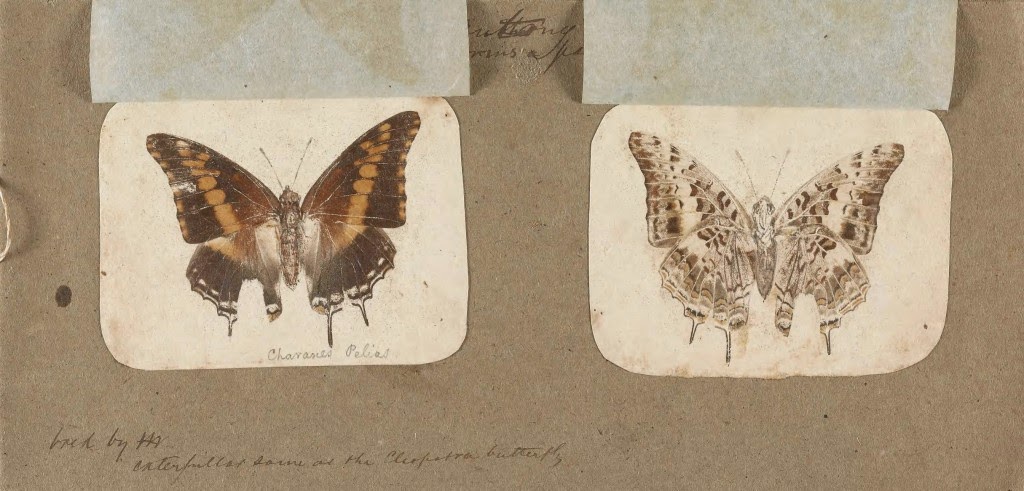
Dorsal and ventral views of specimen from Waller’s Butterflies collected in the Shire Valley East Africa.


Horace Waller was an English missionary and anti-slavery activist in the 19th century. In 1859 Waller joined the Universities’ Mission to Central Africa (UMCA). As Lay Superintendent to the UMCA, Waller befriended the famous missionary Dr. David Livingstone and botanist John Kirk who were in Africa as part of the British government-funded Zambezi Expedition. Livingstone, as head of that expedition, and Kirk, as naturalist, together navigated the Zambezi River area between 1858 and 1863. The purpose of the expedition was to chart the geography and catalogue the natural resources of the area. On 19 March 1863 Kirk wrote in his diary “Mr Waller is making a fine collection of insects, chiefly of the Lepidoptera”. Waller assembled this field book of the Butterflies collected in the Shire Valley East Africa from his time there.

Waller was an amateur naturalist, but a clearly practiced one, who shared his collection with experienced naturalists such as Roland Trimen who later thanked Waller for showing him specimens from the Shire valley.

View Full Size Image
Detail from Journal of science and annals of astronomy (v. 1, 1864, p. 651) “On the Butterflies of Madagascar”, by Roland Trimen.

The butterfly specimens in Waller’s field book were prepared by an infrequently employed technique termed lepidochromy in the 19th century. Lepidochromy involved using humidified, relaxed wings and an adhesive such as gum Arabic. By pressing the wings between two prepared papers the dorsal and ventral sides could be separated from each other and the scales, or “feathers”, would remain. Once mounted, the bodies of the insects were drawn in. This type of transfer illustration is classified as a nature print.

View Full Size Image
Detail from Scientific American: Supplement v. 27: no. 697. (May 11, 1889, p. 11138).

Ninety years before Waller ventured into Africa, George Edwards published a group of essays in 1770 that included “A Receipt For taking the Figures of Butterflies on Thin Gummed Paper.” This, or a slight derivation of it, was the method most likely employed by Waller to mount his “Flys”. By 1889, refinements in the process of lepidochromy were outlined completely in Scientific American, Supplement. It was a simple but onerous process where in the wings were transferred twice so that the brighter outer layer of scales would be right side up when mounted.

Printed volumes with nature prints were also published, but they were few. Printed editions were very labor-intensive and required hundreds and sometimes thousands of specimens. An immodest example is Sherman F. Denton’s two volume set of Moths and butterflies of the United States east of the Rocky Mountains (Boston, 1900) where more than 50,000 butterflies and moths were immortalized.

View Full Size Image
North America’s largest native moth (Hyalophora cecropia). As nature shows them : moths and butterflies of the United States, east of the Rocky Mountains. v. 1. 1900. http://biodiversitylibrary.org/page/12726507.

The scholarship on this humble field book continues. Dr. David Clough of the Namizimu Institute Mangochi Malawi recently inquired about the volume for exhibition after seeing the blog post, “The Art in Field Books” by Lesley Parilla. Dr. Clough then shared Waller’s butterflies with his colleague Dr. Lawrence Dritsas, a historian of science at the University of Edinburgh in Scotland. When the field book was acquired into the collection of Judge Russell E. Train in the late 20th century the authorship had been misattributed to Sir John Kirk. Dr. Dritsas has since properly identified the work’s creator as Horace Waller. Waller’s monogram is evident on the cover just below the title. From a book historian’s point of view, now the only remaining question is at what point was the field book’s authorship confused.

View Full Size Image
Title page/cover to Waller’s Butterflies collected in the Shire Valley East Africa.

Lepidopterists both at the Smithsonian and in Africa have also been consulted about the specimens and a complete and accurate list of the butterfly types have been identified by Dr. Clough and Smithsonian lepidopterists Dr. Robert Robbins and Mr. Brian Harris.

This book was digitized by The Field Book Project for the Biodiversity Heritage Library. It has been transcribed within the Smithsonian’s Transcription Center.

View Full Size Image
Dorsal and ventral views of specimen from Waller’s Butterflies collected in the Shire Valley East Africa.

With thanks to Dr. Lawrence Dritsas from the University of Edinburgh, David Clough from the Namizimu Institute, Steve Collins from the African Research Institute, and Dr. Robert Robbins, Brian Harris, and Lesley Parilla from the Smithsonian Institution. 

The Russell E. Train Africana Collection is housed in the Joseph F. Cullman 3rd Library of Natural History located the Smithsonian Institution’s National Museum of Natural History.

November 20, 2014by ulib-libraryjobs
Blog Reel, Featured Books

Shaping Public Perception of Africa: David Livingstone

Happy Birthday, David Livingstone!

View Full Size Image
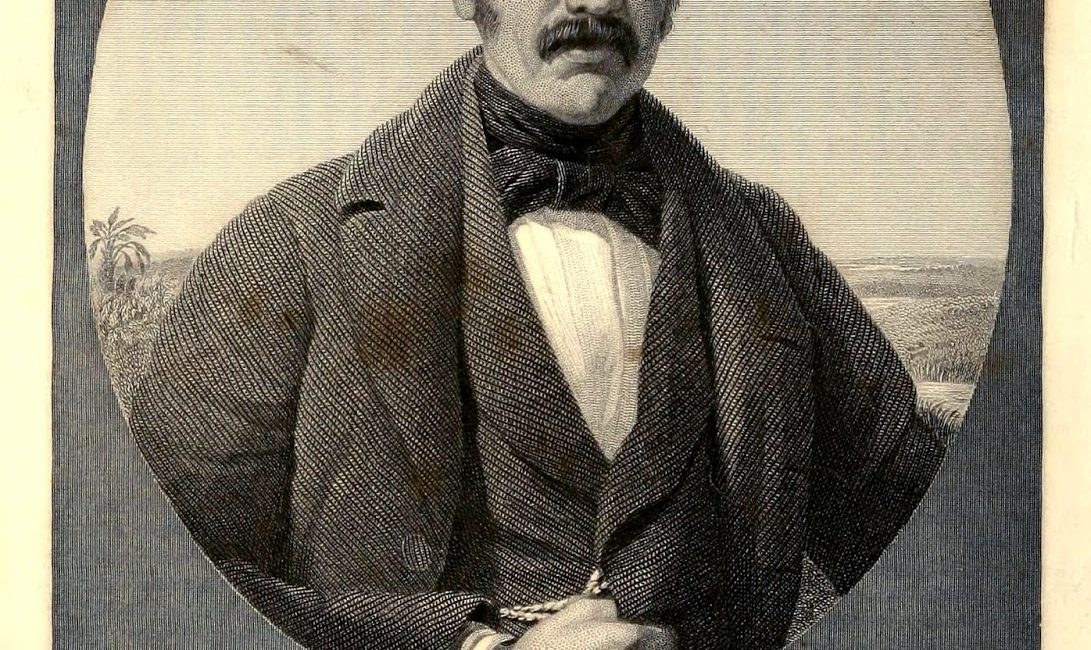
David Livingstone. Missionary Travels.

“Dr. Livingstone, I presume?”

Most of us have heard that famous phrase, uttered by Henry Morton Stanley of the New York Herald upon finding David Livingstone in Ujiji, Tanzania, on November 10, 1871.  However, just because you know the phrase doesn’t mean you know the man. Come with us as we explore this legendary explorer and celebrate his birthday!

Humble Origins

David Livingstone was the second of seven children born to a tea salesman in Blantyre, Scotland in 1813. From the age of ten, he worked in a cotton mill spending twelve hours a day tying broken threads on spinning machines. Fortune, however, had him destined for much greater things. At 23 years old, he entered Anderson’s University in Glasgow to study medicine, and in 1840, after completing his studies in London, he was licensed as a physician and ordained as a missionary. Originally intending to serve in China, Livingstone was inspired by the convictions of Robert Moffet, a missionary stationed at Kuruman, a missionary outpost in South Africa. Thus, Livingstone began his lifelong affair with Africa and set out in 1840 as a medical missionary to South Africa. He would spend the rest of his life exploring Africa, with only two visits to England over the subsequent 32 years.

An Account of More than a Decade in Africa

Livingstone, David. Missionary Travels and Researchers in South Africa. (1857). Contributed by Smithsonian Libraries.

Livingstone recounted his explorations and experience in Africa between 1840 and 1856 in his acclaimed publication Missionary Travels and Researches in South Africa. One of the nineteenth century’s best-selling books, Missionary Travels established Livingstone’s reputation as not only an exciting explorer, but also a kind-hearted humanitarian aching to improve conditions for Africans.

Missionary Travels is a narrative compilation of Livingstone’s personal field diaries.  Livingstone was careful to construct the composition to appeal to both scientific and religious readers, hoping to encourage further positive involvement in Africa. The work also includes 47 illustrations – most crafted by Captain Henry Need and Joseph Wolf.

Livingstone published the work with John Murray, one of the era’s most renowned publishers of geographical books. Murray was so anxious to secure the publication that he offered to finance all expenses in return for only one-third of the profit obtained.  

View Full Size Image
The Missionary’s Escape from the Lion. Missionary Travels.

The most famous illustration in Missionary Travels is entitled “The Missionary’s Escape from the Lion,” which depicted Livingstone pinned by a lion with his fellow travelers attempting to rescue him. Livingstone called the illustration “abominable,” asserting that “[e]veryone who knows what a lion is will die with laughing at it.” Murray ignored Livingstone’s dissatisfaction and included the illustration, knowing that most people reading Missionary Travels would not have the knowledge necessary to detect its absurdity. Furthermore, Murray understood that many audiences might never actually read the book but experience it only through illustrations. Thus, it was necessary to craft a dramatic story through images alone.

12,000 copies of the first edition of the book published in 1857, and, even at a price of one guinea each, sold out immediately. Several additional printings were ordered, selling with such success that Murray did not publish a cheaper, abridged version of the work (A Popular Account of Missionary Travels in South Africa) until 1861.

An Explorer at Heart

View Full Size Image
Stanley and Livingstone meet. Illustration from The Illustrated London News, 1872

As Missionary Travels and Researches in South Africa confirms, though a missionary, Livingstone spent much of his career exploring the wilds of Africa. Enthused by Livingstone’s discoveries as related in his book, the British government funded an expedition up the Zambezi River (1858-64), tasked with uncovering a route between the upper Zambezi and the coast. Extensive rapids past Cabora Bassa unfortunately made negotiating the river to the coast impossible, and the British government recalled the expedition 1864. Though unsuccessful, naturalists in the expedition party collected a wealth of valuable specimens during the six years of the expedition.

From 1866-67, Livingstone led a privately-funded expedition to discover the source of the Nile, which was debated at that time to be either Lake Albert or Lake Victoria. Arriving at Lake Bangweulu on November 8, 1867, Livingstone mistakenly asserted it as the upper reaches of the Nile. In truth, the source of the Nile lies in the high mountains of Burundi.

By the end of the Nile expedition, Livingstone’s public image was suffering due to the failures of his expeditions and reports that Livingstone was a poor leader and manager. After 1867, Livingstone’s health failed and he lost contact with the outside world completely, prompting the New York Herald to send Henry Morton Stanley in search of him in 1869. Stanley located him in Ujiji in 1871, and the article he later published about Livingstone restored public opinion of him, casting him as a great hero of adventure and discovery. However, despite Stanley’s urging to return to England to recover his health, Livingstone refused. He died in 1873 in present-day Zambia. His heart was buried under a Mvula tree and his body was transported to England, where it was interred at Westminster Abbey.

Though many of the expeditions that Livingstone undertook were unsuccessful at achieving the undertakings’ primary goals, the discoveries made along the way, and the natural riches recorded – many for the first time for Western people – made a monumental impact on the future of African exploration, understanding, and native relations.

A Monumental Legacy

View Full Size Image
Victoria Falls. Based on sketches by David Livingstone. Missionary Travels.

David Livingstone left behind an impressive legacy. He was the first European to successfully complete a transcontinental journey across southern Africa. He was the first European to see Victoria Falls, which he named after the British Monarch of the time. He discovered for Western science many locales throughout Africa, including Lake Tanganyika, Lake Ngami, Lake Mweru, Lake Bangweulu, and the upper Zambezi River. He was instrumental in increasing European awareness of the horrors of the slave trade in Africa and encouraging equitable, rather than dictatorial, European relations and fair commercial interactions with Africa. His explorations and zeal for Africa inspired and enabled future missionaries to serve in Africa, providing valuable medical and educational support.

He was awarded the Gold Medal of the Royal Geographical Society and memorials exist for him throughout Africa, the United Kingdom, and North America. Today, we celebrate the scientific contributions, as well as the humanitarian considerations, of this icon of nineteenth century science and exploration. Happy Birthday, David Livingstone!

Additional Livingstone Resources

  • View more of Livingstone’s publications in BHL.
  • Explore Livingstone’s 1871 field diary, made digital by the David Livingstone Spectral Imaging Project in November, 2011.
  • Learn more about the history of publishing Missionary Travels.
  • Learn more about Livingstone’s life through Livingstone Online

We hope you enjoyed this post. Interested in guest-blogging for BHL? We’d love that! Natural history, biodiversity and conservation topics are especially welcomed. Email us your ideas at [email protected].

March 19, 2013by ulib-libraryjobs

Help Support BHL

BHL's existence depends on the financial support of its patrons. Help us keep this free resource alive!

search

About BHL

The Biodiversity Heritage Library (BHL) is the world’s largest open access digital library for biodiversity literature and archives. BHL operates as a worldwide consortium of natural history, botanical, research, and national libraries working together to digitize the natural history literature held in their collections and make it freely available for open access as part of a global “biodiversity community.”

Join Our Mailing List

Sign up to receive the latest news, content highlights, and promotions.

Subscribe Now

Subscribe to Blog via Email

Enter your email address to subscribe to this blog and receive notifications of new posts by email.

Join 319 other subscribers

Subscribe to Blog Via RSS

Subscribe to the blog RSS feed to stay up-to-date on all the latest BHL posts.

Access RSS Feed

Inspiring Discovery through Free Access to Biodiversity Knowledge.

The Biodiversity Heritage Library makes it easier than ever for you to access the information you need to study and explore life on Earth…for free, anytime, anywhere.


64+ Million Pages of
Biodiversity Literature Online.

EXPLORE

Tools and Services
to Transform Research.

EXPLORE

300,000+
Illustrations on Flickr.

EXPLORE

ABOUT | HARMFUL CONTENT | PRIVACY | SITE MAP | TERMS OF USE