Biodiversity Heritage Library - Program news and collection highlights from BHL
  • Home
  • News
  • Featured Books
    • All Featured Books
    • Book of the Month Series
    • BHL at 20
  • User Stories
  • Campaigns
    • Fossil Stories
    • Garden Stories
    • Monsters Are Real
    • Page Frights
    • Her Natural History
    • Earth Optimism 2020
  • Tech Blog
  • Visit BHL
Home
News
Featured Books
    All Featured Books
    Book of the Month Series
    BHL at 20
User Stories
Campaigns
    Fossil Stories
    Garden Stories
    Monsters Are Real
    Page Frights
    Her Natural History
    Earth Optimism 2020
Tech Blog
Visit BHL
  • Home
  • News
  • Featured Books
    • All Featured Books
    • Book of the Month Series
    • BHL at 20
  • User Stories
  • Campaigns
    • Fossil Stories
    • Garden Stories
    • Monsters Are Real
    • Page Frights
    • Her Natural History
    • Earth Optimism 2020
  • Tech Blog
  • Visit BHL
Biodiversity Heritage Library - Program news and collection highlights from BHL
Blog Reel, Featured Books

How Many Buntings? Revisiting the Relationship Between Linnaeus and Catesby

illustration of a bird on a flower
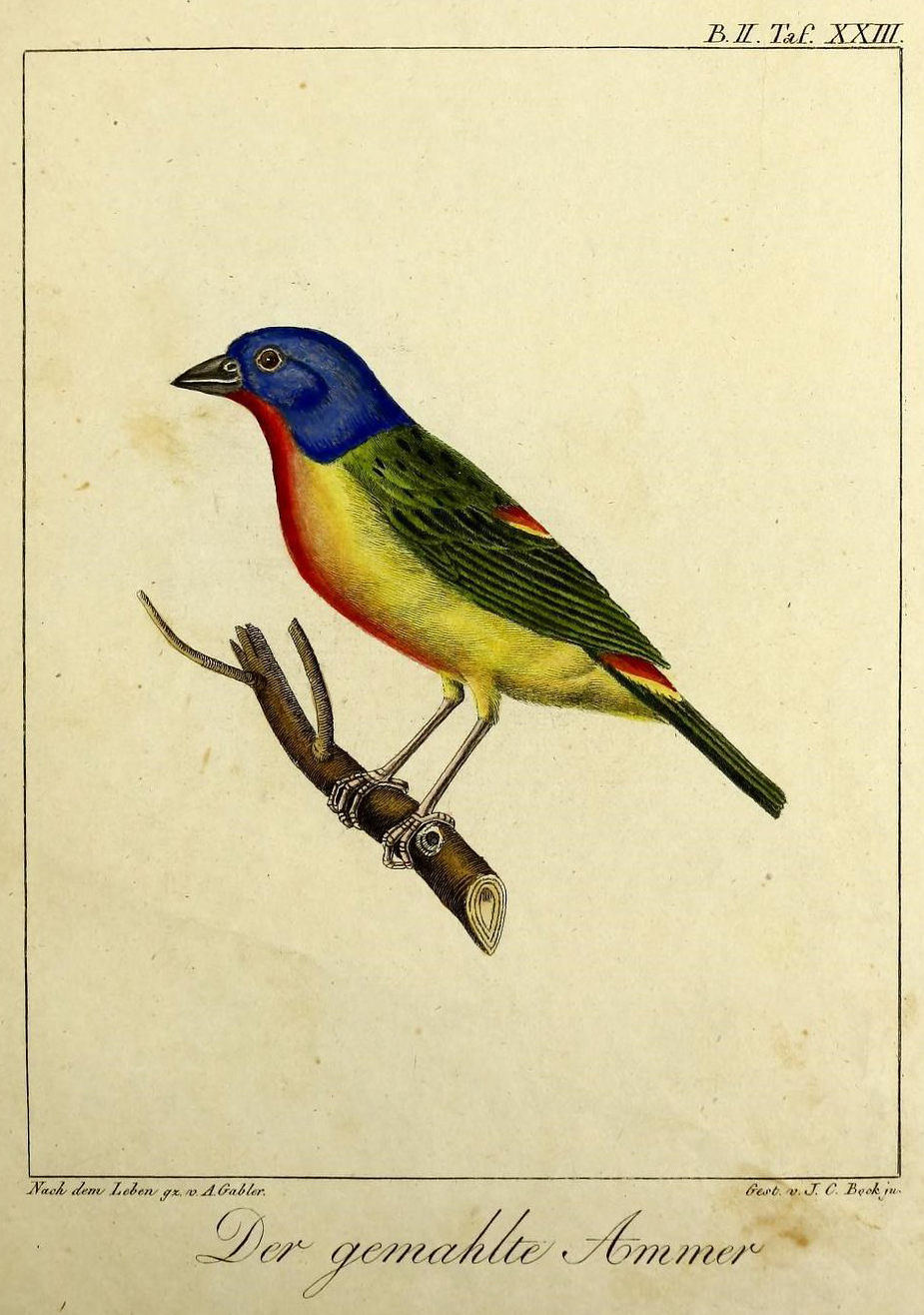
illustration of a blue, red, yellow and green bird

Pl. XXIII. Wolf, Johann. Abbildungen und Beschreibungen merkwürdiger naturgeschichtlicher Gegenstände. 1818-1822. Atlas. Contributed in BHL from the Field Museum of Natural History Library.

Not many birds bedazzle as thoroughly as the adult male Painted Bunting. No matter how many you’ve seen or how often, every one remains a source of startlement, whether it is emerging shyly from a Florida thicket, swaying on a heavy grass halm in the deserts of Arizona, or chewing steadily at a feeder in snowy Massachusetts. This, the most gaudily colored bird north of Mexico, is guaranteed to create a stir.
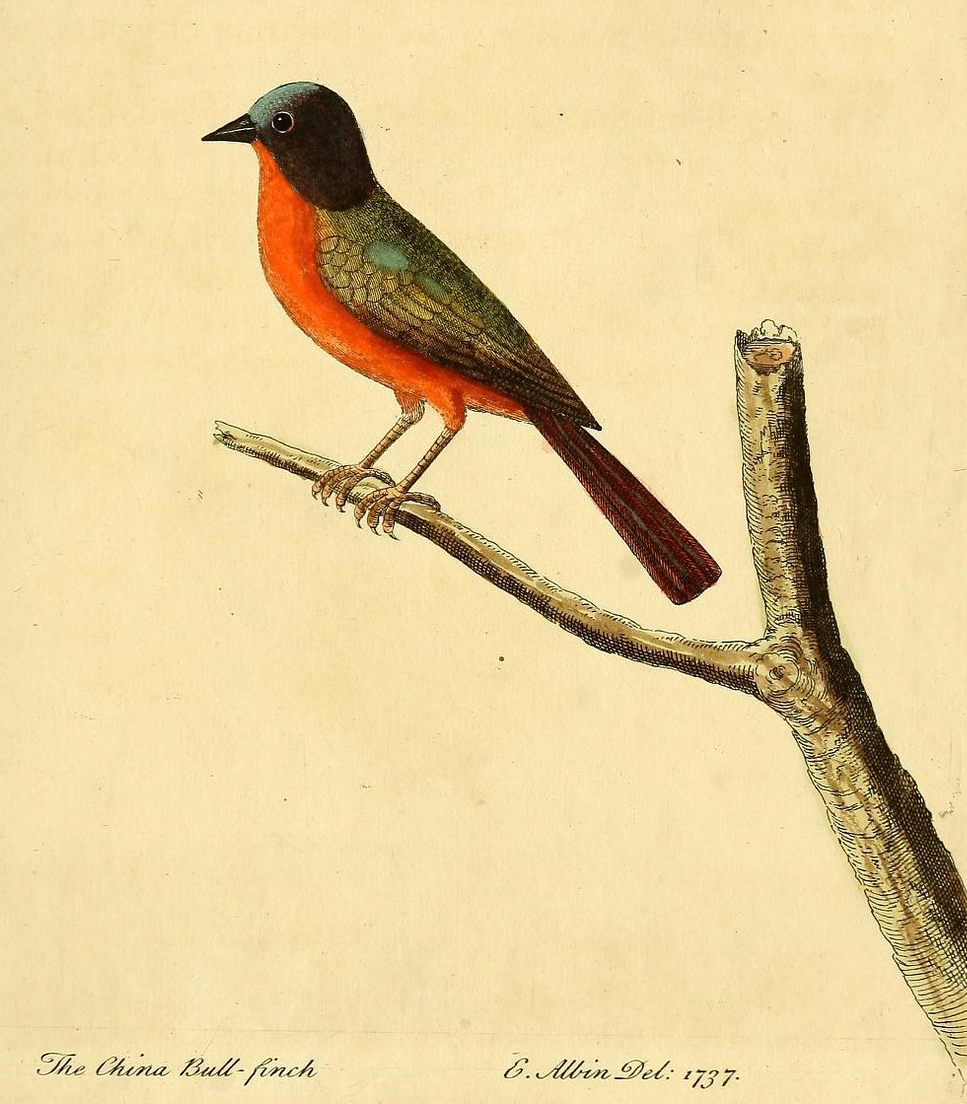
illustration of a bird

Numb. LXVIII. Albin, Eleazar. A natural history of birds. 1731-1738. v. 3. Art by Elizabeth Albin. Contributed in BHL from the Smithsonian Libraries.

That stir was even greater three hundred years ago, when European natural historians first confronted this novel beauty. So colorful was the bird that the first scientists to describe it believed that it must be native to regions even more exotic than America. Eleazar Albin, in the notes accompanying his or his daughter Elizabeth Albin’s 1737 engraving of the species, reported that the bird had been brought to England from China for the pleasure “of a curious Gentleman” (Albin 1738). A dozen years on, Linnaeus, having failed to find the bird described or depicted in the handbooks available to him, diagnosed it as a new species, which he inscrutably named Emberiza ciris, and determined that with so brightly colored a plumage, the specimens could have come only from India (Linnaeus 1750).
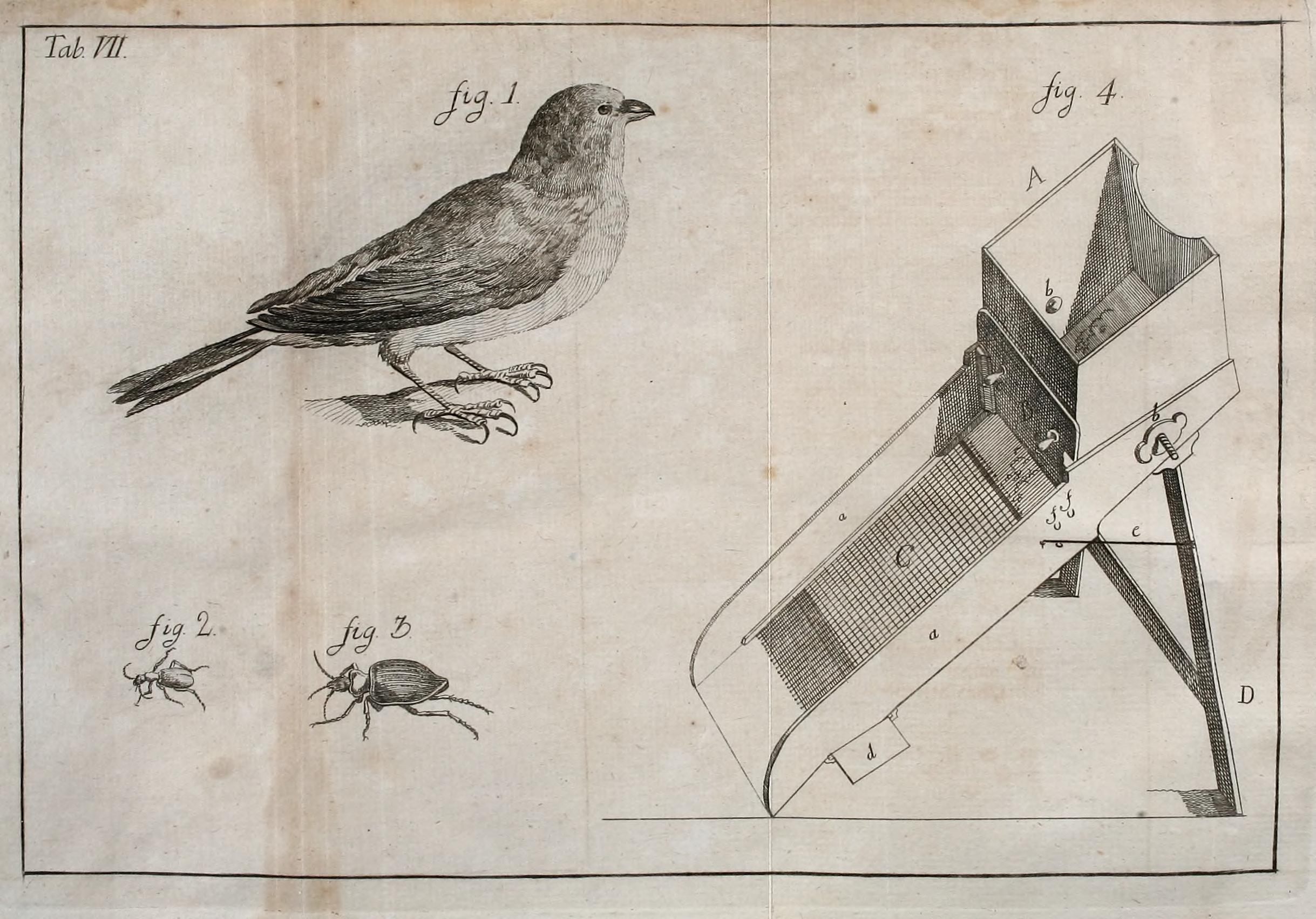
illustration of a bird, box, and insect

Tab. VII. Linnaeus, Carl. “En Indianisk sparf.” Kongliga Swenska vetenskapsacademiens handlingar ser. 1, v. 11. 1750. Contributed in BHL from Smithsonian Libraries.

With the benefit of nearly three centuries’ hindsight, such wild geographic speculation was strictly speaking unnecessary. As early as the 1720s, the natural historian Mark Catesby had seen, drawn, and described the Painted Bunting in southeastern North America, an account that he published in London in 1729 (Catesby 1729). Moreover, the Spanish in America had known the bird even before that, poetically naming it the “mariposa pintada,” the ultimate source of the species’ modern English name. (Coincidentally, it was by way of Spain that Linnaeus’s type specimen would later reach Sweden.) In their early publications, neither Albin nor Linnaeus reveals any awareness of these facts, but in 1758, Linnaeus included the colorful little finch in the tenth edition of the Systema with a citation to Catesby and, this time, an accurate, if not overly precise, statement of its range: “Habitat in America” (Linnaeus 1758).

Even as he corrected earlier misapprehensions about the bird’s geographic distribution, Linnaeus introduced a new confusion into the historical record of the Painted Bunting. In the 1758 Systema, the formal species diagnosis—based, of course, on the colorful adult male—is followed by a description of the female, which is “blue, with white on the belly only, [and] becomes almost gray in winter” (Linnaeus 1758). The only citation Linnaeus gives for this brief account of the female is Catesby, who, he says, depicted her on Plate 44 of his Natural History of Carolina under the name Liniaria caerulea (Linnaeus 1758).
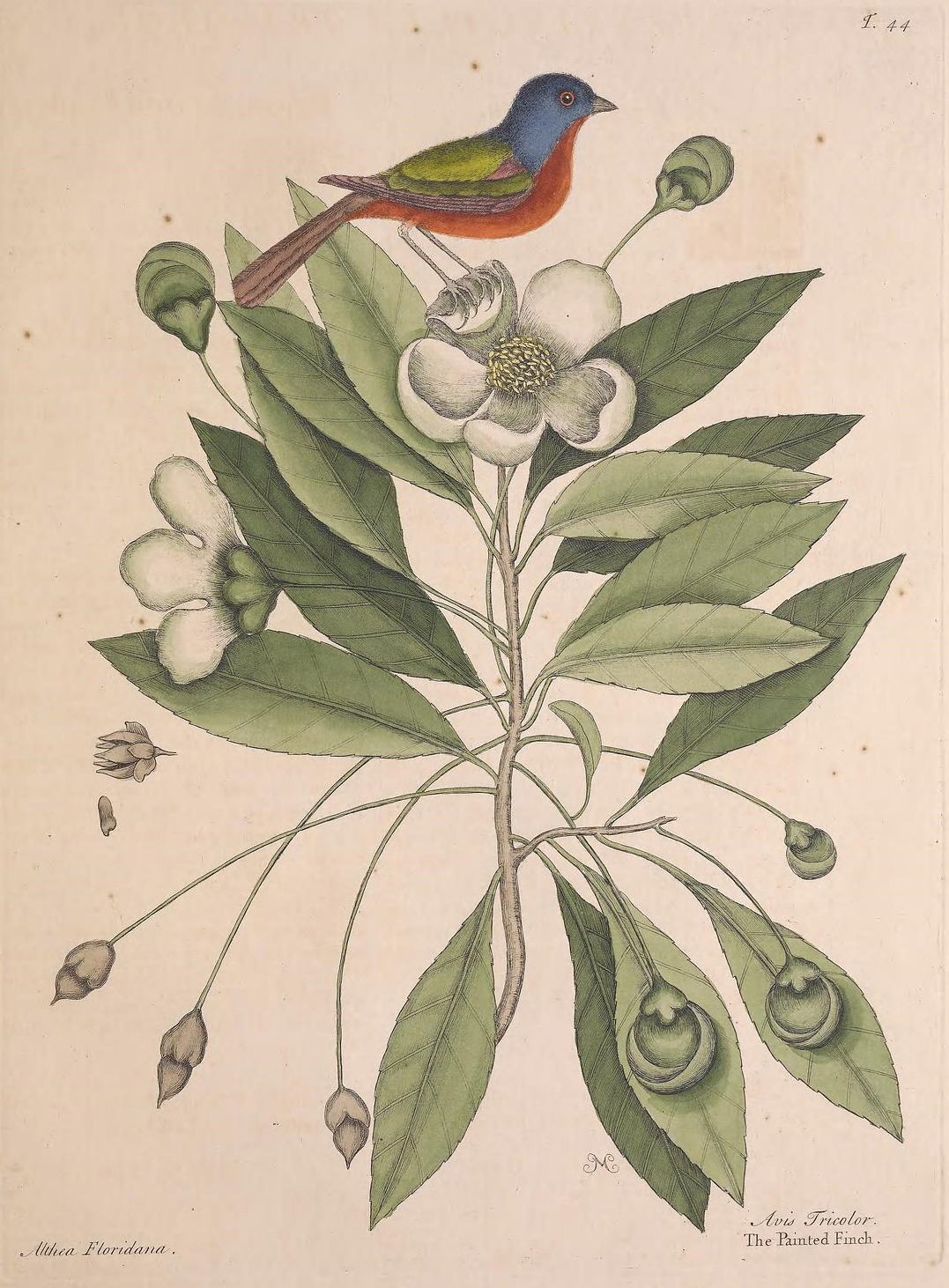
illustration of a bird on a flower

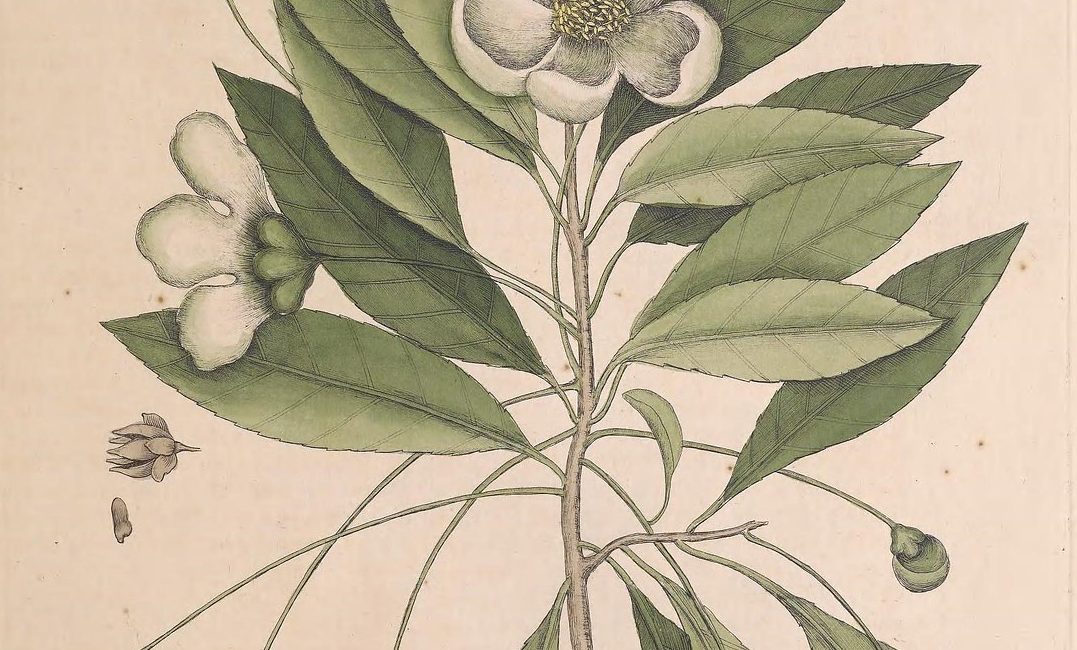
T. 44. Catesby, Mark. The natural history of Carolina, Florida and the Bahama Islands. v. 1 (1729-1732). Contributed in BHL from Smithsonian Libraries.

In fact, however, Catesby portrays only the male Painted Bunting on Plate 44 as published, and the accompanying text describes the female of that species quite differently, as “remarkable for her plain Colour, which is not unlike that of a Hen-Sparrow, but with a faint Tincture of Green” (Catesby 1729). Catesby treats his Liniara caerulea—the bird we know as the Indigo Bunting—as a distinct species, the Blew Linnet, the male of which is depicted on his Plate 45 and not, as Linnaeus erroneously indicates, Plate 44.
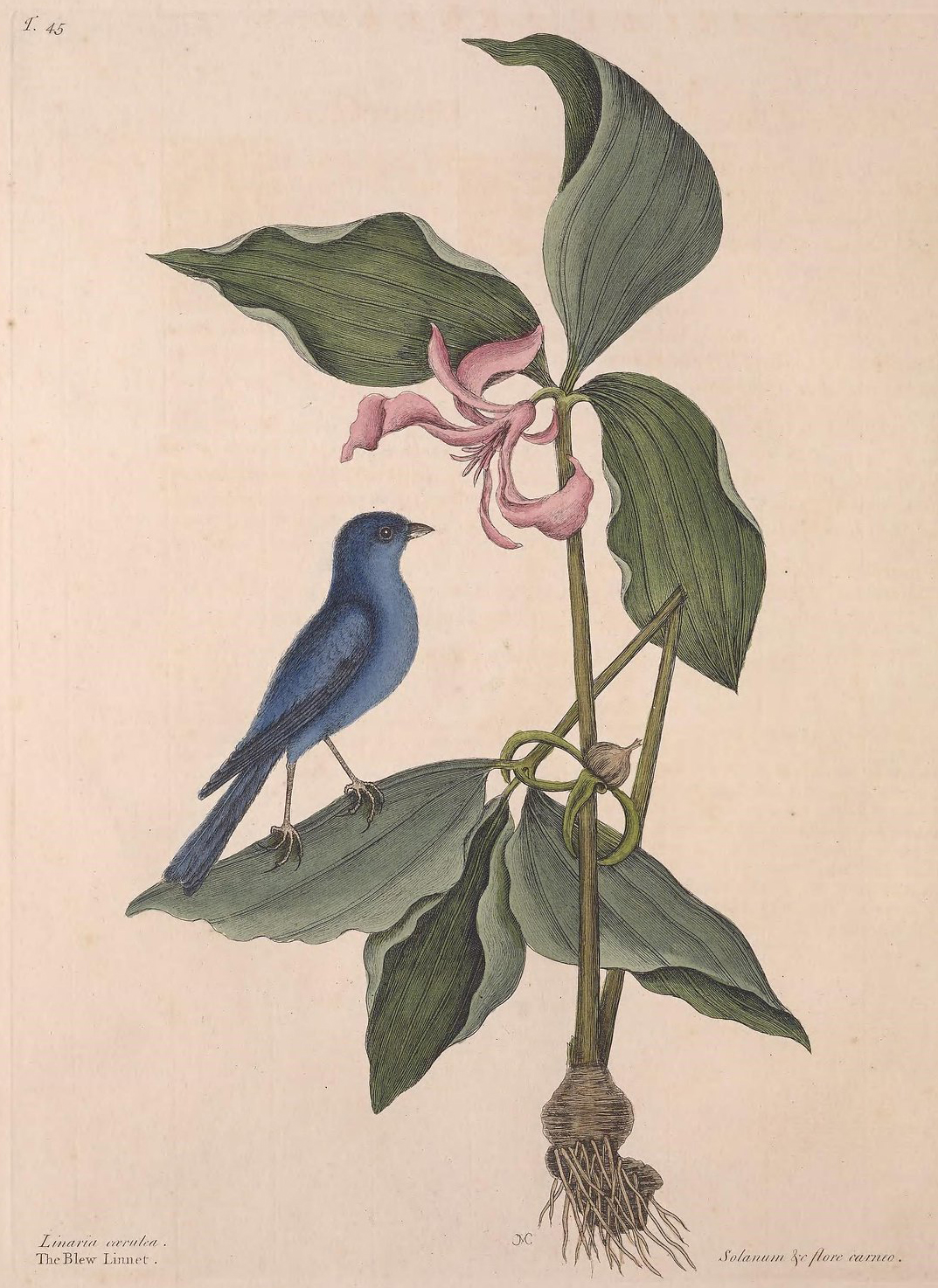
illustration of a blue bird on a plant

T. 45. Catesby, Mark. The natural history of Carolina, Florida and the Bahama Islands. v. 1 (1729-1732). Contributed in BHL from Smithsonian Libraries.

It is easy to forgive the odd typographical error in the nearly 1,400 pages of the 1758 Systema. But Linnaeus’s erroneous “lump” of the two bunting species and his mistaken claim that both are depicted on the same plate in Catesby are more than mere slips of the pen. Instead, these misstatements complicate what is generally thought of as the direct and straightforward link between Catesby and Linnaeus (for example, Stone 1929), shifting attention instead to the Swedish taxonomer’s still under-appreciated reliance on a different, intermediate source—the ornithological works of George Edwards.

——–––––––

In August of 1736, Linnaeus wrote to a botanical colleague that he had just returned from England, where he had spoken with Catesby “and the other botanists” (Linnaeus 1736). This was their only meeting. As prolific a correspondent as Linnaeus was, the sum total of extant letters between the two great naturalists is a single brief cover note accompanying a small shipment of plants Catesby sent to Sweden (Jarvis 2015). More surprising still, Linnaeus “almost certainly” did not own any of the volumes of Catesby’s Carolina, apparently consulting the Englishman’s work instead in the libraries of colleagues and patrons in Sweden and The Netherlands (Jarvis 2015).

The intellectual and personal relationship that bound Linnaeus and George Edwards ran far deeper—and centered not on botany but on ornithology. Linnaeus would eventually name nearly 350 species of birds on the basis of descriptions, paintings, and etchings furnished by Edwards over the years (Lederer 2019). A. Stuart Mason goes so far as to name Linnaeus as Edwards’s “admirer” (Mason 1992), an assessment amply vouched for in the preserved correspondence of the two naturalists. It is uncertain whether the two well-traveled colleagues ever met (James 1933), but Linnaeus clearly held Edwards and his work in considerable esteem.
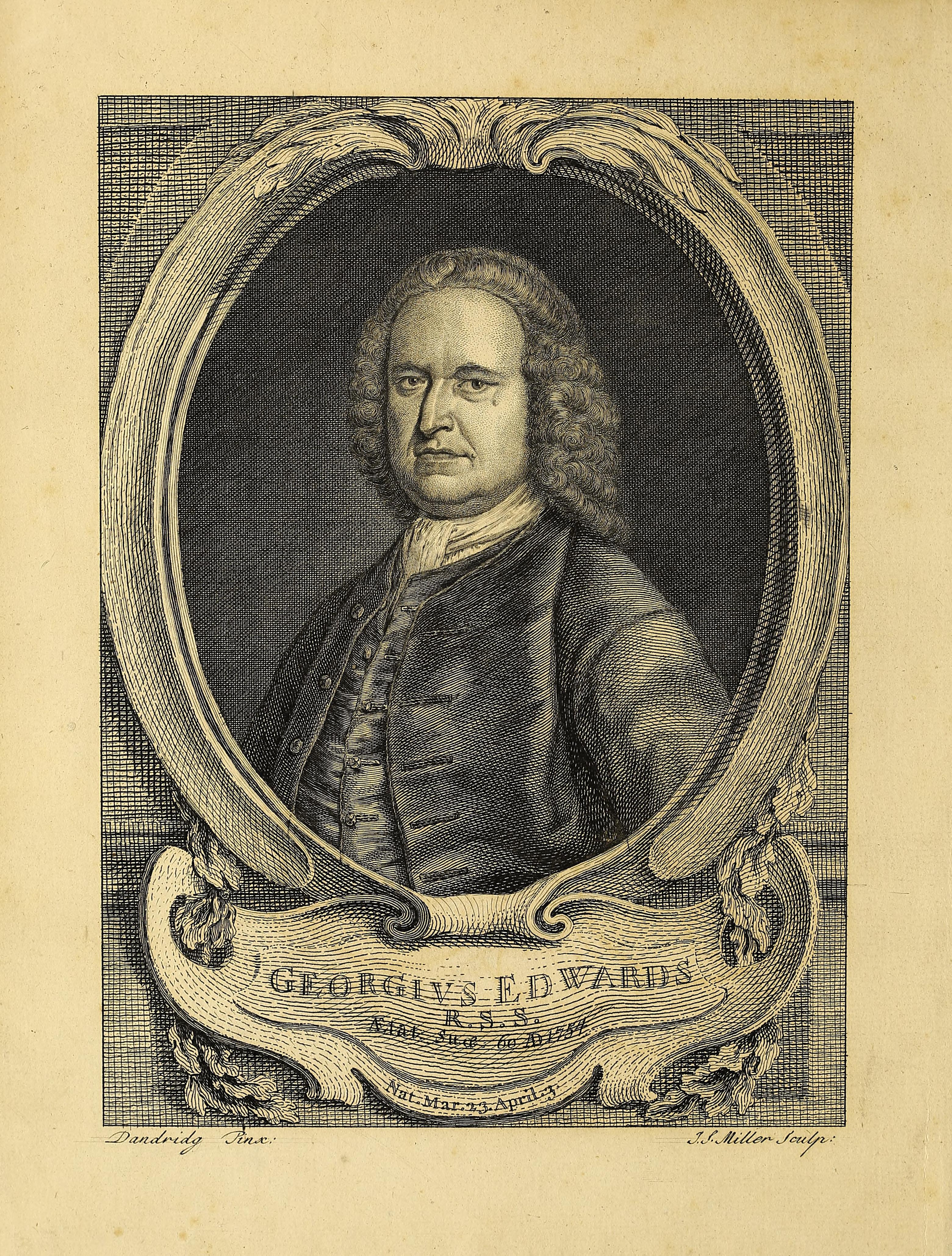
black and white portrait of a man

Portrait of George Edwards. Edwards, George. A natural history of birds. pt. 1 (1743). Contributed in BHL from Smithsonian Libraries.

In a 1759 letter introducing Edwards to Daniel Solander, the Swedish taxonomer names Edwards as preeminent among contemporary ornithologists, and pronounces himself happy to have lived to see the Englishman’s work with his own eyes (Linnaeus 1759). On the completion in 1764 of Edwards’s Gleanings of Natural History, Linnaeus would send his congratulations for having introduced to science “so very many extraordinarily rare birds, such a number as no one else has ever discovered or ever will, or far less will ever illustrate them so vividly that your birds are lacking only their song. They will sing your fame for as long as there are birds and men. Thanks to them, you have become an immortal ornament to our age…. Count me among your sincere admirers!” (Linnaeus 1765).

So great was Linnaeus’s respect for his English colleague that he had hung his portrait on the wall of his cabinet, where it served as a daily reminder of Edwards’s accomplishments (Linnaeus 1758b). Paintings, prints, and written descriptions passed between the two men almost non-stop, including both published and unpublished works (see, e.g., Edwards 1757 and Edwards 1760). The fact that Edwards sent Linnaeus “black”—that is to say, uncolored—plates from the Gleanings suggests that his gift was more than a simple ornamental courtesy, submitted instead for serious study.

——–––––––

In addition to his own significant accomplishments, George Edwards played a major role in preserving and promoting the works of Mark Catesby, whom he outlived by nearly a quarter of a century. The connection of the two men was both a personal and a professional one: not only did Catesby share certain of his specimens with Edwards (Edwards 1747), but he was so generous as to offer to teach Edwards, his “nearest rival” and his “good friend” alike, to etch his own plates for publication (Mason 1992). In turn, Edwards would see a second, posthumous edition of Catesby’s Carolina through the press beginning in 1754—and he would serve as his friend and mentor’s literary and artistic executor, preparing Catesby’s Nachlaß for auction to the benefit of the elder artist’s widow (McBurney 2015).

Edwards was clearly ideally situated to serve as the point of transmission between his two friends Catesby and Linnaeus, particularly so, of course, after Catesby’s death in 1749. With no convenient access to Carolina, the great Swede would quite naturally have relied on his London colleague’s intimate familiarity with Catesby’s work. Edwards, however, was not a transparent conduit, passing Catesbiana on to Upsalla verbatim. Instead, much of what he provided Linnaeus—and much of what is attributed in the Systema straightforwardly to “Catesby”—was in fact decidedly second-hand, filtered through Edwards’s own use, and in some cases his own reassessment, of Catesby’s American material in his ornithological works.

This should be unsurprising given the structure, chronological and geographic, of the network binding Linnaeus, Catesby, and Edwards, but until now it seems that the citations to “Catesby” in the Systema have been accepted at face value, as direct and unmediated references to that author’s Carolina. That assumption explains the persistent puzzlement in the scholarship as to “why Linnaeus omitted a number of Catesby’s birds” from the 1758 edition of the Systema, birds Catesby had illustrated, described, and published a generation earlier (Stevens 1936). O.A. Stevens counted ten such mysterious omissions, birds present in the first edition of Catesby’s Carolina but for some reason not taken over into the 1758 Systema.

If we accept that Linnaeus was not making direct use of Catesby but was instead relying on Edwards’s reception of Catesby, the matter is easily explained: of the ten species of Catesbeyan birds Linnaeus ignored, all ten—the Blue-winged Teal, Yellow-bellied Sapsucker, Hairy and Downy Woodpeckers, Tufted Titmouse, Gray Catbird, American Robin, Red-Winged Blackbird, Orchard Oriole, and Indigo Bunting—had also been excluded from Edwards’s Natural History of Birds. Had Linnaeus directly consulted Catesby’s Carolina, he would have had no reason to leave those species aside; depending entirely on Edwards, however, he would have had no reason to even suspect their existence.
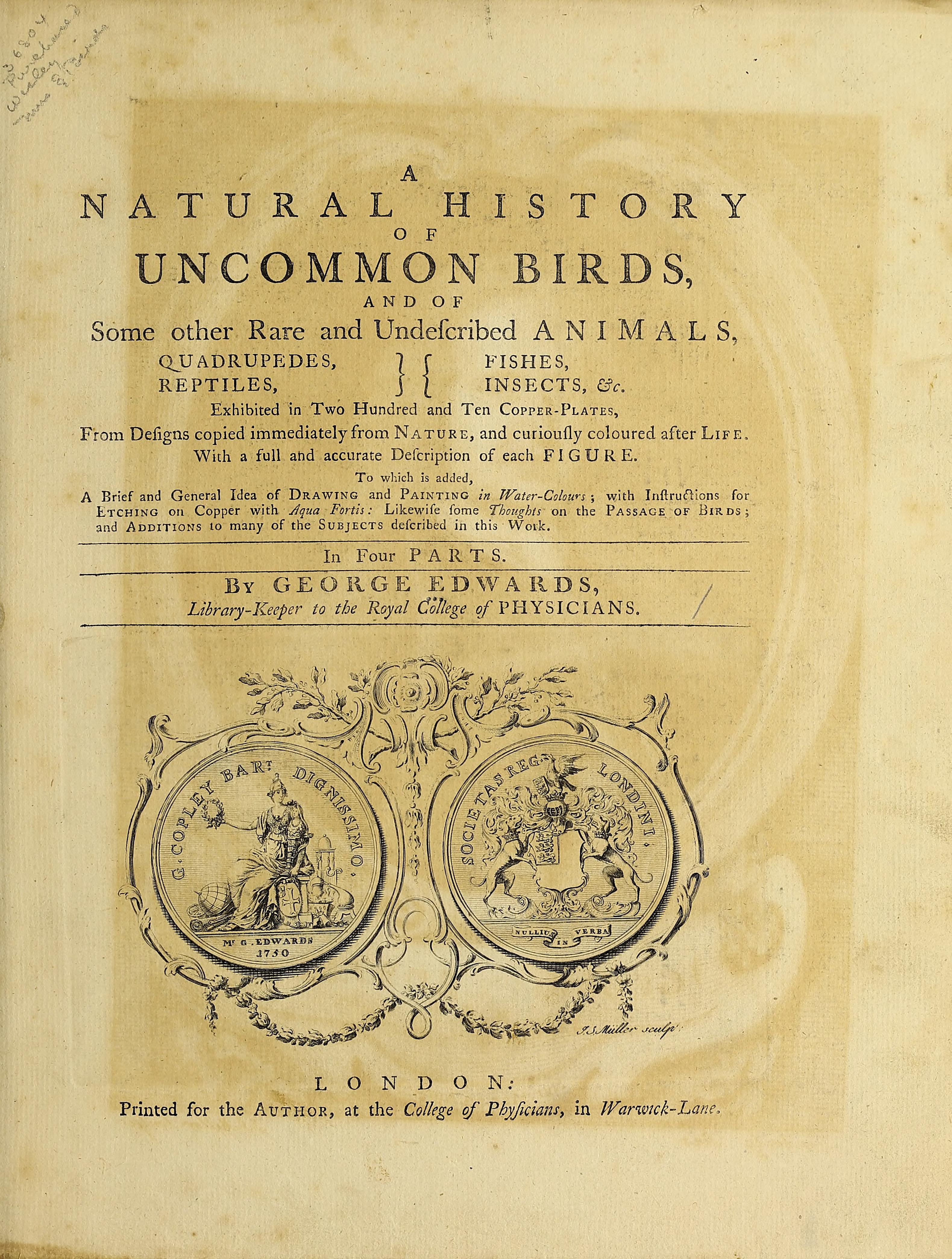
title page of natural history of birds

Title Page. Edwards, George. A natural history of birds. Pt. 1 (1743). Contributed in BHL from Smithsonian Libraries.

——–––––––

That this was in fact the true chain of transmission—from Catesby to Edwards to Linnaeus, and not, as has long been assumed, directly from Catesby to Linnaeus—is demonstrated as well by the twisting career of the Painted Bunting in the ornithological works of all three authors.

As pointed out above, Linnaeus’s account of this species in the 1758 Systema introduces certain inconsistencies with his claimed source, Catesby’s Carolina. First, Linnaeus asserts that the female Painted Bunting is blue with a white belly, turning gray in the colder season; Catesby had described her quite differently, as dull-colored and sparrow-like, with an overtone of green. Linnaeus then goes on to cite Catesby’s Plate 44 as the authority for his description; in fact, though, that plate depicts only the male Painted Bunting, while the bird Linnaeus mistakes for the female, in reality a male Indigo Bunting, is shown on the following Plate 45.

These errors, at first regard trivial, are in fact revelatory of George Edwards’s crucial role as the link between the ornithologies of Catesby and Linnaeus. In his Natural History, published the year after Catesby’s death, Edwards corrected what he believed was his friend and mentor’s misapprehension. Edwards wrote that the tricolored bird of Catesby’s Plate 44—a Painted Bunting—and the blue bird of Plate 45—an Indigo Bunting—“are both the same; the one not arrived at its perfect Colour, and the other perfect…. This Bird in its first State resembles a Hen Sparrow, its second is Blue, and its last as the above described [that is to say, the particolored adult male Painted Bunting], with many intermixed Stages between each of these” (Edwards 1750).
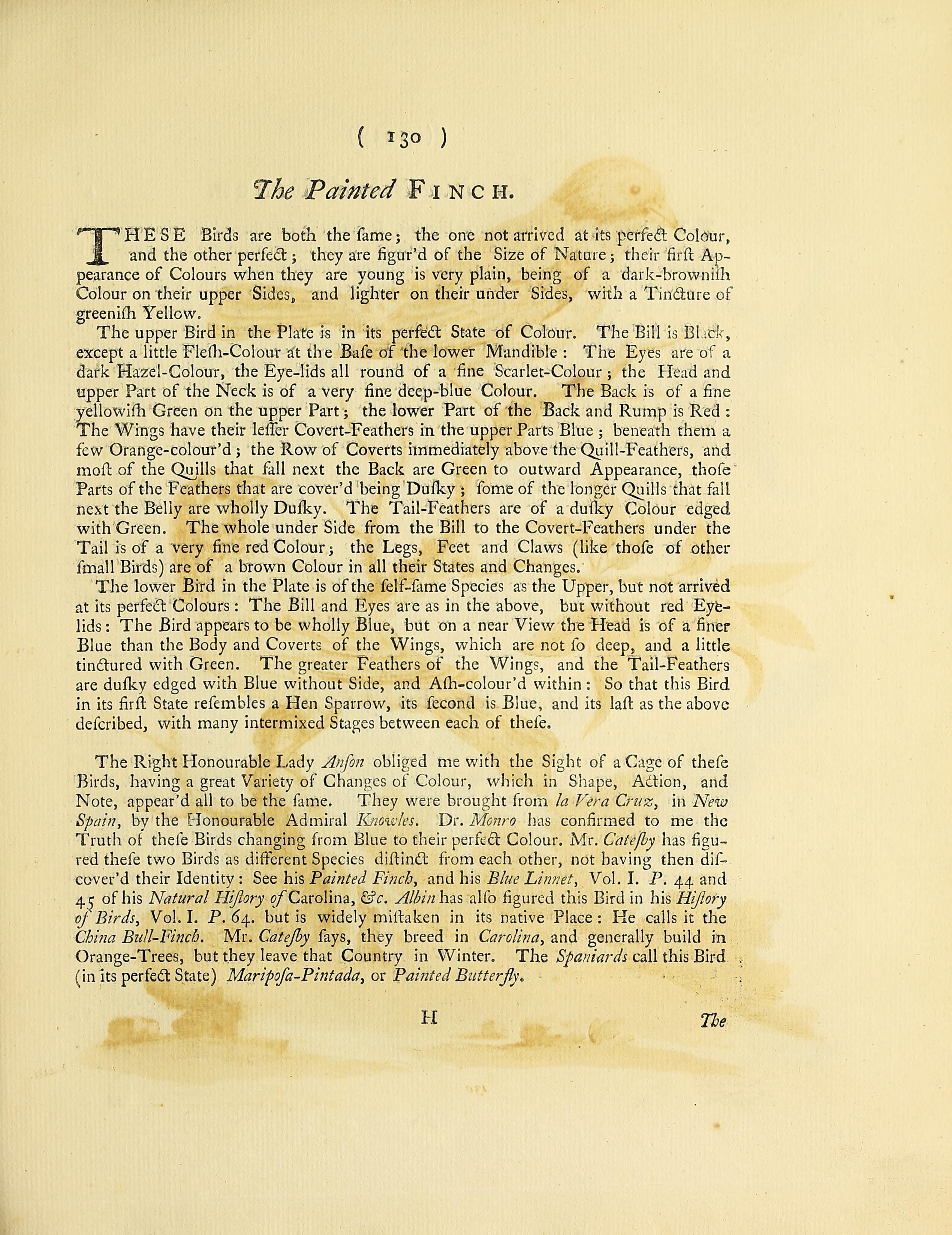
Page 130. Edwards, George. A natural history of birds. v. 3 (1750). Contributed in BHL from Smithsonian Libraries.

In London, Edwards had studied a cageful of buntings of various colors, brought to Lady Anson from Mexico by Admiral Knowles; the conclusions he drew about the species’ plumage sequence were affirmed by his friend and patron John Monro (Edwards 1750). Linnaeus’s citation to “Catesby” notwithstanding, it was Edwards’s assessment of the buntings as “both the same,” and not Catesby’s original identification of two distinct species, that entered Linnaeus’s Systema in 1758.

Edwards must be held responsible, too, for Linnaeus’s erroneous reference to Catesby’s Plate 44 for the “female” of the Painted Bunting (in fact, the male of the Indigo Bunting). As already noted, the plate published as number 44 in Carolina depicts only a male Painted Bunting—but a watercolor painted in preparation for that plate, one of the unpublished works the sale of which Edwards facilitated on Catesby’s death, shows two birds sharing a perch in a magnolia (RL 25875). The upper individual is a brightly colored male Painted Bunting; the lower is an adult male Indigo Bunting. Each is labeled, in Catesby’s hand, as an apparently distinct species: the Painted Bunting as “Tricolor. Ligurinus,” the Indigo as “Linaria Cœrulea.” At least the upper inscription antedates the trimming and mounting of the sheet. Most tellingly, Catesby also numbered his painting, “44.”
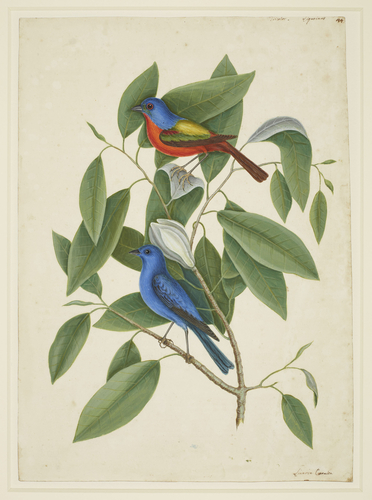
illustration of two birds on a plant

Illustration by Mark Catesby of Painted bunting Passerina ciris (L.), indigo bunting Passerina cyanea (L.), and sweet bay Magnolia virginiana (L.). Sourced from the Royal Collection Trust. Image metadata reads: “Inscribed on the recto in pen and ink in Catesby’s hand, upper right: ‘Tricolour. Ligurinus’; lower right: ‘Linaria Caerulea’; upper right corner ’44’. The Painted Finch appears in Volume I, Plate 44, and the Blue Linnet in Volume I, Plate 45, of Catesby’s The Natural History of Carolina, Florida and the Bahama Islands.” Source link: https://www.rct.uk/collection/925875/recto-the-paintednbspfinch-the-blue-linnet-and-the-sweet-flowering-bayverso-the

That number is clearly a reference to the Plate 44 that Catesby would subsequently publish in his Carolina. Plate 44 depicts only one bird, an adult male Painted Bunting. That bird is clearly based on the individual in Catesby’s earlier painting, now perched somewhat more steadily in a somewhat more decorative magnolia. The Indigo Bunting figured in the painting was also taken over into the published work, but on a separate plate—Plate 45—where it balances tremulously on the leaf of a trillium.

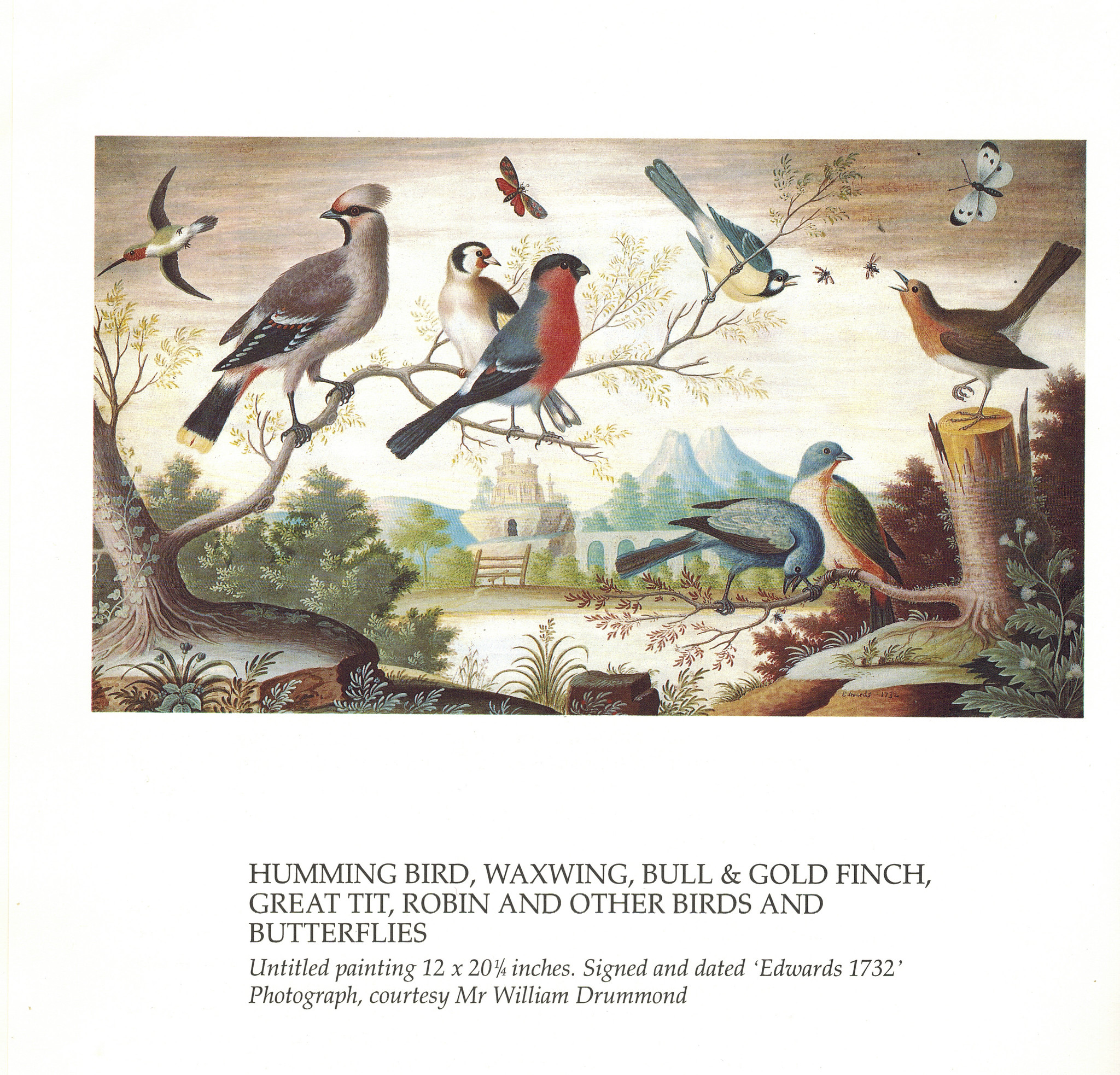
Linnaeus’s citation to Catesby’s Plate 44 for his description of the female Painted Bunting makes sense only if it in fact refers to the preliminary painting, not to the published plate. The painting certainly passed through Edwards’s hands as he prepared the Catesby estate for auction, and it is reasonable to conclude that the information he supplied Linnaeus was based on that “44,” not on the published plate assigned that number. The painting’s confrontation of the two buntings—in spite of Catesby’s labels—could be read as confirmation of Edwards’s theory of conspecificity, a theory he had illustrated himself, wordlessly, in a whimsical 1732 painting depicting what we now recognize as a Painted and an Indigo Bunting posed intimately on the same branch.
various birds perched on a scenic background

Edwards’s bunting painting, from Mason, “The Bedell and His Birds”. Source: Rick Wright on Flickr.

——–––––––

In reliance on Edwards’s initial understanding of the species’ status and plumages, Linnaeus again identified the male Indigo Bunting as a female Painted in the eleventh, 1760 edition of the Systema naturae (Linnaeus 1760). The truth would out, however, and in 1766, in what was the first major revision since 1758, the twelfth edition of the Systema “split” the buntings to recognize the Indigo as a separate species, Tangara cyanea, for the first time; describing only the adult male (“blue, with blackish rectrices”), Linnaeus now cites the correct text page and plate from Catesby’s Carolina (Linnaeus 1766).

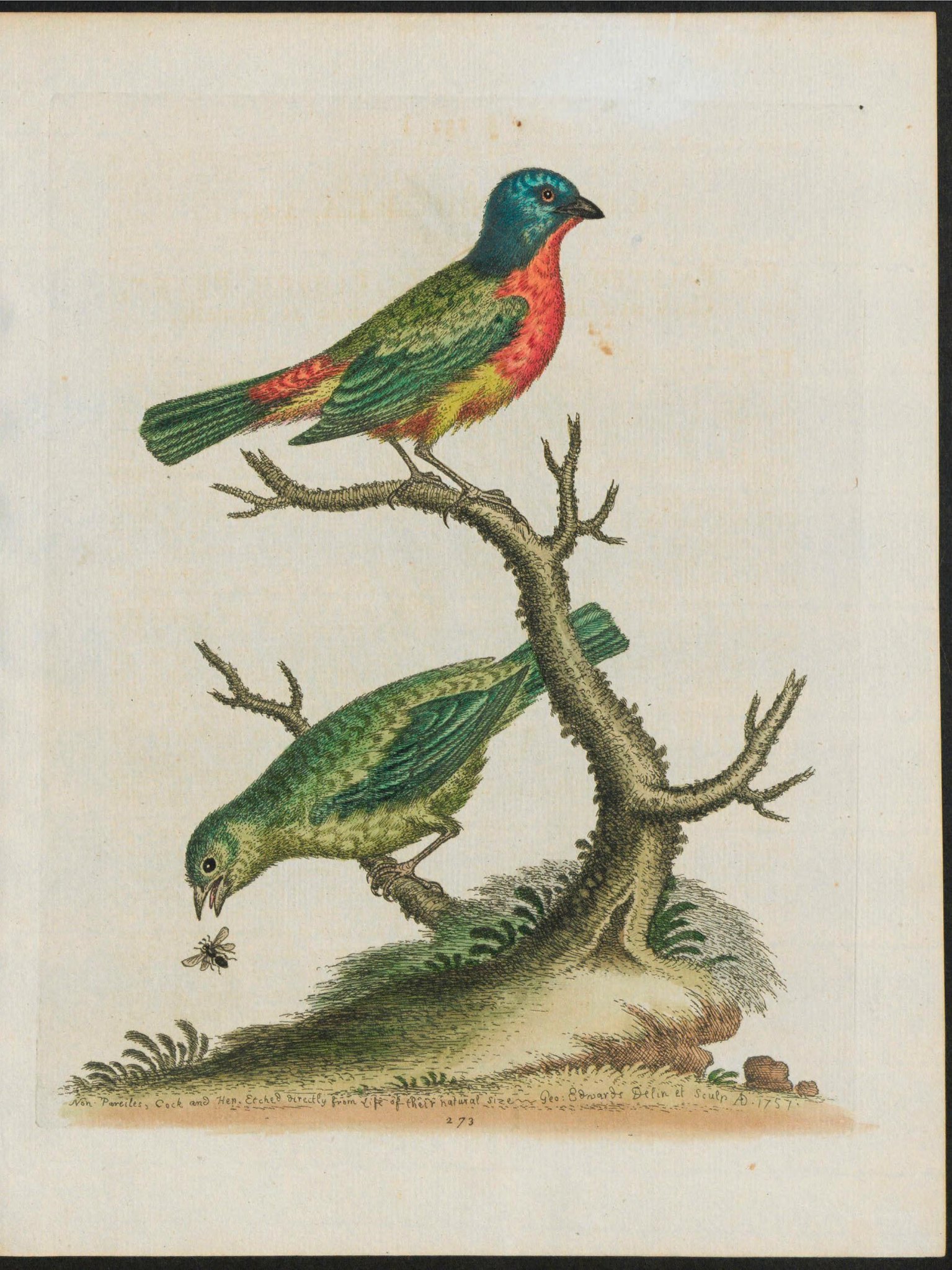
Linnaeus’s change of view had been preceded, half a dozen years earlier, by another reassessment of the buntings: that in George Edwards’s Gleanings of Natural History. In the second, 1760 volume of this continuation of his Natural History of Birds, Edwards provided a new and accurately labeled plate of the Painted Bunting, showing both a colorful adult male and a female, the latter “wholly of a parrot green colour” (Edwards 1760b).
two birds on a stick

Plate of Painted Buntings. Edwards, George. 1758-1764. Gleanings of natural history. Part II. Contributed in BHL from the National Library Board, Singapore.

The addition of the female figure, and Edwards’s description of the other, non-adult and non-male age and sex classes “as plain-coloured as a hen Sparrow” (Edwards 1760b), reveal that his rethinking was the result of a renewed consultation of Catesby’s Carolina, which had described the female Painted Bunting in much the same words. This is no coincidence. Just as Linnaeus’s earlier “lump” of the Indigo and Painted Buntings was the result of his relying on Edwards’s interpretation of Catesby, so too did his “split” of the two birds in 1766 reflect Edwards’s re-evaluation of their status.

No one can deny the significance of Mark Catesby’s work to the natural historical enterprise of the eighteenth century in general, or to the Linnaean tradition specifically. But an examination of the other bird species attributed by the Systema to “Catesby” would likely confirm what the case of the buntings so cogently suggests: that not Catesby but his “good friend,” pupil, and literary executor George Edwards was Linnaeus’s direct source for the North American birds credited to him.

Works Cited

Adler, K. 2015. “Ctesby’s Fundamental Contributions to Linnaeus’s Binomial Catalogue of North American Animals.” Pp. 251-264 in Nelson, E. Charles, and David J. Elliott, eds. The Curious Mr. Catesby: A “Truly Ingenious” Naturalist Explores New Worlds. Athens, GA: University of Georgia Press.

Albin, E. 1738. A Natural History of Birds. Vol. 3. London: privately published.

Catesby, M. 1729 [1731]. The Natural History of Carolina, Florida, and the Bahama Islands. Vol. 1. London: privately published.

Edwards, G. 1747. A Natural History of Birds. Vol. 2. London: College of Physicians.

——-. 1750. A Natural History of Birds. Vol. 3. London: College of Physicians.

——-. 1757. George Edwards to Carolus Linnaeus. October 15, 1757. In Linnaean Correspondence. 

——-. 1760a. George Edwards to Carolus Linnaeus. August 12, 1760. In Linnaean Correspondence. 

——-. 1760b. Gleanings of Natural History. Pt. 2. London: College of Physicians.

James, T.E. 1933. “George Edwards, F.R.S. (1694-1773): An Eighteenth-century Naturalist.” Science Progress in the Twentieth Century (1919-1933) 27.107: 486-493.

Jarvis, C.E. 2015. “Carl Linnaeus and the Influence of Mark Catesby’s Botanical Work.” Pp. 189-204 in Nelson, E. Charles, and David J. Elliott, eds. The Curious Mr. Catesby: A “Truly Ingenious” Naturalist Explores New Worlds. Athens, GA: University of Georgia Press.

Lederer, R. 2019. The Art of the Bird: The History of Ornithological Art Through Forty Artists.

Linnaeus, C. 1736. [L5980. Carl Linnaeus to Johannes Burman.] The Linnaean Correspondence. Ferney-Voltaire: Centre international d’étude du XVIIIe siècle. On line at linnaeus.c18.net.

——-. 1750. “En Indianisk sparf.” Kongliga Swenska vetenskapsacademiens handlingar ser. 1, vol. 11: 278-280.

——-. 1758a. Systema naturae. 10th ed. Vol. 1. Stockholm: Lars Salvius.

——-. 1758b. Carolus Linnaeus to George Edwards. March 20, 1758. In Linnaean Correspondence. On line at tinyurl.com/LynnEdw1758.

——-. 1759. Carolus Linnaeus to George Edwards. April 12, 1759. In Linnaean Correspondence. On line at tinyurl.com/LinnEdwApr1759.

——-. 1760. Systema naturae. 11th ed. Vol. 1. Halle/Saale: Johann Jacob Curt.

——-. 1764. Carolus Linnaeus to George Edwards. April 12, 1764. In Linnaean Correspondence. On line at tinyurl.com/LinnEdw1764.

——-. 1766. Systema naturae. 12th ed. Vol. 1. Stockholm: Lars Salvius.

Mason, A.S. 1992. George Edwards: The Bedell and His Birds. London: Royal College of Physicians.

McBurney, H. 2015. “Mark Catesby’s Preparatory Drawings for The Natural History of Carolina, Florida and the Bahama Islands.” Pp. 141- 154 in Nelson, E. Charles, and David J. Elliott, eds. The Curious Mr. Catesby: A “Truly Ingenious” Naturalist Explores New Worlds. Athens, GA: University of Georgia Press.

Stevens, O.A. 1936. “The First Descriptions of North American Birds.” Wilson Bulletin 48: 203-215.

Stone, W. 1929. “Mark Catesby and the Nomenclature of North American Birds.” Auk 46: 447-454.
December 5, 2019by michelle.underhill
Blog Reel, Campaigns, Featured Books

Color Our Collections: The Art of Intaglio Printing

View Full Size Image

This year for Color Our Collections, we’ve produced a coloring book with illustrations from books that represent the evolution of the art of printing. This week on our blog, we’ll explore the books featured in the coloring book and the printing techniques used for the illustrations.

You can download our 2017 Color Our Collections coloring book here.

Learn more about Color Our Collections here.

The Art of Intaglio Printing

In the Intaglio family of printmaking, an image is incised into a surface, usually a metal plate. Intaglio includes such familiar processes as etching and engraving. In engraving, the image is physically carved into a plate using special tools like burins. In etching, an image is drawn onto the surface of a plate that is covered in wax. The stylus, used to draw the lines in the wax, exposes the metal of the image lines. The plate is then dipped in an acid bath. The acid etches the exposed image lines but does not affect the portions of the plate covered in wax.

Intaglio techniques were used for book illustration by the latter half of the 15th century and became the standard for illustrating books by the late 16th century. Intaglio was used predominantly until around the mid-19th century, when lithography started gaining ground.

This video from the Museum of Art, Rhode Island School of Design demonstrates the copper plate engraving process:

Catesby’s Copper Plate Etchings

In the early eighteenth century, English naturalist Mark Catesby set foot in a New World. After spending the better part of ten years, spread across two separate trips, exploring and documenting North America’s rich biodiversity, he would eventually publish his research and original artworks as the first fully illustrated book on the flora and fauna of North America.

View Full Size Image
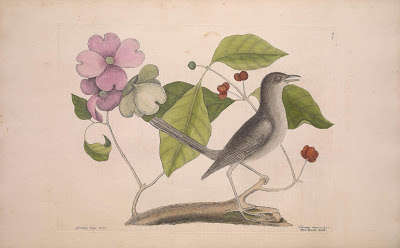
Eastern flowering dogwood (Cornus florida) and northern mockingbird (Mimus polyglottos). Catesby, Mark. The natural history of Carolina, Florida and the Bahama Islands. v. 1, ed. 1. pl. 27. Digitized by Smithsonian Libraries. http://biodiversitylibrary.org/page/40753198.

Published over eighteen years between 1729-1747, The Natural History of Carolina, Florida, and the Bahama Islands contains 220 plates based mostly upon Catesby’s own watercolors, which he worked up based on sketches he made in the field. The final publication was illustrated with copper plate etchings produced by Catesby himself. Catesby also hand-colored (maybe not all) the prints as well.

View Full Size Image
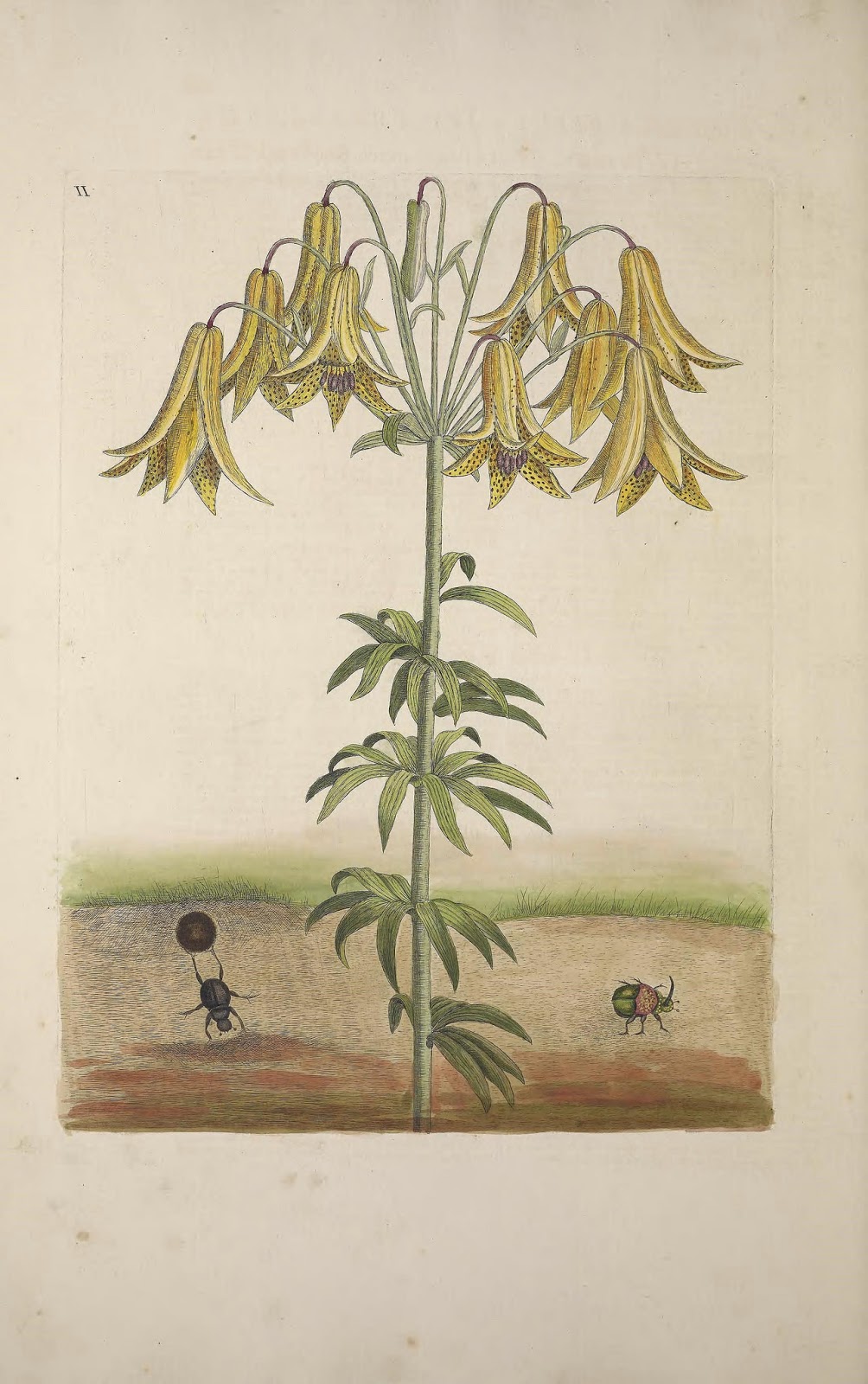
Canada lily (Lilium canadense), dung beetle (Canthon pilularis), and rainbow scarab beetle (Phanaeus vindex). Catesby, Mark.The Natural History of Carolina, Florida, and the Bahama Islands. v. 2, ed. 1. pl. 11. Digitized by Smithsonian Libraries. http://www.biodiversitylibrary.org/page/40680431.

Catesby’s work was also extremely influential to the work of Carl Linnaeus, whose binomial system for naming plants and animals is still in use today. Linnaeus cited Catesby extensively in his Species Plantarum (1753) and Systema Naturae (1758). For many of Linnaeus’ species names, Catesby is his only reference, and thus Catesby’s illustrations in Natural History serve as the type for many of Linnaeus’ species.

View Full Size Image
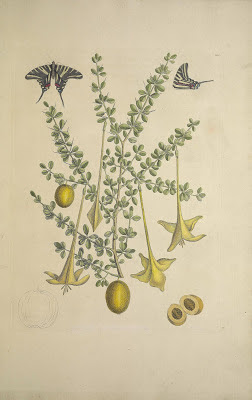
Lily thorn (Catesbaea spinosa). Pictured with zebra swallowtail (Protographium marcellus). Catesby is the only source that Linnaeus cited when naming Catesbaea spinosa in Species Plantarum (1753). This engraving serves as the type for this name. Catesby, Mark. The Natural History of Carolina, Florida, and the Bahama Islands. v. 2, ed. 1. pl. 100. Digitized by Smithsonian Libraries. http://biodiversitylibrary.org/page/40680398.

The first edition of Catesby’s Natural History in BHL, which was used to produce the coloring pages in this year’s coloring book, was digitized from the collections of Smithsonian Libraries. This copy is one of only a few known perfect copies of this first edition and the only one known to contain all three pieces of ephemera relating to the production of the work.

Note: This post was edited on 8 February 2017.

References

  • American Printing History Association. History of Printing Timeline. https://printinghistory.org/timeline/.
  • National Gallery of Art. Colorful Impressions. https://www.nga.gov/exhibitions/clrflimpr-tech.shtm.
  • Nelson, E C, and David J. Elliott. The Curious Mister Catesby: A “truly Ingenious” Naturalist Explores New Worlds. 2015. Print.
February 8, 2017by michelle.underhill
Blog Reel, User Stories

Catesby in the Classroom: Students Explore the Intersection of Art and Science

Portrait version of the Biodiversity Heritage Library logo.

In the early eighteenth century, English naturalist Mark Catesby set foot in a New World. After spending the better part of ten years, spread across two separate trips, exploring and documenting North America’s rich biodiversity, he would eventually publish his research and original artworks as the first fully illustrated book on the flora and fauna of North America.

View Full Size Image
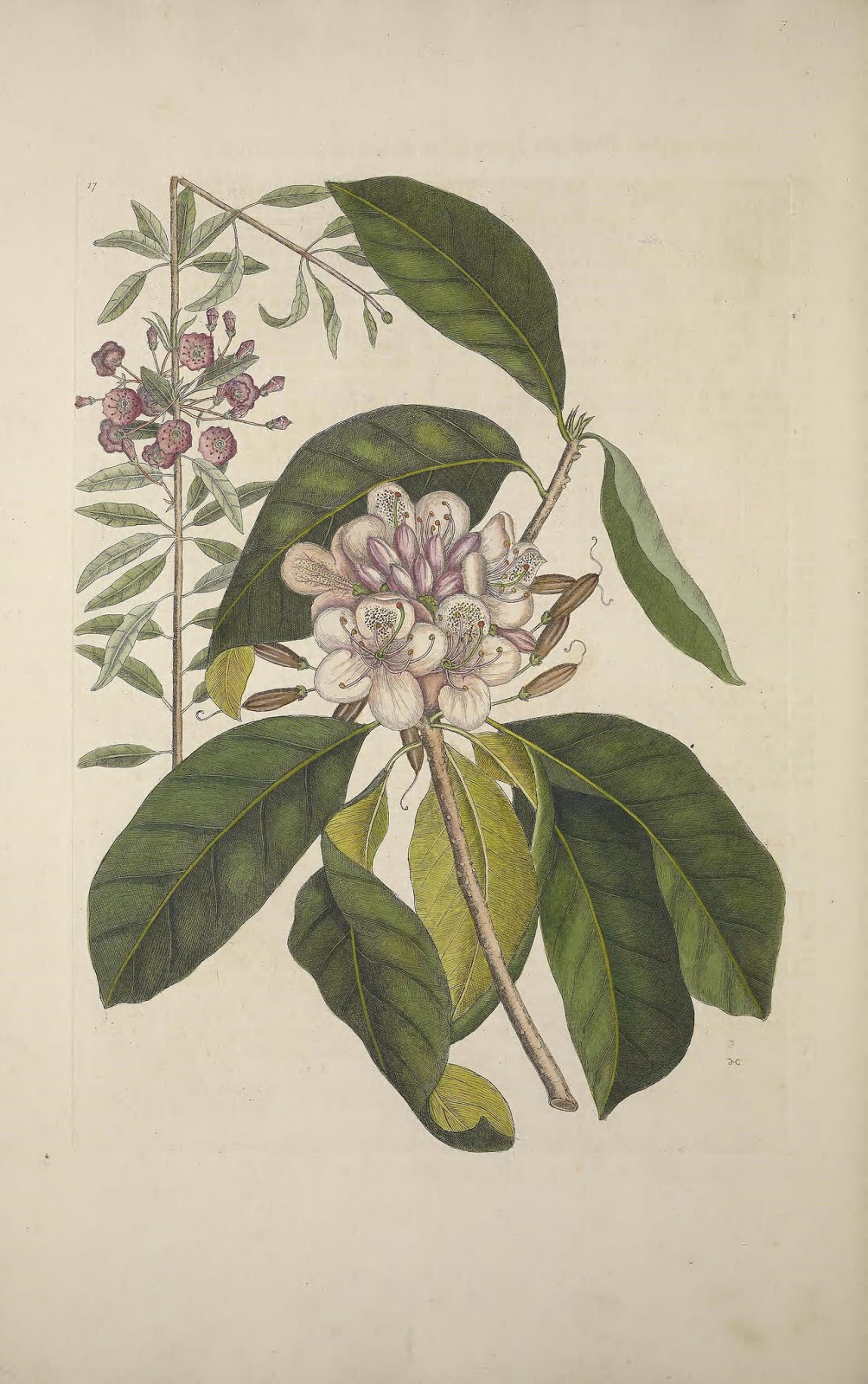
Catesby, Mark. The Natural History of Carolina, Florida, and the Bahama Islands. v. 1, ed. 1. pl. 19. Digitized by Smithsonian Libraries. http://www.biodiversitylibrary.org/page/40753174.

Published over eighteen years between 1729-1747, The Natural History of Carolina, Florida, and the Bahama Islands contains 220 plates based mostly upon Catesby’s own watercolors, which he worked up based on sketches he made in the field.

The success of Catesby’s work was based largely on his emphasis on personal observation and use of art to convey a visual record of his research.

Over 250 years later, students in South Carolina are following Catesby’s example.

As part of a collaboration with the Catesby Commemorative Trust, Dr. Tracey Hunter-Doniger used illustrations from The Natural History of Carolina, Florida, and the Bahama Islands as the foundation for lesson plans designed to help students learn more about the importance of observation and the relationship between art and science.

“Before photography, scientists used drawings to record what they saw. Scientists also had to be artists. These lessons are an opportunity for students to see how art and science are connected while also understanding the importance of Catesby’s work and his role in natural history,” emphasizes Tracey.

View Full Size Image
Dr. Tracey Hunter-Doniger. Image Credit: College of Charleston website http://teachered.cofc.edu/faculty-staff-listing/hunter-doniger-tracey.php.

A fifteen year K-8 visual art education veteran, Tracey has spent the last five years at the College of Charleston as an Assistant Professor of Creativity and Creative Arts in Education. In the fall of 2016, Tracey teamed up with her friend Erin Russell, the art teacher at Memminger Elementary School in Charleston, SC, to implement a trial run of her lesson plans in the 1st, 3rd, and 5th grade art classes at Memminger.

All three classes were challenged to use their powers of observation to record what they saw, just as Catesby had done centuries before. Students were given copies of Catesby’s illustrations, which Tracey downloaded and printed from the Biodiversity Heritage Library. The first edition copy of Catesby’s masterpiece in BHL, digitized from the Joseph F. Cullman Rare Book Library at Smithsonian Libraries, is one of the few known perfect copies of this edition in existence.

“Having access to this resource through BHL is a treasure,” praises Tracey. “Being able to show the students the prints of the original artworks and use them to explain that these represent what Catesby saw and what he wanted to convey speaks volumes to the students.”

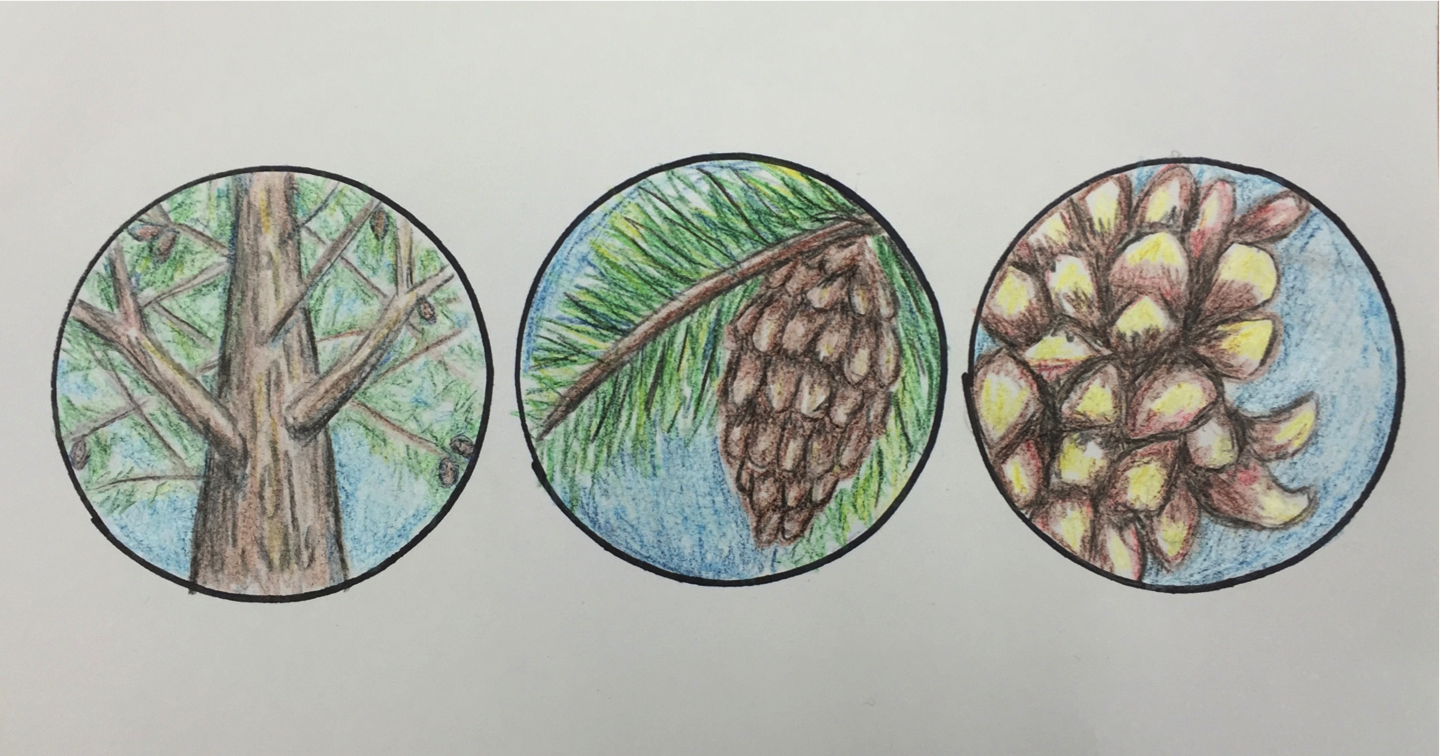
The first grade students were instructed to use the illustrations as a reference to draw their own copy of the specimens. The third and fifth graders were asked to flex their observational skills even further by not only copying the illustration as they saw it, but also homing in on a specific section of the image and creating a more detailed depiction of that area, as though they were looking at it through the lens of a microscope.

View Full Size Image
Example of the 3rd and 5th grade Catesby lesson, whereby students “zoom” in on details in the specimen being observed. Example by Dr. Tracey Hunter-Doniger.

While the trial runs of each class were limited to one, 45-minute session, Tracey believes that the lessons helped the students understand how art can be a scientific tool. For future iterations, she hopes to run the classes as three-week lessons where students start by observing and copying Catesby’s art in the classroom and then extend their learning to the outdoors by taking nature walks and drawing in the field, as Catesby did. She would also love the students to have the opportunity to explore Catesby’s publication in full through the BHL website.

“Access is key,” stresses Tracey. “In an ideal scenario, we would go into the website, we would do research, and then we would practice the skills we learn by going into the field. We would ‘do’ as Catesby did. We would ‘be’ Catesby in the field.”

The lessons that Tracey created are just two of several that are being developed as part of a collaboration with the Catesby Commemorative Trust and the College of Charleston. For example, a science lesson, written by William Veal, Cyndi Hall, and Rodney Moore, uses Catesby’s art to help students assess how adaptations contribute to a species’ ability to survive in a given environment. Lesson activities include drawing a bird inspired by a Catesby illustration, noting characteristics (such as beak shape), and performing experiments to see how various adaptations might help that species survive.

The lessons plans resulting from this collaboration are being made available to teachers in South Carolina through the LearningWhy site created by South Carolina ETV. The plans are also available to teachers across the country through PBS LearningMedia.

View Full Size Image
Catesby, Mark. The Natural History of Carolina, Florida, and the Bahama Islands. v. 2, ed. 1, pl. 17. Digitized by Smithsonian Libraries. http://www.biodiversitylibrary.org/page/40680449.

From Tracey’s perspective, the use of Catesby’s material in these lesson plans is a powerful way to integrate primary source material that is not only historically significant but also highly relevant to the area where she and her students live.

“Living in an area that’s so rich in history, it’s very impactful to be able to show the students how Catesby’s story fits into that history,” says Tracey. “The art is the visual side of that narrative. It helps explain who Catesby was, what he did, and why he was important. If you’re telling the Catesby story, the art is a critical part of that story.”

Thanks to the Biodiversity Heritage Library and Smithsonian Libraries, students in South Carolina and others around the world can freely and easily access Catesby’s work and countless other natural history treasures, no matter where their classroom journeys take them.

______________________________________

This post may contain the personal opinions of BHL users or affiliated staff and does not necessarily represent the official Biodiversity Heritage Library (BHL) position on these matters.

January 12, 2017by michelle.underhill
Blog Reel, Featured Books

Alexander Wilson and the Catbird

View Full Size Image

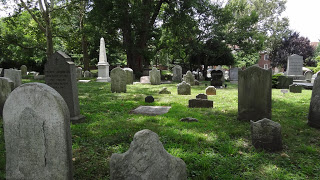
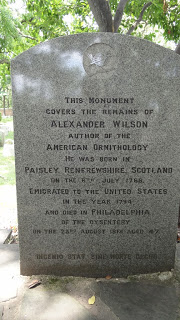
A tiny corner of green in a bustling city landscape, the cemetery of Philadelphia’s Gloria Dei Church is the resting place of Alexander Wilson, who died 200 years ago today at the age of 47, his great American Ornithology almost finished.

Gloria Dei—formerly Old Swedes’ Church, the most ancient house of worship still standing in the state of Pennsylvania—offers the modern tourist a welcome spot of shade, but it would certainly not have been Wilson’s choice of final destination. Even in 1813, this Southwark neighborhood of Philadelphia was a busy one, and Wilson had, as his executor, George Ord (1781-1866), reports:

“expressed a wish to be buried in some rural spot, sacred to peace and solitude, whither the charms of nature might invite the steps of the votary of the Muses, and the lover of science, and where the birds might sing over his grave.”

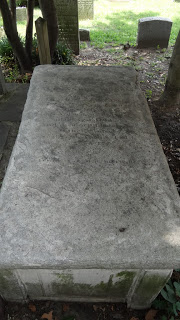
Unfortunately, Wilson was unable to repeat that wish in the ten days of agony that preceded his death; “otherwise,” writes Ord, “it should have been piously observed.” Instead, the dust of the Father of American Ornithology still lies in a weathered marble tomb beneath the shadow and the roar of I-95.

But the votaries of the Muses still come, and the lovers of science. And the birds still sing over Alexander Wilson’s grave.

View Full Size Image

_*_*_*_

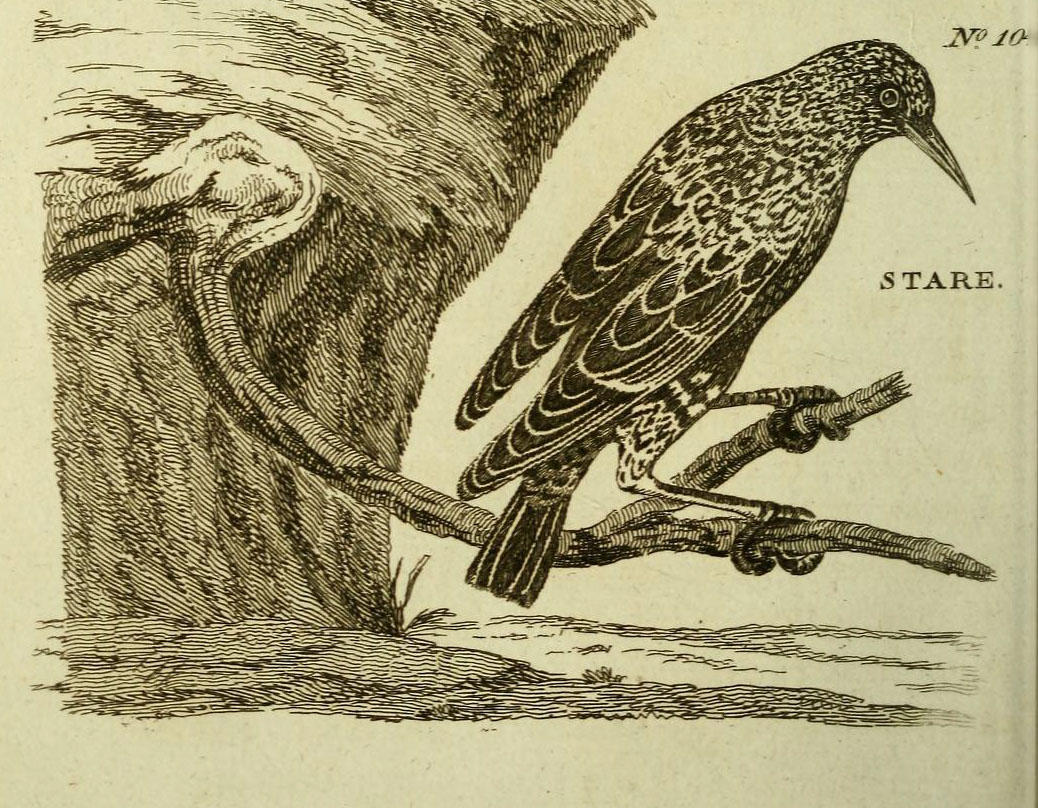
Urban Philadelphia’s bird life has changed, of course, since 1813. The voices that rise most prominently today above the whoosh and rumble of traffic are the homely chirping of House Sparrows, and the whistles of European Starlings, both species that Wilson knew well from his youth in Scotland, but neither of which would appear in Pennsylvania for decades to come.

View Full Size Image
European Starling in Pennant’s British Zoology

The House Finch, too, whose cheerful buzzes tumble down from the steeple of Gloria Dei, was unknown in Philadelphia two centuries ago—and indeed, still believed to be restricted to Mexico,was not recorded in the western United States until ten years after Wilson’s death.

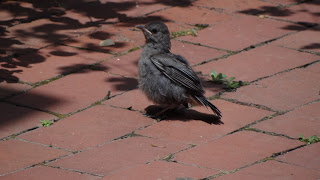
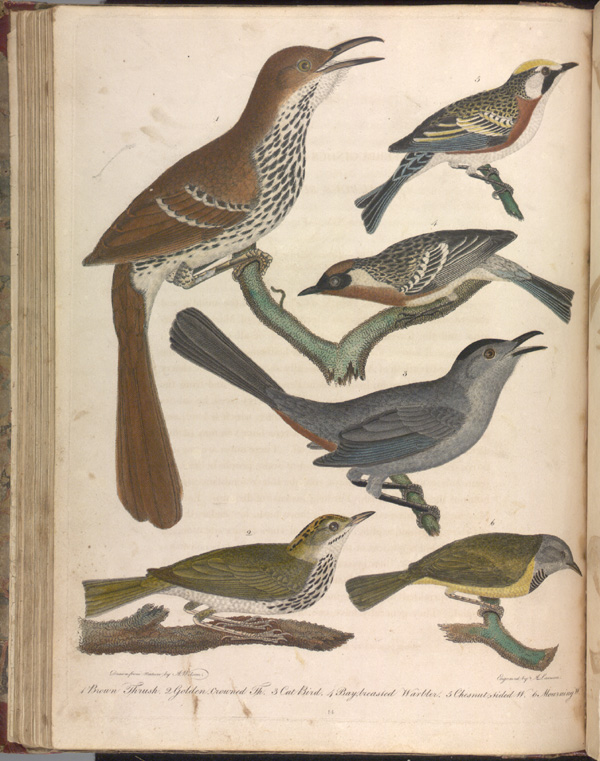
Native birds persist, though, even in this most urban of Philadelphia neighborhoods, and each summer, just as in Wilson’s day, still yields a modest crop of American Robins, Chipping Sparrows, and Common Grackles. But the real specialty of Gloria Dei is the Gray Catbird. More typical of forest edges and wooded suburbs, these sleekly elegant mimics sing and feed and nest in the cemetery, producing young that are as noisy as they are endearingly scruffy.

View Full Size Image

Alexander Wilson would have approved.

*_*_*_*

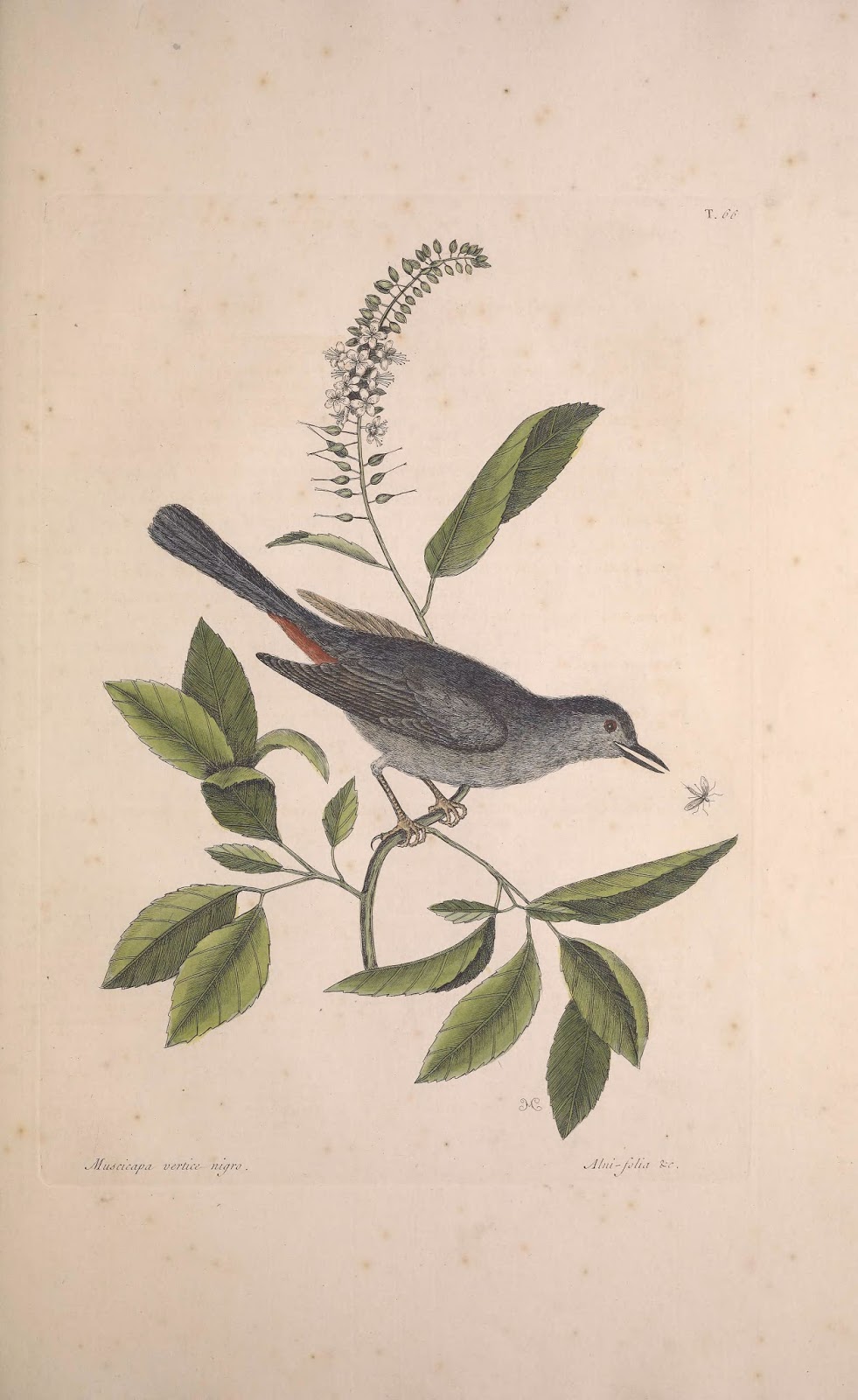
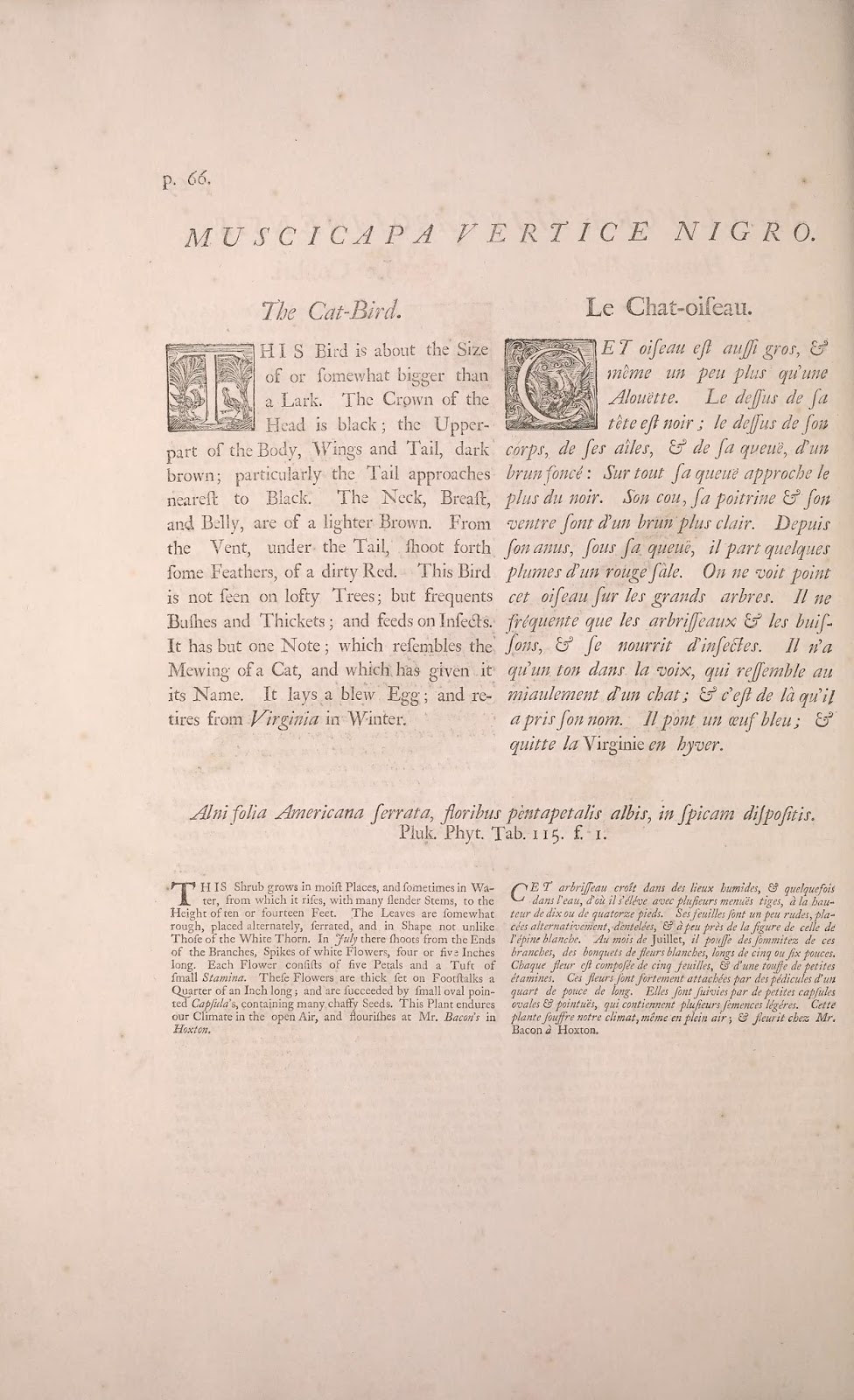
The Gray Catbird had been known to European science for nearly a century by the time Wilson first encountered the species. Mark Catesby (1683-1749) painted the bird for his Natural History of Carolina, Florida, and the Bahama Islands, noting that its English and French names derived from its signature call, “which resembles the Mewing of a Cat.” Catesby was responsible, too, for the long-persistent classification of this species among the European muscicapids: he headed his account “Muscicapa vertice nigro,” the black-crowned flycatcher.

View Full Size Image

Mathurin Brisson (1723-1806) relied completely, it seems, on Catesby and his painting for his description of the same bird; like his English predecessor, Brisson considered the catbird a flycatcher, a “gobe-mouche,” but the formal Latin (and non-binomial) name he gave it focused not on the bird’s head pattern but on its overall color and geographic origin: “Muscicapa Virginiana fusca” he called it, echoing precisely the French designation “Gobe-mouche brun de Virginie.”

The Count de Buffon (1707-1788) followed Brisson and Catesby by calling it the “moucherolle de Virginie”, but he for the first time acknowledged some taxonomic uncertainty with his observation that the catbird combined the size of the American tyrant flycatchers with the “straight and nearly hookless bill” of their Old World counterparts.

Thanks to the stubborn French resistance to the modern binomial system, it fell to Linnaeus to give Catesby’s catbird an “official” name, a task he completed in 1766, in the 12th edition of the Systema.

View Full Size Image

The Archiater retained the generic designation Muscicapa, but for his epithet selected none of the obvious alternatives already suggested by Catesby and by Brisson: the catbird would be not “vertice-nigro,” not “virginiana,” not even “fusca,” but carolinensis, ostensibly because the species “inhabits Carolina” (Catesby’s Virginian type locality notwithstanding), but more likely because the great nomenclator could not resist another opportunity to memorialize, even obliquely, his own given name.

The mistaken notion that the catbird was a flycatcher trickled into the English-language ornithology of the eighteenth century. John Latham (1740-1837) called it the “Cat Flycatcher” in his General Synopsis of Birds, and Thomas Pennant (1726-1798) (who was able to extend the species’ known range as far north as New York) retained the name when he listed the species in his Arctic Zoology.

*_*_*_*

Exalted as all those authorities are, none of them added substantially to the little life history information Catesby had given his readers in 1729:

View Full Size Image

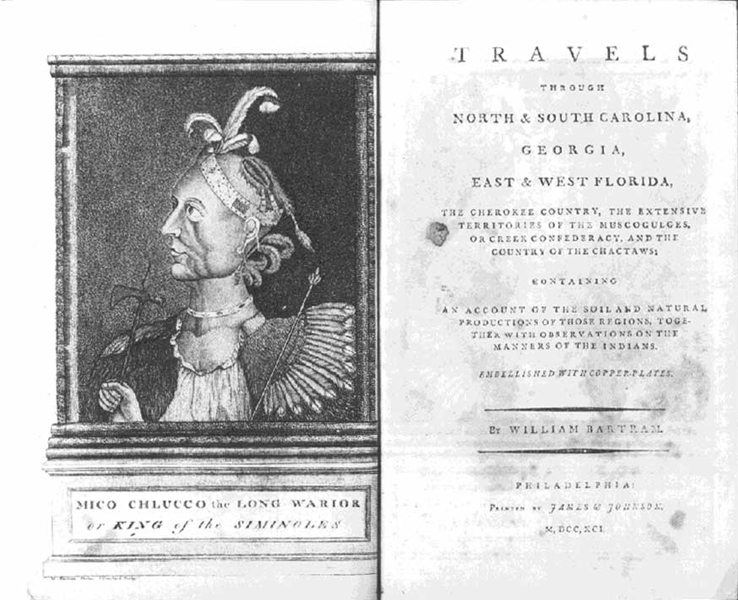
In the mid-1770s, though, the Philadelphia naturalist and writer William Bartram (1739-1823) undertook his own journey through the American south, retracing in part Catesby’s route—and gently correcting his predecessor’s errors and misapprehensions in the book that Bartram would publish in 1790, the Travels.  

View Full Size Image

Bartram was particularly surprised by Catesby’s “detraction of the fame due” the catbird as a singer. Where the earlier explorer had claimed that it produced only a single note—that well-known eponymous meowing—Bartram found that “the cat bird” was in reality … one of our most eminent songsters, little inferior to the philomela or mock-bird; and in some remarkable instances, perhaps, exceeds them both, in particular as a buffoon or mimick; he endeavours to imitate every bird and animal, and in many attempts does not ill succeed, even in rehearsing the songs, which he attentively listens to, from the shepherdess and rural swain, and will endeavor and succeed to admiration, in repeating the melodious and variable airs from instrumental music, and this in his wild state of nature.

*_*_*_*

Alexander Wilson met William Bartram in Philadelphia in 1802, and the unlikely pair quickly became friends. The intellectual stimulation and emotional support that Wilson—a perennially impoverished schoolteacher—found in Bartram and his family inspired him to devote himself entirely to the project that would become the American Ornithology.

View Full Size Image

Wilson also, it seems, came to share his friend and mentor’s admiration for the Gray Catbird, and his account of the species is one of the finest and most complete in the American Ornithology, showing Wilson at his brilliant best as writer and observer.

Here as elsewhere, Wilson, with the immigrant’s zeal, sets the knowledge gained from experience—he was after all a child of the Scottish Enlightenment—against the bookish speculations of the cabinet naturalists of Old Europe. Note how he invokes not mere static structure but the behavior of the living bird in rejection of the venerable Anglo-French tradition of assigning this bird to the muscicapids:

This bird has been very improperly classed among the Fly-Catchers. As he never seizes his prey on wing, has none of their manners, feeds principally on fruit, and seems to differ so little from the Thrushes, I think he more properly belongs to the latter tribe than to any other genus we have. His bill, legs and feet, place and mode of building, the colour of his eggs, his imitative notes, food and general manners, all justify me in removing him to this genus.

Wilson pointedly ignores the Linnaean epithet carolinensis to call his bird Turdus lividus, the “bluish thrush,” honoring his Philadelphia colleague Bartram, who had coined that specific name in his Travels.

Where Catesby and his followers could say only that the catbird leaves Virginia in the winter, Wilson, reckoning backward from the species’ February arrival in Georgia, deduced that the wintering grounds lay “not far distant, probably in Florida.” Returning in April to Pennsylvania, the birds have built their nests by early May, in “a thicket of briars or brambles, a thorn bush, thick vine, or the fork of a small sapling.”

Celebrated by his compatriot Sir William Jardine as the first who truly studied the birds of North America in their natural abodes, and from real observation, Wilson found the Gray Catbird an especially obliging subject for experimentation. Curious about the extent to which a breeding pair could recognize its own eggs and young, the naturalist took two eggs from one [catbird] which was sitting, and in their place put two of the Brown Thrush, or Thrasher…. In a minute or two the male made his approaches, stooped down and looked earnestly at the strange eggs … [and] with the greatest gentleness took out both the Thrasher’s eggs, first one and then the other, carried them single about thirty yards, and dropt them among the bushes…. Soon after the female resumed her place on the nest as before.

Placing two half-fledged chicks in another catbird’s nest had a similar result: “She soon turned them both out”; happily, catbirds bounce, and soon enough the father bird was feeding them on the ground “with great assiduity and tenderness.” On another occasion, Wilson moved a nest and its four well-advanced eggs from one side of a thicket to the other; in less than half an hour, the female was once again incubating her displaced clutch.

*_*_*_*

Wilson also took advantage of his close acquaintance with the catbird to weigh in on the venerable controversy of the “fascination” of birds by snakes—a matter still unresolved for some a century later. Never one to mince words, he blames “credulity and ignorance” for the “absurd” belief that a snake, with [its] eyes, breath, or any other known quality he possesses, should be capable of drawing a bird, reluctantly from the tree tops to its mouth; in all of the encounters between snakes and catbirds “personally witnessed” by Wilson, the bird, he says, was the actual “assailant,” attacking the reptile in an effort to drive it away from its nest and young.

*_*_*_*

Wilson joined his careful observation of the catbird with a genuine affection for the species. That fondness was, as he reports, not shared by all of his contemporaries; blinded by “illiberal and persecuting prejudice,” the farmer of Wilson’s day protected his strawberries, his early cherries, and his “finest ripe mellow pears”

by shooting [the catbird] down with his gun, as he finds old hats, wind-mills and scarecrows are no impediments in his way to these forbidden fruits…. The boys are now set to watch the cherry trees with the gun; and thus commences a train of prejudices and antipathies that commonly continue through life.

For Wilson, though, as for all “the generous and the good, the lovers of nature and of rural charms,” the confidence which this familiar bird places in man by building in his garden, under his eye, the music of his song, and the interesting playfulness of his manners, will always be more than a recompence [sic] for all the little stolen morsels he snatches.

I’d like to think that the catbirds of Gloria Dei are even today repaying the compliment.

View Full Size Image

August 23, 2013by Kathryn Stine

Help Support BHL

BHL's existence depends on the financial support of its patrons. Help us keep this free resource alive!

search

About BHL

The Biodiversity Heritage Library (BHL) is the world’s largest open access digital library for biodiversity literature and archives. BHL operates as a worldwide consortium of natural history, botanical, research, and national libraries working together to digitize the natural history literature held in their collections and make it freely available for open access as part of a global “biodiversity community.”

Follow BHL

  • Bluesky logo
  • Instagram logo
  • Facebook logo
  • Flickr logo
  • Twitter logo

Join Our Mailing List

Sign up to receive the latest news, content highlights, and promotions.

Subscribe Now

Subscribe to Blog via Email

Enter your email address to subscribe to this blog and receive notifications of new posts by email.

Join 319 other subscribers

Subscribe to Blog Via RSS

Subscribe to the blog RSS feed to stay up-to-date on all the latest BHL posts.

Access RSS Feed


64+ Million Pages of
Biodiversity Literature Online.

EXPLORE

Tools and Services
to Transform Research.

EXPLORE

300,000+
Illustrations on Flickr.

EXPLORE

ABOUT | HARMFUL CONTENT | PRIVACY | SITE MAP | TERMS OF USE