

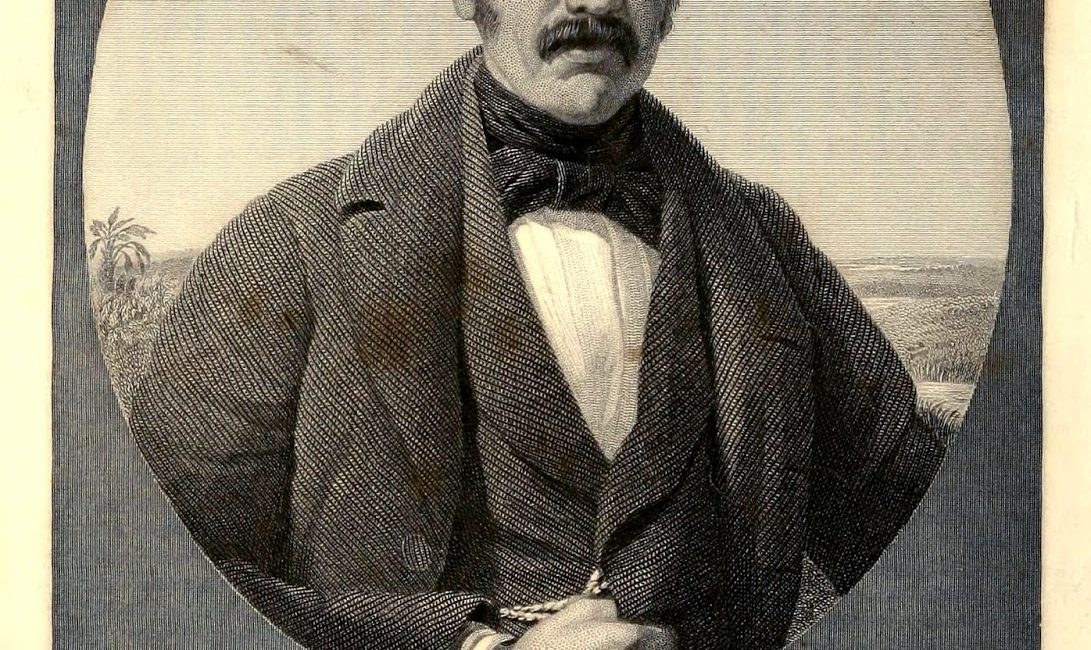
Happy Birthday, David Livingstone!
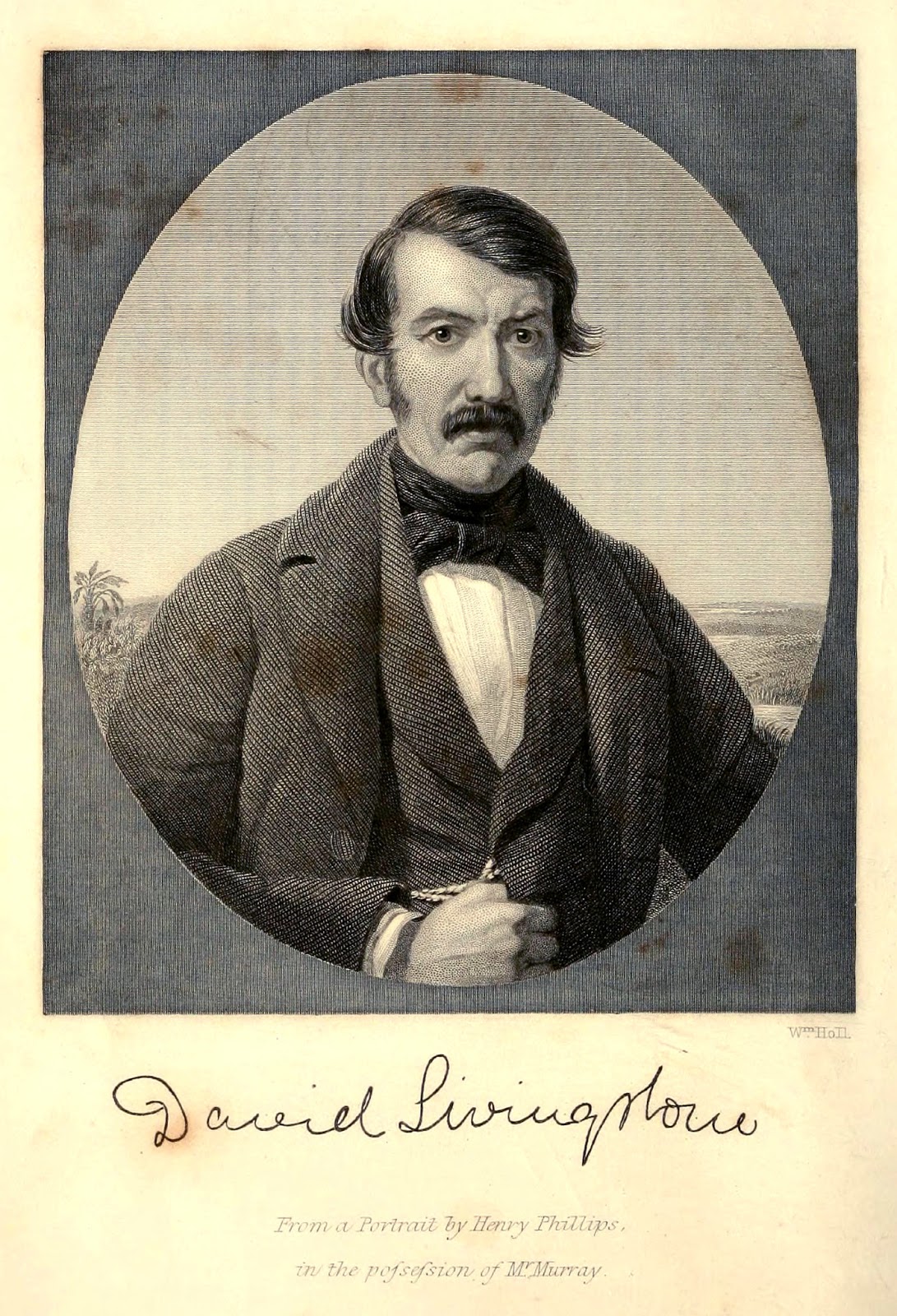 |
| David Livingstone. Missionary Travels. |
“Dr. Livingstone, I presume?”
Most of us have heard that famous phrase, uttered by Henry Morton Stanley of the New York Herald upon finding David Livingstone in Ujiji, Tanzania, on November 10, 1871. However, just because you know the phrase doesn’t mean you know the man. Come with us as we explore this legendary explorer and celebrate his birthday!
Humble Origins
David Livingstone was the second of seven children born to a tea salesman in Blantyre, Scotland in 1813. From the age of ten, he worked in a cotton mill spending twelve hours a day tying broken threads on spinning machines. Fortune, however, had him destined for much greater things. At 23 years old, he entered Anderson’s University in Glasgow to study medicine, and in 1840, after completing his studies in London, he was licensed as a physician and ordained as a missionary. Originally intending to serve in China, Livingstone was inspired by the convictions of Robert Moffet, a missionary stationed at Kuruman, a missionary outpost in South Africa. Thus, Livingstone began his lifelong affair with Africa and set out in 1840 as a medical missionary to South Africa. He would spend the rest of his life exploring Africa, with only two visits to England over the subsequent 32 years.
An Account of More than a Decade in Africa
Livingstone recounted his explorations and experience in Africa between 1840 and 1856 in his acclaimed publication Missionary Travels and Researches in South Africa. One of the nineteenth century’s best-selling books, Missionary Travels established Livingstone’s reputation as not only an exciting explorer, but also a kind-hearted humanitarian aching to improve conditions for Africans.
Missionary Travels is a narrative compilation of Livingstone’s personal field diaries. Livingstone was careful to construct the composition to appeal to both scientific and religious readers, hoping to encourage further positive involvement in Africa. The work also includes 47 illustrations – most crafted by Captain Henry Need and Joseph Wolf.
Livingstone published the work with John Murray, one of the era’s most renowned publishers of geographical books. Murray was so anxious to secure the publication that he offered to finance all expenses in return for only one-third of the profit obtained.
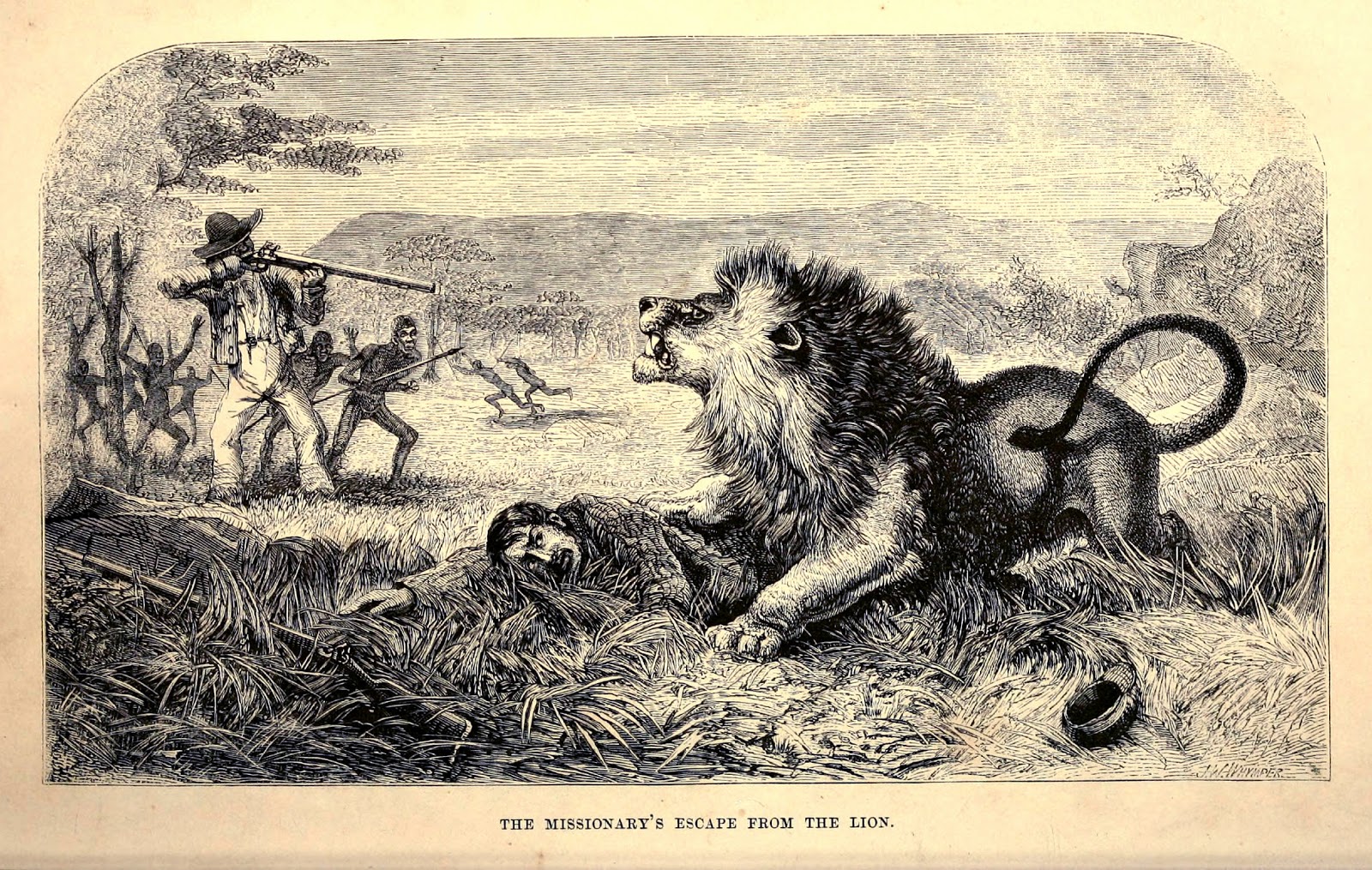 |
| The Missionary’s Escape from the Lion. Missionary Travels. |
The most famous illustration in Missionary Travels is entitled “The Missionary’s Escape from the Lion,” which depicted Livingstone pinned by a lion with his fellow travelers attempting to rescue him. Livingstone called the illustration “abominable,” asserting that “[e]veryone who knows what a lion is will die with laughing at it.” Murray ignored Livingstone’s dissatisfaction and included the illustration, knowing that most people reading Missionary Travels would not have the knowledge necessary to detect its absurdity. Furthermore, Murray understood that many audiences might never actually read the book but experience it only through illustrations. Thus, it was necessary to craft a dramatic story through images alone.
12,000 copies of the first edition of the book published in 1857, and, even at a price of one guinea each, sold out immediately. Several additional printings were ordered, selling with such success that Murray did not publish a cheaper, abridged version of the work (A Popular Account of Missionary Travels in South Africa) until 1861.
An Explorer at Heart
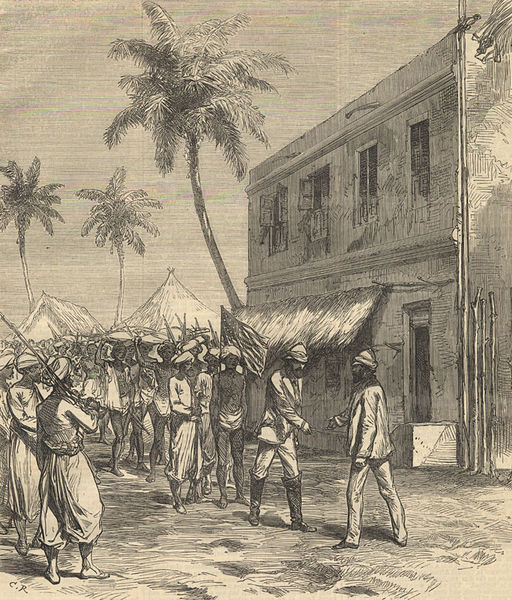 |
| Stanley and Livingstone meet. Illustration from The Illustrated London News, 1872 |
As Missionary Travels and Researches in South Africa confirms, though a missionary, Livingstone spent much of his career exploring the wilds of Africa. Enthused by Livingstone’s discoveries as related in his book, the British government funded an expedition up the Zambezi River (1858-64), tasked with uncovering a route between the upper Zambezi and the coast. Extensive rapids past Cabora Bassa unfortunately made negotiating the river to the coast impossible, and the British government recalled the expedition 1864. Though unsuccessful, naturalists in the expedition party collected a wealth of valuable specimens during the six years of the expedition.
From 1866-67, Livingstone led a privately-funded expedition to discover the source of the Nile, which was debated at that time to be either Lake Albert or Lake Victoria. Arriving at Lake Bangweulu on November 8, 1867, Livingstone mistakenly asserted it as the upper reaches of the Nile. In truth, the source of the Nile lies in the high mountains of Burundi.
By the end of the Nile expedition, Livingstone’s public image was suffering due to the failures of his expeditions and reports that Livingstone was a poor leader and manager. After 1867, Livingstone’s health failed and he lost contact with the outside world completely, prompting the New York Herald to send Henry Morton Stanley in search of him in 1869. Stanley located him in Ujiji in 1871, and the article he later published about Livingstone restored public opinion of him, casting him as a great hero of adventure and discovery. However, despite Stanley’s urging to return to England to recover his health, Livingstone refused. He died in 1873 in present-day Zambia. His heart was buried under a Mvula tree and his body was transported to England, where it was interred at Westminster Abbey.
Though many of the expeditions that Livingstone undertook were unsuccessful at achieving the undertakings’ primary goals, the discoveries made along the way, and the natural riches recorded – many for the first time for Western people – made a monumental impact on the future of African exploration, understanding, and native relations.
A Monumental Legacy
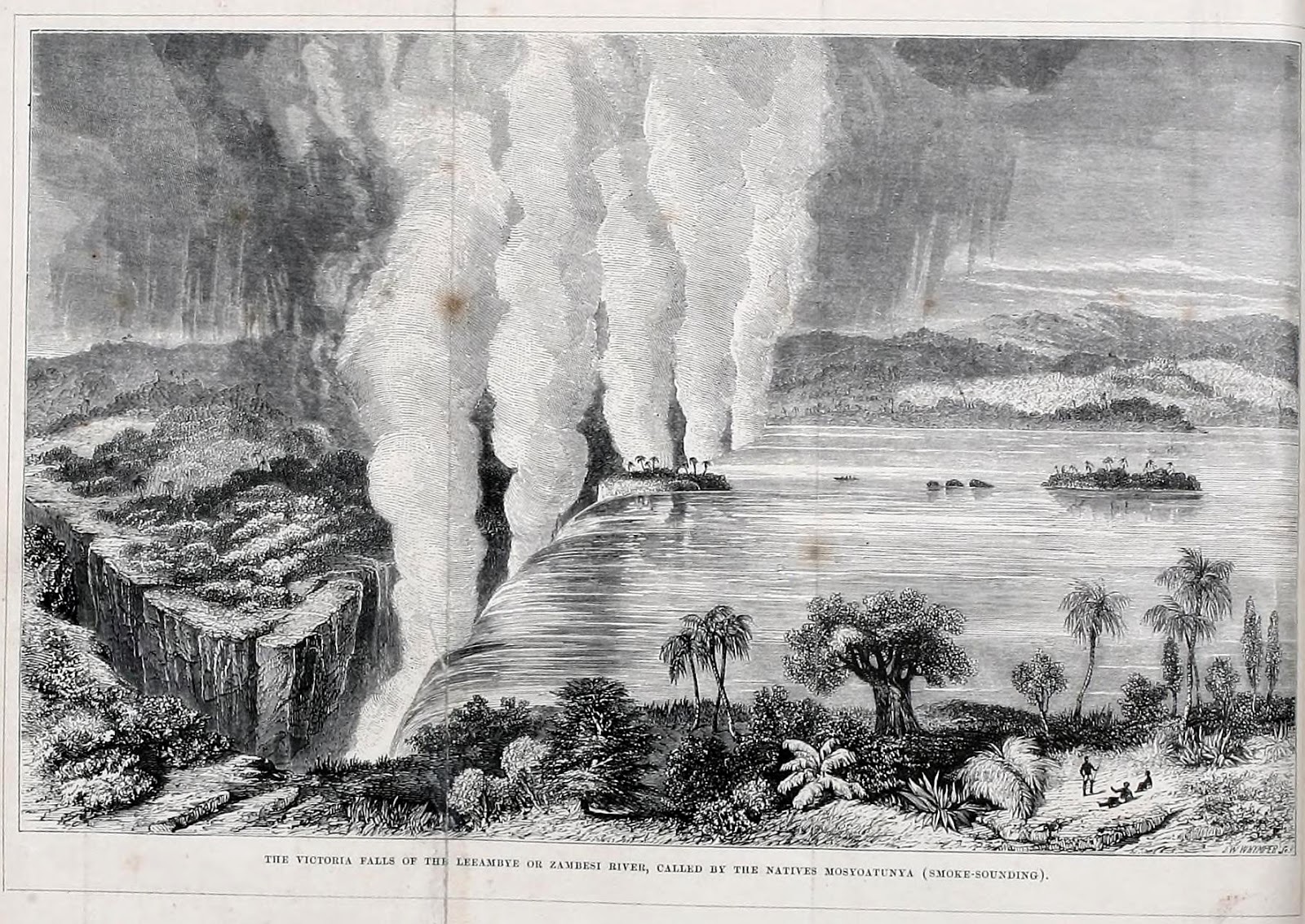 |
| Victoria Falls. Based on sketches by David Livingstone. Missionary Travels. |
David Livingstone left behind an impressive legacy. He was the first European to successfully complete a transcontinental journey across southern Africa. He was the first European to see Victoria Falls, which he named after the British Monarch of the time. He discovered for Western science many locales throughout Africa, including Lake Tanganyika, Lake Ngami, Lake Mweru, Lake Bangweulu, and the upper Zambezi River. He was instrumental in increasing European awareness of the horrors of the slave trade in Africa and encouraging equitable, rather than dictatorial, European relations and fair commercial interactions with Africa. His explorations and zeal for Africa inspired and enabled future missionaries to serve in Africa, providing valuable medical and educational support.
He was awarded the Gold Medal of the Royal Geographical Society and memorials exist for him throughout Africa, the United Kingdom, and North America. Today, we celebrate the scientific contributions, as well as the humanitarian considerations, of this icon of nineteenth century science and exploration. Happy Birthday, David Livingstone!
Additional Livingstone Resources
- View more of Livingstone’s publications in BHL.
- Explore Livingstone’s 1871 field diary, made digital by the David Livingstone Spectral Imaging Project in November, 2011.
- Learn more about the history of publishing Missionary Travels.
- Learn more about Livingstone’s life through Livingstone Online
We hope you enjoyed this post. Interested in guest-blogging for BHL? We’d love that! Natural history, biodiversity and conservation topics are especially welcomed. Email us your ideas at [email protected].
