
Biodiversity Heritage Library - Program news and collection highlights from BHL
  • Home
  • News
  • Featured Books
    • All Featured Books
    • Book of the Month Series
    • BHL at 20
  • User Stories
  • Campaigns
    • Fossil Stories
    • Garden Stories
    • Monsters Are Real
    • Page Frights
    • Her Natural History
    • Earth Optimism 2020
  • Tech Blog
  • Visit BHL
Home
News
Featured Books
    All Featured Books
    Book of the Month Series
    BHL at 20
User Stories
Campaigns
    Fossil Stories
    Garden Stories
    Monsters Are Real
    Page Frights
    Her Natural History
    Earth Optimism 2020
Tech Blog
Visit BHL
  • Home
  • News
  • Featured Books
    • All Featured Books
    • Book of the Month Series
    • BHL at 20
  • User Stories
  • Campaigns
    • Fossil Stories
    • Garden Stories
    • Monsters Are Real
    • Page Frights
    • Her Natural History
    • Earth Optimism 2020
  • Tech Blog
  • Visit BHL
Biodiversity Heritage Library - Program news and collection highlights from BHL
BHL News, Blog Reel, Tech Updates

Providing More Robust Data in BHL’s OAI-PMH Dublin Core Feed

Overview of Live Data from BHL

Recently, BHL performed a comprehensive review of all live data feeds and outputs to ensure that we are providing robust metadata to our downstream consumers. Live BHL data can be found at BHL’s Developer and Data Tools. BHL’s live data outputs include:

  • API v3
  • OAI-PMH

OAI-PMH is an acronym for the Open Archives Initiative Protocol for Metadata Harvesting. It allows other discovery services and aggregators to harvest BHL’s metadata in standard formats such as Metadata Object Description Schema (MODS) and Dublin Core (DC).

The OAI-PMH protocol only requires metadata to be expressed in the unqualified Dublin Core (DC) format. However, it also can be extended to express the metadata in other formats. Because unqualified DC is constrained to just 15 core elements, it is not uncommon for OAI-PMH repositories to also provide metadata in a more robust format. BHL provides MODS in addition to DC. Consumers of the BHL OAI-PMH feed are encouraged to use the MODS-formatted data instead of Dublin Core because it provides additional data elements that aid in user discovery.

It’s important to note that BHL provides five sets of metadata via OAI-PMH:

  1. Item = This set contains individual volumes hosted by BHL. The content is viewable in BHL.
  2. Title = This set contains metadata about the monographs and journals represented in BHL.
  3. Part = This set contains articles/chapters/treatments/etc. hosted by BHL. The content is viewable in BHL.
  4. Item External = This set contains individual volumes not hosted by BHL. The content must be viewed on a site not maintained by BHL.
  5. Part External = This set contains articles/chapters/treatments/etc. not hosted by BHL. The content must be viewed on a site not maintained by BHL.

Improving BHL’s OAI-PMH Dublin Core Feed

To provide more robust data in BHL’s OAI-PMH Dublin Core feed, three changes have been made to the feed:

  1. Creative Commons (CC) license information was added as a second <rights> element;
  2. A <relation> element was added to titles that are part of a monographic series, allowing BHL to model more complex bibliographic relationships that exist in the BHL database; and
  3. A non-standard “type” attribute was removed from the <relation> element for parts.

Important: If you are a developer, using the non-standard “type” attribute in your code at the part-level, this is a breaking change. Please take note and update your code accordingly.
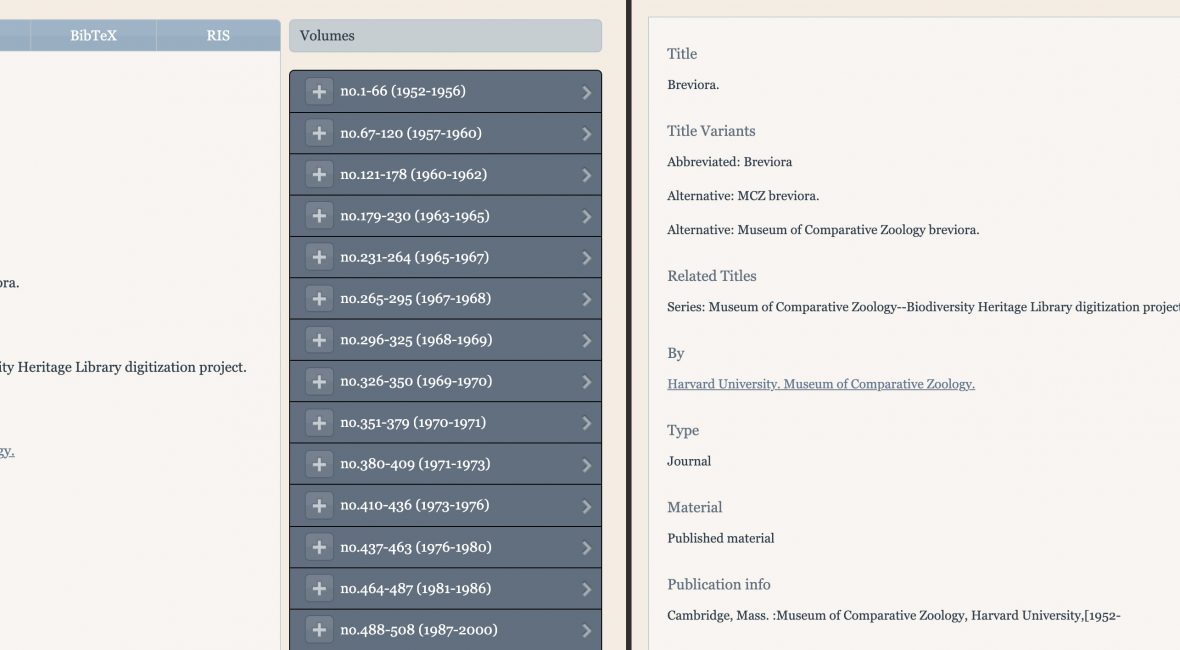
Below is an example output of a monographic series using the <relation> element at the title-level:

<OAI-PMH xmlns="http://www.openarchives.org/OAI/2.0/" xmlns:xsi="http://www.w3.org/2001/XMLSchema-instance" xsi:schemaLocation="http://www.openarchives.org/OAI/2.0/ http://www.openarchives.org/OAI/2.0/OAI-PMH.xsd">
<responseDate>2023-01-31T13:45:05Z</responseDate>
<request verb="GetRecord" metadataPrefix="oai_dc" identifier="oai:biodiversitylibrary.org:title/965"> https://www.biodiversitylibrary.org/oai </request>
<GetRecord>
<record>
<header>
<identifier>oai:biodiversitylibrary.org:title/965</identifier>
<datestamp>2008-01-02T11:47:12Z</datestamp>
<setSpec>title</setSpec>
</header>
<metadata>
<oai_dc:dc xmlns:xsi="http://www.w3.org/2001/XMLSchema-instance" xmlns:oai_dc="http://www.openarchives.org/OAI/2.0/oai_dc/" xmlns:dc="http://purl.org/dc/elements/1.1/" xsi:schemaLocation="http://www.openarchives.org/OAI/2.0/oai_dc/ http://www.openarchives.org/OAI/2.0/oai_dc.xsd">
<dc:title>Adephagous and clavicorn Coleoptera from the Tertiary deposits at Florissant, Colorado, with descriptions of a few other forms and a systematic list of the nonrhynchophorous Tertiary Coleoptera of North America</dc:title>
<dc:creator>Scudder, Samuel Hubbard, 1837-1911</dc:creator>
<dc:subject>Beetles, Fossil</dc:subject>
<dc:subject>Paleontology</dc:subject>
<dc:subject>Tertiary</dc:subject>
<dc:publisher>Washington, Govt. print. off, 1900</dc:publisher>
<dc:contributor>Smithsonian Libraries</dc:contributor>
<dc:date>1900</dc:date>
<dc:type>Book</dc:type>
<dc:type>text</dc:type>
<dc:identifier>https://www.biodiversitylibrary.org/bibliography/965</dc:identifier>
<dc:identifier>info:doi/10.5962/bhl.title.965</dc:identifier>
<dc:language>English</dc:language>
<dc:relation>https://www.biodiversitylibrary.org/bibliography/42496</dc:relation>
</oai_dc:dc>
</metadata>
</record>
</GetRecord>
</OAI-PMH>

Data harvesters currently consuming BHL’s OAI-PMH feeds, please update your code accordingly. Also, feel free to leave a comment for the BHL Technical Team with any feedback regarding any of our live data outputs. Thank you and happy harvesting!

Related Links

  • Open Archives Initiative Protocol for Metadata Harvesting
  • Metadata Object Description Schema (MODS)
  • Dublin Core
  • Developer and Data Tools – BHL
February 3, 2023by mdimeo
BHL News, Blog Reel, Tech Updates

Updates to Bibliography Pages in BHL

Screenshot of bibliography pages in BHL with and without tabs.

We have updated the bibliography pages in BHL to streamline the presentation of information about and metadata export options for content in the Library.

Previously, bibliographic details and export options were available through different tabs on title and part pages. These tabs have now been removed, and all bibliographic information is consolidated into a single display.

Screenshot showing BHL bibliography pages before and after.

The various tabs on title and part bibliography pages have now been consolidated into a single display.

BHL’s metadata export options have also been relocated. BHL offers metadata exports in MODS, BibTex, and RIS formats. MODS is an XML-based bibliographic description schema used in a variety of library applications. BibTex and RIS are bibliographic citation files that are compatible with a variety of citation management tools. The MODS file is a title-level download. The BibTex and RIS files are item-level downloads.

The MODS download is available at the bottom of the title and part bibliography pages.

Screenshot of a title page in BHL with the "Download MODS" button circled.

MODS download on the title and page bibliography pages.

The BibTex and RIS downloads are available in two places:

1) Under the volume or part details on bibliography pages.

Screenshot of the citation download options in the BHL website.

BibTex and RIS downloads on title (left) and part (right) bibliography pages.

2) Under the “Download Contents” menu in the book viewer, via the “Download Citation” option.

Screenshot of the BHL book viewer with the citation download options displayed.

Download citation options in the BHL book viewer.

As part of this update, we have removed the direct Mendeley import from BHL, as the generic RIS and BibTex formats are compatible with a variety of citation management softwares including Mendeley.

Details about our metadata export services are also available in the FAQ on the BHL About site.

February 11, 2021by michelle.underhill
Blog Reel, User Stories

Finding Agriculture among Biodiversity: Metadata in Practice

The Biodiversity Heritage Library is committed to providing free and open access to over 500 years of natural history literature from across the globe. Towards that goal, the Library currently contains over 45 million pages of biodiversity content, representing over 155,000 volumes and 90,000 titles.

However, hosting the content online is just part of our vision to “inspire discovery through free access to biodiversity knowledge.” Users must be able to identify content relevant to their work and interest from amongst this vast corpus. For this, metadata is all-important.

Metadata is “data that describes other data.” BHL’s metadata describes the digital resources in our collection, providing not only author, title, volume, publication year and place, and article information, but also keywords describing the topics discussed within each book. Eventually, full-text searching will also allow users to search across the actual text within a book to discover items relevant to their search parameters.

View Full Size Image
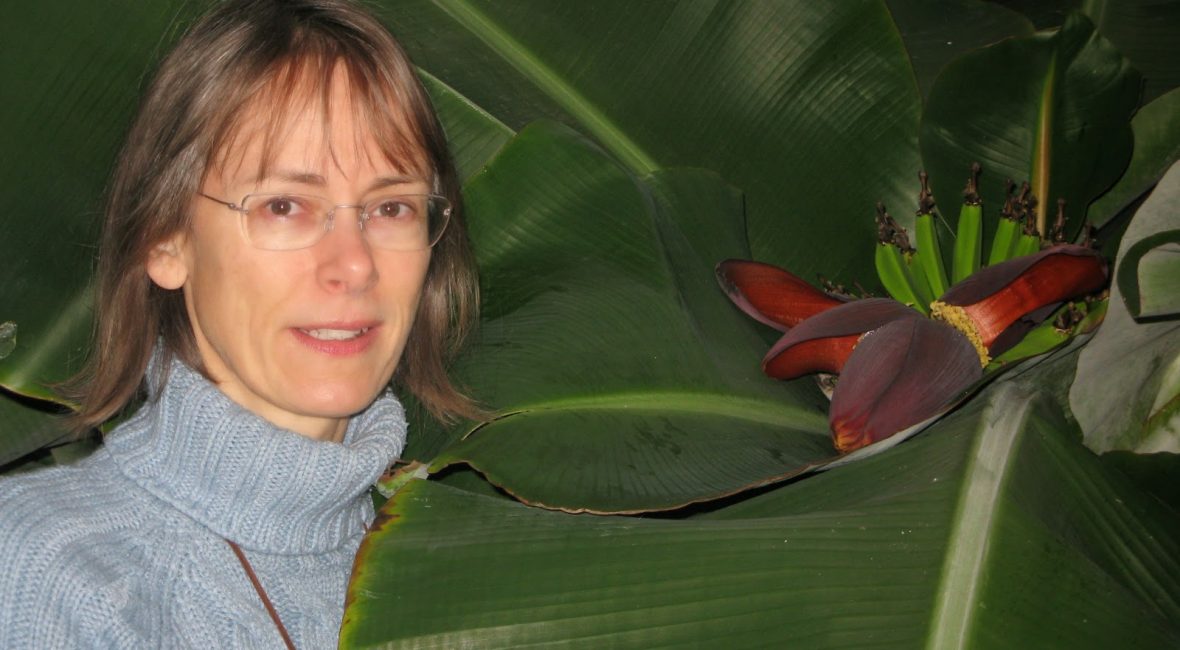
Dr. Jane Bromley, with her home-grown banana plant.

Dr. Jane Bromley knows the importance of metadata all too well. It is a critical component of her daily work.

Bromley is a research fellow at The Open University, where she has worked since 2012 as part of a subgroup of the Natural Language Processing group. Under the EU FP7 funded agINFRA project, which aims to promote data sharing in agricultural sciences, Bromley’s subgroup studies information extraction from legacy biodiversity literature. Specifically, they are seeking to enhance an existing specialist agricultural resource, AGRIS.

AGRIS is a collaborative network of more than 150 institutions providing free access to agricultural information in the form of more than 7 million bibliographic references on agricultural research and technology. This multilingual bibliographic database also contains links to related data resources on the Web.

BHL contains a vast amount of agricultural information. Searching the subject “agriculture” alone produces over 2,100 books and journals in BHL. Recognizing the potential of these resources, Bromley and her colleagues, including Dr. David King and Dr. David Morse, developed a process to enhance AGRIS with BHL content. They relied on BHL’s metadata to do this.

“BHL is a unique resource for agricultural researchers,” explains Bromley. “Its long-term view can prove invaluable in locating wild relatives of crops and understanding their relationship to local habitats and ecosystems. It is the only way to access this breadth of biodiversity literature electronically.”

To filter BHL for relevant agricultural content, Bromley and her team downloaded the “Title Table” file from BHL, which is a list of all titles available in BHL with the associated URL and Call Number. After also downloading the bibliographic information for each item in MODS format, Bromley used the Call Number field to discriminate agricultural material using the Library of Congress Classification LCC scheme. While Call Numbers are alphanumeric codes that identify the shelf location of an item in a library, the specific combination of letters and numbers used allows the library to arrange items according to subject, and thus also serves as an indication of the subject of the book itself.

“I selected items with code starting “S, SB, SD, SF, SH, SK” meaning class Agriculture or one of its subclasses,” articulates Bromley. “I then selected only those items whose bibliographic data said they were of genre: book, thesis, article or bibliography, as AGRIS only accepts: books, book chapters, thesis, journal articles, conference papers, and bibliography. BHL contains complete journals rather than journal articles, so these were not included. That meant that items such as Canadian Journal of Agricultural Science or Journal of Agricultural Research were omitted. For items that passed both of these matches I also scraped the item’s URL to recover the location of the PDF image of the item and the OCR text.”

Finally, Bromley wrote a new MODS file for each item matching her filtering criteria, resulting in 12,645 MODS files with the URLs to the associated PDF and OCR files appended. Each item’s MODS data was converted and included in AGRIS by the AGRIS team, and are available here.

View Full Size Image

Bromley’s experiments with filtering BHL are written up as a conference paper that she presented at the 8th Metadata and Semantics Research Conference in Karlsruhe as part of a special track Metadata and Semantics for Open Repositories, Research Information Systems and Data Infrastructures, jointly chaired by Imma Subirats (FAO) and by Nikos Houssos (Greek National Documentation Centre). You can download a copy of the paper here: http://oro.open.ac.uk/41117/

Bromley’s filtering strategy resulted in high precision but lower recall. Nearly all of the selected material was about agriculture, but many items that also contain agricultural information but are classified under different call numbers were omitted. To address this omission, Bromley would eventually like to download the OCR text for every item and mine it for agriculturally related terms.

David Livingstone’s Missionary Travels and Researches in South Africa is a fantastic example of materials that are missed when strictly Call Number strategies are employed.

“This was the document that proved to me that in order to find all the relevant agricultural material in BHL we need to mine the whole texts,” emphasizes Bromley. “It’s a seminal book in the British consciousness, which I never thought I’d get to read as part of my research. And, interestingly, it turns out to be a key document in my research. Despite containing information about: domestic animals, The Boers as Farmers, Discovery of grape-bearing vines, The sugar-cane, Coffee Estate, and Coffee Plantations amongst others (all listed in the table of contents), which are all relevant to agricultural research, there is no way to tell from the title or the Subjects that it contains these nuggets.”

View Full Size Image
“Bakalahari women filling their egg-shells and water-skins at a pool in the desert.” Livingstone, David. Missionary Travels and Researches in South Africa (1858). http://biodiversitylibrary.org/page/39590153.

BHL staff are constantly working to improve our Library’s metadata. Ongoing work to enhance pagination information, merge duplicate title and author entries, associate related titles through bibliographic hyperlinks, and generally correct any errors that exist is tackled by a team of librarians throughout our consortium. Furthermore, current projects such as Mining Biodiversity and Purposeful Gaming are supporting OCR correction that will eventually enable full-text searching. The NEH Art of Life project has not only allowed us to systematically identify and manually classify illustrations throughout the BHL corpus, but in the next few weeks we will be calling for volunteers to help us tag a set of images in Flickr with keywords that describe the illustrations’ content. These tags will eventually be ingested into BHL to further enhance our metadata.

You can help us improve our metadata! If you notice a problem or area for improvement, send us feedback! Real BHL librarians will not only answer your feedback but use it to help direct our metadata improvement efforts.

We are honored to present Dr. Bromley’s work using BHL and its metadata to enhance biodiversity databases, expanding the reach of our content to new audiences and supporting a wide range of research initiatives. Do you have an example of how you’ve used BHL to support your research? Tell us about it by sending an email to [email protected].

January 20, 2015by ulib-libraryjobs

Help Support BHL

BHL's existence depends on the financial support of its patrons. Help us keep this free resource alive!

search

About BHL

The Biodiversity Heritage Library (BHL) is the world’s largest open access digital library for biodiversity literature and archives. BHL operates as a worldwide consortium of natural history, botanical, research, and national libraries working together to digitize the natural history literature held in their collections and make it freely available for open access as part of a global “biodiversity community.”

Follow BHL

  • Bluesky logo
  • Instagram logo
  • Facebook logo
  • Flickr logo
  • Twitter logo

Join Our Mailing List

Sign up to receive the latest news, content highlights, and promotions.

Subscribe Now

Subscribe to Blog via Email

Enter your email address to subscribe to this blog and receive notifications of new posts by email.

Join 319 other subscribers

Subscribe to Blog Via RSS

Subscribe to the blog RSS feed to stay up-to-date on all the latest BHL posts.

Access RSS Feed


64+ Million Pages of
Biodiversity Literature Online.

EXPLORE

Tools and Services
to Transform Research.

EXPLORE

300,000+
Illustrations on Flickr.

EXPLORE

ABOUT | HARMFUL CONTENT | PRIVACY | SITE MAP | TERMS OF USE