Biodiversity Heritage Library - Program news and collection highlights from BHL
  • Home
  • News
  • Featured Books
    • All Featured Books
    • Book of the Month Series
    • BHL at 20
  • User Stories
  • Campaigns
    • Fossil Stories
    • Garden Stories
    • Monsters Are Real
    • Page Frights
    • Her Natural History
    • Earth Optimism 2020
  • Tech Blog
  • Visit BHL
Home
News
Featured Books
    All Featured Books
    Book of the Month Series
    BHL at 20
User Stories
Campaigns
    Fossil Stories
    Garden Stories
    Monsters Are Real
    Page Frights
    Her Natural History
    Earth Optimism 2020
Tech Blog
Visit BHL
  • Home
  • News
  • Featured Books
    • All Featured Books
    • Book of the Month Series
    • BHL at 20
  • User Stories
  • Campaigns
    • Fossil Stories
    • Garden Stories
    • Monsters Are Real
    • Page Frights
    • Her Natural History
    • Earth Optimism 2020
  • Tech Blog
  • Visit BHL
Biodiversity Heritage Library - Program news and collection highlights from BHL
Blog Reel, Campaigns, Featured Books, Page Frights

Sea Monks and Other Page Frights: Celebrate Halloween, Library and Archives Style!

View Full Size Image

Welcome to Page Frights, a month-long social media celebration of Halloween!

All this month (1-31 October), libraries and archives around the world will be sharing spooky, creepy, frightening, and otherwise Halloween-related books and images from their collections on social media with the hashtag #PageFrights.

Follow along and join the conversation on Twitter, Instagram, Facebook, Tumblr, and other social media sites and visit the Page Frights website to learn more.

We have lots of great content planned for BHL this month as part of Page Frights. Would you like a taste of what you can expect? If so, please allow us to introduce the sea monk!

Piscis monachi habitu, “Fish with the habit of a monk”

In the 1540s (probably in 1546), a mysterious creature was caught in the Øresund, the strait between the island of Sjælland (Denmark) and Sweden. The creature was described as a sea monk (or monk fish) with “a human head and face, resembling in appearance the men with shorn heads, whom we call monks because of their solitary life; but the appearance of its lower parts, bearing a coating of scales, barely indicated the torn and severed limbs and joints of the human body” (Paxton & Holland, 39).

View Full Size Image
The monk fish, pisces monachus. Belon, Pierre. De Aquatilibus. 1553. http://biodiversitylibrary.org/page/4770183.  Digitized by the Ernst Mayr Library, Museum of Comparative Zoology, Harvard University.

The discovery was described by several naturalists of the day, including Pierre Belon (who described it as the monk fish, pisces monachus, in his 1553 publication De Aquatilibus), Guillaume Rondelet (who described it as piscis monachi habitu, “fish with the habit of a monk”, in his 1554 publication Libri de Piscibus Marinis), and Conrad Gesner (who summarized Rondelet and Belon’s accounts and referenced additional drawings by Georg Fabricius and a Hector Mythobius in his 1558 Historia Animalium). None of these men had actually seen the specimen that they described, and Belon and Rondelet’s accounts were obtained from as yet unidentified German source material (Paxton & Holland, 40, 46).

View Full Size Image
Piscis monachi habitu, “fish with the habit of a monk”. Rondelet, Guillaume. Libri de Piscibus Marinis. 1554. http://biodiversitylibrary.org/page/42089971. Digitized by Smithsonian Libraries.

While these publications were clearly linked to a 16th century encounter with a mysterious zoological specimen, they are not the earliest known references to a sea monk. Sea monks were referenced as early as the late 12th or early 13th centuries, such as in Alexander Neckham’s De Naturis Rerum (which includes the statement “other fish resemble monks”) and in Albertus Magnus’ De Animalibus (which references Monachus maris, “the sea monk…a fish occasionally seen in the British sea…[which] entices those travelling on the sea until it lures them in. It then seeks to the bottom and takes its fill of their flesh”) (Paxton & Holland, 43).

What species could have been the inspiration for such a mysterious creature? Many theories have been proposed. Danish zoologist Japetus Steenstrup proposed in his 1855 publication ‘Om den i Kong Christian IIIs tid i Øresundet fanget Havmund (Sømunken kaldet)‘ that the Øresund specimen was a giant squid (Paxton & Holland, 42). Other suggestions include various seal species or even a walrus. More recently, it was suggested that the Øresund monkfish was actually an angelshark species, possibly Squatina squatina (Paxton & Holland, 43).

View Full Size Image
Comparison of Rondelet and Belon’s sea monks with a giant squid. Steenstrup, Japetus. Om den i Kong Christian IIIs tid i Øresundet fanget Havmund (Sømunken kaldet). Dansk Maanedsskrift. v. 1 (1855). Obtained via Google Books.

Identifying an origin species for the monkfish is further complicated by the fact that these representations were also possibly influenced by religious tensions of the period. The association between clerical figures and monsters may be seen as a commentary on these tensions, with religious elements being imposed on natural entities.

Since the original Øresund specimen is lost, pisces monachus will likely forever remain shrouded in mystery – a frightening entry in the chronicles of natural history.

Celebrate Halloween, Library & Archives Style with Page Frights

We invite you to join us for Page Frights this month as we highlight other fascinating, frightening, and/or Halloween-related natural history images and publications. BHL content will include:

  • Social media posts on Twitter, Facebook, and Instagram
  • Blog posts
  • Page Frights image collections in Flickr and Pinterest
  • A collection of “monster” natural history books in our Monsters Are Real BHL collection
  • Pumpking carving patterns inspired by BHL images in the Page Frights Pumpkin Pattern Gallery

Also as part of Page Frights, joining this year’s GIF IT UP fun by encouraging you to create creepy GIFs inspired by #PageFrights images. Learn more.

View Full Size Image
“Attack of the Sea Monster!” In 1555, Olaus Magnus published an image and description of the Soe Orm, which he claimed was a giant sea serpent 200 feet in length that lived near the shore or Bergen and came out at night to eat the farmers’ livestock. His image and description was republished for centuries. See more fantastic images come to life as part of GIF IT UP. GIF created by Richard Naples (Smithsonian Libraries), based on Gessner, Conrad. Historia Animalium. 2nd ed. 1604. http://biodiversitylibrary.org/page/42166517.

Get Your Own Sea Monster & Support Biodiversity Research

View Full Size Image
Shop the BHL Page Frights CafePress Collection today!

With our Page Frights CafePress collection, you can purchase your very own piece of the Page Frights fun and help support scientific research at the same time! 100% of the proceeds from product sales will be used to digitize more books for BHL.

Start shopping today!

Learn more about how free and open access to natural history publications on BHL can help save biodiversity and transform research.

Reference

Paxton, C. G. M. & R. Holland. Was Steenstrup Right? A New Interpretation of the 16th Century Sea Monk of the Øresund. – Steenstrupia 29 (1): 39–47. Copenhagen, Denmark. November 2005. ISSN 0375-2909.

October 1, 2016by ulib-libraryjobs
Blog Reel, Campaigns, Featured Books, Monsters Are Real

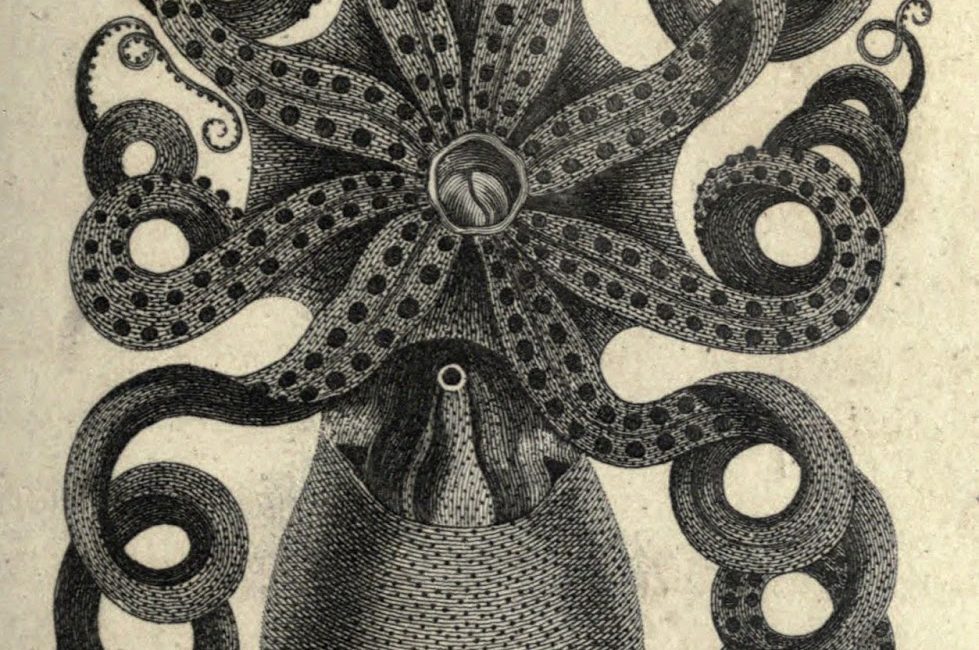
The Octopus…The Monster that Isn’t

“…A very formidable animal, and possess[ing] such a degree of strength as to make it dangerous to attack it without great precaution. Such is the ferocity and violence with which it defends itself, that even the strongest Mastiff can hardly subdue it without a long and doubtful contest. It has even been known to attack a person while swimming, and to fasten itself with dangerous force round the body and limbs.”

Such a description conjures up images of a great behemoth, perhaps with sharp fangs, great talons, and fiery red eyes. It was given by George Shaw in a lecture to the Royal Institute and published in 1809.

It is a description of the Curled Octopus (Eledone cirrhosa), reaching a total size of 5-15 inches. Not quite the beast the description implies…

View Full Size Image
“Eight Armed Cuttle Fish” aka Curled Octopus. Shaw, George. Zoological Lectures Delivered at the Royal Institution by George Shaw. v. 2. 1809. http://biodiversitylibrary.org/page/21511926.

The octopus, like the squid (aka kraken), has long held an unwarranted reputation as a monster. “Their strangely repulsive appearance, and the fictional stories of their attacks, have built up in the popular mind a picture of the ‘devil fish’ which no amount of accurate description is ever likely to cut down to authentic size,” mused Frank W. Lane in Kingdom of the Octopus (1962).

“Ever since people started writing about such things – and probably when they only talked about them – they have never been content simply to name and describe the octopus, but have insisted on passing judgment upon it,” wrote James Artz of the American Museum of Natural History (Ellis, pg. 257).

View Full Size Image
Amazing Mollusca from the Gulf of Naples: Octopus macropus, Tremoctopus violaceus, and Ocythoe tuberculata. Jatta, Giuseppe. I Cefalopodi viventi nel Golfo di Napoli (sistematica) : monografia. 1896. http://biodiversitylibrary.org/page/35424286.

Accounts of the Octopus’ “vile” personality can be found throughout hundreds of years’ worth of literature, even well into the twentieth century and by respected scientists.

The Octopus as Monster

In the first century AD, Pliny the Elder positions the octopus (which he labels a polyp, along with squids) as a gruesome monster, writing, “no animal is more savage in causing the death of a man in the water; for it struggles with him by coiling round him and it swallows him with its sucker-cups and drags him asunder by its multiple suction” (Ellis, pg. 261).

Not surprisingly, Denys de Montfort, the personality behind the legendary kraken image, could not resist the opportunity to contribute to the growing octopus lore in the early nineteenth century. Within Histoire Naturelle Générale et Particulière des Mollusques, he describes an episode where an octopus attacked and nearly succeeded in drowning his dog on the beach. He and his dog were finally able to subdue the monster by tearing off its arms…Given Montfort’s demonstrated history of untruths, his account is hardly to be believed.

View Full Size Image
“The Common Octopus.” Montfort, Denys. Histoire naturelle, générale et particulière des mollusques : animaux sans vertèbres et a sang blanc. v. 2. 1801. http://biodiversitylibrary.org/page/35755415.

Perhaps the most sensational, and damaging, account of the octopus was presented by Victor Hugo in Toilers of the Sea (1866). Within it, Hugo describes his protagonist’s (Gillat) encounter with an octopus in a cave, which does its utmost to annihilate him. Hugo writes of the beast’s attack: “The hydra incorporates itself with the man; the man becomes one with the hydra. The spectre lies upon you…the devil-fish, horrible, sucks your life blood away…Powerless, you feel yourself gradually emptied into this horrible pouch, which is the monster itself.”

View Full Size Image
Gillat’s struggle with the “monster” octopus, as described in Toilers of the Sea. Annual Report of the Board of Regents of the Smithsonian Institution. 1916. http://biodiversitylibrary.org/page/14187072.

Henry Lee and Addison Verrill, both of whom wrote extensively on squid and octopus, boldly challenged Hugo’s passages, outlining the multiple fallacies included. In Cephalopods of the North-eastern Coast of America, Verrill writes, “The description of the ‘poulpe’ or devil-fish by Victor Hugo…is quite as fabulous and unreal as any of the earlier accounts, and even more bizarre. His description represents no real animal whatever.”

View Full Size Image
Graneledone verrucosa. Verrill, A.E. Cephalopods of the North-eastern Coast of America. v. 2. 1881. http://biodiversitylibrary.org/page/11826821.

Unfortunately, such melodramatic accounts, popular among the public, helped to further secure the octopus’ reputation as a monster, despite the counterarguments against them.

Similar descriptions of the octopus as a monster continued into the twentieth century. For instance, a 1907 fieldbook from Florence Merriam Bailey, American ornithologist and nature writer, whilst in California, deems the octopus a “horrible creature,” describing an episode where a friend was attacked by one in Bermuda. “Their strength is tremendous & they put out [[strikethrough]] au [[/strikethrough]] arms and grasp you and hold on with suction discs & then draw the object up and cut it across the back of the neck with thin knives.”

View Full Size Image
Thomas Beale, surgeon on a British whaling voyage in 1835, claimed he was attacked by an octopus on the beach on the Bonin Islands, south of Japan. Gosse, Philip Henry. The Romance of Natural History. 1864. http://biodiversitylibrary.org/page/23537396.

A 1919 National Geographic article by John Oliver La Gorce, called “Devil-Fishing in the Gulf Stream,” presents the mollusk as “most repulsive, having a large, ugly head, a fierce-looking mouth…two diabolical eyes…capable of sending forth a demonic glare when angered…When challenged [it] will fight to the last, doing its best to pull the object of its wrath beneath the surface of the waters.”

But while natural history has been cruelly unkind to the octopus, presenting the creature itself as a monster, this cephalopod also served to inspire one of mythology’s greatest beasts – The Hydra.

The Hydra: A Case of Mistaken Identity

The Hydra is a “mythical” beast most commonly described as having nine heads, each of which will regenerate if decapitated. The Greek hero Hercules was commanded to kill a Hydra as his second labor. The marble tablet in the Vatican depicting this exploit interprets the hydra as a strikingly octopus-like monster.

View Full Size Image
The Hydra, as illustrated by Gessner. Notice the suction-cup like spots on its body…very octopus-like. Gessner, Conrad. Historia Animalium. 2nd Ed. 1604. http://biodiversitylibrary.org/page/42166090.

In the book Sea Fables Explained, Henry Lee writes that the Lernean Hydra was simply a huge Octopus. Many scholars have postulated that hydra are based on octopus. After all, their many tentacles could be misinterpreted as heads, and octopus can regenerate lost limbs, possibly explaining the unending head supply of the hydra.

View Full Size Image
Hercules slaying the Lernean Hydra, as depicted on a marble tablet in the Vatican. Lee, Henry. Sea Fables Explained. 1883. http://biodiversitylibrary.org/page/10985663.

Well into the eighteenth century, many naturalists believed the hydra to be a real creature. Albertus Seba, a famed apothecary from Amsterdam, boasted an extensive cabinet of curiosities, filled with many magnificent biodiversity specimens. From 1734-65, Seba published an account of his cabinet in Locupletissimi rerum naturalium thesauri accurata descriptio, et iconibus artificiosissimis expressio, per universam physices historiam. This work included an image of a hydra, based on a specimen held by the Burgomeister of Hamburg. While Linnaeus later proved this particular specimen to be a fake, an amalgamation of snake skins and weasel heads with possible religious overtones, exaggerated accounts of an octopus likely inspired such monsters in the first place.

View Full Size Image
The Hydra! Seba, Albertus. Locupletissimi rerum naturalium thesauri accurata descriptio, et iconibus artificiosissimis expressio, per universam physices historiam. v. 1. 1734. http://biodiversitylibrary.org/page/41047754.


An Undeserved Reputation and the Monster that Isn’t

The octopus’ “monster” reputation is completely unwarranted. It is hardly necessary to emphasize the fact that the hydra, though inspired by a real animal, is not itself a real species. Debunking longstanding conceptions of the octopus itself as a terrible, vicious monster, however, has proven more difficult.

View Full Size Image
Benthoctopus levis. Chun, Carl. The Cephalopoda. 1975. http://biodiversitylibrary.org/page/32124297.

“The octopus is, in fact, a gentle, curious creature with a surprising ‘intelligence,’” argues marine biologist Richard Ellis of the American Museum of Natural History (Ellis, pg. 261). Around 300 species are recognized, constituting over a third of all cephalopods. They are perhaps the most intelligent invertebrate, demonstrating complex problem-solving abilities and the use of tools.

Octopus range in size from the minute Octopus wolfi, measuring about 0.6 inches in length, to the Giant Pacific Octopus (Enteroctopus dofleini), with a radial span of 20ft (and possibly as much as 32ft) – certainly large enough to inspire some fantastic monster myths. The only octopus species truly dangerous to humans are the three (or perhaps four) species of Blue-Ringed Octopus, which are some of the world’s most venomous marine animals and capable of killing humans.

View Full Size Image
Giant Octopus. Holder, C.F. Along the Florida Reef. 1899. http://biodiversitylibrary.org/page/23386919.

So, in the case of the octopus, it is more a story of the monster that isn’t. These cephalopods most definitely are not, as Victor Hugo asserts in Toilers of the Sea, “the concrete forms of evil,” but are in fact a wonderfully diverse, spectacularly intelligent, and reportedly shy group.

So, are monsters real? In the case of the octopus, no.

View Full Size Image
Hydra. Aldrovandi, Ulisse. Serpentum, et draconum historiæ libri duo. 1640. http://biodiversitylibrary.org/page/41765442.
  • Follow our blog and #bhlMonstersRreal on Twitter and Facebook all week to learn more about monsters and the animals that inspired them.
  • Browse historic illustrations of octopi and squid-inspired monsters and the animals that they’re based on in Flickr.
  • Browse the books that portray these historic monsters in BHL.
  • Carve a Hydra in your Halloween Pumpkin this year! Share your carvings with us on Facebook and Twitter!
  • See some of our favorite monsters come to life on the Smithsonian Libraries’ Tumblr!

Reference:

  • Ellis, Richard. Monsters of the Sea. New York: Alfred A. Knopp, Inc., 1994. Print.
October 30, 2014by ulib-libraryjobs
Blog Reel, Campaigns, Featured Books, Monsters Are Real

Release the Kraken!

“Architeuthis, the giant squid, is the quintessential sea monster, probably responsible for more myths, fables, fantasies, and fictions than all other marine monsters combined…[It] surely is the most remarkable unscheduled arrival in the history of zoology, crypto or otherwise. An animal that was believed by many to be mythological verified its existence…” (Ellis, 122, 133-34).

Science knows it by the name Architeuthis dux. For centuries, however, it was known by an altogether more infamous one – The Kraken.

The Kraken: A History

Aristotle first introduced us to the giant squid (which he called teuthos) in 350 BCE, and then, in AD 77-79, Pliny the Elder related a tale of a “polyp” that was killed during its attempt to steal salted fish from the fish ponds in Carteia (Ellis, pg. 123). Described as having 30-foot long arms, the beast has been identified as a squid.

Giant squids have been seen throughout the world’s oceans, but they are quite common in the seas around Norway and Greenland. Indeed, the word “kraken” comes from the Norwegian “krake,” meaning “fabulous sea monsters.” The late 14th century version of the Icelandic saga Örvar-Oddr gives an account of the Hafgufa (“sea mist”) and Lyngbakr (“heather-back”) – beasts occurring in the Greenland Sea. While Lyngbakr is credited as the “largest whale in the sea,” the Hafgufa

“is the hugest monster in the sea. It is the nature of this creature to swallow men and ships, and even whales and everything else within reach. It stays submerged for days, then rears its head and nostrils above surface and stays that way at least until the change of tide.”

Hafgufa, it has been suggested, is a giant squid. The thirteenth century Norwegian work Konungs skuggsjá describes the beast, saying that it appears “more like an island than a fish.” The 1917 translation identifies this “monster” as the Kraken.

View Full Size Image
The Kraken. Magnus, Olaus. Historia de Gentibus Septentrionalibus. 1555. http://biodiversitylibrary.org/page/41862917.

Never missing a chance to tell a good monster tale, Olaus Magnus detailed the kraken as a “monstrous fish” within Historia de Gentibus Septentrionalibus, describing them as having long sharp horns, huge red eyes, and “hairs like goose feathers, thick and long, like a beard hanging down.” He claims that “one of these Sea-Monsters will drown easily many great ships provided with many strong Marriners” – a characteristic reported in the earlier Icelandic work. Magnus’ depiction of the beast, as a strange mix of fish and squid, is quite different from those we find later in the literature, suggesting that his monster is likely a confusion of many sightings, including not only the giant squid but perhaps whales and cuttlefish as well.

View Full Size Image
Kraken, after Magnus. Gessner, Conrad. Historia Animalium. 2nd Ed. 1604. http://biodiversitylibrary.org/page/42165838.

In his first edition of Systema Naturae (1735), Carolus Linnaeus classified the kraken as a cephalopod with the scientific name Microcosmus marinus. Though it was removed from later editions of Systema, Linnaeus’ 1746 publication, Fauna Suecica, describes the kraken as “a unique monster” inhabiting the seas of Norway. He does, however, include a disclaimer that he has never seen the animal himself.

Erik Pontoppidan, bishop of Bergen, in his Det Forste Forsorg paa Norges Naturlige Historie “Natural History of Norway” (Copenhagen, 1752–3), added significantly to the kraken tale. Also writing extensively on mermaids and sea serpents, Pontoppidan describes the kraken as “the largest sea monster in the world…round, flat, and full of arms, or branches.” He writes that not only is the kraken sometimes mistaken for an island, but also that it is possible of pulling the largest ships down to the ocean’s bottom. The greatest danger to sailors he claims, however, is the whirlpool created when it sinks, capable of “draw[ing] everything down with it.”

View Full Size Image
A very octopus-like Kraken. Montfort, Denys. Histoire naturelle, générale et particulière des mollusques : animaux sans vertèbres et a sang blanc. v. 2. 1801. http://biodiversitylibrary.org/page/35755564.

One of the most famous illustrations associated with the kraken, and one in which we see it take a definite cephalopod (if not more octopus-like) persona, comes from French malacologist Pierre Dénys de Montfort’s 1802 book Histoire Naturelle Générale et Particulière des Mollusques. Advertised as an encyclopedic description of mollusks, Montfort describes two kinds of giant octopus in the work: the Kraken Octopus, so often described by Norwegian sailors, and the Colossal Octopus, which he claims attacked a ship off the coast of Angola. The besieged sailors, he reports, prayed to St. Thomas, and were subsequently saved from the creature. He asserts that a votive picture of a ship embraced by this monster octopus was displayed in the St. Thomas chapel at St. Malo, though its existence has not been proven.

Whether or not Montfort truly believed this tale, he apparently had no qualms about publishing fiction as fact. Henry Lee, author of The Octopus in 1875, quoted Montfort as stating, “If my entangled ship is accepted, I will make my ‘colossal poulpe’ otherthrow a whole fleet.” True to his word, soon after his Histoire Naturelle publication, Montfort claimed that this same giant beast attacked and sunk a fleet of six French man-of-wars and four British ships. His reports, apparently, were influenced by Magnus and Pontoppidan’s description of the kraken’s capabilities.

View Full Size Image
“Kraken” attacking a fleet after a fashion described by Montfort. Annual Report of the Board of Regents of the Smithsonian Institution. 1916. http://biodiversitylibrary.org/page/14187069.

In the mid-1800s, the kraken took an authentic biological form as Architeuthis, passing from myth to science. Prof. Japetus Steenstrup, lecturer at Copenhagen University, introduced the giant squid in a paper that related the original description of the earliest record of a giant squid carcass washing ashore: Thingore Sand, Iceland, in 1639. The paper was read in 1849, and the official scientific name was later published in 1857.

Although the giant squid was finally taxonomically official, physical evidence of the creature remained scarce. A near-catch of a specimen in November, 1861, by the Alecton off Tenerife in the Canary Islands ended with only a detached piece of the squid’s tail as any evidence of the encounter. In 1871 and 1872, two giant squid carcasses were collected on the Grand Banks and at Coombs’ Cove, Fortune Bay, Newfoundland, respectively, the latter of which was a reported 52 feet long.

View Full Size Image
Near-catch of Giant Squid by crew of the Alecton, 1861. Annual Report of the Board of Regents of the Smithsonian Institution. 1916. http://biodiversitylibrary.org/page/14187077.

Finally, in December 1873, science caught a break. Four fishermen in Logy Bay, Newfoundland caught a giant squid in their fishing nets. The in-tact specimen was brought to Reverend Moses Harvey, an amateur naturalist, who draped it over a sponge bath for display. He then contacted Addison Emery Verrill, professor of zoology at Yale University, who conducted a full study of the specimen, which measured in at 32 feet long.

View Full Size Image
Giant Squid specimen draped over a sponge bath, 1873. Verrill, A.E. The Cephalopods of the North-eastern Coast of America. pt. 1. 1882. http://biodiversitylibrary.org/page/11826545.

Verrill collected information on every known specimen of Architeuthis and published his findings in a paper entitled The Cephalopods of the North-eastern Coast of America. Part I. The Giant Squids (Architeuthis) and their Allies; with Observations on Similar Large Species from Foreign Localities.

View Full Size Image
“In 1855, Danish zoologist Japetus Steenstrup proposed that the fabled sea bishop [another mythical monster often associated with mermaids] was actually a giant squid. He offered a picture illustrating how the misunderstanding could have occurred.” Learn more in the American Museum of Natural History’s Mythic Creatures online exhibit, from which this quote is derived. This image: Gessner, Conrad. Historia Animalium. 2nd Ed. 1604. http://biodiversitylibrary.org/page/42166070.

The Giant Squid in Science

But while the giant squid’s acceptance into the scientific canon established the cephalopod as fact, Architeuthis’ habitat, life history, breeding habits, and even definitive size remain shrouded in mystery. It currently holds the record as the second-largest mollusk and extant invertebrate (exceeded only by the colossal squid). Recent studies have revealed that it feeds on deep-sea fish and other squids, but its hunting methods and reproductive cycle are still unknown. While it was long believed that there were many species within the Architeuthis genus, recent genetic analysis suggests there is only one: Architeuthis dux. Claims of lengths reaching 150 -200 feet have been reported, even by scientists, without evidence to justify such claims. The Smithsonian’s National Museum of Natural History suggests maximum lengths of nearly 60 feet.

Until recently, no images of the giant squid in its natural habitat had ever been taken. But, on September 30, 2004, Tsunemi Kubodera (National Science Museum of Japan) and Kyoichi Mori (Ogasawara Whale Watching Association) changed this, capturing 500 photographs of a 26 foot giant squid using a camera attached to a baited line. From 2006-2012, in three separate incidents, the giant squid was reportedly filmed, though two of the specimens were less than twelve feet long.

View Full Size Image
This female giant squid, caught in a net by a Spanish fisherman in 2005, is on display in the Smithsonian’s Sant Ocean Hall. Image Credit: Don Hurlbert/Smithsonian Institution, CC:BY-NC-SA. http://eol.org/data_objects/27480683. Learn more about the Giant Squid from the Smithsonian’s National Museum of Natural History.

While our knowledge about this species is increasing, we still have much to learn. Considering its size, the Giant Squid remains a surprisingly elusive creature. It demonstrates just how much we still have to learn about the ocean.

A World with a Kraken

So, does the kraken really exist? Most definitely. It is the species Architeuthis dux, the giant squid (possibly with some giant cuttlefish, colossal squid, and octopus sightings thrown into the mix).

Is it a warship-sized beast, capable of pulling entire ships to the ocean floor and indiscriminately devouring helpless sailors? No.

Yet again, inexperience and sensationalism turned reality into fiction. And to some degree, this continues to this day. Our research about this animal is still in its infancy, and much misinformation abounds. There is still much we have to learn about the “Kraken.”

  • Follow our blog and #bhlMonstersRreal on Twitter and Facebook all week to learn more about monsters and the animals that inspired them.
  • Browse historic illustrations of octopi and squid-inspired monsters and the animals that they’re based on in Flickr.
  • Browse the books that portray these historic monsters in BHL.
  • Carve a monster in your Halloween Pumpkin this year! Share your carvings with us on Facebook and Twitter!
  • See some of our favorite monsters come to life on the Smithsonian Libraries’ Tumblr!
View Full Size Image
“Release the Kraken!” In H. P. Lovecraft’s short story “The Call of Cthulhu,” Cthulhu (a part man, part dragon, and part octopus monster) attacks a ship. The sailors try to kill the beast by ramming it repeatedly, but Cthulhu simply turns into green mist and reassembles. See more fantastic historic monsters come to life on the Smithsonian Libraries’ Tumblr. GIF created by Richard Naples (Smithsonian Libraries), based on Montfort, Denys. Histoire naturelle, générale et particulière des mollusques : animaux sans vertèbres et a sang blanc. v. 2. 1801. http://biodiversitylibrary.org/page/35755564.


Reference:

  • Ellis, Richard. Monsters of the Sea. New York: Alfred A. Knopp, Inc., 1994. Print.
October 30, 2014by michelle.underhill
Blog Reel, Campaigns, Featured Books, Monsters Are Real

A Whale of a Tale…The Leviathan

The Devil Whale

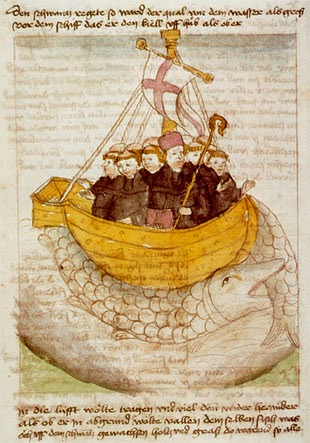
In the 6th century AD, St. Brendan, an Irish cleric, and eighteen other monks, sailed out from Ireland to cross the ocean. Amidst their journey, they came upon a black, treeless island and decided to make camp for the night. Several monks set up a cooking station and lit a fire. And then the island began to move. Terrified, the monks fled back to their boat, leaving the food and fire behind. St. Brandon urged them not to be afraid; it was simply the great fish Jasconius, “which laboreth night and day to put his tail in his mouth, but for greatness he may not” (Navigatio sancti Brendan abbatis, 9th century, translated from Latin).

View Full Size Image
St. Brendan atop Jasconius. Manuscriptum translationis germanicae (ca. 1460, Cod. Pal. Germ. 60, fol. 179v, Universitätsbibliothek Heidelberg). http://www.hs-augsburg.de/~harsch/Chronologia/Lspost10/Brendanus/bre_navi.jpg.

Gessner describes Jasconius by another name: the Trol whale or Devil Whale, which lies asleep in the water and is often mistaken for an island by hapless sailors. Gessner was likely inspired by Magnus, who claims that the whale’s skin is like sand, lending to its confusion with a beach. When the whale is disturbed by the sailors’ dinner fires, it sinks, causing such a whirpool that the ships themselves are often sunk.

View Full Size Image
The Devil Whale, complete with sailors trying to cook a meal on its back. Gessner, Conrad. Historia Animalium. 2nd Ed. 1604. http://biodiversitylibrary.org/page/42165750.

For centuries, men have imagined all manner of aquatic monsters. The ocean was a strange and foreign place, and even several hundred years ago, was very little explored. “If the very body of the ocean presented a fearsome aspect, with its dark, roiling waters, its threatening visage, and its intimidating vistas, its occupants were the quintessence of terror,” wrote marine biologist Richard Ellis in his book Monsters of the Sea. “The landlubbers’ only contact with the large creatures of the sea was at best sporadic and often completely incomprehensible” (Ellis, pgs. 193-194).

This sporadic contact spawned tales of horrible beasts. Quite often, these horrible beasts were, in truth, cetaceans.

The Sperm Whale: Chief Among the Leviathans

Even before sailors encountered whales in the ocean, washed up carcasses, sometimes badly mutilated, ignited a fear of the creatures of the deep. According to Ellis, “the sperm whale, with its mysterious habit of stranding on shallow beaches, was probably responsible for many of the legends and myths of sea monsters.” (pg. 194).

The record of sperm whale strandings is quite dramatic. Quite often, they are stranded en masse. For instance, in 1723, seventeen whales were stranded ashore the Elbe River in Germany. In 1784, thirty-one made landfall in Brittany. In 1888, sixteen washed up in Cape Canaveral, and in 1974, 72 were found on the coasts of New Zealand.

A variety of circumstances can result in a stranding, including rough weather, illness or age, difficulty giving birth, hunting mishaps, or even attempts to rescue another whale in distress.

View Full Size Image
Sperm Whale stranding. Jonstonus, Joannes. Historiae naturalis de quadrupetibus libri. pt. 2-6. 1650. http://biodiversitylibrary.org/page/44040300.

The sperm whale (Physeter macrocephalus) is a strange animal, even among whales. The largest toothed whale, and toothed predator, in the world, the sperm whale holds many records. It has the longest intestinal tract and largest brain in the animal kingdom. It also has the largest nose of any animal and cavities within its head hold reservoirs of liquid wax called Spermaceti. This behemoth can reach up to 67 feet long and weigh as much as 125,000 pounds!

View Full Size Image
A Sperm Whale in search of food. Scammon, C.M. The marine mammals of the north-western coast of North America. 1874. http://biodiversitylibrary.org/page/16226208.

A Whole Order of Leviathan Inspiration

While their strange appearance and prolific beachings likely inspired many monster stories, sperm whales are not the only cetaceans that natural history writers had contact with. For instance, a blue whale – the largest animal to have ever lived – is documented as having come ashore as early as 1692, in Scotland. A 95-foot specimen was placed on exhibit in Europe in 1827, “further enhancing the image of the whale as a gigantic monster” (Ellis, pg. 197). Interactions with right whales, bowheads, baleens, and orcas also inspired Leviathan legends.

Whales From Hell

The range of monsters inspired by cetaceans is charmingly diverse, including many varieties in addition to the Devil Whale. Most are likely the result of an amalgamation of many species, and some (like the Devil Whale) may also have been shaped by religious undercurrents.

Pristers

Pristers are found in multiple forms throughout Carta Marina and in many subsequent publications. Magnus actually identified these beasts as whales, describing them as “two hundred cubits long, and very cruel.”

View Full Size Image
Physeter, or Prister. Magnus, Olaus. Historiae de gentibus septentrionalibus. 1555. http://biodiversitylibrary.org/page/41862918.

The common feature among them is the presence of two blowholes, most often acting as water cannons drowning unlucky vessels. Magnus warns, “to the danger of Sea men, he will sometimes raise himself beyond the sail yards, and cast such floods of waters above his head, which he had sucked in, that with a cloud of them, he will often sink the strongest ships…Sometimes, not content to do hurt by water only…he will cruelly over throw the ship like any small vessel, striking it with his back, or tail.” If that isn’t bad enough, Magnus also claims that it has a mouth like a Lamprey, “whereby he sucks in his meat or water.”

View Full Size Image
Prister attacking a ship. Magnus, Olaus. Historiae de gentibus septentrionalibus. 1555. http://biodiversitylibrary.org/page/41862919.

How can such a beast be defeated? Not by cannon-fire. Magnus warns that the beast’s layer of fat is too thick for such absurdities. Instead, try sounding a trumpet, which will startle the monster, or dump some empty barrels in the ocean, with which the creature will become distracted and stop to play.

View Full Size Image
The Prister, monsters actually identified as whales in historic publications, are reported to be mighty enough to sink the strongest ships. Cannon-fire was, according to Olaus Magnus, who published three versions of them in 1555, useless against these beasts. Instead, sailors should sound trumpets and throw barrels into the water to distract these monsters. See more fantastic historic monsters come to life on the Smithsonian Libraries’ Tumblr. GIF created by Richard Naples (Smithsonian Libraries), based on Gessner, Conrad. Historia Animalium. 2nd ed. 1604. http://biodiversitylibrary.org/page/42165750.

What species is this monster likely based on? Well, Baleen Whales do actually have two blowholes, and Magnus refers to the beasts as Physeter. The modern-day suberfamily including sperm whales is Physeteroidea.

The Ziphius

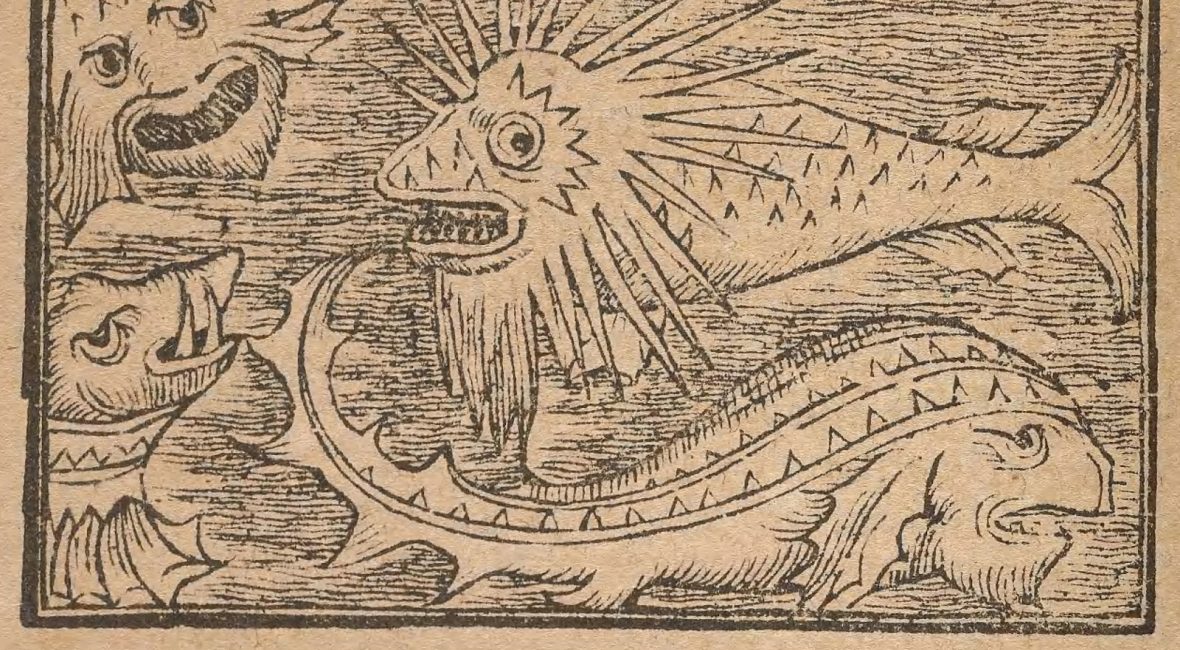
“The sword-fish is like no other, but in something it is like a whale. He hath as ugly a head as an Owl; his mouth is wondrous deep, as a vast pit, whereby he terrifies and drives away those that look into it. His eyes are horrible, his back Wedge-fashion, or elevated like a sword. His snout is pointed. These often enter upon the Northern Coasts as Thieves and hurtful Guests, that are always doing mischief to ships they meet, by boring holes in them, and sinking them.”

View Full Size Image
The Ziphius, after Magnus. Gessner, Conrad. Historia Animalium. 2nd Ed. 1604. http://biodiversitylibrary.org/page/42165841.

Thus Magnus describes the Ziphius (translation via John Ashton’s Curious Creatures in Zoology (1890)), whose name comes from the Greek xiphias, meaning sword (recall Magnus’ comparison of its fin to a sword). This bizarre, owl-headed creature is depicted with a seal in its jaws. This, and the shape of the fin, suggest that the monster may be based on an Orca. A Great White Shark has also been suggested.

And the porcupine-fish attacking the Ziphius? Jury’s still out on that one…

The Case for the Leviathan

We all know whales are real, and we know that they can grow to extraordinary sizes (the largest size on earth, in fact). They have even been documented to attack and sink ships (for instance, in 1820, the vessel Essex was sunk by a sperm whale), so those crews wishing to harpoon a whale has reason to be cautious.

View Full Size Image
Physeter, or Prister. Magnus, Olaus. Historiae de gentibus septentrionalibus. 1555. http://biodiversitylibrary.org/page/41862920.

Does the Leviathan exist? Yes. Even within the sixteenth century writings of Magnus and Gessner, Leviathan monsters such as Devil Whales and Pristers are identified as whales. However, are you likely to mistake a whale for an island and try to cook your dinner on it? Is a whale prone to kill a human simply for the fun of it? Probably not.

As is the case with all monsters inspired by real animals, limited – and sometimes dramatic (think witnessing a breaching near your boat for the first time, or stumbling upon the decomposing corpse of a sperm whale) – contact with these mammals fueled fear and sensationalism, resulting in harrowing tales of great beasts roaming the oceans.

But, in the end, a Leviathan, by any other name, is simply a whale (or perhaps an Orca) and most definitely not a monster.

  • Follow our blog and #bhlMonstersRreal on Twitter and Facebook all week to learn more about monsters and the animals that inspired them.
  • Browse historic illustrations of leviathans and their whale counterparts on Flickr.
  • Browse the books that portray these historic monsters in BHL.
  • Carve a Leviathan in your Halloween Pumpkin this year! Share your carvings with us on Facebook and Twitter!
  • See some of our favorite monsters come to life on the Smithsonian Libraries’ Tumblr!


References:

  • Ellis, Richard. Monsters of the Sea. New York: Alfred A. Knopp, Inc., 1994. Print.
  • Simon, Matt. “Kraken and Owl Whales: Take a Dip with History’s Most Terrifying Sea Monsters.” Wired. 13.09.13. Web. 20.10.14. http://www.wired.com/2013/09/carta-marina/#slideid-591797.
October 28, 2014by michelle.underhill

Help Support BHL

BHL's existence depends on the financial support of its patrons. Help us keep this free resource alive!

search

About BHL

The Biodiversity Heritage Library (BHL) is the world’s largest open access digital library for biodiversity literature and archives. BHL operates as a worldwide consortium of natural history, botanical, research, and national libraries working together to digitize the natural history literature held in their collections and make it freely available for open access as part of a global “biodiversity community.”

Join Our Mailing List

Sign up to receive the latest news, content highlights, and promotions.

Subscribe Now

Subscribe to Blog via Email

Enter your email address to subscribe to this blog and receive notifications of new posts by email.

Join 319 other subscribers

Subscribe to Blog Via RSS

Subscribe to the blog RSS feed to stay up-to-date on all the latest BHL posts.

Access RSS Feed

Inspiring Discovery through Free Access to Biodiversity Knowledge.

The Biodiversity Heritage Library makes it easier than ever for you to access the information you need to study and explore life on Earth…for free, anytime, anywhere.


64+ Million Pages of
Biodiversity Literature Online.

EXPLORE

Tools and Services
to Transform Research.

EXPLORE

300,000+
Illustrations on Flickr.

EXPLORE

ABOUT | HARMFUL CONTENT | PRIVACY | SITE MAP | TERMS OF USE