Biodiversity Heritage Library - Program news and collection highlights from BHL
  • Home
  • News
  • Featured Books
    • All Featured Books
    • Book of the Month Series
    • BHL at 20
  • User Stories
  • Campaigns
    • Fossil Stories
    • Garden Stories
    • Monsters Are Real
    • Page Frights
    • Her Natural History
    • Earth Optimism 2020
  • Tech Blog
  • Visit BHL
Home
News
Featured Books
    All Featured Books
    Book of the Month Series
    BHL at 20
User Stories
Campaigns
    Fossil Stories
    Garden Stories
    Monsters Are Real
    Page Frights
    Her Natural History
    Earth Optimism 2020
Tech Blog
Visit BHL
  • Home
  • News
  • Featured Books
    • All Featured Books
    • Book of the Month Series
    • BHL at 20
  • User Stories
  • Campaigns
    • Fossil Stories
    • Garden Stories
    • Monsters Are Real
    • Page Frights
    • Her Natural History
    • Earth Optimism 2020
  • Tech Blog
  • Visit BHL
Biodiversity Heritage Library - Program news and collection highlights from BHL
BHL News, Blog Reel

‘What’s in a Name?’ Launched at Harvard Museum of Natural History

Why are names important in science? What is the difference between scientific names (also known as Latin names or taxonomic names) and common names? Why do some species have multiple names? The grant project team for What’s in a Name, supported by the Institute of Museum and Library Services (IMLS), set out to find answers and develop exhibits and other ways for anyone to explore this phenomenon. With millions of different species to identify and understand, the process of naming organisms helps scientists organize and understand the tree of life. The physical and virtual results of this exploration creatively demonstrate how scientists identify and name species, how names relate to scientific research and the progression of knowledge, and how museum specimen collections play a crucial role in the process of naming.

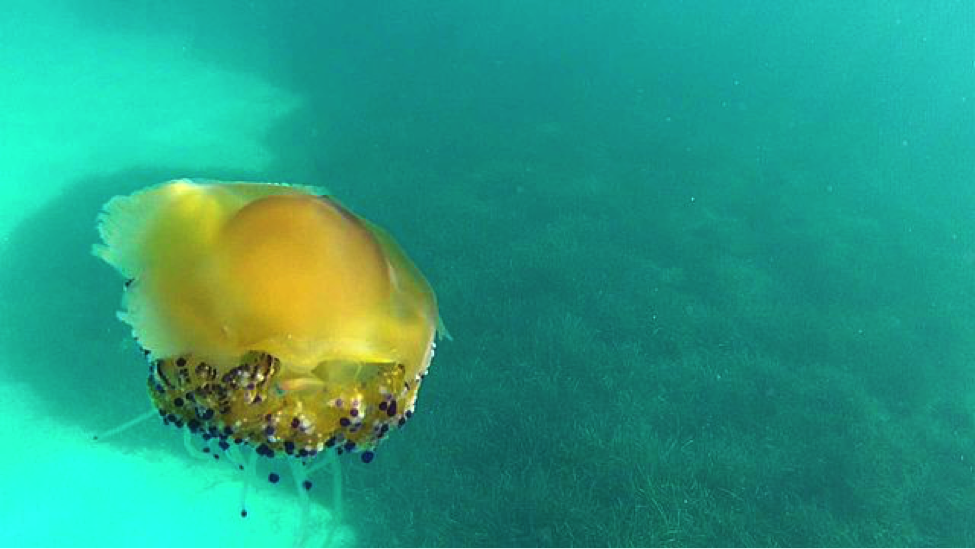
Why would something be called “Fried Egg jelly fish”, and also be known as Phacellophora camtschatica?

View Full Size Image
Image of the Fried Egg Jelly courtesy of gpapadop79 – Own work, CC BY-SA4.0, https://commons.wikimedia.org/w/index.php?curid=45347541.

Scientific names take the form of “Genus species”. Scientific names serve to distinctively identify an organism and also to show evolutionary relationships. The genus links the organism to its evolutionary relatives while the species name demonstrates its uniqueness (not unlike the family and first name convention of many people in North America). Organisms also have common names. Common names can be confusing—for instance a “Robin” in the United States is a completely different bird than a “Robin” in Europe, but if the scientific name is used, confusion can be reduced via the name unique to the organism.

The system of binomial nomenclature is used to assign species with their two-part Latin names. Carl von Linné (1707 – 1778) established a system of tiered taxonomic classification, which assigned species formal names, in the 18th century. His classification is outlined in his book, Systema Naturae. His purpose was to reduce confusion from the proliferation of common names by supplying a unique name to each organism that also displayed potential relationships with other organisms. The names were formulated from Latin words. Linné even Latinized his own name and is now best known by that name: Carolus Linnaeus.
View Full Size Image
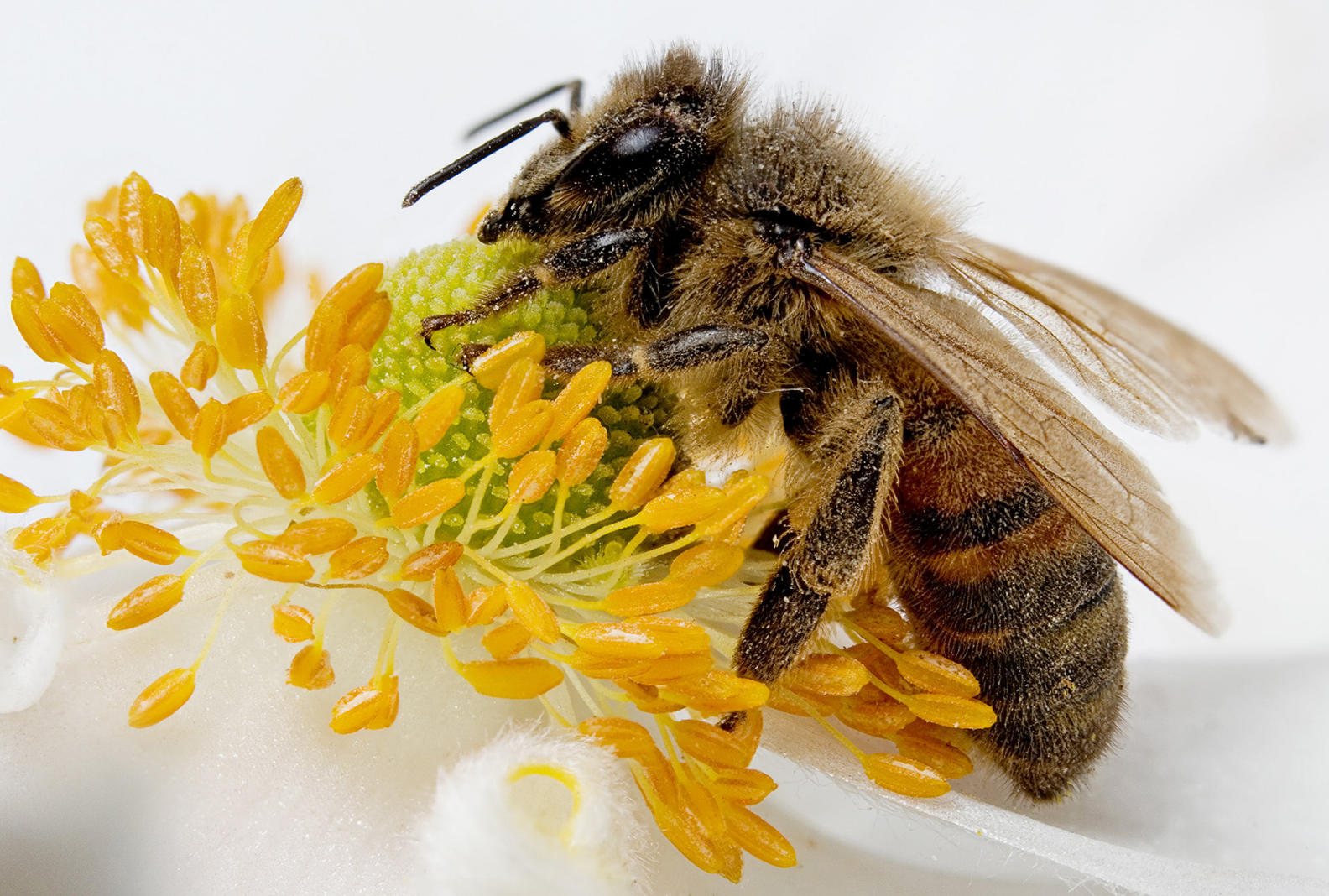
From the What’s In a Name PDF, page 32: “Carl Linnaeus gave the European Honeybee its name, Apis mellifera, which is Latin for “honey-bearing bee.” By some accounts, Linnaeus later became dissatisfied with the name he bestowed and argued to change it from Apis mellifera, to Apis mellifica, or “honey-making bee.” His mistake, he argued, was that bees make honey within the hive; they do not bear it from the flower. His argument was presumably unsuccessful as the bee still bears the erroneous name.” Image: A European Honeybee, Apis mellifera, visiting a flower that is dusting it with pollen. (JJ Harrison, CC BY-SA 3.0).

Species may be discovered by scientists poring over specimens in a museum or someone exploring an area rich in biodiversity. It is not necessary to be a scientist to name a new species but scientific names must conform to rules laid out by the International Code of Zoological Nomenclature and the International Code for Nomenclature for algae, fungi and plants. Names can reflect a characteristic of a species (Peromyscus leucopus-white-footed mouse) or can be named after a person or location (Mandelia microcornata-a nudibranch named for Nelson Mandela). Sometimes, scientists display a sense of humor when naming: Agra phobia and Agra vation are the scientific names of South American beetles. A hungry entomologist (Neal Evenhuis) named a series of flies (genus) Pieza and most notably, a species Pieza pi.

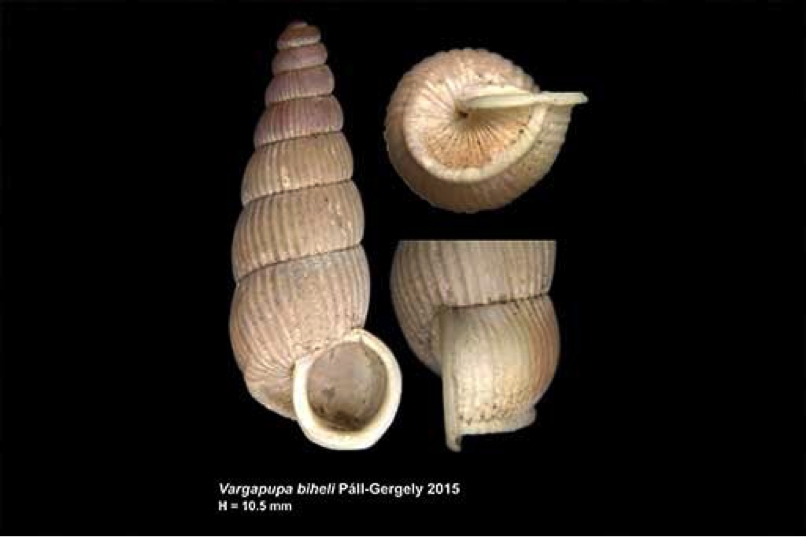
The results from the work of What’s in a Name? include four interactive exhibit stations at the Harvard Museum of Natural History on Honeybees, the extinct Dimetrodon, Jellies and Poison Ivy. There are also free online resources, including a website and a 60-page free e-book. The online resources include eight more species stories that feature images and references from the Biodiversity Heritage Library (BHL) and include familiar organisms like the dodo and sugar maple, as well as our favorite, the snail Vargapupa biheli named after BHL!
View Full Size Image
Vargapupa biheli. Image courtesy Dr. Barna Páll-Gergely.

Featured in the exhibit display on Dimetrodon, Stephanie Pierce, Assistant Professor of Vertebrate Paleontology, Harvard University, describes research being done right now on specimens of the fossil species Dimetrodon milleri, in the Museum of Comparative Zoology collection:

The What’s in a Name? project is a partnership between Harvard Museums of Science and Culture (HMSC), the Encyclopedia of Life (EOL), and the BHL, as represented by the Ernst Mayr Library of the Museum of Comparative Zoology at Harvard University. This project was made possible by IMLS.

For more information about scientific names and naming, check out the following sources

  • Bright, M. 2012. The Frog with Self-cleaning Feet: And Other Extraordinary Tales From the Animal World. Biteback Publishing. 304 pages.
  • Evenhuis, N. L.2002. Pieza, a new genus of microbombyliids from the New World (Diptera: Mythicomyiidae). Zootaxa 36(1). DOI: http://dx.doi.org/10.11646/zootaxa.36.1.1
  • Freeland, C. 2008. On Name Finding in the BHL. BHL Blog, March. https://goo.gl/wJIOWC
  • Greenstein, B. 2016. How’s your fern and bird coverage, BHL? BHL Blog, August.
  • Harvard Museums of Science and Culture. 2017, “What’s in a Name?.” http://whatsinaname.hmnh.harvard.edu/files/imls/files/_whatsinaname_.pdf
  • Judd, W. 2014.Weirdest species names. Australian Geographic. March 2014. https://goo.gl/UQ3xMA
  •  Zielinski, S. 2009. The World’s Strangest Scientific Names. Smithsonian Magazine. https://goo.gl/D3aMbb
February 14, 2017by ulib-libraryjobs
Blog Reel, Featured Books

Fantastic Worlds: Exploring the Ocean through Science and Fiction

In July 2015, BHL founding institution Smithsonian Libraries opened a new exhibit at the Smithsonian’s National Museum of American History entitled Fantastic Worlds: Science and Fiction 1780-1910. The exhibit invites visitors to explore the fantastic worlds of fiction inspired by 19th century scientific discovery and invention. It features fabulous natural history books on topics ranging from marine life to geology and dinosaurs and expeditions to the polar regions and interior Africa. Exhibit curators Kirsten van der Veen (Special Collections, Dibner Library, Smithsonian Libraries) and Doug Dunlop (Metadata Librarian, Smithsonian Libraries) not only walk visitors through some of the remarkable scientific discoveries of the Victorian era but also demonstrate the profound impact these advances had on popular fiction.

View Full Size Image
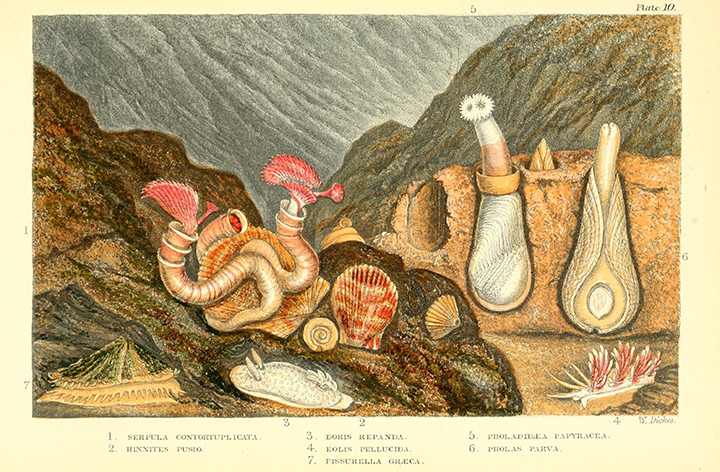
Kingsley, Charles. Glaucus. 4th Ed. (1859). http://biodiversitylibrary.org/page/29363521.

In the exhibit section entitled “Sea Change: Underwater Worlds,” visitors can experience 19th century ocean exploration through the lens of publications, both scientific and fictional, produced during the time period. As the exhibit articulates:

“The sea was a vital part of 19th-century life: distant travel, commerce, and the livelihoods of many depended on it. Tales of sea voyages, both fact and fiction, were immensely popular. As scientists explored the depths of the oceans, however, stories began to take place not just on the sea, but in it.

In the early 1800s, scientists believed the deep sea simply could not sustain life. Knowledge of the oceans had largely been limited to shores and shallow waters, but the mid-19th century saw the start of our exploration of this immense underwater world. Technological improvements to submersible vessels and diving gear helped make the seas more accessible. The bold plan to lay a telegraph cable across the Atlantic Ocean made understanding the ocean floor essential, and helped drive deep-sea exploration further.

Victorian Britain had a fascination with the sea, and with the natural world in general. The pastime of shell collecting became very popular in the mid-1800s. As the middle class grew and people found themselves with leisure time, the seaside became a frequent holiday destination. Amateur naturalists and vacationers scoured the shores for specimens to add to their collections. Collecting and cataloging one’s findings was considered a morally appropriate, enriching activity, and a worthy antidote to idleness. This fascination mirrored the interests of the scientific community, as newly coordinated efforts to dredge for marine fauna and survey the coasts were initiated, to address the notable lack of new knowledge of the undersea world.

View Full Size Image
Kingsley, Charles. Glaucus. 4th Ed. (1859). http://biodiversitylibrary.org/page/29363529.

Books on the identification of sea life, like Rev. Charles Kingsley’s Glaucus, or, The Wonders of the Shore, were very popular. Perhaps best known for his children’s book The Water Babies, Kingsley was a prolific writer of non-fictional works as well, including sermons, social commentaries, and scientific treatises. He was a capable amateur naturalist, too, well-versed in the scientific issues of the day (he and Charles Darwin corresponded) and a proponent of science education. Glaucus, named for an ancient Greek sea-god, encouraged personal and religious improvement through knowledge of the natural world, in this case the corals, mollusks, and anemones found at the seashore.

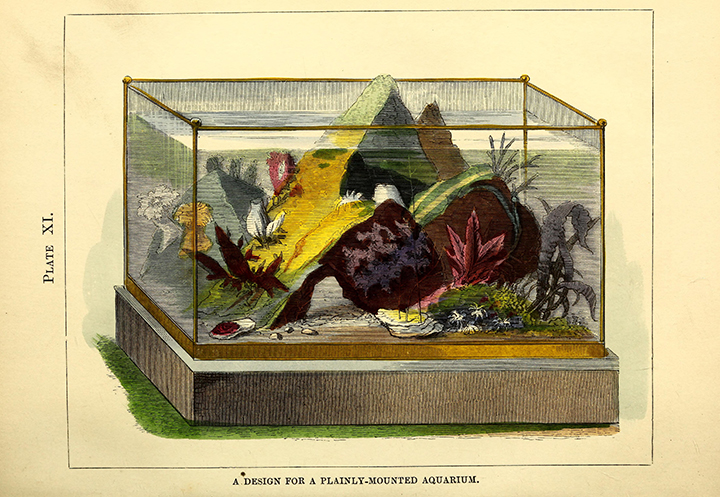
Interest in sea life found its way into the home in the 1850s as the first aquariums (or “aqua-vivariums”) appeared. Having a miniaturized version of the ocean floor at home became a mid-19th century fad. The first public aquarium opened in 1853 in London. Purveyors of aquatic plants and animals catered to aquarium enthusiasts. Books [such as Henry Noel Humphreys’ Ocean Gardens: The History of the Marine Aquarium. London, 1857] offered advice to enthusiasts on creating and maintaining their indoor “ocean gardens.”

View Full Size Image
Humphreys, Henry Noel. Ocean gardens : the history of the marine aquarium, and the best methods now adopted for its establishment and preservation (1857). http://biodiversitylibrary.org/page/43084496.

As the exhibit shows, the public’s growing interest in the deep ocean can be clearly seen in the popularity of many of the fictional works of the time, especially Vingt Mille Lieues Sous les Mers (Twenty Thousand Leagues Under the Seas in English) by Jules Verne. Within the work, the famous Captain Nemo takes his captive guests on a journey through the oceans in his submarine. The work draws on many of the scientific advances, such as self-propelled submarines and diving suits, and features many of the exotic underwater species, that were captivating the public during the era.

Not only were the inventions and species featured in works like Twenty Thousand Leagues Under the Seas a reflection of the advances of the time, but the very idea of extended underwater expeditions like that undertaken by Captain Nemo also mirrored the scientific endeavors being launched. According to the exhibit:

“Britain’s Challenger expedition, a massive four-year undertaking begun in 1872, vastly increased knowledge about the deep sea. Its goal: to circumnavigate the globe and study the ocean’s depths. It was the first large-scale government-funded scientific expedition. The HMS Challenger was a British naval warship outfitted for scientific study and included a chemistry lab and a workroom for the study of specimens.

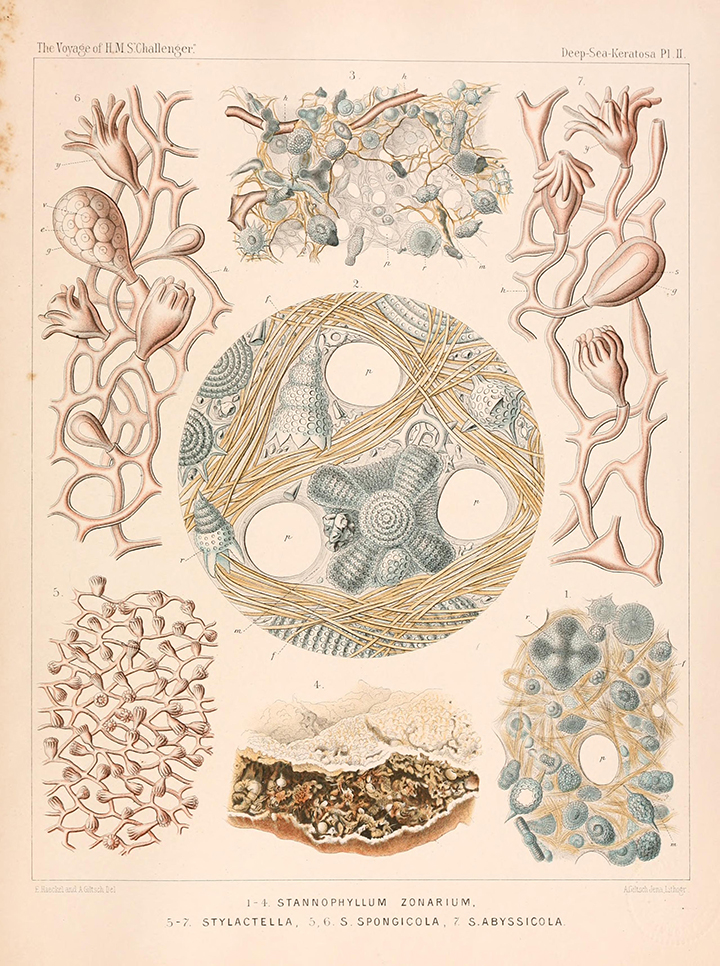
The expedition resulted in 50 volumes of scientific reports. More than 4,500 new species of marine life were recorded, and scientists were finally able to prove that life did indeed exist in the ocean’s depths. The hundreds of crates of specimens were painstakingly studied and illustrated by experts worldwide, like those by Ernst Haeckel [Report on the Scientific Results of the Voyage of H.M.S. Challenger during the years 1873–76…Zoology: Report on the Deep-Sea Keratosa. Edinburgh, 1889], and formed the basis for the marine collections at the Natural History Museum in London.”

View Full Size Image
Haeckel, Ernst. Report on the scientific results of the voyage of H.M.S. Challenger during the years 1873-76. Zoology v. 32, pt. 82 (1889). http://biodiversitylibrary.org/page/2225158.

Many of the books featured in the “Sea Change: Underwater Worlds” section of the exhibit, such as Glaucus, Ocean Gardens, and Report on the Scientific Results of the Voyage of H.M.S. Challenger during the years 1873–76, can be found in BHL. You can learn more about underwater science and fiction in the Victorian period in the Fantastic Worlds online exhibit from Smithsonian Libraries. The exhibit at the Smithsonian National Museum of American History runs through February 26, 2017, and is free to the public. Be sure to visit the exhibit if you’re in Washington, D.C., or browse the online exhibit to learn more about the fantastic intersection of science and fiction in the Victorian era.

Exhibit Text Featured in this Post by: 
Kirsten van der Veen
Special Collections, Dibner Library of the History of Science and Technology, Smithsonian Libraries

January 21, 2016by michelle.underhill

Help Support BHL

BHL's existence depends on the financial support of its patrons. Help us keep this free resource alive!

search

About BHL

The Biodiversity Heritage Library (BHL) is the world’s largest open access digital library for biodiversity literature and archives. BHL operates as a worldwide consortium of natural history, botanical, research, and national libraries working together to digitize the natural history literature held in their collections and make it freely available for open access as part of a global “biodiversity community.”

Join Our Mailing List

Sign up to receive the latest news, content highlights, and promotions.

Subscribe Now

Subscribe to Blog via Email

Enter your email address to subscribe to this blog and receive notifications of new posts by email.

Join 319 other subscribers

Subscribe to Blog Via RSS

Subscribe to the blog RSS feed to stay up-to-date on all the latest BHL posts.

Access RSS Feed

Inspiring Discovery through Free Access to Biodiversity Knowledge.

The Biodiversity Heritage Library makes it easier than ever for you to access the information you need to study and explore life on Earth…for free, anytime, anywhere.


64+ Million Pages of
Biodiversity Literature Online.

EXPLORE

Tools and Services
to Transform Research.

EXPLORE

300,000+
Illustrations on Flickr.

EXPLORE

ABOUT | HARMFUL CONTENT | PRIVACY | SITE MAP | TERMS OF USE