
Biodiversity Heritage Library - Program news and collection highlights from BHL
  • Home
  • News
  • Featured Books
    • All Featured Books
    • Book of the Month Series
    • BHL at 20
  • User Stories
  • Campaigns
    • Fossil Stories
    • Garden Stories
    • Monsters Are Real
    • Page Frights
    • Her Natural History
    • Earth Optimism 2020
  • Tech Blog
  • Visit BHL
Home
News
Featured Books
    All Featured Books
    Book of the Month Series
    BHL at 20
User Stories
Campaigns
    Fossil Stories
    Garden Stories
    Monsters Are Real
    Page Frights
    Her Natural History
    Earth Optimism 2020
Tech Blog
Visit BHL
  • Home
  • News
  • Featured Books
    • All Featured Books
    • Book of the Month Series
    • BHL at 20
  • User Stories
  • Campaigns
    • Fossil Stories
    • Garden Stories
    • Monsters Are Real
    • Page Frights
    • Her Natural History
    • Earth Optimism 2020
  • Tech Blog
  • Visit BHL
Biodiversity Heritage Library - Program news and collection highlights from BHL
Blog Reel, User Stories

Finding Refuge in the Library: How BHL Inspired the Mycological Book Club

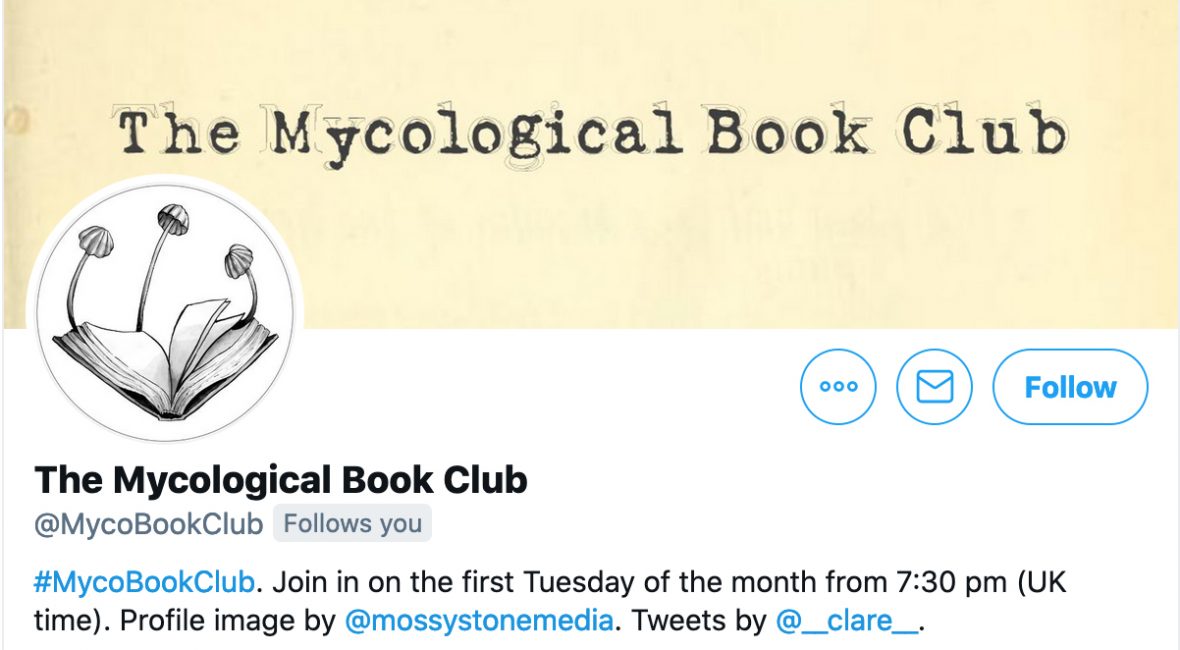
Screenshot of the Twitter profile of @MycoBookClub.

On 23 March 2020, the U.K. went into its first national lockdown in response to the COVID-19 pandemic. Social distancing and teleworking became the norm, and the walls of our homes became, in many ways, the boundaries of our individual worlds.

Amateur mycologist Clare Blencowe was eager to find a positive distraction from the realities of life during a pandemic. The Biodiversity Heritage Library’s open access collections, which for Blencowe had become a welcome refuge from the continuous onslaught of negative news articles, now became the inspiration for a new, socially distanced way to connect with other fungi lovers—in the form of “The Mycological Book Club”, an online, Twitter-based book club with a particular focus on open access literature.
#MycoBookClub logo fungi growing out of a book

#MycoBookClub logo, designed by illustrator Kelsey Sconberg of Mossy Stone Media.

“We were at the beginning of a national lockdown,” recalls Blencowe. “All social events were cancelled, and I found myself endlessly scrolling through increasingly doom-laden news, feeling increasingly doom-y. #MycoBookClub started as a simple distraction, an opportunity for a shared experience: people reading the same book and discussing it on Twitter at an allotted time.”

Screenshot of the Twitter profile of @MycoBookClub.

@MycoBookClub on Twitter.

Blencowe brought her idea to life by founding the @MycoBookClub Twitter account, establishing the #MycoBookClub hashtag to facilitate discussion, and setting a recurring date and time for book club meetings—the first Tuesday of the month at 7:30pm (GMT) on Twitter. She then scheduled the first #MycoBookClub meeting for 5 May 2020.

That first meeting, which brought together just a handful of followers, was dedicated to Mordecai Cubitt Cooke’s Rust, Smut, Mildew & Mould: An Introduction to the Study of Microscopic Fungi (Fifth ed. 1886), which club members accessed through BHL.

Welcome to #MycoBookClub, folks! It’s a pleasant evening here at @MycoBookClub headquarters in Sussex, England.

We’re talking about ‘MICROSCOPIC FUNGI: Rust, Smut, Mildew & Mould’ by M.C. Cooke (1886). You can find it at: https://t.co/7WO005ZS5Q pic.twitter.com/GxWzmYhnxg

— The Mycological Book Club (@MycoBookClub) May 5, 2020

With passages celebrating the beauty and wonder of the often unheeded nature in our own backyards and neighborhoods, the title was a fitting—and motivating—choice for an audience confined to their homes and local natural surroundings.

As Cooke writes,

“We might traverse the primeval forests of the new world, and explore the unknown regions of the old, and not encounter so much to excite our admiration, or cause our wonder, as lies about our feet at home; marvels which we tread beneath our feet, or kick from our path, because they appear to be only rotten sticks, withered grass, and decaying leaves.”

“Cooke’s writing provided inspiration for enjoying nature near home,” shares Blencowe. “I felt myself lifted by his soaring rhetoric.”

Photo of a human with long brown hair in a shirt with fungi images on it.

Amateur mycologist Clare Blencowe, founder of the #MycoBookClub. Photo courtesy of Clare Blencowe.

#MycoBookClub has allowed Blencowe to share and grow her interest in mycology—an interest that began in earnest about five years ago when a new job as manager of the Sussex Biodiversity Record Centre, and the much shorter commute that came with it, provided her with newfound time to pursue her interest in fungi. While she considers mycology a hobby, her involvement in the field has grown over the years through membership in the British Mycological Society, where she was recently elected to their Field Mycology and Conservation Committee.

BHL helped nurture this love of mycology well before the birth of #MycoBookClub. Blencowe’s first in-depth interaction with the Library occurred in April 2019, when her discovery of a small brown fungus cup in the woods led her to seek confirmation of its identity—which she believed to be the Anemone Cup Dumontinia tuberosa—by posting to the British Mycological Society Facebook group. UK-based mycologist Lukas Large responded to her post with the link to a color plate for comparison from Émile Boudier’s Icones Mycologicæ (1905-1910) in BHL.

Illustration of fungi.

Illustration of Dumontinia tuberosa, plate 477. Boudier, Émile. Icones Mycologicæ (1905-1910), v.3. Art by Boudier. Contributed in BHL from the University Library, University of Illinois Urbana Champaign.

“The information contained in this beautiful colour plate far surpassed anything I had access to in my field guides at home,” shares Blencowe. “It helped me to understand the structure and features of this fungus I had in front of me, and spurred me on to take a closer look at it under the microscope. That experience really opened my eyes to what a useful resource the books in BHL can be: to inform observation and help identify species in a present day context. Sure, species concepts and nomenclature may have moved on, but the detail with which mycologists such as Boudier recorded their observations is a lesson in itself.”

Since that eye-opening experience, Blencowe continues to turn to BHL as a resource to support her interests in mycology, reading titles online and downloading select pages and images as needed. Some of her favorite aspects of the Library include a good search functionality, user-friendly online reading and content downloading, high quality scans, clear copyright information, easily-shareable direct page links, and the image collections in Flickr. Since founding #MycoBookClub, she uses BHL almost every week.

We’ve talked already here at #MycoBookClub about M.C. Cooke, but tonight we’re also feasting our eyes on ‘Selecta Fungorum Carpologia’ by The Brothers Tulasne.

You can find their illustrations in the Biodiversity Heritage Library: https://t.co/DN4Hi816XE pic.twitter.com/buaU9fMTa4

— The Mycological Book Club (@MycoBookClub) June 2, 2020

“I love the little bookish details that are preserved in BHL: the gilt decoration on a publication’s cover, ornate book plates, library stamps, barely-decipherable pencil marks and blank pages uniquely speckled with foxing,” shares Blencowe. “The scanned pages hold so much more than simply the words and the illustrations. They do your soul good.”

A reminder that it’s #MycoBookClub night tonight, from 7:30pm UK time.

We’re trying out a theme this evening: illustration ?https://t.co/Bvx0nDHY08

— The Mycological Book Club (@MycoBookClub) November 3, 2020

In the months following the club’s first meeting in May 2020, #MycoBookClub continued to grow, amassing more followers and receiving attention in outlets like The British Mycological Society Newsletter and IMA Fungus. Blencowe established a “virtual bookshelf” to maintain a list of all the books that #MycoBookClub had discussed—many of which were accessed through BHL.

Screenshot of a virtual bookshelf with thumbnails of book covers.

#MycoBookClub “virtual bookshelf.” Source: https://mycobookclub.blogspot.com

“The more time I spend in the Library, the more amazed I am by the vast amount of literature it contains—and the neat way it is organised and presented,” lauds Blencowe. “BHL also provides the opportunity to take a deep dive into the source material for a fascinating glimpse into the machinery of global science in the 19th century.”

While she’s enjoyed many titles in BHL, a recent favorite is Anna Maria Hussey’s Illustrations of British Mycology (1847-55), which was the subject of the July 2020 #MycoBookClub meeting. Published under the name Mrs. T.J. Hussey, the two-volume work illustrates and describes species collected by Hussey and her sister, Frances Reed.

#MycoBookClub returns Tues 7 July, 7:30pm (UK time).

Thought we could take a broader look at the fungal kingdom this month with ‘Illustrations of British Mycology’ by Anna Maria Hussey (1847).

You can read it in the @BioDivLibrary, here: https://t.co/4BPXfDyWhd pic.twitter.com/icBcIRd1xM

— The Mycological Book Club (@MycoBookClub) June 7, 2020

“Hussey writes from the perspective of an enthusiastic amateur which I found both highly relatable and genuinely inspiring,” affirms Blencowe. “She writes in a chatty, conversational style which is peppered with fascinating contemporary details (such as her observation that Boletus subtomentosus has ‘the texture of a Limerick glove’) and timeless wisdom (‘life passes in gaining experience for ourselves…till at last we have acquired the wisdom to guide us safely…’).”

Illustration of fungi.

Illustration of Suillellus luridus, plate 35. Hussey, Anna Maria. Illustrations of British Mycology, ser.2 (1855). Art by Hussey. Contributed in BHL from The New York Botanical Garden, LuEsther T. Mertz Library. Explore all illustrations from Illustrations of British Mycology in the BHL Flickr.

Blencowe has gathered and shared via @MycoBookClub some of her favorite elements from Hussey’s work, including her approach to mycology, her discussion of fungus names, her commentary on fungi in nature, her descriptions of fungal habitats, and miscellaneous myco-chatter. Illustrations of British Mycologyis also noteworthy as a rare female-authored work in the bibliography of historic mycological literature.

“Browsing the historic biodiversity literature, it is very noticeable that certain perspectives predominate,” notes Blencowe. “The books are mostly written by men—white men. So it was a particular joy to come across Hussey’s book. I’m keen to explore ways that @MycoBookClub can provide a platform for different perspectives and respectfully champion Indigenous knowledge of fungi.”

While ours may still be a socially-distanced world, initiatives like #MycoBookClub remind us that there are still opportunities to connect with others, share our passions, and nurture a community. And while the news may still be filled with dire headlines, naturalists like Mordecai Cubitt Cooke and Anna Maria Hussey remind us that we can still find solace in nature close to home and in unexpected places, if we are just willing to look.

To quote Hussey: “The world is full of beauty that we pass by unheeded.”

Illustration of fungi.

Illustration of Crinipellis scabella, plate 68. Hussey, Anna Maria. Illustrations of British Mycology, ser.1 (1847). Art by Frances Reed. Contributed in BHL from The New York Botanical Garden, LuEsther T. Mertz Library. This plate accompanies Hussey’s quote: “The world is full of beauty that we pass by unheeded.”

Everyone is welcome to join the #MycoBookClub. Follow @MycoBookClub for updates and meeting information, and join the discussion the first Tuesday of each month at 7:30pm (GMT) using the #MycoBookClub hashtag on Twitter.

February 1, 2021by michelle.underhill
Blog Reel, Featured Books

Unearthing Scientific History through Art: New Insights from the Archives of Lewis David von Schweinitz, the “Father of North American Mycology”

illustration of fungi

The information in this post is derived from the article “New Light on the Mycological Work of Lewis David von Schweinitz” (2018) by Jason M. Karakehian, William R. Burk and Donald H. Pfister, published in IMA Fungus: 9(1).

fungi illustration

Plate 12. Conspectus fungorum in Lusatiae Superioris agro Niskiensi crescentium, e methodo Persooniana (1805). Figures based on drawings by Schweinitz. Icones fungorum Niskiensium served as a sketchbook to inform this work. Contributed to BHL by the LuEsther T. Mertz Library of The New York Botanical Garden.

In 1805, the “Father of North American mycology”, Lewis David von Schweinitz (1780-1834), published an account of the fungi in Niesky, Germany with his friend and mentor, Johannes Baptista von Albertini (1769-1831). Documenting over 1,000 species, including 100 published as new-to-science, Conspectus fungorum in Lusatiae Superioris agro Niskiensi crescentium, e methodo Persooniana is still referenced to this day as a classic mycological text and ecological record.

The Conspectus is illustrated with 12 hand-colored plates based on drawings by Schweinitz, each featuring 6-10 figures of new species described. Whenever possible, Schweinitz based his drawings on fresh specimens, but when this was not an option, he referred to fungarium specimens or to a collection of earlier watercolors he’d created of representative specimens.

fungi illustrations

Plate 178. Fungorum Nieskiensium Icones. (ca.) 1802-1805. v. 3. Contributed in BHL from the Academy of Natural Sciences of Drexel University, Library & Archives.

Today, these watercolor volumes are dispersed between several American institutions and offer a wealth of insight into the history and development of the Conspectus. A five-volume set created (ca.) 1802-1805 and bearing the title Fungorum Nieskiensium Icones is distributed between the Archives of the Academy of Natural Sciences of Drexel University, Philadelphia (volumes 1-3 and 5) and the Rare Book Collection, Wilson Library, University of North Carolina, Chapel Hill (volume 4). Nearly every specimen featured in the Conspectus has a corresponding illustration in these 5-volumes.

A volume of original watercolors consisting of copies of figures from the 5-volume set, bearing the title Icones Fungorum and created (ca.) 1818-1826, is held by the Herbarium Library, University of Michigan, Ann Arbor, MI.

The earliest volume of original watercolors related to the Conspectus, however, is the Icones Fungorum Niskiensium, created (ca.) 1798-1802 and held in the archives of the Farlow Reference Library of Cryptogamic Botany at Harvard University. This volume (hereafter referred to as the Harvard Icones) served Schweinitz as a sketchbook of sorts, which he used to inform the final paintings in the 5-volume Fungorum Nieskiensium Icones and eventually the Conspectus itself.

fungi illustrations

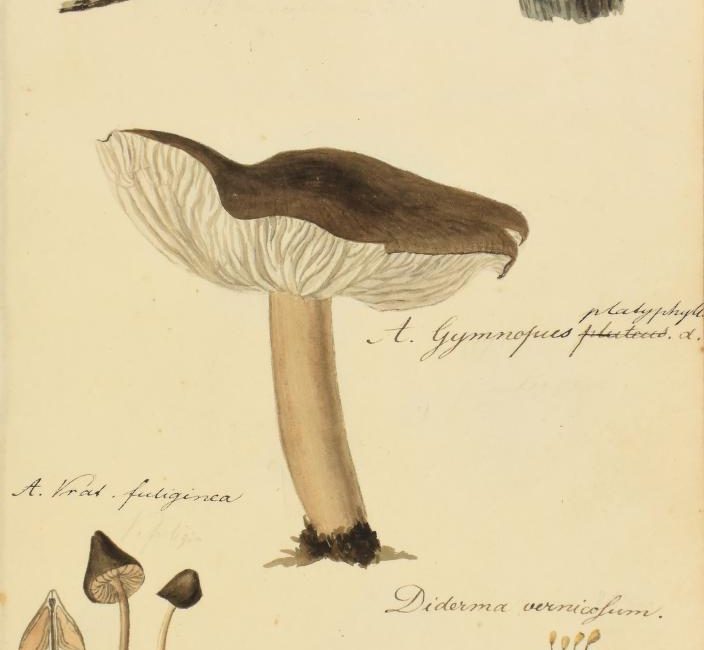
Agaricus (Gymnopus) platyphyllus. Illustration from Fungorum Nieskiensium Icones v. 2, pl. 113, fig. 77 (left) and corresponding illustration in Icones Fungorum Niskiensium, pl. 23 (right). Contributed in BHL from the Library & Archives of the Academy of Natural Sciences of Drexel University and Botany Libraries, Farlow Reference Library of Cryptogamic Botany, Harvard University.

The Harvard Icones has been digitized in the Biodiversity Heritage Library thanks to the Botany Libraries, Farlow Reference Library of Cryptogamic Botany, Harvard University, while the 5-volume set is available in BHL thanks to the Library & Archives of the Academy of Natural Sciences of Drexel University and the Wilson Library of the University of North Carolina at Chapel Hill. The Conspectus has been digitized in BHL by the LuEsther T. Mertz Library of The New York Botanical Garden.

The history of these watercolor volumes and their relationship to the Conspectus was recently examined in-depth within the article “New Light on the Mycological Work of Lewis David von Schweinitz” (2018) by Jason M. Karakehian, William R. Burk and Donald H. Pfister, published in IMA Fungus: 9(1). The article presents research made possible in-part thanks to the digital copies available in BHL.

As a sketchbook, the Harvard Icones provides a unique window into the development of Schweinitz’s research on the fungal species presented in the Conspectus. The 249 watercolor figures in the the Harvard Icones depict specimens he collected and painted during his time attending a Moravian seminary in Niesky. Most figures are labeled with a binomial in ink, although edits and annotations to the names throughout the work, as well as notes on the quality of the illustrated specimen, varieties, and colorations, illustrate the working-manuscript nature of the volume.

fungi illustration

Plate 17. Merisma foetidum specimen labeled as “spec. parv.” [meager specimen]. Schweinitz, Lewis David von. Icones fungorum Niskiensium. (ca.) 1798-1802. Contributed in BHL from Botany Libraries, Farlow Reference Library of Cryptogamic Botany, Harvard University.

As outlined in the IMA Fungus article, the Harvard Icones has a rather convoluted history. A clue to that history can be found in the single fly-leaf bound within the volume and featuring the hand-written inscription on the recto: “Catherine Eliza Perceval — Philadelphia — March 8th 1826 —”.

fly-leaf

Fly-leaf featuring inscription for “Catherine Eliza Perceval”. Schweinitz, Lewis David von. Icones fungorum Niskiensium. (ca.) 1798-1802. Contributed in BHL from Botany Libraries, Farlow Reference Library of Cryptogamic Botany, Harvard University.

Born in Quebec in 1811, Catherine Perceval was the daughter of Anne Mary Perceval and Michael Henry Perceval. Anne had an interest in botany fueled by her association with other local female botanists, Christian Ramsay, the Countess of Dalhousie, and Harriet Campbell Sheppard. The group actively botanized together, and Anne is listed as a collector in several important botanical works of the era, including Hooker’s Flora boreali-americana ([1829]-1840) and Torrey and Gray’s A Flora of North America (1838-43).

The Harvard Icones passed into the Perceval family’s possession during a meeting in 1826 between Anne and William Darlington, a correspondent of Anne’s, at their mutual friend J. Daniel Steinhauer’s residence in Philadelphia. Schweinitz described Steinhauer as an “excellent friend…[and]…botanist”. As detailed in the IMA Fungus article, Schweinitz and Daniel Steinhauer were likely introduced by Daniel’s brother, Henry Steinhauer, who was also a friend of Schweinitz’s from his time at the Moravian seminary in Germany.

Henry had attempted to have copies made of the figures in Schweinitz’s 5-volume watercolor set, and towards this end, Schweinitz had given Henry his “Icones Fungorum Niesk’m” shortly prior to January 1818. The watercolor volume held in the Michigan Herbarium Library is the result of these endeavors. Karakehian et al. postulate that as part of this exchange the Harvard Icones may have ended up in Henry’s possession and passed to Daniel Steinhauer upon Henry’s death, after which it was passed along to Anne or directly to her daughter, Catherine (whose name is found in the Icones inscription).

fungi illustration

Plate 49. Merulius crispus labeled as “inexplicat[us]”, reflecting doubt as to whether the specimen was a fungus. Similarly, label of “Substantia aquatica” [watery substance]. Schweinitz, Lewis David von. Icones fungorum Niskiensium. (ca.) 1798-1802. Contributed in BHL from Botany Libraries, Farlow Reference Library of Cryptogamic Botany, Harvard University.

The volume later passed from Catherine to her son Francis Denys and eventually ended up in the possession of antiquarian book dealers and scholars William and Marianne Salloch, after whose death it was sold to a Bungay book dealer at a Christie’s auction in 1991, advertised as “Original American Watercolors” by Catherine Eliza Perceval.

Microbiologist and mycophile Elio Schaechter eventually purchased the volume from the book dealer and showed it to Donald Pfister at the Farlow Herbarium, whose research ultimately allowed him to attribute the work to Schweinitz. He also generated a manuscript index to the illustrations, which has also been digitized in BHL along with the Harvard Icones itself.

In the early 2000s, David Hewitt of the Farlow Herbarium was the first to propose that the Harvard Icones served Schweinitz as a sketchbook after comparing it to the four volumes of watercolors held at the Academy of Natural Sciences. Karakehian et al. support this conclusion, presenting further evidence within their IMA Fungus article including the incomplete quality of the sketches, the lack of any systematic arrangement of the specimens on the plates, and the annotations reflecting edits or uncertainty about species identifications, none of which are present in the five-volume set or the Conspectus.

fungi illustrations

Plate 20. “Clavaria monstrosa” label indicating an anomalous specimen. Question marks indicating uncertainty over “Mycena leptocephalus” identification. Schweinitz, Lewis David von. Icones fungorum Niskiensium. (ca.) 1798-1802. Contributed in BHL from Botany Libraries, Farlow Reference Library of Cryptogamic Botany, Harvard University.

The research presented by Karakehian et al. provides novel insight into the development of a foundational mycological work. As Karakehian explains,

“These watercolor volumes are part of the knowledge-base that Schweinitz employed in his studies of American fungi. Therefore, understanding the history of these volumes is essential not only to a clearer understanding of the American mycobiota, but to an elucidation of the depth of the scientific knowledge-base at the founding of mycology in North America.”

fungi illustration

Plate 6. Trichia rubiformis labeled as “statu jun.” [immature state]. Schweinitz, Lewis David von. Icones fungorum Niskiensium. (ca.) 1798-1802. Contributed in BHL from Botany Libraries, Farlow Reference Library of Cryptogamic Botany, Harvard University.

The Harvard Icones and its related works also provide a prime example of how unprecedented research is made possible thanks to digitization initiatives like the Biodiversity Heritage Library, which allow easy reference to and comparison between volumes held in multiple institutions across the United States. As Karakehian et al. acknowledge within their paper,

“It is important to note that much of this work that resulted in this paper was made possible because archives, manuscripts and books are becoming increasingly available through digital efforts being made around the world.”

Given the unique and rare nature of the  Harvard Icones, the book was scanned at Harvard using an Internet Archive TableTop Scanner that is shared with between the Harvard Botany Libraries and the Ernst Mayr Library of the Museum of Comparative Zoology.  This mini version of an Internet Archive scribe allows Harvard librarians to scan rare or fragile materials without the wear and tear of off-site transportation. Once scanned, the Internet Archive processed the images and the final product was made accessible in the Internet Archive and BHL.  We are so grateful to the Botany Libraries, Farlow Reference Library of Cryptogamic Botany, Harvard University for all of their work to digitize the Harvard Icones in BHL and make it freely available to the world.

Similarly, we extend our sincere thanks to the LuEsther T. Mertz Library of The New York Botanical Garden, the Library & Archives of the Academy of Natural Sciences of Drexel University and the Wilson Library of the University of North Carolina at Chapel Hill, for digitizing Schweinitz’s Conspectus and other, complementary archival works, ensuring that they are also now freely available through BHL.

Take a closer look at how BHL facilitated research on these remarkable archives with our BHL User series, where Karakehian provides more insight into BHL’s impact on his work to unravel the mysteries surrounding Schweinitz’s Icones.

Post with contributions from Jason M. Karakehian (Master’s degree candidate at the Harvard Extension School), Judith A. Warnement (Librarian of Harvard University Botany Libraries), and Diane Rielinger (Digital Projects Librarian, Harvard University Herbaria & Libraries).

November 1, 2018by michelle.underhill
Blog Reel

North American Mycological Association Shares Work on Fungi

mycophile 1 57.6.20017.jpg

Mycroporus affinis, photo by Robert Gergulics. The Mycophile, v. 57, no. 6. 2017. Contributed to BHL by the North American Mycological Association.

“Birds, flowers, insects, stones delight the observant. Why not toadstools? A tramp after them is absorbing, study of them interesting, and eating of them health-giving and supremely satisfying.” – Charles McIlvaine (1840-1909), mycologist

The North American Mycological Association (NAMA) could be described as a mutualism between citizen scientists and academics who share dedication to the study of fungi. Founded in 1967, the organization of volunteers collaborates with professional mycologists from academic centers. With over 80 affiliated clubs and 1,700 members in the United States, Canada and Mexico, NAMA’s initiatives cover a lot of ground.

“We explore all aspects of fungi, including edibility, toxins, dying fabric, cultivation, using mushrooms to support the environment, potential medicinal applications, and photography,” says NAMA President David Rust. “This working relationship between amateur volunteers and professionals helped self-taught mycologists like Gary Lincoff [author of ‘National Audubon Society Field Guide to North American Mushrooms’] to learn and document developments in the field before such information sharing became routine on the Internet.”

mycophile 2 49.2pg - Copy.jpg

Wool dyed with Cortinarius semisanguineus, photo by Noah M. Siegel. The Mycophile, v. 49, no. 2. 2008. Contributed to BHL by the North American Mycological Association.

In that spirit of collaboration and open access, NAMA licensed its journal McIlvainea (named for mycologist Charles McIlvaine of the epigraph) and newsletter The Mycophile to BHL as a part of the Expanding Access to Biodiversity Literature project, funded by the Institute of Museum and Library Services. NAMA made digital copies of its publications available to project staff members and volunteers at The New York Botanical Garden for uploading into BHL. (The Mycophile is currently available on BHL, with McIlvaninea upcoming.)

“The Mycophile is our bi-monthly report on developments in the field of mycology, in particular amateur mycology; book reviews; club activities; and the accomplishments of our affiliated clubs,” Rust explains. “The newsletter reports on our annual foray, a gathering of approximately 350 mushroom enthusiasts where we collect, document, and voucher specimens of all types of fungi found at that location. These fungi end up in The Field Museum of Chicago and are entered into a database which is now available to the public on their website. NAMA has over 20 years of mushrooms and data available to researchers at The Field. In McIlvainea, we publish an annual report on mushroom poisonings around North America, gleaned from poison control centers and incidents reported by our network of 150 emergency mushroom identifiers. We also publish articles by renowned mycologists on current taxonomic developments and new research.”

“Our newest initiative, the North American Mycoflora Project, will provide a look at all fungi on the continent which have not been properly classified or named,” continues Rust. “It would provide online keys and downloadable applications, up to date distribution maps, links to macroscopic and microscopic images, and links to nucleotide sequences and phylogenetic trees.”

mycophile 3 46.3.jpg

Unfortunately, not all fungi are “health-giving”… image caption reads: “This month’s featured fungus is Amanita muscaria var. Formosa. See inside this issue for NAMA’s Summary of Mushroom Poisonings in 2004 along with lovely photos of ‘the usual suspects’.” The Mycophile, v. 46, no. 3. 2005. Contributed to BHL by the North American Mycological Association.

As well as sharing more recent initiatives, these publications have value as records of past mycological study. In ‘Mycology Meets History: The NAMA Archive’, a 2008 Mycophile article, David W. Rose elaborates on the value of the organization’s record keeping:

“In the case of the NAMA records, there is, for example, a file of documents on every annual foray complete with programs, board agendas and meeting minutes, mushroom collection lists, participants lists, and photographs; and this detailed abundance is a testament to an organization that takes science, history and its educational mission very seriously.”

mycophile 4 47.5.jpg

Small white fungus Christiansenia mycetophila parasitizes Collybia dryophila. The Mycophile, v. 47, no. 4. 2006. Contributed to BHL by the North American Mycological Association.

This article also closes with a punchline on the dangers of mycological work that is just too good not to share.

“The moral about ‘history lost’ bears repeating, in an anecdote that should have special resonance for mycologists. One huge collection that I processed in my archival work at the New York Botanical Garden was the William Jacob Robbins Papers. Robbins was a plant physiologist and Director of the Garden from 1938-1958, and though he is scarcely remembered for his mycology, he conducted a lengthy series of chemical assays of many species of fungi in the 1950s in the attempt to determine potential sources of antibiotics. […] his laboratory notebooks were extensive, and I organized and catalogued them all. All his note-books were clear labeled by genus or by species […] Most were in good condition, some were in bad shape. The final lab notebook in the series was labeled ‘Various Molds,’ and it had been damaged, unfortunately: completely covered by – you guessed it – various molds.”

mycophile 5 57.6.2017.jpg

Schizophyllum commune, photo by Mark Bower. The Mycophile, v. 57, no. 6. 2017. Contributed to BHL by the North American Mycological Association.

Many thanks to NAMA for sharing its publications with BHL, and to David Rust for contributing to this post!

Reference

North American Mycological Association

June 20, 2018by Joel Richard

Help Support BHL

BHL's existence depends on the financial support of its patrons. Help us keep this free resource alive!

search

About BHL

The Biodiversity Heritage Library (BHL) is the world’s largest open access digital library for biodiversity literature and archives. BHL operates as a worldwide consortium of natural history, botanical, research, and national libraries working together to digitize the natural history literature held in their collections and make it freely available for open access as part of a global “biodiversity community.”

Follow BHL

  • Bluesky logo
  • Instagram logo
  • Facebook logo
  • Flickr logo
  • Twitter logo

Join Our Mailing List

Sign up to receive the latest news, content highlights, and promotions.

Subscribe Now

Subscribe to Blog via Email

Enter your email address to subscribe to this blog and receive notifications of new posts by email.

Join 319 other subscribers

Subscribe to Blog Via RSS

Subscribe to the blog RSS feed to stay up-to-date on all the latest BHL posts.

Access RSS Feed


64+ Million Pages of
Biodiversity Literature Online.

EXPLORE

Tools and Services
to Transform Research.

EXPLORE

300,000+
Illustrations on Flickr.

EXPLORE

ABOUT | HARMFUL CONTENT | PRIVACY | SITE MAP | TERMS OF USE