Biodiversity Heritage Library - Program news and collection highlights from BHL
  • Home
  • News
  • Featured Books
    • All Featured Books
    • Book of the Month Series
    • BHL at 20
  • User Stories
  • Campaigns
    • Fossil Stories
    • Garden Stories
    • Monsters Are Real
    • Page Frights
    • Her Natural History
    • Earth Optimism 2020
  • Tech Blog
  • Visit BHL
Home
News
Featured Books
    All Featured Books
    Book of the Month Series
    BHL at 20
User Stories
Campaigns
    Fossil Stories
    Garden Stories
    Monsters Are Real
    Page Frights
    Her Natural History
    Earth Optimism 2020
Tech Blog
Visit BHL
  • Home
  • News
  • Featured Books
    • All Featured Books
    • Book of the Month Series
    • BHL at 20
  • User Stories
  • Campaigns
    • Fossil Stories
    • Garden Stories
    • Monsters Are Real
    • Page Frights
    • Her Natural History
    • Earth Optimism 2020
  • Tech Blog
  • Visit BHL
Biodiversity Heritage Library - Program news and collection highlights from BHL
Blog Reel, Campaigns, Featured Books, Page Frights

Bishops in the Sea for Halloween!

View Full Size Image
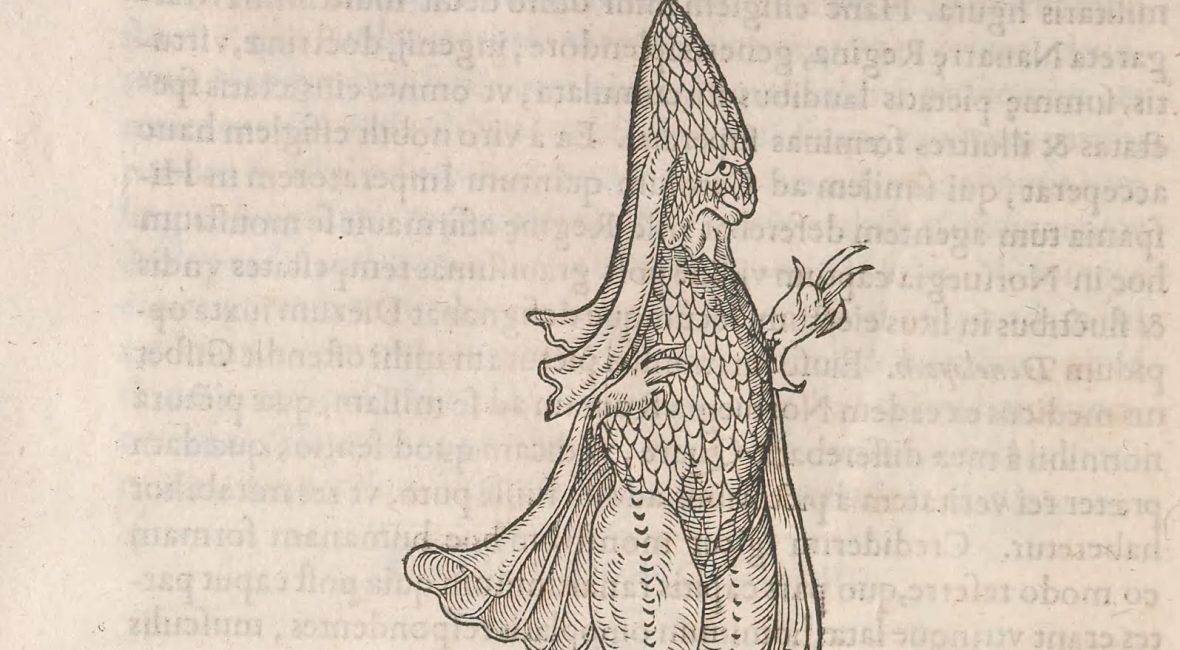
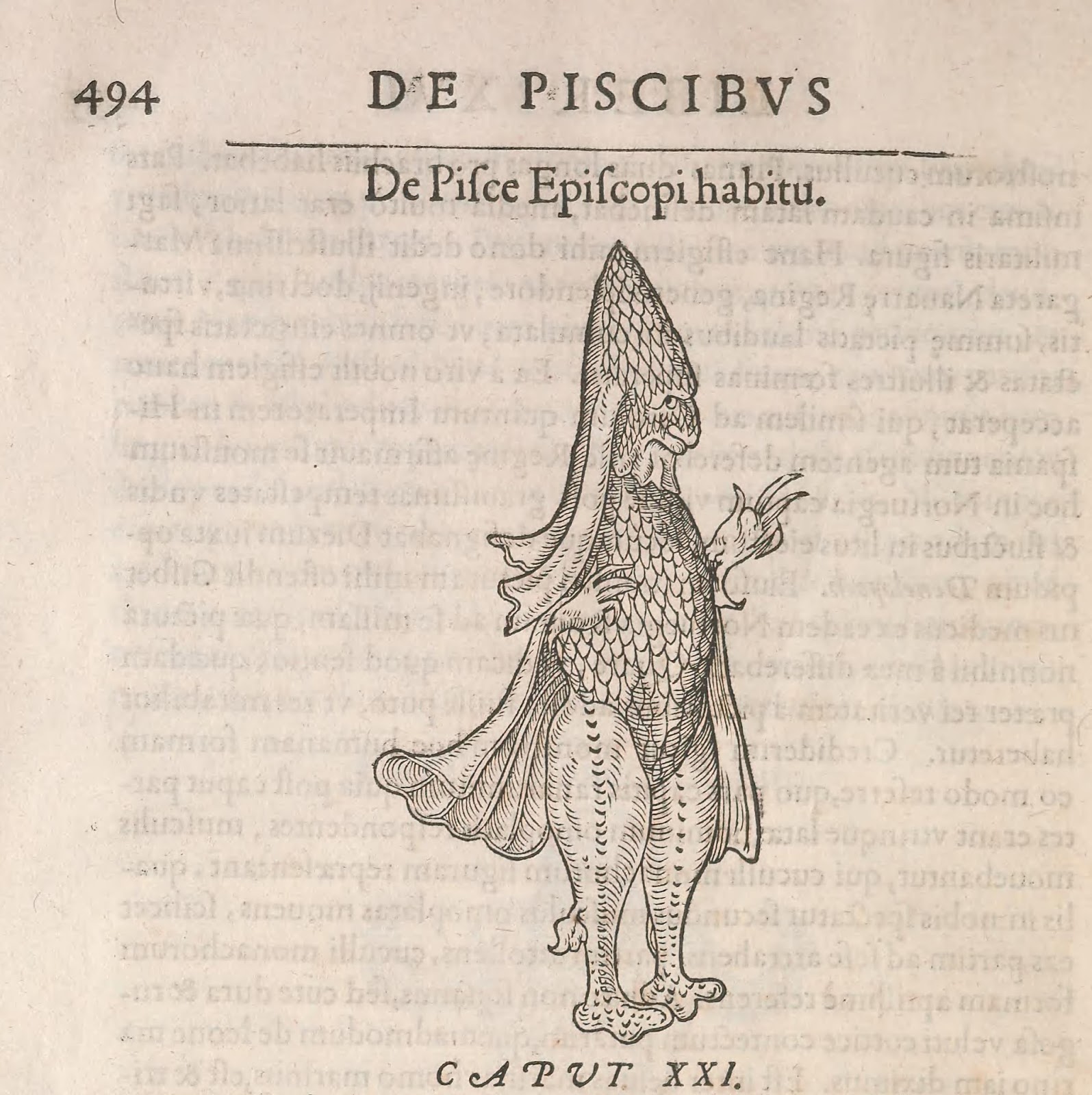
The ‘bishop fish’. Rondelet, Guillaume. Libri de Piscibus Marinis. 1554. http://biodiversitylibrary.org/page/42089973. Digitized by Smithsonian Libraries.

Apparently, clergymen in the 16th century had a lot of extra time on their hands to masquerade as sea monsters and make their marks on the annals of natural history as sea monks and bishop fish.

All this month, we’ve been exploring curious creatures in natural history as part of Page Frights. Today being Halloween, we thought we’d continue the fun by highlighting another “clergyman monster in disguise,” the bishop fish!

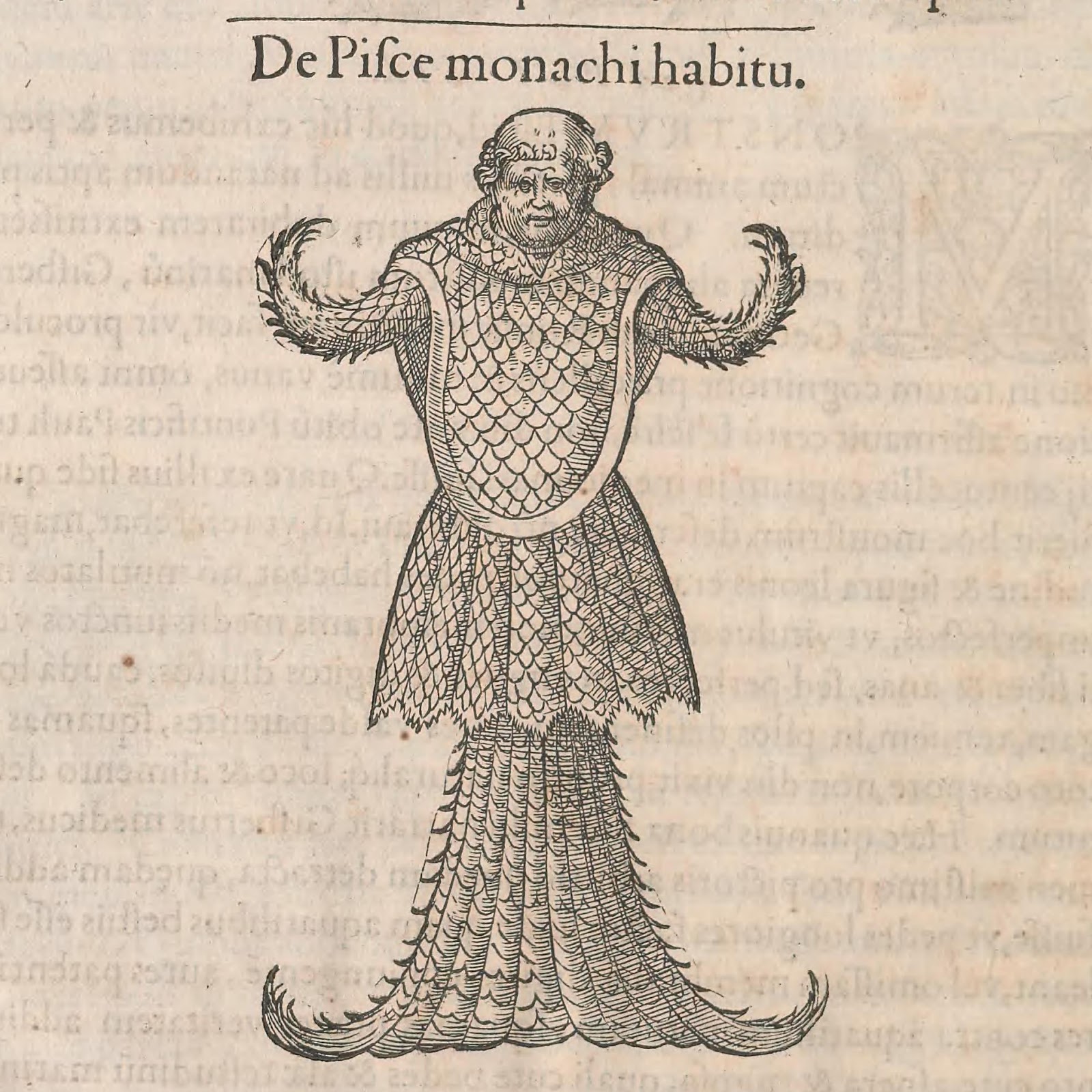
Earlier this month, we highlighted the ‘sea monk,’ or Piscis monachi habitu (“Fish with the habit of a monk”), a specimen of which was reportedly caught in the seas between Sweden and Denmark in the 1540s. The creature was said to resemble a monk, with “a human head and face, resembling in appearance the men with shorn heads.” The sea monk made its way into many natural history books of the era, including Belon’s De Aquatilibus (1553), Rondelet’s Libri de Piscibus Marinis (1554), and Gessner’s Historia Animalium (1558).
View Full Size Image
Piscis monachi habitu, “fish with the habit of a monk”. Rondelet, Guillaume. Libri de Piscibus Marinis. 1554. http://biodiversitylibrary.org/page/42089971. Digitized by Smithsonian Libraries.

Rondelet and Gessner also depict another similar monster: the ‘bishop fish’ or “monstre marin en habit d’évêque.” The monster was said to have two projections resembling claws in place of pectoral fins, tail fins resembling legs, and a projection resembling a bishop’s miter on its head. In his Libri de Piscibus Marinis, Rondelet writes that,

“I have seen a portrait of another sea-monster at Rome, whither it had been sent with letters that affirmed for certain that in 1531 one had seen this monster in a bishop’s garb, as here portrayed, in Poland. Carried to the king of that country, it made certain signs that it had a great desire to return to the sea. Being taken thither it threw itself instantly into the water” (translation David Starr Jordan)

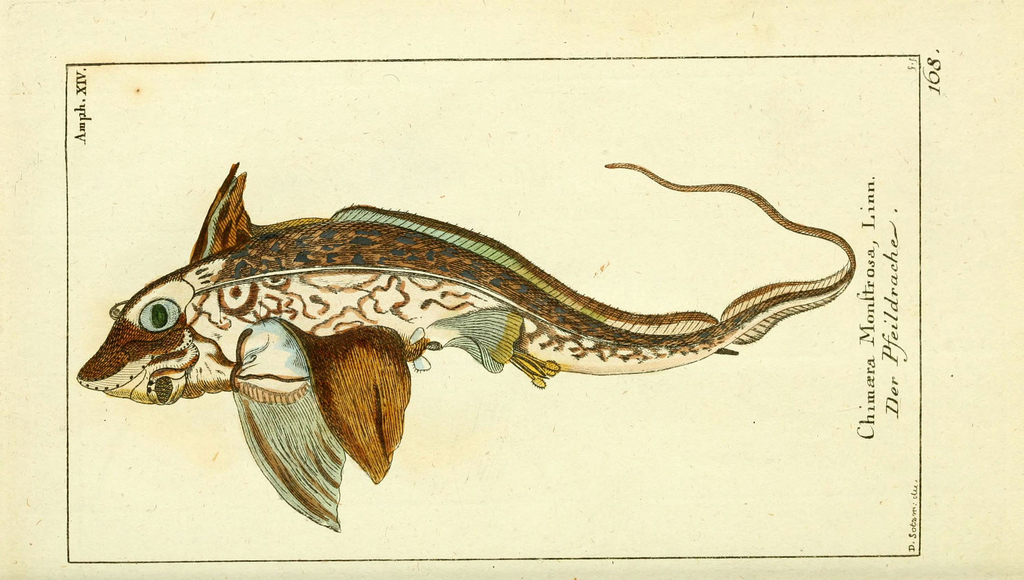
Some researchers have postulated, as with the monk fish, that legends of the bishop fish may have been inspired by giant squids. In v. 5 of his General Zoology, George Shaw suggested that the northern chimaera (Chimaera monstrosa) may have been responsible for the myth. He writes,

“I have sometimes found it not improbable that the Bishop-Fish, described and figured in the works of Rondeletius, may have taken its rise from distorted preparations of the upper part of this animal, with the addition of some other articles to form the lower part.”
View Full Size Image
Could Chimaera monstrosa have been the inspiration for the bishop fish? Borowski, Georg Heinrich. Gemeinnüzzige Naturgeschichte des Thierreichs. Bd. 4, plates (1783). http://biodiversitylibrary.org/page/28346493. Digitized by Smithsonian Libraries.

Rondelet’s Libri de Piscibus Marinis (literally “Book of Marine Fish”) described nearly 250 marine animals, including fish, whales, marine invertebrates, and seals (all of which were referred to as fish), and was the standard ichthyological reference work for over a century. Given the importance of this title, it is not surprising that the legend of the bishop fish was perpetuated throughout many future natural history publications.
View Full Size Image
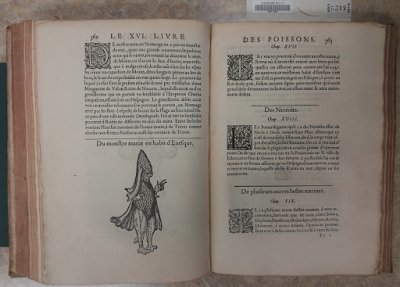
Bishop fish in the Canadian Museum of Nature’s copy of the French edition (1558, Histoire Entière des Poissons) of Rondelet’s Libri de Piscibus Marinis. This copy will be digitized for BHL.

BHL’s first Canadian partner, the Canadian Museum of Nature, holds the French edition (1558) of Rondelet’s Libri de Piscibus Marinis, which will be digitized for inclusion in BHL. Roberto Lima, Acquisitions and Cataloguing Officer in the museum’s library, provides some insight on the publication and the museum’s copy.

“The exact provenance of our copy of Rondelet’s Histoire entière des poissons is as intriguing as the depicted bishop fish itself, which makes it even more relevant for Halloween! We believe we acquired it through inheritance from the Geological Survey of Canada, the country’s oldest scientific agency. The copy still shows the now dissolved National Museums of Canada Library stamp, which reflects both the item’s as well as the Canadian Museum of Nature’s history within the Government of Canada. Mysterious as it may be as far as its actual origin goes, the presence of this item in the GSC collections is no surprise if one considers the importance of this publication. This is also why this book is on our priority list for digitisation in the context of the Biodiversity Heritage Library. It is appealing to think that this 1558 French translation will rejoin its 1554-5 Latin counterpart in the BHL’s digital space, similar to what happened during the XVI century when both works saw the light of the day in the print world.”

We too look forward to comparing the different versions of these works, and the curious creatures they depict, in BHL’s digital space. You can subscribe to BHL’s RSS feed of recent additions to be notified when this and other interesting titles are added to BHL.

So, as you don your Halloween costumes today, give a thought to the mysterious clerical sea monsters of bygone centuries. Perhaps the clergymen of the era had an affinity for costumes as well…. 😉

Happy Halloween!
October 31, 2016by michelle.underhill
Blog Reel, Featured Books

Ancient Myths Inspired by Fossils

The study of mythology associated with fossils is a relatively new field, which Adrienne Mayor (2005) terms “the folklore of paleontology”; she continues by saying that “[c]ombining oral traditions and paleontology, and drawing on history, archaeology, anthropology, and mythology, the investigation of fossil legends offers a new way of thinking about pre-Darwinian encounters with prehistoric remains” (Preface, p. xxiv). Drawing from several resources, one can create a dynamic picture of what a large variety of cultures around the world and throughout time have thought were the myths associated with dinosaur, bird, and other prehistoric fossils.

Due to extensive travel, Greeks and Romans discovered fossils throughout the Mediterranean and into India (Mayor, 2000b, p. 8). The fossils of dinosaurs, mastodons, mammoths and other creatures were pervasive parts of the natural landscape in the Greek and Roman periods, helping to account for why Greeks and Romans developed mythologies about giant creatures as they sought to understand the presence of these remains (Mayor, 2000b, p. 8). Some highlights from Greek and Roman mythology include the following accounts.

View Full Size Image
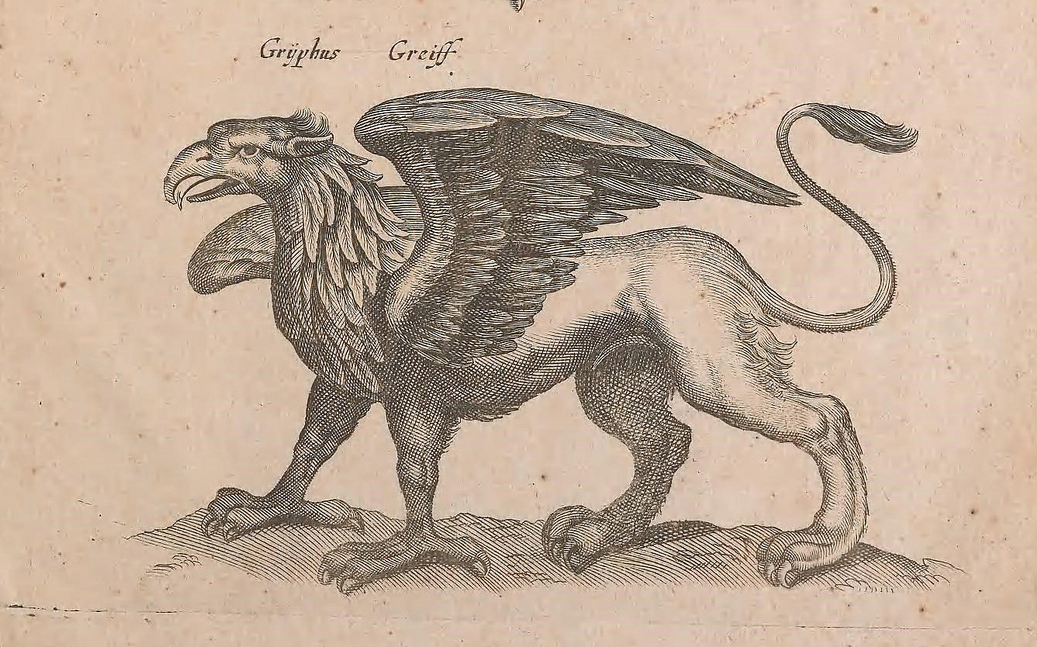
Griffin, likely inspired by encounters with fossils. Jonstonus, Joannes. Historiae naturalis de quadrupedibus libri. pt. 6 (1657). http://biodiversitylibrary.org/page/40913115. Digitized by Smithsonian Libraries.

In 675 B.C. when the Greek traveler, Aristeas, visited Scythian nomads in the Gobi deserts, the nomads told him about an area beyond Issedonia where griffins defended gold from the nomads (Mayor, 2000b, pp. 22-3). Aristeas wrote that the nomads would battle the griffins and that Issedonian accounts portrayed these creatures as lion-sized, with curved beaks like eagles (Mayor, 2000b, p. 23). Near Eastern cultures have been depicting such creatures since 3000 B.C. (Mayor, 2000b, p. 23). In the thirteenth century, the Chinese in Turfan and Lop Nur feared the surrounding deserts—which used to be Issedonian lands that were thought to be haunted by demons and dragons. In particular, the people feared the large bones in these deserts, calling them “dragon bones” (Mayor, 2000b, p. 38). In 1922, American adventurer Roy Chapman Andrews followed caravan trails through China to the Gobi desert and found the fossilized remains of Protoceratops (the size of a lion) and Psittacosaurus (which has a prominent beak); these fossil bones combine to form the image of the griffin, as described by the Scythian nomads and later the Greeks, Romans and other cultures (Mayor, 2000b, pp. 39-40).

View Full Size Image
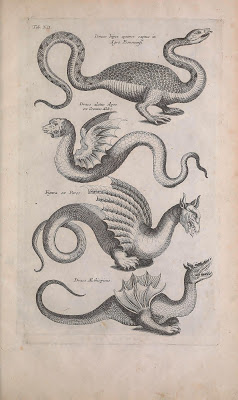
Various dragon forms. Dragon myths may have been inspired in part by encounters with fossils. Jonstonus, Joannes. Historiae naturalis de quadrupedibus libri. pts. 2-5 (1657). http://biodiversitylibrary.org/page/40918325. Digitized by Smithsonian Libraries.

In North Africa during the third to second century B.C., Carthaginians were digging trenches when they came upon two fossilized skeletons, each about 34 feet long (Mayor, 2000b, p. 153). The skeletons were assumed to be those of mythic giants, and Phlegon of Tralles, who served Hadrian (reigned between A.D. 117-38) at the time, claimed that the skeletons were proof that all life forms were becoming smaller (Mayor, 2000b, p. 149). This area, Ancient Carthage on the Gulf of Tunis, is rich with mastodon fossils, deinotheres, and mammoths (Mayor, 2000b, pp. 153-4), which paleontologists believe to be the source of the giant myths. Mayor provides evidence of the similarity between prehistoric fossils and Greek and Roman mythical creatures by citing contemporary Greek and Roman oral (transcribed) and written histories, as well as artwork produced during these periods.

View Full Size Image
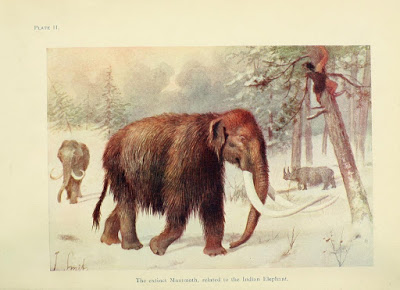
Mammoths may have inspired many Native American myths. Westell, William Percival. The book of the animal kingdom. (1910). http://biodiversitylibrary.org/page/10102652.

Not to be ignored are Native American fossil mythologies from the Americas, also treated by Mayor (2005) in another work. She addresses tribes from North and South America and those mythologies believed to be based on prehistorical fossils by analyzing oral, Native American fossil lore preserved by various people during the colonial period, the sixteenth to eighteenth century, and the nineteenth and twentieth centuries (Preface, pp. xxxvi-xxxviii). Additionally, she interviewed scholars and Native Americans willing to discuss important myths concerning large creatures and monsters that she—and they—associate with fossilized creatures. Included in her findings are myths about monster bison, giants that were neither man nor animal (but were probably based on mastodon bones), a giant monster that promised its own extinction (thought to be a mammoth), giants in Tlaxcala, Mexico believed to have killed all the ancestors of the Tlaxcalteca people (presumed to be inspired by Colombian mammoth fossils), bird monsters (that were probably fossilized prehistoric birds of prey), giant lizards (assumed to be Triceratops) and sea creatures that battled flying creatures (assumed to be the marine fossils of mosasaurs and the fossils of the flying Pteradons, respectively). Each of these mythological creatures, and many more, addressed by Mayor, come from different Native American cultures throughout the Americas, though there are some overlaps occasionally in mythological themes, and the connection between myth and creature is largely supported by the actual presence of fossils in the region of the myth that reflect the appearance of the mythological creature being addressed.

Want to learn more about the connection between ancient myths and fossils? Then check out these resources (also cited above):

  • Greer, A., Dermitzakis, M. and Vos, J. (2008). Fossil folklore from India: The Siwalik Hills and the Mahâbhârata. Folklore, 119(1), 71-92.
  • Lyons, S. L. (2009). Species, serpents, spirits, and skulls: Science at the margins in the Victorian age. Albany, N.Y.: State University of New York.
  • Mayor, A. (2000a). A time of giants and monsters. Archaeology, 53(2), 58-61.
  • Mayor, A. (2005). Fossil legends of the first Americans. Princeton, N.J.: Princeton University Press.
  • Mayor, A. (2000b). The first fossil hunters: Dinosaurs, mammoths, and myth in Greek and Roman times. Princeton, N.J.: Princeton University Press.

Tune in all week for more great fossil fun with our Fossil Stories event, including:

  • Tweets and Facebook Posts
  • Blog Posts highlighting milestones and key publications in the history of fossil research
  • A Flickr Collection with hundreds of historic fossil illustrations
  • A Pinterest Collection featuring a selection of our favorite fossil illustrations
  • A BHL Collection containing seminal publications in the history of paleontology
  • A series of live webcasts at BHL partner institutions
  • A citizen science challenge in collaboration with The Field Book Project, the Smithsonian Transcription Center, and Smithsonian Institution Archives
Follow #FossilStories on Twitter and Facebook to learn more.
October 13, 2015by micahv
Blog Reel, Campaigns, Featured Books, Monsters Are Real

The Quest for the Sea Serpent: An Oarfish or Something More?

View Full Size Image
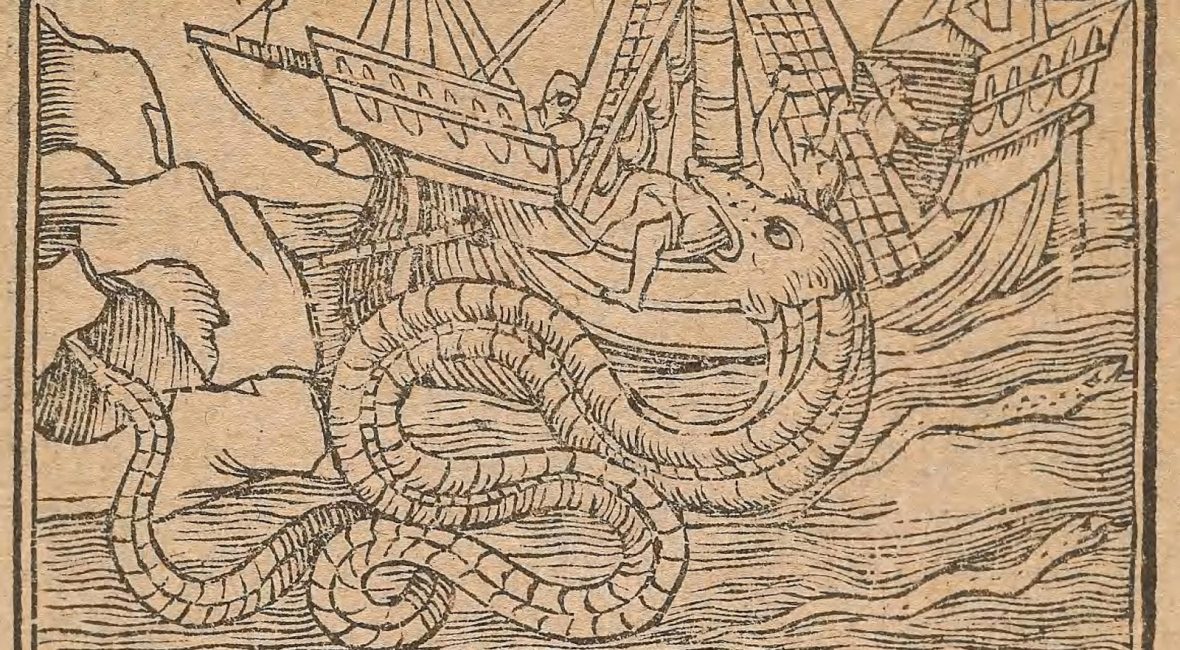
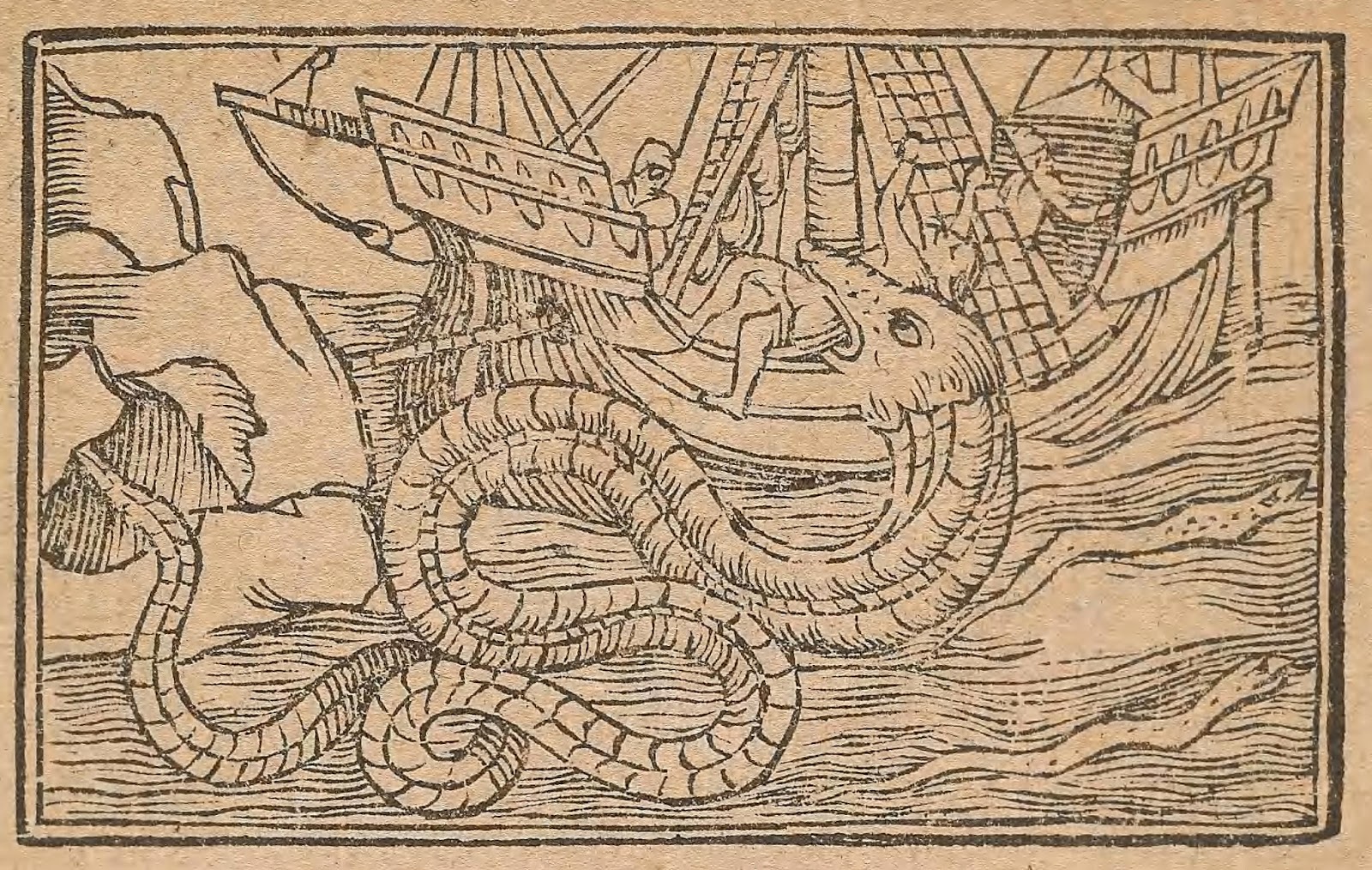
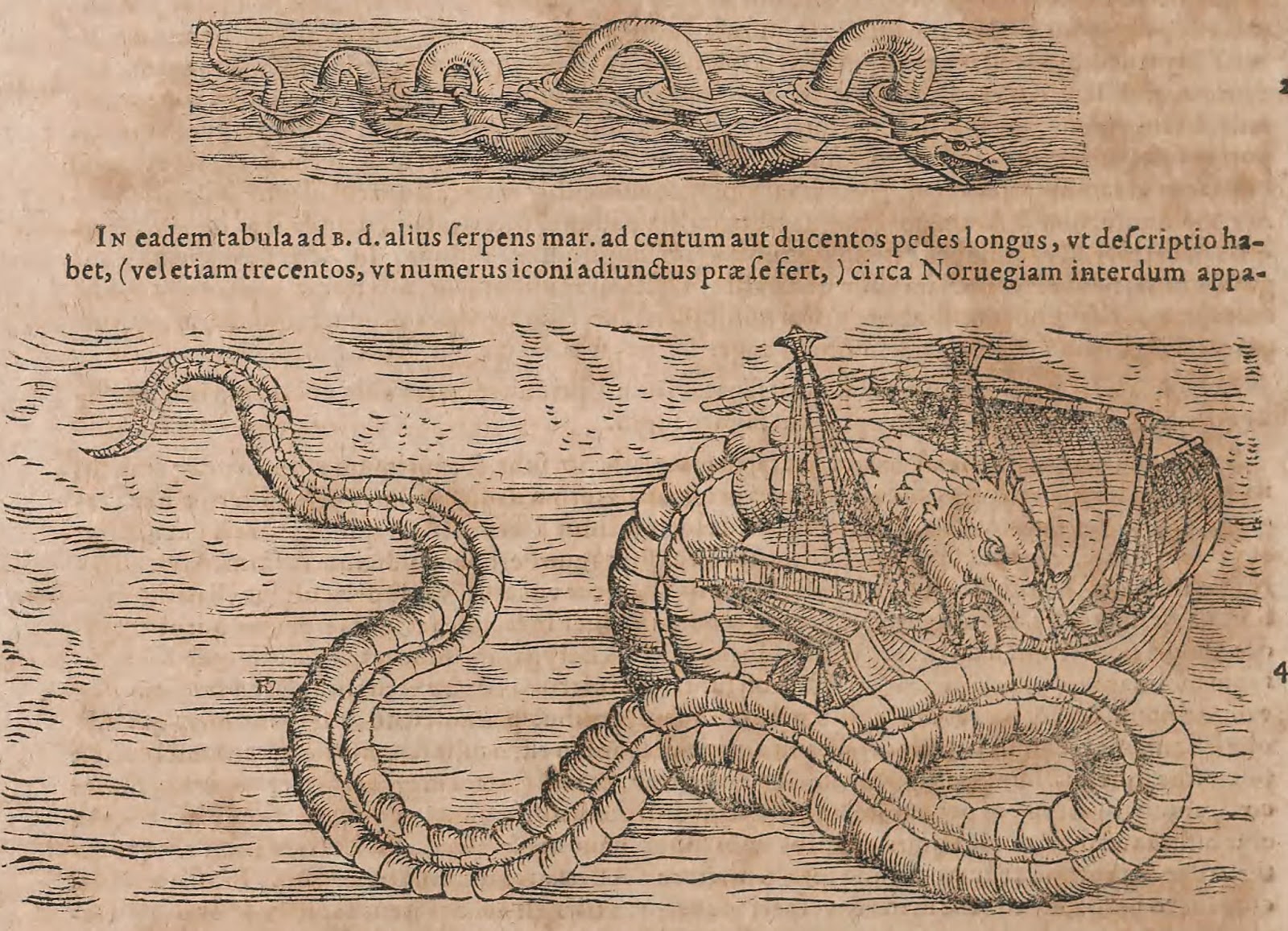
“Soe Orm.” Magnus, Olaus. Historia de Gentibus Septentionalibus. [ca. 1557 edition]. http://biodiversitylibrary.org/page/41862944.

In the 16th century, the ocean was a terrifying place. Creatures of unimaginable size and ferocity stalked the waters. One such beast was Soe Orm.

“A very large sea serpent of a length upwards of 200 feet and 20 feet in diameter which lives in rocks and in holes near the shore of Bergen; it comes out of its cavern only on summer nights and in fine weather to destroy calves, lambs, or hogs, or goes into the sea to eat cuttles, lobster, and all kinds of sea crabs. It has a growth of hairs of two feet in length hanging from the neck, sharp scales of a dark brown color, and brilliant flaming eyes.”

Olaus Magnus gave this gripping description of his sea serpent, accompanied by an equally formidable woodcut, in the 1555 masterpiece Historia de Gentibus Septentrionalibus (ca. 1557 edition available in BHL). Magnus was hardly the first to assert that giant sea serpents existed, but his prestigious reputation (he was, after all, the archbishop of Sweden), and the subsequent recirculation of his descriptions and imagery by other notable historians, solidified a belief in the existence of such monsters.

View Full Size Image
“Sea Serpent, after Magnus.” Gessner, Conrad. Historia Animalium. 2nd ed. 1604. http://biodiversitylibrary.org/page/42166517.

Magnus, of course, did not come up with the tale of Soe Orm on his own. The creatures he describes are based on accounts from sailors and Scandinavian locales, which in turn were based on encounters with strange aquatic creatures that became immortalized as sea serpents.

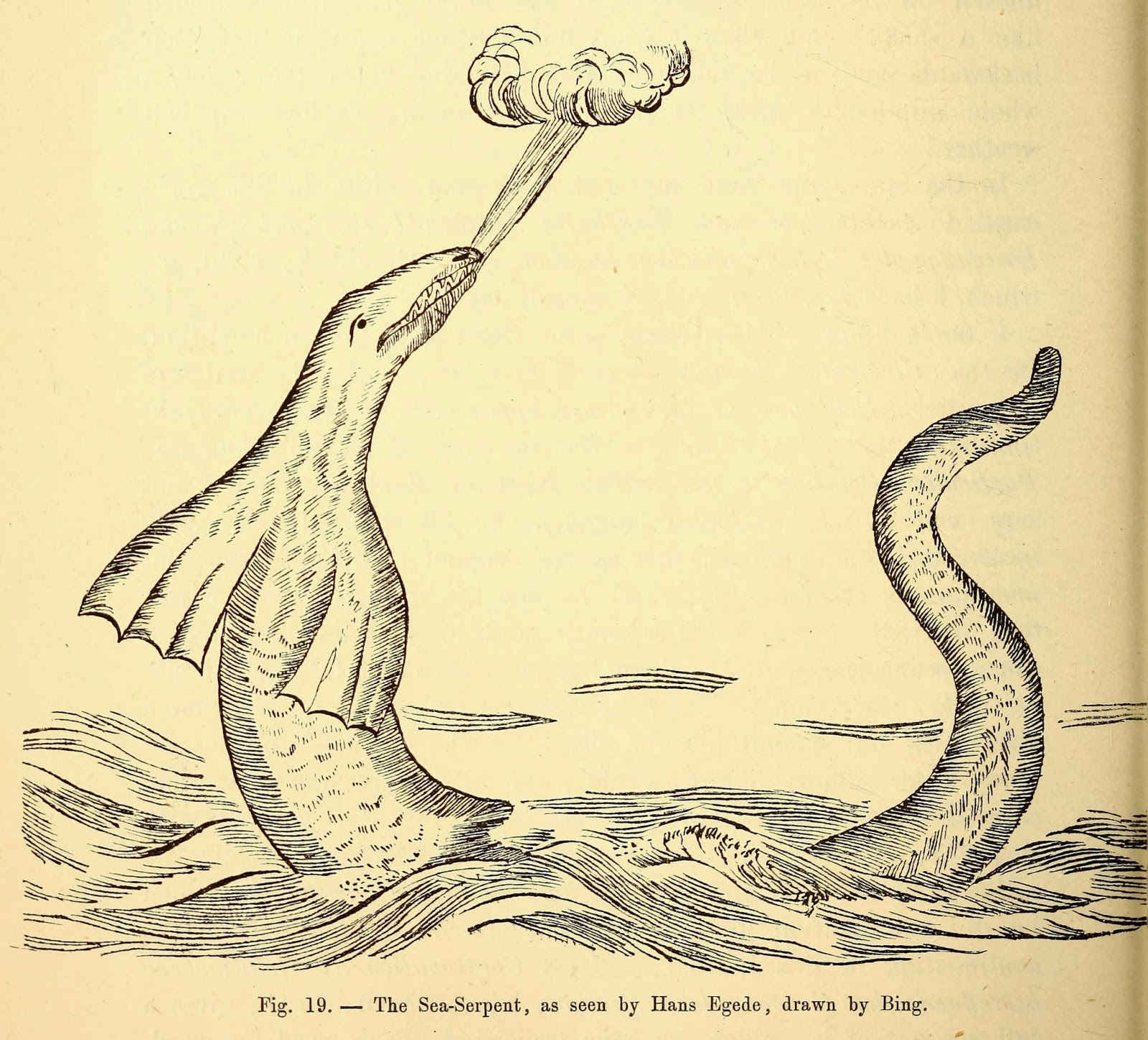
One of the earliest illustrations of a sea serpent drawn from an eye-witness account comes from Danish missionary Hans Egede, who claimed to have seen one off the coast of Greenland in 1734.

“The monster was of so huge a size, that coming out of the water its head reached as high as the mast-head; its body was as bulky as the ship, and three or four times as long. It had a long pointed snout, and spouted like a Whale-Fish; great broad paws, and the body seemed covered with shell-work.”

View Full Size Image
“Sea Serpent drawn after Hans Egede’s description.” Reproduced in: Oudemans, A.C. The Great Sea Serpent. 1892. http://biodiversitylibrary.org/page/41617356.

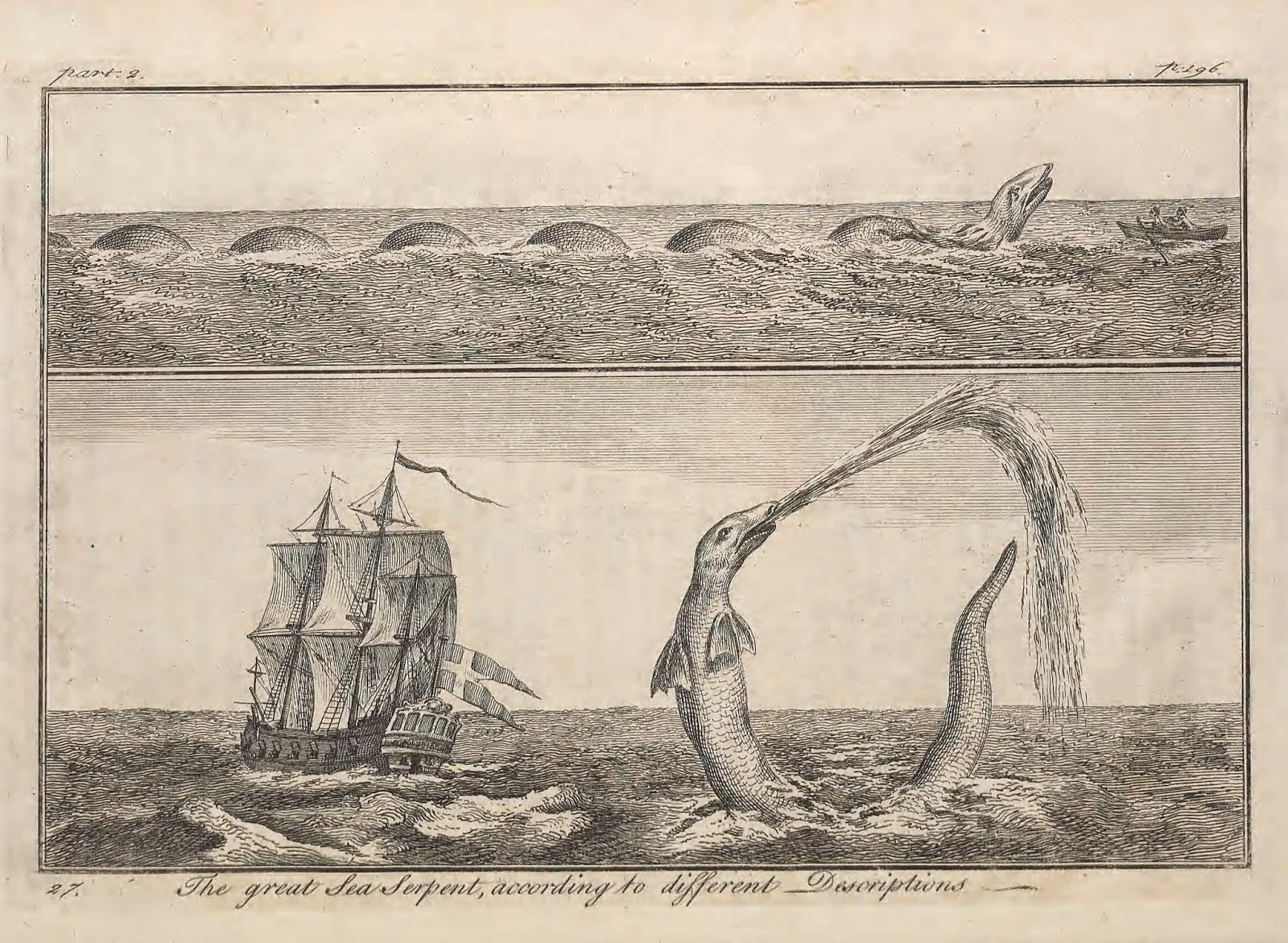
A drawing of Egede’s beast, and this description, was published in Det Gronlands nye Perlustration in 1741. Fourteen years later, Bishop Erik Ludvigsen Pontoppidan of Bergen published The Natural History of Norway, which relates two separate eye witness accounts of a sea serpent, one with a head that resembled a horse, and another with a snake-like body. Pontoppidan asserts that these eye-witness accounts provide “proper authorities for the real existence of this creature.”

View Full Size Image
“Sea Serpent representations based on accounts given to Erik Pontoppidan.” The Natural History of Norway. 1755. http://biodiversitylibrary.org/page/41885141.

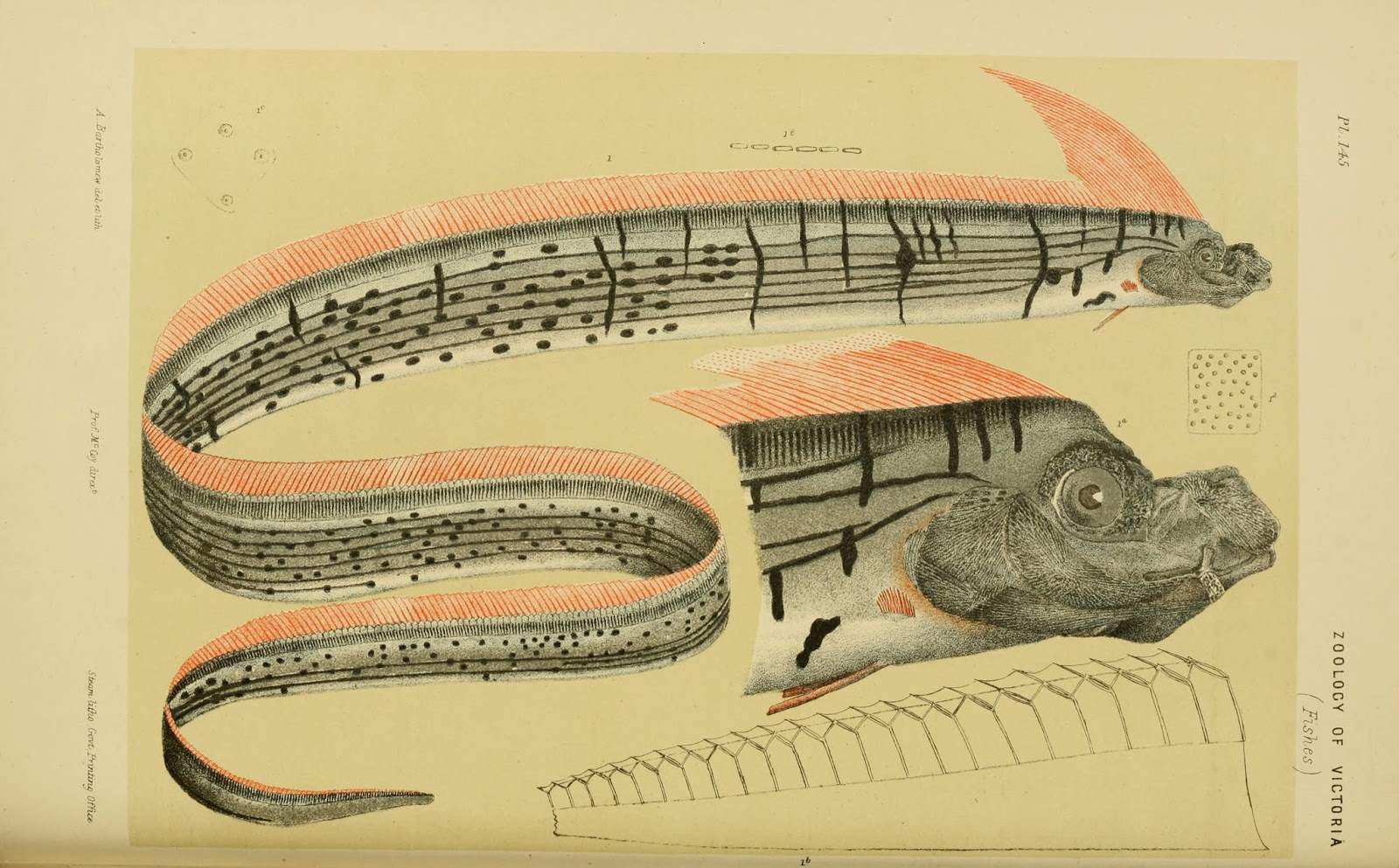
Descriptions of sea serpents with manes or growths of hair about their necks (like those of Magnus and Pontoppidan) are common amongst monster lore. This feature provides a clue to one of the animals commonly mistaken for a sea serpent: the Oarfish.

View Full Size Image
“Oarfish.” Natural History of Victoria. Decades 11-15. 1890. http://biodiversitylibrary.org/page/3828708. See an oarfish on display at Natural History Museum, Los Angeles County. See a video of a real oarfish.

An enigmatic creature, the oarfish is the longest bony fish alive, possibly measuring as long as 45-50 feet. Human encounters with these fish are rare, but they do have a red cockscomb of spines on their head and a red dorsal fin running the length of their bodies. Fleeting glimpses of oarfish could easily be exaggerated into an encounter with a monstrous sea serpent, and, to an untrained eye, the remains of such a fish washed up on a beach could understandably resemble the sea serpent of legend.

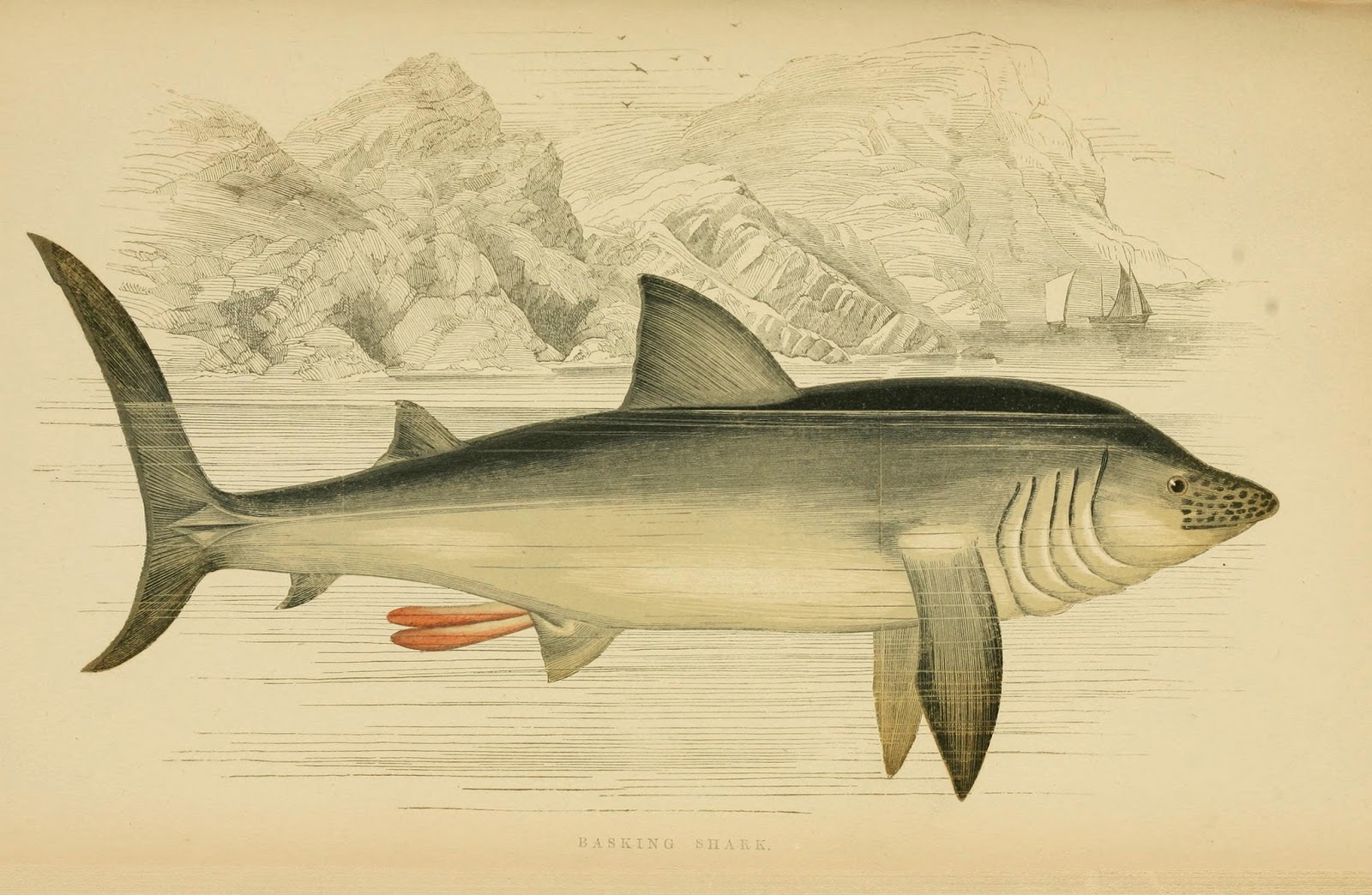
Basking Sharks, the second largest living fish (behind whale sharks) measuring up to 40 feet in length, have also been mistaken for sea serpents. In 1808, a badly decomposed carcass washed up on Stronsay. At a meeting of the Wernerian Natural History Society in Edinburgh, it was asserted that this carcass was the same creature described by Egede and Pontoppidan, and it was given the name Halsydrus (“sea water snake”). Later analysis of the skin and cartilage revealed that the “monster” was in fact a basking shark, and hardly a monster. These gentle giants are passive feeders with a diet of zooplankton and small fish and invertebrates.

View Full Size Image
“Basking Shark.” Couch, Jonathan. A History of the Fishes of the British Isles. v. 1. 1868. http://biodiversitylibrary.org/page/13419312.

One of the most infamous sea serpent episodes spanned decades. From 1817-19, a mass of people, including fishermen, military personnel, and pedestrians, reported seeing a sea monster at least eighty, but perhaps one hundred feet, long, with a head resembling a horse, in the harbor off Gloucester, MA. There were so many eye-witness reports that the Linnaean Society of New England formed a special investigating committee to examine the possibility of such a creature.

View Full Size Image
“The Sea Serpent ‘baby’ found in Massachusetts: Scoliopus atlanticus.” Oudemans, A.C. The Great Sea Serpent. 1892. http://biodiversitylibrary.org/page/41617628. Learn more about the Gloucester mystery, and see a digitized letter from Francis Boott describing the events, in a post from Kew Royal Botanic Gardens, by Jon Nicholls.

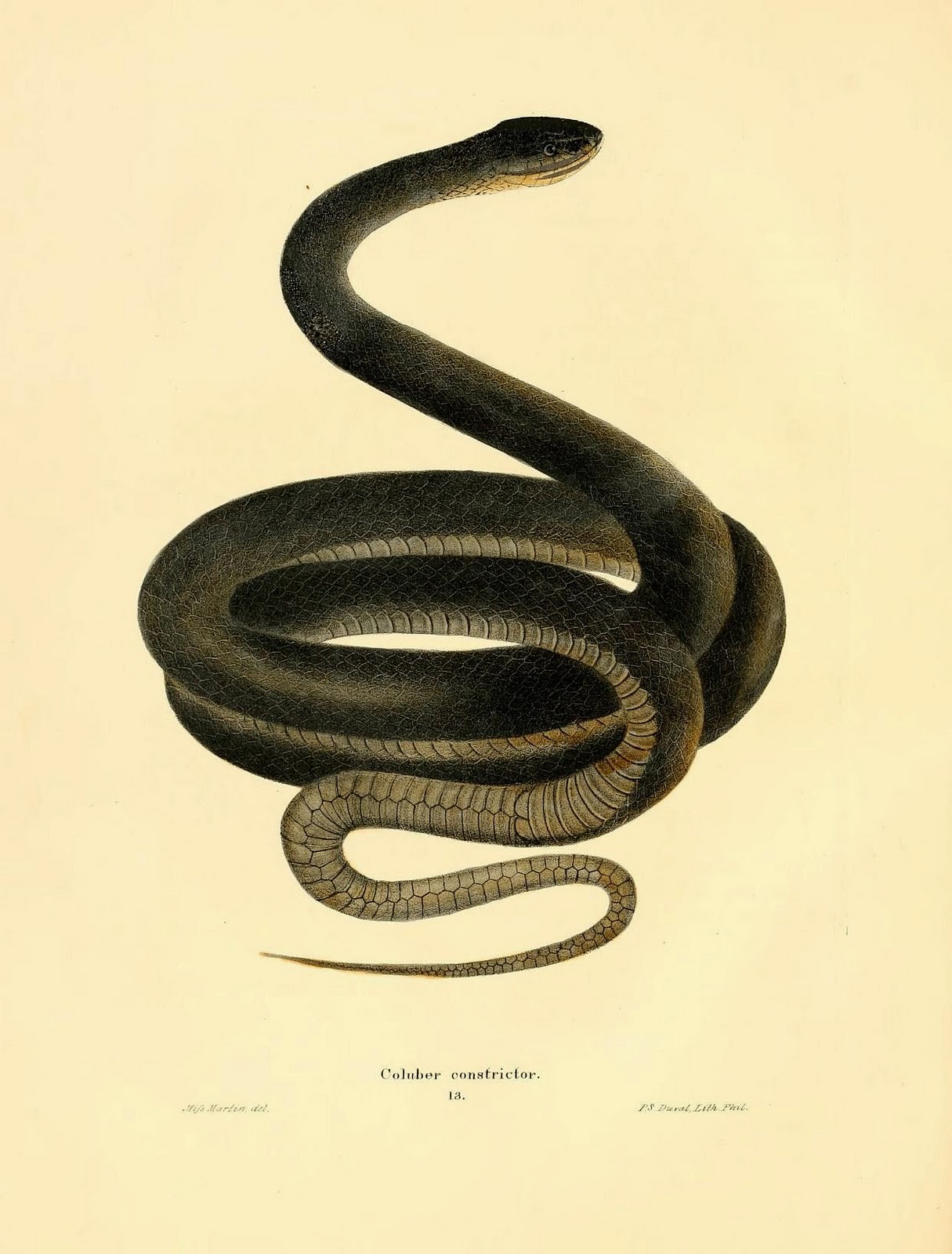
Then, in October 1817, two young boys found a three-foot-long, serpent body with humps on a beach not far from where the sightings had occurred. The Linnaean Society declared that the Gloucester sea serpent had visited the harbor in order to lay eggs, and that the specimen the boys had found represented one of its young. They invented an entirely new genus and named the sea serpent Scoliophis atlanticus (“Atlantic Humped Snake”). Shortly thereafter, naturalist Alexandre Lesueur examined the specimen and reported that it was, in fact, a deformed common blacksnake (Coluber constrictor).

View Full Size Image
“Common Blacksnake.” North American Herpetology. v. 4. 1840. http://biodiversitylibrary.org/page/3682780.

In 1819, undaunted by Lesueur’s findings, and still believing the Gloucester serpent to be valid, French-American naturalist Constantin Samuel Rafinesque-Schmaltz gave the creature a scientific name, Pelamis megophias, but admitted that it might constitute its own genus, in which case it should be named Megophias monstrosus.

Enthusiasm and belief in the Gloucester sea serpent continued, with repeated sightings throughout the nineteenth and twentieth centuries (the last documented sighting was in 1962). While the identity of the creature has never been established, several candidates have been proposed, including a row of leaping porpoises, giant eels, sea snakes, whales, seals, and, of course, our good friend the oarfish. The spontaneously-created scientific name Scoliophis atlanticus is now considered a synonym of the basking shark, revealing yet another likely identity for the monster. No evidence confirming the existence of a new-to-science species off the coast of Massachusetts has been found.

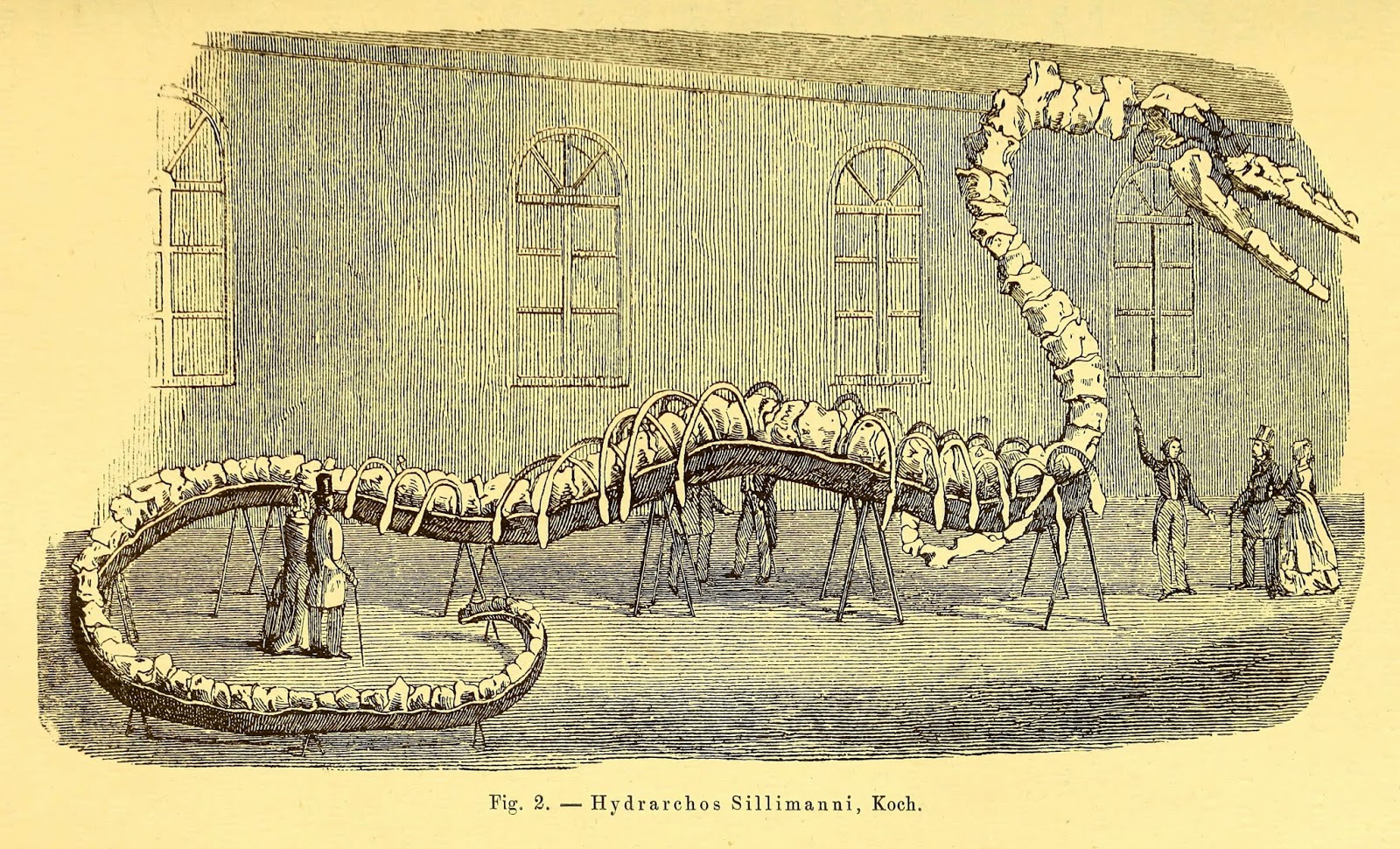
Sea Serpent proponents enjoyed a brief moment of triumph in 1845 when Albert C. Koch, a German collector, exhibited a full skeleton of what he called Hydrarchos sillimani at the Apollo Saloon on Broadway. Claiming to have found the entire skeleton in Clarksville, Alabama, his sea serpent was 114 feet in length. The glory was short-lived. Harvard anatomist Jeffries Wyman debunked the skeleton as an “artfully assembled collection of bones from at least five fossil specimens of Basilosaurus, a 45-foot long ancestral whale.” (Ellis, pg. 56).

View Full Size Image
“Albert Koch’s Sea Serpent.” Oudemans, A.C. The Great Sea Serpent. 1892. http://biodiversitylibrary.org/page/41617235.

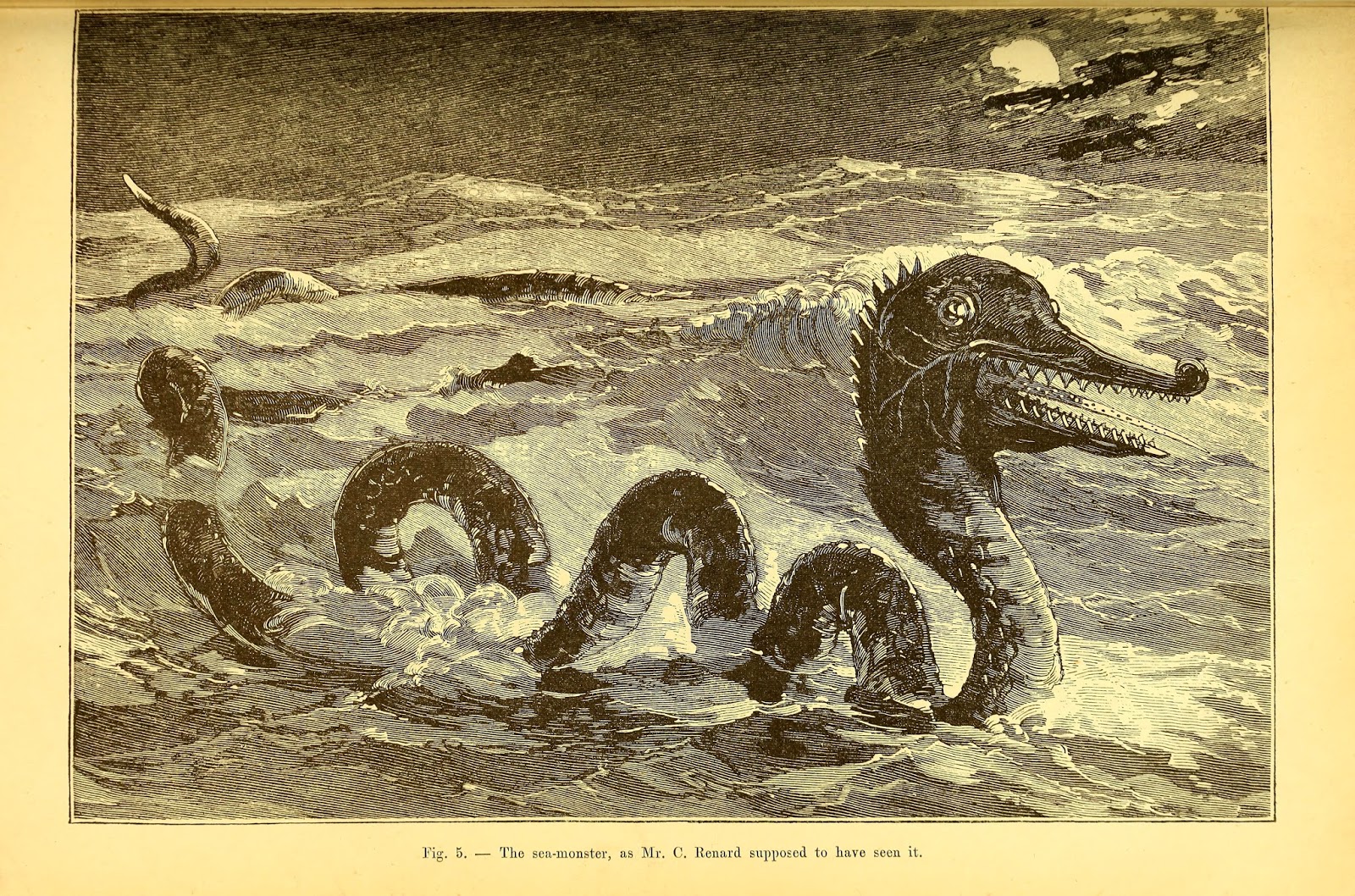
In the late nineteenth century, Olaus Magnus’ accounts were again repurposed, this time in Antoon Cornelis Oudemans’ The Great Sea-Serpent. An entomologist by training, Oudemans spent a majority of his free-time amassing a wealth of information on sea serpents, in which he fully believed. His book represents a systematic collection and analysis of the sightings supporting the sea-serpents’ existence. He claimed that all verified sightings of the beast belonged to the creature classified by Rafinesque, but that the monster was not a reptile at all but a mammal that belonged within the order Pinnipedia. Demonstrating some transformation in public opinion by the end of the nineteenth century, Oudemans’ book was highly criticized at its release. Times (London) went so far as to call it “a joke.” Nevertheless, it is an invaluable resource as record of sea serpent lore and sightings.

View Full Size Image
“The Sea Monster.” Oudemans, A.C. The Great Sea Serpent. 1892. http://biodiversitylibrary.org/page/41617299.

Does the Sea Serpent Exist?

Accounts of sea serpents continue to this day, including the still unresolved debate regarding the Cadborosaurus. Many have been unquestionably linked to known species, while others are associated with likely candidates.

View Full Size Image
Reported specimen of Cadborosaurus willsi, an alleged sea serpent from the Pacific Ocean. Over 200 sightings have been attributed to this species. This image captures a carcass taken from a Sperm Whale’s stomach and photographed in October, 1937. Researchers believe this specimen is actually a fetal baleen whale. http://commons.wikimedia.org/wiki/File:Cadborosaurus_October_1937.jpg.

So, does a sea creature roaming the seas, seen by countless witnesses over the centuries, really exist? Yes. It just goes by the more common name of Oarfish…or Basking Shark…or Humpback Whale…or Eel…It’s just another classic case of mistaken identity flavored with some good-old-fashioned embellishment…

Then again…

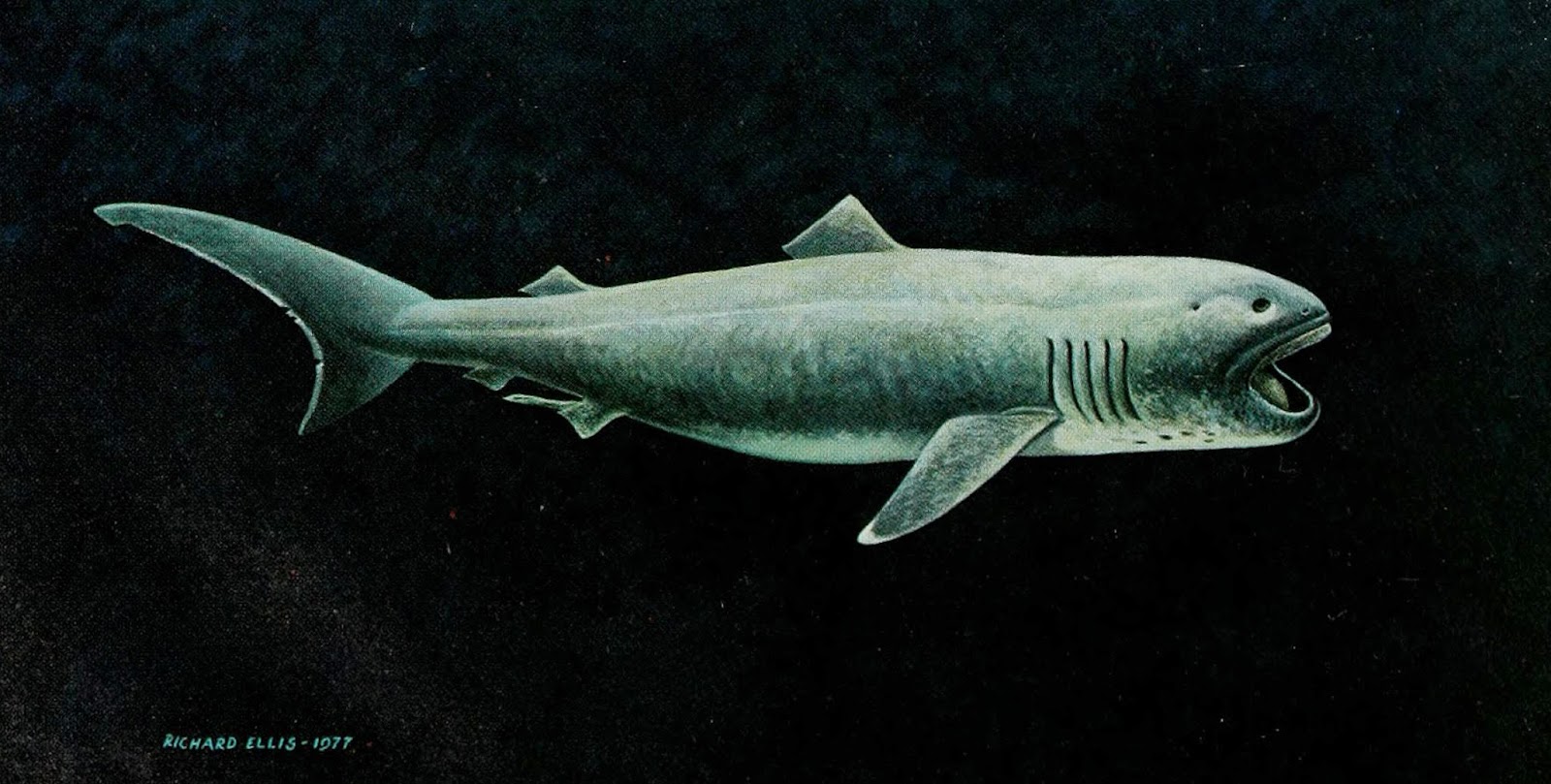
…Unlike the hydra and mermaids, questions as to the existence of the legendary sea serpent still remains. It’s a favorite topic within cryptozoology. The rediscovery of the coelacanth in 1938, believed extinct for 70 million years, and the discovery of the megamouth shark in 1976, leads many proponents to insist that an undiscovered marine titan, or a surviving dinosaur, is yet to be found.

View Full Size Image
In 1976, an extremely rare deep water shark, the Megamouth, was discovered off the coast of Hawaii. See the description of the new species in Proceedings of the California Academy of Sciences. 4th series, v. 43. 1983. http://biodiversitylibrary.org/page/15775401. See a Megamouth and Coelacanth on display at the Natural History Museum, Los Angeles County.

Does an unidentified species of untold length, serpentine in appearance, lurk in the ocean depths, waiting to be discovered? Only time will tell…though we’d venture to guess it does not come ashore at night to feast on livestock….

View Full Size Image
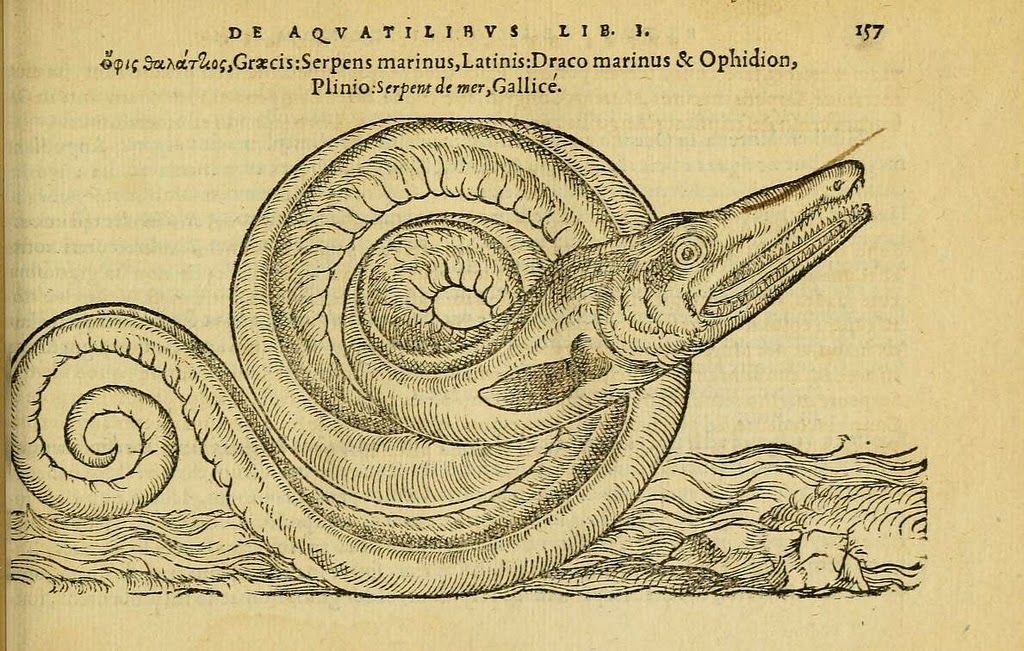
“The Sea Serpent.” Belon, Pierre. Petri Bellonii Cenomani De aquatilibus, libri duo cum [epsilon, iota] conibus ad viuam ipsorum effigiem, quoad eius fieri potuit, expressis. 1553. http://biodiversitylibrary.org/page/4770301. Explore more Sea Serpent lore in the Mythic Creatures online exhibit from the American Museum of Natural History.

More Monsters Are Real fun!

  • Follow our blog and #bhlMonstersRreal on Twitter and Facebook all week to learn more about monsters and the animals that inspired them.
  • Browse historic illustrations of sea serpents and animals mistaken for sea serpents on Flickr.
  • Browse the books that portray these historic monsters in BHL.
  • Carve a Sea Serpent in your Halloween Pumpkin this year! Share your carvings with us on Facebook and Twitter!
  • See some of our favorite monsters come to life on the Smithsonian Libraries’ Tumblr!
View Full Size Image
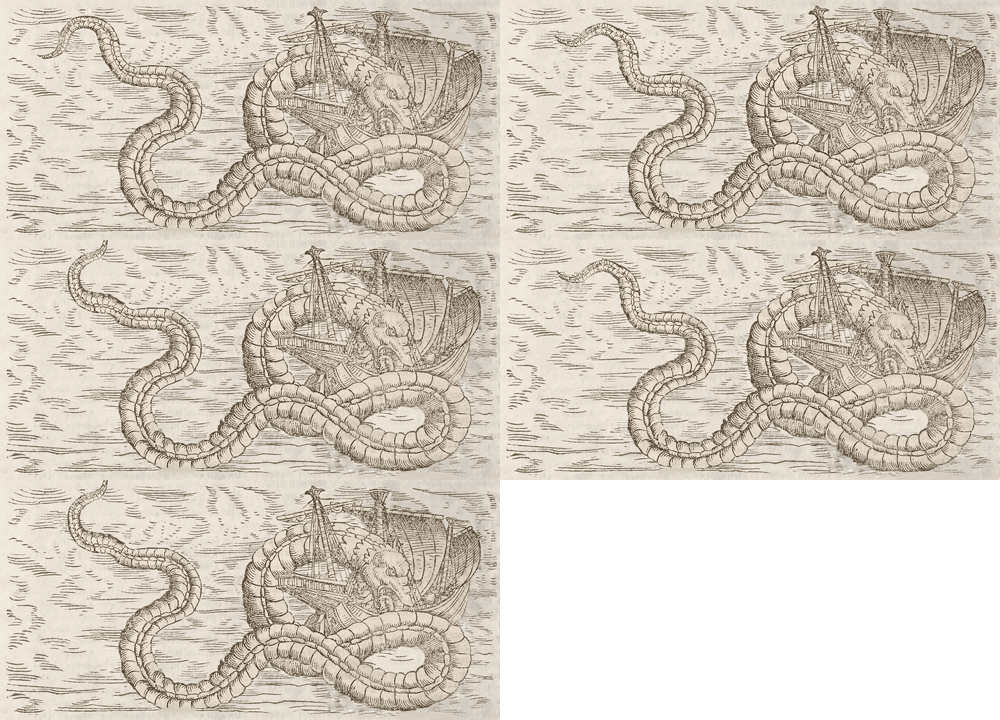
“Attack of the Sea Monster!” In 1555, Olaus Magnus published an image and description of the Soe Orm, which he claimed was a giant sea serpent 200 feet in length that lived near the shore or Bergen and came out at night to eat the farmers’ livestock. His image and description was republished for centuries. See more fantastic historic monsters come to life on the Smithsonian Libraries’ Tumblr. GIF created by Richard Naples (Smithsonian Libraries), based on Gessner, Conrad. Historia Animalium. 2nd ed. 1604. http://biodiversitylibrary.org/page/42166517.

Reference:

  • Ellis, Richard. Monsters of the Sea. New York: Alfred A. Knopp, Inc., 1994. Print.
October 29, 2014by michelle.underhill

Help Support BHL

BHL's existence depends on the financial support of its patrons. Help us keep this free resource alive!

search

About BHL

The Biodiversity Heritage Library (BHL) is the world’s largest open access digital library for biodiversity literature and archives. BHL operates as a worldwide consortium of natural history, botanical, research, and national libraries working together to digitize the natural history literature held in their collections and make it freely available for open access as part of a global “biodiversity community.”

Join Our Mailing List

Sign up to receive the latest news, content highlights, and promotions.

Subscribe Now

Subscribe to Blog via Email

Enter your email address to subscribe to this blog and receive notifications of new posts by email.

Join 319 other subscribers

Subscribe to Blog Via RSS

Subscribe to the blog RSS feed to stay up-to-date on all the latest BHL posts.

Access RSS Feed

Inspiring Discovery through Free Access to Biodiversity Knowledge.

The Biodiversity Heritage Library makes it easier than ever for you to access the information you need to study and explore life on Earth…for free, anytime, anywhere.


64+ Million Pages of
Biodiversity Literature Online.

EXPLORE

Tools and Services
to Transform Research.

EXPLORE

300,000+
Illustrations on Flickr.

EXPLORE

ABOUT | HARMFUL CONTENT | PRIVACY | SITE MAP | TERMS OF USE