Biodiversity Heritage Library - Program news and collection highlights from BHL
  • Home
  • News
  • Featured Books
    • All Featured Books
    • Book of the Month Series
    • BHL at 20
  • User Stories
  • Campaigns
    • Fossil Stories
    • Garden Stories
    • Monsters Are Real
    • Page Frights
    • Her Natural History
    • Earth Optimism 2020
  • Tech Blog
  • Visit BHL
Home
News
Featured Books
    All Featured Books
    Book of the Month Series
    BHL at 20
User Stories
Campaigns
    Fossil Stories
    Garden Stories
    Monsters Are Real
    Page Frights
    Her Natural History
    Earth Optimism 2020
Tech Blog
Visit BHL
  • Home
  • News
  • Featured Books
    • All Featured Books
    • Book of the Month Series
    • BHL at 20
  • User Stories
  • Campaigns
    • Fossil Stories
    • Garden Stories
    • Monsters Are Real
    • Page Frights
    • Her Natural History
    • Earth Optimism 2020
  • Tech Blog
  • Visit BHL
Biodiversity Heritage Library - Program news and collection highlights from BHL
Blog Reel, Featured Books

The Sea Dog: Exploring the Discovery & Classification of the Shark

It’s that time of year again! That special week set aside to celebrate the fabulously diverse Selachimorpha clade: Shark Week!

If you were to ask an average person to differentiate between a tiger shark, Great White, whale shark, bull shark, or mako, most could probably do so, or would at least be aware that such varieties existed. This wasn’t always the case. A mere six hundred years ago, sharks were known only by the bizarre personas recounted by animated sailors. And even when more accurate depictions and accounts began to circulate, the world was completely ignorant of the vast diversity of these creatures. A shark, generally, was a shark. It took an army of people, and several hundred years, to even begin to comprehend these magnificent fish, and we’ve still only scraped the surface.

The Shark in Myth

View Full Size Image
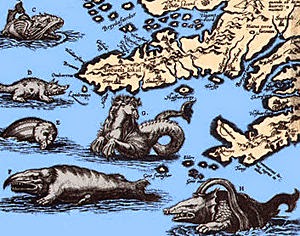
A selection of monsters that supposedly plagued the Atlantic Ocean. By Abraham Ortelius. 1570. Theatrum Orbis Terrarum.

Eleven hundred years ago, man was just starting to venture boldly into the open oceans. At that time, and throughout the Middle Ages, the sea was a place of mysticism and superstition, with countless tales of leviathans, monsters, and spirits plaguing the waters. Researchers believe many of these tales were actually based on real creatures, however exaggerated. Some of the beasts may have been at least partially informed by shark sightings.

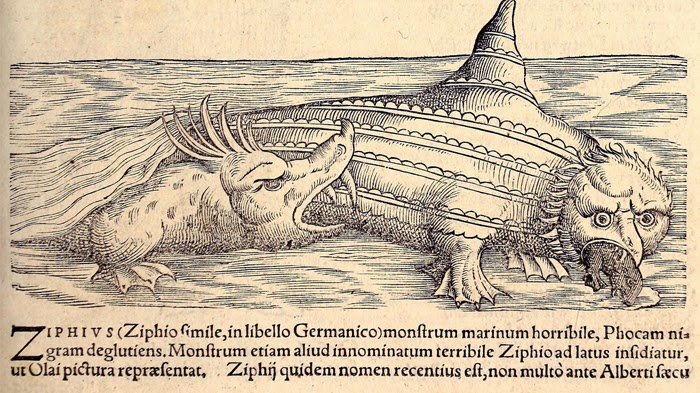
Conrad Gessner (the man behind our strange walrus a few weeks ago) depicted the Ziphius in his 1560 work Icones Animalium. Many researchers believe the beast with the back fin may be a Great White, due in part to the unfortunate seal in its jaws. The porcupine-fish taking a bite out of the Ziphius’ side? The jury’s still out on that one…
View Full Size Image
The Ziphius. Conrad Gessner. 1560. Icones Animalium.

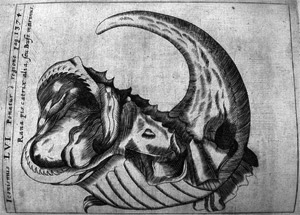
Caspar Schott’s 1662 beast is equally fanciful, but the teeth and jaws suggest that it may be inspired in part by a shark.
View Full Size Image
A shark? Caspar Schott. 1662. Physica Curiosa.

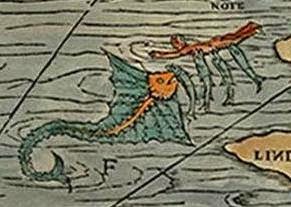
Despite limited contact with sharks, or perhaps because of it, artists generally portrayed the fish as ravenous man-eaters. Olaus Magnus’ 1539 Carta Marina shows a hapless man besieged by a gang of sharks. Fortunately for him, a kind-hearted ray-like creature has come to the rescue.
View Full Size Image
Olaus Magnus. 1539. Carta Marina.

Also in the Middle Ages, fossilized shark teeth were identified as petrified dragon tongues, called glossopetrae. If ground into a powder and consumed, these were said to be an antidote for a variety of poisons.

The Shark as a Sea Dog

By the time of the Renaissance, the existence of sharks was more generally known, though their diversity was woefully underestimated. Only those species that were clearly distinct based on color, size, and shape – such as hammerheads, blue sharks, and smaller sharks such as dogfish – were distinguished. As for the Lamnidae – Great Whites, makos, and porbeagles – these were identified as a single species.

In the 1550s, we see the Great White debut to an audience that would remain captivated by it for hundreds of years, though under a rather strange monicker.

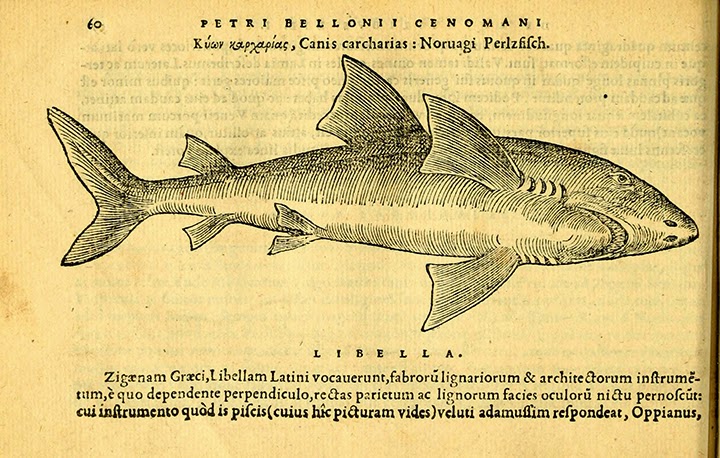
In 1553, Pierre Belon, a French naturalist, published De aquatilibus duo, cum eiconibus ad vivam ipsorum effigiem quoad ejus fieri potuit, ad amplissimum cardinalem Castilioneum. Belon attempted the first comparative analysis of sharks, and presented 110 species of fish in a much more realistic light than previously provided. In addition to a hammerhead, Belon included a woodcut of a shark he named Canis carcharias.
View Full Size Image
Canis carcharias. Pierre Belon. 1553. De aquatilibus duo.

Some readers may recognize that “Canis” is the genus currently assigned to dogs. Belon was not attempting to classify sharks with dogs by asserting this name. Indeed, systematic classification based on ranked hierarchies would not come onto the scene for over two hundred years. The common practice at this time was to choose descriptive names based on physical characteristics. Colloquial speech referred to sharks as “sea dogs,” and carcharias comes from the Greek “Carcharos” (ragged), which Belon associated with the appearance of the shark’s teeth.
View Full Size Image
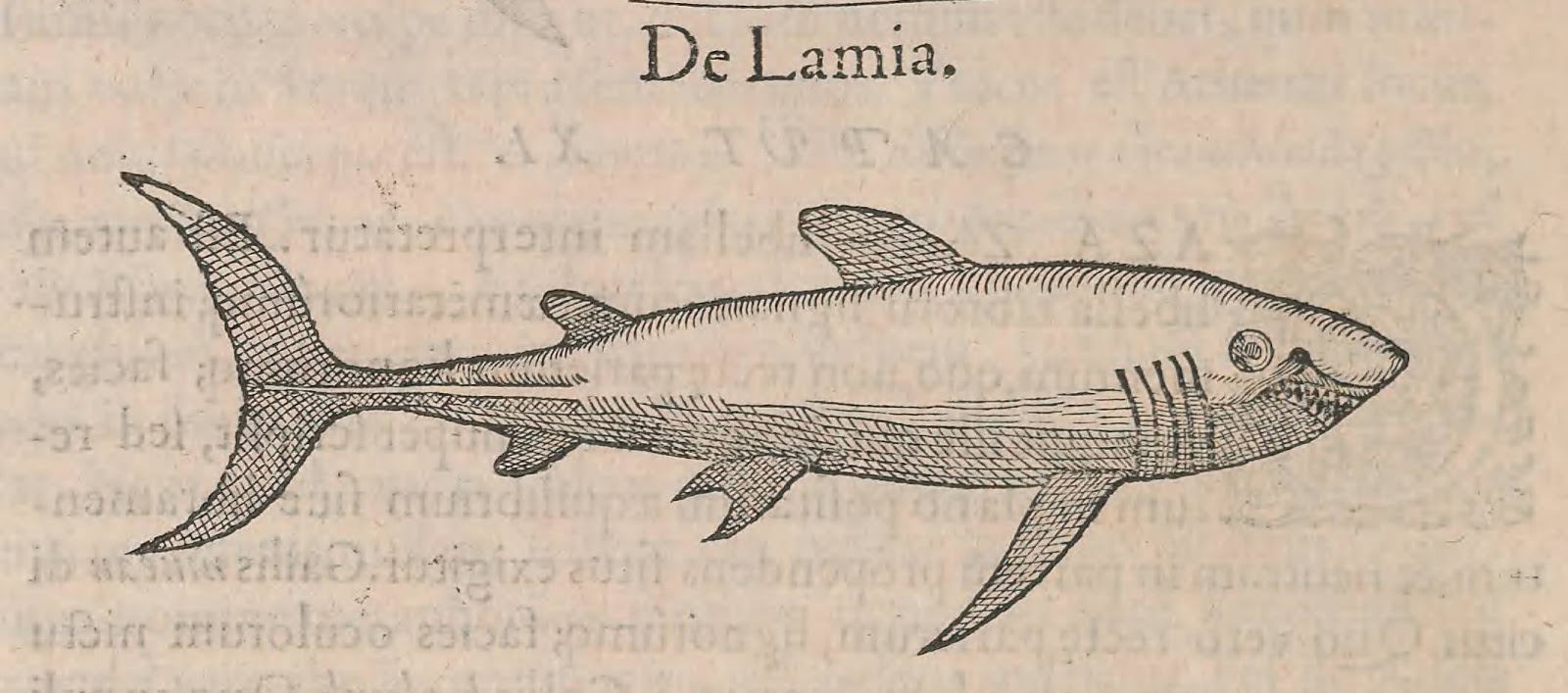
De Lamia. Guillaume Rondelet. 1554. Libri de Piscibus.

In 1554, French physician Guillaume Rondelet gave us another illustration of a Great White, under the name De Lamia (a child-eating demon in Greek mythology). Publishing Libri de Piscibus Marinis, Rondelet described more than 440 species of aquatic animals. Along with his illustration, Rondelet conveyed a tale of one specimen found with a full suit of armor in its belly. He also proposed that it was this fish, and not a whale, that was the culprit behind Jonah’s Biblical plight. A whale, he postulated, did not have a throat wide enough to swallow a man whole and regurgitate him later.
View Full Size Image
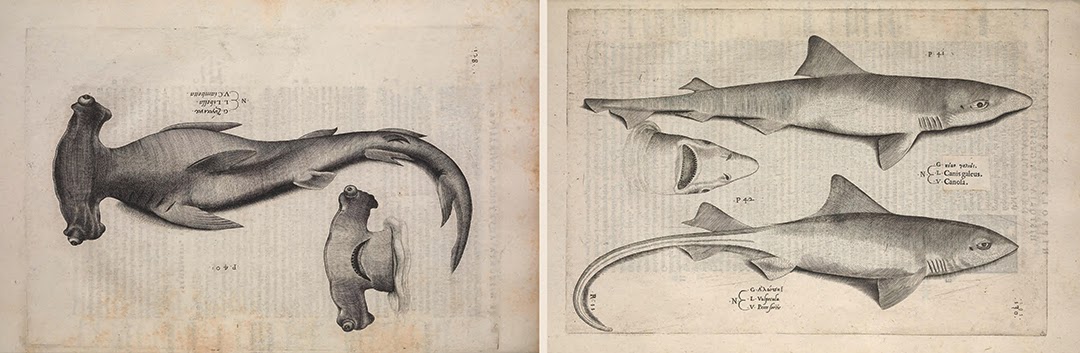
Hammerhead and Catsharks. Ippolito Salviani. 1554. Aquatilium Animalium Historiae.

That same year, Ippolito Salviani published another book on fish, Aquatilium Animalium Historiae, replete with engravings that included the hammerhead and (most likely) catsharks.

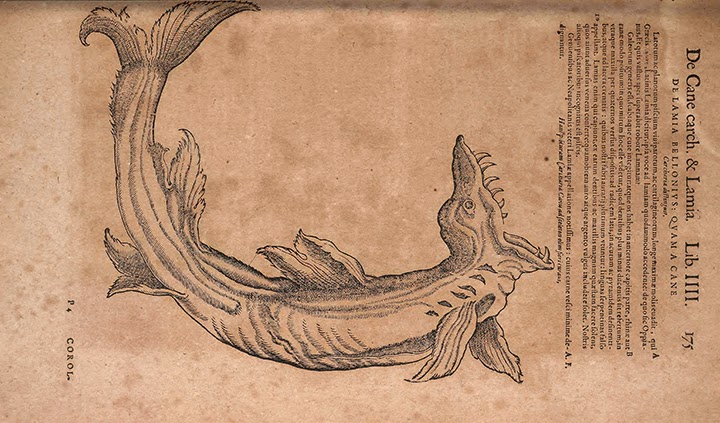
Though Conrad Gessner may have published accounts of many mythical beasts (such as the Ziphius in 1560), his 1558 work Historia Animalium (2nd edition linked here) was an attempt to give a factual representation of the known world of natural history. Within it, he included a much more recognizable illustration of the Great White (under both names Lamia and Canis carcharias). The study was based on a dried specimen, thus accounting for the rather desiccated appearance.
View Full Size Image
Gessner’s Lamia. Conrad Gessner. 1604. Historia Animalium (2nd edition).

Finally, in 1569, the word “Sharke” finally finds its place in the English language, popularized by Sir John Hawkins’ sailors, who brought home a shark specimen that was exhibited in London that year.

Influenced by the violent, and commonly exaggerated, stories circulated by sailors and explorers, general perception pegged sharks as ravenous beasts intent on devouring everything in sight.

Sharks and the “Modern” Era

By the 1600s, a more widespread attempt to classify fish according to form and habitat, and a fresh curiosity in shark research and diversity, found a footing in scientific research.

In 1616, Italian botanist Fabio Colonna published an article, De glossopetris dissertatio, in which he postulated that the mystical glossopetrae were actually fossilized shark teeth. The article had little impact, but in 1667, following the dissection of a Great White shark head, Danish naturalist Niels Stensen (aka Steno) published a comparative study of shark teeth, theorizing for the first time that fossils are the remains of living animals and again suggesting that glossopetrae were indeed fossilized shark teeth.

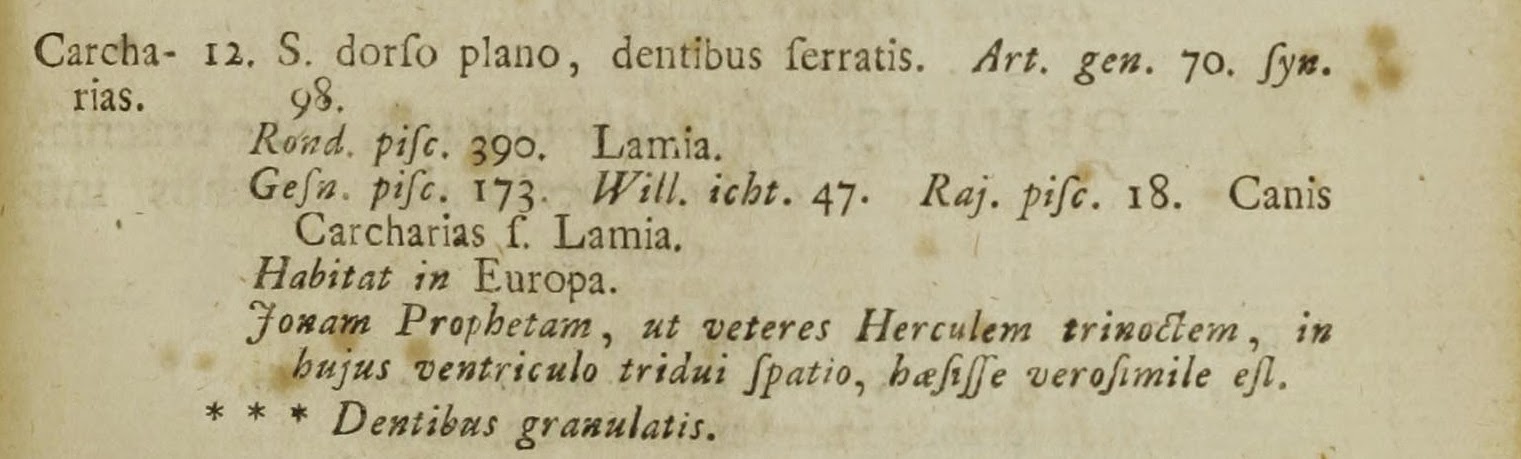
In the mid-1700s, a famous figure emerged. In 1735, Swedish botanist and physician Carl Linnaeus published his first version of Systema Naturae, at a mere 11 pages. Within this first edition, he classified sharks in the group Condropterygii, along with lampreys and sturgeon.

Linnaeus continued expanding his classification system, and in 1758 he published the tenth edition of Systema Naturae – the work we consider the beginning of zoological nomenclature. Within this edition, Linnaeus introduced binomial nomenclature, a naming scheme which identifies organisms by genus and species, with an attempt to reflect ranked hierarchies. This system provides the foundation of modern biological nomenclature, which groups organisms by inferred evolutionary relatedness.
View Full Size Image
Squalus carcharias. Carl Linnaeus. 1758. Systema Naturae (10th ed.).

Within Systema Naturae (10th ed.), Linnaeus identified 14 shark species, all of which he placed in the genus Squalus, which today is reserved only for typical spurdogs. He also presents his binomial for the Great White: Squalus carcharias. And he, like Rondelet before him, suggests that it was indeed a Great White that swallowed Jonah whole in ancient times.
View Full Size Image
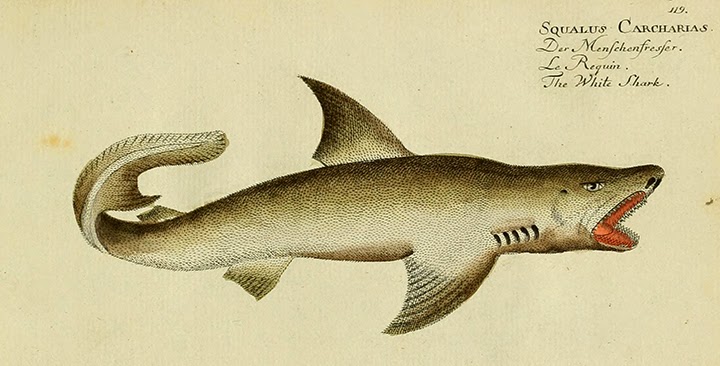
Squalus carcharias. Marcus Bloch. 1796. Allgemeine Naturgeschichte der Fische.

By the late 1700s, we see a greater attempt to distinguish between the varieties of white sharks. From 1783-1795, Marcus Elieser Bloch published twelve volumes on fish under the title Allgemeine Naturgeschichte der Fische, with 216 illustrations. His Great White, perhaps the first in color, bears Linnaeus’ name. And in 1788, French naturalist Pierre Joseph Bonnaterre gave the porbeagle shark its first scientific name, Squalus nasus, distinguishing another “white shark” as a distinct species.
View Full Size Image
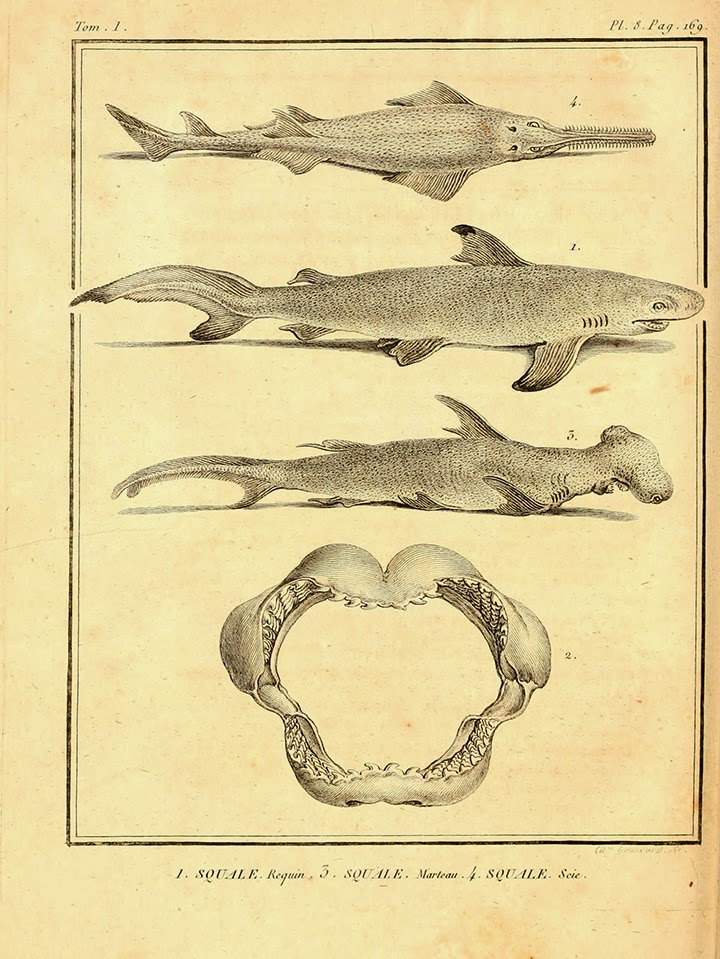
Squalus. Bernard Germain de La Cepede. 1798. Histoire Naturelle des Poissons.

French zoologist Bernard Germain de La Cepede grouped sharks, rays, and chimaeras as “cartilaginous fish,” identifying 32 types, in his 1798 work Histoire Naturelle des Poissons. He describes the “white shark” as the largest shark (a distinction truly held by the whale shark).
View Full Size Image
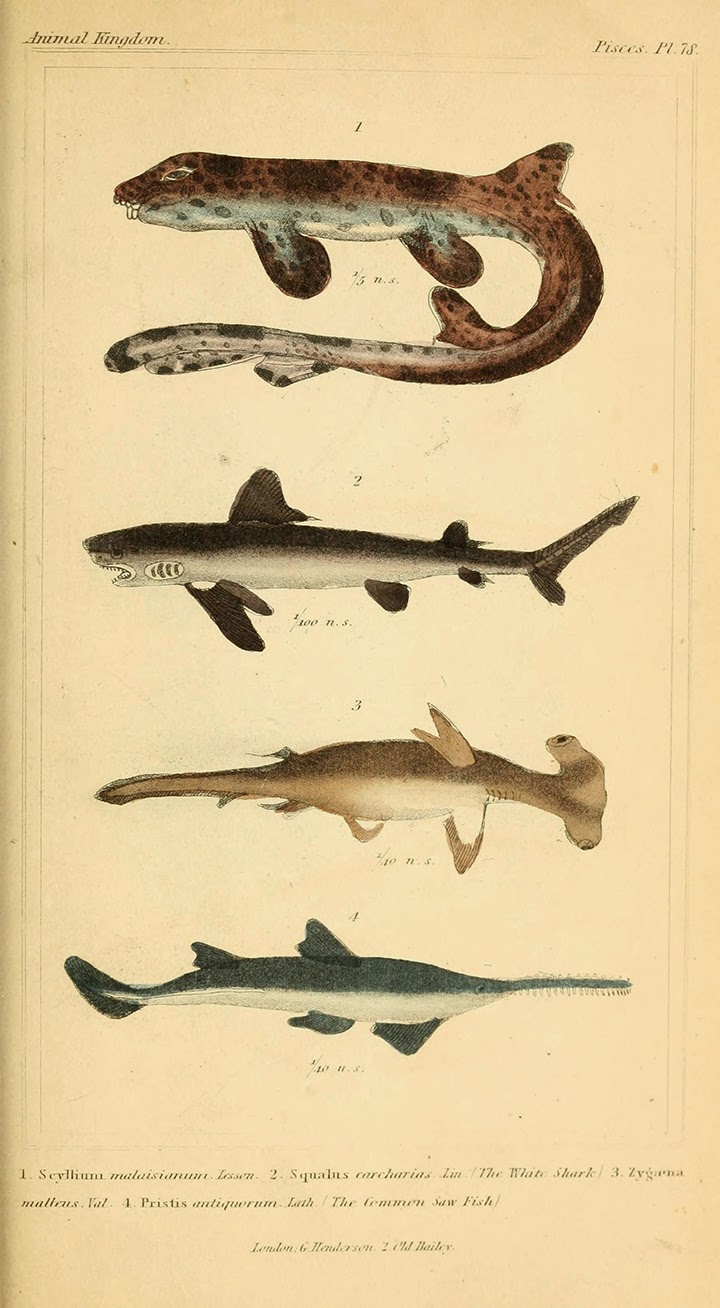
Selachians. Georges Cuvier.
The Animal Kingdom (1837 ed.).

In his 1817 work The Animal Kingdom, French anatomist Georges Cuvier listed sharks as “selachians,” a term still in use today as the clade including sharks: Selachimorpha.

In 1838 we see the first use of the modern Great White genus name. Scottish physician and zoologist Andrew Smith proposed the generic name Carcharodon in a work by Johannes Müller and Fredrich Henle (linked here in Smith’s later 1840s publication), pulling together the Greek “carcharos” (meaning ragged and used in the association by Belon nearly 300 years earlier) and “odon” (Greek for “tooth”). Thus, Smith was proposing a name meaning “ragged tooth.”

Finally, in 1878, Smith’s genus name “Carcharodon,” and Linnaeus’ species name “carcharias” were pulled together to form the scientific name we know the Great White by today: Carcharodon carcharias.

Thanks to the dedication and curiosity of past naturalists and contemporary taxonomists, we’re now aware of the incredible diversity of sharks. There are over 470 species known today; that’s quite a leap from the mere 14 species identified by Linnaeus over 250 years ago!

Want more Shark content? Get over 350 free shark illustrations in the BHL Flickr collection, and browse dozens of historic books on sharks in our BHL and iTunes U collections. You can also explore the incredible diversity of sharks in the Ocean Portal.

Happy Shark Week!

August 12, 2014by michelle.underhill
Blog Reel, Featured Books

How to Grow a Turkey and Other Fun Facts

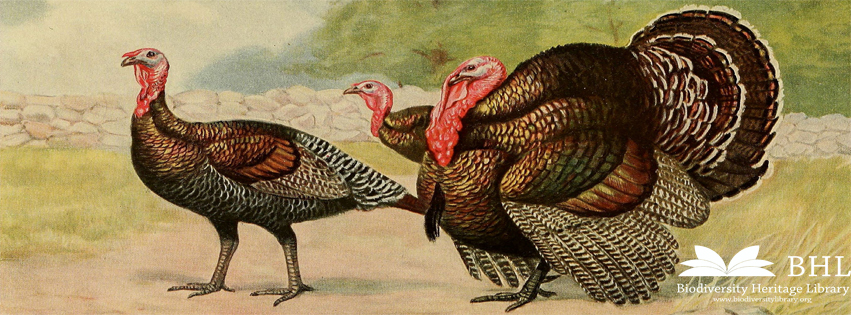
Portrait version of the Biodiversity Heritage Library logo.

Happy Thanksgiving From Your Friends at the BHL!

View Full Size Image
Gobble Gobble Gobble

The days before Thanksgiving are often spent by moms frantically shopping around for a prize turkey at their local supermarkets which, are hopefully already de-feathered, shrink-wrapped and packaged for our convenience. However, did you know that many folks still procure their turkey Thanksgiving meal the good old-fashioned way by “growing them?” If you are scratching your head wondering how exactly one “grows” a turkey, then this week’s Book of the Week is for you. Author Herbert Myrick tells us all about Turkeys and How to Grow Them (1905).  His book is a “Treatise on the natural history and origin of the name of turkeys; the various breeds, and best methods to insure success in the business of turkey growing ” In the book we learn about the different breeds of turkey from the taxonomic genus Meleagris, the awe-inspiring and downright immodest mating tactics of male turkeys and yes how to “grow” a turkey just in time for Thanksgiving. Today for fun’s sake, we will be highlighting the antics of male turkey mating behaviors. Did you know that a male turkey can be called a “Tom”, a “Gobbler”, a “Cock” or a “Stag”? For your enjoyment this Thanksgiving holiday, we have compiled some entertaining quotes from the book about Stag mating behavior. Subsequently, these very quotes will be visualized for you with a short Youtube video that documents the mating dance of one very special Gobbler, Marco the Turkey. Quite the show, indeed. Not to be missed.

Moreover, we will provide you with three gifts this Thanksgiving and it’s not even Christmas yet:

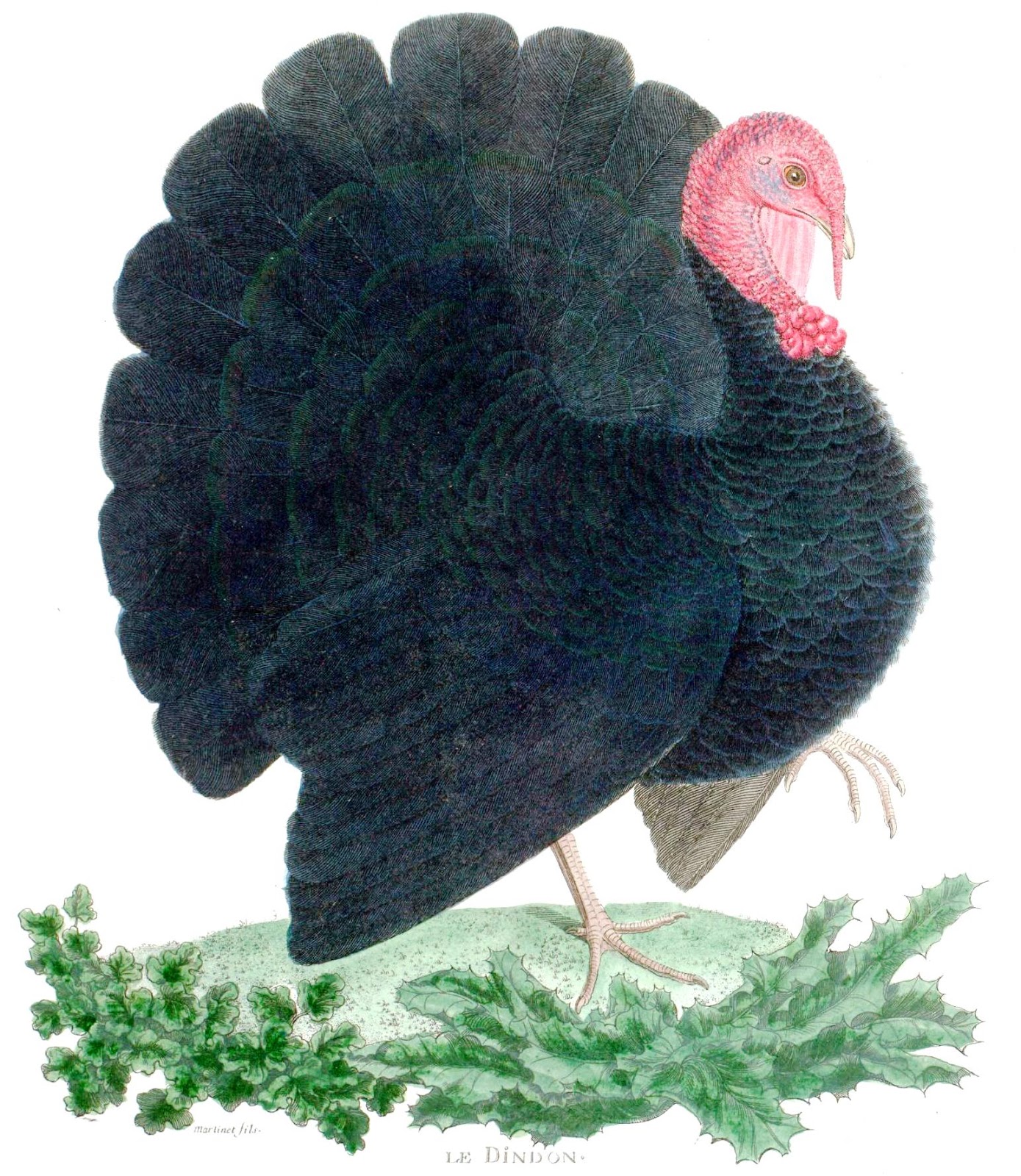
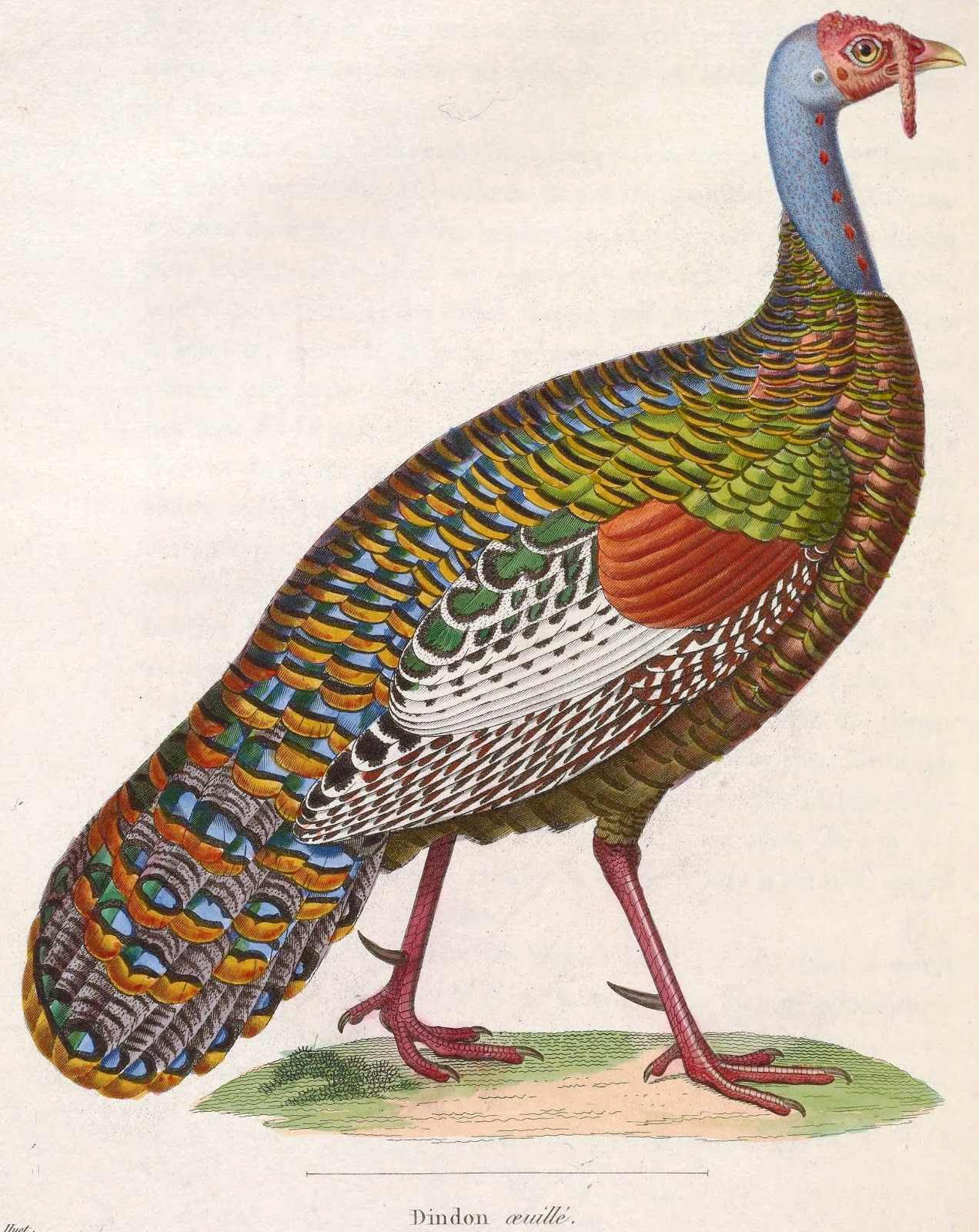
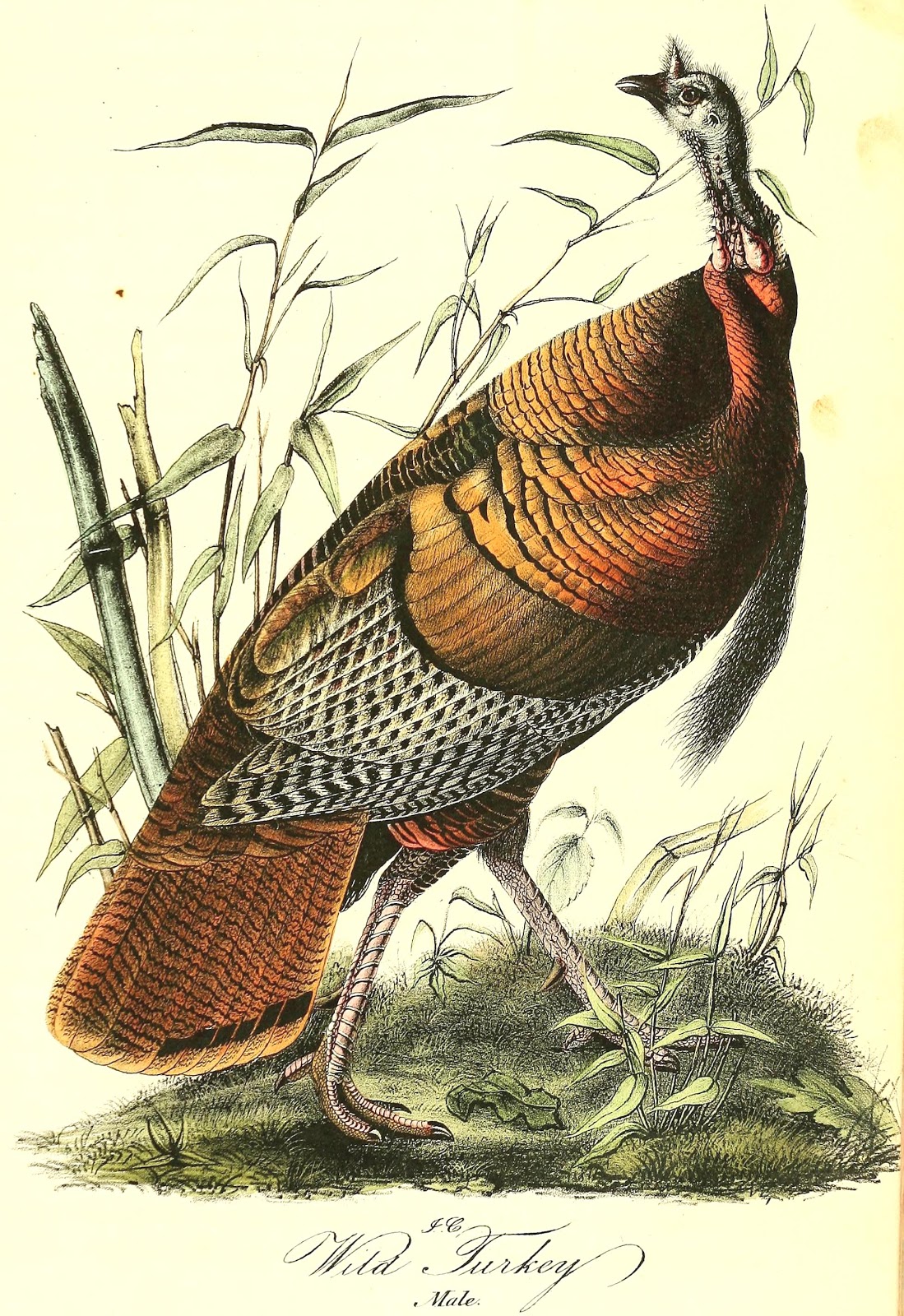
1) Stellar images of turkeys from our Flickr account including a rare Audubon print of the wild Turkey from his famed work, The Birds of America.

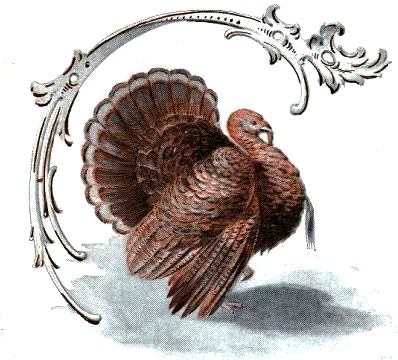
2) Turkey day cover art is now available for you to freely use with any of your social media accounts; created expressly for you by BHL’s Flickr Guru Gilbert Borrego. Thanks Gilbert!

3) A fun fact to share at the Thanksgiving table about tryptophan and how it ISN’T linked to the post-meal sleepiness that we are all too familiar with.

Surely all things to be thankful about! Enjoy!

Turkey Mating Habits

To begin our discussion of male turkey mating behaviors we would like to preface a forthcoming video of a particularly amorous Gobbler’s mating dance with a quote from the book, Turkeys and How to Grow Them:

“The males may then be heard calling to the females from every direction, until the woods ring with their loud and liquid cries, which are commenced long ere the sun appears above the horizon, and continue for hours with steadiest persistency.”

“…If the female answering the call is on the ground, the males fly to her and parade before her with all the pompous strutting that characterizes the family.”

Ready to see this in action? It seems that in the turkey world, the males are the showier sex: strutting about, dancing, crying delirious mating calls, and putting on dazzling outfits to impress their female counterparts. And what do the females do? They casually ignore the male’s pleas for the most part. Occasionally, they have been known to entertain a mating dance which you absolutely must witness for yourself:

Marco’s Mating Display

Let’s thank user Sallyatthederby on YouTube for uploading this amazing display of male prowess by Marco the Turkey. He is clearly trying to attract the female in the background while simultaneously showing off for the camera. It’s funny to watch the female turkey as she looks downright confused by Marco’s behavior and disinterestedly pecks at the fence. Poor lady seems to be searching for an escape hatch. We can’t blame Marco for trying. He knows he is a lovely site! We are sure he will find love eventually.

Gift Time!

1) Stellar Turkey Images:

View Full Size Image
Source: Ornithologie (1773-1792)
View Full Size Image
Source: Nouveau recueil de planches coloriées d’oiseaux, v. 5 (1838)
View Full Size Image
Source: Birds of America, v.5 (1840-1844)
 
2) Social Media Cover Art: use it for your Facebook or Twitter Accounts
View Full Size Image
Full-sized download available on our Pinterest Account.

3) The Trytophan Equates Sleepiness Myth Has Been Debunked

View Full Size Image

Every year at Thanksgiving, Americans gather around and eat to their heart’s content. Post-dinner they do one of three things: 1) argue with their relatives 2) hide from the crazy people 3) a good majority of us fall asleep. Turkey, the meal’s main course is popularly thought to make its imbiber quite sleepy. However, this Thanksgiving you can proclaim to all of your family members that there is conclusive evidence that is absolutely positively NOT TRUE. According to the popular show Myth Busters, Tory Belleci, Kari Byron, and Grant Imahara investigated this claim that consuming turkey/tryptophan causes drowsiness. The Myth Busters Team put together three holiday meals in which to test this theory. The variables being tested were 1) portion size and 2) the presence vs. absence of turkey in the meal. After testing each meal, and timing the resultant effects of drowsiness, they found that the amount of food eaten had a much larger effect on whether or not one felt sleepy. This flies in the face of the turkey/tryptophan explanation for post-thanksgiving meal drowsiness. The conclusion of the episode was: The Tryptophan Sleepiness Myth was “Busted.” Meal size and subsequent effects of insulin NOT turkey derived trytophan is responsible for your extreme sleepiness. So to be clear it’s the Turkey + mulled cider + all those other side dishes that just keep coming and coming = extreme sleepiness aka food coma.

Please enjoy eating, sleeping and being merry this Thanksgiving from your friends at the BHL!

We hope you enjoyed this post. Interested in guest-blogging for BHL? We’d love that! Natural history, biodiversity and conservation topics are especially welcomed. Email us your ideas at [email protected]

November 22, 2012by [email protected]
Blog Reel, Featured Books

Book of the Week: Shark Week, Part 2. The Mythology of the Shark

View Full Size Image

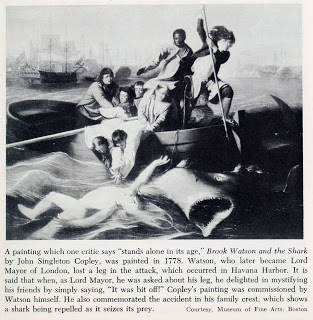
Welcome to Part Two of our Shark Week Book of the Week feature! If you recall from our last post, this week we’re featuring the book Shadows in the Sea (1963) by Harold W. McCormick. Last time, we highlighted shark attacks. This time, we’re recounting the various roles sharks have played in legend and mythology throughout the ages. Sharks have been revered as gods and powerful spiritual beings for thousands of years, long before Zeus, or even Cronus, debuted on the scene. As McCormick writes,

“As the Greeks wrote their myths in the constellations, Orion, the mighty hunter, wheeled across the winter sky in eternal, futile pursuit of Taurus, the great bull, and Leo, the couchant lion. But long before the Greeks looked skyward and evolved their myths, primitive men discerned in the flickering pattern of the stars cosmic enactments of their fearsome struggles with their own devil-god – the shark.”

Like the Greek gods, sharks also have within their repertoire a constellation myth, as told by the Warrau Indians of South America. For this tribe, Orion’s Belt has a far more sinister backstory – it is a severed human leg. According to the legend, the leg once belonged to Nohi-Abassi, who schemed to kill his mother-in-law by enticing a hungry shark to eat her. Unluckily for him, however, his sister-in-law, “playing the role of a shark,” cut off his leg. Nohi-Abassi died, and while his leg now rests in the sky as Orion’s Belt, the rest of him wound up in an altogether less celestial place.

View Full Size Image

Also like the Greeks, whose gods were constantly cavorting with human women and begetting demi-gods, many Hawaiian myths tell of similar erotic behavior among their shark gods. Legend tells that Kamo-hoa-lii, king of the sharks, fell in love with Kalei, a human, and transformed himself into a man to marry her and bear a child with her. “The child, Nanaue, looked like any other child – except that on his back he bore the mark of his shark-father, the mouth of a shark.” The story does not end well for the child, who devoured many islanders after the taboo of never being fed animal flesh was broken, presumably birthing an insatiable desire for human flesh. He was eventually caught – in his shark form – and taken to a hill in Kain-alu that still bears his name.

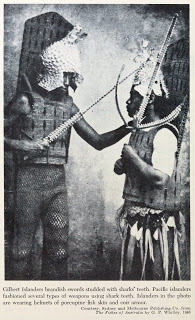
A staple of ancient Roman culture also bears a grisly similarity to the history of cultural practices involving sharks. While the Roman gladiator practice of pitting man against land beasts like lions or tigers is fairly well-known to most people (thanks in large part to Hollywood), gladiator games involving sharks are perhaps somewhat less well-known. But, like Sparatcus, Hawaiian warriors were also matched against fearsome killers for imperial entertainment. Shark pens constructed of large lava stones encircling a 4-acre area at the edge of a bay served as the den for the sharks. Fish and human bait were used to lure sharks into the pens, and Hawaiian warriors battled for their lives using a shark-tooth dagger, which was simply a single shark-tooth affixed to the end of a long stick. The warriors had a single opportunity to prevail: they must allow the sharks to charge them, attempting to dive beneath the shark at the last moment and use the shark-tooth dagger to slit the underside of the shark open.

View Full Size Image

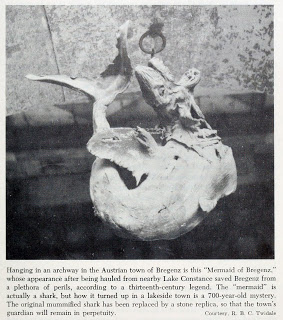
Sharks also find themselves on the list of species with mistaken identities. Just as manatees and similar creatures have been mistaken for mermaids throughout history, so, too, has the shark been given this misnomer. In the town of Bregenz, Austria, a severely contorted, mummified shark has hung from an archway as a reputed “mermaid” guarding the town since, allegedly, the thirteenth century. Legend tells that a fisherman brought the “mermaid” in with his catch early one morning, but before he could return it, the “Spirit of the Lake” told him to hang her from the Arch of the Martinster as she was “beget of a land woman and…of no use [in the water].” Dr. Denys W. Tucker of the British Museum “tentatively identified the mermaid, from a photograph, as a mummified Porbeagle shark.”

The chapter has many more stories to tell. One myth explains how various species of sharks were created as a result of an especially cruel young woman beating, squishing and lashing various sharks. Another relates how two particularly lazy sharks laid still for so long that they became islands. Some cultures tell a Jonah and the Whale type story which would be more aptly named “Jonah and the Shark.”

Moving past myth to historical fact, our book of the week describes “shark charmers” and holy men who kiss sharks in order to overpower and subdue them. Throughout history, holy wars have been fought among tribes, resulting from one tribe inadvertently or otherwise catching and/or defiling the sacred shark species of another tribe. Sharks have even played a central role in the resolution of documented crimes throughout history!

It truly is worth the time to read through this chapter of our book of the week, as it recounts the rich history of the shark as it has evolved through cultural experience. Maybe it will inspire you to see something other than a belt in the night sky 🙂

And, you can see all of the imagesfrom our book of the week, Shadows in the Sea (1963) by Harold W. McCormick, on our Flickr site.

August 4, 2011by michelle.underhill

Help Support BHL

BHL's existence depends on the financial support of its patrons. Help us keep this free resource alive!

search

About BHL

The Biodiversity Heritage Library (BHL) is the world’s largest open access digital library for biodiversity literature and archives. BHL operates as a worldwide consortium of natural history, botanical, research, and national libraries working together to digitize the natural history literature held in their collections and make it freely available for open access as part of a global “biodiversity community.”

Join Our Mailing List

Sign up to receive the latest news, content highlights, and promotions.

Subscribe Now

Subscribe to Blog via Email

Enter your email address to subscribe to this blog and receive notifications of new posts by email.

Join 319 other subscribers

Subscribe to Blog Via RSS

Subscribe to the blog RSS feed to stay up-to-date on all the latest BHL posts.

Access RSS Feed

Inspiring Discovery through Free Access to Biodiversity Knowledge.

The Biodiversity Heritage Library makes it easier than ever for you to access the information you need to study and explore life on Earth…for free, anytime, anywhere.


64+ Million Pages of
Biodiversity Literature Online.

EXPLORE

Tools and Services
to Transform Research.

EXPLORE

300,000+
Illustrations on Flickr.

EXPLORE

ABOUT | HARMFUL CONTENT | PRIVACY | SITE MAP | TERMS OF USE