Biodiversity Heritage Library - Program news and collection highlights from BHL
  • Home
  • News
  • Featured Books
    • All Featured Books
    • Book of the Month Series
    • BHL at 20
  • User Stories
  • Campaigns
    • Fossil Stories
    • Garden Stories
    • Monsters Are Real
    • Page Frights
    • Her Natural History
    • Earth Optimism 2020
  • Tech Blog
  • Visit BHL
Home
News
Featured Books
    All Featured Books
    Book of the Month Series
    BHL at 20
User Stories
Campaigns
    Fossil Stories
    Garden Stories
    Monsters Are Real
    Page Frights
    Her Natural History
    Earth Optimism 2020
Tech Blog
Visit BHL
  • Home
  • News
  • Featured Books
    • All Featured Books
    • Book of the Month Series
    • BHL at 20
  • User Stories
  • Campaigns
    • Fossil Stories
    • Garden Stories
    • Monsters Are Real
    • Page Frights
    • Her Natural History
    • Earth Optimism 2020
  • Tech Blog
  • Visit BHL
Biodiversity Heritage Library - Program news and collection highlights from BHL
BHL News, Blog Reel

BHL and EOL team up for NESCent Research Sprint

View Full Size Image
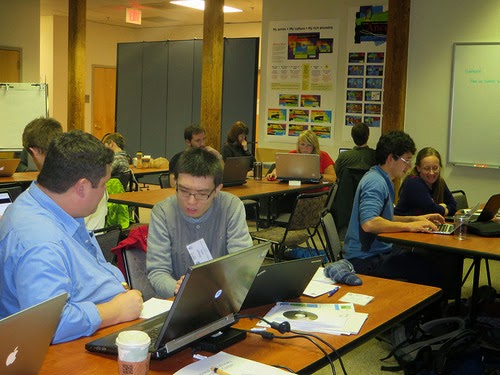
Research teams at the NESCent-EOL-BHL Research Sprint.
Photograph by Cyndy Parr.

In early February, the National Evolutionary Synthesis Center (NESCent) hosted the EOL-BHL Research Sprint. NESCent, based in Durham, NC, is a non-profit science center supporting research in the evolutionary sciences. NESCent emphasizes an interdisciplinary approach to research, and so the idea behind the Sprint was to put together teams of programmers and life scientists to expose each other to questions and ways of thinking that they might not necessarily consider in their normal work. Informaticians could bring programming and data skills to bear on questions that scientists may not have had the programming expertise to implement effectively, using BHL‘s and EOL‘s now considerable amount of freely available data. Scientists could identify questions based on the data to programmers that they might not have considered. Plus, the meeting was useful in identifying how well researchers could identify and retrieve the data they needed from the BHL text corpus. To this end, William Ulate, BHL Technical Director and John Mignault, a member of the BHL Technical Advisory Group attended the meeting.

The teams covered a wide variety of interesting topics from studying the color of butterflies based on extracting color information from images to studying changes in ontologies over time based on an analysis of the text in the BHL corpus (see http://bit.ly/1dnnhG0). Over the course of the sprint, the teams began data mining EOL and BHL for their data sets and started preliminary analyses of their data. Each day, groups met at the end of the day to share experiences and progress. By the end of the sprint, each of the teams were sharing plans for further collaboration and completing their analyses. Plans for publication and grants proposals based on sprint ideas were also discussed. In an open, collaborative spirit, members shared the materials freely via Google Drive.

We learned some interesting things about the way people approach the BHL data set. Many of the teams on the first day wanted to use the BHL application programming interface for bulk data retrieval. Several team members asked us how they could download “all of the text.” When we told them that this was impractical and would result in a great deal of unwanted data, they asked how they could retrieve data based on, for example taxa – I want to harvest all pages with names from this taxon (Chordata) or this common name (Vertebrate). Others wanted data restricted by location. We tried to assist them given their specific needs rather than their initial request for the whole data set (see http://bit.ly/1rvbut3). This raised useful questions as to how we can provide the data to researchers need in the ways they need it – should we offer ways to request bulk data downloads based on a specific set of criteria? Should we alter the API (http://www.biodiversitylibrary.org/api2/docs/docs.html) in order to make it possible to retrieve more closely focused data sets? As BHL becomes better known as a source of “Big Data” for the biodiversity community, we will need to evolve our access to that data in order to better meet the needs of our users.

We were also surprised to discover the popularity of the R statistical programming language among scientists. Many team members used R in their work, to such an extent that a short R group discussion was scheduled for one morning during the meeting. Scott Chamberlain of Simon Fraser University has created an R interface to the BHL API, available at http://bit.ly/1oAFKjI. It is always good to see BHL and its data used in new and interesting ways. Follow up further results from this Sprint at: http://blog.eol.org.

The Sprint was a valuable meeting for BHL: it exposed our valuable data to more scientists and informaticians, and it gave BHL staff useful feedback on the uses of the BHL data corpus and its value to researchers. We would like to thank EOL, NEScent and the Richard Lounsbery Foundation for the opportunity and their collaboration in making this event a success.

March 27, 2014by sayeedmd
BHL News, Blog Reel

NESCent-EOL-BHL Research Sprint

Portrait version of the Biodiversity Heritage Library logo.

We invite participants for an event that will pioneer the mining of the Encyclopedia of Life (http://eol.org) and the Biodiversity Heritage Library (http://www.biodiversitylibrary.org) to address outstanding and novel questions about the ecology and evolution of biodiversity. We aim to identify questions and data for which biologists may lack informatics skills and resources to address or analyze successfully; and symmetrically, to guide informaticians to pressing ecological and evolutionary questions. We seek to make actual discoveries through joint activities and to test the “computability” of major biodiversity databases.

We invite proposals for synthetic research on any aspect of biological science that will leverage EOL and BHL resources.  Successful applicants will be matched with an informatician, in 2 person teams, and receive support to travel to and work on-site at the National Evolutionary Synthesis Center for 4 days.

Applications for participation will be evaluated on the extent to which they

  • address an important and outstanding biological question,
  • are “risky” endeavors but with a reasonable chance of success,
  • reflect EOL’s mission to empower scientific research by providing comprehensive and trusted biodiversity data and/or NESCent’s scientific mission to advance research that addresses fundamental questions in evolutionary science. Both organizations promote the integration of methods, concepts, and data within and across disciplines (for more on the context and a classification of synthesis in evolutionary science please read Linking Big: The Continuing Promise of Evolutionary Synthesis),
  • provide evidence that sufficient data are available to tackle the question,
  • provide evidence that appropriate analytical tools are available or will be developed during the event,
  • generate products that typically fall into three broad categories (in order of importance):
    • Synthetic papers and reviews,
    • Software or mathematical tools that solve a major analytical problem.
    • New open data for Encyclopedia of Life allowing others to build on your foundation.

We will not support collection of original data or field research, but encourage the mining of public and private databases such as EOL and BHL.  NESCent is committed to making data, databases, software and other products that are developed as part of NESCent activities available to the broader scientific community. Applicants should review the Data And Software Policy for NESCent.

Proposals will be evaluated in terms of both the scientific value of the project and the qualifications of the applicant.  Visitors will receive support for travel to and from NESCent, lodging, and a per diem for meals not provided.

Before you Apply

All applicants are encouraged to contact Craig McClain, Assistant Director of Science of NESCent, or Cynthia Parr, Chief Scientist of Encyclopedia of Life, for feedback on project ideas. Proposals will be considered through November 15.  The event will likely take place February 3-7, 2014. Please review our Reporting Requirements, Travel Guidelines, and Data and Software Policy before applying.

Proposals Guidelines

Proposals are short and not to exceed 2 single-spaced (12-pt type) pages, plus a 2-page CV.   Proposals should be organized as follows:

  • Title (80 characters max)
  • Name and contact information
  • Project Summary (250 words max)
  • Public Summary (250 words max) – written for the public and visible on the NESCent web site
  • Introduction and Goals – A statement of the outstanding question being addressed and a concise review of the concept and the literature to place the project in context.
  • Proposed Activities – A clear statement of any specific data (include citations or urls) and analytical tools that will be required for the project.  The proposal should also include a clear statement on how synthesis will occur. Letters of support are required from the proprietor of datasets, analytical tools, or software not publically available or owned by the applicant or managed by EOL and BHL.
  • Rationale for support – Why can this activity be most effectively conducted at NESCent and with the Encyclopedia of Life or BHL.
  • Anticipated IT Needs – Briefly describe any needs for IT support that are important to the success of the proposed project. Please indicate whether development of software will be required. Also, briefly describe your plans to make resulting data and software available; including any conditions that might limit your ability to make these available. Please remember you need not possess the informatics skills to address the questions but do need to identify what skills are lacking.  You may propose an informatician to collaborate with.  Prior contact and letter of support with the informatician is encouraged.  If no teammate is suggested EOL/NESCent will work to identify proper support for you.
  • Anticipated Results – include a clear statement of anticipated papers, data and software products, and anticipated public release of data and products
  • Short CV of the applicant(s) (2 pages)
  • Proposal Submission

    Proposals will be accepted in digital format only as a single pdf file. Graphics should be embedded directly into the proposal document. Note that proposals should be submitted as a single pdf file including all of the components listed above, including the CV. Email your proposal to Craig McClain and Cynthia Parr, by November 15, 2013.

    Data, Software and Publication Policy

    The open availability of data, software source code, methods, and results is good scientific practice and a key ingredient of synthetic research. NESCent expects that all data and software created through NESCent-sponsored activities be made publicly available no later than one year after the conclusion of the NESCent award, or immediately upon publication of an associated article, whichever comes earlier. For more information please visit our Data, Software and Publication Policy.

    Funding for this opportunity is generously provided by the Richard Lounsbery Foundation.

    September 30, 2013by joelrichard

    Help Support BHL

    BHL's existence depends on the financial support of its patrons. Help us keep this free resource alive!

    search

    About BHL

    The Biodiversity Heritage Library (BHL) is the world’s largest open access digital library for biodiversity literature and archives. BHL operates as a worldwide consortium of natural history, botanical, research, and national libraries working together to digitize the natural history literature held in their collections and make it freely available for open access as part of a global “biodiversity community.”

    Join Our Mailing List

    Sign up to receive the latest news, content highlights, and promotions.

    Subscribe Now

    Subscribe to Blog via Email

    Enter your email address to subscribe to this blog and receive notifications of new posts by email.

    Join 319 other subscribers

    Subscribe to Blog Via RSS

    Subscribe to the blog RSS feed to stay up-to-date on all the latest BHL posts.

    Access RSS Feed

    Inspiring Discovery through Free Access to Biodiversity Knowledge.

    The Biodiversity Heritage Library makes it easier than ever for you to access the information you need to study and explore life on Earth…for free, anytime, anywhere.


    64+ Million Pages of
    Biodiversity Literature Online.

    EXPLORE

    Tools and Services
    to Transform Research.

    EXPLORE

    300,000+
    Illustrations on Flickr.

    EXPLORE

    ABOUT | HARMFUL CONTENT | PRIVACY | SITE MAP | TERMS OF USE