
Biodiversity Heritage Library - Program news and collection highlights from BHL
  • Home
  • News
  • Featured Books
    • All Featured Books
    • Book of the Month Series
    • BHL at 20
  • User Stories
  • Campaigns
    • Fossil Stories
    • Garden Stories
    • Monsters Are Real
    • Page Frights
    • Her Natural History
    • Earth Optimism 2020
  • Tech Blog
  • Visit BHL
Home
News
Featured Books
    All Featured Books
    Book of the Month Series
    BHL at 20
User Stories
Campaigns
    Fossil Stories
    Garden Stories
    Monsters Are Real
    Page Frights
    Her Natural History
    Earth Optimism 2020
Tech Blog
Visit BHL
  • Home
  • News
  • Featured Books
    • All Featured Books
    • Book of the Month Series
    • BHL at 20
  • User Stories
  • Campaigns
    • Fossil Stories
    • Garden Stories
    • Monsters Are Real
    • Page Frights
    • Her Natural History
    • Earth Optimism 2020
  • Tech Blog
  • Visit BHL
Biodiversity Heritage Library - Program news and collection highlights from BHL
Blog Reel, Featured Books

The Last Heath Hen, and Other News From the Collecting Net In Woods Hole

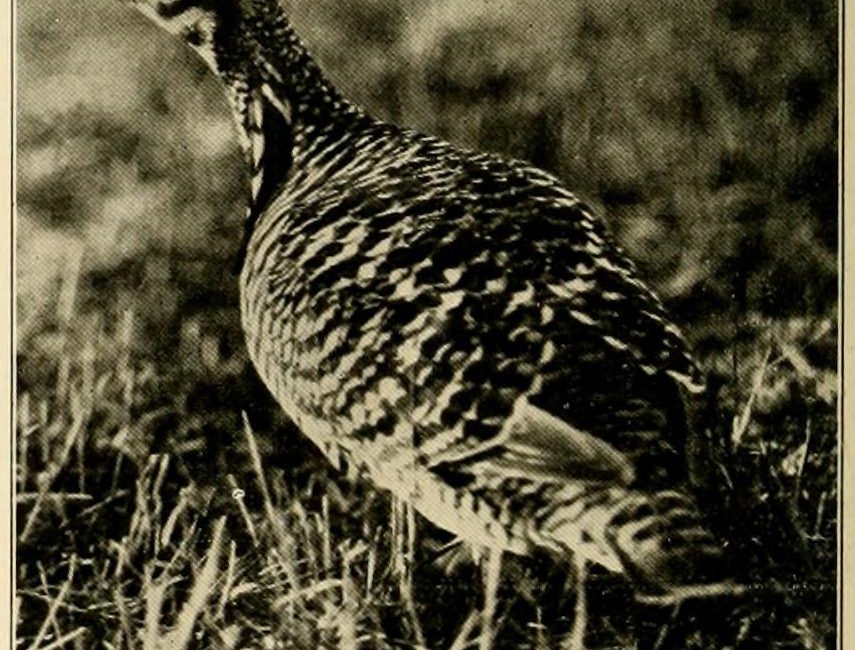
black and white photo of a bird, the heath hen

“On Martha’s Vineyard Island just across the Sound from the Marine Biological Laboratory is the home of the lone survivor of the Heath Hen. The death of this individual will also mean the death of its race, and then another bird will have taken its place among the endless array of extinct forms. The numbers of Heath Hen have been closely followed by ornithologists and since 1908 a detailed census has been taken of the birds each year. For the first time in the history of ornithology a species has been studied and photographed in its normal environment down to the very last individual.”

-Professor Alfred O. Gross, Bowdoin College, as written in The Collecting Net: Volume 5, Number 3, 12 July 1930.

black and white photo of a bird, the heath hen

“The Last Heath Hen.” Gross, Alfred O. The Collecting Net. v.5, no.33 (1930). Contributed in BHL from MBLWHOI Library. In copyright. Digitized with the permission of the rights holder. CC BY-NC-SA.

We came across a unique article, “The Last Heath Hen,” in the Biodiversity Heritage Library recently. The article from The Collecting Net newspaper is a beautifully-crafted account from 1930 of the then-last stand and near extinction of the last animal of the ground-feeding Heath Hen species (Tympanuchus cupido cupido), a member of the grouse family and subspecies of the Prairie Chicken. This species once ranged from Maine to the Carolinas in American colonial times and before but was all but extinct on the US mainland by 1870, except for it holding its own in the scrub brush, open fields, and low pine forests of Martha’s Vineyard, Massachusetts.
Historical Spotlight: Martha’s Vineyard

Martha’s Vineyard is an island about twice as long and a bit wider than the island of Manhattan, four miles across the Vineyard Sound body of water from the village of Woods Hole in the town of Falmouth on the Cape Cod peninsula.. The Aquinnah Wampanoag Tribe had lived on the Island of Martha’s Vineyard for close to 10,000 years when the island was “discovered” by English explorer Bartholomew Gosnold and named after his deceased daughter Martha in 1602.  Woods Hole (also a land of the Wampanoag Nation), “discovered” by Gosnold in 1602, is a village which in the 19th Century was a whaling port and maritime industrial center, and in the 20th Century became home to six world renowned scientific research institutions, the second oldest of which in 1888 was founded as the Marine Biological Laboratory (MBL), which published The Collecting Net.

The Collecting Net article, “The Last Heath Hen,” was written by the ornithologist Dr. Alfred Otto Gross, an MBL summer research scientist and Professor of Zoology at Bowdoin College in Maine. This story is a simple account of the prelude to the end of this species, as extinction officially occurred two years later in 1932. The Commonwealth of Massachusetts and a coalition of conservation organizations made real efforts to save the heath hen—efforts which ultimately failed, as sadly in the end disease, predators, and a forest fire in its breeding ground sealed the fate of this species. Dr. Gross writes that it was decided by conservation organizations, with respect to the last individual of this species, to allow it to live its last years in peace without interference from the government or hunters. Thus, this sensitive account by Dr. Gross, based upon his own research.

According to this undated appreciation of Dr. Gross in the Bowdoin College Daily Sun:

“Although he enjoyed teaching, Gross was a devoted researcher who contributed prolifically to the study of ornithology; he was the author of 265 scientific articles and books and was recognized as a Fellow of the American Ornithologists’ Union in 1930.”

The science history of the oldest private biological laboratory in the United States, the Marine Biological Laboratory (MBL), is well documented through thousands of publications, as well as in The Collecting Net. The venerable in-house journal of the Marine Biological Laboratory, the Biological Bulletin, has been continuously published, first by MBL and now by the University of Chicago Press, since 1890. The Archives of the MBL holds the papers of scientists, photographs, films, and the administrative records of 133 years of transformative biological science, not to mention over 15,000 rare books going back to the 1500’s, many of which are freely accessible through the BHL. While the science is well documented, getting to know the social history of this year-round (once only during the summer) seaside science mecca is assisted by examining The Collecting Net weekly newspaper, a scrappy summertime tabloid which was published by the social MBL Club from 1926-1953.

Front page of "The Collecting Net"

Front page, The Collecting Net, v.3, no.1 (1928). Contributed in BHL from MBLWHOI Library. In copyright. Digitized with the permission of the rights holder. CC BY-NC-SA.

The Collecting Net joined the science and the social going on during busy MBL summers, used advertising revenues for a scholarship fund for MBL students, and was edited by a team initially led by Ware Cattell, who later became editor of the journal Science. When the newspaper hit its weekly publishing deadline, it was loaded on a boat and motored across Buzzards Bay to New Bedford where it was typeset, printed, and returned to Woods Hole. While the more recent issues (1950’s) present official-looking administrative accounts of lectures and research, the first years of The Collecting Net offered an exciting and often humorous glimpse into the arts and sciences and lives of the people who spent their summers working at the Marine Biological Laboratory—from ferry and train schedules to Boston, New York, Martha’s Vineyard and Nantucket; to a comprehensive directory of all the employees and scientists at MBL every summer; to summer choral and drama auditions and performances; and many, many advertisements (see below an assortment of these).

"bug hunters!"

Scientists in Woods Hole are still known as “bug hunters”! Advertisement from Morrison’s Market in The Collecting Net, v.1 (1926). Contributed in BHL from MBLWHOI Library. In copyright. Digitized with the permission of the rights holder. CC BY-NC-SA.

screenshot of text from a book with the "note to the editor"

A vital “Letter to the Editor”. The Collecting Net, v.5, no.33 (1930). Contributed in BHL from MBLWHOI Library. In copyright. Digitized with the permission of the rights holder. CC BY-NC-SA.

Screenshot of text, advertisement for "The University Players"

The most well known University Players were Henry Fonda and James Stewart. The University Platers Guild advertisement. The Collecting Net, v.5, no.33 (1930). Contributed in BHL from MBLWHOI Library. In copyright. Digitized with the permission of the rights holder. CC BY-NC-SA.

Screenshot of text, "Living Marine Forms" advertisement

Live marine specimens were locally collected and packed for the Woods Hole departing train for all points, USA. General Biological Supply House advertisement. The Collecting Net, v.5, no.33 (1930). Contributed in BHL from MBLWHOI Library. In copyright. Digitized with the permission of the rights holder. CC BY-NC-SA.

The Collecting Net masthead was “an independent publication devoted to the activities of biologists at the laboratories in Woods Hole.” One thing which The Collecting Net offered relative to the science taking place in Woods Hole during the summers was something which has always been quite important in science literature, and that is the opportunity to rapidly publish findings and new ideas. This, The Collecting Net provided, as in Dr. Ernest E. Just’s “Methods for experimental embryology…,” below, which was published so it could be used by students at MBL the next day! Dr. Alfred O. Gross’ account of the final days of the heath hen was published so the readers of the work could respond to it immediately.

One thing missing though, relative to all the current science of those times, was that The Collecting Net, when published, was not indexed for later discovery. For this reason, almost a century after the first issue was published in 1926, through the Biodiversity Heritage Library it is possible to search the full text content of the articles published within, thereby giving that science new exposure, freely accessible in Woods Hole or anywhere in the world.

Screenshot of text, an article by E.E. Just.

Ernest E. Just, an MBL scientist, was known for his experimentation technique. He was the first African American scientist in the United States to receive a PhD in Zoology, from the University of Chicago. “Methods for Experimental Embryology with Special Reference to Marine Invertebrates.” The Collecting Net, v.3 (1928). Contributed in BHL from MBLWHOI Library. In copyright. Digitized with the permission of the rights holder. CC BY-NC-SA.

April 29, 2021by Joel Richard
Blog Reel, Campaigns, Featured Books

World Oceans Day through Books: Corals, Oceanography, and the Deep Sea

This post is the third in our series leading up to the celebration of World Oceans Day on June 8. This series explores publications that represent important milestones in the progress of marine bioscience research and ocean exploration.

Darwin and the Theory of Coral Reef Formation: Structure and Distribution of Coral Reefs

Charles Darwin will forever be remembered for his theory of evolution by means of natural selection and the publication of On the Origin of Species in 1859. But Darwin’s scientific contributions extend even beyond this monumental achievement. As an example, Darwin also presented a theory of how coral reefs and atolls are formed.

Coral reefs are underwater ecosystems built by colonies of tiny animals – mostly stony corals – and held together by calcium carbonate structures that these animals secrete. These reefs are home to at least 25% of all marine species. An atoll is a ring-shaped coral reef that encircles a lagoon.

View Full Size Image
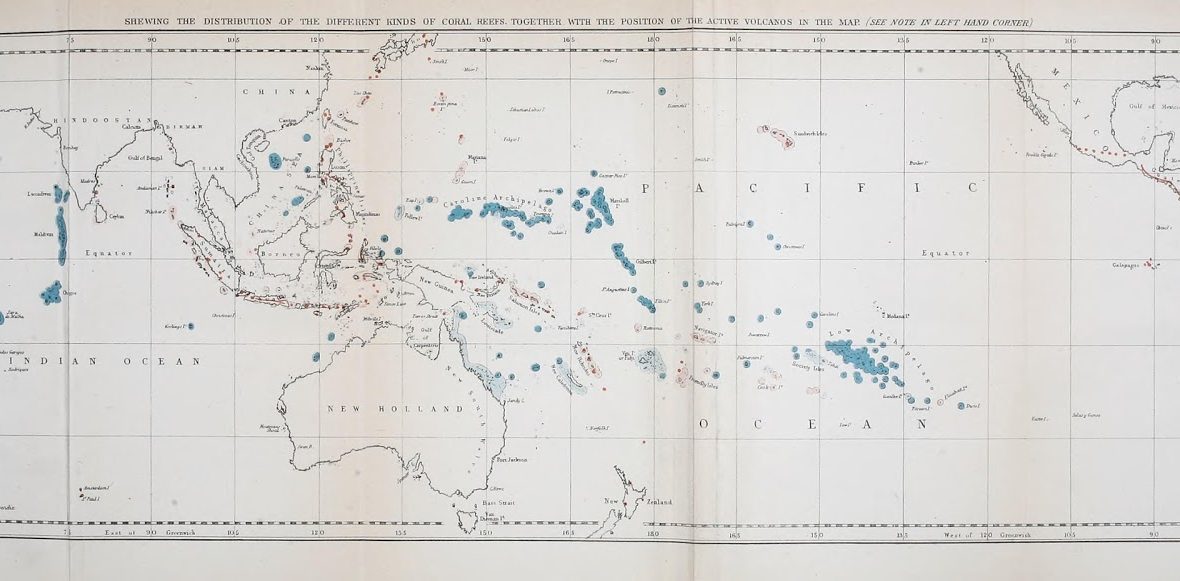
Distribution of known coral reefs of the world during Darwin’s time, including the types. Darwin, Charles. The Structure and Distribution of Coral Reefs. 1842. http://biodiversitylibrary.org/page/40453231.

Darwin developed his theory about the formation of coral reefs and atolls during his famous Beagle voyage (1831-36). He published the theory as his first monograph in 1842 as The Structure and Distribution of Coral Reefs, Being the first part of the geology of the voyage of the Beagle, under the command of Capt. Fitzroy, R.N. during the years 1832 to 1836.

The process by which corals and atolls are formed was a popularly-debated scientific question in the early 19th century. Darwin’s coral theory stated that atolls formed from a gradual process from fringing reefs to barrier reefs and finally atolls. As Gordon Chancellor explains in Darwin Online,

“In clean, agitated, tropical seas corals will form fringing reefs just below low tide level. If the coastline is being elevated (as for example may happen if the island is an active volcano) this type of reef should persist but as soon as the living coral is raised above the surf it will die and become a strip of white limestone. If the coastline is stable, the coral will gradually grow out from the shore to become a barrier reef. If the coast is sinking, as Darwin thought was happening to hundreds of islands in the south Pacific, the coral might keep pace by growing upwards but as the land sinks beneath the waves all that would remain would be a more or less circular atoll. Eventually the rate of subsidence might prove too fast, or (perhaps as in our own times of global warming) sea level will rise too fast and the atoll will die.”

Although Darwin’s theory was widely but not universally accepted during his lifetime, modern investigations support his ideas. Coral Reefs also helped establish Darwin’s reputation as a leading scientific mind and helped provde him with the credibility he needed to have his theory of evolution taken seriously. Indeed, Coral Reefs was not only Darwin’s first monograph, but it also demonstrated a common theme throughout all of Darwin’s theories – that gradual change over time, often the result of an aggregation of the individual actions of small organisms, can account for the entire history of our planet and the species, ecosystems, and geological formations we see today.

View Full Size Image
Various atolls illustrated by Darwin. Darwin, Charles. The Structure and Distribution of Coral Reefs. 1842. http://biodiversitylibrary.org/page/40453240.

The First Textbook on Oceanography: The Physical Geography of the Sea

Oceanography is defined as the study of the ocean, and it can include many topics such as marine life, ocean currents, waves, plate tectonics, meteorology, and many others. Matthew Fontaine Maury, who served in the United States Navy from 1825-61, is sometimes called the “Father of Modern Oceanography and Naval Meteorology.” By studying old ship logs, Maury was able to make important deductions about ocean currents and winds, which resulted in the 1847 publication of Wind and Current Chart of the North Atlantic, which amassed this information to produce a guide to help sailors reduce the length of ocean voyages. Maury also used these ship logs to chart whale migrations, and this research in turn led him to advocate for the existence of a Northwest Passage, through which whales could gain access to both the Atlantic and Pacific Oceans.

View Full Size Image
Illustrating various winds, ship passages, and lengths. Maury, Matthew Fontaine. The Physical Geography of the Sea. 1855. http://biodiversitylibrary.org/page/47369923.

In 1855, Maury published The Physical Geography of the Sea, which is considered the first extensive and comprehensive book on oceanography. As Maury states, the work is “a philosophical account of the winds and currents of the sea; of the circulation of the atmosphere and ocean; [and] of the temperature and depth of the sea” and includes discussions about ocean salinity and many perplexing ocean phenomena, including the Gulf Stream. Although today we know that much of Maury’s science is incorrect, this book helped popularize oceans and the science of the seas and laid the foundation for much of the oceanographic research that followed.

The Foundations of Modern Oceanography: The Challenger Expedition

While the field of ichthyology continued to expand throughout the 16th – 19th centuries, and publications on oceanography including ocean currents and their effects on meteorology appeared in the mid-1800s, even by the 19th century, scientific knowledge about Earth’s watery depths was still very limited. In fact, until the middle of the nineteenth century, many still subscribed to the Abyssal Theory, which stated that life could not exist below about 600 meters (2,000 feet).

View Full Size Image
Radiolaria by Ernst Haeckel, collected during the Challenger Expedition. Report on the scientific results of the voyage of H.M.S. Challenger during the years 1873-76. v. 18 plates. 1887. http://biodiversitylibrary.org/page/39632734.

In 1872, the Royal Society of London launched the first non-commercial exploration of the deep sea – the Challenger Expedition. The purposes of the expedition were to investigate the physical conditions of the deep sea, ascertain the chemical composition of seawater at various depths, determine the physical and chemical character and sources of deep-sea deposits, and investigate the distribution of organic life at different depths. The expedition circumnavigated the globe, traveling nearly 70,000 nautical miles from 1872-76, and resulted in the discovery of nearly 4,700 new-to-science species of marine life, 492 deep sea soundings, 133 bottom dredges, 151 open water trawls, and 263 serial water temperature observations. In 1875, the crew also recorded a sounding of 4,475 fathoms, (8,184 meters), which would later prove to be the southern end of the Mariana trench and one of the deepest known places on the ocean floor. The expedition was monumental in broadening knowledge of the ocean’s depths and species, and revolutionized the field of oceanography.

View Full Size Image
Starfish from Percy Sladen collected during the Challenger Expedition. Report on the scientific results of the voyage of H.M.S. Challenger during the years 1873-76. v. 30 plates. 1887. http://biodiversitylibrary.org/page/25170168.

The findings from the expedition were published in 50 volumes from 1880-95 as the series Report Of The Scientific Results of the Exploring Voyage of H.M.S. Challenger during the years 1873-76. Sir John Murray, pioneering Scottish oceanographer, described the report as, “the greatest advance in the knowledge of our planet since the celebrated discoveries of the fifteenth and sixteenth centuries.”

Uncovering the Deep Ocean: The Valdivia Expedition

The success of the Challenger Expedition ignited a fever to explore the deep sea and the creatures that called it home. In the late nineteenth century, German marine biologist Carl Chun proposed the first German deep-sea expedition, which was approved by Germany’s last Kaiser, Wilhelm II. In 1898, with national funding, the Valdivia Expedition set sail from Hamburg for the subantarctic seas with a mission to sample, record, and study as many deep-sea organisms and habitats as possible. Covering over 32,000 nautical miles and visiting 268 stations around the West Coast of South Africa, the Gulf of Guinea, the Antarctic Sea, and a large portion of the Indian Ocean, the expedition used the dredging techniques popularized on the Challenger Expedition to collect deep-sea specimens. The expedition was a resounding success, resulting in the discovery of many new deep-sea species, including the vampire squid, which Chun named Vampyroteuthis infernalis, meaning “vampire squid from hell.” The results of the expedition were published over a four-decade period in a 24-volume series entitled Wissenschaftliche Ergebnisse der Deutschen Tiefsee-Expedition auf dem Dampfer “Valdivia” 1898-1899.

View Full Size Image
Deep sea fish collected during the Valdivia Expedition. Wissenschaftliche Ergebnisse der Deutschen Tiefsee-Expedition auf dem Dampfer “Valdivia” 1898-1899. Bd. 15, T. 1. 1908. http://biodiversitylibrary.org/page/6002199.

One of the most important volumes in this series was August Brauer’s report on the deep-sea fishes discovered on the expedition. Published as the series’ fifteenth volume in 1908, Die Tiefsee-Fische is considered the starting point of deep-sea ichthyology. The volume also firmly established the widespread global existence of fish in the bathypelagic zone (depth of 3,300-13,000 feet) and documented the sensory adaptations and bioluminescent capabilities of many deep-sea species. A highlight of the publication are the 44 plates created by the shipboard artist and scientific draftsman Fritz Winter, with whom Brauer collaborated closely to ensure the lifelike, accurate representation of the described specimens.

View Full Size Image
Deep sea fish collected during the Valdivia Expedition. Wissenschaftliche Ergebnisse der Deutschen Tiefsee-Expedition auf dem Dampfer “Valdivia” 1898-1899. Bd. 15, T. 1. 1908. http://biodiversitylibrary.org/page/6002204.

More World Oceans Day Resources

  • Follow us on Twitter, Facebook, and this blog all this week as we explore marine biodiversity and awesome related publications in BHL.
  • Check out some monumental publications in historic and present-day marine bioscience research in our BHL collection.
  • Browse a selection of marine biodiversity illustrations in Flickr and Pinterst
June 3, 2015by ulib-libraryjobs

Help Support BHL

BHL's existence depends on the financial support of its patrons. Help us keep this free resource alive!

search

About BHL

The Biodiversity Heritage Library (BHL) is the world’s largest open access digital library for biodiversity literature and archives. BHL operates as a worldwide consortium of natural history, botanical, research, and national libraries working together to digitize the natural history literature held in their collections and make it freely available for open access as part of a global “biodiversity community.”

Join Our Mailing List

Sign up to receive the latest news, content highlights, and promotions.

Subscribe Now

Subscribe to Blog via Email

Enter your email address to subscribe to this blog and receive notifications of new posts by email.

Join 319 other subscribers

Subscribe to Blog Via RSS

Subscribe to the blog RSS feed to stay up-to-date on all the latest BHL posts.

Access RSS Feed

Inspiring Discovery through Free Access to Biodiversity Knowledge.

The Biodiversity Heritage Library makes it easier than ever for you to access the information you need to study and explore life on Earth…for free, anytime, anywhere.


64+ Million Pages of
Biodiversity Literature Online.

EXPLORE

Tools and Services
to Transform Research.

EXPLORE

300,000+
Illustrations on Flickr.

EXPLORE

ABOUT | HARMFUL CONTENT | PRIVACY | SITE MAP | TERMS OF USE