Biodiversity Heritage Library - Program news and collection highlights from BHL
  • Home
  • News
  • Featured Books
    • All Featured Books
    • Book of the Month Series
    • BHL at 20
  • User Stories
  • Campaigns
    • Fossil Stories
    • Garden Stories
    • Monsters Are Real
    • Page Frights
    • Her Natural History
    • Earth Optimism 2020
  • Tech Blog
  • Visit BHL
Home
News
Featured Books
    All Featured Books
    Book of the Month Series
    BHL at 20
User Stories
Campaigns
    Fossil Stories
    Garden Stories
    Monsters Are Real
    Page Frights
    Her Natural History
    Earth Optimism 2020
Tech Blog
Visit BHL
  • Home
  • News
  • Featured Books
    • All Featured Books
    • Book of the Month Series
    • BHL at 20
  • User Stories
  • Campaigns
    • Fossil Stories
    • Garden Stories
    • Monsters Are Real
    • Page Frights
    • Her Natural History
    • Earth Optimism 2020
  • Tech Blog
  • Visit BHL
Biodiversity Heritage Library - Program news and collection highlights from BHL
Blog Reel, User Stories

“What a Gem!” BHL Supports Teuthology Research

Here’s a word of the day for you: Teuthology.

What does it mean? It’s the study of cephalopods. What are cephalopods? Well, they are a class of mollusks that include two extant subclasses: Coleoidea and Nautiloidea.

Still not sure what cephalopods are? You probably know them by their more common monikers: octopuses, squid, cuttlefish, and nautiluses. There are over 800 living species of cephalopods known today.

View Full Size Image
Dr. Ian G. Gleadall, Reader in Marine Biology at the International Fisheries Science Unit of Tohoku University Graduate School of Agricultural Sciences, Sendai, Japan.

Dr. Ian G. Gleadall has been studying the biology of cephalopods (particularly octopuses) for 40 years. Dr. Gleadall (a marine biologist who works in Sendai, Japan) discovered BHL in November, 2014 while visiting the National Museum of Natural History in Paris. It has had a profound impact on his research. As Dr. Gleadall explains:

“[BHL] is a truly wonderful tool. Highly useful, reliable in operation, intuitive and easy to use. I have been writing a complex systematic review of cephalopod taxonomy, with an emphasis on the octopuses of the Indo-Pacific region, particularly centred on the seas of the Japanese Archipelago. Because of many previous errors and unclear references to earlier studies in this field, I had recently decided to go deeper into previous naming systems for the Cephalopoda, particularly as regards the various groups of octopus.

“There are a number of different, rival schemes in taxonomy, so it is necessary to read the original description for each name in order to assess which should be regarded as the most appropriate to use. Many of the earlier works were published in rare and valuable tomes which are now difficult to get hold of. These books are sometimes huge in size and libraries are reluctant to have them inspected at first hand because their condition is often deteriorating and they may be heavy and difficult to handle. Getting copies of such works is in itself often very difficult and the administrative procedures can be frustrating and time consuming. It is also expensive to visit each institution concerned in many different countries.

“However, the BHL online catalogue of works provides access to a large number of such rare works, allowing me to find and study many of the books I need to use from the comfort of my laptop computer and a wireless internet connection. If I want to have copies of relevant sections, it is very easy to mark pages for collation into a customized PDF file, or even to download an entire book. This service has proven to be extremely valuable to me.

“Over recent months I have been able to quickly gain access to many older texts and this has enabled me to achieve my aims far quicker than would otherwise have been possible. For example, often when I read a new work, I find further references to works that I previously was not aware of. I can then quickly look for (and find) those using BHL. Normally, this could involve having to revisit a library in another country that I have already visited once, or I would have to try to get the library staff to send me a copy, neither of which is as fast or convenient as using BHL.”

During intensive periods of study, Dr. Gleadall uses BHL daily, sometimes downloading up to four 4 custom PDFs in a day, in addition to studying other materials online. It’s not surprising, then, that the ability to download custom PDFs is Dr. Gleadall’s favorite feature on BHL.

“About half of the publications that I access on BHL I read online and take notes. Where there is a lot of material and I do not have time to complete my work in a single session (or if there are many data-dense tables, for example), I’ll select the pages that I’m interested in and arrange for a custom PDF,” explains Dr. Gleadall. “[The custom PDF service] is so easy and intuitive to use (why can’t other internet services be so convenient and trouble-free?!).”
View Full Size Image
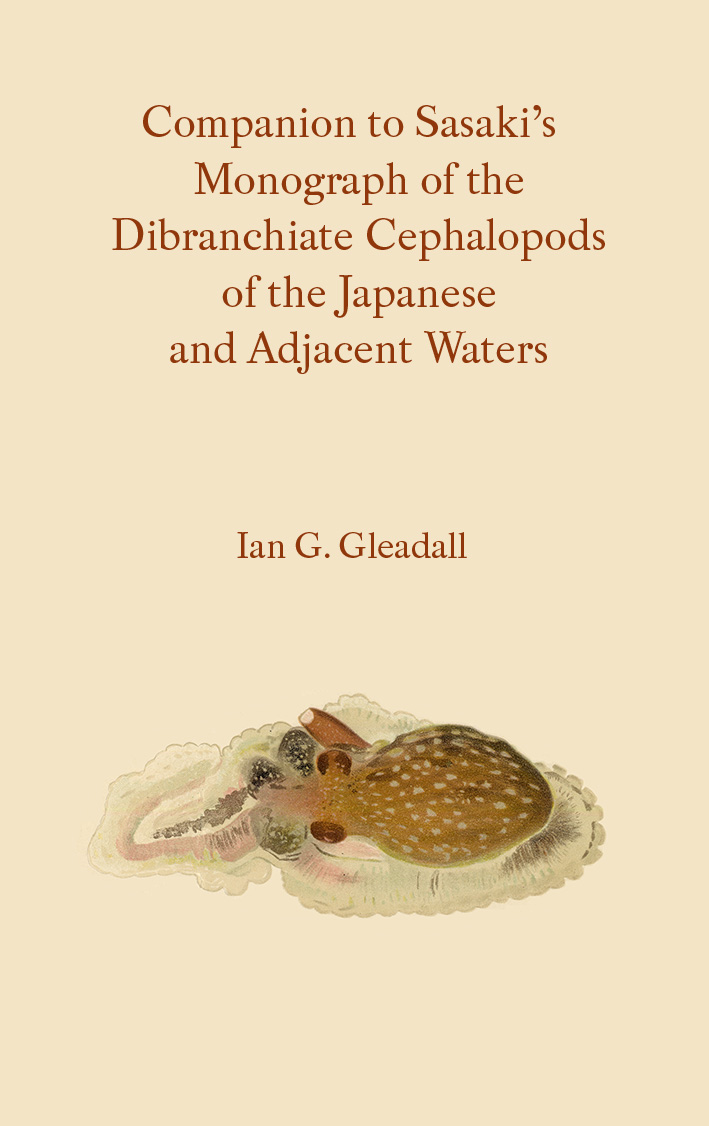
A book by Ian Gleadall (in the final stages of publication) concerning the classic 1929 monograph on the Cephalopoda by Madoka Sasaki. In writing this book, many of the references required to prepare the synonymies of various cephalopod orders, families, genera and species were viewed using the BHL online archive.

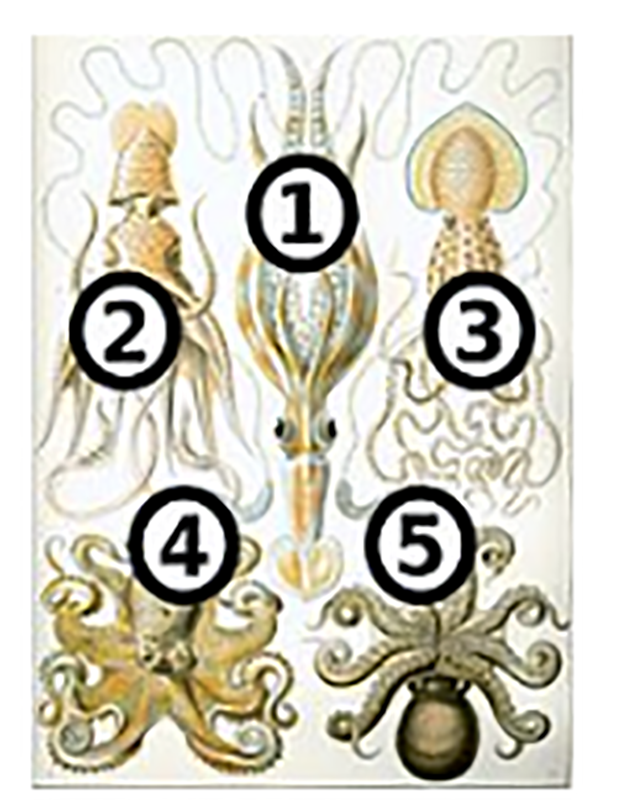
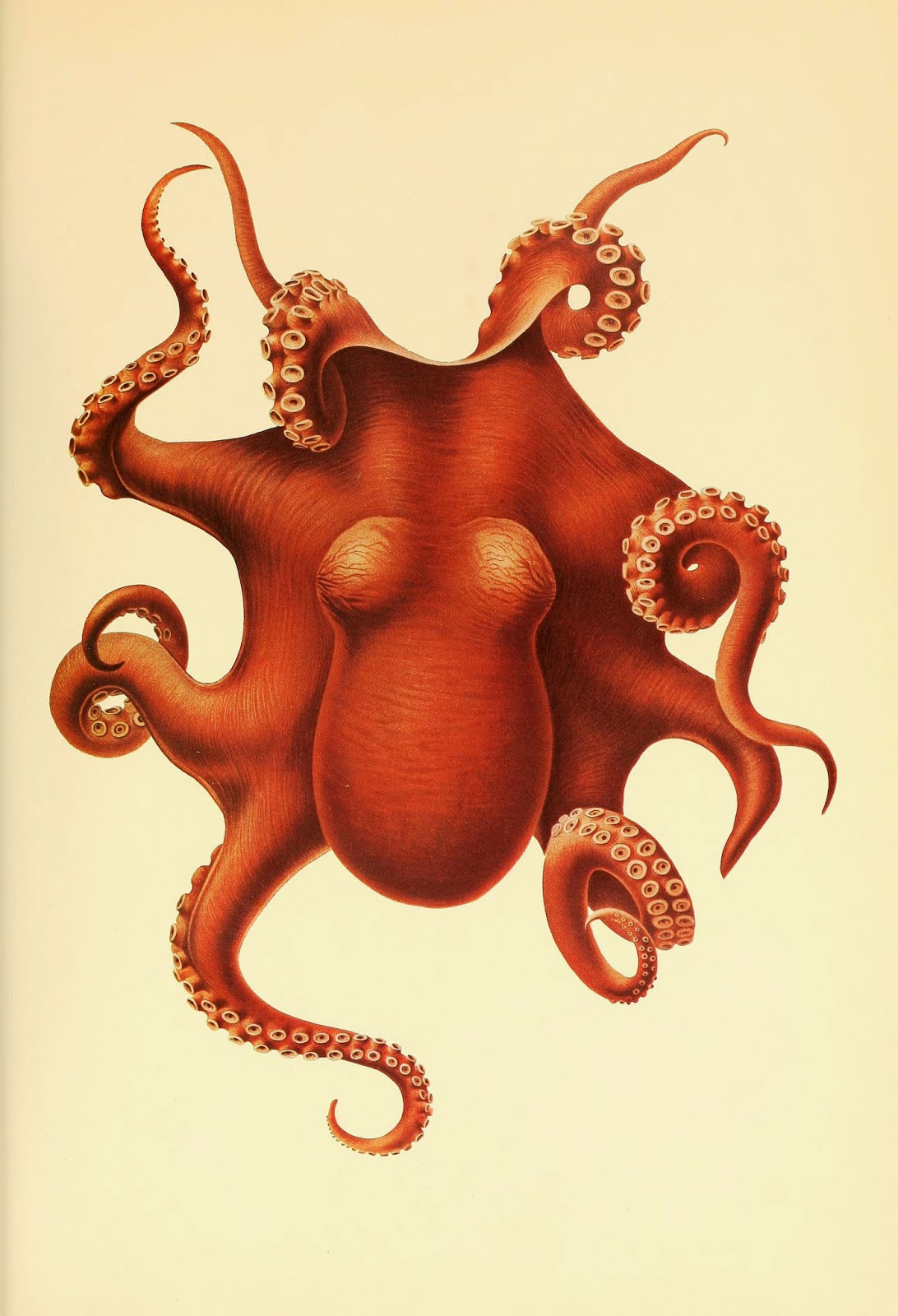
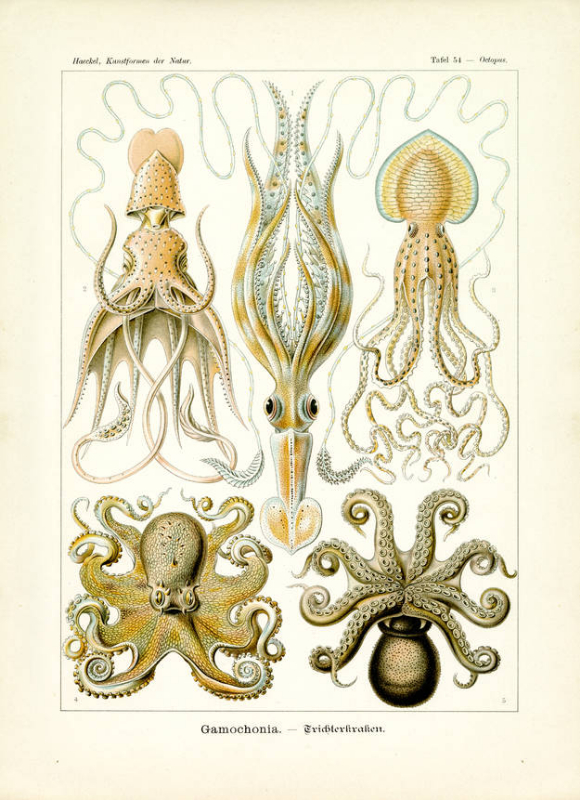
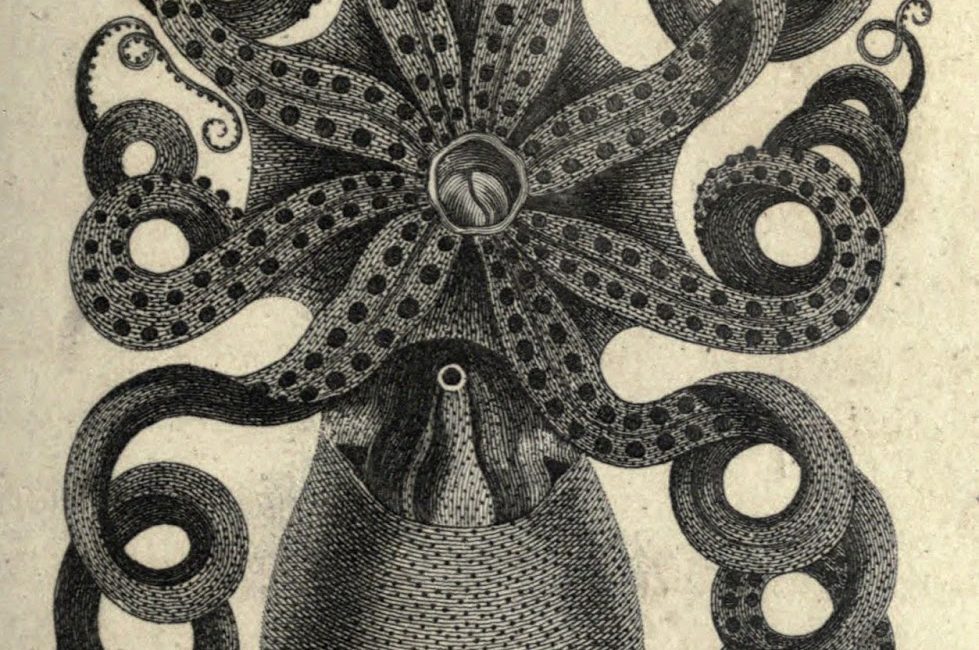
A highlight for Dr. Gleadall in his research is the opportunity to explore some of the beautiful works of art that are part of the heritage of biological description, such as the stunning cephalopod lithograph created by Ernst Haeckel as part of his Kunstformen der Natur (1904).
View Full Size Image
54th plate from Ernst Haeckel’s Kunstformen der Natur (1904), depicting squids and octopuses classified as Gamochonia. http://biodiversitylibrary.org/page/47388247.
View Full Size Image
Key to Haeckel’s plate, above. 1) Chiroteuthis veranyi (Férussac); 2) Histioteuthis ruppellii (Vérany); 3) Pinnoctopus cordiformis (Quoy and Gaimard); 4) Octopus vulgaris(Lamarck); 5) Octopus granulatus (Lamarck).

“In modern times, there are many artful illustrations and computer graphic images, but many people are unaware of the gorgeous images of more than 100 years ago, where no expense was spared to produce magnificent series of books reporting on the collections from localities far and wide by the early explorers,” lauds Dr. Gleadall.

While the experience of seeing these illustrations in person creates an impression that a computer screen cannot quite replicate (as Dr. Gleadall explains, many of the rare volumes containing these artworks are massive in size), it is often difficult to gain access to such works in physical library collections. The availability of these books in BHL, and the artwork on the BHL Flickr, ensures that everyone can see and experience this wonderful biodiversity heritage.

It is this immediate and unrestricted access that has most-impacted Dr. Gleadall’s work.

“BHL has considerably smoothed the way for me and speeded up the rate at which I can view a large number of relevant references. I look forward to being able to publish my results far more quickly than would otherwise have been possible without BHL. Many thanks.”

Thank you, Dr. Gleadall, for sharing with us the impact that BHL has on your work. Do you use BHL to support your own research? Want to tell us about it? Send an email to [email protected]!
September 10, 2015by michelle.underhill
Blog Reel, Campaigns, Featured Books, Monsters Are Real

The Octopus…The Monster that Isn’t

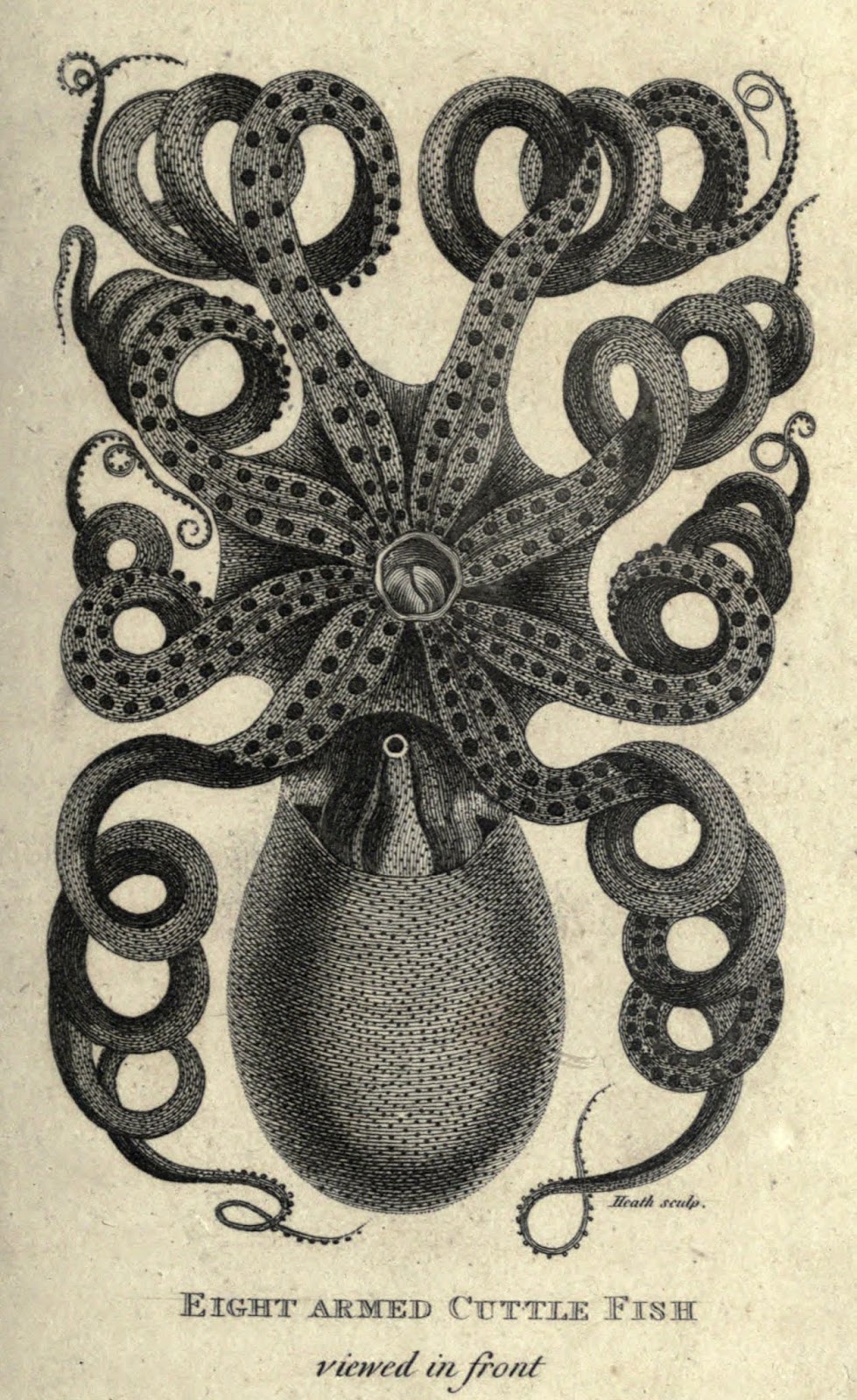
“…A very formidable animal, and possess[ing] such a degree of strength as to make it dangerous to attack it without great precaution. Such is the ferocity and violence with which it defends itself, that even the strongest Mastiff can hardly subdue it without a long and doubtful contest. It has even been known to attack a person while swimming, and to fasten itself with dangerous force round the body and limbs.”

Such a description conjures up images of a great behemoth, perhaps with sharp fangs, great talons, and fiery red eyes. It was given by George Shaw in a lecture to the Royal Institute and published in 1809.

It is a description of the Curled Octopus (Eledone cirrhosa), reaching a total size of 5-15 inches. Not quite the beast the description implies…

View Full Size Image
“Eight Armed Cuttle Fish” aka Curled Octopus. Shaw, George. Zoological Lectures Delivered at the Royal Institution by George Shaw. v. 2. 1809. http://biodiversitylibrary.org/page/21511926.

The octopus, like the squid (aka kraken), has long held an unwarranted reputation as a monster. “Their strangely repulsive appearance, and the fictional stories of their attacks, have built up in the popular mind a picture of the ‘devil fish’ which no amount of accurate description is ever likely to cut down to authentic size,” mused Frank W. Lane in Kingdom of the Octopus (1962).

“Ever since people started writing about such things – and probably when they only talked about them – they have never been content simply to name and describe the octopus, but have insisted on passing judgment upon it,” wrote James Artz of the American Museum of Natural History (Ellis, pg. 257).

View Full Size Image
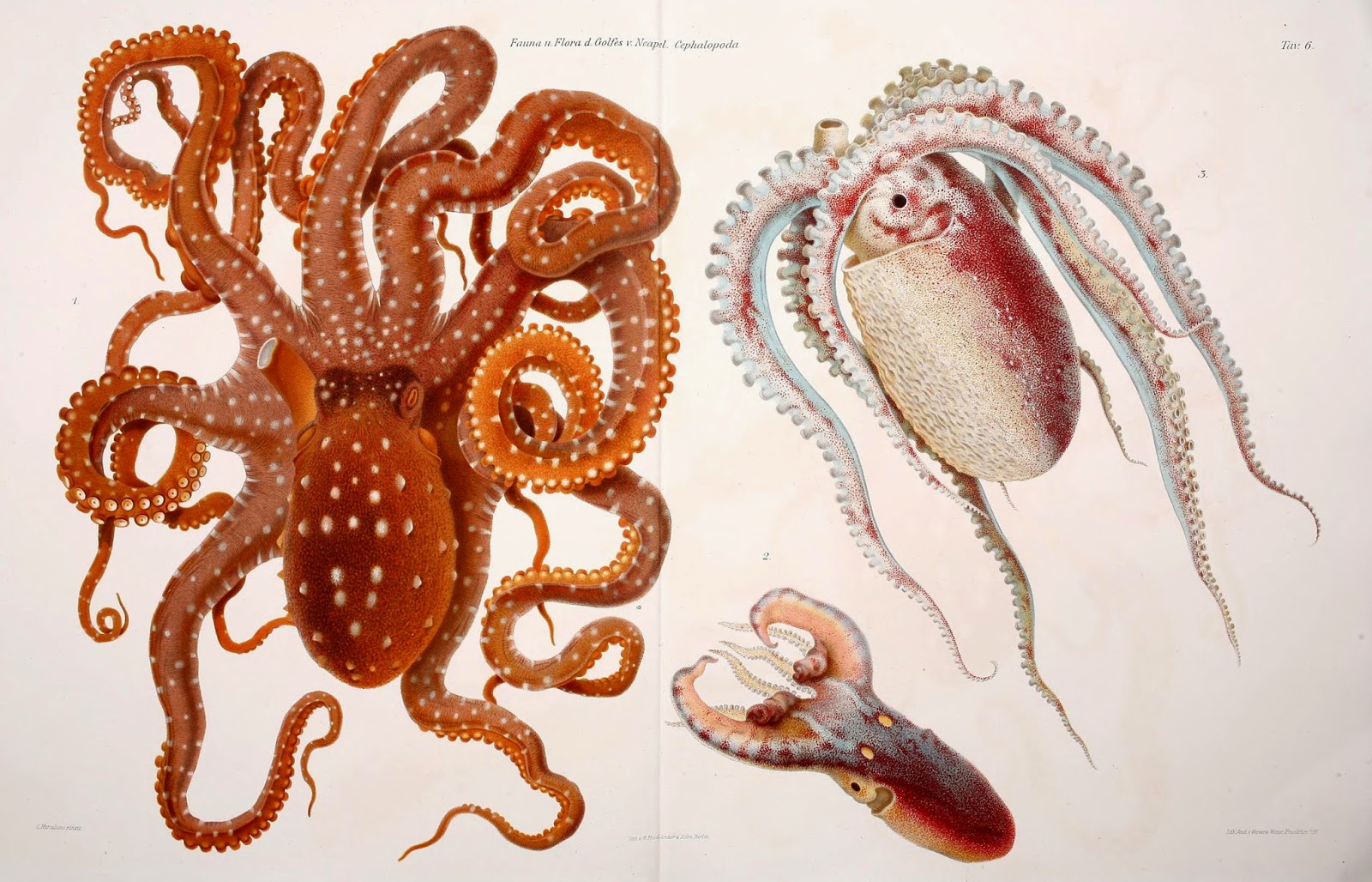
Amazing Mollusca from the Gulf of Naples: Octopus macropus, Tremoctopus violaceus, and Ocythoe tuberculata. Jatta, Giuseppe. I Cefalopodi viventi nel Golfo di Napoli (sistematica) : monografia. 1896. http://biodiversitylibrary.org/page/35424286.

Accounts of the Octopus’ “vile” personality can be found throughout hundreds of years’ worth of literature, even well into the twentieth century and by respected scientists.

The Octopus as Monster

In the first century AD, Pliny the Elder positions the octopus (which he labels a polyp, along with squids) as a gruesome monster, writing, “no animal is more savage in causing the death of a man in the water; for it struggles with him by coiling round him and it swallows him with its sucker-cups and drags him asunder by its multiple suction” (Ellis, pg. 261).

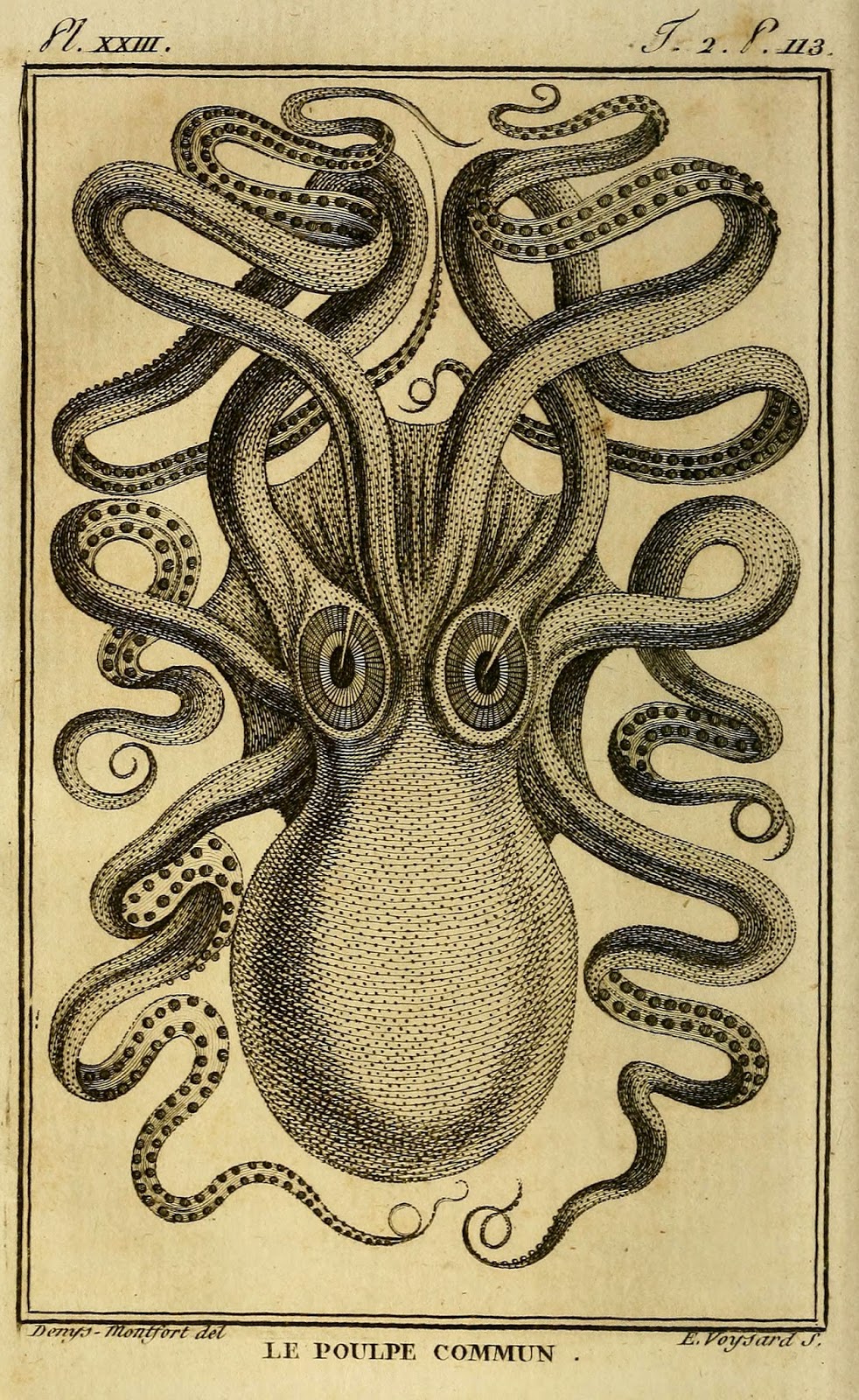
Not surprisingly, Denys de Montfort, the personality behind the legendary kraken image, could not resist the opportunity to contribute to the growing octopus lore in the early nineteenth century. Within Histoire Naturelle Générale et Particulière des Mollusques, he describes an episode where an octopus attacked and nearly succeeded in drowning his dog on the beach. He and his dog were finally able to subdue the monster by tearing off its arms…Given Montfort’s demonstrated history of untruths, his account is hardly to be believed.

View Full Size Image
“The Common Octopus.” Montfort, Denys. Histoire naturelle, générale et particulière des mollusques : animaux sans vertèbres et a sang blanc. v. 2. 1801. http://biodiversitylibrary.org/page/35755415.

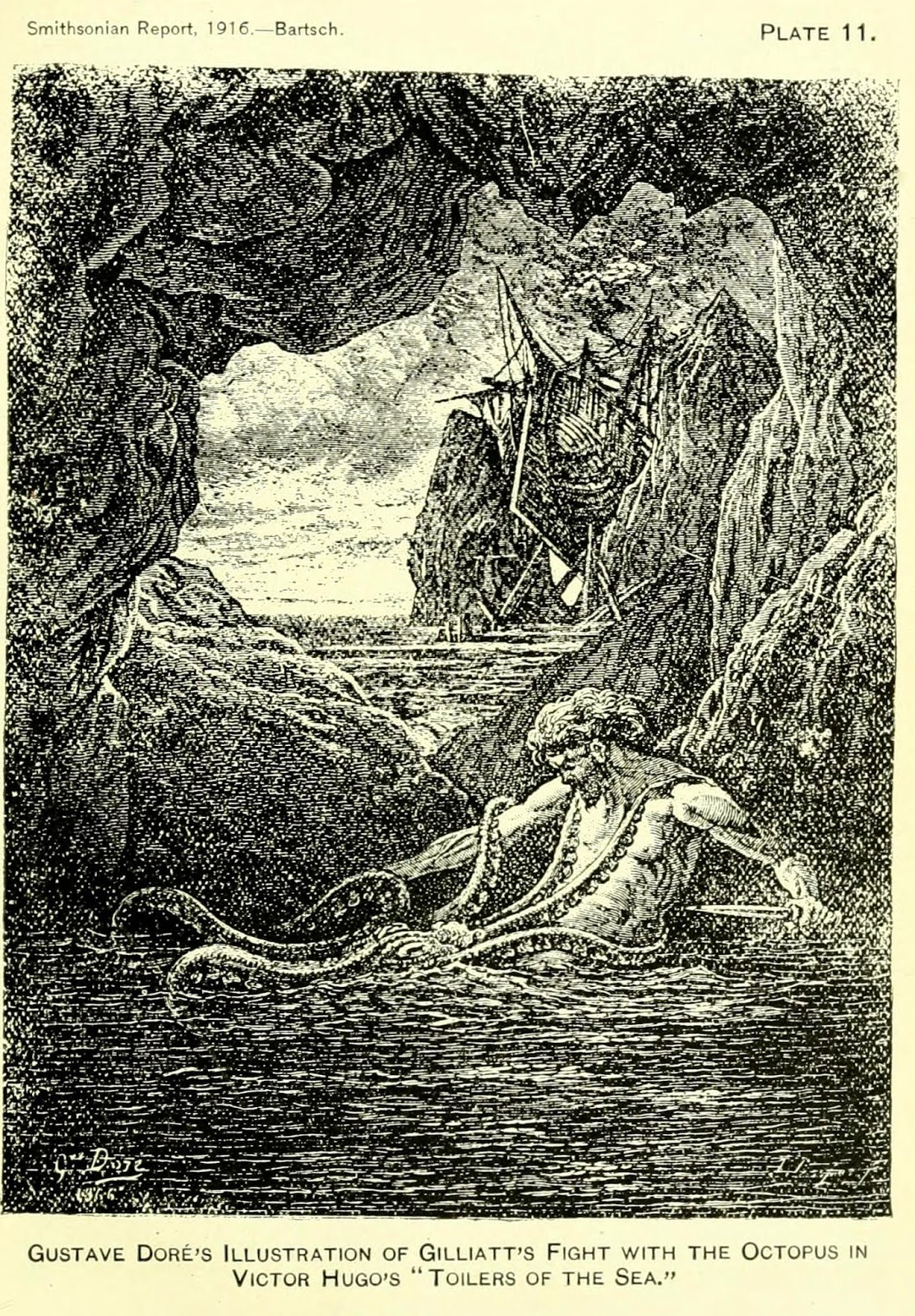
Perhaps the most sensational, and damaging, account of the octopus was presented by Victor Hugo in Toilers of the Sea (1866). Within it, Hugo describes his protagonist’s (Gillat) encounter with an octopus in a cave, which does its utmost to annihilate him. Hugo writes of the beast’s attack: “The hydra incorporates itself with the man; the man becomes one with the hydra. The spectre lies upon you…the devil-fish, horrible, sucks your life blood away…Powerless, you feel yourself gradually emptied into this horrible pouch, which is the monster itself.”

View Full Size Image
Gillat’s struggle with the “monster” octopus, as described in Toilers of the Sea. Annual Report of the Board of Regents of the Smithsonian Institution. 1916. http://biodiversitylibrary.org/page/14187072.

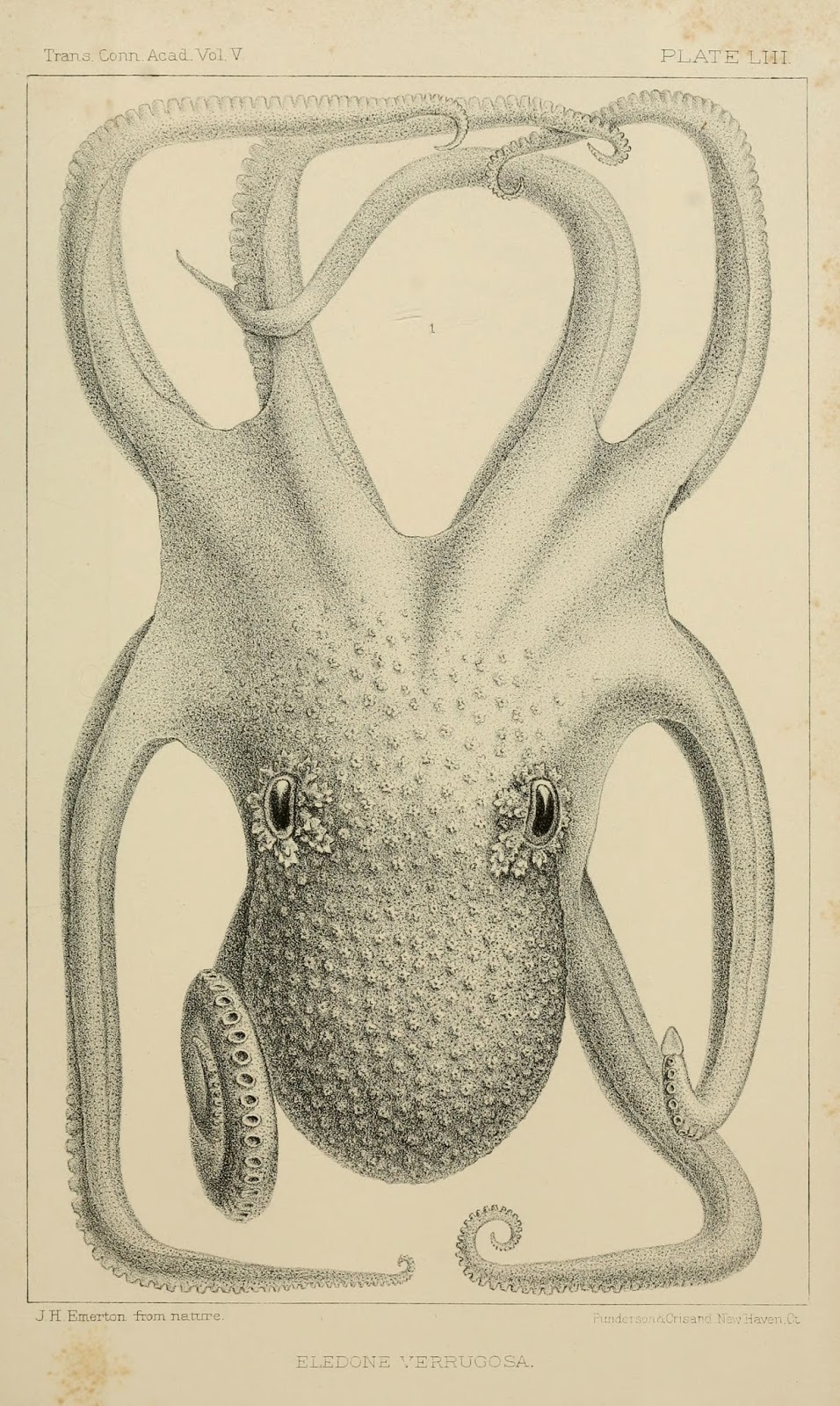
Henry Lee and Addison Verrill, both of whom wrote extensively on squid and octopus, boldly challenged Hugo’s passages, outlining the multiple fallacies included. In Cephalopods of the North-eastern Coast of America, Verrill writes, “The description of the ‘poulpe’ or devil-fish by Victor Hugo…is quite as fabulous and unreal as any of the earlier accounts, and even more bizarre. His description represents no real animal whatever.”

View Full Size Image
Graneledone verrucosa. Verrill, A.E. Cephalopods of the North-eastern Coast of America. v. 2. 1881. http://biodiversitylibrary.org/page/11826821.

Unfortunately, such melodramatic accounts, popular among the public, helped to further secure the octopus’ reputation as a monster, despite the counterarguments against them.

Similar descriptions of the octopus as a monster continued into the twentieth century. For instance, a 1907 fieldbook from Florence Merriam Bailey, American ornithologist and nature writer, whilst in California, deems the octopus a “horrible creature,” describing an episode where a friend was attacked by one in Bermuda. “Their strength is tremendous & they put out [[strikethrough]] au [[/strikethrough]] arms and grasp you and hold on with suction discs & then draw the object up and cut it across the back of the neck with thin knives.”

View Full Size Image
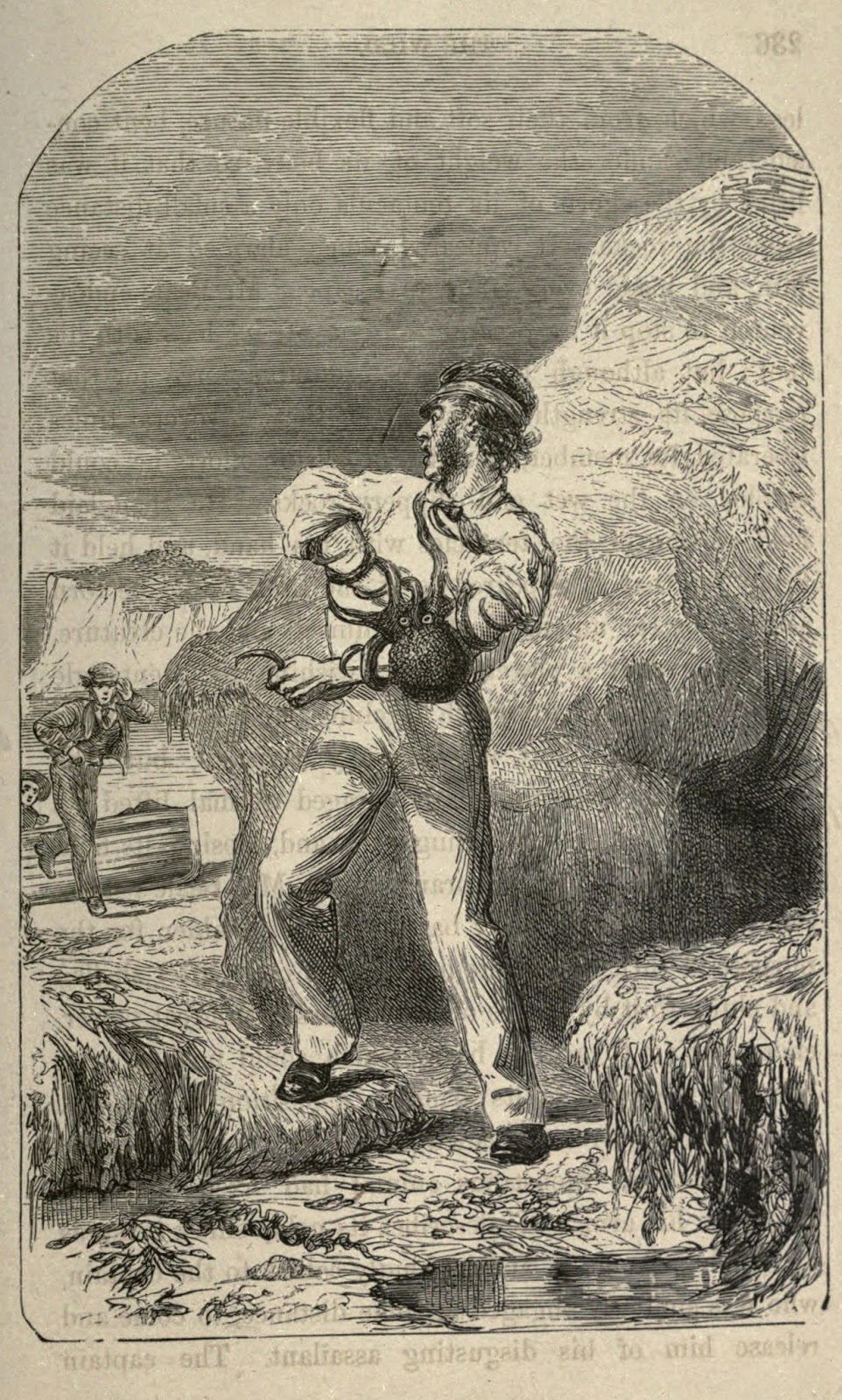
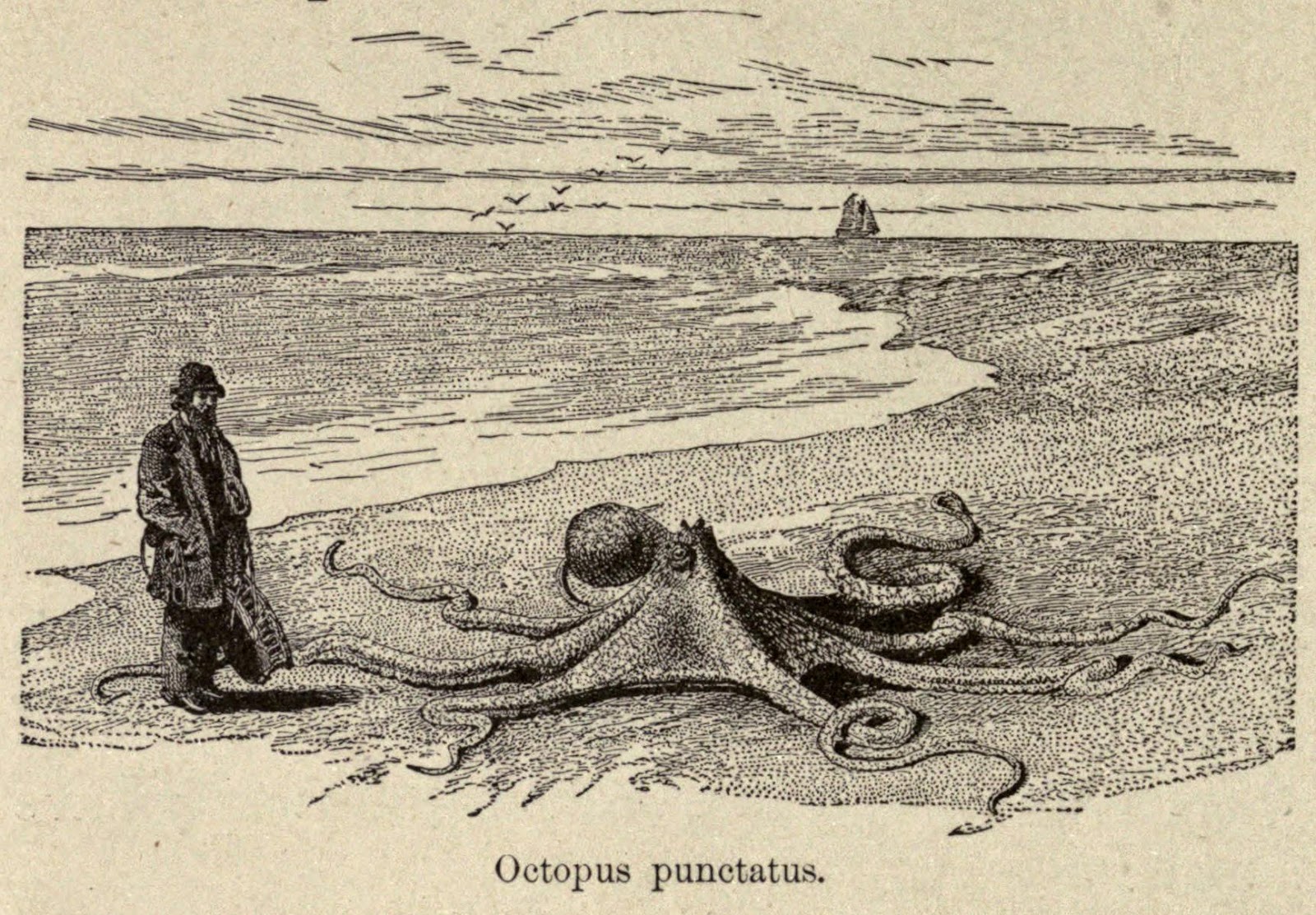
Thomas Beale, surgeon on a British whaling voyage in 1835, claimed he was attacked by an octopus on the beach on the Bonin Islands, south of Japan. Gosse, Philip Henry. The Romance of Natural History. 1864. http://biodiversitylibrary.org/page/23537396.

A 1919 National Geographic article by John Oliver La Gorce, called “Devil-Fishing in the Gulf Stream,” presents the mollusk as “most repulsive, having a large, ugly head, a fierce-looking mouth…two diabolical eyes…capable of sending forth a demonic glare when angered…When challenged [it] will fight to the last, doing its best to pull the object of its wrath beneath the surface of the waters.”

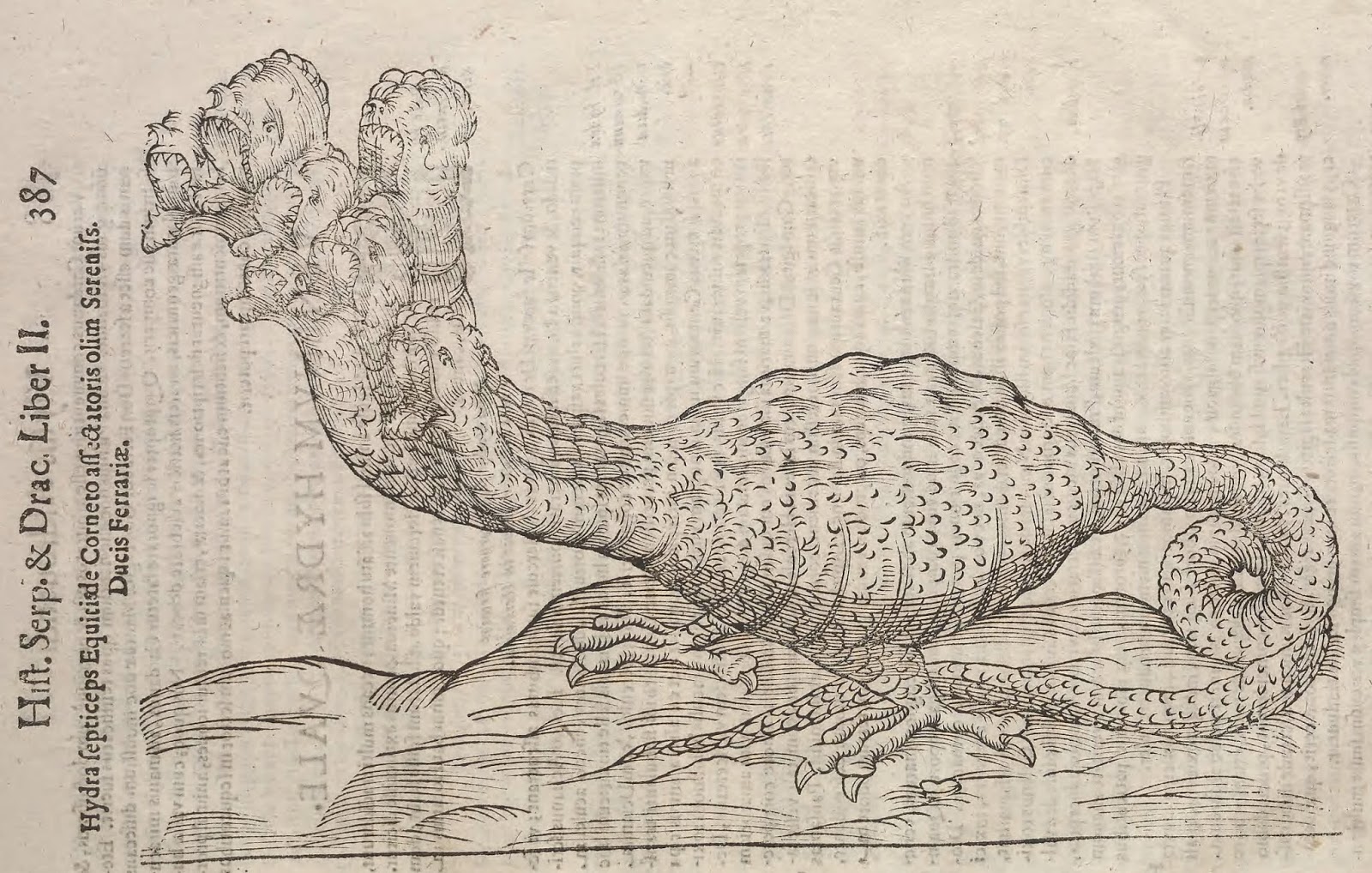
But while natural history has been cruelly unkind to the octopus, presenting the creature itself as a monster, this cephalopod also served to inspire one of mythology’s greatest beasts – The Hydra.

The Hydra: A Case of Mistaken Identity

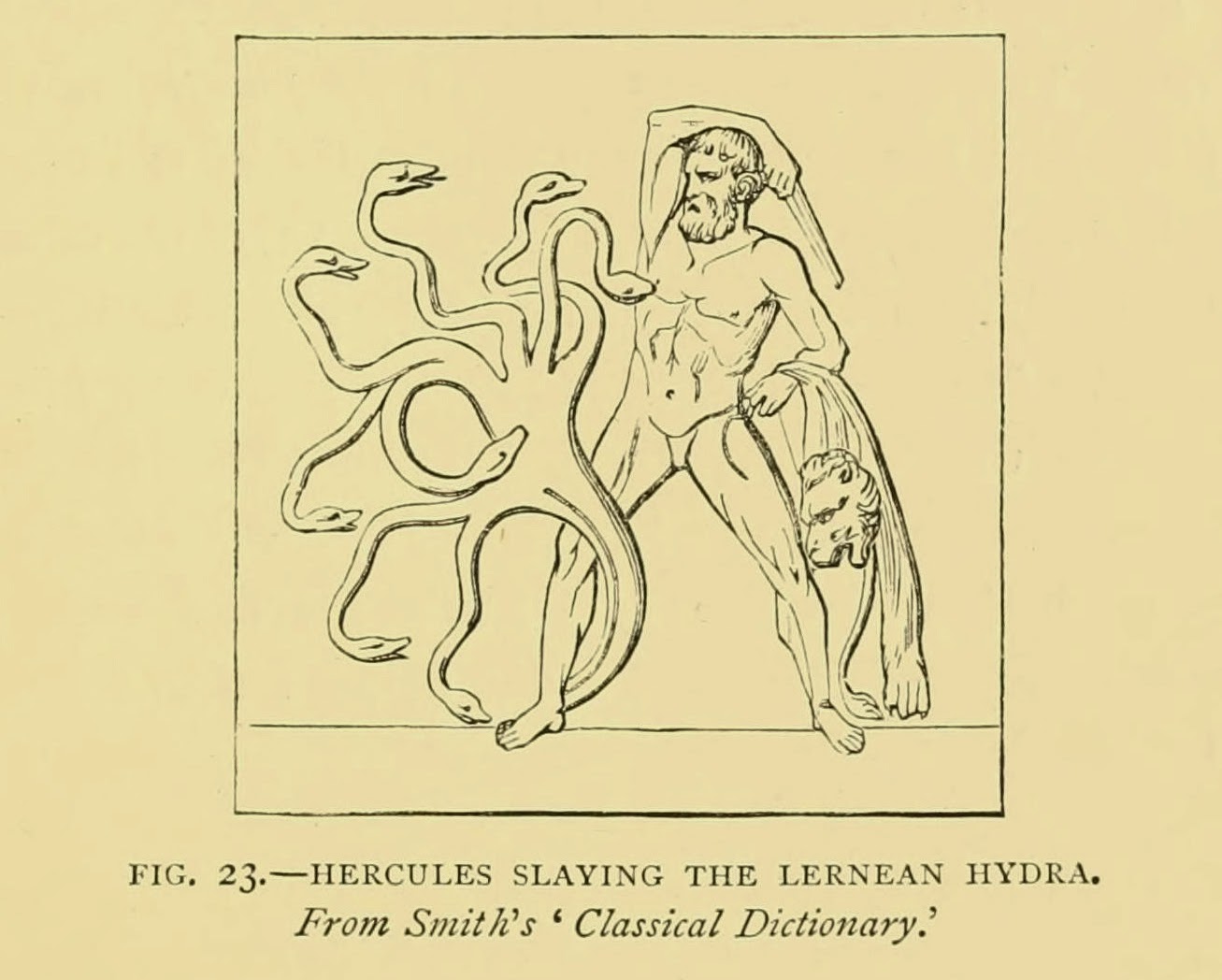
The Hydra is a “mythical” beast most commonly described as having nine heads, each of which will regenerate if decapitated. The Greek hero Hercules was commanded to kill a Hydra as his second labor. The marble tablet in the Vatican depicting this exploit interprets the hydra as a strikingly octopus-like monster.

View Full Size Image
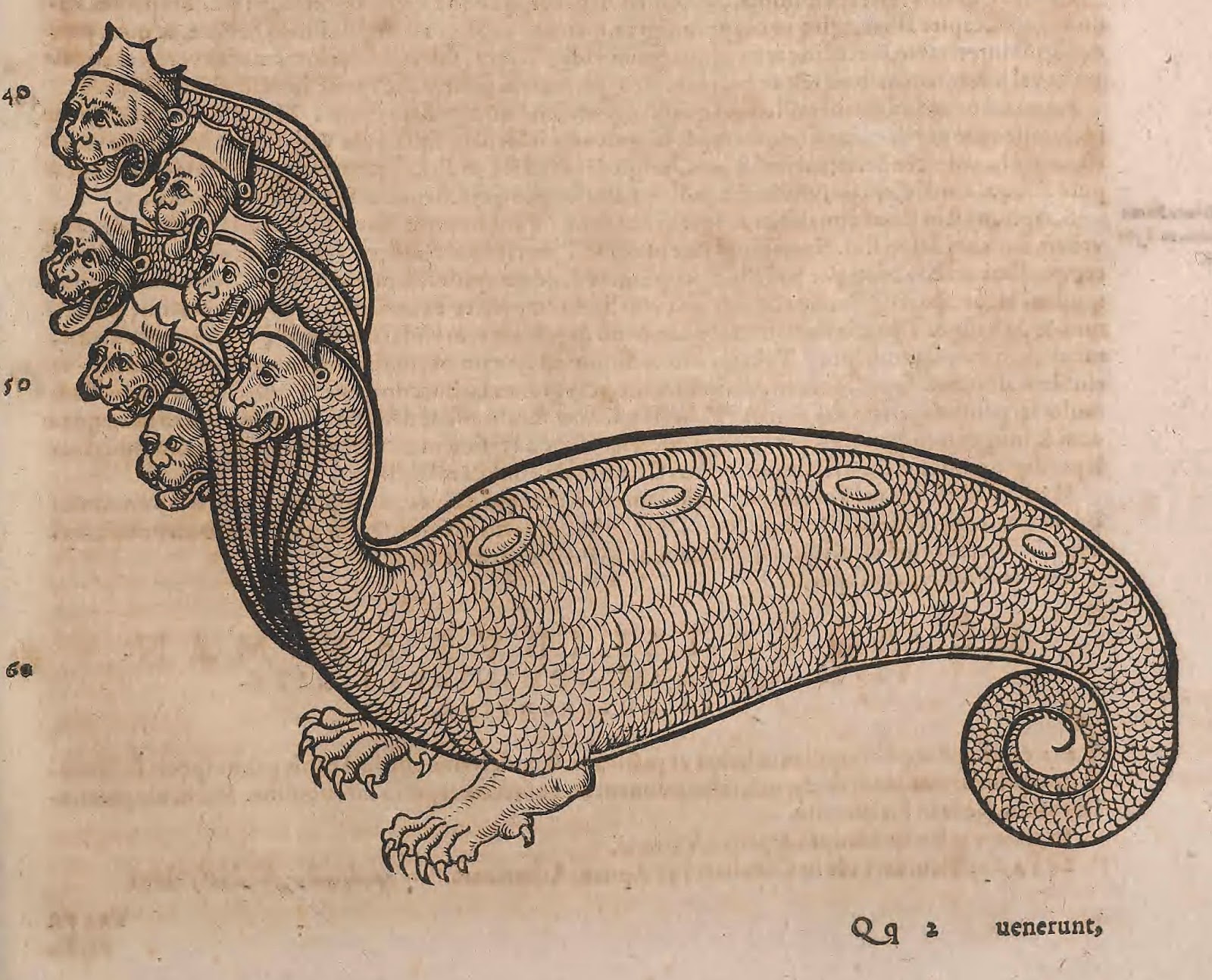
The Hydra, as illustrated by Gessner. Notice the suction-cup like spots on its body…very octopus-like. Gessner, Conrad. Historia Animalium. 2nd Ed. 1604. http://biodiversitylibrary.org/page/42166090.

In the book Sea Fables Explained, Henry Lee writes that the Lernean Hydra was simply a huge Octopus. Many scholars have postulated that hydra are based on octopus. After all, their many tentacles could be misinterpreted as heads, and octopus can regenerate lost limbs, possibly explaining the unending head supply of the hydra.

View Full Size Image
Hercules slaying the Lernean Hydra, as depicted on a marble tablet in the Vatican. Lee, Henry. Sea Fables Explained. 1883. http://biodiversitylibrary.org/page/10985663.

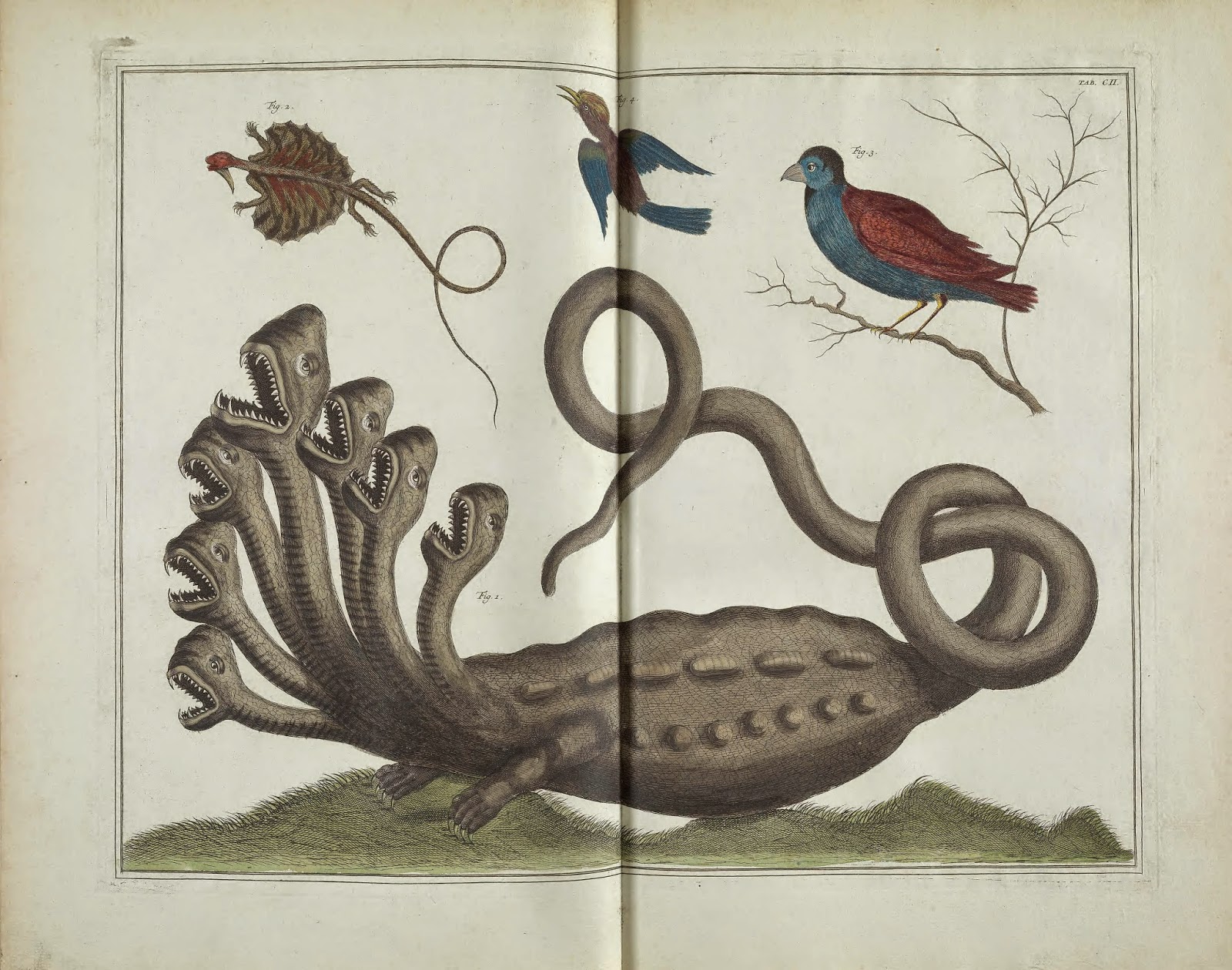
Well into the eighteenth century, many naturalists believed the hydra to be a real creature. Albertus Seba, a famed apothecary from Amsterdam, boasted an extensive cabinet of curiosities, filled with many magnificent biodiversity specimens. From 1734-65, Seba published an account of his cabinet in Locupletissimi rerum naturalium thesauri accurata descriptio, et iconibus artificiosissimis expressio, per universam physices historiam. This work included an image of a hydra, based on a specimen held by the Burgomeister of Hamburg. While Linnaeus later proved this particular specimen to be a fake, an amalgamation of snake skins and weasel heads with possible religious overtones, exaggerated accounts of an octopus likely inspired such monsters in the first place.

View Full Size Image
The Hydra! Seba, Albertus. Locupletissimi rerum naturalium thesauri accurata descriptio, et iconibus artificiosissimis expressio, per universam physices historiam. v. 1. 1734. http://biodiversitylibrary.org/page/41047754.


An Undeserved Reputation and the Monster that Isn’t

The octopus’ “monster” reputation is completely unwarranted. It is hardly necessary to emphasize the fact that the hydra, though inspired by a real animal, is not itself a real species. Debunking longstanding conceptions of the octopus itself as a terrible, vicious monster, however, has proven more difficult.

View Full Size Image
Benthoctopus levis. Chun, Carl. The Cephalopoda. 1975. http://biodiversitylibrary.org/page/32124297.

“The octopus is, in fact, a gentle, curious creature with a surprising ‘intelligence,’” argues marine biologist Richard Ellis of the American Museum of Natural History (Ellis, pg. 261). Around 300 species are recognized, constituting over a third of all cephalopods. They are perhaps the most intelligent invertebrate, demonstrating complex problem-solving abilities and the use of tools.

Octopus range in size from the minute Octopus wolfi, measuring about 0.6 inches in length, to the Giant Pacific Octopus (Enteroctopus dofleini), with a radial span of 20ft (and possibly as much as 32ft) – certainly large enough to inspire some fantastic monster myths. The only octopus species truly dangerous to humans are the three (or perhaps four) species of Blue-Ringed Octopus, which are some of the world’s most venomous marine animals and capable of killing humans.

View Full Size Image
Giant Octopus. Holder, C.F. Along the Florida Reef. 1899. http://biodiversitylibrary.org/page/23386919.

So, in the case of the octopus, it is more a story of the monster that isn’t. These cephalopods most definitely are not, as Victor Hugo asserts in Toilers of the Sea, “the concrete forms of evil,” but are in fact a wonderfully diverse, spectacularly intelligent, and reportedly shy group.

So, are monsters real? In the case of the octopus, no.

View Full Size Image
Hydra. Aldrovandi, Ulisse. Serpentum, et draconum historiæ libri duo. 1640. http://biodiversitylibrary.org/page/41765442.
  • Follow our blog and #bhlMonstersRreal on Twitter and Facebook all week to learn more about monsters and the animals that inspired them.
  • Browse historic illustrations of octopi and squid-inspired monsters and the animals that they’re based on in Flickr.
  • Browse the books that portray these historic monsters in BHL.
  • Carve a Hydra in your Halloween Pumpkin this year! Share your carvings with us on Facebook and Twitter!
  • See some of our favorite monsters come to life on the Smithsonian Libraries’ Tumblr!

Reference:

  • Ellis, Richard. Monsters of the Sea. New York: Alfred A. Knopp, Inc., 1994. Print.
October 30, 2014by ulib-libraryjobs
Blog Reel, Campaigns, Featured Books, Monsters Are Real

Release the Kraken!

“Architeuthis, the giant squid, is the quintessential sea monster, probably responsible for more myths, fables, fantasies, and fictions than all other marine monsters combined…[It] surely is the most remarkable unscheduled arrival in the history of zoology, crypto or otherwise. An animal that was believed by many to be mythological verified its existence…” (Ellis, 122, 133-34).

Science knows it by the name Architeuthis dux. For centuries, however, it was known by an altogether more infamous one – The Kraken.

The Kraken: A History

Aristotle first introduced us to the giant squid (which he called teuthos) in 350 BCE, and then, in AD 77-79, Pliny the Elder related a tale of a “polyp” that was killed during its attempt to steal salted fish from the fish ponds in Carteia (Ellis, pg. 123). Described as having 30-foot long arms, the beast has been identified as a squid.

Giant squids have been seen throughout the world’s oceans, but they are quite common in the seas around Norway and Greenland. Indeed, the word “kraken” comes from the Norwegian “krake,” meaning “fabulous sea monsters.” The late 14th century version of the Icelandic saga Örvar-Oddr gives an account of the Hafgufa (“sea mist”) and Lyngbakr (“heather-back”) – beasts occurring in the Greenland Sea. While Lyngbakr is credited as the “largest whale in the sea,” the Hafgufa

“is the hugest monster in the sea. It is the nature of this creature to swallow men and ships, and even whales and everything else within reach. It stays submerged for days, then rears its head and nostrils above surface and stays that way at least until the change of tide.”

Hafgufa, it has been suggested, is a giant squid. The thirteenth century Norwegian work Konungs skuggsjá describes the beast, saying that it appears “more like an island than a fish.” The 1917 translation identifies this “monster” as the Kraken.

View Full Size Image
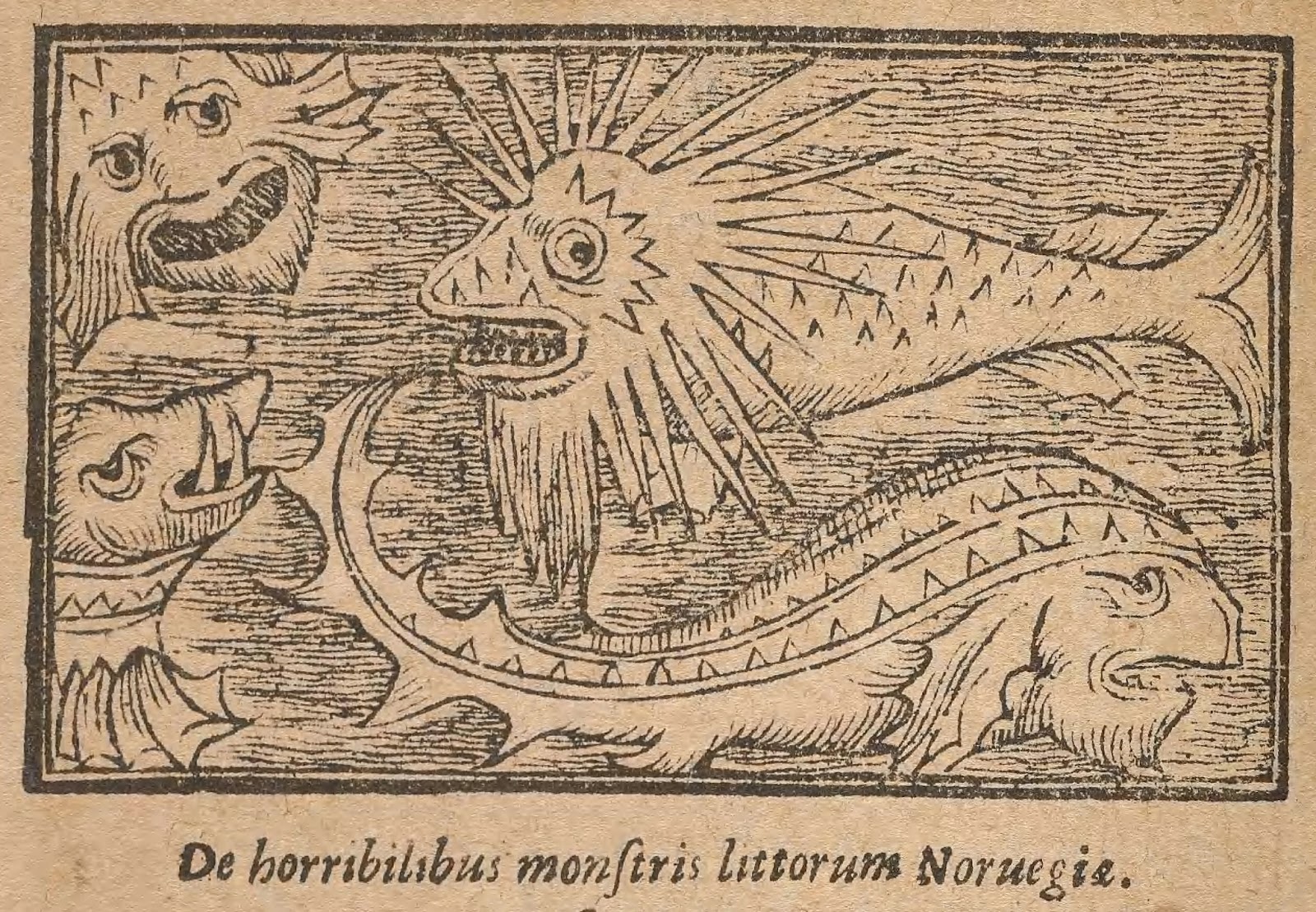
The Kraken. Magnus, Olaus. Historia de Gentibus Septentrionalibus. 1555. http://biodiversitylibrary.org/page/41862917.

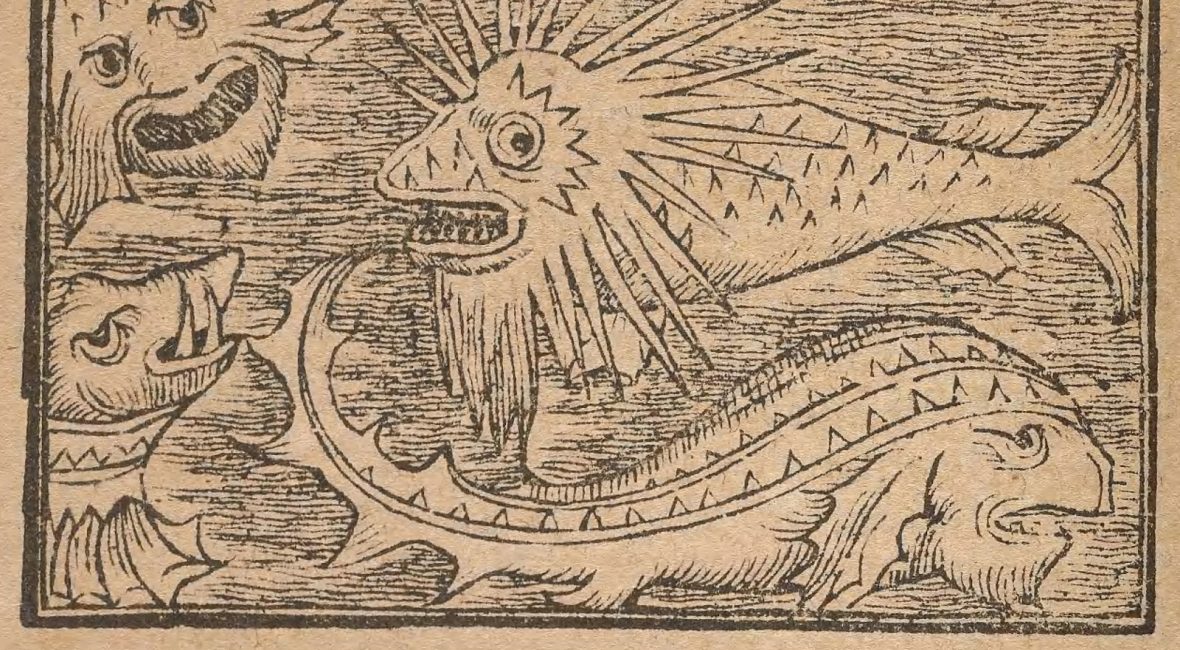
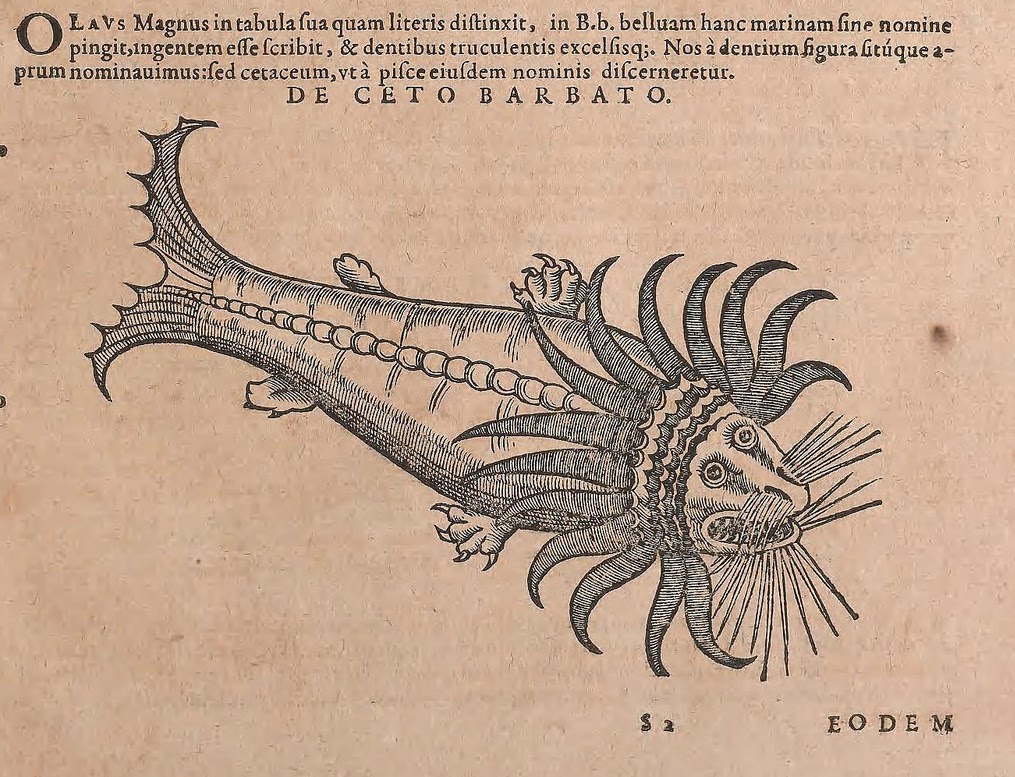
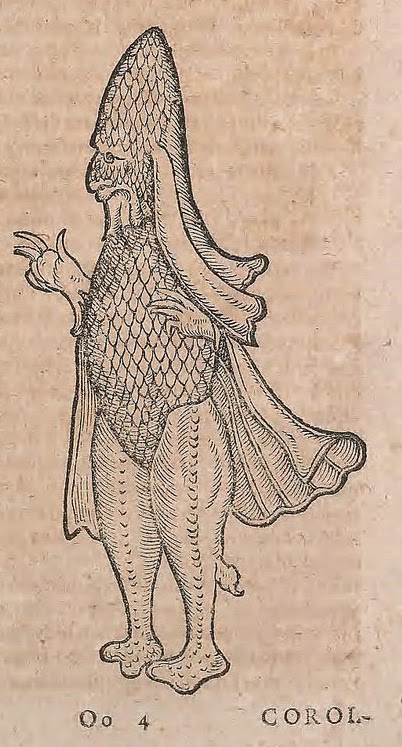
Never missing a chance to tell a good monster tale, Olaus Magnus detailed the kraken as a “monstrous fish” within Historia de Gentibus Septentrionalibus, describing them as having long sharp horns, huge red eyes, and “hairs like goose feathers, thick and long, like a beard hanging down.” He claims that “one of these Sea-Monsters will drown easily many great ships provided with many strong Marriners” – a characteristic reported in the earlier Icelandic work. Magnus’ depiction of the beast, as a strange mix of fish and squid, is quite different from those we find later in the literature, suggesting that his monster is likely a confusion of many sightings, including not only the giant squid but perhaps whales and cuttlefish as well.

View Full Size Image
Kraken, after Magnus. Gessner, Conrad. Historia Animalium. 2nd Ed. 1604. http://biodiversitylibrary.org/page/42165838.

In his first edition of Systema Naturae (1735), Carolus Linnaeus classified the kraken as a cephalopod with the scientific name Microcosmus marinus. Though it was removed from later editions of Systema, Linnaeus’ 1746 publication, Fauna Suecica, describes the kraken as “a unique monster” inhabiting the seas of Norway. He does, however, include a disclaimer that he has never seen the animal himself.

Erik Pontoppidan, bishop of Bergen, in his Det Forste Forsorg paa Norges Naturlige Historie “Natural History of Norway” (Copenhagen, 1752–3), added significantly to the kraken tale. Also writing extensively on mermaids and sea serpents, Pontoppidan describes the kraken as “the largest sea monster in the world…round, flat, and full of arms, or branches.” He writes that not only is the kraken sometimes mistaken for an island, but also that it is possible of pulling the largest ships down to the ocean’s bottom. The greatest danger to sailors he claims, however, is the whirlpool created when it sinks, capable of “draw[ing] everything down with it.”

View Full Size Image
A very octopus-like Kraken. Montfort, Denys. Histoire naturelle, générale et particulière des mollusques : animaux sans vertèbres et a sang blanc. v. 2. 1801. http://biodiversitylibrary.org/page/35755564.

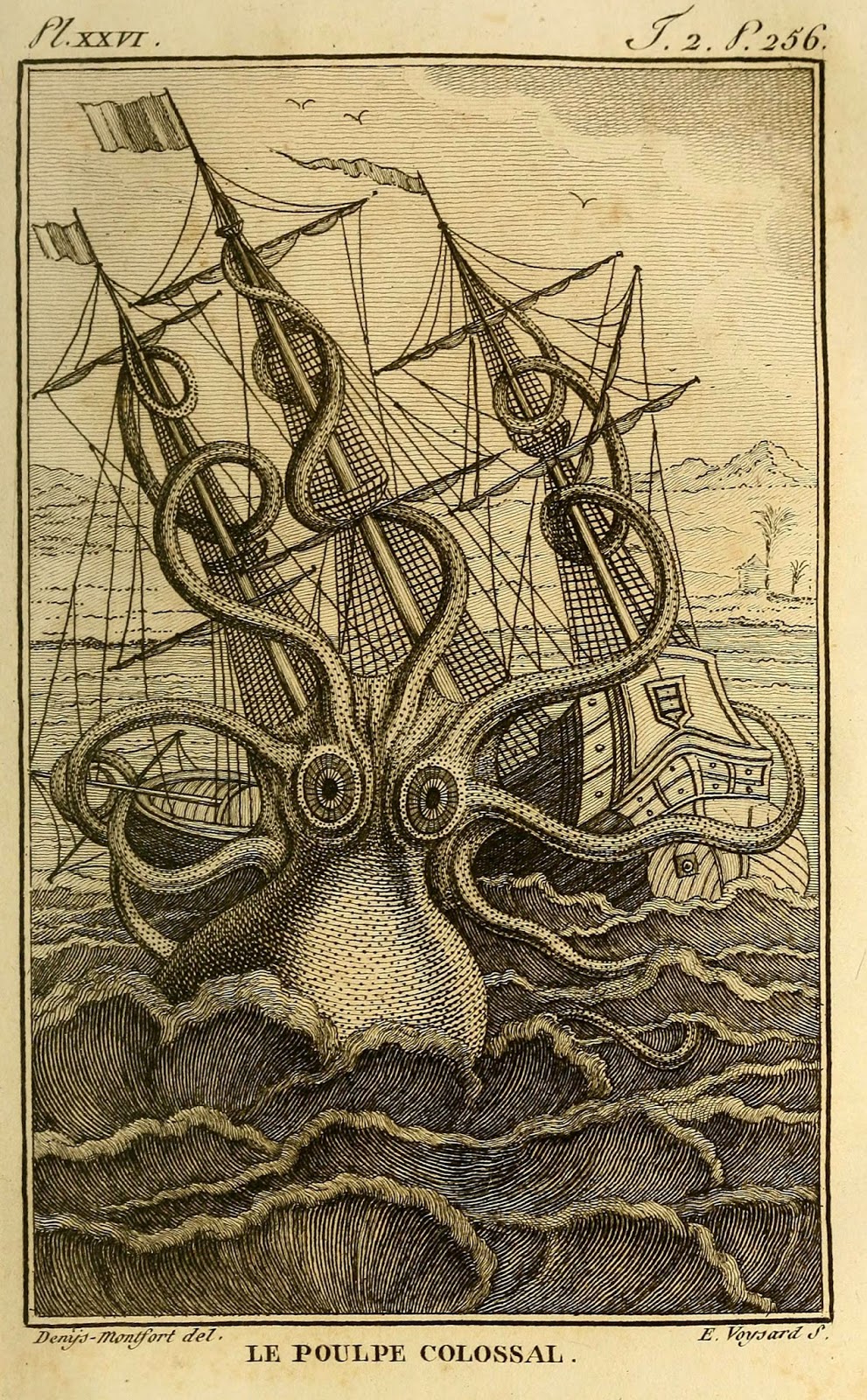
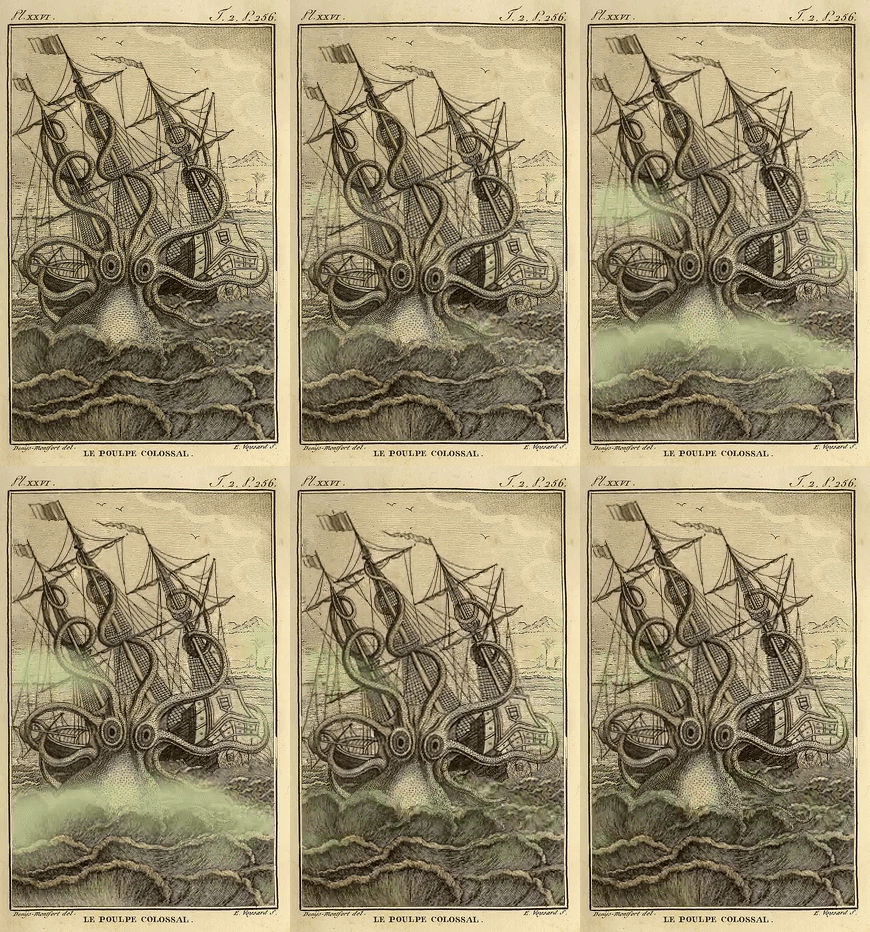
One of the most famous illustrations associated with the kraken, and one in which we see it take a definite cephalopod (if not more octopus-like) persona, comes from French malacologist Pierre Dénys de Montfort’s 1802 book Histoire Naturelle Générale et Particulière des Mollusques. Advertised as an encyclopedic description of mollusks, Montfort describes two kinds of giant octopus in the work: the Kraken Octopus, so often described by Norwegian sailors, and the Colossal Octopus, which he claims attacked a ship off the coast of Angola. The besieged sailors, he reports, prayed to St. Thomas, and were subsequently saved from the creature. He asserts that a votive picture of a ship embraced by this monster octopus was displayed in the St. Thomas chapel at St. Malo, though its existence has not been proven.

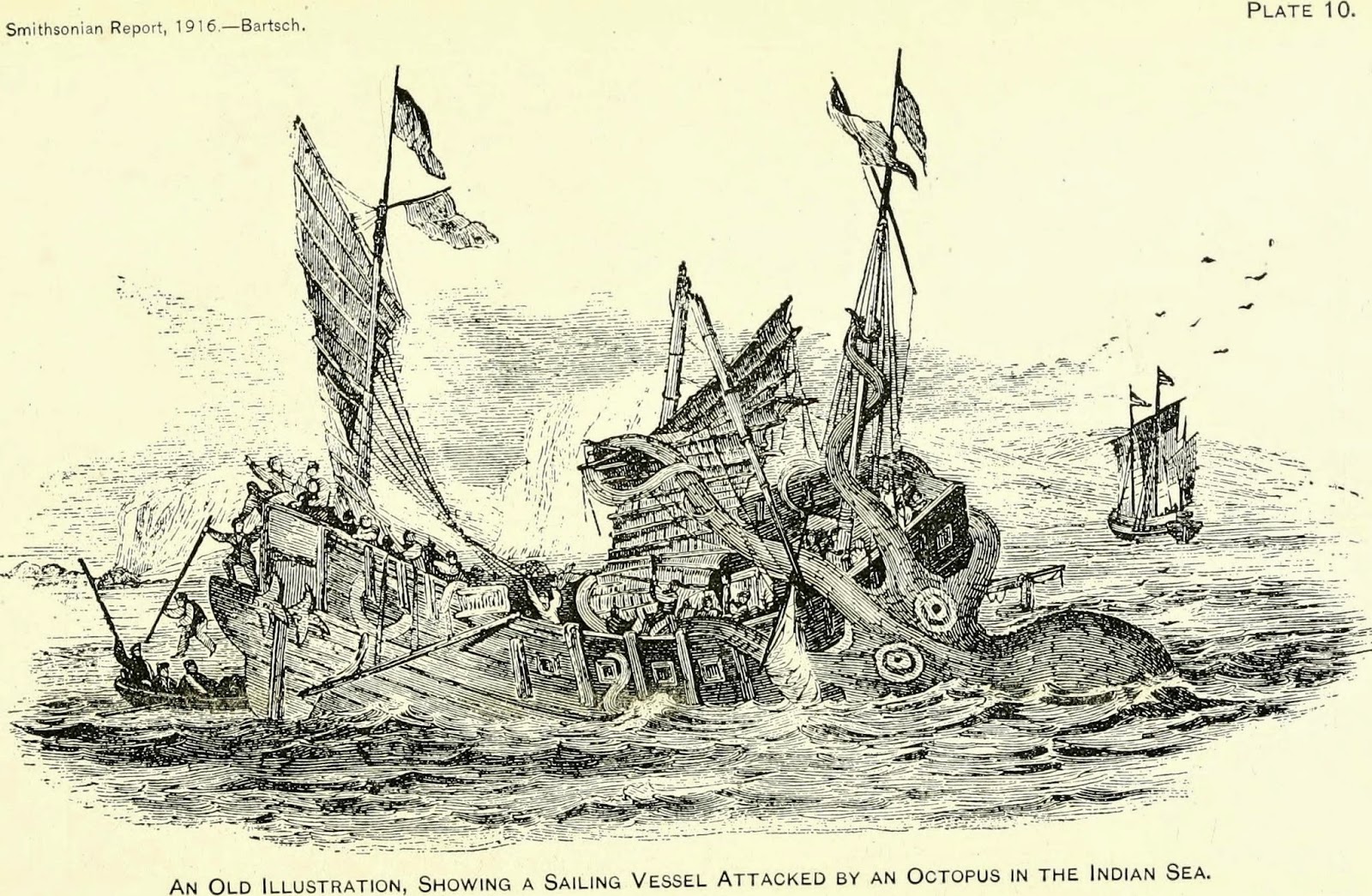
Whether or not Montfort truly believed this tale, he apparently had no qualms about publishing fiction as fact. Henry Lee, author of The Octopus in 1875, quoted Montfort as stating, “If my entangled ship is accepted, I will make my ‘colossal poulpe’ otherthrow a whole fleet.” True to his word, soon after his Histoire Naturelle publication, Montfort claimed that this same giant beast attacked and sunk a fleet of six French man-of-wars and four British ships. His reports, apparently, were influenced by Magnus and Pontoppidan’s description of the kraken’s capabilities.

View Full Size Image
“Kraken” attacking a fleet after a fashion described by Montfort. Annual Report of the Board of Regents of the Smithsonian Institution. 1916. http://biodiversitylibrary.org/page/14187069.

In the mid-1800s, the kraken took an authentic biological form as Architeuthis, passing from myth to science. Prof. Japetus Steenstrup, lecturer at Copenhagen University, introduced the giant squid in a paper that related the original description of the earliest record of a giant squid carcass washing ashore: Thingore Sand, Iceland, in 1639. The paper was read in 1849, and the official scientific name was later published in 1857.

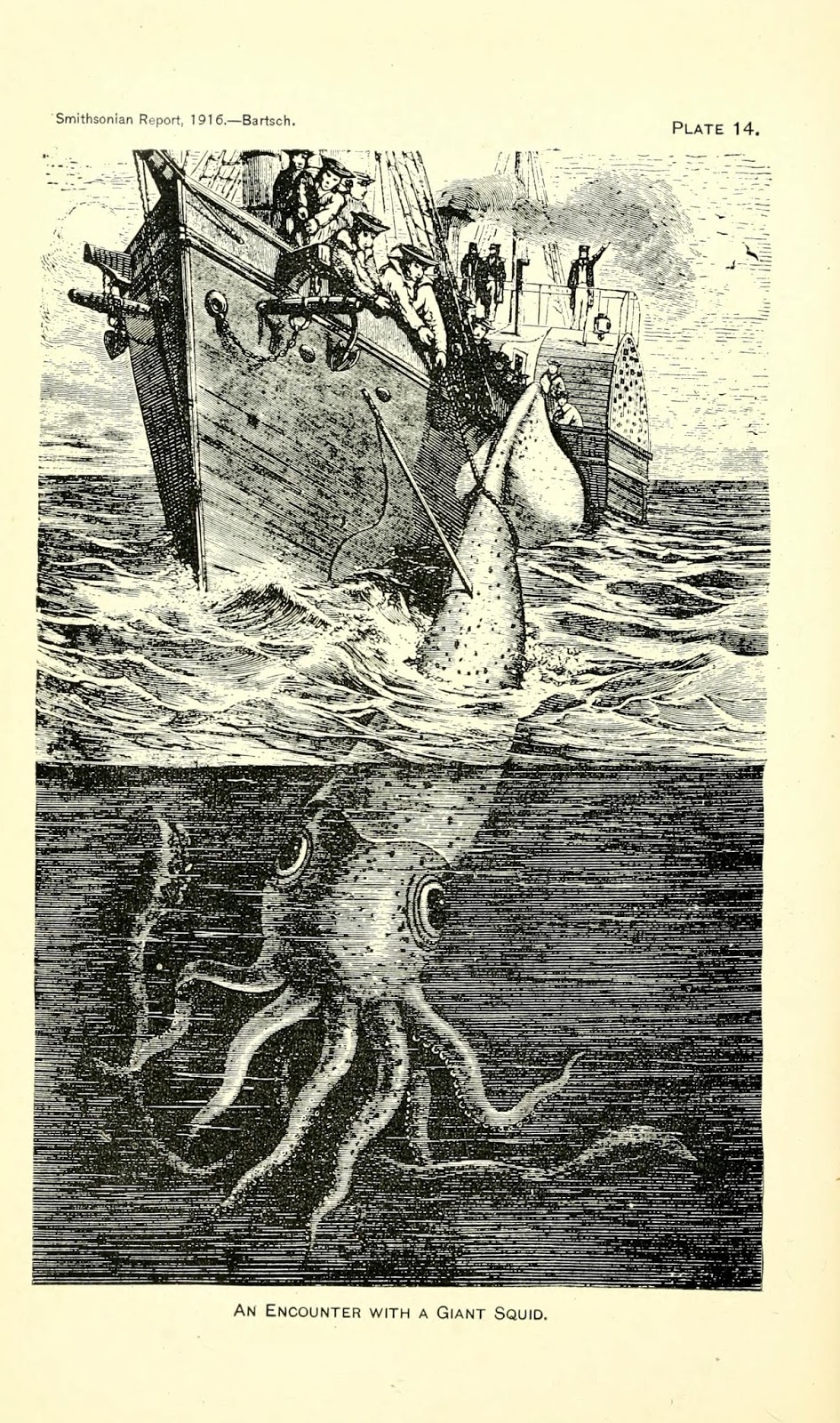
Although the giant squid was finally taxonomically official, physical evidence of the creature remained scarce. A near-catch of a specimen in November, 1861, by the Alecton off Tenerife in the Canary Islands ended with only a detached piece of the squid’s tail as any evidence of the encounter. In 1871 and 1872, two giant squid carcasses were collected on the Grand Banks and at Coombs’ Cove, Fortune Bay, Newfoundland, respectively, the latter of which was a reported 52 feet long.

View Full Size Image
Near-catch of Giant Squid by crew of the Alecton, 1861. Annual Report of the Board of Regents of the Smithsonian Institution. 1916. http://biodiversitylibrary.org/page/14187077.

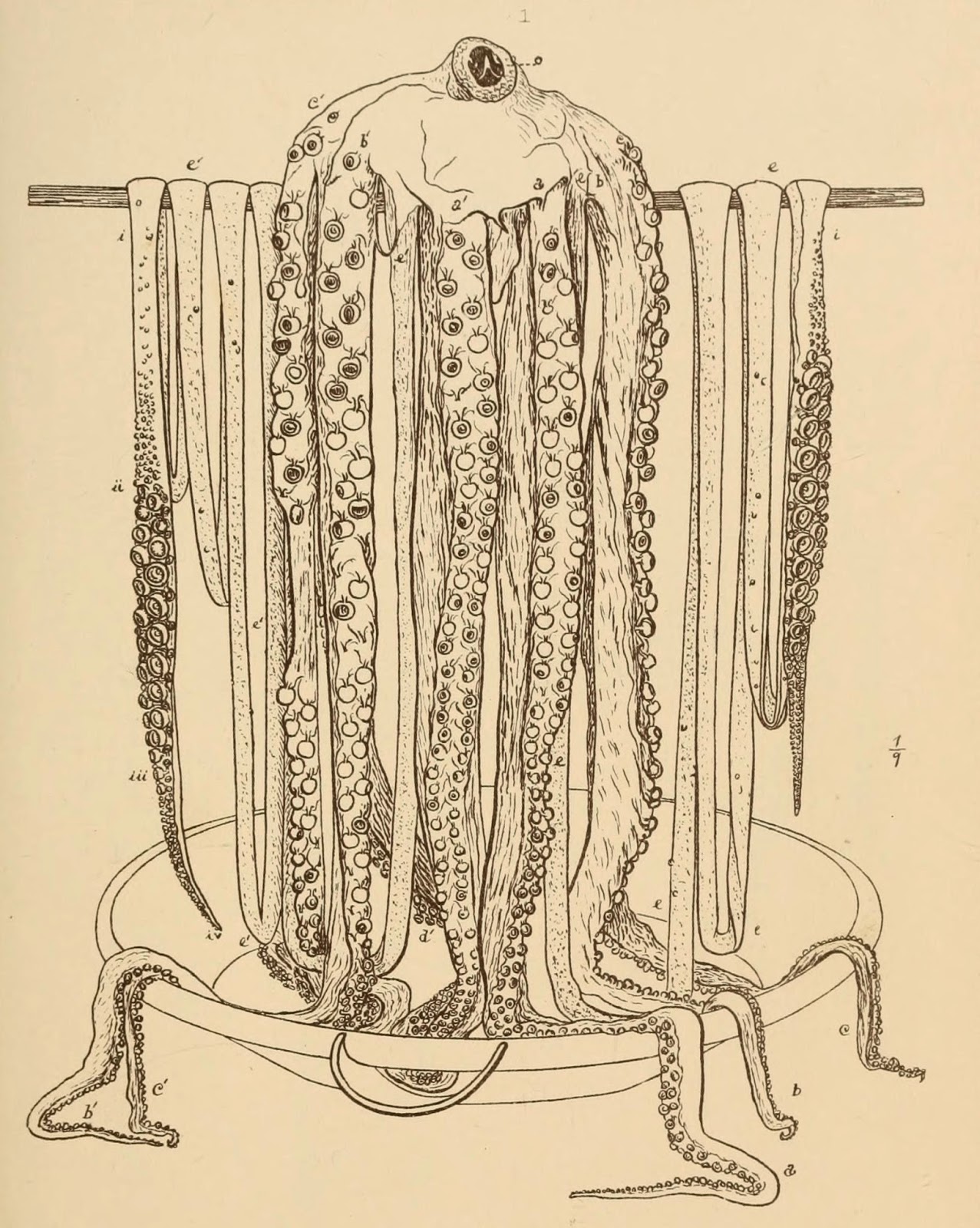
Finally, in December 1873, science caught a break. Four fishermen in Logy Bay, Newfoundland caught a giant squid in their fishing nets. The in-tact specimen was brought to Reverend Moses Harvey, an amateur naturalist, who draped it over a sponge bath for display. He then contacted Addison Emery Verrill, professor of zoology at Yale University, who conducted a full study of the specimen, which measured in at 32 feet long.

View Full Size Image
Giant Squid specimen draped over a sponge bath, 1873. Verrill, A.E. The Cephalopods of the North-eastern Coast of America. pt. 1. 1882. http://biodiversitylibrary.org/page/11826545.

Verrill collected information on every known specimen of Architeuthis and published his findings in a paper entitled The Cephalopods of the North-eastern Coast of America. Part I. The Giant Squids (Architeuthis) and their Allies; with Observations on Similar Large Species from Foreign Localities.

View Full Size Image
“In 1855, Danish zoologist Japetus Steenstrup proposed that the fabled sea bishop [another mythical monster often associated with mermaids] was actually a giant squid. He offered a picture illustrating how the misunderstanding could have occurred.” Learn more in the American Museum of Natural History’s Mythic Creatures online exhibit, from which this quote is derived. This image: Gessner, Conrad. Historia Animalium. 2nd Ed. 1604. http://biodiversitylibrary.org/page/42166070.

The Giant Squid in Science

But while the giant squid’s acceptance into the scientific canon established the cephalopod as fact, Architeuthis’ habitat, life history, breeding habits, and even definitive size remain shrouded in mystery. It currently holds the record as the second-largest mollusk and extant invertebrate (exceeded only by the colossal squid). Recent studies have revealed that it feeds on deep-sea fish and other squids, but its hunting methods and reproductive cycle are still unknown. While it was long believed that there were many species within the Architeuthis genus, recent genetic analysis suggests there is only one: Architeuthis dux. Claims of lengths reaching 150 -200 feet have been reported, even by scientists, without evidence to justify such claims. The Smithsonian’s National Museum of Natural History suggests maximum lengths of nearly 60 feet.

Until recently, no images of the giant squid in its natural habitat had ever been taken. But, on September 30, 2004, Tsunemi Kubodera (National Science Museum of Japan) and Kyoichi Mori (Ogasawara Whale Watching Association) changed this, capturing 500 photographs of a 26 foot giant squid using a camera attached to a baited line. From 2006-2012, in three separate incidents, the giant squid was reportedly filmed, though two of the specimens were less than twelve feet long.

View Full Size Image
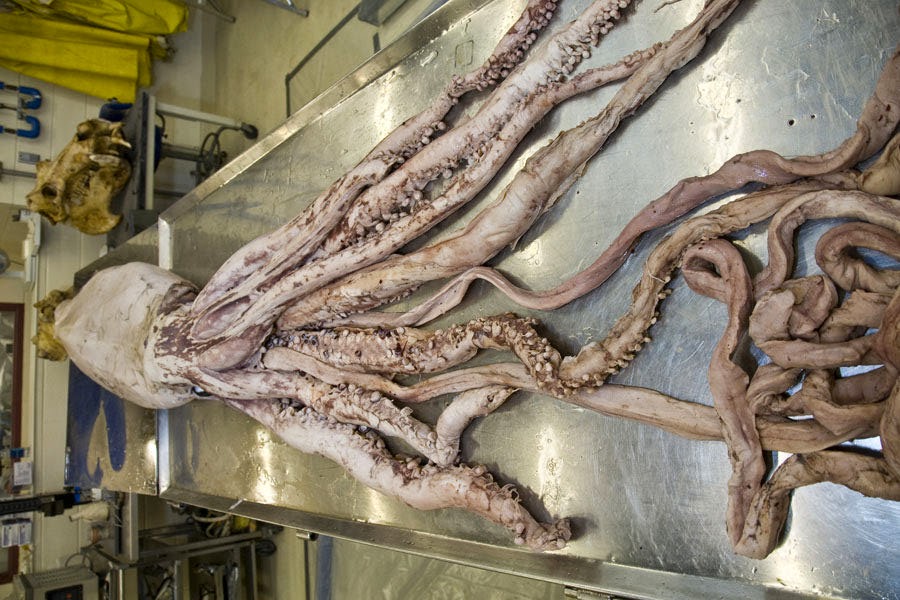
This female giant squid, caught in a net by a Spanish fisherman in 2005, is on display in the Smithsonian’s Sant Ocean Hall. Image Credit: Don Hurlbert/Smithsonian Institution, CC:BY-NC-SA. http://eol.org/data_objects/27480683. Learn more about the Giant Squid from the Smithsonian’s National Museum of Natural History.

While our knowledge about this species is increasing, we still have much to learn. Considering its size, the Giant Squid remains a surprisingly elusive creature. It demonstrates just how much we still have to learn about the ocean.

A World with a Kraken

So, does the kraken really exist? Most definitely. It is the species Architeuthis dux, the giant squid (possibly with some giant cuttlefish, colossal squid, and octopus sightings thrown into the mix).

Is it a warship-sized beast, capable of pulling entire ships to the ocean floor and indiscriminately devouring helpless sailors? No.

Yet again, inexperience and sensationalism turned reality into fiction. And to some degree, this continues to this day. Our research about this animal is still in its infancy, and much misinformation abounds. There is still much we have to learn about the “Kraken.”

  • Follow our blog and #bhlMonstersRreal on Twitter and Facebook all week to learn more about monsters and the animals that inspired them.
  • Browse historic illustrations of octopi and squid-inspired monsters and the animals that they’re based on in Flickr.
  • Browse the books that portray these historic monsters in BHL.
  • Carve a monster in your Halloween Pumpkin this year! Share your carvings with us on Facebook and Twitter!
  • See some of our favorite monsters come to life on the Smithsonian Libraries’ Tumblr!
View Full Size Image
“Release the Kraken!” In H. P. Lovecraft’s short story “The Call of Cthulhu,” Cthulhu (a part man, part dragon, and part octopus monster) attacks a ship. The sailors try to kill the beast by ramming it repeatedly, but Cthulhu simply turns into green mist and reassembles. See more fantastic historic monsters come to life on the Smithsonian Libraries’ Tumblr. GIF created by Richard Naples (Smithsonian Libraries), based on Montfort, Denys. Histoire naturelle, générale et particulière des mollusques : animaux sans vertèbres et a sang blanc. v. 2. 1801. http://biodiversitylibrary.org/page/35755564.


Reference:

  • Ellis, Richard. Monsters of the Sea. New York: Alfred A. Knopp, Inc., 1994. Print.
October 30, 2014by michelle.underhill
Blog Reel, Featured Books

Book of the Week: Die Cephalopoden

This week we are celebrating cephlapods. Not sure what they are? Cephalopods are a group of exclusively marine mollusks that include squid, octopus and nautilus. They are closely related to snails, slugs and clams. Let’s be honest, you might be most familiar with them on your plate.

View Full Size Image
Cephlopods have short life spans that range from 6 months to 2 years.

These intelligent but vulnerable invertebrates are fascinating. They are represented in fossil records as long ago as 500 million years. If I had to pick, I’d say squids are my favorite 8-legged species, and not just because this is Squidturday. Squids defend themselves by being agile and fast as well as releasing sepia, often referred to as ink. The sepia creates a smokescreen providing the squid to make a get away. Camouflage is another defense mechanism. They cannot only change the color of their skin but the shape and texture to reflect their surroundings. This is possible through pigment cells on their arms called chromatophores. It doesn’t stop there, certain species can fly out of the water for short distances.

The most well known species of squid popularized in book like Homer’s Odyssey and Jules Verne’s 20,000 leagues Under the Sea is the Giant or Colossal Squid. Not much is known about this squid because it is so rare to find. However, it is known that they live in the deep Atlantic Ocean and can bite with their sharp beaks. Their only predator is the sperm whale. They can reach lengths of up to 60 feet and weight as much as 1,000 pounds. Imagine looking into the soccer ball sized eyes of one of these invertebrates. Scary!

View Full Size Image
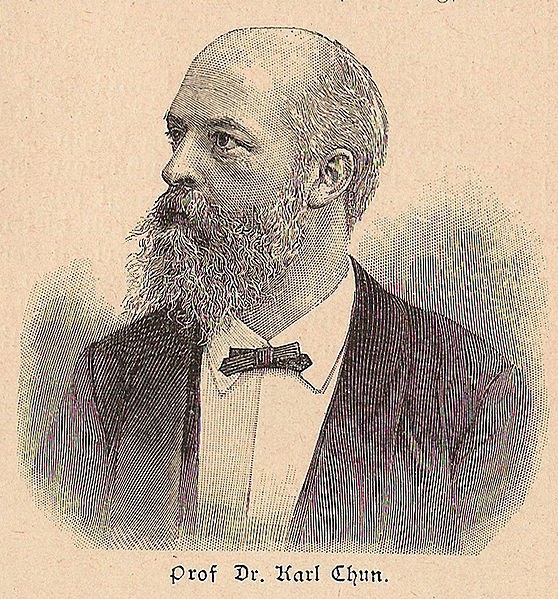
Image of Carl Chun from Jarhrbuch der Berliner Morgenzeitung, 1900.

Little was known about these creatures in the 1900s. So Carl Chun, a well known German marine biologist with a specialty in cephalopods and plankton, led the German expedition aboard the steamboat Valdivia in 1898 to explore the deep sea. He was among a growing fraction of scientist who believed that there was life in the deep sea. Lasting just a year, the trip explored the West Coast of South Africa, the Gulf of Guinea, the Antarctic Sea, and a large portion of the Indian Ocean and collected as many biological samples as possible. The results of the expedition lead to 24 volumes titled Ergebnisse der Deutschen Tiefsee-Expedition auf dem Dampfer “Valdivia” 1898-1899″ (Scientific results of the German deep-sea expedition on the steamer “Valdivia” 1898-1899) which Die Cephalopoden is apart of.

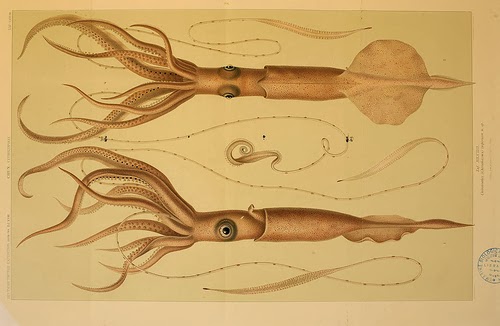
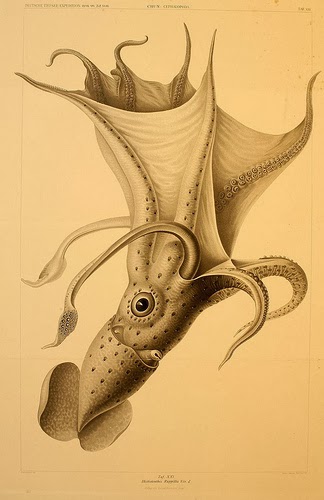
BHL’s copy of Die Cephalopoden provides much more information on cephalopods and squid. If you don’t sprechen deutsch, check out the English translation. From this expedition, Chun discovered and named a new species of squid, the vampire squid. Its species name, Vampyroteuthis infernalis, means “vampire squid from hell.”

To learn more about the Valdivia expedition, check out the BHL blog post Book of the Week: The Valdivia Expedition.

View Full Size Image
They are curious animals that explore their environment and are capable of learning, and will play with objects.

And if you want to see more beautiful illustrations from Chun’s Die Cephalopoden check out the BHL Flickr set.

References:
Ferris, Jabr. (2 August 2010). Fact or Fiction: Can a a Squid Fly out of the Water? Scientific American. Retrieved from http://www.scientificamerican.com/article.cfm?id=can-squid-fly≻=WR_20100804

Robey, Jason. (25 January 2013). Giant Squid Facts. Top 10 Startling Giant Squid Facts. Discovery. Retrieved from http://blogs.discovery.com/show-news/2013/01/top-10-startling-giant-squid-facts.html

Rodolfo. (19 June 2010). Basic Facts about Cephlapods. OBIS, Ocean Biographic Information System.  retrieved from http://www.iobis.org/node/161

Unknown. (n.d.) Cephalopod DayRetrieved from http://cephalopodday.tumblr.com/about

Watson, Stephanie. (1 June 2007). How Squid WorkHowStuffWorks.com. Retrieved from http://science.howstuffworks.com/zoology/marine-life/squid.htm

October 8, 2013by gworthey

Help Support BHL

BHL's existence depends on the financial support of its patrons. Help us keep this free resource alive!

search

About BHL

The Biodiversity Heritage Library (BHL) is the world’s largest open access digital library for biodiversity literature and archives. BHL operates as a worldwide consortium of natural history, botanical, research, and national libraries working together to digitize the natural history literature held in their collections and make it freely available for open access as part of a global “biodiversity community.”

Join Our Mailing List

Sign up to receive the latest news, content highlights, and promotions.

Subscribe Now

Subscribe to Blog via Email

Enter your email address to subscribe to this blog and receive notifications of new posts by email.

Join 319 other subscribers

Subscribe to Blog Via RSS

Subscribe to the blog RSS feed to stay up-to-date on all the latest BHL posts.

Access RSS Feed

Inspiring Discovery through Free Access to Biodiversity Knowledge.

The Biodiversity Heritage Library makes it easier than ever for you to access the information you need to study and explore life on Earth…for free, anytime, anywhere.


64+ Million Pages of
Biodiversity Literature Online.

EXPLORE

Tools and Services
to Transform Research.

EXPLORE

300,000+
Illustrations on Flickr.

EXPLORE

ABOUT | HARMFUL CONTENT | PRIVACY | SITE MAP | TERMS OF USE