Biodiversity Heritage Library - Program news and collection highlights from BHL
  • Home
  • News
  • Featured Books
    • All Featured Books
    • Book of the Month Series
    • BHL at 20
  • User Stories
  • Campaigns
    • Fossil Stories
    • Garden Stories
    • Monsters Are Real
    • Page Frights
    • Her Natural History
    • Earth Optimism 2020
  • Tech Blog
  • Visit BHL
Home
News
Featured Books
    All Featured Books
    Book of the Month Series
    BHL at 20
User Stories
Campaigns
    Fossil Stories
    Garden Stories
    Monsters Are Real
    Page Frights
    Her Natural History
    Earth Optimism 2020
Tech Blog
Visit BHL
  • Home
  • News
  • Featured Books
    • All Featured Books
    • Book of the Month Series
    • BHL at 20
  • User Stories
  • Campaigns
    • Fossil Stories
    • Garden Stories
    • Monsters Are Real
    • Page Frights
    • Her Natural History
    • Earth Optimism 2020
  • Tech Blog
  • Visit BHL
Biodiversity Heritage Library - Program news and collection highlights from BHL
Blog Reel, Featured Books, User Stories

Smithsonian Libraries, BHL, and My Research on South Asian Mammals

This blog post is part of a series from Smithsonian Libraries highlighting Unearthed, a new collection of paleobiology literature in the Biodiversity Heritage Library curated by Smithsonian Libraries in celebration of the opening of the National Museum of Natural History’s David H. Koch Hall of Fossils – Deep Time exhibit. Follow the series throughout 2019 as Smithsonian scientists and librarians discuss the collection, identify their favorite books within it, and explain the importance of paleobiology literature in research today.
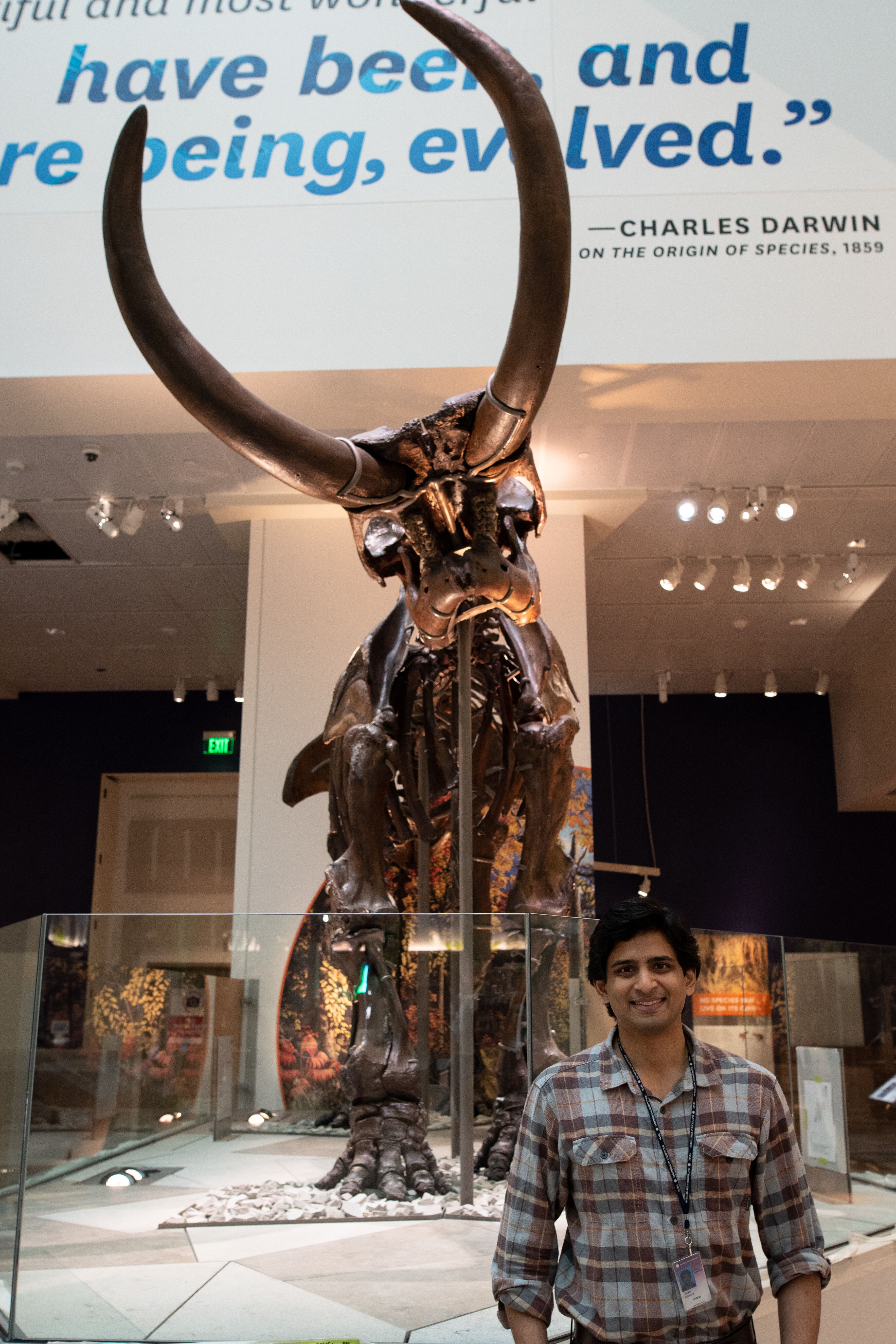
Man standing in front of a mastodon specimen.

Advait Jukar in front of an American Mastodon, Mammut americanum, in the David H. Koch Hall of Fossils – Deep Time.

I’m a Deep Time – Peter Buck Fellow in the Department of Paleobiology at the Smithsonian’s National Museum of Natural History where I study the ecology and evolution of prehistoric vertebrates, especially fossil mammals from the Indian subcontinent. The Indian subcontinent has one of the richest mammalian fossil records anywhere in the world. The Siwalik Hills and surrounding regions in Northwest India and Pakistan have a fossil record ranging from about 23 million years ago to about half a million years ago, making this region an ideal place to study how mammalian communities have changed through time.

Fossil mammals in India were first discovered by British explorers and naturalists in the 1830s and 40s. Hugh Falconer, Proby Cautley, W.E. Baker, and H.M. Durand discovered one of the largest deposits of fossil mammals from the Pliocene and Pleistocene (3.6 million years to 0.6 million years) in the region between the rivers Yamuna and Sutlej. These fossils eventually made their way back to the Natural History Museum in London and form one of the most important fossil collections in the world. These collections form the basis of my research on the reassessment of the taxonomy of fossil mammals from India, the biogeography of South Asian mammals, and paleocommunity change.

Understanding the taxonomy of a particular group in the fossil record (the basis for any study on diversity, biogeography, ecology, etc.) requires a review of the various species that have been named. A species is named when a scientist determines that a particular specimen is different enough from other species. This specimen is then classified as the holotype, or voucher specimen for the species. When a new fossil is found, or additional comparisons are made, some described species are determined to be synonymous, and therefore cease to be valid, or sometimes more than one species is found lumped together under the same name. Therefore, revisory studies require an expansive review of the literature, especially the descriptions of the holotypes.

Despite the excellent fossil record, mammals from India have received comparatively little attention from paleontologists in the past. So, to understand the diversity of fossil mammals in the collection, I had to go back to the original papers and books where they were described. In many cases, the species were named by Falconer, but formally described several years later by Richard Lydekker.

Lydekker was a staff member with the Geological Survey of India from 1877-1881, and thereafter came to work at the Natural History Museum, London in 1882. There, he compiled catalogues of fossil mammals, reptiles, amphibians and birds for Henry Woodward, the then Keeper of Fossils at the Natural History Museum. These catalogues are the first formal descriptive documents on Falconer’s Siwalik fossils and are extremely important for any student of fossil mammals. Lydekker also assigned what are known as lectotype specimens for many of the species (the name given to one specimen from a collection which is to be used as a voucher when a holotype has not been designated). Any taxonomic revision would now require a firm understanding of the lectotypes, other specimens referred to that species, and the original description.

These catalogues (Catalogue of the Fossil Mammalia in the British Museum and Catalogue of the fossil Reptilia and Amphibia in the British Museum by Lydekker) are housed in the paleobiology libraries at the National Museum of Natural History and have been digitized by the Biodiversity Heritage Library. They have become an invaluable resource for me in my research. I used the books as a reference to identify key specimens for comparison and used them to revise the taxonomy and biogeography of three-toed horses in the Pliocene of India. I am currently using the catalogues to sort out the taxonomy and diversity of proboscideans from the Pliocene and Pleistocene of the Indian Subcontinent.

In addition to these catalogues, Smithsonian Libraries also has copies of the Palaeontologia Indica Series X, where Lydekker described many other Siwalik species from specimens housed in the collections of the Geological Survey of India in Kolkata; the Fauna Antiqua Sivalensis, the book of Plates that Falconer and Cautley commissioned to illustrate their collection of Siwalik fossils; and Charles Murchison’s Palaeontological Memoirs of Hugh Falconer, which is a collection of Falconer’s notes and papers on the Siwalik fauna, among other related discoveries. These scientific journals and books have made my research possible, not only for my dissertation, but also for other projects that I have since embarked upon.
JukarBook2.jpg

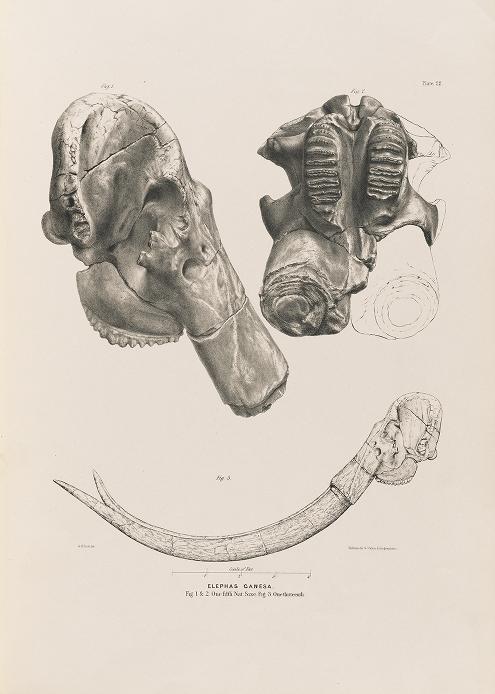
Plate 22 from Fauna antiqua sivalensis, being the fossil zoology of the Sewalik Hills, in the north of India (1846) by Hugh Falconer. Contributed in BHL from the Ernst Mayr Library of the Museum of Comparative Zoology, Harvard University.


Selected BHL Books from Smithsonian Libraries in Unearthed

Catalogue of the Fossil Mammalia in the British Museum. Part 1-Part 5. 1885-1887. https://www.biodiversitylibrary.org/bibliography/61849

Catalogue of the fossil Reptilia and Amphibia in the British Museum. Part 1-Part 4. 1888-1890. https://www.biodiversitylibrary.org/bibliography/61848.

Indian Tertiary and post Tertiary Vertebrata. Palaeontologia Indica Series X. v.1-v.4. 1874-1902. https://www.biodiversitylibrary.org/bibliography/125505.

Fauna antiqua sivalensis, being the fossil zoology of the Sewalik Hills, in the north of India. 1846. https://www.biodiversitylibrary.org/item/124939.
December 12, 2019by Joel Richard
Blog Reel, Featured Books, User Stories

Building the Smithsonian’s Dinosaurs with Materials from the Smithsonian Libraries and BHL

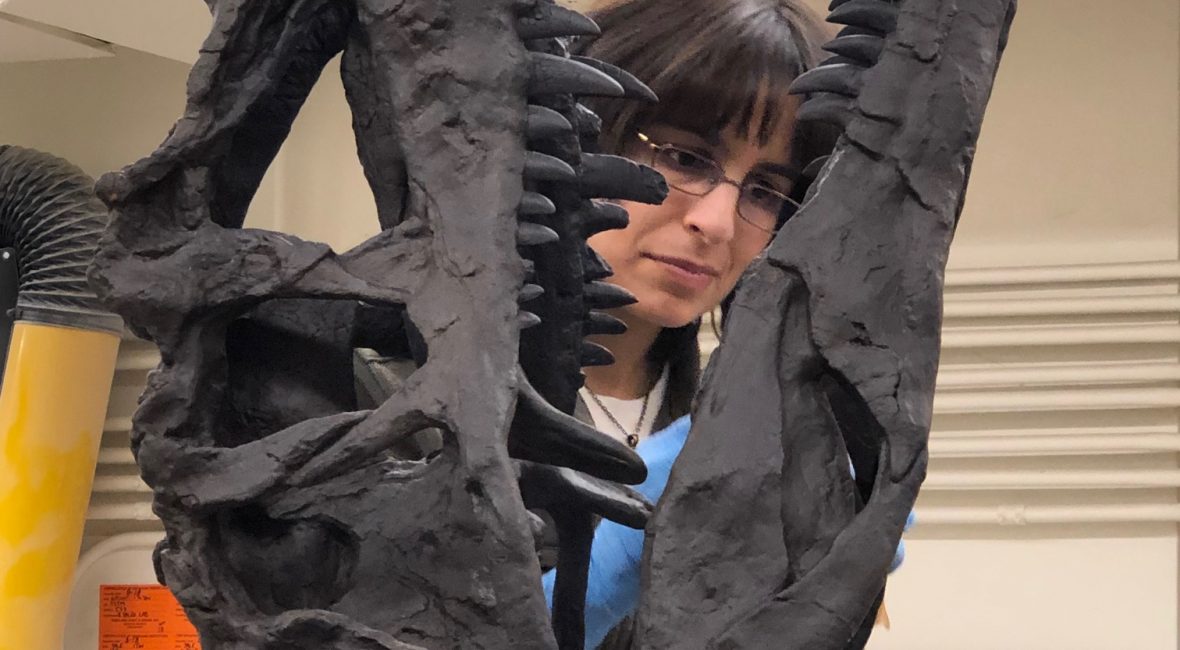
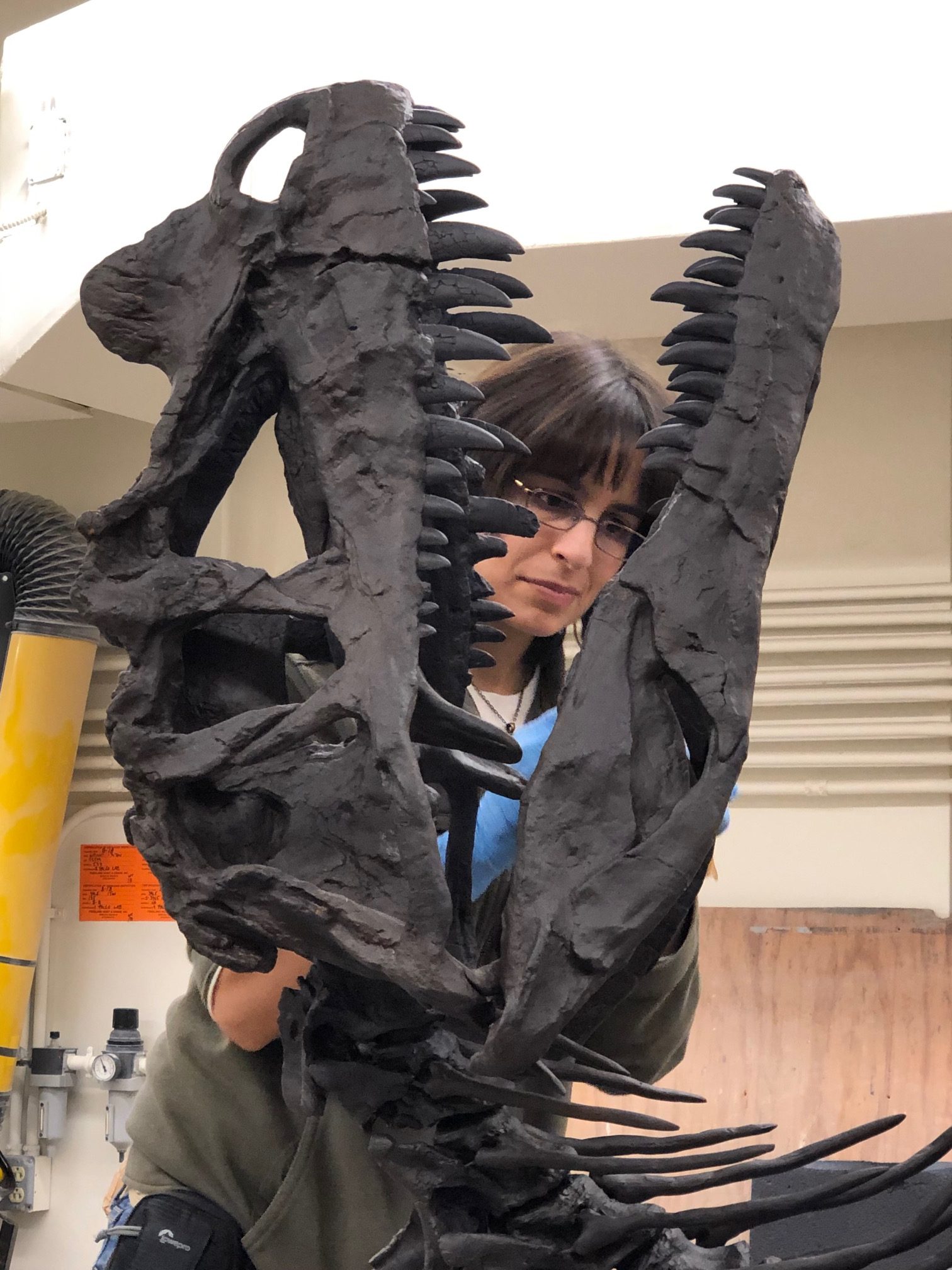
Woman working on a dinosaur skull specimen

This blog post is part of a series from Smithsonian Libraries highlighting Unearthed, a new collection of paleobiology literature in the Biodiversity Heritage Library curated by Smithsonian Libraries in celebration of the opening of the National Museum of Natural History’s David H. Koch Hall of Fossils – Deep Time exhibit. Follow the series throughout 2019 as Smithsonian scientists and librarians discuss the collection, identify their favorite books within it, and explain the importance of paleobiology literature in research today.

My name is Michelle Pinsdorf, and I am a paleontologist and preparator of fossil vertebrates in the Smithsonian National Natural History Museum’s Department of Paleobiology. Preparators’ work can cover a wide variety of duties, from fieldwork to discovering new fossil specimens, freeing those specimens from their surrounding host rock in our laboratories, safely housing specimens for research collections, and helping to build exhibits for specimens going out on display. We call it “grave to cradle” work.

Most of the time you’ll find a fossil preparator leaning over a lab bench with a fine tool in hand, peering through a microscope and exposing the details of a fossil that helps researchers identify and publish about it. But for the past five years, my lab colleagues and I have been working on the renovation of the Natural History Museum’s fossil exhibits. This has involved the dismantling of many previously exhibited fossil mounts to allow for the conservation of the fossils and remounting them in new poses and settings. With the significant scientific value of these fossils, a lot of research and planning happens before each individual specimen is worked on.

Woman working on a dinosaur skull specimen

Michelle Pinsdorf working on the cast model of the Ceratosaurus before it was installed in the David H. Koch Hall of Fossils – Deep Time.

When research is needed in a museum, a research library is essential! A publication of great help to my work is fortunately quickly accessible to me through the Smithsonian Libraries system and the Biodiversity Heritage Library. One of the crown jewels of the Museum’s collections is the nearly complete skeleton of the carnivorous dinosaur Ceratosaurus nasicornis. It is the most complete skeleton of this species found to date, originally named by Othniel Charles Marsh.

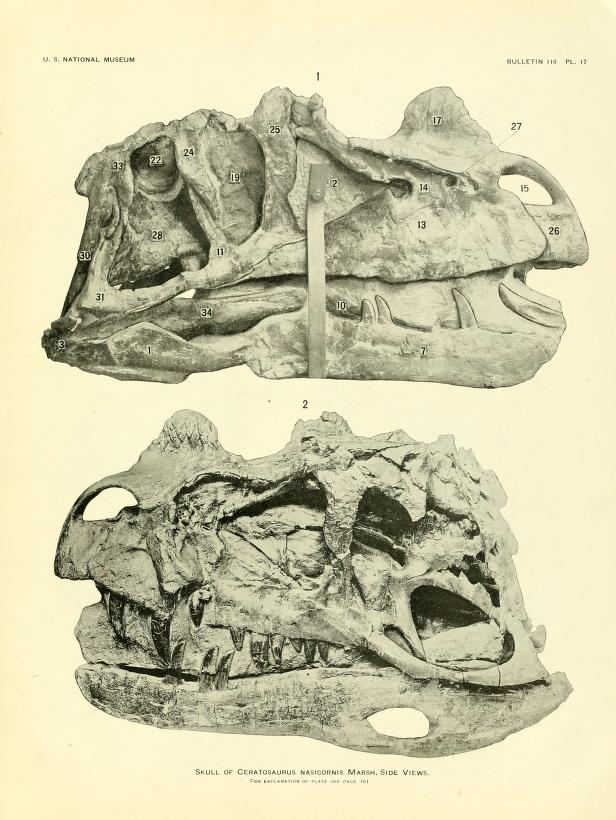
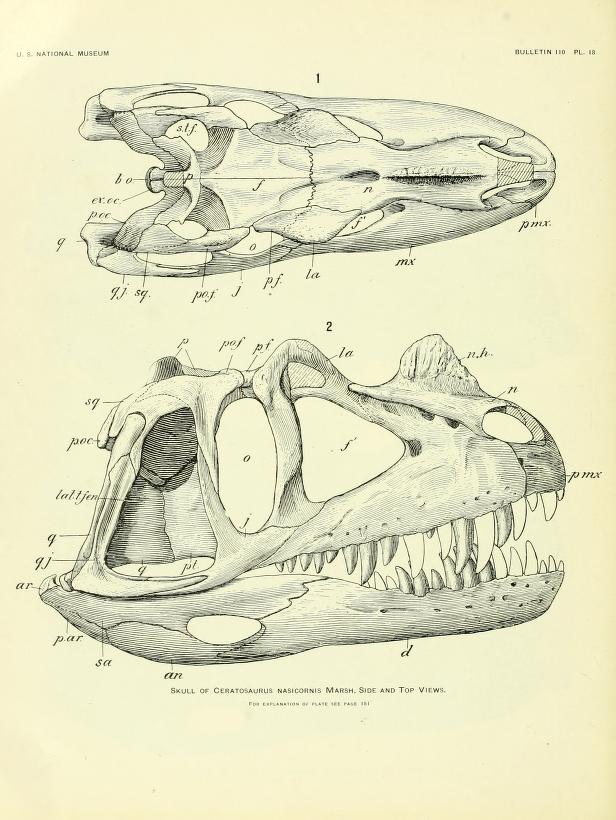
When the specimen was mounted for exhibit at the Smithsonian in 1911, it was fully described by curator Charles Whitney Gilmore, and included in the publication Osteology of the carnivorous Dinosauria in the United States National Museum: with special reference to the genera Antrodemus (Allosaurus) and Ceratosaurus, in Bulletin of the United States National Museum, volume 110. Gilmore provided detailed descriptions and illustrations of this unique specimen, figured prior to it being partially embedded in a display plaque for exhibit. Those figures and measurements proved essential to my work to re-prepare the specimen out of the plaster plaque, exposing a side of the fossils no one since Gilmore’s time had been able to see.

Illustration of a dinosaur skull

Plate depicting the skull of Ceratosaurus nasicornis from Osteology of the carnivorous Dinosauria in the United States National museum: with special reference to the genera Antrodemus (Allosaurus) and Ceratosaurus, in Bulletin of the United States National Museum, volume 110 (1920). Contributed in BHL from Smithsonian Libraries.

This fascinating specimen now gets to serve science in multiple ways. With each bone removed and cleaned, the fossils have been once again made available to paleontologists for study. Each bone was molded and cast, so that the casts could be reassembled in a dynamic new pose for public display in the new Deep Time fossil exhibit halls. The digitization of Gilmore’s publication allowed for me to quickly reference it from my workstation, my home computer, even on my phone. And the physical copy is also close at hand in the Natural History Museum itself, for when I need the kind of inspiration that comes with smelling old paper and seeing neat rows of bindings.

I look forward to seeing what new research will come from my work with Ceratosaurus, and the reactions of museum visitors when they get to see the new mount for the first time.

Illustration of a dinosaur skull

Plate depicting the skull of Ceratosaurus nasicornis from Osteology of the carnivorous Dinosauria in the United States National museum: with special reference to the genera Antrodemus (Allosaurus) and Ceratosaurus, in Bulletin of the United States National Museum, volume 110 (1920). Contributed in BHL from Smithsonian Libraries.

November 14, 2019by Joel Richard
Blog Reel, Featured Books, User Stories

Exploring Prehistoric Sloths: From Thomas Jefferson to Sloth Poop

This blog post is part of a series from Smithsonian Libraries highlighting Unearthed, a new collection of paleobiology literature in the Biodiversity Heritage Library curated by Smithsonian Libraries in celebration of the opening of the National Museum of Natural History’s David H. Koch Hall of Fossils – Deep Time exhibit. Follow the series throughout 2019 as Smithsonian scientists and librarians discuss the collection, identify their favorite books within it, and explain the importance of paleobiology literature in research today.

I study sloths, and as popular as they have become on the internet, the thing most people do not realize is that we are living in a world majorly deprived of most types of sloth. Today there are only two types of sloths: two-fingered (genus Choloepus) and three-fingered (genus Bradypus). (You may have heard them referred to a two-toed and three-toed, but they both have three digits on their hind limb, so the difference is on the forelimb, in other words, their hand, hence: fingers.) There are only a few species of each kind of sloth and they all live in the trees of tropical rainforests in Central and South America.

But back in prehistoric times, there were many types of sloths: more than 80 genera across five different families. They lived as far north as the Yukon Territory and Alaska, as far south as Patagonia, and stretched from coast to coast in the United States and even colonized islands throughout the Caribbean. The smallest of these fossil sloths were still bigger than any sloth alive today, and the biggest extinct sloths were the size of modern elephants (but could probably walk around on two legs like an awkward bear). All this means there is a lot to learn about the sloths that are no longer with us.

Man staring at a fossil of a giant sloth

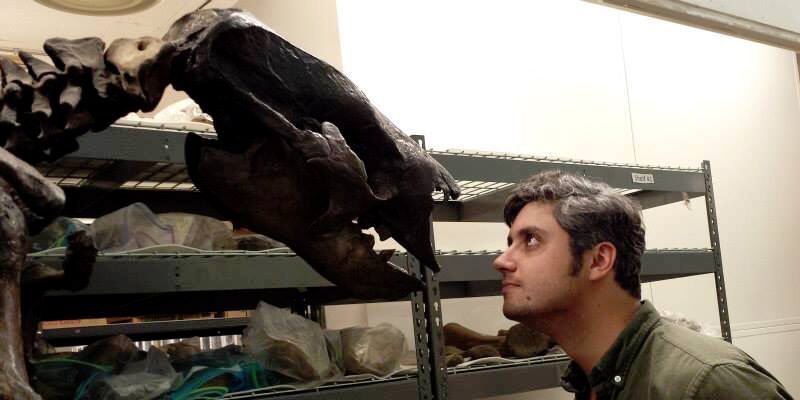
Ryan Haupt and giant sloth fossil photo taken by Emily Thorpe in the collections of the Denver Museum of Nature and Science.

The earliest scientific description of a fossil sloth was written by then Vice President Thomas Jefferson, based on some bones found in a cave in what was then Virginia, now West Virginia, by some men mining saltpeter (potassium nitrate), which crystalizes out of deposits of bat guano and was an important economic resource as a major chemical component of gunpowder. The bones were given to the land owner, who knew that Thomas Jefferson had an interest in Natural History, and so he had them sent to Monticello.

Jefferson presented his findings at the American Philosophical Society in Philadelphia in 1797, which was then published in writing in 1799.[1] Jefferson interpreted the animal as something similar to a large lion, though in reality probably closer in size to a large bear, and named the animal Megalonyx, which means “great claw”, because, like living sloths, ground sloths also had impressive claws.

In addition to thinking this animal was some great hunter, Jefferson did not like the idea that this animal was extinct (remember, this is still half a century before the publication of Darwin’s The Origin of Species [2]). After working through some of the logic of his argument, Jefferson concludes, “If this animal then has once existed, it is probable on this general view of the movements of nature that he still exists…” According to a possibly apocryphal tale, when Jefferson was preparing Lewis and Clark for their journey to the interior of the continent, he showed them the massive claws of Megalonyx and warned them to stay vigilant should the beast still be stalking the forests of the then still “untamed” parts of Western Virginia, Ohio, and beyond.

Even 100 years after Thomas Jefferson’s first description, there were questions as to whether or not relatives of Megalonyx still existed in the far reaches of South America [3], owing in part to some amazingly-preserved mummified sloths that look “recent” compared to many fossils, with bits of skin and fur still clinging to desiccated bone. As far as we can tell, we sadly live in a world bereft of ground sloths, but in some ways, we are still trying to answer some of the earliest questions Jefferson and others had about their no longer observable lifestyles.

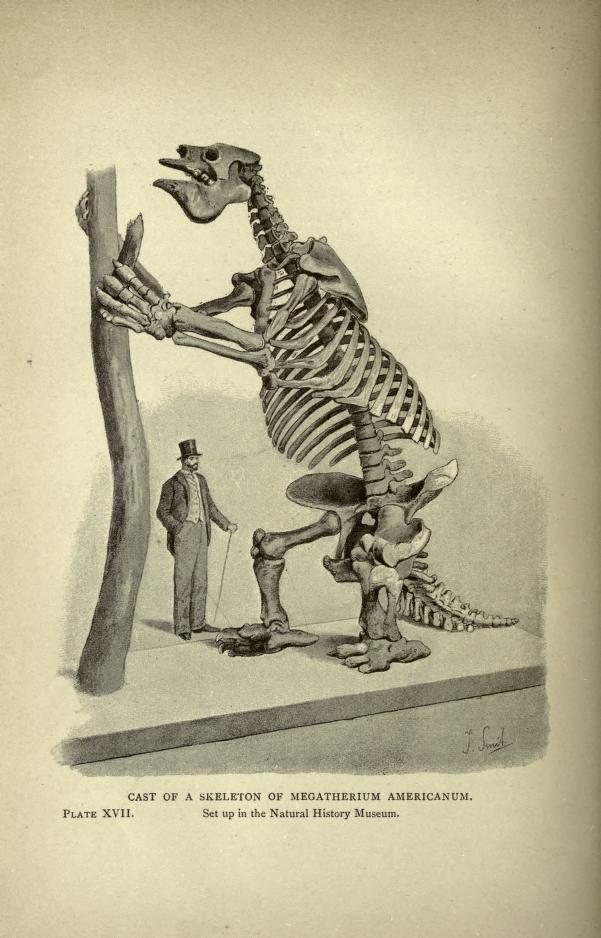
For example, there is a fossil site in South America that has several different types of ground sloths and seemingly no predators to eat them, leading to a question of how so many large herbivores avoided scouring the plant life bare. One paleontologist has proposed that the elephant-sized Megatherium, one of the largest ground sloths ever to evolve, may have scavenged or even hunted the smaller animals in their range, harkening back to Jefferson’s lion-esque Megalonyx. While this seems implausible, it is an idea and one that we can try to test, which is where my research comes in.

Illustration of a skeleton of a giant ground sloth

Plate depicting Megatherium americanum fossilized skeleton from Extinct monsters : a popular account of some of the larger forms of ancient animal life, by H.N. Hutchinson. Contributed in BHL from the Ernst Mayr Library of the Museum of Comparative Zoology, Harvard University.

One focus of my research is what ground sloths ate. Paleontologists use a lot of different techniques to determine diet in animals we cannot directly observe anymore, such as the type of teeth the animal had and the other types of fossils found in the same area (including fossil poop if we can find any!). We also use less obvious methods like the microscopic scratches seen on the chewing surfaces of teeth, or even the actual atoms in the fossils themselves (because those atoms ultimately come from the atoms of food, so you really are what you eat).

Sloth teeth are softer than normal mammal teeth, and grow continuously throughout their entire lives, which makes them better suited to the persistent chewing of leafy browse or grasses than the tearing of flesh and crunching of bone. Two species of ground sloth have been found in caves associated with fossil feces (sometimes called coprolites), and when taken apart or analyzed chemically, the feces only shows evidence of poorly digested plants. And when we look at the ratios of different isotopes trapped in bone, teeth, and even the poop, we see evidence of a mix of plants in the diet, but little evidence of animal protein being eaten.

One avenue of my research is testing some of these fossil findings against modern sloths, to make sure that our interpretations of these data are correct. Two-fingered sloths are often given a little bit of dog food in captivity, whereas three-fingered sloths are not, so I have actually been able to chemically test the isotopes of a slightly omnivorous sloth against a pure herbivore to see how that compares to the fossils!

So, from these lines of evidence we can conclude that ground sloths were herbivores much like modern sloths, and while there is much more research to be done, it is incredibly helpful to be able to look back to the earliest days of paleontology through the Smithsonian Libraries’ collections and see how the thinking about sloths has changed drastically even as we still work to answer some of the earliest questions about these magnificent, lazy, internet-famous beasts.

References

[1] Jefferson, Thomas. 1799. “A Memoir on the Discovery of Certain Bones of a Quadruped of the Clawed Kind in the Western Part of Virginia.” Transactions of the American Philosophical Society, v. 4.

[2] Darwin, Charles. 1859. On the Origin of Species. London: John Murray.

[3] Ameghino, Florentino. 1898. “An Existing Ground-Sloth in Patagonia.” Natural Science, v. 13.

October 16, 2019by Joel Richard
Blog Reel, Featured Books, User Stories

Unearthed: Exploring Paleobiology Literature with Smithsonian Libraries

This blog post is part of a series from Smithsonian Libraries highlighting Unearthed, a new collection of paleobiology literature in the Biodiversity Heritage Library curated by Smithsonian Libraries in celebration of the opening of the National Museum of Natural History’s David H. Koch Hall of Fossils – Deep Time exhibit. Follow the series throughout 2019 as Smithsonian scientists and librarians discuss the collection, identify their favorite books within it, and explain the importance of paleobiology literature in research today.

#1_HANS_SUES.jpg

Dr. Hans Sues, avid reader, bibliophile, and Senior Scientist and Curator of Fossil Vertebrates in the Department of Paleobiology at the Smithsonian’s National Museum of Natural History.

My name is Hans Sues. I am Senior Scientist and Curator of Fossil Vertebrates in the Department of Paleobiology at the Smithsonian’s National Museum of Natural History. My principal research interests are the evolutionary history and paleobiology of late Paleozoic and Mesozoic amphibians, reptiles, and mammal precursors. I received my Ph.D. from Harvard University.

Unlike disciplines such as engineering and chemistry, natural history in general and paleontology in particular are scientific fields that draw heavily on literature from around the world and dating back some 300 years. Scientific hypotheses change over time, but innumerable older articles and monographs retain great value because they include much essential primary information – for example, the original descriptions of new animal and plant species.

The Smithsonian Libraries are one of the most comprehensive resources for literature on natural history in the world. In addition to housing vast numbers of books and journals, the Libraries has partnered with other major academic libraries to create the Biodiversity Heritage Library (BHL). BHL provides an excellent, ever-growing online source of often very rare books and older journals (for copyright reasons, primarily predating 1923), which are immensely useful to any researcher in natural history. Smithsonian Libraries continues to make concerted efforts, in collaboration with Smithsonian scientists, to identify and digitize as much of the primary literature in natural history as possible. In my own research, I frequently draw on this resource.

Now the Smithsonian Libraries has gathered a selection of its BHL Paleobiology literature collection in one convenient web page, Unearthed! A Digital Dig into the Smithsonian Libraries’ Paleobiology Collections, in celebration of the opening of the National Museum of Natural History’s David H. Koch Hall of Fossils – Deep Time exhibition. The new, 31,000-square-foot fossil hall invites visitors to explore the epic story of how Earth’s distant past is connected to the present and informs our future.

#2_LEIDY_1865_PLATE.jpg

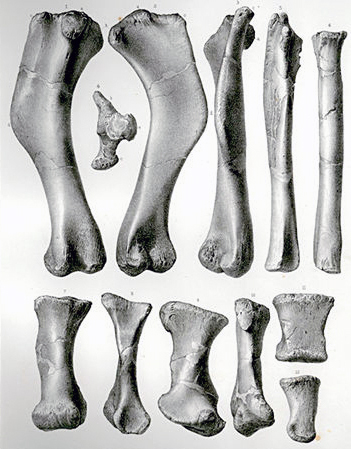
Limb bones of America’s first named dinosaur, Hadrosaurus foulkii, illustrated by Leidy (1865) in the Smithsonian Contributions to Knowledge. Contributed in BHL from Smithsonian Libraries.

One important highlight of the Smithsonian Libraries’ collection is Smithsonian Contributions to Paleobiology. Since the mid-nineteenth century, the Smithsonian Institution has issued a large number of scientific publications that have reported the work of its own scientists and many researchers affiliated with the institution. Early works include classic monographs on fossil mammals and reptiles from the United States. In my area of expertise, a large number of monographs have been published in the Smithsonian Contributions to Paleobiology since the 1960s. Many of these volumes are not easily obtainable as print copy, but now the Smithsonian Libraries and BHL have made the series (through no. 95, 2011) digitally accessible to paleontologists and avocational fossil collectors around the globe. More recent issues are available through Smithsonian Scholarly Press.

June 19, 2019by Joel Richard

Help Support BHL

BHL's existence depends on the financial support of its patrons. Help us keep this free resource alive!

search

About BHL

The Biodiversity Heritage Library (BHL) is the world’s largest open access digital library for biodiversity literature and archives. BHL operates as a worldwide consortium of natural history, botanical, research, and national libraries working together to digitize the natural history literature held in their collections and make it freely available for open access as part of a global “biodiversity community.”

Join Our Mailing List

Sign up to receive the latest news, content highlights, and promotions.

Subscribe Now

Subscribe to Blog via Email

Enter your email address to subscribe to this blog and receive notifications of new posts by email.

Join 319 other subscribers

Subscribe to Blog Via RSS

Subscribe to the blog RSS feed to stay up-to-date on all the latest BHL posts.

Access RSS Feed

Inspiring Discovery through Free Access to Biodiversity Knowledge.

The Biodiversity Heritage Library makes it easier than ever for you to access the information you need to study and explore life on Earth…for free, anytime, anywhere.


64+ Million Pages of
Biodiversity Literature Online.

EXPLORE

Tools and Services
to Transform Research.

EXPLORE

300,000+
Illustrations on Flickr.

EXPLORE

ABOUT | HARMFUL CONTENT | PRIVACY | SITE MAP | TERMS OF USE