
Biodiversity Heritage Library - Program news and collection highlights from BHL
  • Home
  • News
  • Featured Books
    • All Featured Books
    • Book of the Month Series
    • BHL at 20
  • User Stories
  • Campaigns
    • Fossil Stories
    • Garden Stories
    • Monsters Are Real
    • Page Frights
    • Her Natural History
    • Earth Optimism 2020
  • Tech Blog
  • Visit BHL
Home
News
Featured Books
    All Featured Books
    Book of the Month Series
    BHL at 20
User Stories
Campaigns
    Fossil Stories
    Garden Stories
    Monsters Are Real
    Page Frights
    Her Natural History
    Earth Optimism 2020
Tech Blog
Visit BHL
  • Home
  • News
  • Featured Books
    • All Featured Books
    • Book of the Month Series
    • BHL at 20
  • User Stories
  • Campaigns
    • Fossil Stories
    • Garden Stories
    • Monsters Are Real
    • Page Frights
    • Her Natural History
    • Earth Optimism 2020
  • Tech Blog
  • Visit BHL
Biodiversity Heritage Library - Program news and collection highlights from BHL
Blog Reel, Featured Books

Book of the Week: Big Cats Week!

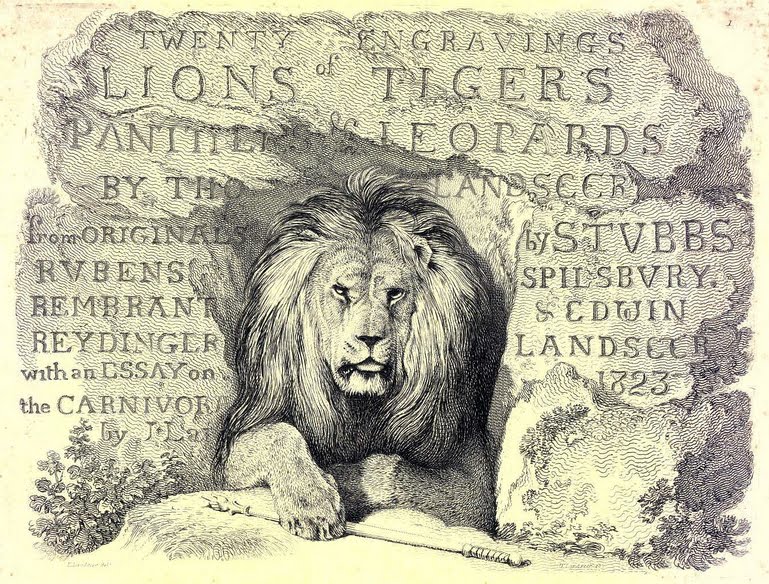
View Full Size ImageThis week is Big Cats Week, and to celebrate we’re featuring a book in our collection that has some of the loveliest engravings of these majestic felines that we’ve ever seen. The book, Engravings of Lions, Tigers, Panthers, Leopards, Dogs, etc. (1853), by Thomas Landseer, contains 39 plates. The first twenty – of lions, tigers, panthers, and leopards – are engravings by Thomas Landseer after original works by Stubbs, Rubens, Spilsbury, Rembrant, Reydinger, and Edwin Landseer.

We hope you enjoy these marvelous works, and for each of the species depicted, we’ve included some interesting facts and links to the animals in EOL, where you can learn even more about them. Be sure to check out Big Cats Week on the National Geographic website, and you can follow the discussion on twitter (BHL account – @BioDivLibrary) with the hashtag #bigcatsweek. And remember, you can see all of the illustrations from this work on our Flickr account.

View Full Size ImageLion

  • Second largest living cat
  • The tallest of all living cats
  • Until about 10,000 years ago, the lion was the most widespread mammal after humans, with ranges including Africa, Europe, Asia and even the Americas
  • Usually, eight subspecies of lions are recognized
  • Lions can be bred with tigers, leopards, and panthers, producing, respectively, ligers, leopons, and jaglions
  • The only member of the cat family to display obvious sexual dimorphism (with the manes on males)

View Full Size ImageTiger

  • The largest of all cat species
  • The longest canine teeth among living felids
  • Six living recognized subspecies
  • The subspecies of tigers are the most varied in size of any cat species. The Siberian, Bengal and Caspian are the largest living felids and some of the largest to ever live. While males of these varieties can weigh between 600-670 pounds, the smallest tiger subspecies, the Sumatran, weighs only 170-310 pounds.
  • The South China Tiger subspecies is listed as one of the 10 most critically endangered animals in the world, and indeed may already be extinct in the wild.

View Full Size ImagePanther (Jaguar or Cougar)

  • The panther may refer to the leopard in Africa and Asia, the cougar in North America, or the jaguar in Central and South America.
  • The jaguar resembles the leopard physically but is larger
  • The jaguar has an exceptionally powerful bite, crushing the skulls of prey to deliver a “death-bite” to the brain
  • The mountain lion, cougar, or puma, native to the Americas, has the largest range of any large wild terrestrial mammal in the Western Hemisphere
  • The cougar is closer genetically to the domestic cat than true lions

View Full Size ImageLeopard

  • The smallest of the four big cats (lion, tiger, jaguar and leopard)
  • It is chiefly found in sub-Saharan Africa, though small populations can be found in Asia
  • Both leopards and jaguars that are completely black are known as black panthers
  • There are nine recognized subspecies of leopards
  • The Amur Leopard, one of the nine subspecies, is considered one of the rarest felids in the world, with only approximately 30-35 individuals in the wild
  • The Arabian Leopard is the smallest leopard subspecies
  • The Persian Leopard is the largest leopard subspecies
December 15, 2011by ulib-libraryjobs

Help Support BHL

BHL's existence depends on the financial support of its patrons. Help us keep this free resource alive!

search

About BHL

The Biodiversity Heritage Library (BHL) is the world’s largest open access digital library for biodiversity literature and archives. BHL operates as a worldwide consortium of natural history, botanical, research, and national libraries working together to digitize the natural history literature held in their collections and make it freely available for open access as part of a global “biodiversity community.”

Join Our Mailing List

Sign up to receive the latest news, content highlights, and promotions.

Subscribe Now

Subscribe to Blog via Email

Enter your email address to subscribe to this blog and receive notifications of new posts by email.

Join 319 other subscribers

Subscribe to Blog Via RSS

Subscribe to the blog RSS feed to stay up-to-date on all the latest BHL posts.

Access RSS Feed

Inspiring Discovery through Free Access to Biodiversity Knowledge.

The Biodiversity Heritage Library makes it easier than ever for you to access the information you need to study and explore life on Earth…for free, anytime, anywhere.


64+ Million Pages of
Biodiversity Literature Online.

EXPLORE

Tools and Services
to Transform Research.

EXPLORE

300,000+
Illustrations on Flickr.

EXPLORE

ABOUT | HARMFUL CONTENT | PRIVACY | SITE MAP | TERMS OF USE