Biodiversity Heritage Library - Program news and collection highlights from BHL
  • Home
  • News
  • Featured Books
    • All Featured Books
    • Book of the Month Series
    • BHL at 20
  • User Stories
  • Campaigns
    • Fossil Stories
    • Garden Stories
    • Monsters Are Real
    • Page Frights
    • Her Natural History
    • Earth Optimism 2020
  • Tech Blog
  • Visit BHL
Home
News
Featured Books
    All Featured Books
    Book of the Month Series
    BHL at 20
User Stories
Campaigns
    Fossil Stories
    Garden Stories
    Monsters Are Real
    Page Frights
    Her Natural History
    Earth Optimism 2020
Tech Blog
Visit BHL
  • Home
  • News
  • Featured Books
    • All Featured Books
    • Book of the Month Series
    • BHL at 20
  • User Stories
  • Campaigns
    • Fossil Stories
    • Garden Stories
    • Monsters Are Real
    • Page Frights
    • Her Natural History
    • Earth Optimism 2020
  • Tech Blog
  • Visit BHL
Biodiversity Heritage Library - Program news and collection highlights from BHL
Blog Reel, Featured Books

John Cassin’s Vireos

It’s been going on for six weeks now, but these first days of September see the southbound migration of songbirds in full swing. And all up and down the east coast of North America, birders are taking to the field in search of little brown birds and little green birds and little greenish-brown birds.

It was no different in the early autumn of 1842. On a fine September morning, the 29-year-old John Cassin set out for Bingham’s Woods, then and now—as part of today’s Fairmount Park—one of Philadelphia’s favorite birding playgrounds. It’s unlikely that Cassin, the bicentennial of whose birth in Delaware County, Pennsylvania, we mark today, was carrying field glasses; but we do know that he had his gun. One of the migrants he shot that day was in the upper branches of a tree of considerable heighth [sic], engaged in capturing insects, and attracted [Cassin’s] attention by its slow and apparently deliberate movements.

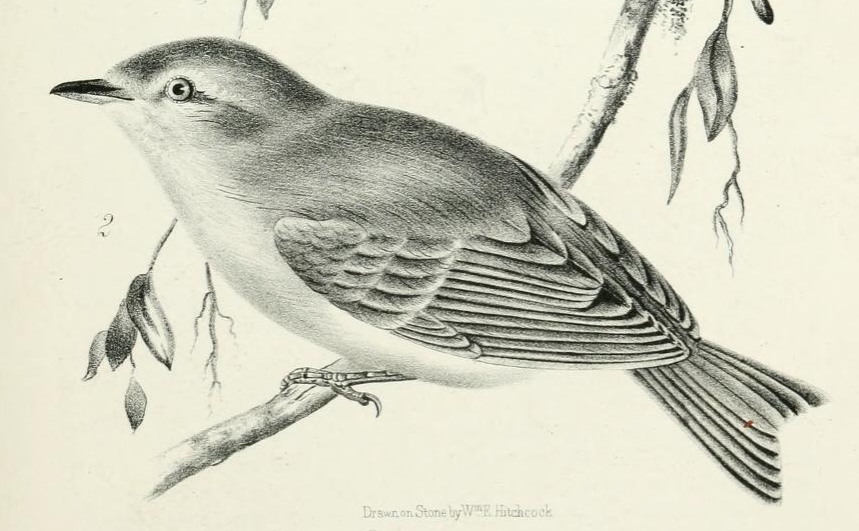
He skinned the bird and added it to his private collection, where it lay for the better part of a decade before Cassin—meanwhile Curator, Life Member, and Corresponding Secretary of the Academy of Natural Sciences in Philadelphia—described it in 1851 as the type of a new species, which he named Vireosylvia philadelphica.

View Full Size Image

That was the first, last, and only Philadelphia Vireo John Cassin would ever see; indeed, “this rare species”, was not found again in Pennsylvania until September 1878, almost ten years after the untimely death of the man who, more than any other student of Natural History in America, ha[d] advanced the science of Ornithology, and whose matured and well[-]cultivated mind enabled him to render cheerfully and generously much assistance to younger students and to institutions of learning in that and other branches of knowledge.

*_*_*_*

In the same article—titled, with characteristic modesty, a “sketch” —Cassin described two more new vireos.
View Full Size Image

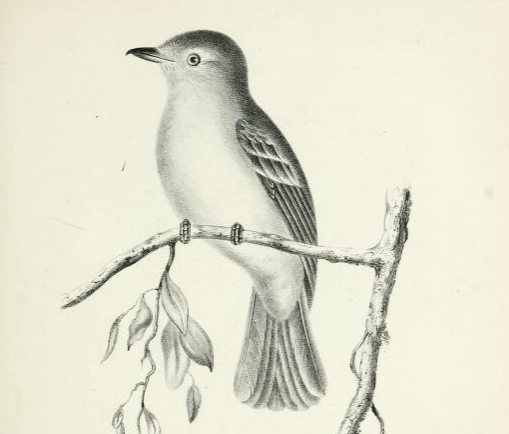
The first, “recognized without difficulty by the very delicate cream color of the entire under surface of its body, which color [he had] never seen in any other bird,” had come to Cassin’s attention in the form of three skins, two from Monterey, California, in the collections of theSmithsonian (now specimens A 3724 and A 3725 and one from Georgetown, California, in the Philadelphia Academy.

The Academy’s skin had been collected and donated by “the far-famed Taxidermist” John G. Bell, “a man of marked personality and ardent enthusiasms” who over his long life was both field companion to the aging Audubon and mentor to the young Theodore Roosevelt.

Bell, of course, already had a vireo named for him, and Spencer Baird, Cassin’s counterpart at the Smithsonian, urged the Philadelphian to name this novum instead after the collector of the specimens now in Washington, William Hutton. Cassin at first resisted:

Calling that Vireo after your friend Hutton is one of the severest things. I don’t want to do it – when he gets better known I will call something after him. This kind of thing is bad enough at best, but to name a bird after a person utterly unknown is worse than that. I do not doubt his entire capability but I don’t like to thrust honors upon him.

Baird, though, ever amiable and ever persuasive, prevailed, and Cassin graciously took “the liberty of naming” the new bird for “Mr. Wm. Hutton, a zealous and talented young naturalist now resident at San Diego, in California.”

Like Cassin’s Philadelphia Vireo, the Hutton’s Vireo remained little known and mysterious for some years after its discovery and description. Not until California observers had figured out how to tell itconsistently from the Ruby-crowned Kinglet was the species’ true abundance recognized.

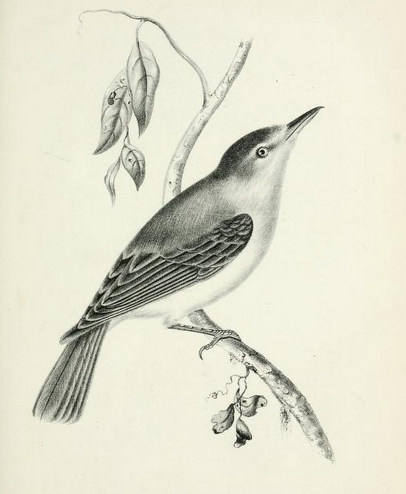
The third of Cassin’s novae species is based on skins collected by Bell in Panama and by Philippe August de Barruel-Beauvert, a French businessman in Nicaragua.
View Full Size Image

Abandoning patronyms, Cassin named this “very handsome species” flavoviridis for its “fine yellowish olive” upperparts and “fine greenish yellow” of the flanks and undertail. By 1858, the bird’s known range had been extended to northeastern Mexico, with two specimens taken in Monterrey by Darius Couch of kingbird fame. Twenty years later, the young James Cushing Merrill collected a male on Fort Brown, Texas, the first record of this species in the United States.

*-*-*-*

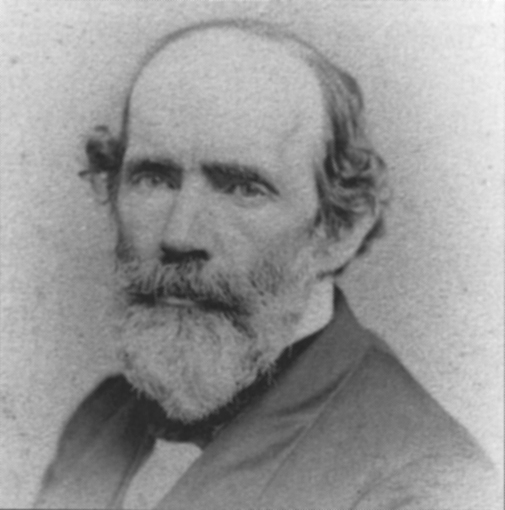
Cassin himself, of course, lauded by Coues—whose praise was never cheap—as the “Nestor of American ornithology”,  was honored by his contemporaries in the names of numerous other birds, among them, inevitably, a vireo.

In 1858, John Xantus, prized by Baird as a collector of “matchless skill and diligence,” described two new birds from Fort Tejon, California; he named one of them Vireo cassinii.

Xantus, one of the more colorful of Baird’s protégés, had been elected—under the name Louis de Vésey—to membership in the Philadelphia Academy in December 1856; according to Harry Harris, Xantus / de Vésey, on his roundabout way from Leavenworth to Tejon by way of New York in March 1857, “found time to attend a meeting … in order personally to acknowledge his election.” Presumably, he and Cassin met then, and they obviously found each other congenial souls: in January 1859, Xantus wrote enthusiastically to Baird that Mr Cassin wrote me a very long & interesting letter, I returned his compliments with a still longer one….

For all his faith in Xantus, Baird harbored some doubts about the validity of the new vireo. Just months after its formal description, he (and Cassin) included the species in their summary of the ornithology of the great Pacific Railroad Surveys, but warned the reader that the bird—still known from only the single specimen—was obviously closely related to either the Hutton’s Vireo or the Blue-headed Vireo.

In 1865, Baird again reviewed Xantus’s type, and this time pronounced himself now inclined to consider the specimen upon which Vireo cassini was based to be only a dull-plumaged, winter skin of V. solitaria, with the under parts tinged with brownish-buff, and the olive shades obscured. I have never seen a specimen killed in eastern North America having this coloration, nor even making a decided approximation to it, but I can find no tangible characteristic of external form to distinguish them.

Not long thereafter, Robert Ridgway sent two new specimensof the vireo back to Washington, collected in Nevada as part of the seventeen-year-old naturalist’s duties on the King Survey. In their 1874 History, Baird, Thomas Brewer, and Ridgway describe those skins as “even more different from true solitarius” than Xantus’s type, and concluded that the Cassin’s Vireo was after all “really distinct, as a variety,” that is to say, as a subspecies of the Solitary Vireo.

So things stood for the next century and a quarter, with the bird once named for Cassin treated as “just” racially distinct from the other big, wing-barred, white-spectacled vireos. In July 1997, however, the American Ornithologists’ Union reversed that venerable taxonomic decision to restore the Cassin’s Vireo to full species status, giving it once again a place in the field guides, the checklists, and birders’ memories.

*_*_*_*

The bird that John Cassin shot in Bingham’s Woods on that long-ago September morning is now officially known as the Philadelphia Vireo. But the species has also had another label: even into the early twentieth century, it was sometimes called the Brotherly-love Greenlet, a charming if straightforward translation of the scientific name Cassin gave his first specimen.

It’s too sentimental for us today, no doubt, and the bland and logical alternative sanctioned by the AOU will prevail forever. But the notion of “brotherly love” recalls not just the city on the Delaware, but the collegial affection and professional respect that bound the great ornithologists and collectors of what Elliott Coues would call, in a deserved tribute to a man “patient and laborious in the technic of his art, and full of book-learning in the history of his subject,” The Cassinian Period.
View Full Size Image

September 6, 2013by Kathryn Stine
Blog Reel, Featured Books

Alexander Wilson and the Catbird

View Full Size Image

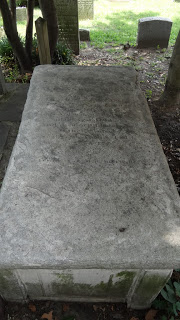
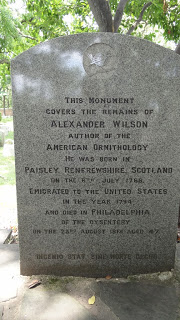
A tiny corner of green in a bustling city landscape, the cemetery of Philadelphia’s Gloria Dei Church is the resting place of Alexander Wilson, who died 200 years ago today at the age of 47, his great American Ornithology almost finished.

Gloria Dei—formerly Old Swedes’ Church, the most ancient house of worship still standing in the state of Pennsylvania—offers the modern tourist a welcome spot of shade, but it would certainly not have been Wilson’s choice of final destination. Even in 1813, this Southwark neighborhood of Philadelphia was a busy one, and Wilson had, as his executor, George Ord (1781-1866), reports:

“expressed a wish to be buried in some rural spot, sacred to peace and solitude, whither the charms of nature might invite the steps of the votary of the Muses, and the lover of science, and where the birds might sing over his grave.”

Unfortunately, Wilson was unable to repeat that wish in the ten days of agony that preceded his death; “otherwise,” writes Ord, “it should have been piously observed.” Instead, the dust of the Father of American Ornithology still lies in a weathered marble tomb beneath the shadow and the roar of I-95.

But the votaries of the Muses still come, and the lovers of science. And the birds still sing over Alexander Wilson’s grave.

View Full Size Image

_*_*_*_

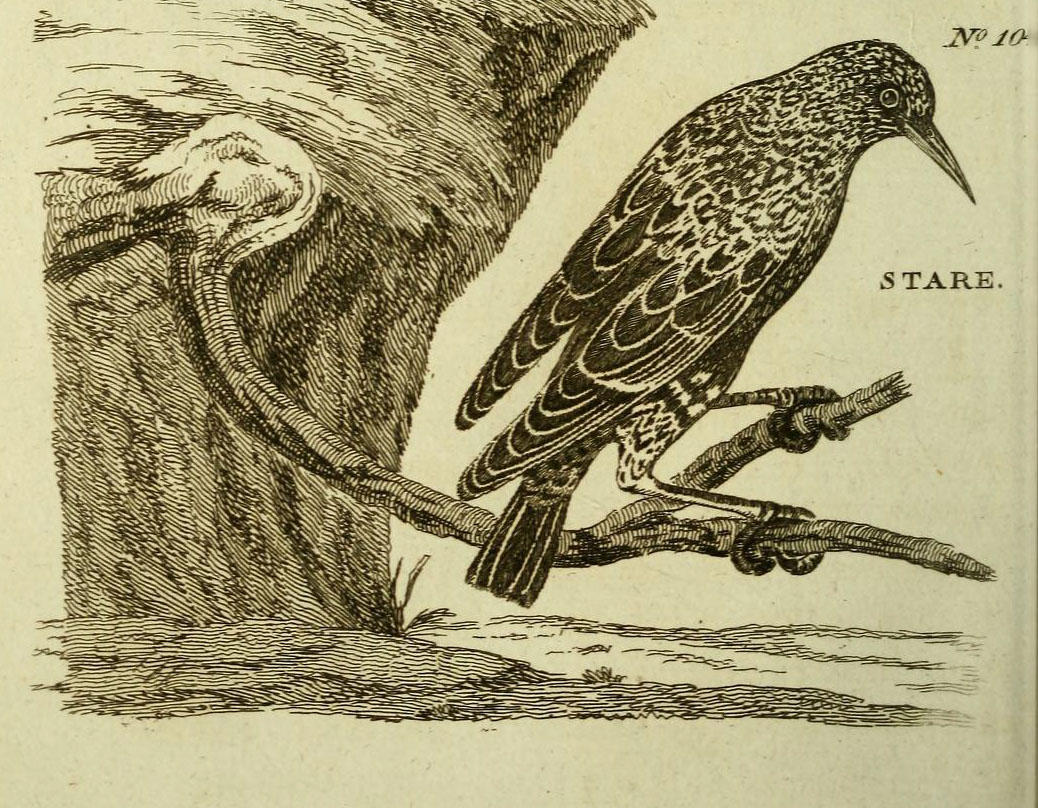
Urban Philadelphia’s bird life has changed, of course, since 1813. The voices that rise most prominently today above the whoosh and rumble of traffic are the homely chirping of House Sparrows, and the whistles of European Starlings, both species that Wilson knew well from his youth in Scotland, but neither of which would appear in Pennsylvania for decades to come.

View Full Size Image
European Starling in Pennant’s British Zoology

The House Finch, too, whose cheerful buzzes tumble down from the steeple of Gloria Dei, was unknown in Philadelphia two centuries ago—and indeed, still believed to be restricted to Mexico,was not recorded in the western United States until ten years after Wilson’s death.

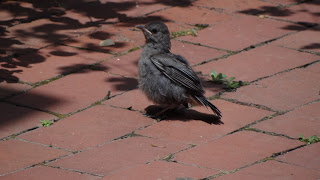
Native birds persist, though, even in this most urban of Philadelphia neighborhoods, and each summer, just as in Wilson’s day, still yields a modest crop of American Robins, Chipping Sparrows, and Common Grackles. But the real specialty of Gloria Dei is the Gray Catbird. More typical of forest edges and wooded suburbs, these sleekly elegant mimics sing and feed and nest in the cemetery, producing young that are as noisy as they are endearingly scruffy.

View Full Size Image

Alexander Wilson would have approved.

*_*_*_*

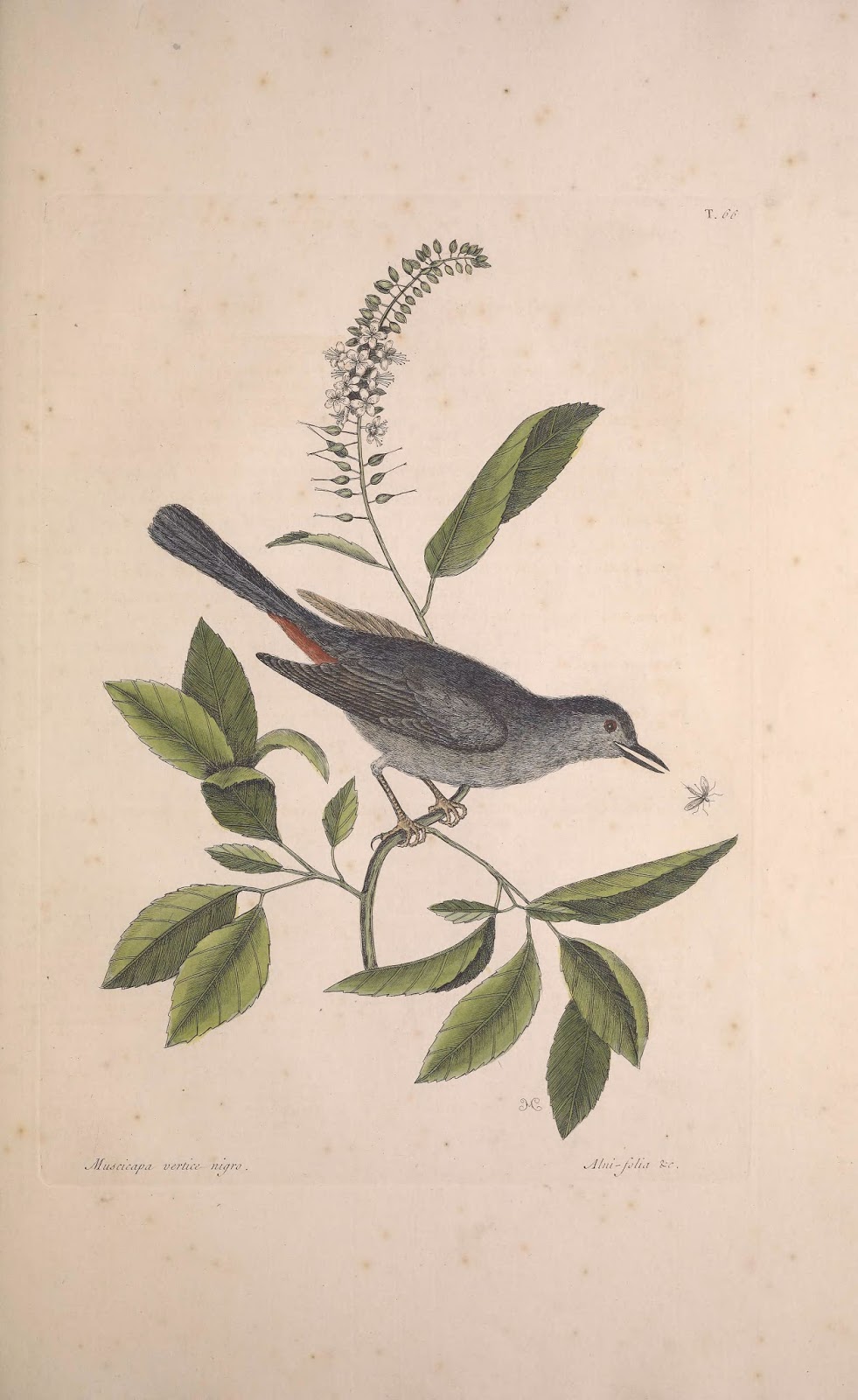
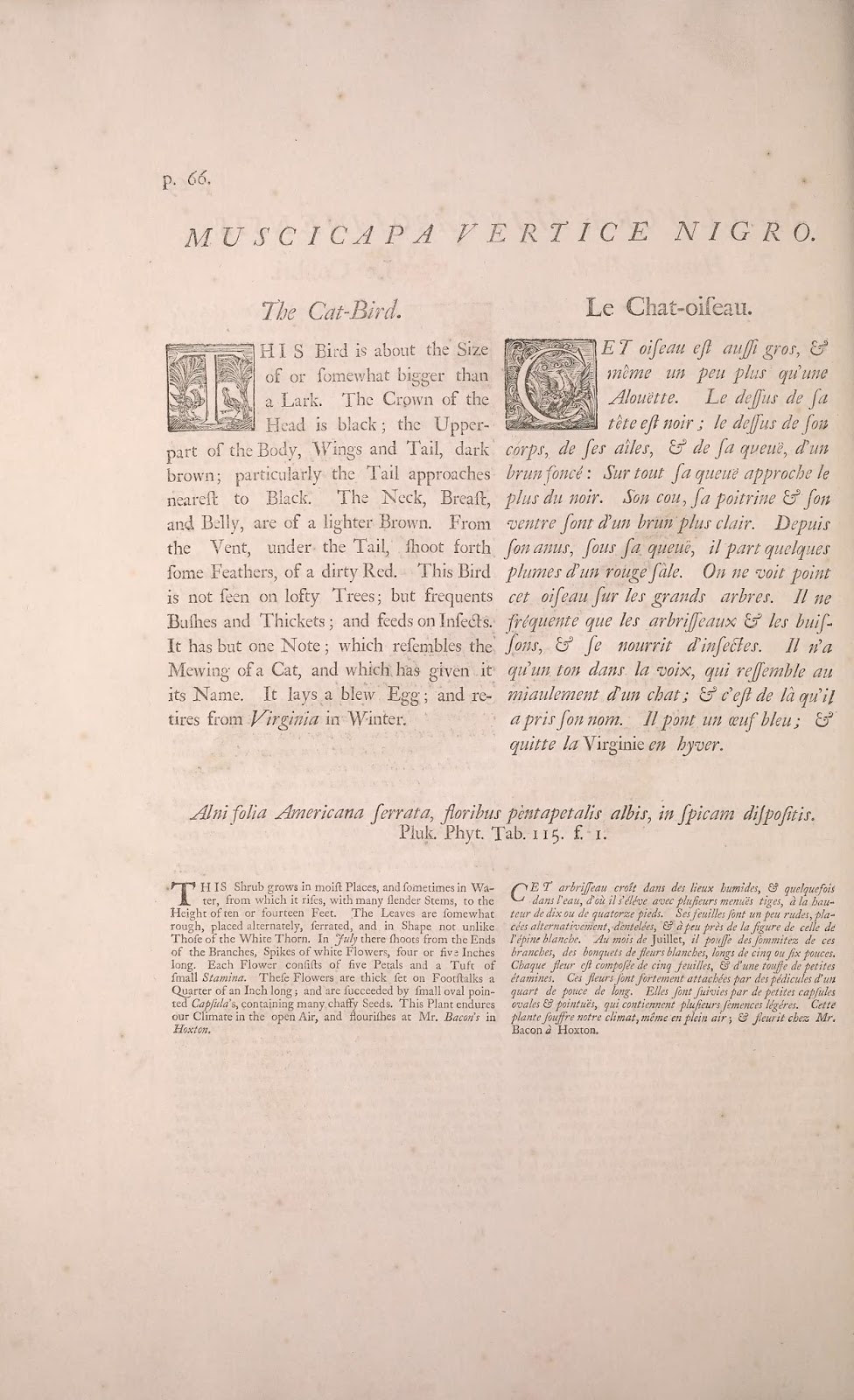
The Gray Catbird had been known to European science for nearly a century by the time Wilson first encountered the species. Mark Catesby (1683-1749) painted the bird for his Natural History of Carolina, Florida, and the Bahama Islands, noting that its English and French names derived from its signature call, “which resembles the Mewing of a Cat.” Catesby was responsible, too, for the long-persistent classification of this species among the European muscicapids: he headed his account “Muscicapa vertice nigro,” the black-crowned flycatcher.

View Full Size Image

Mathurin Brisson (1723-1806) relied completely, it seems, on Catesby and his painting for his description of the same bird; like his English predecessor, Brisson considered the catbird a flycatcher, a “gobe-mouche,” but the formal Latin (and non-binomial) name he gave it focused not on the bird’s head pattern but on its overall color and geographic origin: “Muscicapa Virginiana fusca” he called it, echoing precisely the French designation “Gobe-mouche brun de Virginie.”

The Count de Buffon (1707-1788) followed Brisson and Catesby by calling it the “moucherolle de Virginie”, but he for the first time acknowledged some taxonomic uncertainty with his observation that the catbird combined the size of the American tyrant flycatchers with the “straight and nearly hookless bill” of their Old World counterparts.

Thanks to the stubborn French resistance to the modern binomial system, it fell to Linnaeus to give Catesby’s catbird an “official” name, a task he completed in 1766, in the 12th edition of the Systema.

View Full Size Image

The Archiater retained the generic designation Muscicapa, but for his epithet selected none of the obvious alternatives already suggested by Catesby and by Brisson: the catbird would be not “vertice-nigro,” not “virginiana,” not even “fusca,” but carolinensis, ostensibly because the species “inhabits Carolina” (Catesby’s Virginian type locality notwithstanding), but more likely because the great nomenclator could not resist another opportunity to memorialize, even obliquely, his own given name.

The mistaken notion that the catbird was a flycatcher trickled into the English-language ornithology of the eighteenth century. John Latham (1740-1837) called it the “Cat Flycatcher” in his General Synopsis of Birds, and Thomas Pennant (1726-1798) (who was able to extend the species’ known range as far north as New York) retained the name when he listed the species in his Arctic Zoology.

*_*_*_*

Exalted as all those authorities are, none of them added substantially to the little life history information Catesby had given his readers in 1729:

View Full Size Image

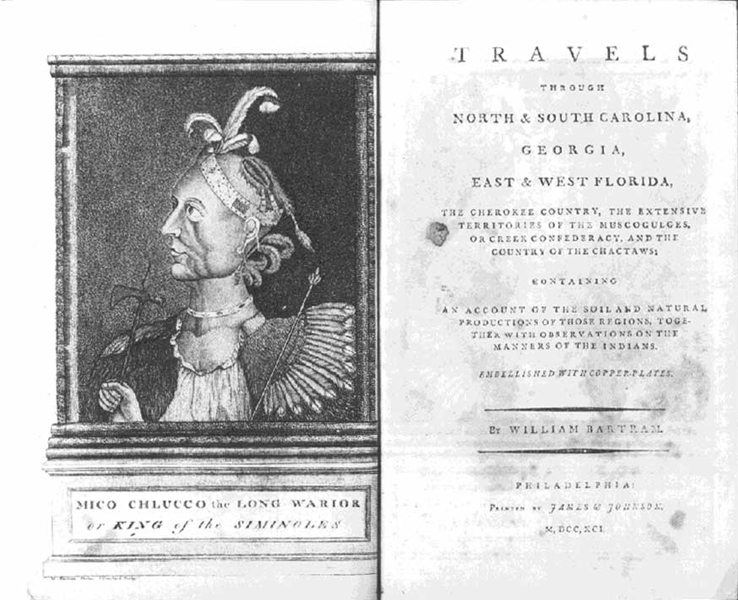
In the mid-1770s, though, the Philadelphia naturalist and writer William Bartram (1739-1823) undertook his own journey through the American south, retracing in part Catesby’s route—and gently correcting his predecessor’s errors and misapprehensions in the book that Bartram would publish in 1790, the Travels.  

View Full Size Image

Bartram was particularly surprised by Catesby’s “detraction of the fame due” the catbird as a singer. Where the earlier explorer had claimed that it produced only a single note—that well-known eponymous meowing—Bartram found that “the cat bird” was in reality … one of our most eminent songsters, little inferior to the philomela or mock-bird; and in some remarkable instances, perhaps, exceeds them both, in particular as a buffoon or mimick; he endeavours to imitate every bird and animal, and in many attempts does not ill succeed, even in rehearsing the songs, which he attentively listens to, from the shepherdess and rural swain, and will endeavor and succeed to admiration, in repeating the melodious and variable airs from instrumental music, and this in his wild state of nature.

*_*_*_*

Alexander Wilson met William Bartram in Philadelphia in 1802, and the unlikely pair quickly became friends. The intellectual stimulation and emotional support that Wilson—a perennially impoverished schoolteacher—found in Bartram and his family inspired him to devote himself entirely to the project that would become the American Ornithology.

View Full Size Image

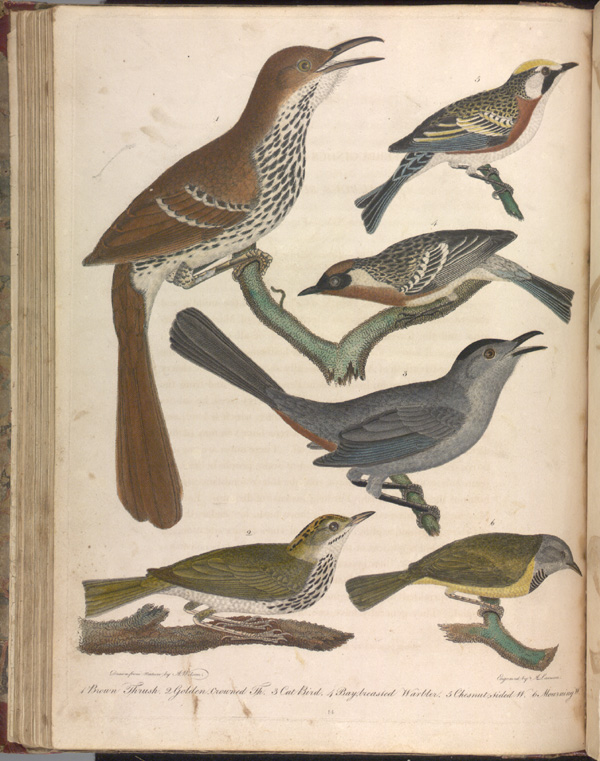
Wilson also, it seems, came to share his friend and mentor’s admiration for the Gray Catbird, and his account of the species is one of the finest and most complete in the American Ornithology, showing Wilson at his brilliant best as writer and observer.

Here as elsewhere, Wilson, with the immigrant’s zeal, sets the knowledge gained from experience—he was after all a child of the Scottish Enlightenment—against the bookish speculations of the cabinet naturalists of Old Europe. Note how he invokes not mere static structure but the behavior of the living bird in rejection of the venerable Anglo-French tradition of assigning this bird to the muscicapids:

This bird has been very improperly classed among the Fly-Catchers. As he never seizes his prey on wing, has none of their manners, feeds principally on fruit, and seems to differ so little from the Thrushes, I think he more properly belongs to the latter tribe than to any other genus we have. His bill, legs and feet, place and mode of building, the colour of his eggs, his imitative notes, food and general manners, all justify me in removing him to this genus.

Wilson pointedly ignores the Linnaean epithet carolinensis to call his bird Turdus lividus, the “bluish thrush,” honoring his Philadelphia colleague Bartram, who had coined that specific name in his Travels.

Where Catesby and his followers could say only that the catbird leaves Virginia in the winter, Wilson, reckoning backward from the species’ February arrival in Georgia, deduced that the wintering grounds lay “not far distant, probably in Florida.” Returning in April to Pennsylvania, the birds have built their nests by early May, in “a thicket of briars or brambles, a thorn bush, thick vine, or the fork of a small sapling.”

Celebrated by his compatriot Sir William Jardine as the first who truly studied the birds of North America in their natural abodes, and from real observation, Wilson found the Gray Catbird an especially obliging subject for experimentation. Curious about the extent to which a breeding pair could recognize its own eggs and young, the naturalist took two eggs from one [catbird] which was sitting, and in their place put two of the Brown Thrush, or Thrasher…. In a minute or two the male made his approaches, stooped down and looked earnestly at the strange eggs … [and] with the greatest gentleness took out both the Thrasher’s eggs, first one and then the other, carried them single about thirty yards, and dropt them among the bushes…. Soon after the female resumed her place on the nest as before.

Placing two half-fledged chicks in another catbird’s nest had a similar result: “She soon turned them both out”; happily, catbirds bounce, and soon enough the father bird was feeding them on the ground “with great assiduity and tenderness.” On another occasion, Wilson moved a nest and its four well-advanced eggs from one side of a thicket to the other; in less than half an hour, the female was once again incubating her displaced clutch.

*_*_*_*

Wilson also took advantage of his close acquaintance with the catbird to weigh in on the venerable controversy of the “fascination” of birds by snakes—a matter still unresolved for some a century later. Never one to mince words, he blames “credulity and ignorance” for the “absurd” belief that a snake, with [its] eyes, breath, or any other known quality he possesses, should be capable of drawing a bird, reluctantly from the tree tops to its mouth; in all of the encounters between snakes and catbirds “personally witnessed” by Wilson, the bird, he says, was the actual “assailant,” attacking the reptile in an effort to drive it away from its nest and young.

*_*_*_*

Wilson joined his careful observation of the catbird with a genuine affection for the species. That fondness was, as he reports, not shared by all of his contemporaries; blinded by “illiberal and persecuting prejudice,” the farmer of Wilson’s day protected his strawberries, his early cherries, and his “finest ripe mellow pears”

by shooting [the catbird] down with his gun, as he finds old hats, wind-mills and scarecrows are no impediments in his way to these forbidden fruits…. The boys are now set to watch the cherry trees with the gun; and thus commences a train of prejudices and antipathies that commonly continue through life.

For Wilson, though, as for all “the generous and the good, the lovers of nature and of rural charms,” the confidence which this familiar bird places in man by building in his garden, under his eye, the music of his song, and the interesting playfulness of his manners, will always be more than a recompence [sic] for all the little stolen morsels he snatches.

I’d like to think that the catbirds of Gloria Dei are even today repaying the compliment.

View Full Size Image

August 23, 2013by Kathryn Stine
Blog Reel, Featured Books

This Means War! A History of the Bone Wars

View Full Size Image
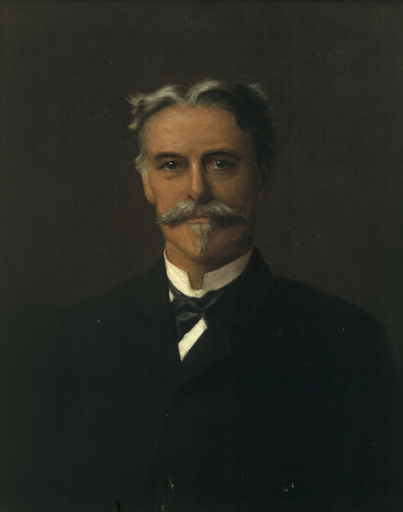
Edward Drinker Cope

Here at the Academy of Natural Sciences of Drexel University in Philadelphia, the story of the so-called Bone Wars is well known.

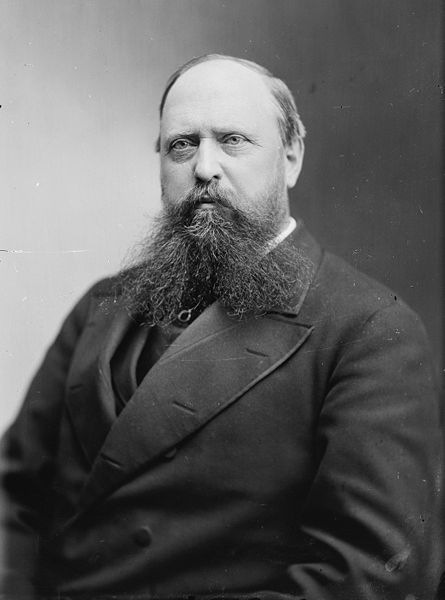
In short, the Academy’s Edward Drinker Cope (1840-1897), also affiliated with U. Penn, and Yale University’s Othniel Charles Marsh (1831-1899), also affiliated with the United States Geological Survey, were both prolific, well respected paleontologists. Both unearthed, described, and published their finds of fossil fauna in the post-Civil War era when the discipline of vertebrate paleontology was quite young in the U.S.

Though the two initially enjoyed each others’ company, a scientific rivalry kicked in whose results were protracted and nasty. Each scientist ridiculed the other’s published works; each endeavored to damage the other’s reputation; each supposedly sent thugs to the other’s fossil-bone quarries to raid, if not destroy, what lay therein.

But why? Briefly, it was all about priority: who had the published privilege to name which species first. In the end, all this rushing and competitiveness resulted, according to Jaffe (2000: 100) in, for example, at least 16 taxonomic names for the same extinct mammal Uintathere. Quoting the current analysis of Walter Wheeler, Jaffes (ibid) reported, “Neither [Cope nor Marsh] paid any attention to the priority of the other’s scientific names, and they both virtually ignored the priority of Leidy’s. The result was nomenclatural chaos.”

View Full Size Image
Othniel Charles Marsh

Fortunately much has been published about the intellectual combats between Cope and Marsh, yet the public never seems to tire of the Bone Wars. Science writer Mark Jaffe (2000) in his comprehensive The Gilded Dinosaur described Marsh and Cope as writing rebuttals to rebuttals within the pages of The American Naturalist. For several seasons the pages of that journal, whose gentle appellation is An Illustrated Magazine of Natural History, were replete with both paleontologists’ accusations of blunders, errors, and recklessness. Buckets of ink were spilled on their defenses, disputes, rejections, ridicules, taunts, and vengeances.

Finally the editors of this had had enough (June 1873), informing subscribers:

WE regret that Professors Marsh and Cope have considered it necessary to carry their controversy to the extent that they have. Wishing to maintain the perfect independence of the NATURALIST in all matters involving scientific criticism, we have allowed both parties to have their full say, but feeling that now the controversy between the authors in question has come to be a personal one and that the NATURALIST is not called upon to devote further space to its consideration, the continuance of the subject will be allowed only in the form of an appendix at the expense of the author.

That expensive appendix followed (June 1873) as Marsh’s Reply to Professor Cope’s Explanation, whose opening lines indicate the flavor of his nine-page thesis:

THE May NATURALIST (p. 290) contains Professor Cope’s long promised “explanation” of the many errors and false dates in his recent publications, and a most remarkable document this explanation is. As a sleight-of-hand performance with names and dates, it shows practice, and is amusing; but to those familiar with the subject, and to moralists, it suggests sad reflections. [et cetera, et cetera, et cetera…]

Cope chimed in again (July 1873) with On Professor Marsh’s Criticisms:

THE recklessness of assertion, the erroneousness of statement, and the incapacity of comprehending our relative positions, on the part of Professor Marsh, render further discussion of the trivial matters -upon which we disagree unnecessary; and my time is too fully occupied on more important subjects to permit me to waste it upon personal affairs which are already sufficiently before the public. Professor M. has recorded his views “cgre perenne,” and may continue to do so without personal notice by E. D. COPE.

Nearly 20 years after these words were published, the bitter battle for buried treasure between two 19th century vertebrate paleontologists continued to have all the intrigues of tabloid magazines today, only based on fossil finds and published claims instead of Hollywood machinations.

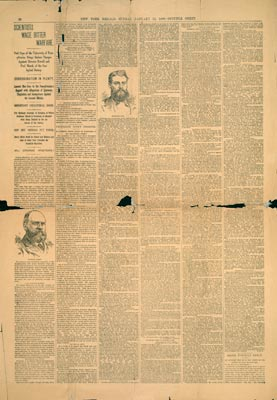
After all, when’s the last time you read a newspaper article began with SCIENTISTS WAGE BITTER WARFARE followed by eight subtitles? That’s what readers of the New York Herald encountered when they opened its pages on Sunday, January 21, 1890:

View Full Size Image
Page from New York Herald

SCIENTISTS WAGE BITTER WARFARE.
—
Prof. Cope of the University of Pennsylvania, Brings Serious Charges
Against Director Powell and Prof. Marsh, of the Geological Survey.
—
CORROBORATION IN PLENTY.
—
Learned Men Come to the Pennsylvanian’s Support with Allegations of Ignorance, Plagiarism and Incompetence Against the Accused Officials.
—
IMPORTANT COLLATERAL ISSUE.
—
The National Academy of Sciences, of Which Professor Marsh is President, is Charged with being Packed in the Interests of the Survey.
—
RED HOT DENIALS PUT FORTH.
—
Heavy Blows Dealt in Attack and Defence (sic) and Lots of Hard Nuts Provided for Scientific Digestion
—
WILL CONGRESS INVESTIGATE?

View Full Size Image
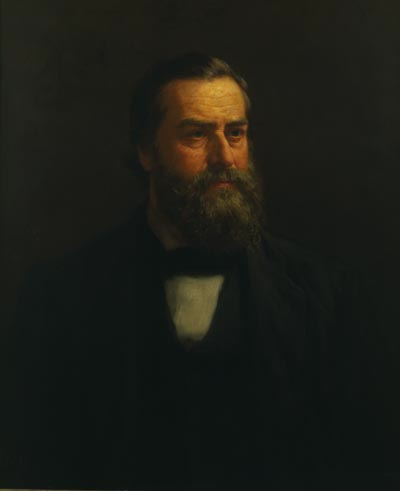
Joseph Leidy

Things got so bad that the pre-eminent natural historian of the day, the Academy of Natural Sciences’ Joseph Leidy (1823-1891), the Father of American Vertebrate Paleontology himself, decided to step out of the discipline he helped to found. This was saying a lot: among Leidy’s famous firsts he described Deinondon horridus, the first dinosaur discovered in the new world — a handful of teeth found by the Survey near the source of the Missouri River in 1856 — and Hadrosaurus folkii, the first articulated dinosaur ever — a nearly complete specimen unearthed in Haddonfield, NJ, in 1858. The remains of both of these animals are carefully curated under lock and key in the Academy’s Vertebrate Paleontology Department to this day.

Despite the intervening 140 years since the Bone Wars raged, the topic has been the Number One subject of Academy Archives researchers in recent years. That research resulted recently in an engaging documentary film in the new series O’Hanlon’s Heroes (see http://programma.vpro.nl/ohanlonshelden/afleveringen/de-bottenoorlog.html), just one example.

In 2012, the Bone Wars has been eclipsed only by Samuel G. Morton (1799-1851) as the most requested archival subject for researchers at the Academy Archives. Morton, certainly deserving of his own blog post, is renowned for having amassed the largest collection of human crania in the 19th century (see Morton, 1839). Like others in this story, Morton was a giant at the Academy of Natural Sciences, serving as its President from 1849 until his death. His skull collection now resides in good hands at the U. Penn Museum of Archeology and Anthropology.

View Full Size Image
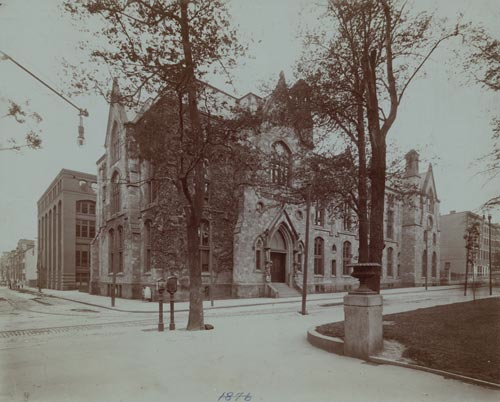
1870s exterior of the Academy of Natural Sciences, Philadelphia
View Full Size Image
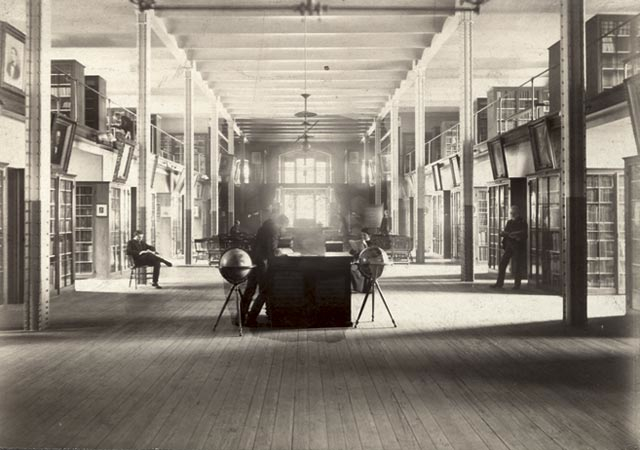
1901 interior of the Academy of Natural Sciences, Philadelphia

We here in the Academy Library & Archives are fortunate to be able to walk up to the stacks, survey entire runs of the American Naturalist, Transactions of the American Philosophical Society, Proceedings of the Academy of Natural Sciences, where the Bone Wars played out in print, among 250,000 other titles on site.

Thanks to the efforts of the Biodiversity Heritage Library, you can access — free — any of 57,000+ titles from the comfort of your own space. See what discoveries you might ignite as you browse the virtual pages at www.biodiversitylibrary.org.

We hope you will enjoy the selection of BHL-digitized works presented in the Bone Wars Collection. You can also download select books by Marsh and Cope for free from within the iTunes environment through our new Bone Wars iTunes U collection!

References and Further Reading

  • American Naturalist, An Illustrated Magazine of Natural History. 1873: Vol 7. Salem, MA: Peabody Academy of Sciences.
  • Cope, E. D., 1870. Synopsis of the Extinct Batrachia, Reptilia and Aves of North America. Transactions of the American Philosophical Society, New Series, Vol. 14, No. 1, pp. 1-252+i-viii
  • Jaffe, M. 2000. The Gilded Dinosaur: The Fossil War Between E. D. Cope and O. C. Marsh and the Rise of American Science. New York: Crown Publishers, 424 pp.
  • Leidy, J., 1860. Extinct Vertebrate from the Judith River and Great Lignite Formations of Nebraska. Transactions of the American Philosophical Society, New Series, Vol. 11, pp. 139-154.
  • Morton, S. G., 1839. Crania Americana ; or, a comparative view of the skulls of various aboriginal nations of North and South America. J. Dobson, [and] Simpkin, Marshall & co: Philadelphia, London.
November 13, 2012by ulib-libraryjobs

Help Support BHL

BHL's existence depends on the financial support of its patrons. Help us keep this free resource alive!

search

About BHL

The Biodiversity Heritage Library (BHL) is the world’s largest open access digital library for biodiversity literature and archives. BHL operates as a worldwide consortium of natural history, botanical, research, and national libraries working together to digitize the natural history literature held in their collections and make it freely available for open access as part of a global “biodiversity community.”

Join Our Mailing List

Sign up to receive the latest news, content highlights, and promotions.

Subscribe Now

Subscribe to Blog via Email

Enter your email address to subscribe to this blog and receive notifications of new posts by email.

Join 319 other subscribers

Subscribe to Blog Via RSS

Subscribe to the blog RSS feed to stay up-to-date on all the latest BHL posts.

Access RSS Feed

Inspiring Discovery through Free Access to Biodiversity Knowledge.

The Biodiversity Heritage Library makes it easier than ever for you to access the information you need to study and explore life on Earth…for free, anytime, anywhere.


64+ Million Pages of
Biodiversity Literature Online.

EXPLORE

Tools and Services
to Transform Research.

EXPLORE

300,000+
Illustrations on Flickr.

EXPLORE

ABOUT | HARMFUL CONTENT | PRIVACY | SITE MAP | TERMS OF USE