
Biodiversity Heritage Library - Program news and collection highlights from BHL
  • Home
  • News
  • Featured Books
    • All Featured Books
    • Book of the Month Series
    • BHL at 20
  • User Stories
  • Campaigns
    • Fossil Stories
    • Garden Stories
    • Monsters Are Real
    • Page Frights
    • Her Natural History
    • Earth Optimism 2020
  • Tech Blog
  • Visit BHL
Home
News
Featured Books
    All Featured Books
    Book of the Month Series
    BHL at 20
User Stories
Campaigns
    Fossil Stories
    Garden Stories
    Monsters Are Real
    Page Frights
    Her Natural History
    Earth Optimism 2020
Tech Blog
Visit BHL
  • Home
  • News
  • Featured Books
    • All Featured Books
    • Book of the Month Series
    • BHL at 20
  • User Stories
  • Campaigns
    • Fossil Stories
    • Garden Stories
    • Monsters Are Real
    • Page Frights
    • Her Natural History
    • Earth Optimism 2020
  • Tech Blog
  • Visit BHL
Biodiversity Heritage Library - Program news and collection highlights from BHL
Blog Reel, Featured Books

Ursus maritimus: A Shining Star in the North Pole

As part of BHL’s Winter Appeal, we’ll be highlighting some of the amazing species that are especially well-adapted to cold, wintery climes as well as those that often come to mind as we celebrate the winter holidays.  Each post will include images, facts and sometimes even stories drawn from the pages of the open access literature in BHL.  The ongoing growth of BHL is supported in part by our dedicated patrons whose gifts we depend on for the the digitization of additional literature, technical development of the program, and improvement of data curation.  We hope you’ll consider donating this holiday season!

Ursus maritimus

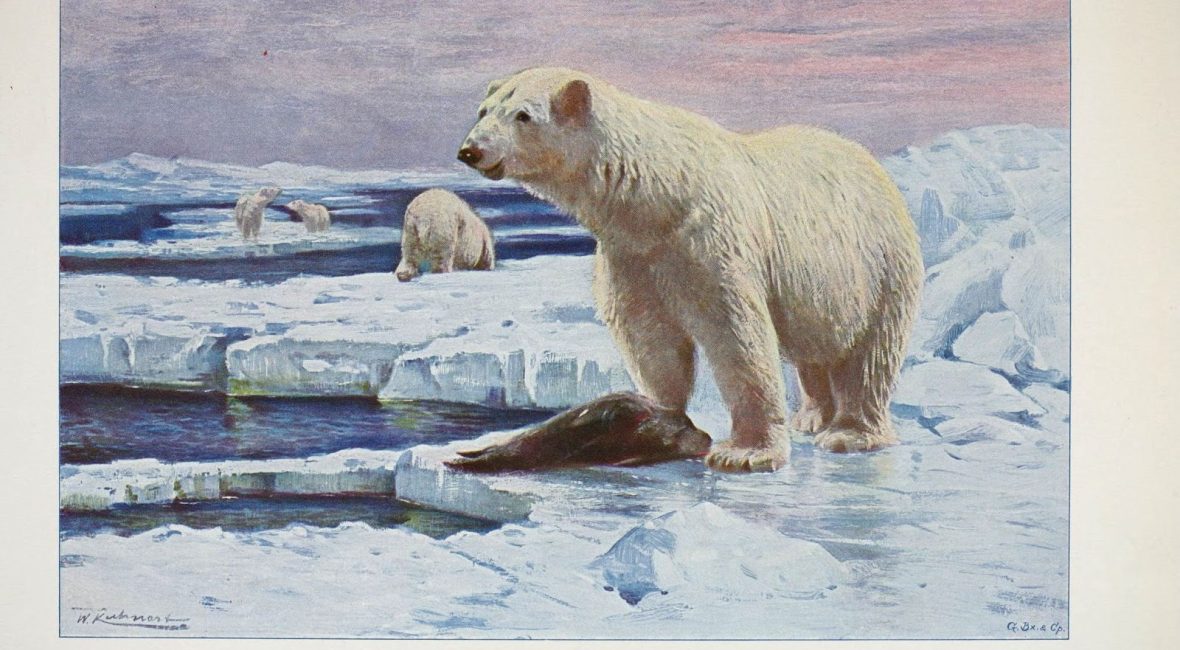
Imagine being out in a quiet, cold landscape with almost nothing around for miles except for the ice and sea.  In this vast expanse of calm and quiet, you might either wander across the ice in search of a meal or even dive down into the freezing cold waters.  Either way, you would remain quite comfortably warm.  Thus is one of the advantages possessed by Ursus maritimus for surviving in this challenging environment.  A thick coat of fur and insulating layer of fat provide warmth and the distinctive white coloring of the coat serves as excellent camouflage when stalking prey.  A long neck and relatively narrow skull for the species provides the aptly-named “sea bear” with a streamlined figure excellent for swimming.

View Full Size Image
Wild Life of the World, v.2.  London, F. Warne and Co., 1916.

http://biodiversitylibrary.org/page/21738961#page/329/mode/1up

Commonly known as the polar bear, Ursus maritimus actually only occurs in one of the poles–the North Pole.  The vast, ice-covered ocean known as the Arctic actually has etymological roots in the ancient Greek word, ἄρκτος, meaning bear.  Antarctic, therefore implying “no bears.”

View Full Size Image
The Quadrupeds of North America.  New York, V.G. Audubon, 1851-54.

http://biodiversitylibrary.org/page/34896849#page/369/mode/1up

When we consider the growing concerns about the effects of climate change on places like the Arctic, polar bears are one of the iconic species that immediately come to mind for many of us.  How might they fare over the next decades?  Despite all of their physical advantages and their placement as an apex predator, polar bear populations have seen recent declines and are already considered a vulnerable species by the IUCN.  Some of the biggest threats facing polar bears are the melting ice cap, hunting, and human development in the area, including oil spills and other negative impacts on the environs.

Yet even before climate change was a prominent topic in science and the news, polar bears held a special place in the public’s imagination.  Tales of exaggerated ferocity were plenty.  One especially eyebrow-raising account tells of the polar bear’s invariable habit of charging at any man encountered.  While today we know that polar bears have been known to attack humans they are just, if not more likely, to avoid such encounters, yet this story goes on to insist that not only do they inevitably charge, they can just as inevitably be tricked into grabbing weapons and committing suicide with them.  Polar bears were undoubtedly less studied and therefore not as well understood in 1861, yet even so the author seems barely able to contain his bemusement at the extraordinary claims of this “eye witness.”  Today, hunting bans now help to protect this magnificent species.  Groups like BHL and our partners EOL work hard to make sure that scientists and others have access to important information about the species, its habitat and behavior so informed conservation decisions can be made.

The polar bear is documented in over 1,200 pages of open access literature made available through the Biodiversity Heritage Library.  BHL relies on donations from individuals to support scanning of the biodiversity literature held in some of the world’s most renowned natural history and botanical libraries.  To learn more about how your donation supports the continued growth of BHL, please visit http://archive.constantcontact.com/fs181/1103622715135/archive/1115465985290.html.  We hope you’ll consider making a contribution today!

December 16, 2013by brooksm

Help Support BHL

BHL's existence depends on the financial support of its patrons. Help us keep this free resource alive!

search

About BHL

The Biodiversity Heritage Library (BHL) is the world’s largest open access digital library for biodiversity literature and archives. BHL operates as a worldwide consortium of natural history, botanical, research, and national libraries working together to digitize the natural history literature held in their collections and make it freely available for open access as part of a global “biodiversity community.”

Join Our Mailing List

Sign up to receive the latest news, content highlights, and promotions.

Subscribe Now

Subscribe to Blog via Email

Enter your email address to subscribe to this blog and receive notifications of new posts by email.

Join 319 other subscribers

Subscribe to Blog Via RSS

Subscribe to the blog RSS feed to stay up-to-date on all the latest BHL posts.

Access RSS Feed

Inspiring Discovery through Free Access to Biodiversity Knowledge.

The Biodiversity Heritage Library makes it easier than ever for you to access the information you need to study and explore life on Earth…for free, anytime, anywhere.


ABOUT | HARMFUL CONTENT | PRIVACY | SITE MAP | TERMS OF USE