
Biodiversity Heritage Library - Program news and collection highlights from BHL
  • Home
  • News
  • Featured Books
    • All Featured Books
    • Book of the Month Series
    • BHL at 20
  • User Stories
  • Campaigns
    • Fossil Stories
    • Garden Stories
    • Monsters Are Real
    • Page Frights
    • Her Natural History
    • Earth Optimism 2020
  • Tech Blog
  • Visit BHL
Home
News
Featured Books
    All Featured Books
    Book of the Month Series
    BHL at 20
User Stories
Campaigns
    Fossil Stories
    Garden Stories
    Monsters Are Real
    Page Frights
    Her Natural History
    Earth Optimism 2020
Tech Blog
Visit BHL
  • Home
  • News
  • Featured Books
    • All Featured Books
    • Book of the Month Series
    • BHL at 20
  • User Stories
  • Campaigns
    • Fossil Stories
    • Garden Stories
    • Monsters Are Real
    • Page Frights
    • Her Natural History
    • Earth Optimism 2020
  • Tech Blog
  • Visit BHL
Biodiversity Heritage Library - Program news and collection highlights from BHL
Blog Reel, Featured Books

The Herefordshire Pomona

Illustration of various apple cultivars

The Herefordshire Pomona. v. 2 (1876-1885). Art by Edith E. Bull. Digitized by Cornell University Library, Mann Library. https://biodiversitylibrary.org/page/55785827.

It is a glimpse into a lush diversity of the past….and into possibilities for a resilient future. The Herefordshire Pomona is a classic in the science and practice of pomology. Compiled and edited by the eminent 19th century horticulturalist Robert Hogg and the physician Henry Graves Bull, who moonlighted as an enthusiastic amateur naturalist, the Pomona was an outgrowth of efforts by the Woolhope Naturalists’ Field Club to record and showcase the different varieties of apples and pears found in the orchards of Herefordshire, a county in the West Midlands region of England.

For centuries, Herefordshire was known as the center of English apple cider production, a reputation that it continues to enjoy today. And yet, already in the mid-1800s there was growing concern among English horticulturalists and naturalists that many of the region’s orchards were falling into disuse, the fruits of their trees being passed over and forgotten in favor of more popular imports from other parts of the country and world.

Illustration of a variety of apple cultivars

The Herefordshire Pomona. v. 2 (1876-1885). Art by Edith E. Bull. Digitized by Cornell University Library, Mann Library. https://biodiversitylibrary.org/page/55785532.

To counter this erosion of agricultural heritage, each year the Woolhope Club staged exhibitions of locally grown apples, inviting renowned experts, including Dr. Hogg, to judge the quality of the featured fruits, and to help identify any fruits not already clearly recognized. To fully capture the insights gained from these explorations, Hogg and Bull enlisted the help of artists Alice Blanche Ellis and Edith Elizabeth Bull (thought to be Dr. Bull’s daughter), who drew their pomological subjects as they saw them— glorious hues, unsightly warts, odd-lot shapes, fluky speckles and all. The resulting work was issued in seven parts between the years 1876 and 1885, purchased on subscription basis by English town and country gentry willing to pay a tidy sum for this comprehensive and gorgeously illustrated work.

HerefordshirePomona_List of Cider Apples Perry Pears_Small.jpg

List of cider apples and perry pears recommended for planting by the Woolhope Club. List of cider apples and perry pears recommended for planting by the Woolhope Club. The Herefordshire Pomona. v. 2 (1876-1885). Digitized by Cornell University Library, Mann Library. https://biodiversitylibrary.org/page/55785887.

While the Pomona may thus have been born as the ultimate coffee table book for upper class households, it performed an invaluable service by documenting the presence of over 400 apple and pear varieties in 19th century England. Its indexes alone, featuring variety names like Garter Apple, Foxwhelp, Cocc-a-gee, Monstrous Pippin, Jolly Beggar, Bess Pool, Kentish Fill-basket, Peasgood’s Nonesuch, Queen of Sauce, Friar, Gipsy King, Schoolmaster, American Mother, Hoary Morning, and Bastard Rough Coat, read like a playful ode to the hidden stories—from lyrically sweet and archly comic to the darkly dramatic—of old English country life. Descriptions for each variety—drawn from Fruit Manual, a significant earlier work by Hogg—are instructive, not just for information about horticultural best practices of the time, but also for their guidance about important qualities of each variety, such as flavor, optimal timing for harvest, and shelf life in storage. And, as the Pomona notes, when it comes to cider apples, one should not be fooled by the size and the often-bitter taste of their varieties, for the smaller the fruit, the better the beverage.

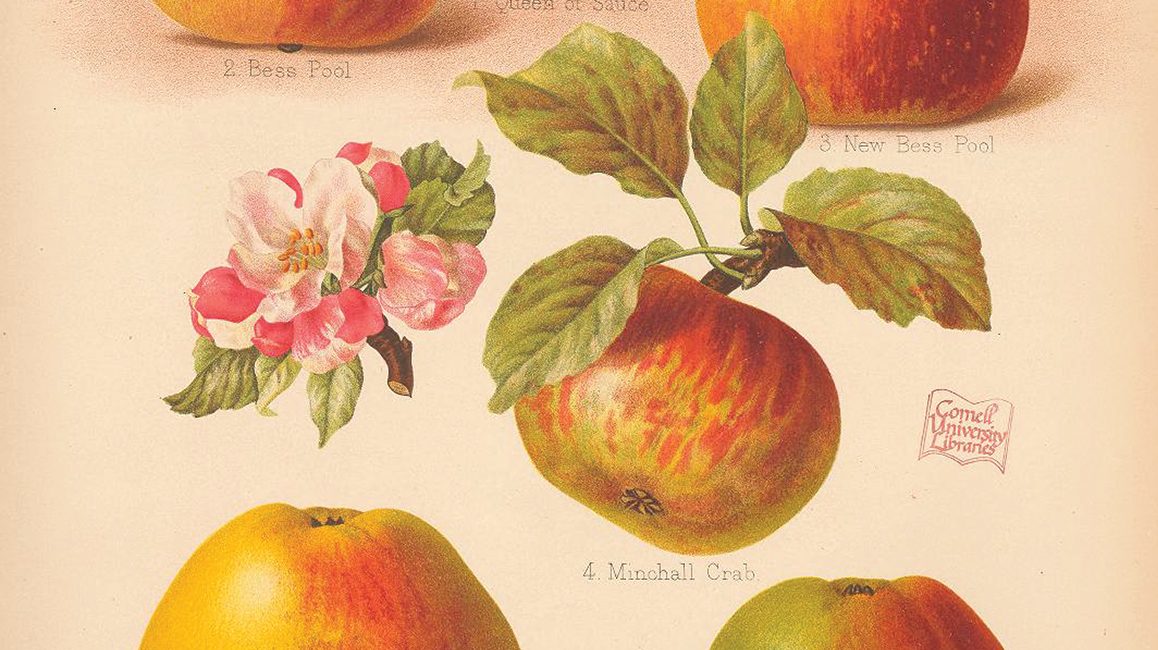
Illustration of a variety of apple cultivars

The Herefordshire Pomona. v. 2 (1876-1885). Art by Alice B. Ellis and Edith E. Bull. Digitized by Cornell University Library, Mann Library. https://biodiversitylibrary.org/page/55785803.

In 1885, six hundred copies of the Herefordshire Pomona’s seven published parts were bound and issued as a two-volume set. Mann Library is fortunate to hold one of these extremely rare sets in the Library’s special collections. Over the past several months, we have digitized both volumes.  Now part of the growing online collection of legacy life sciences literature in the Biodiversity Heritage Library, this digitized copy in the BHL collection makes an invaluable record of English horticultural history widely available to today’s scientists and breeders. As current interest in finding lost cultivars, securing genetic diversity, and developing new varieties with appropriate qualities for a re-emergent cider industry grows, the Herefordshire Pomona will help ensure that insights preserved from our past continue to advance both the discovery and conservation needed for a healthier world tomorrow.

Illustration of a variety of apple cultivars

The Herefordshire Pomona. v. 2 (1876-1885). Art by Alice B. Ellis and Edith E. Bull. Digitized by Cornell University Library, Mann Library. https://biodiversitylibrary.org/page/55785583.

The week of 4 June 2018, BHL is celebrating cider-making and apples with Cornell University Library and Mann Library. Follow #CornellCider on social media for a sweet dose of apple delight and visit the Pomology: Apples and Cider collection on BHL to explore more great books like Herefordshire Pomona.

Sources:

Arbury, Jim. “Pomonas and Pomology,” The Herefordshire Pomona. Ed. Robert Hogg and Henry Graves Bull. 1876. The Folio Society, 2014

Bunyard, Edward A. Guide to the Literature of Pomology. By E.A. Bunyard … [s.n.], 1915, www.biodiversitylibrary.org//bibliography/33776.

Monbiot, George. “Fallen fruit,” The Guardian, 30 October 30, 1994. www.theguardian.com/lifeandstyle/2004/oct/30/foodanddrink.weekend

Nissen, Claus. Die Botanische Buchillustration: Ihre Geschichte Und Bibliographie. 2. Aufl., durchgesehener und verb., A. Hiersemann, 1966.

Roach, F. A., The Cultivated Fruits of Britain: Their Origin and History.  B. Blackwell, 1985

June 7, 2018by Joel Richard

Help Support BHL

BHL's existence depends on the financial support of its patrons. Help us keep this free resource alive!

search

About BHL

The Biodiversity Heritage Library (BHL) is the world’s largest open access digital library for biodiversity literature and archives. BHL operates as a worldwide consortium of natural history, botanical, research, and national libraries working together to digitize the natural history literature held in their collections and make it freely available for open access as part of a global “biodiversity community.”

Join Our Mailing List

Sign up to receive the latest news, content highlights, and promotions.

Subscribe Now

Subscribe to Blog via Email

Enter your email address to subscribe to this blog and receive notifications of new posts by email.

Join 319 other subscribers

Subscribe to Blog Via RSS

Subscribe to the blog RSS feed to stay up-to-date on all the latest BHL posts.

Access RSS Feed

Inspiring Discovery through Free Access to Biodiversity Knowledge.

The Biodiversity Heritage Library makes it easier than ever for you to access the information you need to study and explore life on Earth…for free, anytime, anywhere.


64+ Million Pages of
Biodiversity Literature Online.

EXPLORE

Tools and Services
to Transform Research.

EXPLORE

300,000+
Illustrations on Flickr.

EXPLORE

ABOUT | HARMFUL CONTENT | PRIVACY | SITE MAP | TERMS OF USE