Do you have hen fever?
Many in the 19th century did. From about 1845-1855, an obsession with owning and breeding the world’s finest chickens swept across the United States. The epidemic started with Queen Victoria in England, whose royal menagerie of exotic species was enhanced, according to Wright’s The Illustrated Book of Poultry, in 1843 with a selection of chickens known as Cochin China fowl. As the chickens bred, the queen sent eggs to her royal relatives, igniting a fire of breeding and selling exotic chickens that soon made its way to America.
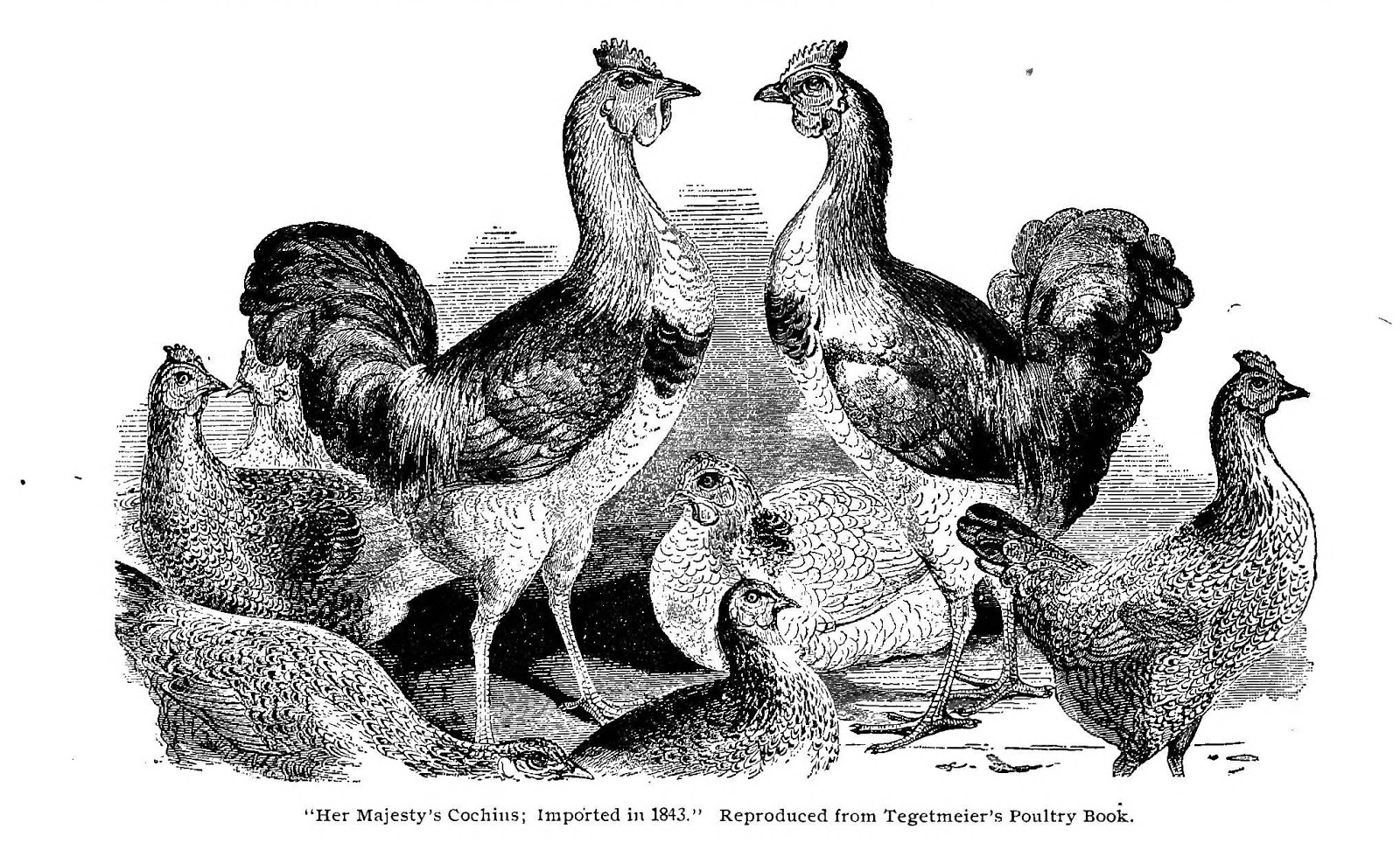 |
| Queen Victoria’s Cochin China fowl. The Asiatics (1904). http://biodiversitylibrary.org/page/37514328. Digitized by Cornell University Library. |
The domesticated chicken is descended from the red junglefowl (Gallus gallus), which was first domesticated nearly 10,000 years ago in Asia and dispersed around the world. Through natural and selective breeding, an astonishing variety of breeds now exist. The American Poultry Association began defining breeds in 1873. Definitions for the breeds were published in the Standard of Perfection. Many of these are now recognized as Heritage Breed chickens, which are defined by The Livestock Conservancy as follows:
“A Heritage Egg can only be produced by an American Poultry Association Standard breed. A Heritage Chicken is hatched from a heritage egg sired by an American Poultry Association Standard breed established prior to the mid-20th century, is slow growing, naturally mated with a long productive outdoor life.”
Today, over three-dozen chicken breeds and 21% of the world’s 8,000 livestock breeds are in danger of extinction. The loss of heritage breeds depletes the genetic diversity of the agricultural system, leaving it increasingly vulnerable to pests and diseases and less adaptable to changing environmental conditions. In an effort to raise awareness about endangered heritage breeds of livestock and poultry, The Livestock Conservancy organized the first Heritage Breeds Week campaign in May 2015. The success of that campaign prompted this year’s International Heritage Breeds Week and Day, May 15-21, 2016, with a mission “To protect endangered livestock and poultry breeds from extinction.” You can follow the campaign hashtag #HeritageBreedsWeek to learn more.
Two of the breeds predominantly responsible for the hen fever of the 19th century are heritage breeds: The Brahma chicken and the Cochin chicken.
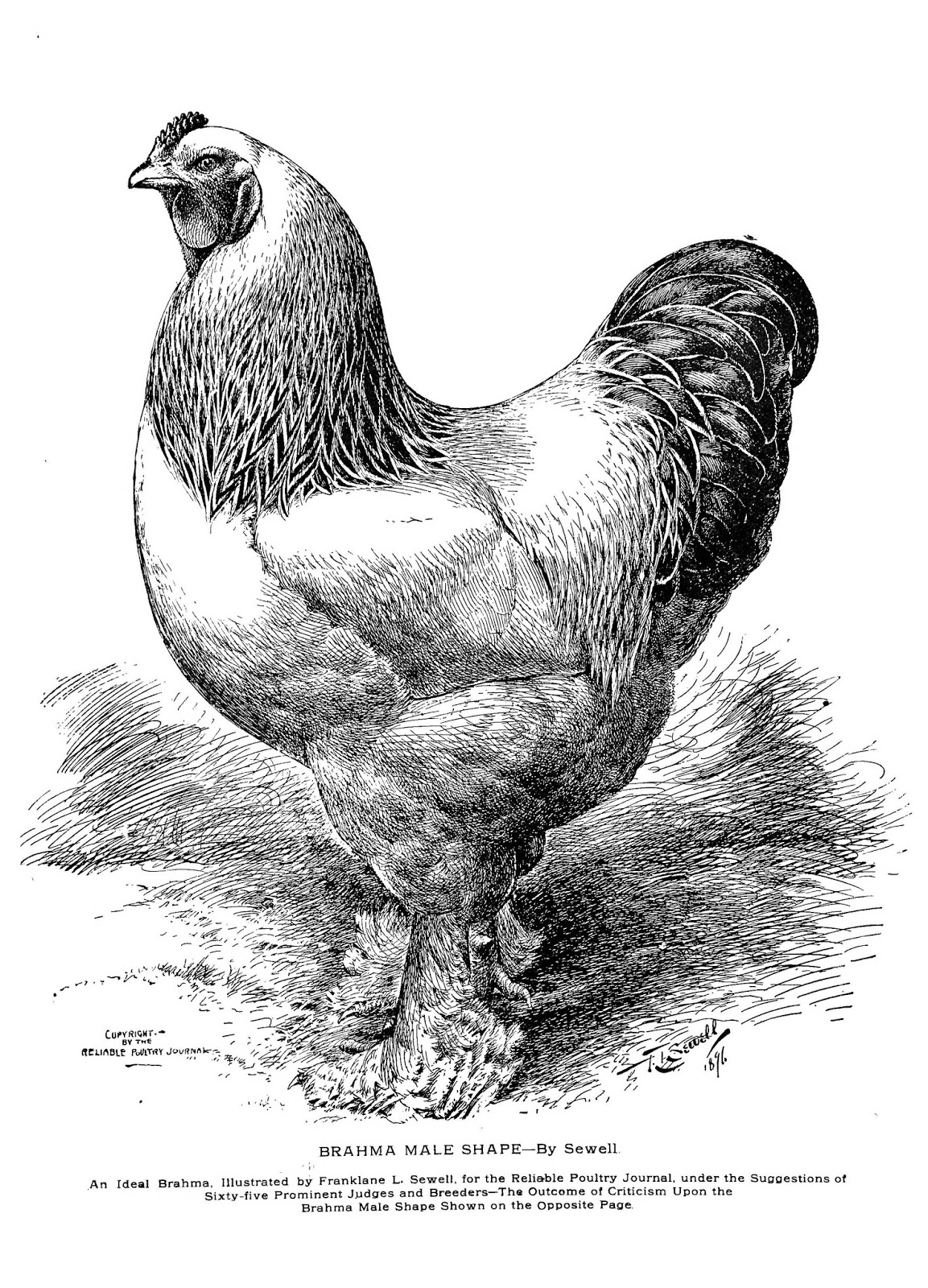 |
| Ideal Brahma. Illustrated by Franklane Lorraine Sewell. The Asiatics (1904). http://biodiversitylibrary.org/page/37514323. Digitized by Cornell University Library. |
Historic publications provide much valuable information about heritage breeds. For example, a history and description of the hen fever-related breeds is captured in The Asiatics; Brahmas, Cochins and Langshans, all varieties, their origin; peculiarities of shape and color; egg production; their market qualities. Breeding, mating and exhibiting, with detailed illustrated instructions on judging (1904). The work, digitized for BHL by Cornell University Library, is made up of many small articles or chapters, most of which were previously published in the Reliable Poultry Journal, also the publisher of this book. The title includes illustrations by notable poultry illustrator Franklane Lorraine Sewell, whose drawings are still used by the American Poultry Association’s Standard of Perfection.
The work provides some interesting insight into the history of hen fever. For example, regarding Queen Victoria’s Cochin China fowl which launched the craze,
“A drawing of those birds was given in the Illustrated London News of that date, from which and the description it is manifest that they had absolutely no points of the Cochin at all, save perhaps yellow legs and large size…But one thing about them there was; these fowls were not only big, but they probably really did come from Cochin China, and from them and that fact came undoubtedly the name, which will now belong, while poultry breeding lasts, to another fowl that has no right to it at all.”
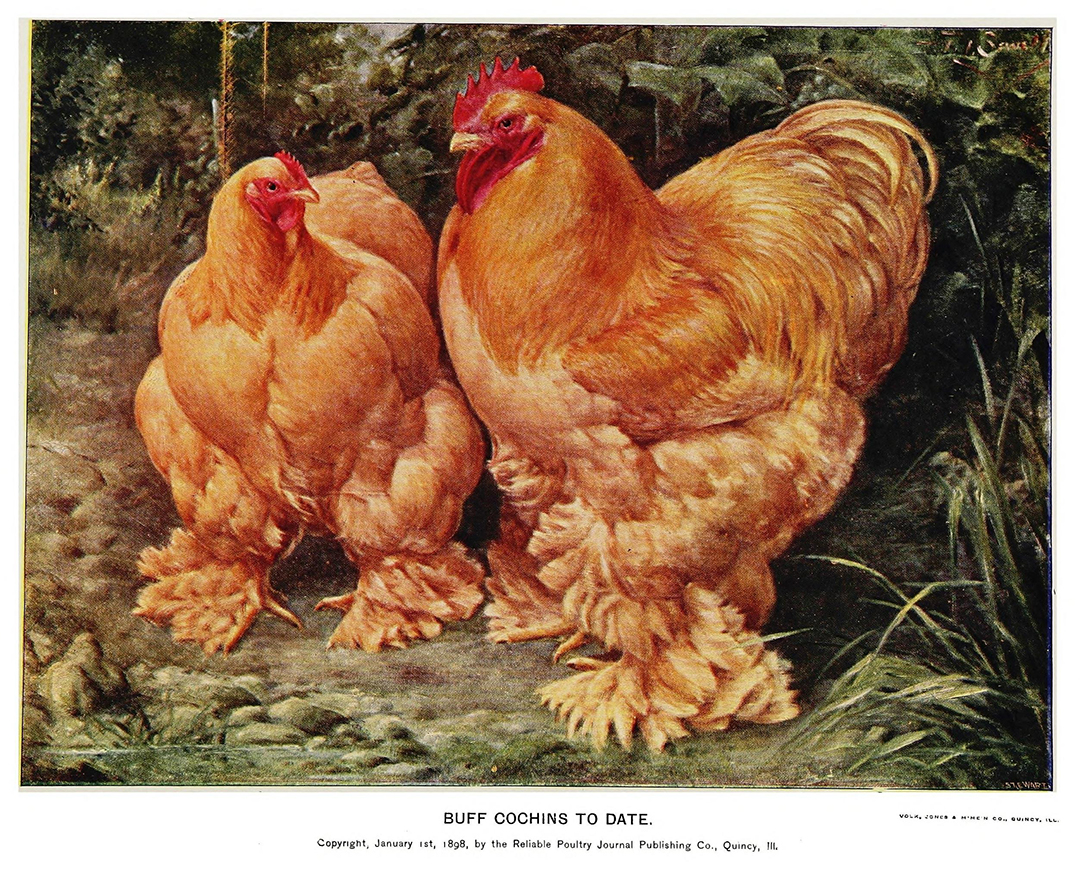 |
| Cochin chicken. The Asiatics (1904). http://biodiversitylibrary.org/page/37514330. Digitized by Cornell University Library. |
The breed which is today known as the Cochin is instead descended from the Shanghais breed. According to The Asiatics,
“The first Poultry Book of Wingfield and Johnson (1853) wrote of them as Shanghais, and all American writers strove for the same name years after the attempt had been abandoned in England; but it was no use. The public had got to know the new, big fowls as Cochins, and would use no other word, and so the name stuck, in the teeth of the facts, and holds the field to this day.”
The Brahma chicken, according to The Asiatics, “were undoubtedly originated in America by selection and careful breeding of what was known as the Gray Chittagongs.”
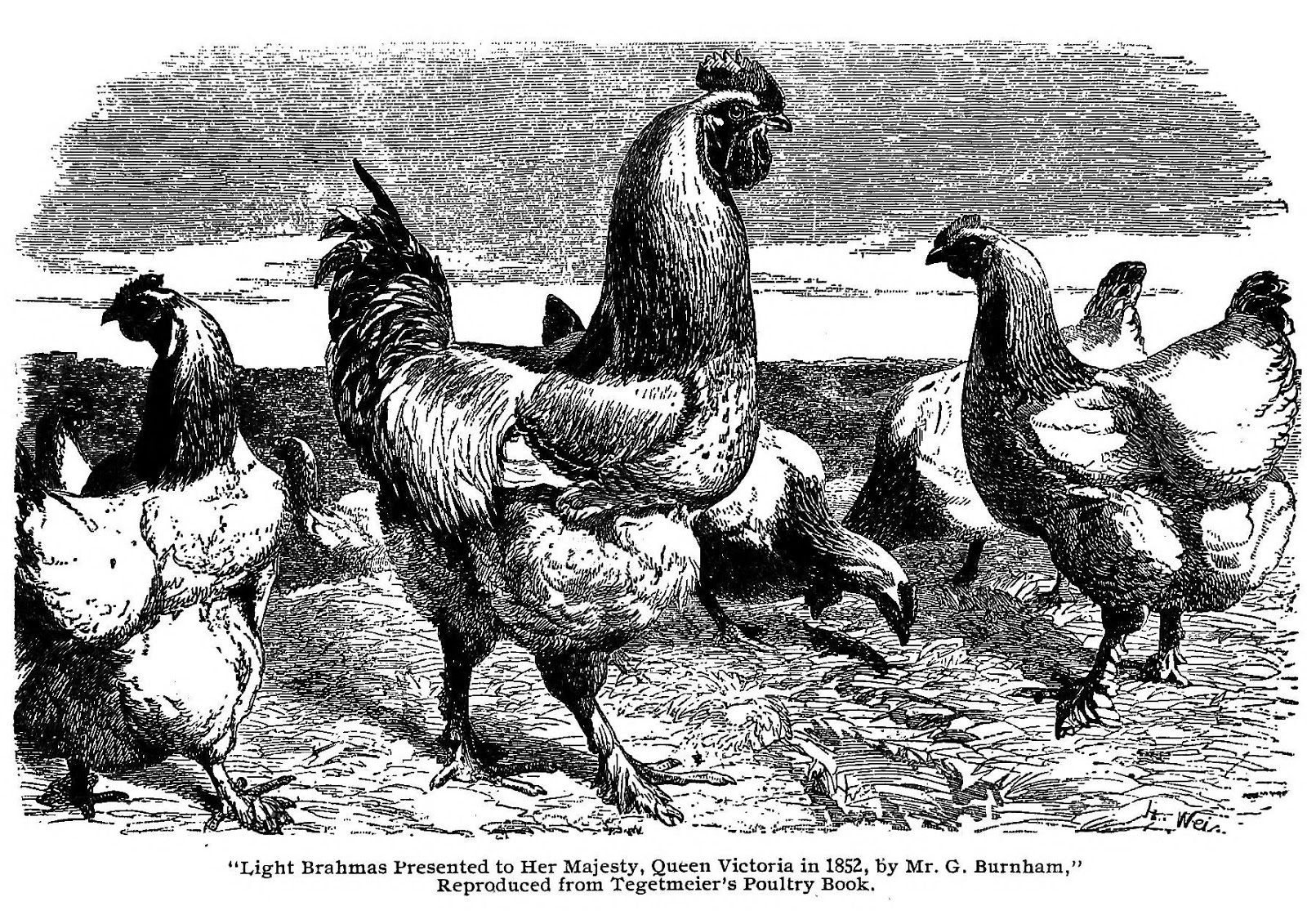 |
| Burnham’s shipment of Brahmas to Queen Victoria. The Asiatics (1904). http://biodiversitylibrary.org/page/37514327. Digitized by Cornell University Library. |
George Burnham, who penned an account of hen fever in his The history of the hen fever. A humorous record, contributed to the Brahma’s association with the fever by sending Queen Victoria nine of his finest stock in 1852, resulting in a significant increase in their popularity and price.
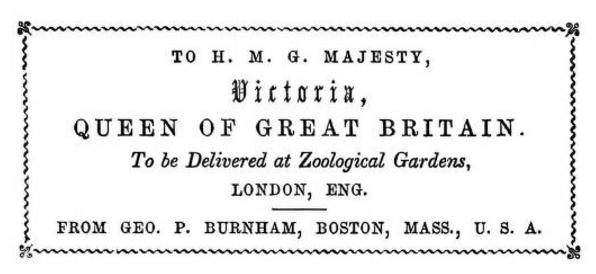 |
| Postage detail for Burnham’s shipment of Brahma chickens to Queen Victoria. A History of the Hen Fever (1855). http://biodiversitylibrary.org/page/37262373. Digitized by Cornell University Library. |
The Asiatics recounts an interesting origin for the Brahma breed in America:
“In regard to the history of these fowls- very little is known. A mechanic by the name of Chamberlain, in this city, first brought them here. Mr. Chamberlain was acquainted with a sailor, who informed him there were three pairs of large imported fowls in New York, and he dwelt so much upon the enormous size of these fowls that Mr. Chamberlain furnished him with money and directed him to go to New York and purchase a pair of them for him, which he did…The man in New York, whose name I have not got, gave no account of their origin, except that they had been brought there by some sailors in the Indian ships…One strain of these fowls, according to Mr. Wright was first called ‘Burram pooters,’ evidently with the intention of having it believed they were of a different race from the Chittagongs and Shanghai, the name being subsequently dropped and replaced by ‘Brahma-Pootre,’ and eventually simplified into Brahmas.”
Historic publications are useful not only for documenting heritage breeds, but also for providing practical tips for raising poultry, especially as part of the backyard chicken farming movement that has been gaining prominence in the 21st century. Cornell’s Albert R. Mann Library highlighted this phenomena as part of a post exploring the most-downloaded book contributed to BHL by Cornell University Library: Poultry diseases, causes, symptoms and treatment, with notes on post-mortem examinations. As cited in that article:
“A 2010 USDA survey of four major U.S. metropolitan areas (Denver, Miami, Los Angeles and New York) found that 4.3% of all households living on 1+ acre of land reported owning chickens.”
A 2014 study published in Poultry Science found that, of 1,487 surveys received from people in 47 U.S. states, 37.7% of respondents had kept backyard chickens for 2-5 years, while 32.5% had done so for less than 2 years. As the authors note, “These results indicate the relative recency of and growing interest in backyard chicken keeping.”
The survey also found that respondents’ motivations for keeping backyard chickens included (from most to least popular) food for home use, pest control, to provide manure for gardening, and pets. 62.5% of respondents relied on books and magazines for information on backyard chicken husbandry. “Almost all respondents also stated that their birds’ health and welfare are better than on commercial poultry farms and that the eggs or meat produced by their flocks are tastier, more nutritious, and safer to consume than purchased poultry products” (Elkhoraibi et al.).
Historic publications like those in BHL can contribute significantly to efforts to preserve important international breeds, providing the genetic diversity necessary to maintain a stable agricultural system. They can also support activities like small-scale poultry keeping, which can help address concerns related to food safety, animal welfare, and the environmental impact of factory farming.
We encourage you to explore The Asiatics and Poultry Diseases in BHL, digitized by Cornell University Library. You can browse all 1.5+ million pages contributed by Cornell to BHL here.
Learn more about backyard chicken farming in the online exhibit Backyard Revival from Cornell’s Mann Library and find out more about the importance of heritage breeds as part of the International Heritage Breeds Week campaign.
Forget hen fever. Here’s hoping for a hen revival!
References
Elkhoraibi, C., R. A. Blatchford, M. E. Pitesky and J. A. Mench. “Backyard chickens in the United States: A survey of flock owners.” Poultry Science first published online September 5, 2014 doi:10.3382/ps.2014-04154