



This year for Color Our Collections, we’ve produced a coloring book with illustrations from books that represent the evolution of the art of printing. This week on our blog, we’ll explore the books featured in the coloring book and the printing techniques used for the illustrations.
You can download our 2017 Color Our Collections coloring book here.
Learn more about Color Our Collections here.
The Art of Woodcuts
In the woodcut printing technique, the image (and sometimes text) is carved into the surface of a wood block. A knife and/or chisel is used to remove the wood surrounding the image, so that only the image lines remain raised or flush with the wood block surface. The block is then inked and pressed against paper to transfer the image. The resulting image is a reverse of that on the wood block.
The earliest known complete and dated printed book, the Diamond Sūtra dated 868 AD, was produced using wood block printing. The work, a Chinese translation of a Buddhist text, can be viewed online thanks to the British Library.
This video from the Victoria and Albert Museum demonstrates the woodcut printing process:
The Woodcuts of Pierre Belon
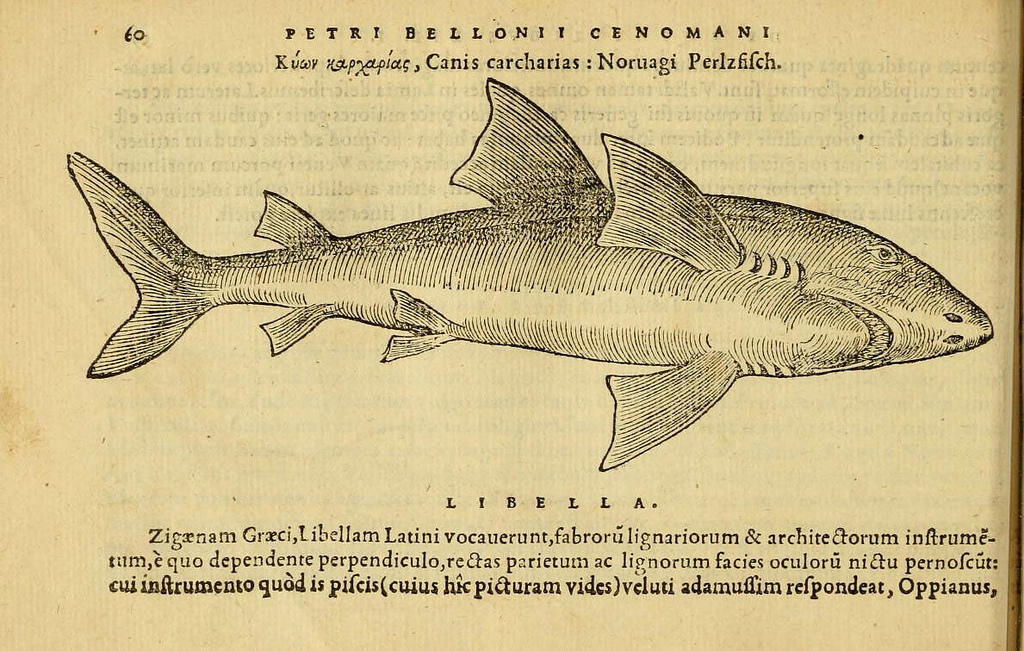 |
| Earliest known published illustration of a great white shark. Illustrated by woodcut. Belon, Pierre. De aquatilibus. 1553. http://biodiversitylibrary.org/page/4770204. Digitized by Harvard University, Ernst Mayr Library, Museum of Comparative Zoology. |
Pierre Belon was a French naturalist who started practice as an apothecary, studied medicine, and later undertook many travels that fueled his interest in natural history. In 1553, he published De aquatilibus, describing over 100 fish, sharks, and rays, as well as many marine mammals. The work is illustrated with woodcuts, and some copies are also hand colored.
Belon details the outward characteristics of the species he depicts and classifies his divisions of aquatic animals by size, skeletal structure, mode of propagation, number of limbs, form of the body, and habitat. As such, De aquatilibus is considered by many to be the beginning of modern ichthyology. The work also includes detailed descriptions of dolphins and their embryos and reproductive anatomy, and thus it is also considered the start of modern embryology.
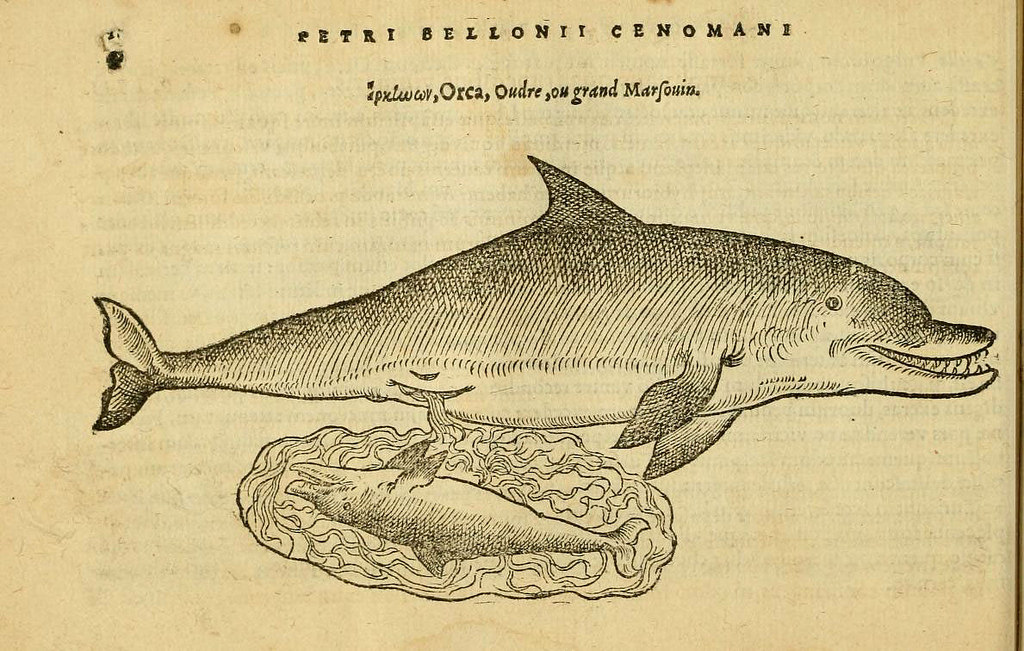 |
| Belon portrayed many dolphins, their embryos, and reproductive anatomy within De aquatilibus, marking the beginning of modern embryology. Illustrated by woodcut. Belon, Pierre. De aquatilibus. 1553. http://www.biodiversitylibrary.org/page/4770162. Digitized by Harvard University, Ernst Mayr Library, Museum of Comparative Zoology. |
Belon stressed the importance of observation in scientific study and communication, chastising those who simply relied on and proliferated historic accounts stemming from the titans of antiquity. However, despite this charge, Belon does include some fantastical creatures within his book, including the “sea monk” and “web-footed horse of Neptune.”
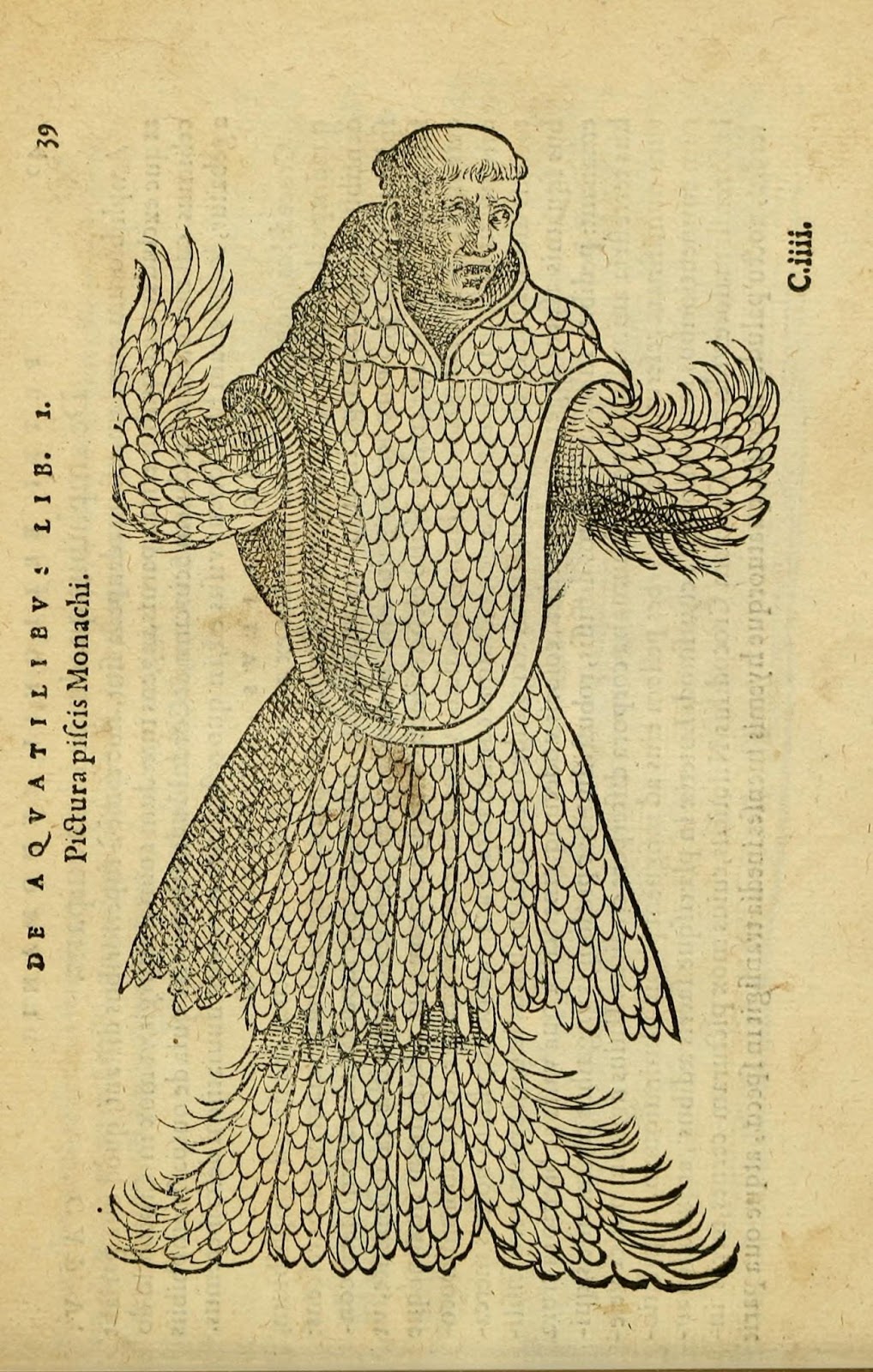 |
| Mythical “sea-monk,” possibly based on a stranded squid. Illustrated by woodcut. Belon, Pierre. De aquatilibus. 1553. http://biodiversitylibrary.org/page/4770183. Digitized by Harvard University, Ernst Mayr Library, Museum of Comparative Zoology. |
Sadly, Belon’s life was cut tragically short. He was murdered by unknown assailants in the Bois de Boulogne in 1564 at the age of 47.
De aquatilibus was digitized in BHL by Harvard University, Ernst Mayr Library, Museum of Comparative Zoology.
References
Steins, John. Woodblock Printing. http://www.johnsteins.com/woodblock-printing.html.
Stiassny, Melanie. Natural Histories: Opulent Oceans. New York: Sterling Publishing, 2014. Print.
