Biodiversity Heritage Library - Program news and collection highlights from BHL
  • Home
  • News
  • Featured Books
    • All Featured Books
    • Book of the Month Series
    • BHL at 20
  • User Stories
  • Campaigns
    • Fossil Stories
    • Garden Stories
    • Monsters Are Real
    • Page Frights
    • Her Natural History
    • Earth Optimism 2020
  • Tech Blog
  • Visit BHL
Home
News
Featured Books
    All Featured Books
    Book of the Month Series
    BHL at 20
User Stories
Campaigns
    Fossil Stories
    Garden Stories
    Monsters Are Real
    Page Frights
    Her Natural History
    Earth Optimism 2020
Tech Blog
Visit BHL
  • Home
  • News
  • Featured Books
    • All Featured Books
    • Book of the Month Series
    • BHL at 20
  • User Stories
  • Campaigns
    • Fossil Stories
    • Garden Stories
    • Monsters Are Real
    • Page Frights
    • Her Natural History
    • Earth Optimism 2020
  • Tech Blog
  • Visit BHL
Biodiversity Heritage Library - Program news and collection highlights from BHL
BHL News, Blog Reel

We’ve Expanded the BHL FAQ!

BHL FAQ now expanded

BHL FAQ now expanded

We’ve expanded the BHL FAQ, providing answers to the most common questions we receive from our users. For example…

Do you need help searching BHL? There’s an FAQ for that.

Do you want to know how to download content from BHL? The FAQ has you covered.

Wondering if you can reuse material from BHL? Learn more about reuse in our FAQ.

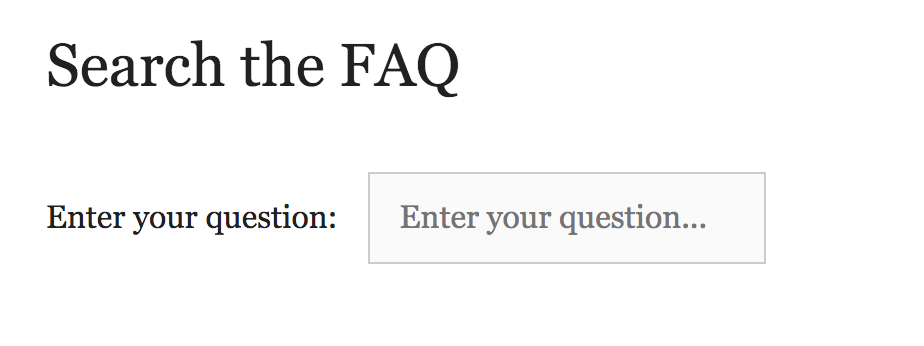
The FAQ is the best place to find answers to your questions about BHL, our collection, and our services. The best way to find an answer for a specific question is to use the FAQ search box. You can also browse by topics using the FAQ categories (e.g. Download, Search, Scientific Names, etc.).

Search box for the BHL FAQ.

Use the FAQ search box to find an answer to a specific question.

The week of 15 July 2019, we’ll be updating the BHL website to replace the links to our Feedback form with links to the FAQ. BHL is voluntarily staffed by our Partner Libraries, and we are limited in our ability to personally respond to individual feedback submitted by our patrons. We encourage you to consult the FAQ first if you need help and to find answers to your questions. We will continue to expand this resource over time. The FAQ also provides information on how to contact us if needed.

Thank you for using the FAQ as your first stop for any BHL-related questions!

July 8, 2019by michelle.underhill
Blog Reel, Featured Books

Book of the Week: User’s Choice – Snakes!

This week we decided to put the power of choosing the book of the week in the hands of our users. So, using the “Questions” app on our Facebook Page, we asked you which book out of the four options given you would like to see featured on our blog. The options were The Snakes of Australia, British Dragonflies, La Galerie des Oiseaux, and A Book of Whales. The winner?

The Snakes of Australia (1869), by Gerard Krefft!

The aim of this work was to provide a full account, with original descriptions retained wherever possible, of “nearly all the Australian Snakes discovered and recorded up to the year 1868.” The author points out that, by 1854, only “about twenty Australian Snakes were known.” In the succeeding five years, thirty were described, and, by the time of the writing of our book of the week, “seventy species were on record.”

For our post, we decided to highlight a few of the species presented in this book. So, sit back, relax, and read about Australian Snakes in the comfort of your own home (unless, of course, you’re not at home, in which case, the sitting back and relaxing part is completely up to you).
View Full Size Image
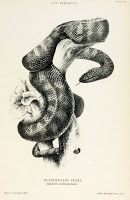
Black-Headed Python (Aspidiotes melanocephalus)

This non-venomous snake can grow up to 7’10”. It is typically “light brown, with a series of darker rings which become indistinct near the sides.” On the underbelly, the Black-Headed Python is “yellowish-white…with a few dark blotches,” while the head and neck are “jet-black above and below.” By the time that this publication was written, very little was known about the snake. “The first specimen which the Museum received was captured by Mr. Rainbird, the well-known collector at Port Denison.”
View Full Size Image
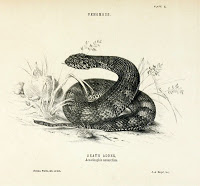
Common Death Adder (Acanthophis antarcticus)

The Common Death Adder is one of the most venomous land snakes in Australia and the world, with fangs longer than most of Australia’s venomous snakes. While a majority of Death Adders are gray with dark rings about the neck and tip of the tail, some members of the species may be red with dark spots. The species can be found in sandy locations, feeding on frogs, lizards, and small mammals. The author notes that, when threatened, the snake “flattens out its whole body, and darts right and left.” However, as previously thought, it “does not jump, and certainly never jumps backwards.”

Diamond Snake (Morelia spilotes)
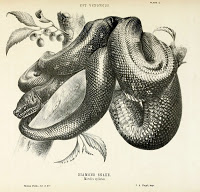
View Full Size Image

This non-venomous snakes has nearly every scale marked with a central single yellow dot. “The largest specimen captured near Sydney, correctly measured, without being stretched, was 10 feet 3 inches long,” though, the author is certain, that specimens measuring over 11 feet no doubt occur, though much more rarely. In nature, this species eats only living mammals, though in captivity it has been observed swallowing already-dead animals. At the time of publication, the author commented that “the species under review are generally infested by various kinds of intestinal worms, including tape-worms, clusters of which have frequently been taken from their stomachs.”
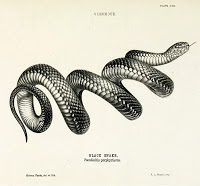
View Full Size ImageRedbellied Black Snake (Pseudechis porphyriacus)

This species is the most common of all of Australia’s venomous snakes. It is “found in low marshy places, is fond of water, dives and swims well, and subsists principally upon frogs, lizards, insects, and other smaller mammalia.” Its highly venous bite can kill “good sized dogs or goats within an hour.” This species rarely grows beyond six feet in length.

This week’s book of the week, The Snakes of Australia (1869), by Gerard Krefft, was contributed by Harvard University, MCZ, Ernst Mayr Library.

To see more Facebook Questions, visit our Questions Page. And be sure to visit us on Facebook or follow us on Twitter (@BioDivLibrary).

April 21, 2011by michelle.underhill

Help Support BHL

BHL's existence depends on the financial support of its patrons. Help us keep this free resource alive!

search

About BHL

The Biodiversity Heritage Library (BHL) is the world’s largest open access digital library for biodiversity literature and archives. BHL operates as a worldwide consortium of natural history, botanical, research, and national libraries working together to digitize the natural history literature held in their collections and make it freely available for open access as part of a global “biodiversity community.”

Join Our Mailing List

Sign up to receive the latest news, content highlights, and promotions.

Subscribe Now

Subscribe to Blog via Email

Enter your email address to subscribe to this blog and receive notifications of new posts by email.

Join 319 other subscribers

Subscribe to Blog Via RSS

Subscribe to the blog RSS feed to stay up-to-date on all the latest BHL posts.

Access RSS Feed

Inspiring Discovery through Free Access to Biodiversity Knowledge.

The Biodiversity Heritage Library makes it easier than ever for you to access the information you need to study and explore life on Earth…for free, anytime, anywhere.


64+ Million Pages of
Biodiversity Literature Online.

EXPLORE

Tools and Services
to Transform Research.

EXPLORE

300,000+
Illustrations on Flickr.

EXPLORE

ABOUT | HARMFUL CONTENT | PRIVACY | SITE MAP | TERMS OF USE