Biodiversity Heritage Library - Program news and collection highlights from BHL
  • Home
  • News
  • Featured Books
    • All Featured Books
    • Book of the Month Series
    • BHL at 20
  • User Stories
  • Campaigns
    • Fossil Stories
    • Garden Stories
    • Monsters Are Real
    • Page Frights
    • Her Natural History
    • Earth Optimism 2020
  • Tech Blog
  • Visit BHL
Home
News
Featured Books
    All Featured Books
    Book of the Month Series
    BHL at 20
User Stories
Campaigns
    Fossil Stories
    Garden Stories
    Monsters Are Real
    Page Frights
    Her Natural History
    Earth Optimism 2020
Tech Blog
Visit BHL
  • Home
  • News
  • Featured Books
    • All Featured Books
    • Book of the Month Series
    • BHL at 20
  • User Stories
  • Campaigns
    • Fossil Stories
    • Garden Stories
    • Monsters Are Real
    • Page Frights
    • Her Natural History
    • Earth Optimism 2020
  • Tech Blog
  • Visit BHL
Biodiversity Heritage Library - Program news and collection highlights from BHL
Blog Reel, Featured Books

The Last Heath Hen, and Other News From the Collecting Net In Woods Hole

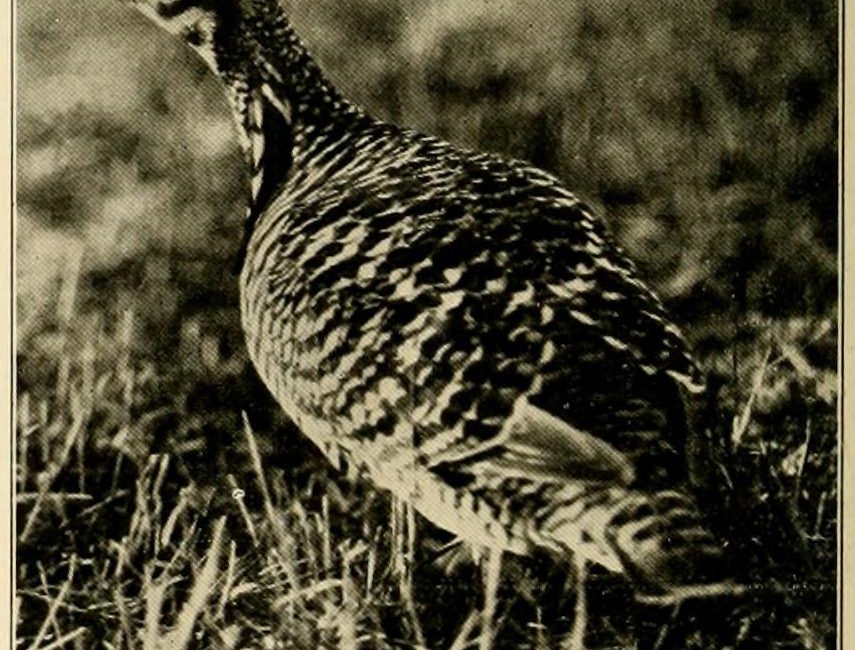
black and white photo of a bird, the heath hen

“On Martha’s Vineyard Island just across the Sound from the Marine Biological Laboratory is the home of the lone survivor of the Heath Hen. The death of this individual will also mean the death of its race, and then another bird will have taken its place among the endless array of extinct forms. The numbers of Heath Hen have been closely followed by ornithologists and since 1908 a detailed census has been taken of the birds each year. For the first time in the history of ornithology a species has been studied and photographed in its normal environment down to the very last individual.”

-Professor Alfred O. Gross, Bowdoin College, as written in The Collecting Net: Volume 5, Number 3, 12 July 1930.

black and white photo of a bird, the heath hen

“The Last Heath Hen.” Gross, Alfred O. The Collecting Net. v.5, no.33 (1930). Contributed in BHL from MBLWHOI Library. In copyright. Digitized with the permission of the rights holder. CC BY-NC-SA.

We came across a unique article, “The Last Heath Hen,” in the Biodiversity Heritage Library recently. The article from The Collecting Net newspaper is a beautifully-crafted account from 1930 of the then-last stand and near extinction of the last animal of the ground-feeding Heath Hen species (Tympanuchus cupido cupido), a member of the grouse family and subspecies of the Prairie Chicken. This species once ranged from Maine to the Carolinas in American colonial times and before but was all but extinct on the US mainland by 1870, except for it holding its own in the scrub brush, open fields, and low pine forests of Martha’s Vineyard, Massachusetts.
Historical Spotlight: Martha’s Vineyard

Martha’s Vineyard is an island about twice as long and a bit wider than the island of Manhattan, four miles across the Vineyard Sound body of water from the village of Woods Hole in the town of Falmouth on the Cape Cod peninsula.. The Aquinnah Wampanoag Tribe had lived on the Island of Martha’s Vineyard for close to 10,000 years when the island was “discovered” by English explorer Bartholomew Gosnold and named after his deceased daughter Martha in 1602.  Woods Hole (also a land of the Wampanoag Nation), “discovered” by Gosnold in 1602, is a village which in the 19th Century was a whaling port and maritime industrial center, and in the 20th Century became home to six world renowned scientific research institutions, the second oldest of which in 1888 was founded as the Marine Biological Laboratory (MBL), which published The Collecting Net.

The Collecting Net article, “The Last Heath Hen,” was written by the ornithologist Dr. Alfred Otto Gross, an MBL summer research scientist and Professor of Zoology at Bowdoin College in Maine. This story is a simple account of the prelude to the end of this species, as extinction officially occurred two years later in 1932. The Commonwealth of Massachusetts and a coalition of conservation organizations made real efforts to save the heath hen—efforts which ultimately failed, as sadly in the end disease, predators, and a forest fire in its breeding ground sealed the fate of this species. Dr. Gross writes that it was decided by conservation organizations, with respect to the last individual of this species, to allow it to live its last years in peace without interference from the government or hunters. Thus, this sensitive account by Dr. Gross, based upon his own research.

According to this undated appreciation of Dr. Gross in the Bowdoin College Daily Sun:

“Although he enjoyed teaching, Gross was a devoted researcher who contributed prolifically to the study of ornithology; he was the author of 265 scientific articles and books and was recognized as a Fellow of the American Ornithologists’ Union in 1930.”

The science history of the oldest private biological laboratory in the United States, the Marine Biological Laboratory (MBL), is well documented through thousands of publications, as well as in The Collecting Net. The venerable in-house journal of the Marine Biological Laboratory, the Biological Bulletin, has been continuously published, first by MBL and now by the University of Chicago Press, since 1890. The Archives of the MBL holds the papers of scientists, photographs, films, and the administrative records of 133 years of transformative biological science, not to mention over 15,000 rare books going back to the 1500’s, many of which are freely accessible through the BHL. While the science is well documented, getting to know the social history of this year-round (once only during the summer) seaside science mecca is assisted by examining The Collecting Net weekly newspaper, a scrappy summertime tabloid which was published by the social MBL Club from 1926-1953.

Front page of "The Collecting Net"

Front page, The Collecting Net, v.3, no.1 (1928). Contributed in BHL from MBLWHOI Library. In copyright. Digitized with the permission of the rights holder. CC BY-NC-SA.

The Collecting Net joined the science and the social going on during busy MBL summers, used advertising revenues for a scholarship fund for MBL students, and was edited by a team initially led by Ware Cattell, who later became editor of the journal Science. When the newspaper hit its weekly publishing deadline, it was loaded on a boat and motored across Buzzards Bay to New Bedford where it was typeset, printed, and returned to Woods Hole. While the more recent issues (1950’s) present official-looking administrative accounts of lectures and research, the first years of The Collecting Net offered an exciting and often humorous glimpse into the arts and sciences and lives of the people who spent their summers working at the Marine Biological Laboratory—from ferry and train schedules to Boston, New York, Martha’s Vineyard and Nantucket; to a comprehensive directory of all the employees and scientists at MBL every summer; to summer choral and drama auditions and performances; and many, many advertisements (see below an assortment of these).

"bug hunters!"

Scientists in Woods Hole are still known as “bug hunters”! Advertisement from Morrison’s Market in The Collecting Net, v.1 (1926). Contributed in BHL from MBLWHOI Library. In copyright. Digitized with the permission of the rights holder. CC BY-NC-SA.

screenshot of text from a book with the "note to the editor"

A vital “Letter to the Editor”. The Collecting Net, v.5, no.33 (1930). Contributed in BHL from MBLWHOI Library. In copyright. Digitized with the permission of the rights holder. CC BY-NC-SA.

Screenshot of text, advertisement for "The University Players"

The most well known University Players were Henry Fonda and James Stewart. The University Platers Guild advertisement. The Collecting Net, v.5, no.33 (1930). Contributed in BHL from MBLWHOI Library. In copyright. Digitized with the permission of the rights holder. CC BY-NC-SA.

Screenshot of text, "Living Marine Forms" advertisement

Live marine specimens were locally collected and packed for the Woods Hole departing train for all points, USA. General Biological Supply House advertisement. The Collecting Net, v.5, no.33 (1930). Contributed in BHL from MBLWHOI Library. In copyright. Digitized with the permission of the rights holder. CC BY-NC-SA.

The Collecting Net masthead was “an independent publication devoted to the activities of biologists at the laboratories in Woods Hole.” One thing which The Collecting Net offered relative to the science taking place in Woods Hole during the summers was something which has always been quite important in science literature, and that is the opportunity to rapidly publish findings and new ideas. This, The Collecting Net provided, as in Dr. Ernest E. Just’s “Methods for experimental embryology…,” below, which was published so it could be used by students at MBL the next day! Dr. Alfred O. Gross’ account of the final days of the heath hen was published so the readers of the work could respond to it immediately.

One thing missing though, relative to all the current science of those times, was that The Collecting Net, when published, was not indexed for later discovery. For this reason, almost a century after the first issue was published in 1926, through the Biodiversity Heritage Library it is possible to search the full text content of the articles published within, thereby giving that science new exposure, freely accessible in Woods Hole or anywhere in the world.

Screenshot of text, an article by E.E. Just.

Ernest E. Just, an MBL scientist, was known for his experimentation technique. He was the first African American scientist in the United States to receive a PhD in Zoology, from the University of Chicago. “Methods for Experimental Embryology with Special Reference to Marine Invertebrates.” The Collecting Net, v.3 (1928). Contributed in BHL from MBLWHOI Library. In copyright. Digitized with the permission of the rights holder. CC BY-NC-SA.

April 29, 2021by Joel Richard
Blog Reel, Campaigns, Earth Optimism 2020

No Egrets: The Story of Fashion and Feathers Through Books

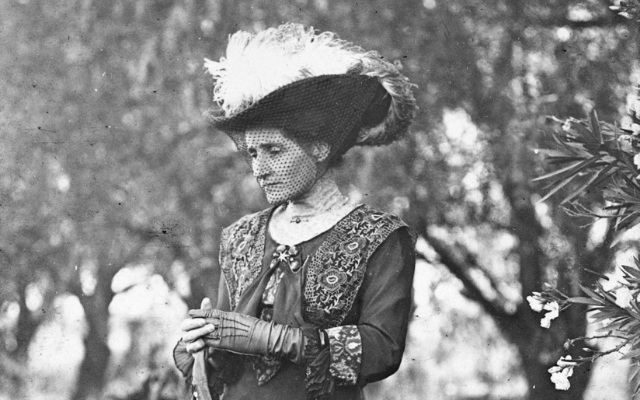
Black and white photo of a woman in a Victorian dress wearing an elaborate adorned with bird feathers. She stands in a forest.

April 2020 marks the 50th anniversary of Earth Day. Organizations around the world have commemorated the occasion by participating in the global Earth Optimism movement — an initiative spearheaded by the Smithsonian to “turn the conservation conversation from doom and gloom to optimism and opportunity”.

Throughout 2020, the Biodiversity Heritage Library (BHL) and our partners are joining the movement by sharing conservation success stories from and made possible by the BHL collection. Follow our blog for conservation stories — past and present — and visit our website for more information and to explore our Earth Optimism book collection.

———————

Feathers have been used in fashion throughout history, but the trend became more widespread from the late 18th century when the Industrial Revolution made luxuries more available to the masses. In the 19th century, new technology improved the speed of production and the millinery industry boomed [1]. Hats with feathers became a status symbol coveted by a new mass market and were produced on an industrial scale.

Birds were hunted around the world to supply plumes to centres of fashion such as London and New York. In 1886, American Museum of Natural History’s ornithologist, Frank Chapman, infamously observed on a walk in New York some 40 native bird species on women’s hats, some with an entire stuffed bird attached [2]. Indeed, women were oft blamed for the trend: in The Ibis in 1887 [3], women were pointed to as “the indirect, but real, instigators of this slaughter”. The author continues: “all that can be hoped for is that the freaks of feminine vanity may take some other and less harmful direction.”

The issue also arises in a letter [4] dated 1865 from ornithologist John Gould to Museum Victoria’s first director, Sir Frederick McCoy, who had previously written to Gould asking him to procure bird specimens for the burgeoning museum’s collections. In the letter, Gould ironically writes:

“The Ladies, the Ladies, have however, so stripped us of birds for their bonnets that but few are now in the market and these of course are high priced.”

Black and white photograph of a woman in Victorian dress with an elaborate hat adorned with bird feathers. She stands in a forest.

Photograph of Flo Tuckfield wearing a hat featuring a large plume of feathers in Merrigum, Victoria, circa 1910s. Credit: Lilian L. Pitts / Source: Museums Victoria, MV000061572.

While women were loudly condemned for their role in consuming feathers, they were also instrumental in the campaigns to raise awareness of the devastating effects of plume hunting on bird populations. For instance, in 1896 the American socialite and amateur naturalist Harriet Hemenway and her cousin Minna Hall led a boycott of feathered hats which attracted 900 participants and led to the formation of the National Audubon Society and passage of the Weeks-McLean Law (aka the Migratory Bird Act), which outlawed market hunting and the interstate transport of birds [5].

As documented by Herbert K. Job in his 1905 book Wild Wings [6], at the turn of the 20th century, an ounce of feathers was worth $32—almost twice as much as an ounce of gold. Job states that during 1902, over 1600 packages of heron plumes were sold at just one London auction house:

“A package is said to average in weight 30 ounces. This makes a total of 48,240 ounces. As it requires about four birds to make an ounce of plumes, these sales meant 192,960 herons killed at their nests, and from two to three times that number of young or eggs destroyed. Is it, then, any wonder that these species are on the verge of extinction?” (p.146)

In Australia, egrets, herons, lyrebirds, bowerbirds and emus were amongst the species targeted by plume hunters.

A brown bird with long, pink tail feathers illustrated on a grassy platform

Illustration of a lyrebird from An account of the English colony in New South Wales by David Collins (1804). Contributed in BHL by Museums Victoria.

Lyrebirds are ancient Australian animals: the Australian Museum in Sydney has fossils of lyrebirds dating back around 15 million years [7]. The Lyrebird reportedly came close to extinction in the early 1900s as it was hunted for its ornate tail feathers. In the 1911 publication, Pros and cons of the plumage bill, bird protectionist James Buckland states that “over 400 lyre-birds were killed in one district in a single season to supply the London plumage market” [8].

In 1901, the Australian Ornithologists’ Union (AOU) was founded to promote the study and conservation of the native bird species of Australia and adjacent regions. One of its members, Tom Tregellas, regularly camped out in a large hollow tree trunk over a period of seventeen years in Sherbrooke Forest, Victoria observing and photographing lyrebirds. Noticing a decrease in the population over time, he crusaded for the protection of lyrebirds and legislation was eventually passed to protect the birds.

The rapid decline of several species whose feathers were used in ladies’ fashion were seen during this period, and some bird species were not as fortunate as the lyrebird. The Huia of New Zealand was declared extinct in 1907, and it is also believed that the use of Great Auk feathers for down partially contributed to its extinction [9].

Periodicals, along with books and public lectures, were one of the key means of circulating information and inspiring action around bird preservation at that time. In volume seven of the journal of the AOU, The Emu, two articles by Australian ornithologist Arthur H. Mattingley are published side-by-side. In the first from November 1906 [10], Mattingley recounts a visit to the Murray River where he photographs egret and heron nests. In the second [11], written only a few weeks later, Mattingley returns to the same area and is horrified to discover that nearly one-third of the birds were killed, with the young left to starve in their nests.

Orphaned baby egrets at nests begging for food.

Photographs accompanying the article “Plundered for their plumes” by A.H. Mattingley, in The Emu, Vol.7 (1907). Contributed in BHL by American Museum of Natural History Library.

The second article, Plundered for their plumes, contains vivid photographs that caused quite a stir internationally. These photos are widely regarded as a tipping point in changing attitudes towards the use of feathers in fashion.

In England, the Royal Society for the Protection of Birds (RSPB) posted the photos on billboards and in shop windows, and in 1911 men carrying enlargements of the story patrolled the West End of London to protest the cruelty of wearing feathers. As a result, the story gained attention throughout the UK, as well as in Paris, Amsterdam, Italy, Spain, Denmark, Australia and the United States [12].

From this point on, the interest of amateur ornithologists changed from bird collection to identification. An Australian Bird Book, by John Albert Leach (1911), and Neville Cayley’s What Bird Is That? (first published in 1931) are two Australian publications that reflect this shift.

Collage of various birds illustrated in color.

Illustration from What bird Is That? by Neville Cayley (1947). Contributed in BHL by Museums Victoria.

Feathered hats did make a reappearance from the 1930s-1960s, but the decades after this saw hats lose popularity as they were no longer a standard item of women’s daywear. Worryingly, feathers have been making a comeback since clothing adorned with marabou and ostrich feathers appeared in a couture runway show in 2017, and PETA have been campaigning against the use of feathers in fashion ever since. The use of down in jackets is also a contentious issue today, and many major international brands have stopped selling down in favour of high-tech synthetics.

While mass market fashion continues to have serious environmental repercussions, this history shows that wide scale attitudinal shifts around such issues are possible. Efforts on this front, however, need to be widespread and sustained.

References

  1. Ehrman, E. (2018) Fashioned from nature, V&A Publishing, London, pp. 97-98.
  2. Callahan, D. (2014) A history of birdwatching in 100 objects, Bloomsbury, London, p.72.
  3. The Ibis (1887) Recently published ornithological works, Ser.5, Vol.5, no.20, p.458, viewed 27 February 2020. https://www.biodiversitylibrary.org/page/8521969.
  4. Letter from John Gould dated 20 December 1865, in Museums Victoria Archives, MV ARCHIVES – NATIONAL MUSEUM OF VICTORIA – Inwards Correspondence – 1863-1876 Gould, J., OLDERSYSTEM~02618.
  5. Souder, W. (2013) How two women ended the deadly feather trade, Smithsonian Magazine, viewed 27 February 2020. https://www.smithsonianmag.com/science-nature/how-two-women-ended-the-deadly-feather-trade-23187277/.
  6. Job, H. (1905) Wild wings; adventures of a camera-hunter among the larger wild birds of North America on sea and land, Houghton, Mifflin & Co, Boston, viewed 27 February 2020. https://www.biodiversitylibrary.org/item/48785.
  7. Boles, W. (2006) ‘The avian fossil record of Australia: an overview’, In: Merrick, J.R. et al. (eds.) Evolution and biogeography of Australasian vertebrates, auscipub, Oatlands, pp.387-411.
  8. Buckland, J. (1911) Pros and cons of the plumage bill, printed by Edmund Evans, p.13, viewed 27 February 2020. https://viewer.slv.vic.gov.au/?entity=IE6076556.
  9. Callahan, D. (2014) A history of birdwatching in 100 objects, Bloomsbury, London, p.72.
  10. Mattingley, A.H. (1907) A visit to heronries, The emu: official organ of the Australasian Ornithologists’ Union, Vol.7, pt.2, pp.[65]-71, viewed 27 February 2020. https://www.biodiversitylibrary.org/page/8517730.
  11. Mattingley, A.H. (1907) Plundered for their plumes, The emu: official organ of the Australasian Ornithologists’ Union, Vol.7, pt.2, pp.71-73, viewed 27 February 2020. https://www.biodiversitylibrary.org/page/8517740.
  12. Cronin, J.K. (2018) Art for animals : visual culture and animal advocacy, 1870-1914, Pennsylvania State University Press, University Park.
October 15, 2020by Joel Richard
Blog Reel, Featured Books

An Annotated Copy of Butterflies of Australia by Waterhouse and Lyell (1914)

Published in 1914, Butterflies of Australia by Gustavus Athol Waterhouse and George Lyell was the first comprehensive work on Australian butterflies to appear in Western scientific literature. It is a thick and rather chunky volume, with descriptions of 332 butterfly species, and was the product of many years of research. The copy held in Museums Victoria’s Rare Book Collection is even thicker than a standard issue, as it is bound with lined pages interleaved throughout. It is an author’s copy, owned and annotated by George Lyell.

1. Inscription Lyell.jpg

Title page of annotated author’s copy of Butterflies of Australia (1914.) Contributed in BHL by Museums Victoria.

Lyell and Waterhouse worked on the book separated by some distance; Lyell’s location in Gisborne, Victoria was 862km (536 miles) away from Waterhouse’s residence in Sydney. They corresponded regularly via mail, and the Museums Victoria Archives now houses some 400 of Lyell’s letters from Waterhouse, which came to the museum with Lyell’s extensive donation of butterflies and moths in 1932. In 2019 a McCoy Seed Fund project enabled further exploration of the archival material to see what it could reveal about the scientists’ collaboration and Lyell’s collection. It also shed some light on the annotated copy in our collection.

The archival material reveals that their publisher, Angus & Robertson, prepared the handsome interleaved copy for Lyell and gave it to Waterhouse to pass on. In a letter dated 28 August 1914 Waterhouse writes “I have the interleaved copy for you, but it is much too bulky & too nicely done to trust to the post” (OLDERSYSTEM~03030, Museums Victoria Archives). Instead Waterhouse entrusted the volume to friend E. H. Proctor to give to Lyell’s brother in Melbourne.

Letter to Lyell.jpg

Letter to George Lyell from his co-author and friend G. A. Waterhouse. Photo Credit: Hayley Webster / Source: Museums Victoria.

Their correspondence also demonstrates how carefully they considered every aspect of the publication. For instance, a letter to Lyell on 20 March 1914 states “I like very much the black headings as they seem to show the divisions at a glance & generally speaking I like the size of the type” (OLDERSYSTEM~03030, Museums Victoria Archives), showing that the typography was carefully considered for readability. Waterhouse was pleased with the plates, writing on 4 Feb 1914 “Dear Lyell, Coloured plate no. 1 is glorious, magnificent drawings, just showed it to [Allan Riverstone] McCulloch who was delighted with it” (OLDERSYSTEM~03030, Museums Victoria Archives).

The illustrations are a combination of original drawings and photographic reproductions: original coloured plates by H. W. Simmonds, drawings of larvae and pupae by Miss J. Kong Sing, and the remaining are from photographs by Henry King. Butterflies of Australia includes 43 plates, and a total of 888 illustrations; its considerable scope and detail was considered very helpful by scientists and collectors when the book was published.

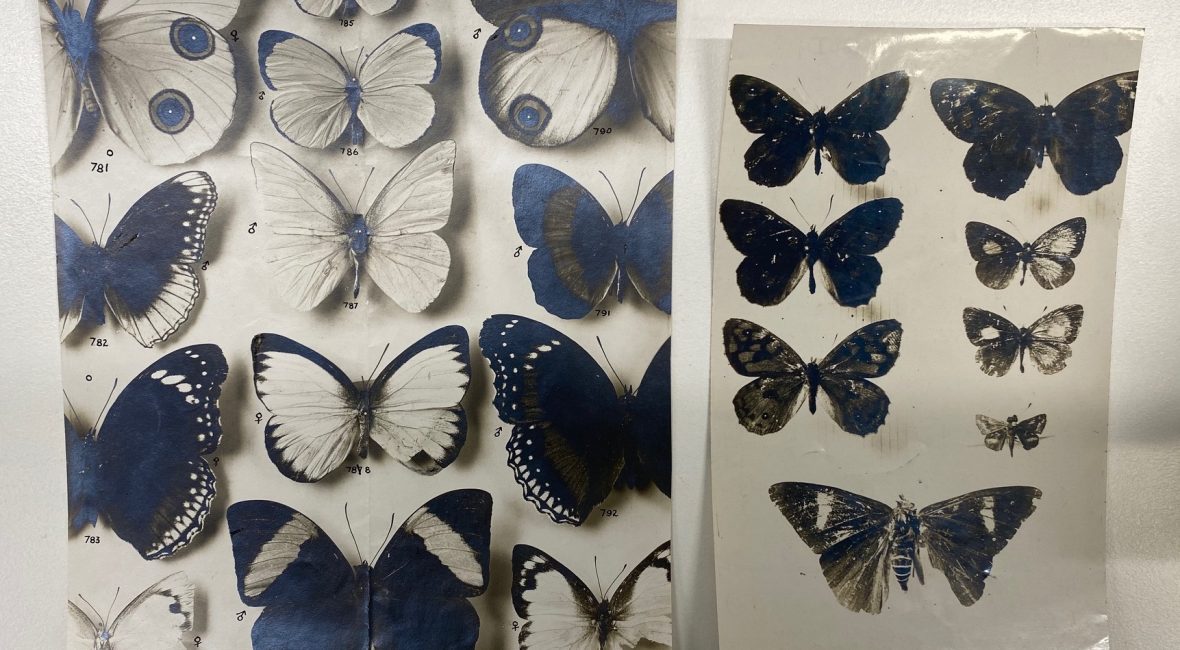
As Museums Victoria Archivist Nik McGrath recounts, Waterhouse destroyed his letters after entering the relevant scientific data onto index cards. While this might seem like a curiously destructive working method, it is not unheard of; researchers working with Charles Darwin’s correspondence have noted that he crossed out personal matters in his letters so he would not be distracted if he needed to return to them for scientific purposes [1]. In this case, in spite of the loss of Lyell’s letters, we retain a lot of the archival material relating to the book including a manuscript, index cards from Waterhouse, notebooks, proofs, black and white photographs of specimens used by illustrators for the book, specimen lists, and newspaper clippings of book reviews.

Butterfly photos.jpg

Along with many others, these photographs of butterflies were used to develop the illustrations for Butterflies of Australia. Photo Credit: Hayley Webster / Source: Museums Victoria.

In addition to looking at the archival material, an examination of the book itself is also revealing. Annotations are dated throughout the 1910s and 1920s and most appear to record sightings. In the introduction to the work, Waterhouse and Lyell note of the geographical focus of their study: “We are hoping this work will serve to indicate the need and point to that direction, and so induce collectors to aid us: we are carefully tabulating every verified record reaching us, and will much appreciate dated specimens for examination and return, especially those from points distant from localities given in our list.”

Lyell is systematic in his approach to annotations, including roughly the same information and formatting for each entry. The marginalia primarily consists of locations added to specimen descriptions, often dated, and sometimes includes a number, gender, and occasionally an elevation.

elevation crop.jpg

The initials GAW frequently appear throughout, and refer to Lyell’s co-author Gustavus Athol Waterhouse. Here Lyell notes that the species is “very plentiful at 5000ft diminishing to 4500 none lower, only few at 6000ft”. Annotated copy of Butterflies of Australia. Contributed in BHL by Museums Victoria.

There are also often initials entered next to the information, which relate to the person collecting the data, as you can see in the example above.

The annotations use a similar approach from the beginning to end of the text; Lyell underlines the printed text in pen, circling the relevant figure numbers, and then notes the date, locations and other data on the interleaved pages.

This is a typical example of how Lyell annotated his copy of Butterflies of Australia, underlining the relevant information and then adding details to the opposite interleaved page. Contributed in BHL by Museums Victoria.

Though the method of data entry is reasonably consistent, there are noticeable changes in ink, indicating that Lyell completed the annotations across a period of time. It would appear that Lyell was copying across data from other sources such as his own field notes and correspondence from other scientists as he received it.

Lyell’s marginalia mainly seems to record observational data, but occasionally includes a reference to secondary reference material. One reference appears to have been copied in its entirety—this is Norman Tyndale’s description of Lycaeninae adaluma from the Transactions of the Royal Society of South Australia in 1922. Tyndale’s description references Waterhouse and Lyell’s work, and suggests a placement of the new species within their system. The placement suggested corresponds to where Lyell has copied in the description.

Revised description crop.jpg

The annotation replicates Tyndale’s description of Lycaeninae adaluma and includes a sketch of the species. Annotated copy of Butterflies of Australia. Contributed in BHL by Museums Victoria.

What exactly was Lyell doing with his annotations? It appears he was using the book to record ongoing research by himself and a group of naturalists across the east coast of Australia. H. J. Jackson notes in Romantic Readers that the practice of interleaving in books by scientists originated in earlier educational practices [2]. I have certainly come across other similar examples in the Museums Victoria Library. It is notable that Lyell’s annotations drop off after the early 1930s. He suffered an illness in 1931 that led to his decision to deposit his collection with the National Museum of Victoria. The rest of his life was dedicated to preparing his collection for transfer to the museum, and this seems to correlate to a decline in annotating.

References

  1. Gregorio, Mario A. & Gill, N. (1990) Charles Darwin’s Marginalia Vol. 1, New York, Garland, p. xiv.
  2. Jackson, H. J, (2005) Romantic Readers: the Evidence of Marginalia, New Haven & London, Yale University Press, p. 84.

Bibliography

Administration – George A. Lyell – Internal Correspondence 1891-1947- Waterhouse, G. A – Museums Victoria Archives, National Museum of Victoria OLDERSYSTEM~03030

Gregorio, Mario A. & Gill, N. (1990) Charles Darwin’s Marginalia Vol. 1, New York, Garland.

Jackson, H. J. (2005) Romantic Readers: the Evidence of Marginalia, New Haven & London, Yale University Press.

McGrath, Nik (2019) Kindred Spirits, Museums Victoria Blog, Retrieved from https://museumsvictoria.com.au/article/kindred-spirits/

McGrath, Nik (2019), Butterflies of the night, University of Melbourne Blog, Retrieved from https://blogs.unimelb.edu.au/insect-museum-collection/2019/01/30/butterflies-of-the-night/

February 27, 2020by Joel Richard
Blog Reel, Featured Books

A Basic Guide to Rare Book Research

In my job as the manager of the Library at Museums Victoria (Australia), I am frequently required to conduct rare book research for programs, displays, online projects, or to establish the provenance of a book. I remember being a little daunted by this task at first, not knowing quite what to cover or what the relevant references were in this field. I have put together this quick guide as a reference for newcomers, using digitised books in BHL to demonstrate how to “read” a book for rare book research. I’ve also included some useful links and further reading if you’d like to delve deeper.

Having conducted numerous talks and tours on rare books in my career, I am now familiar with the questions people ask and prepare by trying to cover as much as possible of the following:

  • Bibliographical information: publication date and the dates of any parts if applicable, edition statement, number of volumes, parts and plates
  • Production details: method of printing and illustrating, method of colouring
  • Print run (edition)
  • Remaining (extant) copies
  • Biographical information of authors/illustrators/contributors
  • Provenance
  • Significance

Here are my top tips for finding that information.

1. Look at the book!

Much information can be gleaned from the item itself. The title page is normally the go-to for bibliographical details and may also provide information about illustrations. For instance, title pages frequently advertise methods of printing and colouring plates.

1. t.p. Mathews small.jpg

Image: This title page informs us that the book contains hand-coloured and monochrome plates. Source: Mathews, Gregory. The birds of Norfolk & Lord Howe Islands and the Australasian South Polar quadrant. 1928. Contributed in BHL from Museums Victoria.

The illustrations themselves often bear further information, such as the names of contributors or the method of printing.

2. Plate Gould small.jpg

Plate 33. Gould, John. Birds of Australia. Volume 1 (1848). Contributed in BHL from Smithsonian Libraries.

You may need to do some detective work to decipher abbreviations. In the example above “J. Gould & H. C. Richter” appears on the left with the abbreviation del et lith and “Hullmandel & Walton” appears on the right with the abbreviation Imp. There are a number of references that you can consult to illuminate these terms (see further reading). Princeton University Library’s post on Printmaker’s abbreviations provides the following information:

  • del = drawn by
  • lith = lithographed by
  • imp = printed by

Therefore, this illustration indicates that it was transferred to (drawn on) the lithographic stone by J. Gould and H. C. Richter and printed by the firm Hullmandel & Walton.

The preface and introduction may also contain acknowledgements of contributors and details on production methods.

3. Preface Gould crop.jpg

Preface. Gould, John. Birds of Australia. Volume 1 (1848). Contributed in BHL from Smithsonian Libraries.

For instance, John Gould’s preface to Birds of Australia provides greater detail than the acknowledgements on individual plates. He laments the loss of his wife Elizabeth part-way through the production of the work, and we learn that she drew the preliminary sketches that Richter used to develop the final prints. Gould also mentions that the illustrations were hand-coloured by a Mr. Bayfield.

Rare books may also contain traces of their previous owners, or provenance. Provenance information is commonly found in the first few pages of a book, such as the inside front cover, flyleaves or title page. Hints as to previous owners can include inscriptions, bookplates or library stamps (more on stamps in my library here).

4. Inscription Lyell small.jpg

Image: This inscription on the title page indicates that this book belonged to author George Lyell. Source: Waterhouse, G. A & Lyell, G.. Butterflies of Australia. 1914. Contributed in BHL from Museums Victoria.

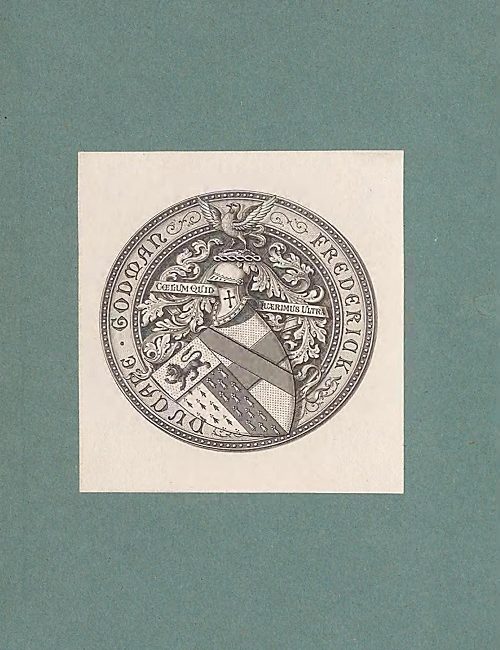
5. Bookplate Ducane Godman small.jpg

Image: Bookplate of naturalist Frederick Ducane Godman, co-author of Biologia Centrali-Americana with Osbert Salvin. Source: Salvin, Osbert. [Collected articles from The Ibis on the ornithology of Central America]. 1859-1864. Contributed in BHL from Museums Victoria.

6. Library stamps Antarctica crop.jpg

Image: These library stamps demonstrate the transfer of this item between institutions. The Museums Victoria Library has received two significant donations of material from the Parliamentary Library of Victoria in its history. Source: Elisha Kent Kane. Arctic explorations : the second Grinnell Expedition in search of Sir John Franklin, 1853, ’54, ’55. Volume 1. 1856. Contributed in BHL from Museums Victoria.

Institutional or library markings may direct you to relevant archival materials.

7. Archival References JJ Wild crop.jpg

Image: Pencil notes in the top right-hand corner of this page indicate that this book was for sale by D. A. Horn Antiquarian Books for $50. The top left-hand numbers are an acquisition number that would allow us to trace the purchase in our archives. Source: Wild, John James. At anchor : a narrative of experiences afloat and ashore during the voyage of H.M.S. Challenger, from 1872 to 1876. 1878. Contributed in BHL from Museums Victoria.

Be particularly attentive to any dates as these should help narrow the date range for further archival research.

2. Consult catalogue records

If you are working with a library book, the catalogue record will be an indispensable resource for bibliographic details, and may contain additional contributor, production or provenance information. Comparing your local catalogue record to other library records will allow you to compare basic details of your copy with others to verify the completeness of your item. Trove and Worldcat are useful for locating library catalogue records and identifying how many copies remain in public collections in Australia or worldwide. It is often difficult to establish the number of extant copies with any certainty unless a census has been conducted (such as this one of the Aurora Australis.)

Auction catalogue records are useful as they normally provide a physical description, brief biography of the author, list any known contributors, and highlight points of significance. The price estimate can be helpful too! Some auction houses make their catalogue records freely available online, so you will be able to find them through an internet search. Otherwise, try consulting your public or institutional library to see if they can help you locate relevant resources.

3. Locate digitised versions

Sometimes it can be useful to consult a digitised version of the book, such as may be found in online repositories like the Biodiversity Heritage Library. This level of detailed research may be needed if you suspect the copy is incomplete, or to compare variations in hand-colouring or binding.

9. Seba Smithsonian.JPG

Image: By comparing our copy of Albertus Seba’s Thesaurus with a Smithsonian copy, I was able to establish that our copy is bound differently; two volumes of plates and two volumes of text, rather than the usual four volumes with plates interleaved throughout. Source: Seba, Albertus. Locupletissimi rerum naturalium thesauri accurata descriptio. Volume 1. 1734-1765. Contributed in BHL from Smithsonian Libraries.

4. Consult secondary references

Verify the information you have compiled by consulting relevant secondary sources. Rare books are described using specific terminology that you may not be familiar with, so it can be helpful to utilise a glossary such as this one from the International League of Antiquarian Booksellers.

Become familiar with standard references in your subject area and region. For instance, in Australia biographical information is readily accessible through the Australian Dictionary of Biography. The Bibliography of Australia by John Alexander Ferguson provides a list of Australian publications, and similar titles document publications in other regions.

Subject-specific bibliographies may also be of use. For instance, in my library I have consulted Antarctica, 1772-1922 : freestanding publications through 1999, Natural science books in English, 1600-1900 and Bibliography of Australian entomology, 1775-1930 : with bibliographical notes on authors and collectors when undertaking rare book research. These types of references can help outline significance and sometimes provide additional information on contributors, editions, or production methods.

If the book or author you are researching is well-known, there will be an array of books, journal articles and websites that provide biographical and contributor information, methods of production, and significance. For instance, recent secondary material on John Gould tends to emphasise the important role of his wife Elizabeth in more detail than is readily apparent from acknowledgements on the works themselves. Secondary sources also suggest that while John Gould certainly had input into the illustrations that adorn his publications, he would not have been the one to transfer the drawing to the lithographic stone.

However, if the book or author is more obscure, this can present a greater challenge. This is a good opportunity to utilise the reference services offered by your local or institutional library!

5. Remember the wider context

In my role as a librarian, I undertake rare book research on items in our collection as required, and therefore my research tends to be object-oriented. While this guide aims to assist this type of research, it is important to be aware of the broader social and historical context that a book was produced in and to consider how this might affect your interpretation (a much bigger topic than I can cover here!).

This guide outlines a basic approach to rare book research and is based on my professional experience. It is most applicable to rare printed materials such as you will find in BHL. If a more detailed approach appeals, the study of bibliography offers techniques for analysing and describing rare books at a more technical level.

Further Reading

Antiquarian Booksellers’ Association of America, ABAA Glossary. Retrieved from https://www.abaa.org/glossary

Carter, John (1980) ABC for book collectors, 6th ed., London & New York, Granada.

Gascoigne, Bamber (2004) How to identify prints : a complete guide to manual and mechanical processes from woodcut to inkjet, London, Thames & Hudson.

International League of Antiquarian Booksellers, ILAB Glossary. Retrieved from https://ilab.org/glossary

Melby, Julie (2009) Printmaker’s abbreviations, Princeton University Library Blog, Retrieved from https://www.princeton.edu/~graphicarts/2009/02/printmakers_abbreviations.html

Pearson, David (2019) Provenance research in book history : a handbook, 2nd ed. London & New Castle, Delaware, Bodleian Library & Oak Knoll.

Russell, Roslyn and Winkworth, Kylie (2009) Significance 2.0 : a guide to assessing the significance of collections, Rundle Mall, South Australia, Collections Council of Australia, https://www.arts.gov.au/what-we-do/museums-libraries-and-galleries/significance-20

Webster, Hayley (2019) Provenance and Library Stamps at Museums Victoria and on BHL, BHL blog, Retrieved from https://blog.biodiversitylibrary.org/2019/10/provenance-and-library-stamps.html#more-23080

November 26, 2019by michelle.underhill
Blog Reel, Featured Books, User Stories

Provenance and Library Stamps at Museums Victoria and on BHL

On the BHL blog, we often focus on the extensive biodiversity information made available through BHL and the innovative ways scientists are using the vast quantities of historical biodiversity data in BHL to conduct contemporary research. BHL is also useful for a range of non-scientific research, however, and is used by researchers in the arts and humanities as well as the sciences. Artists draw on the illustrations for inspiration, while humanities scholars use the digitised collections for historical research.

For librarians and book historians, BHL contains a wealth of provenance information, as well as the material to conduct comparative research. As a librarian in charge of a rare book collection specialising in natural history, I often use BHL to check if our copy of an item is complete, bound in the usual manner, or coloured in the same way as other copies.

A good example of this is Museums Victoria’s copy of Albertus Seba’s Locupletissimi rerum naturalium thesauri accurata descriptio (commonly referred to in English as his Thesaurus). Museums Victoria holds the only copies of Seba’s Thesaurus in Australian libraries; however, using the Biodiversity Heritage Library I have been able to compare our copy with copies around the world in libraries that I would be unlikely to visit. I have been able to identify that our copy is bound differently to the norm, with plates and text in separate volumes — presumably at the request of a previous owner. I was also able to deduce that the unusual teal nails on the opossum are intentional — we had thought it a quirk of hand-colouring! However, all coloured copies on BHL show the opossum sporting a teal mani pedi (fig. 1).

000080372c-39.jpg

Fig. 1. Tab XXXIX. Seba, Albertus. Locupletissimi rerum naturalium thesauri accurata descriptio. Plates to Volumes 1 & 2. 1734-1765. Digitized in BHL by Museums Victoria.

Lately, I have used our digitised items in conjunction with our Rare Book Collection to look at provenance and acquisition information in our collection. This was inspired by a fantastic course in “Provenance in Books” as part of London Rare Book School last year. Our instructor, David Pearson, took us through various aspects of provenance information in books, including bookplates, bindings, inscriptions, and annotations. Working in an institutional library, one of the things I was most interested in was different forms of library acquisition and provenance information. David told us of a project at the British Library to develop a research guide detailing the different stamps used across the institution’s history to assist in identifying when items had been acquired. I set out to develop something similar for our institution, and here is a sample of the work I have done so far, focusing primarily on one of our predecessor institutions, the National Museum of Victoria.

The National Museum of Victoria was established in the 1850s, and the library collection has been developed since its foundation. Accessioning practices have changed over the 160-plus year history of the library. The most consistent practice appears to have been to mark or apply stamps to the title page, or first few flyleaves, of a book. The stamps that appear on these pages are therefore usually the most reliable for dating an acquisition or to assist in narrowing a date range for archival research.

The information available in each library book varies. A book may include all or none of the following: accession number, date of acquisition, library stamp, inscription or bookplate of a previous owner. Books purchased between 1854 and the end of the nineteenth century are the least likely to carry acquisition information; many only bear a stamp, as shown below (fig. 2).

D'orbigny tp stamp.jpg

Fig. 2. Title page of Museums Victoria’s copy of Histoire naturelle : generale et particuliere des cephalopodes acetabuliferes vivants et fossils by Ferussac and d’Orbigny (Volume 2. 1835-1848) with National Museum Victoria stamp.

The practice from around 1900 seems to have been to write the accession date on the top left corner of the title page or the abbreviations ‘Entd.’ Or ‘E’ (fig. 3).

lewin tp stamp.jpg

Fig. 3. Title page of Museums Victoria’s copy of A natural history of the birds of New South Wales (3rd ed. 1822) by John Lewin. Unfortunately, Museums Victoria doesn’t hold a first edition of this work, however we have digitised the 3rd (1822) and 4th editions (1838) for everyone to enjoy!

The National Museum Melbourne stamp appears to have been used from around 1900 to 1930 (fig. 4).

Hahn tp stamp.jpg

Fig. 4. Title page of Museums Victoria’s copy of Monographia Aranearum (or Monographie der Spinnen in German) (1820-1836) by Carl Wilhelm Hahn with National Museum Melbourne stamp. This title is very rare, with only 13 complete copies recorded in Peter Sacher’s census in 1988.[1]

From the 1930s to late 1970s, dated stamps such as the examples below were in use, making purchases in this period very easy to date (figs. 5 & 6).

Fletcher tp stamp.jpg

Fig. 5. Museums Victoria’s copy of A popular sketch of the natural history of Queensland (1886) by Price Fletcher with dated stamp. With a specific date available, this acquisition would be easy to trace in our archives.

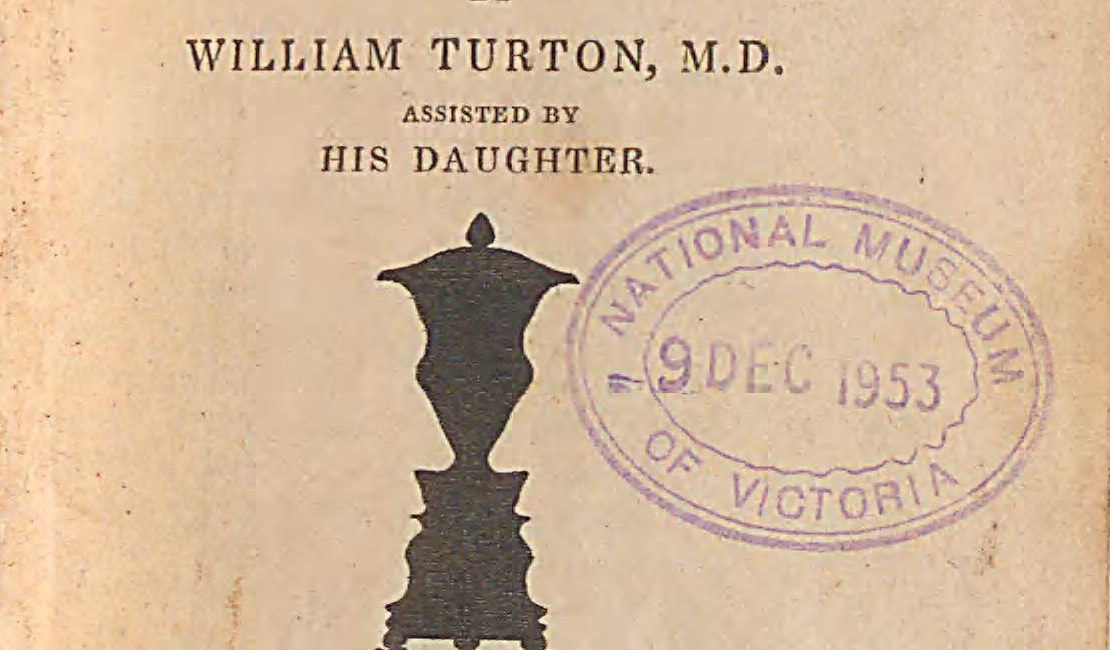
Turton tp.jpg

Fig. 6. Title page of Museums Victoria’s copy of William Turton’s A conchological dictionary of the British Islands (1819) with dated stamp. The acquisition number in the top right-hand corner makes this title even easier than the last example to trace in our archives. Keep looking through this item and you will spy some lovely additional illustrations added in the margins by a former owner.

While dated stamps continued to be used after the 1970s, a blind stamp was used for items that were being directly entered into the Rare Book Collection between the late 1970s and early 2000s (fig. 7).

Example of a blind stamp from Museums Victoria

Fig. 7. This blind stamp would have been considered less intrusive, while still clearly indicating ownership.

This is representative of a shift in library practice towards the designation and separate management of rare book collections. By the late 1970s, the Museums Victoria Library was housing its rare books separately from the general collection.

recent stamp crop.jpg

Fig. 8. A recent example of a dated stamp from 2017. National Museum of Victoria. List of meteorite specimens in the collection of the National Museum of Victoria, September 1972. 1972. Digitized in BHL by Museums Victoria.

Archival research is usually needed to confirm the date of acquisition. Items frequently bear multiple stamps, which may have been applied after accessioning. It appears that stamps were applied to the verso of plates retrospectively, while items may also have been routinely stamped if they were rebound.

While the stamps can be a bit confusing at times, having a general understating of them can help refine a date range for archival research. It also allows me to give a quick answer to a question often asked by tour groups — how long has this item been in your collection?

References

[1] Sacher, Peter 1988 ‘Commentary’ in Hahn, Carl Wilhelm, Monographie der spinnen (1820-1836), Leipzig, Zentralantiquariat der DDR.

Further Reading

Guide to researching provenance of books now in the British Library

Northcote Library – Stamps & Stickers

Daley, Jason. Bonn Library Recovers More Than 600 Books Looted After World War II, Smithsonian Magazine. April 15, 2019.

McGrane, Sally. What became of the Jewish books? New Yorker. February 28, 2014.

October 3, 2019by Joel Richard

Help Support BHL

BHL's existence depends on the financial support of its patrons. Help us keep this free resource alive!

search

About BHL

The Biodiversity Heritage Library (BHL) is the world’s largest open access digital library for biodiversity literature and archives. BHL operates as a worldwide consortium of natural history, botanical, research, and national libraries working together to digitize the natural history literature held in their collections and make it freely available for open access as part of a global “biodiversity community.”

Join Our Mailing List

Sign up to receive the latest news, content highlights, and promotions.

Subscribe Now

Subscribe to Blog via Email

Enter your email address to subscribe to this blog and receive notifications of new posts by email.

Join 319 other subscribers

Subscribe to Blog Via RSS

Subscribe to the blog RSS feed to stay up-to-date on all the latest BHL posts.

Access RSS Feed

Inspiring Discovery through Free Access to Biodiversity Knowledge.

The Biodiversity Heritage Library makes it easier than ever for you to access the information you need to study and explore life on Earth…for free, anytime, anywhere.


64+ Million Pages of
Biodiversity Literature Online.

EXPLORE

Tools and Services
to Transform Research.

EXPLORE

300,000+
Illustrations on Flickr.

EXPLORE

ABOUT | HARMFUL CONTENT | PRIVACY | SITE MAP | TERMS OF USE