Biodiversity Heritage Library - Program news and collection highlights from BHL
  • Home
  • News
  • Featured Books
    • All Featured Books
    • Book of the Month Series
    • BHL at 20
  • User Stories
  • Campaigns
    • Fossil Stories
    • Garden Stories
    • Monsters Are Real
    • Page Frights
    • Her Natural History
    • Earth Optimism 2020
  • Tech Blog
  • Visit BHL
Home
News
Featured Books
    All Featured Books
    Book of the Month Series
    BHL at 20
User Stories
Campaigns
    Fossil Stories
    Garden Stories
    Monsters Are Real
    Page Frights
    Her Natural History
    Earth Optimism 2020
Tech Blog
Visit BHL
  • Home
  • News
  • Featured Books
    • All Featured Books
    • Book of the Month Series
    • BHL at 20
  • User Stories
  • Campaigns
    • Fossil Stories
    • Garden Stories
    • Monsters Are Real
    • Page Frights
    • Her Natural History
    • Earth Optimism 2020
  • Tech Blog
  • Visit BHL
Biodiversity Heritage Library - Program news and collection highlights from BHL
Blog Reel, User Stories

Plants and the People Who Name Them: The International Plant Names Index and BHL

photo of a woman with brown hair

At the end of the twentieth century, the The Royal Botanic Gardens, Kew, The Harvard University Herbaria, and The Australian National Herbarium began collaboration on an ambitious project—to create an online index of names for all of the world’s vascular plants [1].

By combining the data in the nomenclatural indices of these three institutions—namely Index Kewensis, the Gray Card Index, and the Australian Plant Names Index—the collaboration created the International Plant Names Index (IPNI). Hosted by the Royal Botanic Gardens, Kew, today the database includes over 1.6 million records. As part of the provided nomenclatural information, IPNI includes bibliographic details linked to scanned literature in the Biodiversity Heritage Library (BHL) and links to taxonomic data through the Plants of the World Online.

Not surprisingly, given its role as a source of scanned literature for the Index, BHL is a vital resource for those working to build and maintain the IPNI database.

“I started working for the International Plant Names Index in 2013,” says Heather Lindon, Plant and Fungal Names Editor at the Royal Botanic Gardens, Kew . “I need to be able to look up protologues—the original place of publication of plant names and their descriptions. If the earliest place of publication isn’t known, we can use the name search in BHL to try to find it. Since our modern naming system dates to 1753, BHL has a lot of relevant literature for my work. Also, the rules of the International Code of Nomenclature that govern plant names apply to names published in the past, so consulting older works is still relevant for names being published today.”

photo of a woman with brown hair

Heather Lindon, editor of the International Plant Names Index (ipni.org). Photo credit: Christodoulos Foufoulides.

Lindon has worked in the botanical sciences since 2003. Her resume is extensive and varied, and includes: serving as a paleobotanist at the Smithsonian; working on a native seed collection project at Chicago Botanic Gardens; digitizing plant specimens at the Natural History Museum, London and Kew; teaching university level botany; working in entomology on invasive plant control; running a molecular research lab; and conducting field surveys for the US Army.

For the past seven years, Lindon has worked at the Royal Botanic Gardens, Kew as an editor on the Plant and Fungal Names Curation team, which curates the name, author, and publication data in IPNI. While BHL is often praised for providing access to literature that researchers may not otherwise be able to obtain, it also helps improve the research efficiency of those who do have access to robust research libraries.

“Although the library at Kew Gardens is extensive, since I often only need to look at a single page quickly to confirm a name, it’s much faster to use BHL,” explains Lindon. “With over 1.6 million plant name records to curate, and 6,000 more added every year, anything that can speed up the process is welcome. BHL also gives me access to editions or volumes that might be missing from Kew’s Library.”
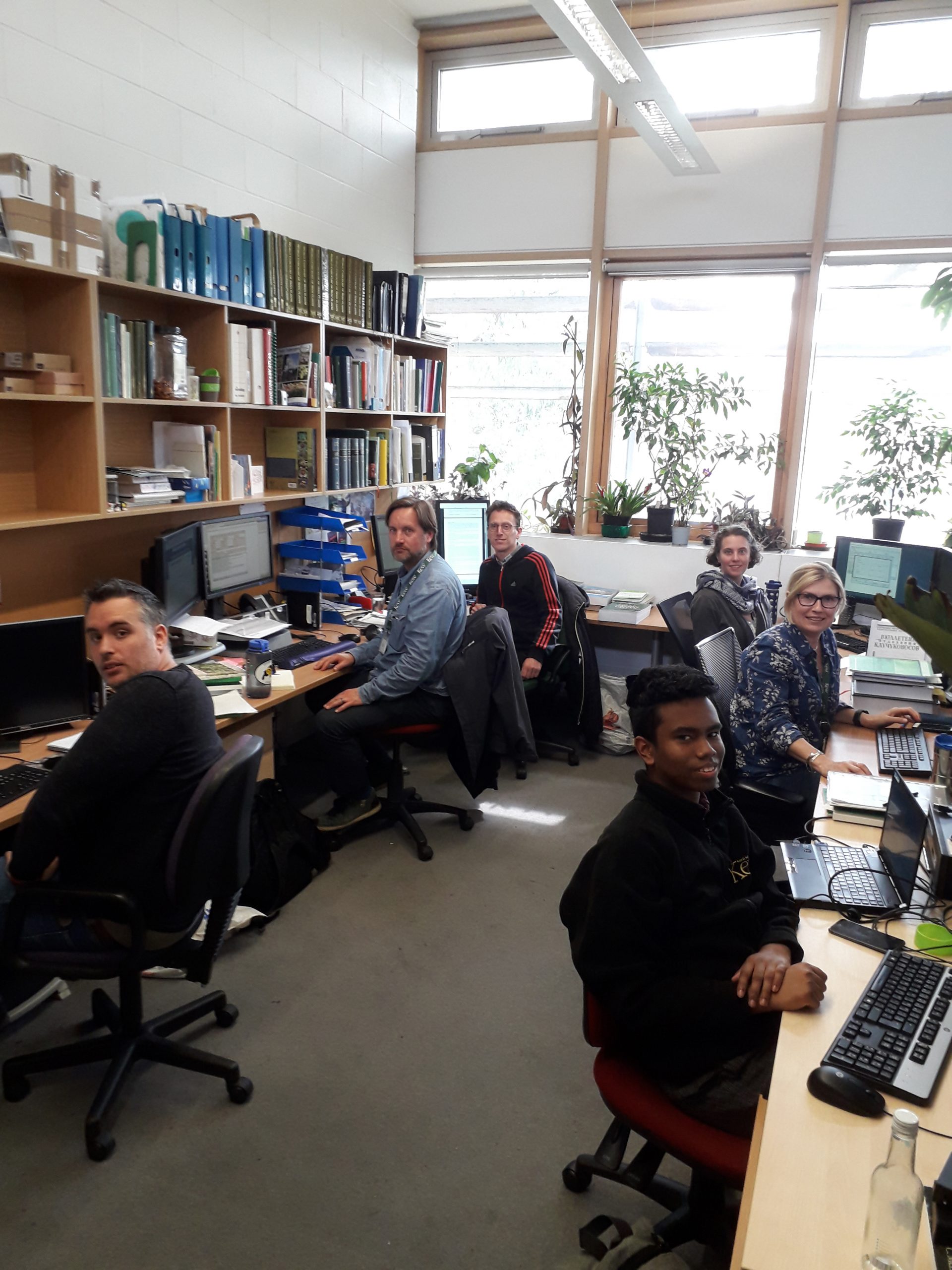
The Plant and Fungal Names team hard at work in their office at Royal Botanic Gardens, Kew. Clockwise from Front Left: Ben Moon (Checklist volunteer), Jonathan Krieger (IPNI), Rafaël Govaerts (World Checklist of Vascular Plants), Heather Lindon, Helen Hartley (both IPNI) Rahim Dina (Student Intern on IPNI to scan literature and link IPNI to BHL).

From verifying the accuracy of the place, date and publication data in IPNI to confirming original spellings, establishing the correct author of a name, or reviewing the language of the original plant description, Lindon and her colleagues use BHL almost daily. For the small team managing the IPNI database, including Lindon and two other content editors at Kew and a collaborator at Harvard University Herbarium, the access and efficiencies that BHL provides are essential.

“BHL is a fantastic tool,” lauds Lindon. “For me personally, it also allows me to work from home more often, which is a huge bonus. That would not have been possible just five or 10 years ago in this kind of work. Even when I am in the office, I can find the information I need quickly.”

The Library is also useful both for answering reference questions received from users and as a way for users to provide feedback to the IPNI team members.

“We receive emails daily from users of our database to address matters of nomenclature. Answering these questions often involves searching through BHL’s literature,” shares Lindon. “Our users who send in questions and corrections can also send us a link directly to the relevant BHL page, which means we can sort out and answer their questions quickly.”
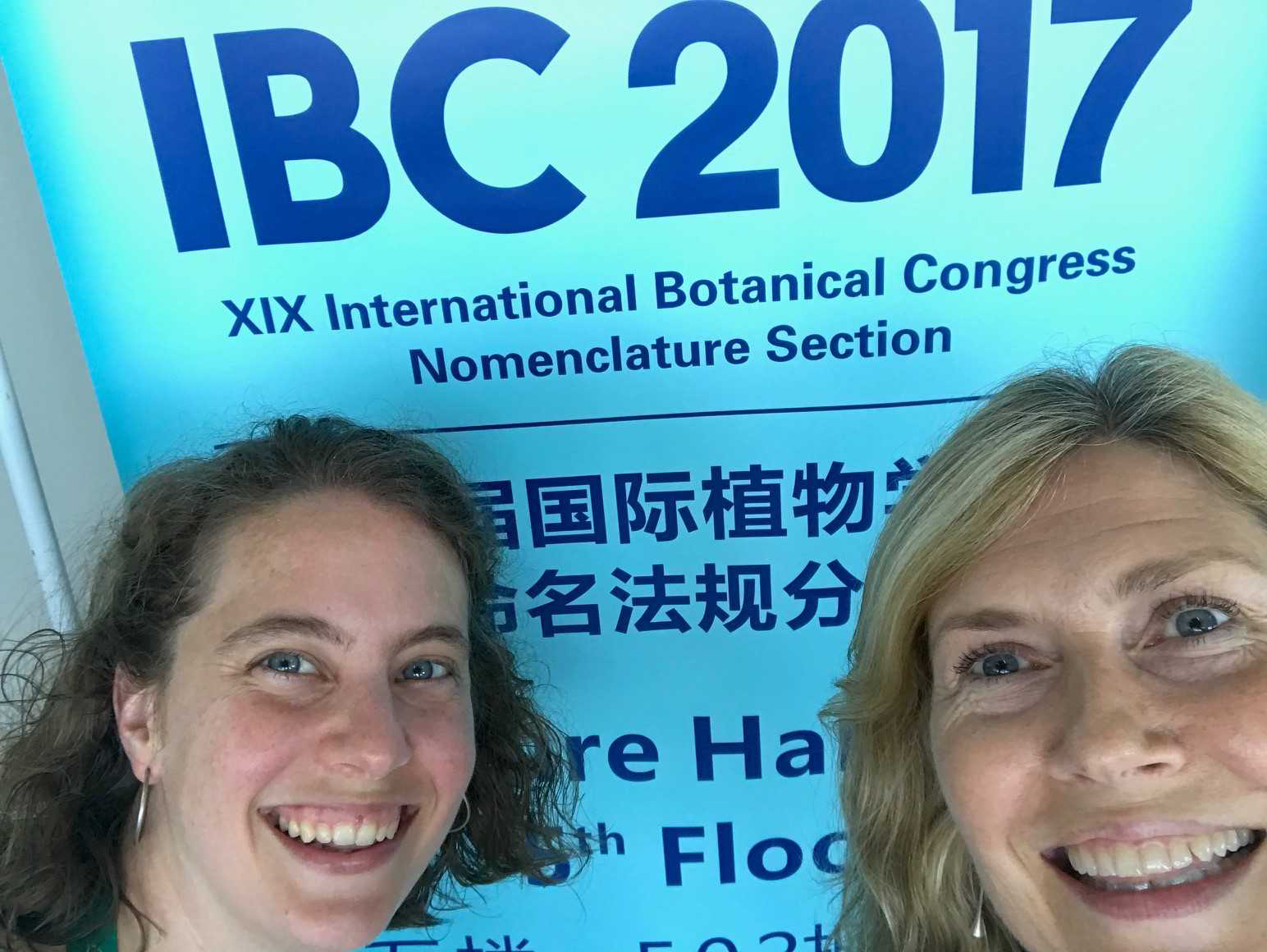
The chance to get together every 6 years to discuss nomenclature for a week is very exciting – for a nomenclaturist! IPNI team members Heather Lindon and Helen Hartley went to the conference in Shenzhen, China in 2017. Photo credit: Helen Hartley.

While BHL is an important repository of scanned literature for the database, inserting links to relevant pages on BHL was once a manual process for Lindon and her colleagues. However, a redesign of the IPNI website dramatically improved this workflow by making use of BHL’s OpenURL Resolver to create dynamic links to BHL pages.

“When IPNI designed its new website, we made sure that it could parse the information about the publication title, volume page and year,” says Lindon. “That means we don’t have to make individual links from names in our system to BHL. We can just tidy up the publication details in one go, and it will automatically link to the correct page in BHL.”

Lindon hopes that IPNI and BHL can build upon this progress to collaborate even further in the future.

“We would like for there to be stronger ties between the IPNI name list and the scientific name finder in BHL,” asserts Lindon. “That will make it easier for us to find names for keeping the database updated, but also for users to find literature on plant names in the search.”

While there are many publications in the Library are are useful for her research, such as the digitized volumes of the original printed copies of Index Kewensis, Lindon’s favorite publication in BHL is Taxonomic Literature 2 (TL-2). TL-2 is a 15 volume guide to the literature of systematic botany published between 1753 and 1940. It serves as the standard by which authors’ names and titles should be abbreviated in works on systematic botany [2].

“Having Taxonomic Literature 2 scanned means that we can easily link to it in our system,” shares Lindon. “If there is a question of publication date or authorship, we can click right through from the author’s record in IPNI and find the answer in TL-2 via BHL.”
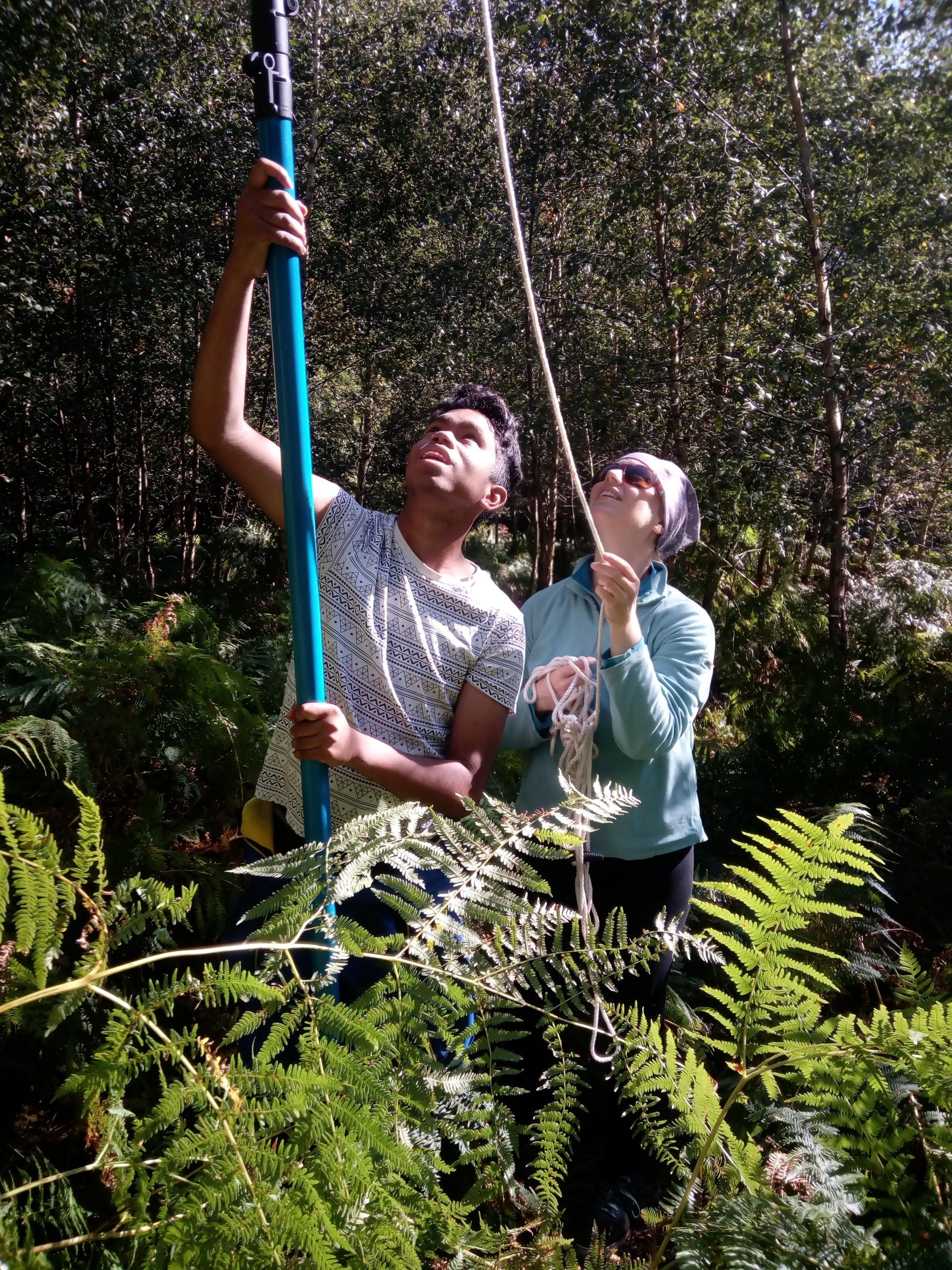
Occasionally, the IPNI team does get out of the office for other projects. Heather Lindon and IPNI Intern Rahim Dina did some seed collecting for Kew’s UK Native Tree Seed Collecting project. Photo credit: Fran Culverhouse.

As an enthusiastic BHL user, Lindon is not only grateful for the support that BHL provides to herself, her colleagues, and the IPNI user community, but she is also proud that her institution is part of BHL’s global consortium—a passionate community working to ensure that everyone, everywhere has access to essential literature.

“It’s been good for Kew’s scientific library to be able to share what they have with users around the world,” affirms Lindon. “BHL makes the information that is often hidden away in institutions accessible, especially for those who might not always have access to a botanical library.”

We are proud to know that BHL is such a vital resource for the International Plant Names Index and its community of editors and users, allowing the Library to support the progression of the plant sciences and the work of systematic botanists around the world.
References

[1] Croft, J., Cross, N., Hinchcliffe, S., Lughadha, E.N., Stevens, P.F., West, J.G. and Whitbread, G. (1999), Plant names for the 21st century: the International Plant Names Index, a distributed data source of general accessibility. TAXON, 48: 317-324. doi:10.2307/1224436

[2] Smithsonian Libraries. “Taxonomic Literature II (TL-2).” Collections. Accessed on December 4, 2019. https://www.sil.si.edu/DigitalCollections/tl-2/.

February 20, 2020by michelle.underhill
Blog Reel, Featured Books

Origins of Australian Ornithology : The Evolution of Australia’s Bird Reference Books

Welcome to Bird Week!

It is bird week from the 21st -27th of October. During this week, we would like to share with you some of the wonderful rare reference books on Australian birds and the stories behind them. These books have been digitised by the Biodiversity Heritage Library and are freely available in open access. The scientific reference works showcased this week include books from 1781 through to 1931. Ornithologists used these books to describe new species found within Australia and added to the growing number of previously undescribed birds during this time.

mathews_Final.jpg

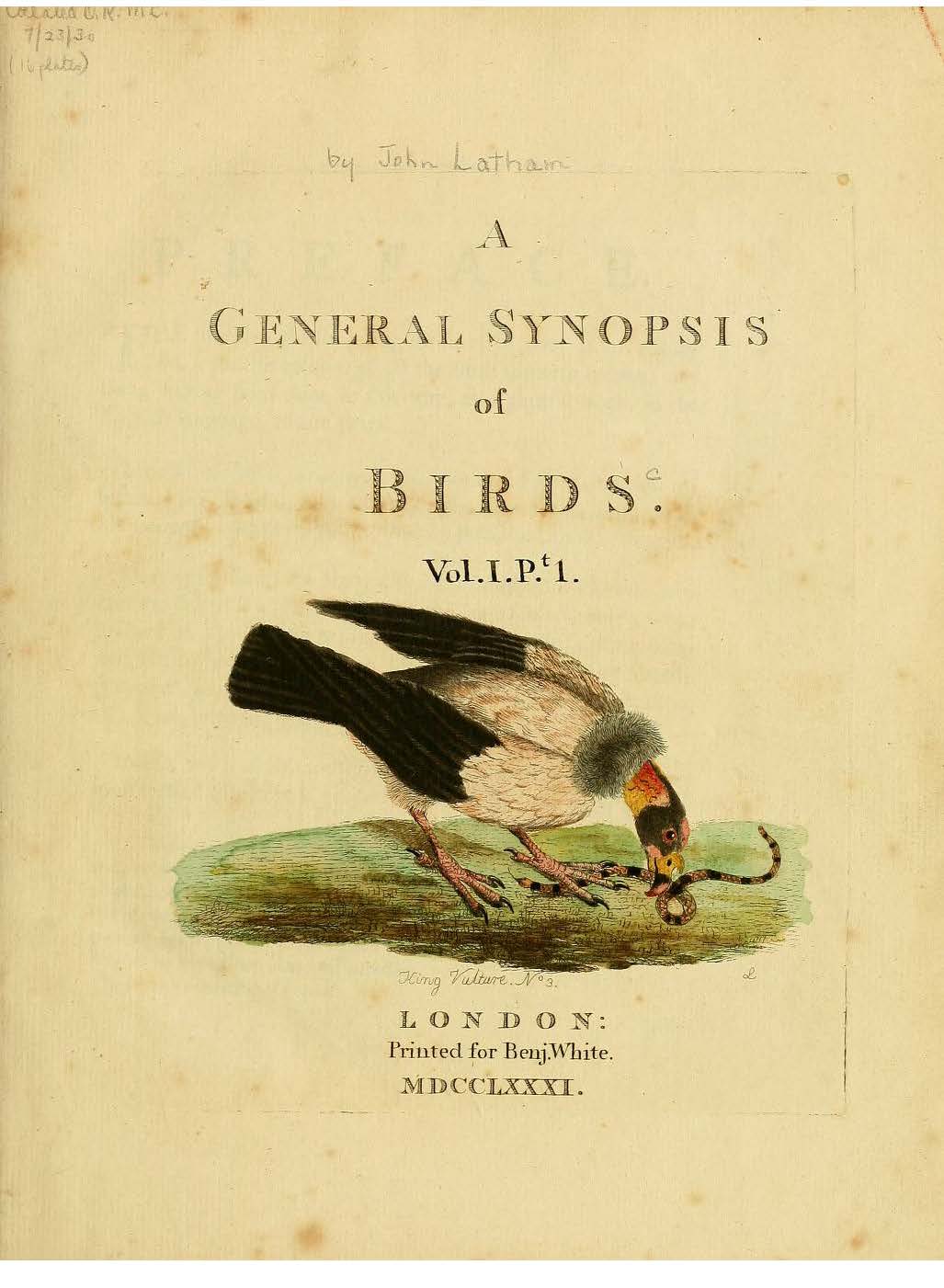
Title page. Latham, John. A General Synopsis of Birds. (1781-1785). Digitised in BHL by Smithsonian Libraries.

A General Synopsis of Birds consists of three volumes each with two parts, published from 1781 to 1785, with supplements in 1787 and 1801. Latham worked from descriptions by explorer William Dampier and Sir Joseph Banks, who sailed on the first voyage to Australia as the naturalist aboard Captain James Cook’s Endeavour from 1768 -1771. All volumes have been digitised by Smithsonian Libraries and can be viewed in BHL.

Eggs.jpg

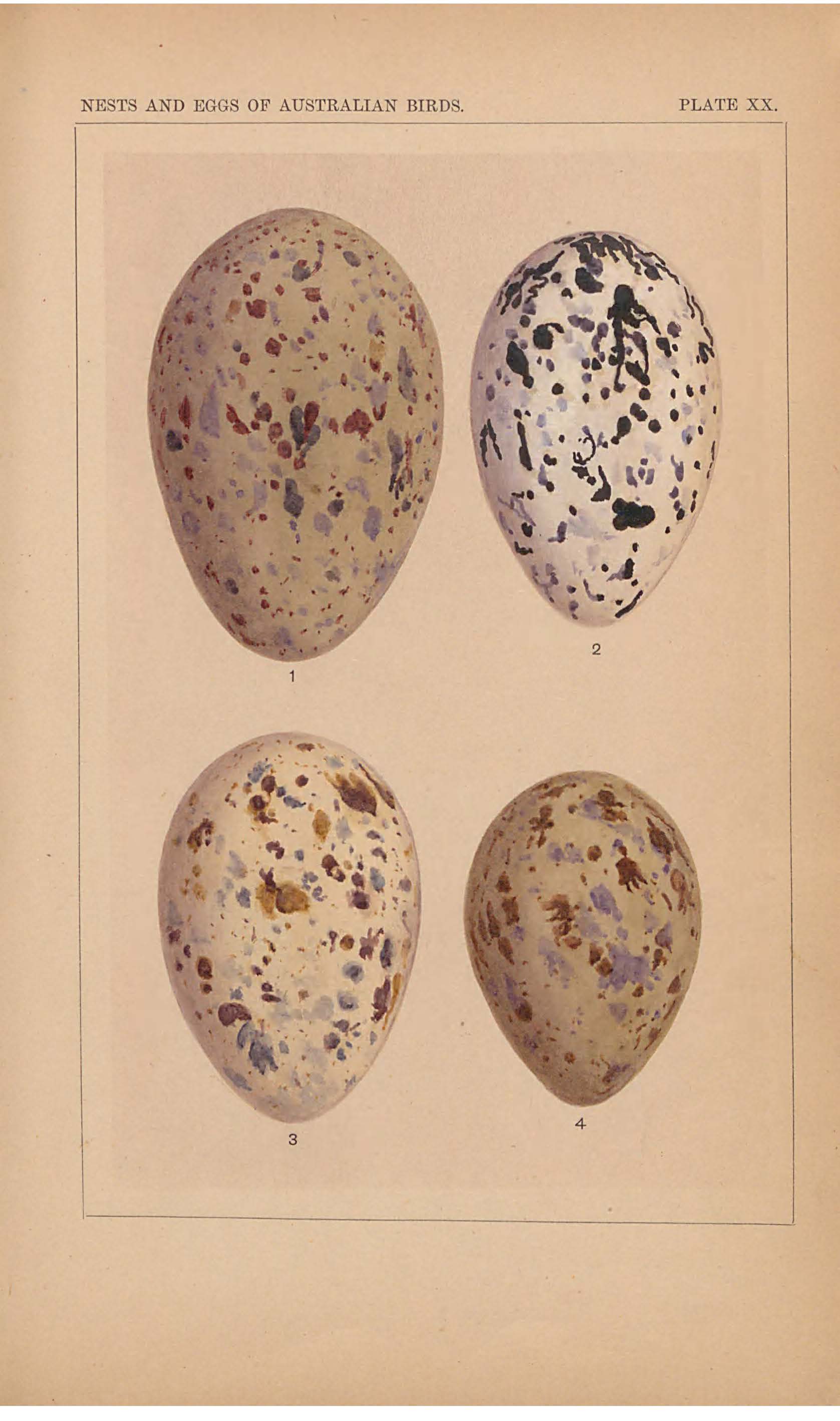
Plate XX. North, Alfred John. Descriptive Catalogue of the Nests and Eggs of Birds found in Australia and Tasmania. (1889). Digitised in BHL by Museums Victoria.

A Descriptive Catalogue of the Nests and Eggs of Birds found in Australia and Tasmania (1889) was published by Alfred John North, who described a number of birds for the first time. This publication contains a detailed description of the eggs of each species that were accessible to North, supplemented with descriptions of such other distinct varieties as occasionally occur. The history of the details of the eggs is often described as unknown, with a few exceptions taken from Gould’s Handbook to the Birds of Australia. The full book is available on BHL thanks to Museums Victoria.

blog BHL Lewin.jpg

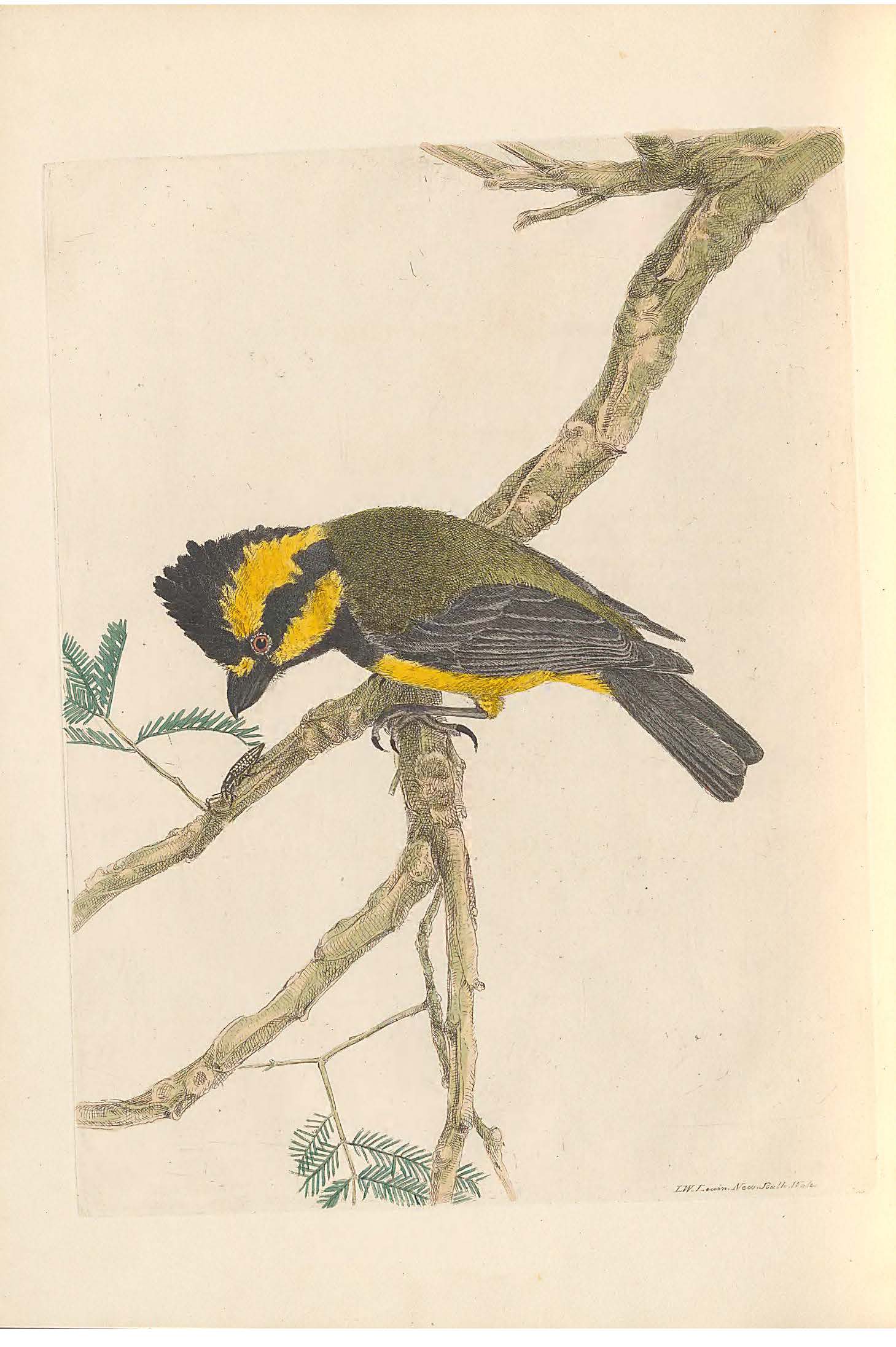
Plate XXIII. Lewin, John. A Natural History of the Birds of New South Wales. 3rd edition (1822). Digitised in the BHL by Museums Victoria.

John Lewin relocated to Australia from England in 1800, keen to visit the colony of New South Wales. His first book on birds, Birds of New Holland, was published in London in 1808. Unfortunately, as the books were shipped back to Australia from London for distribution, they were lost, possibly at sea. Only six copies are known to exist. Lewin decided to begin a second edition. However, his copper illustration plates were still in England, hence he needed to start again from scratch. The second edition was renamed The Birds of New South Wales with their Natural History and was published in 1813. It is recognised as the first illustrated book published in Australia. The third and fourth editions, published under the title A Natural History of the Birds of New South Wales, were published in 1822 and 1838 respectively and have been digitized in BHL by Museums Victoria.

bird heads

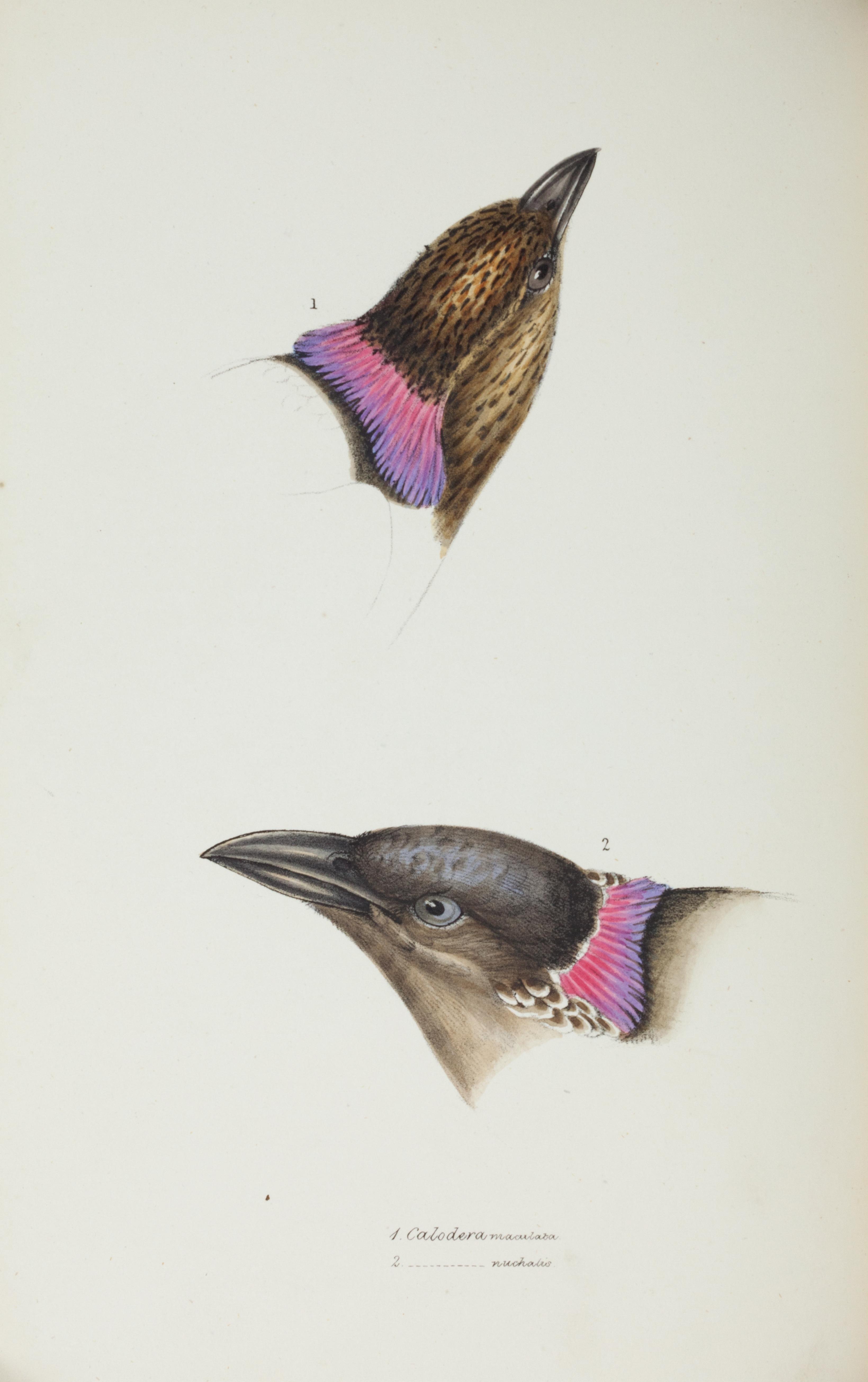
[Plate VI]. Gould, John. A Synopsis of the Birds of Australia, and the Adjacent Islands. (1837-38). Art by Elizabeth Gould. Digitised in the BHL by Museums Victoria.

Acclaimed ornithologist Gould received bird specimens in London from his brothers-in-law in Australia, which he used to publish his Synopsis of the Birds of Australia (1837-38). The illustrations are predominantly of bird heads, all hand-painted by Gould’s wife, Elizabeth. Only basic descriptions of Australian birds were used, as Gould intended to publish this work in order to get to Australia to research and illustrate birds in the wild with his wife. Gould noted that on his return from Australia, these pages would be removed and further knowledge of Australian species and their habitats would be recorded.

Gould_book.jpg

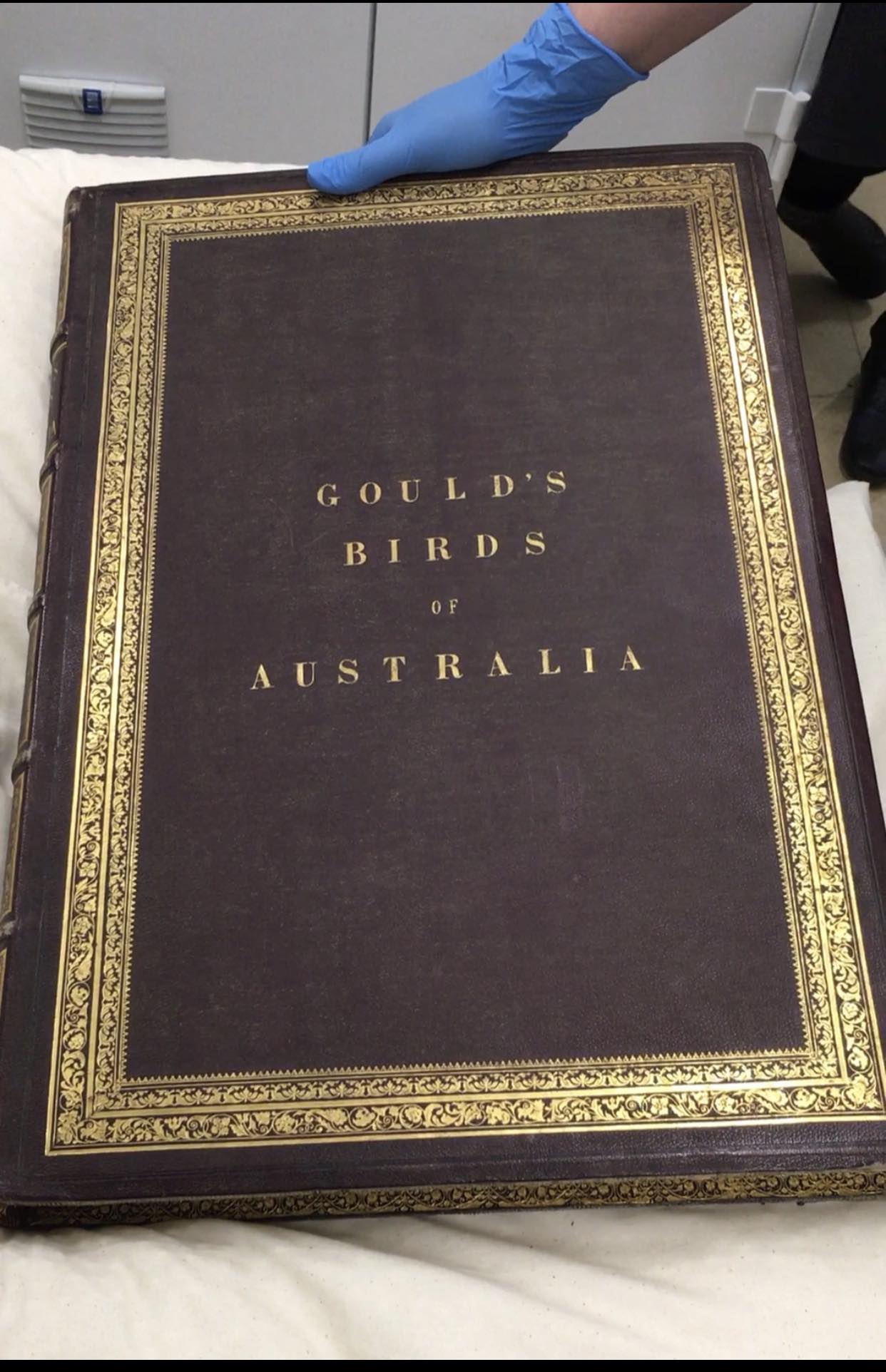
Photograph of the cover of one of the volumes of Gould’s Birds of Australia, from the library collections of the Melbourne Museum of Museums Victoria. The Birds of Australia (1840-1848) has also been digitised in BHL by Smithsonian Libraries

In a letter dated 15th February 1839, while in Australia, Elizabeth Gould wrote “[John] has already done more in obtaining nests and eggs, making skeletons of the various forms of birds, etc., and in getting information of their habits, than has been hitherto done, and will, I hope, be enabled to produce an interesting work on our return.”

On arrival back to England, John Gould published The Birds of Australia between 1840 and 1848. The book encompasses 600 species of birds, of which 200 were first described by Gould. Elizabeth produced 84 of the illustration plates for The Birds of Australia, but sadly, she died in 1841, before the book was completed and only one year after the Goulds’ return from Australia. The remainder of the plates were primarily created by painter Henry Constantine Richter, which were made after sketches by Elizabeth. While in Australia, Elizabeth also created many botanical illustrations and wrote that these helped to “render the work on ‘Birds of Australia’ more interesting…I trust we shall be enabled to make our contemplated work of sufficient interest to ensure it a good sale.”

A good sale it was. The Birds of Australia was bound in seven volumes, costing subscribers £115 — the equivalent to around 18K AUD or 12K USD in today’s money. But the significant contribution this book made to the science of ornithology far exceeds its monetary value.

What_bird.jpg

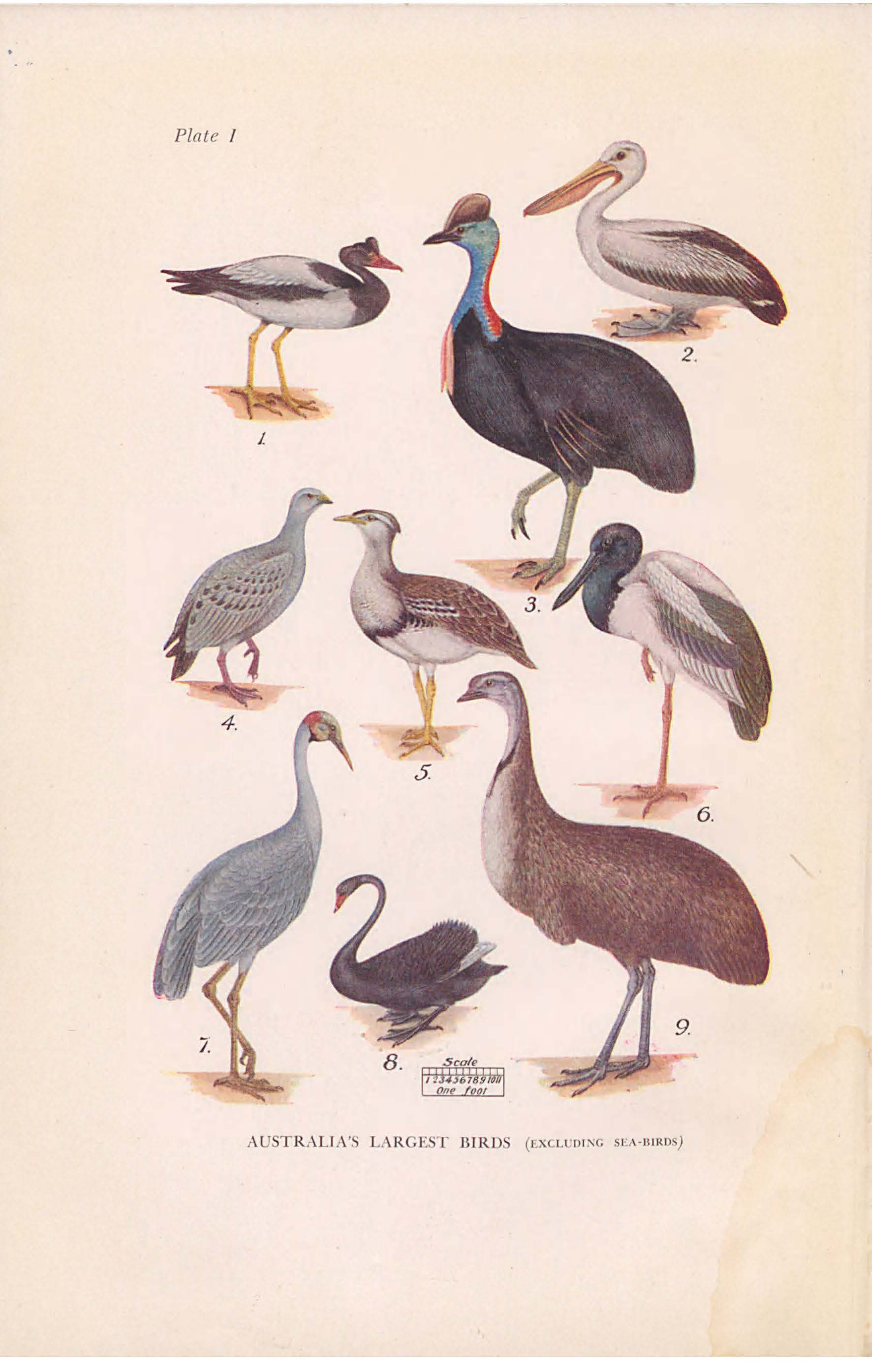
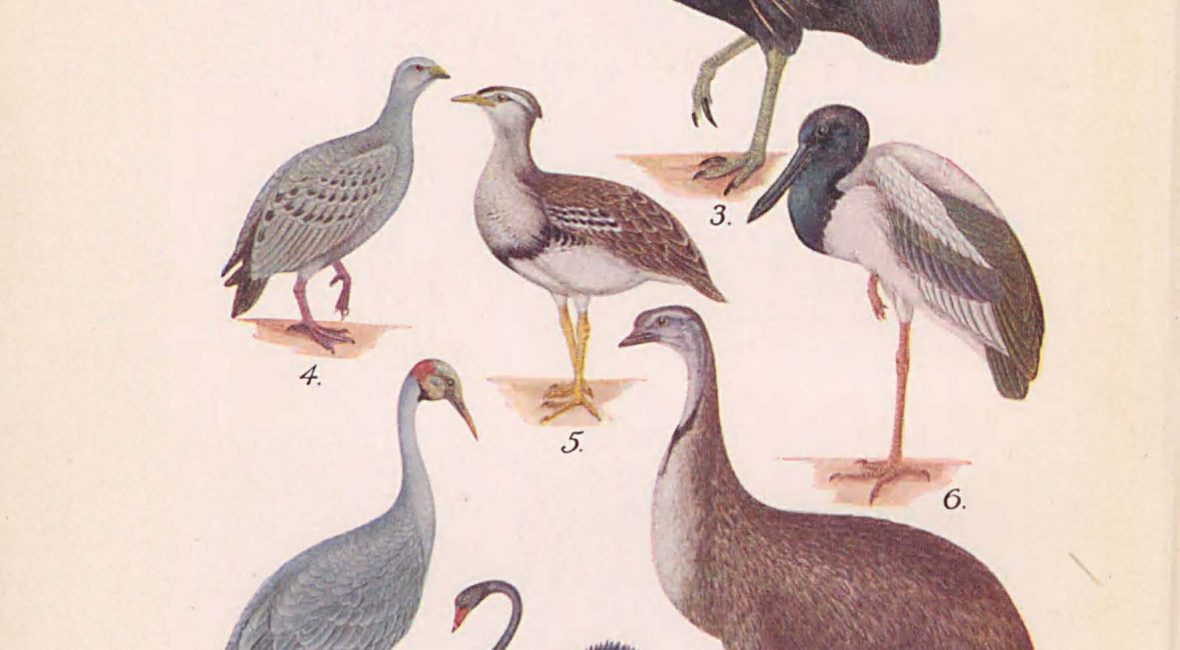
Plate I. Cayley, W, Neville. What Bird is that? (1931). Digitised in BHL by Museums Victoria.

What Bird is that? A Guide to the Birds of Australia (1931) was the first comprehensive field guide that was intended as a bird identification book in Australia. During the early 20th century, there was a growing interest in amateur ornithology, and Cayley had hoped that his book would encourage nature lovers to extend their knowledge and appreciation of Australian birdlife. In addition to being an ornithologist, Cayley was also a prolific artist and produced the 36 plates contained in the book. Subsequent editions were published up until the 1990s and it became a classic ornithological work in Australia.

October 21, 2019by Joel Richard
BHL News, Blog Reel

BHL at Summer Teacher Institutes

This summer, the Library of Congress hosted five-day Summer Teacher Institutes in Washington, DC.  As part of the most recent Institute, BHL shared an exhibit table on Science and Technology with the Library of Congress on Tuesday, August 6, 2013.  Carolyn Sheffield, of the Smithsonian Institution, shared information on BHL and distributed stickers, pins, and BHL business cards—complete with gorgeous illustrations from BHL.  Dr. Tomoko Steen, Research Specialist and Camron Lee, Junior Fellow, both of the Science, Technology, and Business Division of the Library of Congress, shared the table, helping to spread the word about BHL as well as sharing amazing education resources compiled by their Division.

Attendees included 25 teachers from primary, secondary, undergraduate and graduate programs from across the country.   The majority of attendees had not heard of BHL before and were delighted to learn of the free resources that BHL makes available.  Many attendees expressed enthusiasm for the content, especially the images on Flickr, and many said that they were to share the information about BHL’s free resources with their colleagues at their schools.

View Full Size Image

August 19, 2013by sayeedmd
BHL News, Blog Reel

Post Life & Literature: Themes and Outcomes

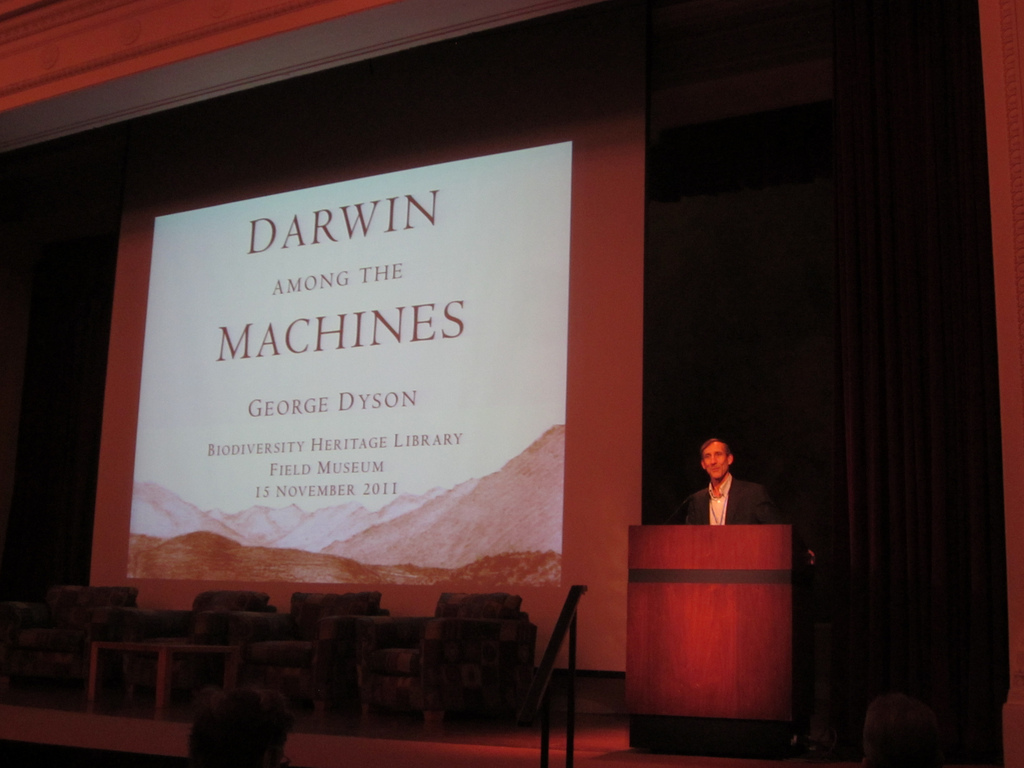
View Full Size ImageIf you happened to be living under a rock for the past two weeks and missed our blog posts, tweets, and posts on Facebook, you might have missed the fact that last week was the Life and Literature Conference, an event hosted by BHL with the express purpose of generating conversations about the priorities for biodiversity literature digitization, particularly as it pertains to BHL, for the next 4-5 years. The conference, which took place November 14-15, 2011, in Chicago, IL, brought together interested parties in a variety of disciplines, including science, education, informatics, and the humanities. Lively discussions and insightful presentations ensued both days, with dozens of live tweets (hashtag #lifelit) constantly streaming for those who could not participate in person.

The conference was divided into four panel discussions, followed on the second day by break-out sessions that allowed attendees to delve deeply into the various topics discussed during panel sessions, ultimately leading to an outline of the various areas deemed most important for BHL to focus on in the next 4-5 years. The four panel sessions included “Research, Informatics, and the Published Record;” “Publishers, Aggregators, and Authors – New Models and Access;” “Learning and Education;” and “Building Collaborative Networks for Science and the Humanities through Scientific Literature.” A synopsis of the four panels can be found on the Life and Literature site, as well as a list of each of the presenters and their biographies. Session presentations are being loaded to the BHL wiki and can be accessed on the Presentations page. Notes from the sessions can be found on the Life and Literature website. You can also view interviews of conference attendees on the website.

View Full Size ImageIn order to facilitate a discussion with the audience during panel and breakout sessions, BHL staff used an application called Titan Pad, which provides a collaborative environment that allows anyone to access a document to view, edit, or make comments in real time. There were Titan Pad pages for each of the panels and breakouts, and live notes, as well as live discussion, occurred via those avenues. These pages remain live, and we encourage anyone interested to continue the discussion in the weeks to come!

While many ideas and themes resulted from the discussion generated at the conference, perhaps the most recurring topic involved the connection between science and the humanities. Presentations by speakers at the Humanities panel highlighted some of the possible intersections between art and science, and each breakout session touched upon the various ways that BHL could partner with the humanities and make the biodiversity illustrations already in BHL more accessible. The BHL Flickr site, which currently houses more than 20,000 images, was a huge success, and attendees discussed additional ideas about how BHL could further promote its illustrations and engage the arts and humanities communities. Such ideas as specific image searching interfaces, image-specific collections, and collaborations with artist communities were discussed, and BHL staff outlined some art-related grant projects currently in the works.

The winner of the Life and Literature Code Challenge was also presented at the conference. The Code Challenge asked users to create applications that would use, disseminate, or display BHL data in new and meaningful ways. The winner? Ryan Schenk, with his application Synynyms. Synynyms works as a taxonomic name aggregator, finding all of the different names given to a species over the years and displaying the frequency of each name variety throughout history. The names are provided by the Encyclopedia of Life, and the publications come from, you guessed it, BHL! Congratulations to Ryan, and thanks for sharing such an awesome tool with us!

View Full Size ImageLast, but certainly not least, two new members of the BHL family were announced, Cornell University Library and the United States Geological Survey (USGS) Libraries. With these new members joining the fold the BHL consortium is now 14 members strong! Stay tuned for more information about BHL’s newest members to come in future posts.

The Life and Literature conference was also surrounded by a variety of other important BHL meetings, including a BHL Global Meeting (see previous post on the event), a BHL Staff meeting, and a meeting devoted to a discussion on the digitization of biodiversity literature in Africa. Watch for posts on the latter two meetings in the days to come.

As we think about the outcomes of the conference, we are excited to explore the possibilities for the future and inform our development through user feedback. For BHL to serve its purpose, it must meet the needs of its user community, and events like Life and Literature allow us to gather and assess those needs. However, if you couldn’t make it to Life and Literature, or if you did but still have more thoughts on BHL’s future, you can still share them! Contribute your ideas through our Titan Pad discussions, by submitting feedback to our website, or posting your ideas via twitter (@biodivlibrary) and Facebook! We’re waiting to hear from you, and thanks to everyone who made Life and Literature such an exciting and successful venture!

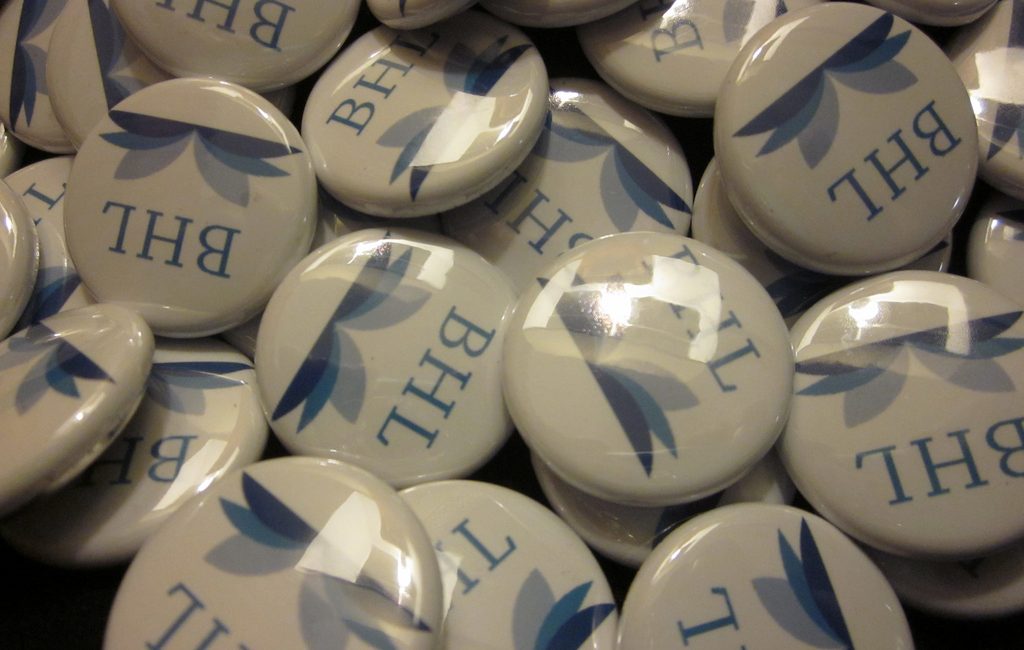
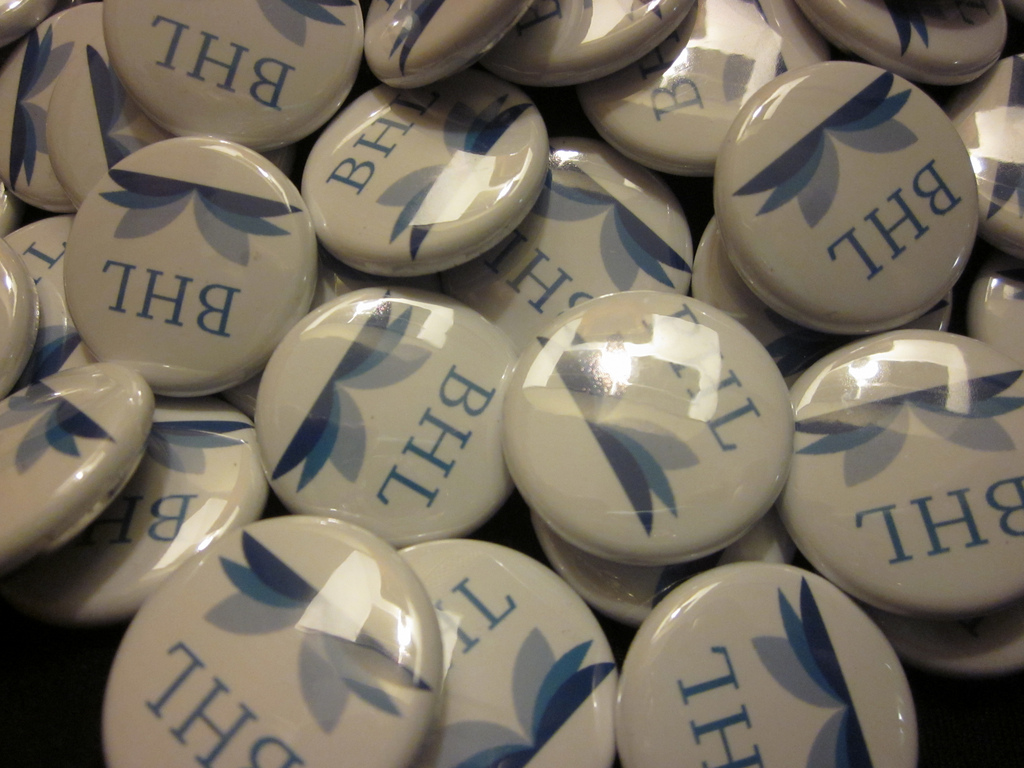
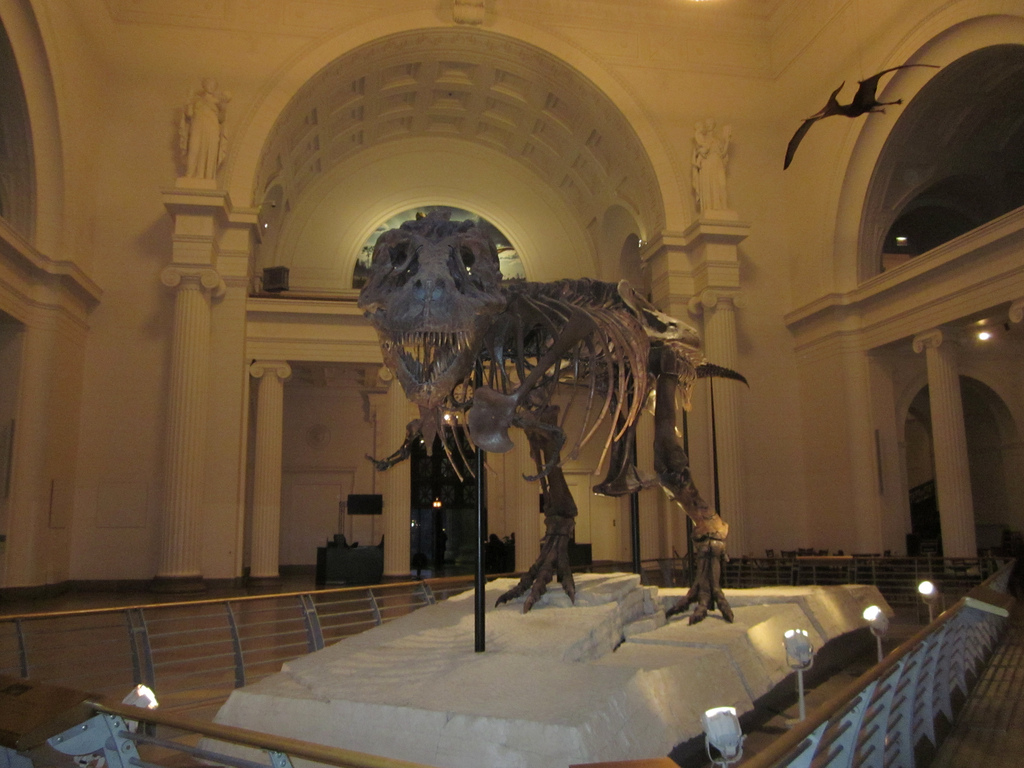
(Images: All images courtesy Martin Kalfatovic. Top: BHL Buttons presented at the Life and Literature Conference; Middle: George Dyson delivering the second plenary speech at Life and Literature; Bottom: SUE – the largest, most complete T-Rex skeleton ever discovered, on display at the Field Museum, the Life and Literature Conference venue)

November 22, 2011by Grace Costantino
BHL News, Blog Reel

BHL and Culturomics

On December 16, 2010 Science released a paper, “Quantitative Analysis of Culture Using Millions of Digitized Books” that describes data mining research using a vast textual archive created by the Google Books. The abstract reads, “We constructed a corpus of digitized texts containing about 4% of all books ever printed. Analysis of this corpus enables us to investigate cultural trends quantitatively. We survey the vast terrain of “culturomics”, focusing on linguistic and cultural phenomena that were reflected in the English language between 1800 and 2000. We show how this approach can provide insights about fields as diverse as lexicography, the evolution of grammar, collective memory, the adoption of technology, the pursuit of fame, censorship, and historical epidemiology. ‘Culturomics’ extends the boundaries of rigorous quantitative inquiry to a wide array of new phenomena spanning the social sciences and the humanities.”

The paper and subsequent commentary has accelerated nascent efforts at macroscopic, algorithmic questioning of large historical textual data sets. Can similar methods be applied fruitfully to the BHL corpus?

Already, Rod Page, bioinformatician and developer of BioStor, has demonstrated suggestive evidence in the affirmative by tracking a small sample of species names for the same organism in BHL texts through time and plotting the number of citations. The graph may be a visual representation of scientific debate and usage. Many other uses are possible, including:

  • Co-occurrence of place names with species
  • Frequency of co-occurrence of species names esp. with key words such as host, prey, predator, symbiont etc.
  • Tracking trends in zoological and botanical research by tracking methodological terminology through time.
  • Identification of taxonomically significant “events” in the literature based on textual cues.

Much of the follow-on activity to the Science paper is occurring in the “Digging into the Data” program. Thus, on May 9, the BHL made its data available for researchers in the Digging into the Data program.

View Full Size Image

BHL Director, Tom Garnett, will be attending the conference, “Digging into the Data” in June where speakers, including the authors of the Science article, will address issues of and opportunities in data mining of large textual corpora. With suitable partners, it is possible that we can seek NSF or Google funding for the unique use case our increasing text corpus presents. The framework for a proposal would be a team of biologists and a team of computer scientists posing research questions for the BHL corpus that would be amenable to algorithmic investigation. Even if funding is not forthcoming, if third party researchers use the BHL corpus to produce scientifically or historically salient results, it will enhance the value and use of the BHL, which can lead to further collaborations.

May 16, 2011by ulib-libraryjobs

Help Support BHL

BHL's existence depends on the financial support of its patrons. Help us keep this free resource alive!

search

About BHL

The Biodiversity Heritage Library (BHL) is the world’s largest open access digital library for biodiversity literature and archives. BHL operates as a worldwide consortium of natural history, botanical, research, and national libraries working together to digitize the natural history literature held in their collections and make it freely available for open access as part of a global “biodiversity community.”

Join Our Mailing List

Sign up to receive the latest news, content highlights, and promotions.

Subscribe Now

Subscribe to Blog via Email

Enter your email address to subscribe to this blog and receive notifications of new posts by email.

Join 319 other subscribers

Subscribe to Blog Via RSS

Subscribe to the blog RSS feed to stay up-to-date on all the latest BHL posts.

Access RSS Feed

Inspiring Discovery through Free Access to Biodiversity Knowledge.

The Biodiversity Heritage Library makes it easier than ever for you to access the information you need to study and explore life on Earth…for free, anytime, anywhere.


64+ Million Pages of
Biodiversity Literature Online.

EXPLORE

Tools and Services
to Transform Research.

EXPLORE

300,000+
Illustrations on Flickr.

EXPLORE

ABOUT | HARMFUL CONTENT | PRIVACY | SITE MAP | TERMS OF USE