 |
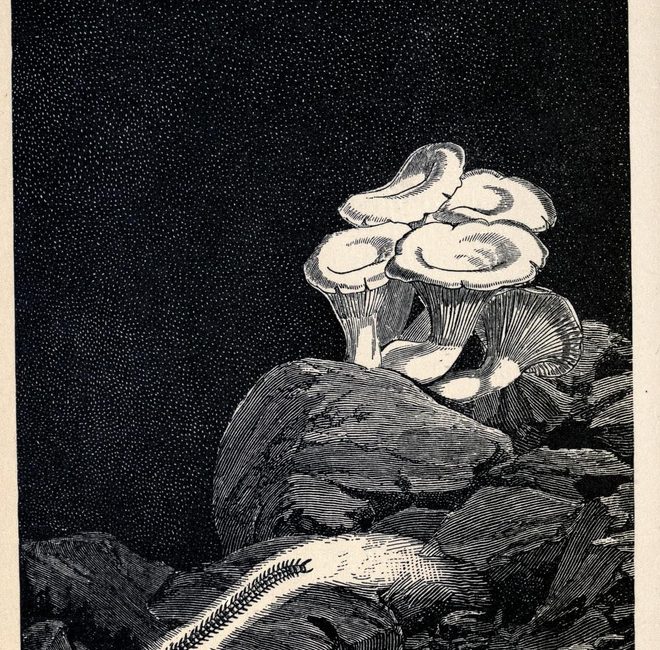
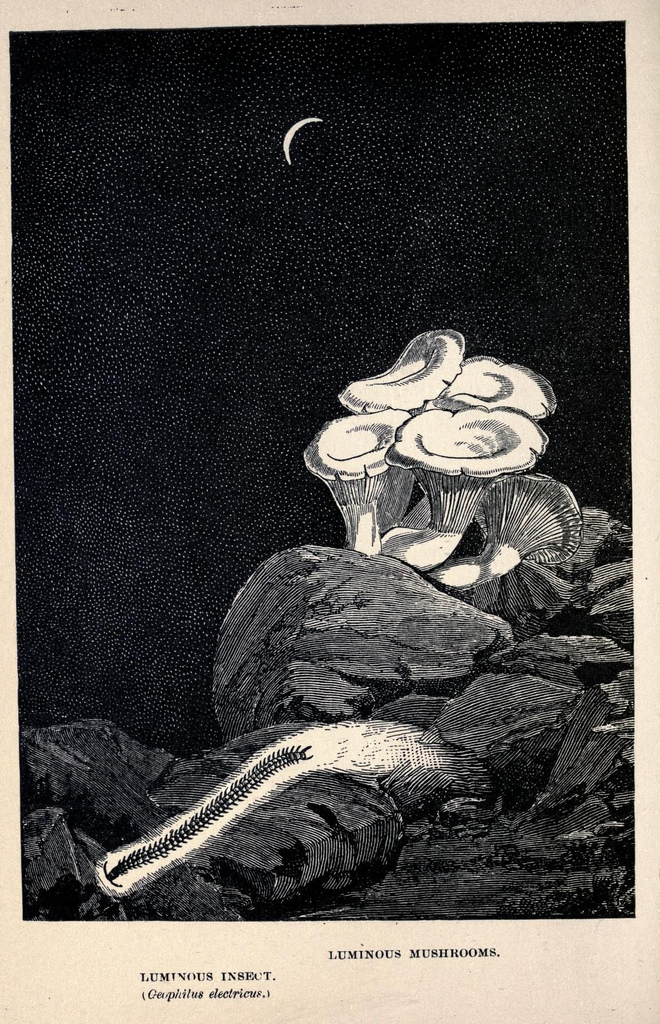
| The bioluminescent mushrooms. |
It’s a damp summer evening. You’re walking through the forest, the canopy overhead blocking any remaining sunlight from trickling to the forest floor. Nearly blind, you stumble over bulging roots and floral debris, groping from tree trunk to tree trunk trying to find your way to a clearing and a glimpse of the North Star. Suddenly, ahead, you spy an eerie, faintly glowing blue aura. You pause, uncertain, but the mysterious light is the only beacon you have, so, with slight trepidation, you flounder towards it. As you approach, the light grows more intense, reminding you, incredibly, of a blue neon sign beckoning from the center of a pitch dark woods. You falter to your knees, timidly reaching out to touch the curious apparition. To your surprise, as by this point you’ve begun to believe you’ve lost your mind and are grasping at hallucinations in the dark, your fingers touch solid mass. You run them gently over the façade of the object, only to realize that the form is something familiar to you – a mushroom. Lost in a sea of darkness, you smile as you realize that even the forest has its nightlights – in this case, the bioluminescent mushroom, Omphalotus olearius, the Jack-o-Lantern Mushroom.
What is Bioluminescence?
Bioluminescence is the production of light by a living organism. It is caused by a chemical reaction, involving the chemicals luciferins, which react with oxygen and release energy in the form of light. The enzyme luciferase is a catalyst used to speed up the reaction.
A wide variety of organisms exhibit bioluminescence, including fireflies, glow worms, millipedes, anglerfish, eels, sea pens, squid, and, of course, mushrooms. Bioluminescence has a variety of functions in the animal kingdom. The iconic anglerfish uses luminescence in a lure to attract unsuspecting prey. The bioluminescence displayed by fireflies is a mating ritual used to attract potential mates. Certain species of squid emit a cloud of luminescent material to distract predators and give the organism a chance to escape. Specific species of bacteria use bioluminescence for communication. And some species, such as the Black Dragonfish, produce a red hue that allows them to detect red-pigmented prey deep under the ocean’s surface.
Bioluminescence has wide application in the human world as well, particularly in the realm of technology. Many biomedical research applications tap into luciferase potential for bioluminescence imaging. Scientists are also exploring the potential for using bioluminescence for detecting bacterial food contamination and infections in suspicious corpses. And consider this idea: Some propose applying bioluminescence to trees to illuminate highlights, thus eliminating the need for street lights.
Living Lights
According to Charles Holder, author of Living Lights, there are a variety of less scientifically-oriented applications for animal bioluminescence in the human world. The most obvious, of course, is using it as a light by which to see, and for this application, Holder quotes a variety of instances:
I have read by the light of a luminous beetle, and have determined the time of night while holding my watch in the glare of ocean animals. Von Bibra wrote his description of the Pyrosoma by its own light; the shark of Bennett illuminated his cabin like a chandelier; photographs have been taken by the light of luminous beetles and by phosphorescent plates; and probably the day is not distant when more important uses will be found for this wonderful light…
Living Lights portrays 27 instances of bioluminescence, illustrated via black and white drawings which are surprisingly effective at conjuring the illusion of light amidst the darkness. For example, Holder’s illustration of an illuminated sea pen, which, when touched, emits a bright greenish light to scare off predators, highlights the minute details of this fascinating creature encapsulated within a pool of blackness interrupted only by other fellows illuminators. Or take the illustration of a diver and Pyrosomes. Pyrosomes are colonial tunicates made up of hundreds of thousands of zooids. These bioluminescent colonies emit an intense blue-green light visible for tens of meters. And, of course, a book on bioluminescence would not be complete without a depiction of the infamous anglerfish.
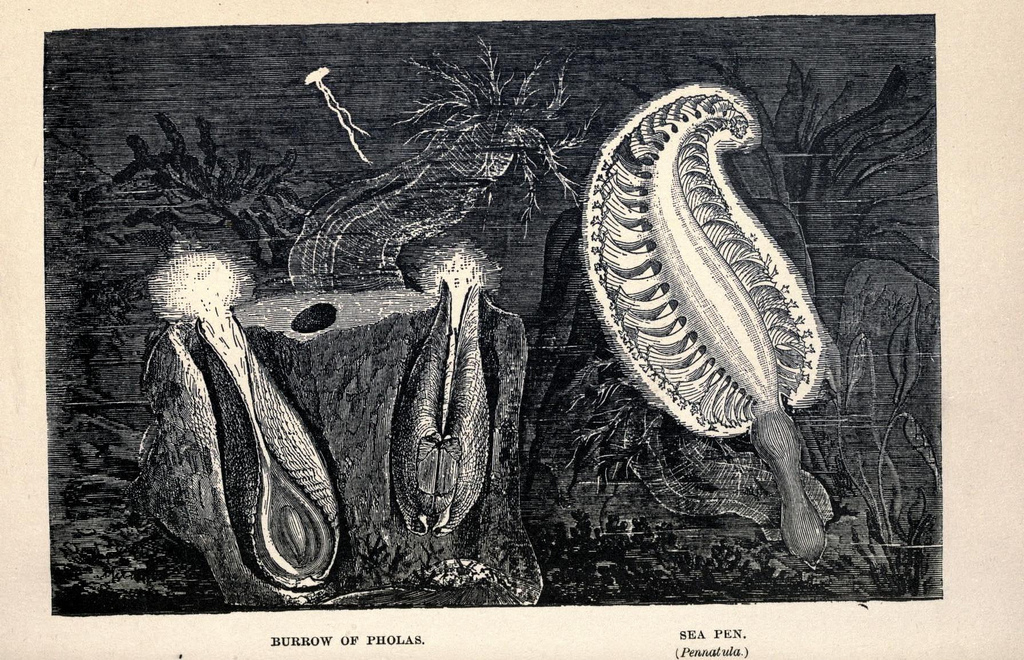 |
| Bioluminescent Sea Pen |
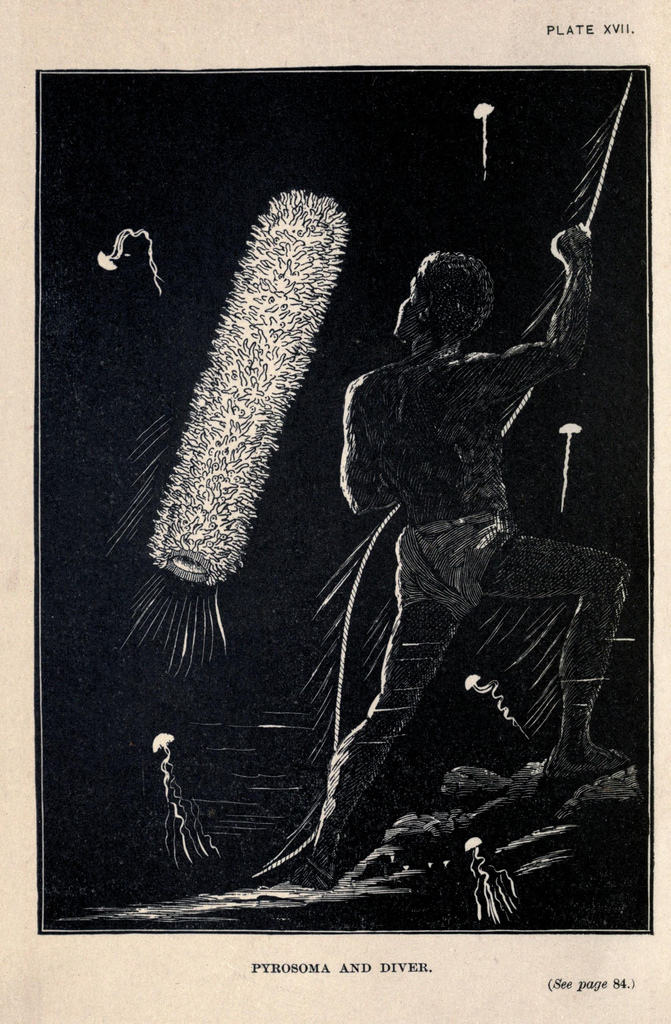 |
| A bioluminescent Pyrosome |
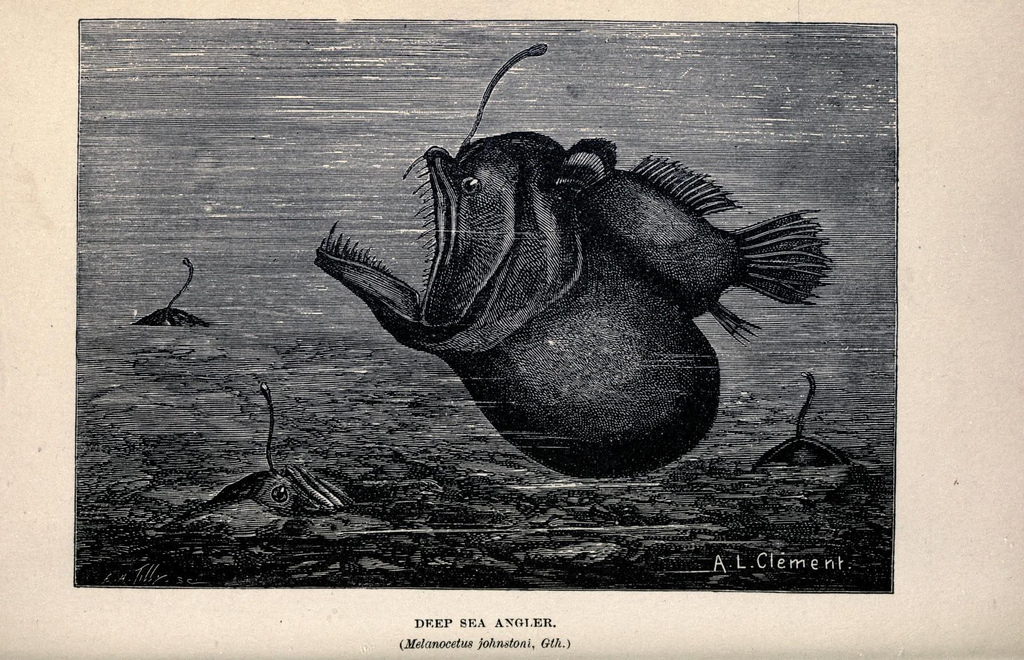 |
| Bioluminescent lure of the anglerfish |
The wealth of bioluminescence depicted by our book of the week extends beyond the few instances we’ve mentioned here. Explore Living Lights in BHL to learn more about this incredible phenomenon and the amazing creatures that claim it. View all of this book’s enchanting illustrations on Flickr. If you’re on Pinterest, don’t forget to visit our Book of the Week collection, in which we share a few of our favorite illustrations from each book. Be sure to Pin your favorites as well!
And the Mushroom Story?
So, how does our forest story end? It’s a tale with a mushroom of a hero. Following the organic path created by your pseudo-electric fungal friends, you find your way to the clearing with your campsite and all your adventurous camping companions. With a sigh of relief, you plump down in a seat by the fire, only to find your eyes cruelly accosted by the blazing flames. Sighing, this time in irritation, you wish you were back among the calming glow of phosphorescent mushrooms.