
Biodiversity Heritage Library - Program news and collection highlights from BHL
  • Home
  • News
  • Featured Books
    • All Featured Books
    • Book of the Month Series
    • BHL at 20
  • User Stories
  • Campaigns
    • Fossil Stories
    • Garden Stories
    • Monsters Are Real
    • Page Frights
    • Her Natural History
    • Earth Optimism 2020
  • Tech Blog
  • Visit BHL
Home
News
Featured Books
    All Featured Books
    Book of the Month Series
    BHL at 20
User Stories
Campaigns
    Fossil Stories
    Garden Stories
    Monsters Are Real
    Page Frights
    Her Natural History
    Earth Optimism 2020
Tech Blog
Visit BHL
  • Home
  • News
  • Featured Books
    • All Featured Books
    • Book of the Month Series
    • BHL at 20
  • User Stories
  • Campaigns
    • Fossil Stories
    • Garden Stories
    • Monsters Are Real
    • Page Frights
    • Her Natural History
    • Earth Optimism 2020
  • Tech Blog
  • Visit BHL
Biodiversity Heritage Library - Program news and collection highlights from BHL
Blog Reel, Featured Books

The Garden: A Place to Learn and Experiment

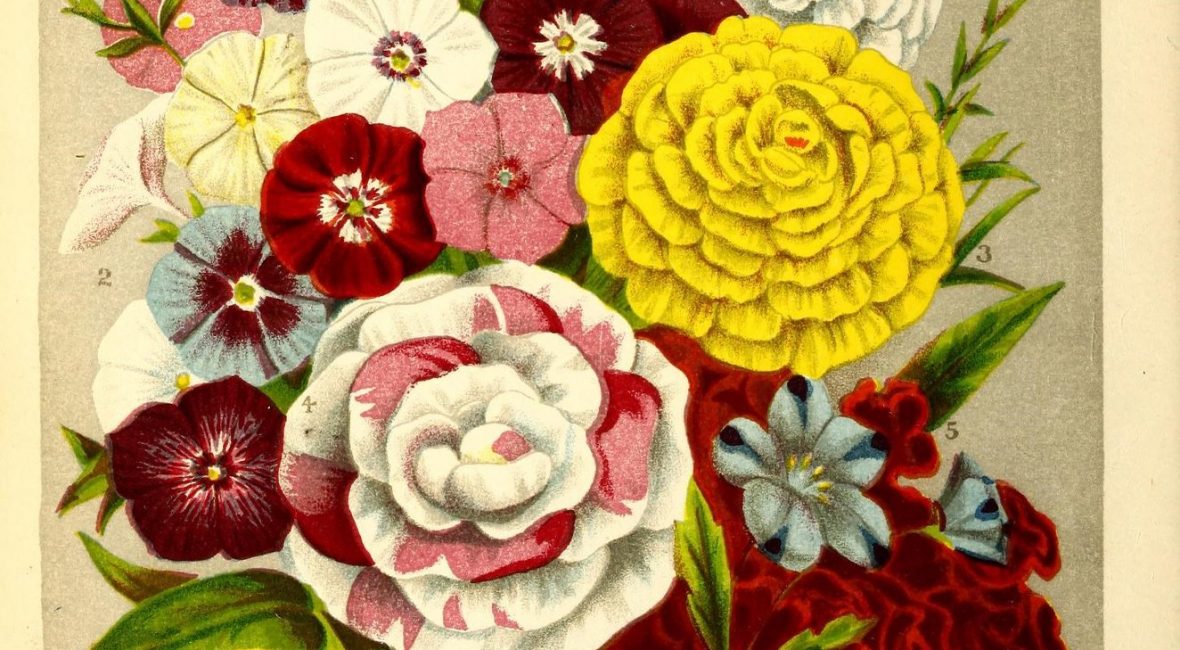
illustration of a colorful bouquet of flowers

This post originally published on the Smithsonian Libraries and Archives’ blog, Unbound.

A garden is a place to rest, relax, rejuvenate. It also provides an opportunity to learn about nature. Staff at Smithsonian Libraries and Archives are also learning and developing new skills. Some of these new skills are related to digitization and accessibility of biodiversity literature.

During these months of telework, I am assisting the Digital Library and Digitization Department to enhance page-level and image-level access to previously digitized books for the Biodiversity Heritage Library (BHL). This involves improving page-level metadata for items in BHL, uploading full-page illustrations to the BHL Flickr, and tagging the images in Flickr with species’ common and scientific names. These digitized books include a variety of content: plants, birds, mammals, reptiles, crustaceans, insects, and so much more. In the course of this work, I have the opportunity to view lovely illustrations. Recently a horticultural catalog caught my attention. The item is titled Vick’s Flower and Vegetable Garden (1878) by James Vick.
title page

James Vick, Rochester, NY. Vick’s Flower and Vegetable Garden (1878), title page. Available online in the Biodiversity Heritage Library.

James Vick was born in England and arrived in New York City at a young age. There, he learned the printer’s trade. He later moved to Rochester, New York. In Rochester, he set type for several newspapers and went on to serve as writer, editor, owner, or publisher of various publications. In 1862, he issued the first Floral Guide and Catalogue. Due to his past experience in the printer and journalist fields, he created a personal style offering gardening advice, anecdotes, correspondence, a complaint section, a children’s section, and color prints. James Vick also began a seed store which later became a well-known seed-display garden. After his death, the company continued into the 20th Century until it was sold to Burpee Seed Co.

Flowers including Perennials: Aquilegia, Perennial Pea, Digitalis (Fox Glove), Double Pink, Perennial Larkspur, Campanula (Canterbury Bell), Sweet William, Picotee, and Pentstemon

James Vick, Rochester, NY. Vick’s Flower and Vegetable Garden (1878), page preceding page 99, Perennials including (1) Aquilegia, (2) Perennial Pea, (3) Digitalis (Fox Glove), (4) Double Pink, (5) Perennial Larkspur, (6) Campanula (Canterbury Bell), (7) Sweet William, (8) Picotee, (9) Pentstemon. Available online in the Biodiversity Heritage Library.

This particular item, Vick’s Flower and Vegetable Garden (1878) by James Vick, is filled with gardening advice, botanical descriptions, and many illustrations. It seems to speak directly to the reader with a conversational tone and focus on learning. As it states on page 5,

“The study of Agriculture and Horticulture has engaged the attention of the wisest from the earliest ages, and yet what wonderful discoveries and improvements have we witnessed in our own day; and we are still learners.”

Flowers including Tender Bulbs: Tritoma uvaria, Gladioli, Tuberose, Dahlia, and Tigridia

James Vick, Rochester, NY. Vick’s Flower and Vegetable Garden (1878), page preceding page 109, Tender Bulbs including (1) Tritoma uvaria, (2) Gladioli, (3) Tuberose, (4) Dahlia, (5) Tigridia. Available online in the Biodiversity Heritage Library.

The catalog includes practical suggestions for selecting seeds, preparing soil, and planting gardens. On the subject of garden design, it suggests keeping the future in mind. When planting trees, it emphasizes the awareness of knowing the size, form, and habits of the full-grown tree as opposed to only thinking of its small size when planted. For those with little outdoor space, there are ideas for creating balcony gardens and window boxes.

Entrance Court and Balcony Garden

James Vick, Rochester, NY. Vick’s Flower and Vegetable Garden (1878), page 20, Entrance Court and Balcony Garden. Available online in the Biodiversity Heritage Library.

Another section focuses on floral decorations, such as incorporating greenery and flowers into decorations. This might include covering letters with greenery to form welcoming words for a guest, adorning a table with a floral centerpiece, decorating a room with garlands, or creating bouquets and button-hole flowers.

Let’s take a closer look at one of these floral decorations, forming and covering letters with greenery and flowers. Perhaps, someone wanted to welcome a guest by displaying a “Welcome” sign or, as in the example below, decorate the words, “Peace on Earth.” As the catalog explains, the first step was to determine the height of all letters. Then, the width of each letter was determined proportional to its height. For example, if six inches was chosen for the height of all upper-case letters, the proportional width for “P” would be four inches, “E” three and a half inches, “A” four and a half inches, and so on, as detailed in the explanation shown in the image below. Once the letters were outlined on heavy straw board, each letter was cut out and dark thread was used to fasten small branches of evergreens or dry moss to the letters. Finally as a finishing touch, berries or everlasting flowers were added to brighten the decoration, as detailed below.

Forming letters to make floral decorations

James Vick, Rochester, NY. Vick’s Flower and Vegetable Garden (1878), page 31, Forming Letters for Floral Decorations. Available online in the Biodiversity Heritage Library.

Another floral decoration is the button-hole flower or bouquet. The button-hole flower was simply that, a single flower with a “pretty, sweet-scented leaf” positioned behind it. Thread or string was used to attach the two together (below, bottom right), and then it was inserted into the bouquet holder which was already filled with water. To fasten the button-hole flower to clothing or hair, a pin was attached to the bouquet holder.

On the other hand, the button-hole bouquet was composed of “a few very fine flowers” (below, bottom left). Once the flowers were nicely arranged, the stems were covered with damp moss or cotton and then tinfoil. The button-hole bouquet was inserted into the bouquet holder or attached directly to clothing with a pin.

English Holly, Winter Berry (Ilex verticillata), Button-hole Bouquet, and Button-hole Flower

James Vick, Rochester, NY. Vick’s Flower and Vegetable Garden (1878), page 36, English Holly, Winter Berry (Ilex verticillata), Button-hole Bouquet, and Button-hole Flower. Available online in the Biodiversity Heritage Library.

Almost every page of Vick’s Flower and Vegetable Garden (1878) includes an illustration. With its conversational style and focus on learning, it encourages readers to try their hand at something new. This might be designing their own garden, planting a small garden in a window box, placing vases or ornamentation around the garden, or creating a floral decoration for a party. For reference purposes, it includes a handy “Botanical Glossary” and guide to “Pronouncing Vocabulary of Botanical Names.”

Towards the end, there are many pages illustrating and describing specific plants. A page focusing on “Classification and Names of Flowers” assists with understanding the divisions of plants as described in this catalog. These divisions include Annuals, Perennials, Greenhouse, Bulbs and Plants, and Holland Bulbs. There is also a section devoted to Vegetables. Detailed information for specific plants includes such things as descriptions, origin, and tips for planting. Every so often, the reader might stumble across a full-page illustration, like the Annuals shown below. Perhaps an illustration such as this might have inspired a bouquet or floral decoration to brighten a room for a holiday or special occasion.

Flowers including Annuals: Ten-Weeks Stock, Phlox drummondii, Double Portulaca, Balsam, Nemophila, Japan Cockscomb, Pansy, and Striped Petunia.

James Vick, Rochester, NY. Vick’s Flower and Vegetable Garden (1878), page preceding page 55, Annuals including (1) Ten-Weeks Stock, (2) Phlox drummondii, (3) Double Portulaca, (4) Balsam, (5) Nemophila, (6) Japan Cockscomb, (7) Pansy, (8) Striped Petunia. Available online in the Biodiversity Heritage Library.

Vick’s Flower and Vegetable Garden (1878) by James Vick is located in the Joseph F. Cullman 3rd Library of Natural History. A digitized version is available on the Biodiversity Heritage Library (BHL) and a Flickr album of its full-page illustrations is available on the BHL Flickr. For more information about James Vick, take a look at this BHL Blog post.

Other seed catalogs by James Vick’s Sons are located in a horticultural collection within the Trade Literature Collection at the National Museum of American History Library. For more information on one of these catalogs, take a look at this post about Vick’s Garden and Floral Guide (1898) by James Vick’s Sons.

Reference

“Vick, James.” Biographies of American Seedsmen & Nurserymen, compiled by Marca L. Woodhams, Librarian, Horticulture Branch Library, Smithsonian Institution Libraries, December 1999. Accessed January 8, 2021. https://www.sil.si.edu/SILPublications/seeds/bios.html#Vick,%20James

April 15, 2021by michelle.underhill
Blog Reel, Featured Books

Seeds in the Stacks: A Closer Look at Two Seedsmen from the Golden Age

The National Agricultural Library (NAL), Special Collections has one of the world’s largest collections of nursery and seed trade catalogs totaling over 200,000 from American as well as international companies. This collection, representing businesses located in all states plus over 50 countries, was named after its long-time curator, Henry G. Gilbert. The earliest catalog is from William R. Prince & Company dated 1771. NAL continues to collect modern-day catalogs.

The collection was begun by Percy Ricker, U.S. Department of Agriculture’s first economic botanist. Through the course of his work, he traveled to many plant nurseries throughout the country and collected duplicate copies of their catalogs. When he retired in the 1940s, he had amassed over 70,000 catalogs, and the collection grew from there.

NAL has been systematically digitizing its seed trade catalogs with over 41,000 catalogs available online through the Biodiversity Heritage Library (BHL) as well as Internet Archive. The bulk of the holdings begin in the late 1800s, which is considered the golden age of mail order catalogs.

James Vick and Peter Henderson are two men who epitomized that golden age.

James Vick and Sons

James Vick (1818-1882) started in the seed business in 1860. Born in England, he immigrated with his family to New York in 1833 and would go on to influence the nursery and seed trade catalog business with beautiful color illustrations and much more.

vicksfloralguide1889jame_00061.jpg

James Vick and Sons Charles, James, and Frank. Vick’s Floral Guide, 1889. Digitized by the U.S. Department of Agriculture, National Agricultural Library.

Prior to getting into the seed business, Vick was a printer for newspapers, experience which helped make his Floral Guides eye-catching. The first one was published in 1862. Vick used chromolithography in several of the guides, creating beautiful horticultural images. In fact, he was a pioneer in mass-producing color illustrations in mass-market catalogs as demonstrated by his 1864 catalog that contained a full-page chromolithograph of double zinnias. His images became so popular that he produced a set of large prints that were either sold separately or given with large orders.

vicksgardenflora1898jame_00411.jpg

Vick’s Garden and Floral Guide, 1898. Digitized by the U.S. Department of Agriculture, National Agricultural Library.

In addition to being a skilled printer, Vick was a successful writer, editor, publisher, and owner of several well-known horticultural publications, so he knew how to connect with people. He developed a personal, chatty style of communication. In addition to information on seeds and plants, his guides shared gossip, correspondence, gardening advice, and a special children’s section as well as space for a complaints forum (for example, the high price of postage).

vicksillustrated1873jame_0003.jpg

Vick’s Illustrated Floral Guide, 1873. Digitized by the U.S. Department of Agriculture, National Agricultural Library.

Throughout Vick’s life, he was constantly trying to improve his business. In the mid-19th century, the best seeds came from Europe. American seeds had an inferior reputation at the time. He wanted to grow high-quality seeds in America and went to Europe to study the methods of the Old World (in particular the effects of climate). In the 1873 Vick’s Illustrated Floral Guide, he shared the results of his studies with readers.

vicksflowerveget00vick_0184.jpg

Vick’s Flower and Vegetable Garden, 1878. Digitized by Smithsonian Libraries.

In addition to his guides, he published a book titled Vick’s Flower and Vegetable Garden and Vick’s Illustrated Monthly magazine. He followed a pattern with lovely etchings, essays, conversation, and beautiful color plates.

vicksfloralguide1881jame_0014.jpg

Vick’s Seed House, 1880. Vick’s Floral Guide, 1881. Digitized by the U.S. Department of Agriculture, National Agricultural Library.

James Vick and Sons was extremely successful, growing the business to include flower farms and a five-story seed house that included a printing office, bindery, box-making establishment, and artists’ and engravers’ rooms. It was a self-contained business and was one of the largest and most well-run seed houses of its time. It had 300 orders and 3,000 letters a day, and its publications reached an annual circulation of 250,000. While its products were excellent, much of its success was due to James Vick and his understanding of the power of connecting and engaging with the customer. His sons carried on that tradition until the early 20th century when the company was sold to Burpee Seed Company.

Peter Henderson

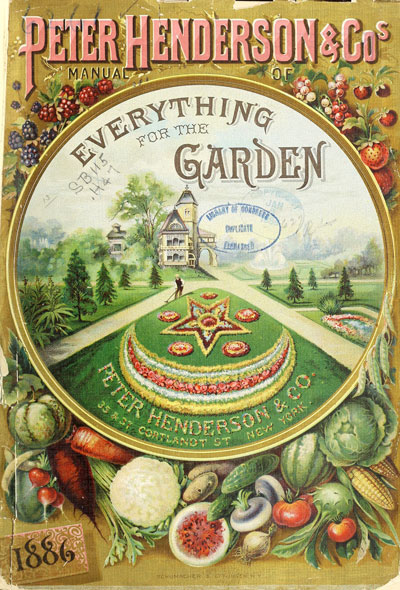
Another nurseryman whose catalogs enjoyed widespread distribution during the “Golden Age” of the mail order catalog business was Peter Henderson (1822-1890). One of the leading authorities on commercial floriculture of the time, he simplified and improved methods of handling plants for commercial purposes. He was head of Peter Henderson & Company, a seed and supply business. The company’s thick catalogs reflected Henderson’s sales concept of “Everything for the Garden” and offered seeds, bulbs, fertilizers, insecticides, and gardening and lawn tools. A prolific writer, Henderson gained popularity through his willingness to share horticultural techniques in his descriptive catalogs, books, articles, and letters.

Bailey_Cyclopedia_Horticulturists_Henderson.jpg

Peter Henderson, Bailey’s Standard Cyclopedia of Agriculture, 1881.

peterhendersonco1886frontpete_27_0003.jpg

Peter Henderson & Co.’s Manual of Everything for the Garden, 1886. Digitized by the U.S. Department of Agriculture, National Agricultural Library.

Born in Scotland in 1822, Henderson showed an early aptitude for handling plants. Perhaps his talent was inherited from his maternal grandfather who was a nurseryman and florist. Beginning at age 16, he apprenticed to head gardener George Sterling at Melville Castle. The following year, Henderson won a gold medal for the best herbarium of native and exotic plants submitted to the Royal Botanical Society of Edinburgh for a competition throughout Great Britain.

buistsprizemedal1894robe_0003.jpg

Scottish nurseryman Robert Buist’s property. Buist’s Garden Seeds, 1894. Digitized by the U.S. Department of Agriculture, National Agricultural Library.

In 1843, he immigrated to the United States and obtained employment as a gardener for several other Scottish nurserymen, including George Thorburn and Robert Buist. He remodeled Charles F. Spang’s greenhouses and grounds. In 1847, Peter and his brother James began a business growing vegetables in New Jersey and marketing them in nearby New York City.

Several years later, the brothers parted ways. Peter began growing and selling ornamental plants from his Jersey City property. In 1871, he founded Peter Henderson & Company and established a seed house and store in New York on Cortlandt Street. In 1880, from his property in nearby South Bergen, he erected state-of-the-art greenhouses with innovative heating and ventilation systems. The location of these greenhouses in the Jersey City area meant that his inventory could be transported conveniently across the country by means of rail and water ways.

peterhendersonco1886back.jpg

Peter Henderson & Co. located at 35-37 Cortlandt Street, New York City. Peter Henderson & Co.’s Manual of Everything for the Garden, 1886. Digitized by the U.S. Department of Agriculture, National Agricultural Library.

peterhendersonco18pete_26_0148_1885back.jpg

Peter Henderson & Co. greenhouses. Peter Henderson & Co.’s Manual of Everything for the Garden, 1885. Digitized by the U.S. Department of Agriculture, National Agricultural Library.

Henderson was willing to share his knowledge on gardening topics with the public, even though it meant letting his competitors know about his research. He contributed articles to magazines such as Hovey’s Magazine of Horticulture, The Horticulturist, Gardener’s Monthly, The Country Gentleman, and Moore’s Rural New-Yorker. His son Alfred wrote in Henderson’s biography that the American Agriculturist desired all his writings so they “…paid him a price per column that has been considered perhaps the largest rate ever paid an American writer.”

Henderson_Gardening-for-Profit.jpg

Gardening for Profit, revised in 1874. Copy in BHL digitized by the Library of Congress.

The U.S. Department of Agriculture asked him to write an article on market gardening for the Report of the Commissioner of Agriculture for the Year 1865. The public’s interest in the subject led to Henderson writing his first book, Gardening for Profit (1866), the first of its kind about commercial marketing of vegetables. He went on to author four more books, including Practical Floriculture (1868), Gardening for Pleasure (1875), Garden and Farm Topics (1884), and Henderson’s Hand Book of Plants (1881). He co-authored How the Farm Pays (1884) with William Crozier, one of the most successful farmers in the United States.

“““““““““““

“To supply a population of a million inhabitants daily, throughout the year, with fresh vegetables would, it might be supposed, require an immense tract of land. Such, however, is not the case.”

Peter Henderson, “Market Gardening in the Vicinity of New York.” Report of the Commissioner of Agriculture for the Year 1865. (Page 243)

“““““““““““`

everythingforgar1909_0190.jpg

Peter Henderson & Co.’s Manual of Everything for the Garden, 1909. Digitized by the U.S. Department of Agriculture, National Agricultural Library.

Henderson’s popular articles and books attracted customers for his plant and seed business. He wrote his own plant descriptions for his catalogs until 1890. He created clever and original advertisements. In fact, he was the first to use a heavy black border around his advertisements. Another reason for his popularity was his prompt and detailed response to correspondence. According to son Alfred in 1890, “…in the last thirty five years he wrote or dictated at least one hundred and seventy-five thousand letters.” He replied to correspondents the same day he received their letters, no matter how tired he was from the rigors of outdoor work and running a business.

peterhenderson1892bulbsplantss0082.jpg

An illustration of a gardener frequently appears in Henderson’s catalogs. Perhaps this figure represents Henderson. Bulbs, Plants, Seeds for Autumn Planting, Peter Henderson & Co., 1892. Digitized by the U.S. Department of Agriculture, National Agricultural Library.

Henderson even traveled long distances to give advice to entrepreneurs on such topics as land suitability, best plants to raise on the property, and greenhouse construction. It was the willingness of this leading florist, seed merchant, and horticultural writer to share knowledge that advanced horticulture from an art form to a science.

James Vick and Peter Henderson were shrewd businessmen who had great influence on the nursery and seed trade business through their catalogs, innovation, and personal styles. They became like friends to their readers and Vick’s seeds or Henderson’s opinions were often sought after. But, these were men who cared about horticulture both as art and science as well as business. They believed that gardening was an uplifting, healthy pursuit and wanted to promote the beauty of horticulture in addition to running successful businesses.

Bibliography

Bailey, Liberty Hyde. The Standard Cyclopedia of Horticulture. Volume III -F.-K. Page 1579. New York: The MacMillan Company, 1915.

Becker, Robert F. “Peter Henderson: Plant Pioneer.” American Horticulturist, 74, no. 12 (December 1995): 24-30.

Christopher, Thomas. “Heirloom Seed Catalogs.” Horticulture 63, no. 12 (December 1985): 24-27.

Henderson, Alfred. Peter Henderson, Gardener-Author-Merchant: A Memoir. New York: McIlroy and Emmet. 1890. Accessed on March 19, 2018. https://archive.org/details/peterhendersonga01hend.

Henderson, Peter. “Market Gardening in the Vicinity of New York.” Report of the Commissioner of Agriculture for the Year 1865. Washington, D.C.: Government Printing Office, 1866.

McIntosh, W.H. History of Monroe County, New York: With Illustrations, Descriptive of its Scenery, Palatial Residences, Public Buildings, Fine Blocks, and Important Manufactories 1788-1877. Philadelphia: Everts, Ensign and Events, 1877.

“Peter Henderson and Company – Peter Henderson and James Henderson.” Jersey City Past and Present. Accessed on March 12, 2018. http://www.njcu.edu/programs/jchistory/Pages/H_Pages/Henderson_Peter.htm.

Ricker, Percy L. and Magdalene R. Newman. The Nursery and Seed Trade Catalog Collection of the United States Department of Agriculture. Washington, 1945. Accessed on April 17, 2018. http://archive.org/details/CAT31064290.

Van Ravenswaay, Charles. A Nineteenth-Century Garden. New York: Universe Books, 1977.

“Vick, James (1818-1882).” n.d. Accessed March 13, 2018. http://www.sil.si.edu/SILPublications/seeds/vickjames.html.

May 24, 2018by Joel Richard

Help Support BHL

BHL's existence depends on the financial support of its patrons. Help us keep this free resource alive!

search

About BHL

The Biodiversity Heritage Library (BHL) is the world’s largest open access digital library for biodiversity literature and archives. BHL operates as a worldwide consortium of natural history, botanical, research, and national libraries working together to digitize the natural history literature held in their collections and make it freely available for open access as part of a global “biodiversity community.”

Join Our Mailing List

Sign up to receive the latest news, content highlights, and promotions.

Subscribe Now

Subscribe to Blog via Email

Enter your email address to subscribe to this blog and receive notifications of new posts by email.

Join 319 other subscribers

Subscribe to Blog Via RSS

Subscribe to the blog RSS feed to stay up-to-date on all the latest BHL posts.

Access RSS Feed

Inspiring Discovery through Free Access to Biodiversity Knowledge.

The Biodiversity Heritage Library makes it easier than ever for you to access the information you need to study and explore life on Earth…for free, anytime, anywhere.


64+ Million Pages of
Biodiversity Literature Online.

EXPLORE

Tools and Services
to Transform Research.

EXPLORE

300,000+
Illustrations on Flickr.

EXPLORE

ABOUT | HARMFUL CONTENT | PRIVACY | SITE MAP | TERMS OF USE