Biodiversity Heritage Library - Program news and collection highlights from BHL
  • Home
  • News
  • Featured Books
    • All Featured Books
    • Book of the Month Series
    • BHL at 20
  • User Stories
  • Campaigns
    • Fossil Stories
    • Garden Stories
    • Monsters Are Real
    • Page Frights
    • Her Natural History
    • Earth Optimism 2020
  • Tech Blog
  • Visit BHL
Home
News
Featured Books
    All Featured Books
    Book of the Month Series
    BHL at 20
User Stories
Campaigns
    Fossil Stories
    Garden Stories
    Monsters Are Real
    Page Frights
    Her Natural History
    Earth Optimism 2020
Tech Blog
Visit BHL
  • Home
  • News
  • Featured Books
    • All Featured Books
    • Book of the Month Series
    • BHL at 20
  • User Stories
  • Campaigns
    • Fossil Stories
    • Garden Stories
    • Monsters Are Real
    • Page Frights
    • Her Natural History
    • Earth Optimism 2020
  • Tech Blog
  • Visit BHL
Biodiversity Heritage Library - Program news and collection highlights from BHL
Blog Reel, Featured Books

In Search of the White Whale: A Legend, a Fossil, a Living Mammal

Portrait version of the Biodiversity Heritage Library logo.
View Full Size Image
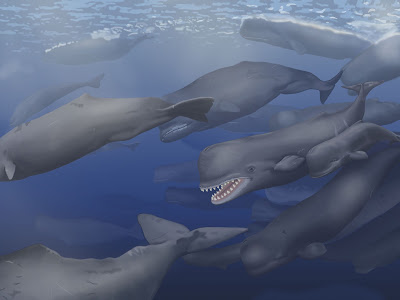
In this reconstruction, a pod of Albicetus travel together through the Miocene Pacific Ocean, surfacing occasionally to breathe. Modern sperm whales are also known for forming these tight-knit groups, composed mainly of females and their calves. Art by A. Boersma for the Smithsonian.

1820. Far west of the Galapagos Islands in the Pacific Ocean. A whaleship pursues a pod of sperm whales. Suddenly, an eighty-five foot long giant charges the ship, ramming it with its head not once, but twice, caving in the bows and sending the ship to a watery grave.

This is the story of the sinking of the Essex, the subject of Ron Howard’s movie adaptation of Nathaniel Philbrick’s novel In the Heart of the Sea, opening this Friday. The sperm whale that sank the Essex also served as one source of inspiration for another literary icon – the infamous white whale Moby Dick.

In addition to the big screen, another “white whale” hits the spotlight on a different stage this week – the scientific stage. Scientists from the Smithsonian Institution have just published new research on an extinct sperm whale that roamed the seas millions of years ago, which they’ve named Albicetus (“white whale”).

Today’s modern sperm whale was first scientifically described by Carl Linnaeus in the tenth edition of his 1758 Systema Naturae, a pivotal work that laid the foundation for our modern system of zoological nomenclature. Within this work, Linnaeus initially described the sperm whale as four separate species: Physeter catodon, Physeter macrocephalus, Physeter microps, and Physeter tursio. Today, we recognize that Linnaeus was actually describing only one species, which is now known by the binomial Physeter macrocephalus.

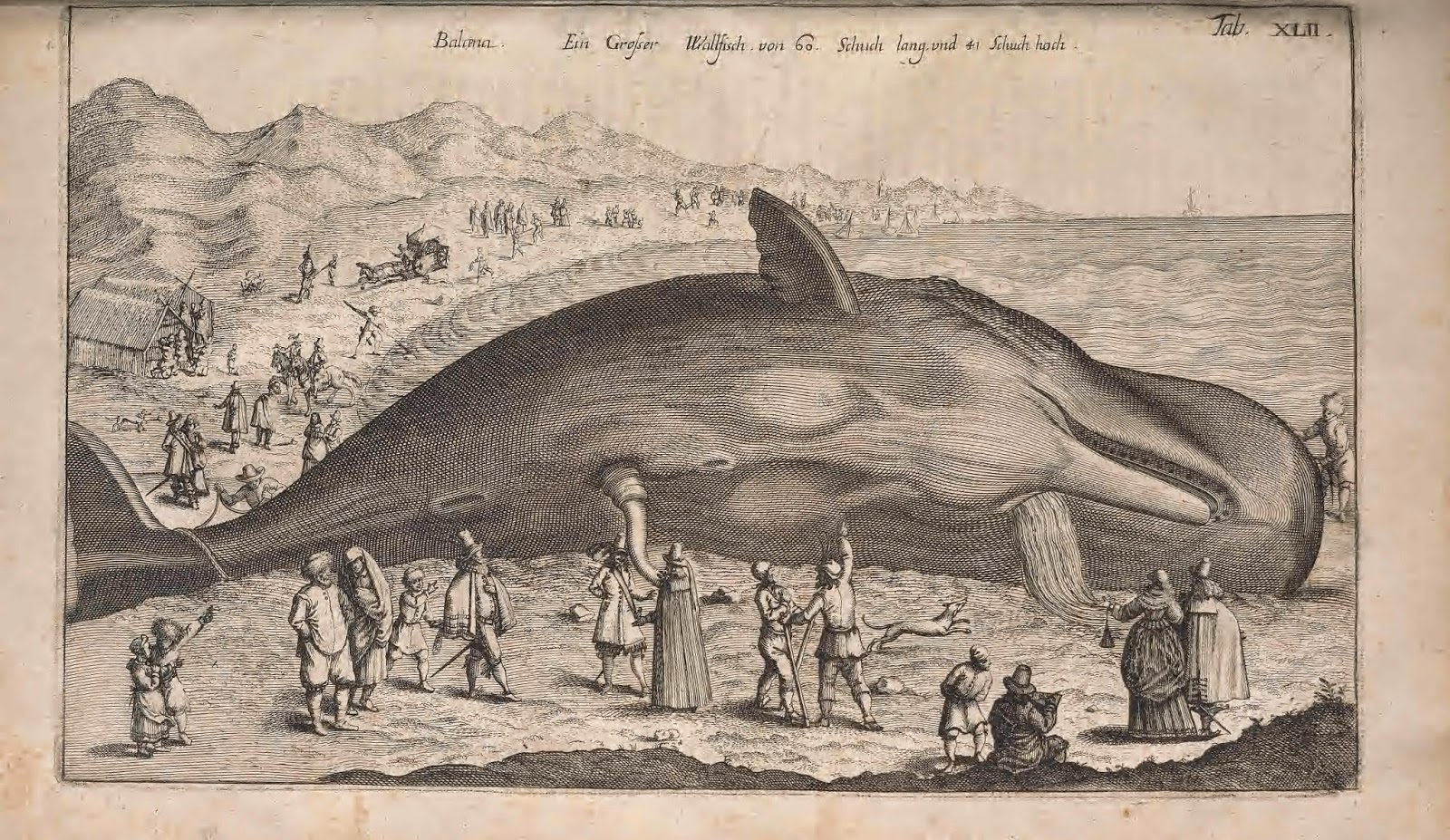
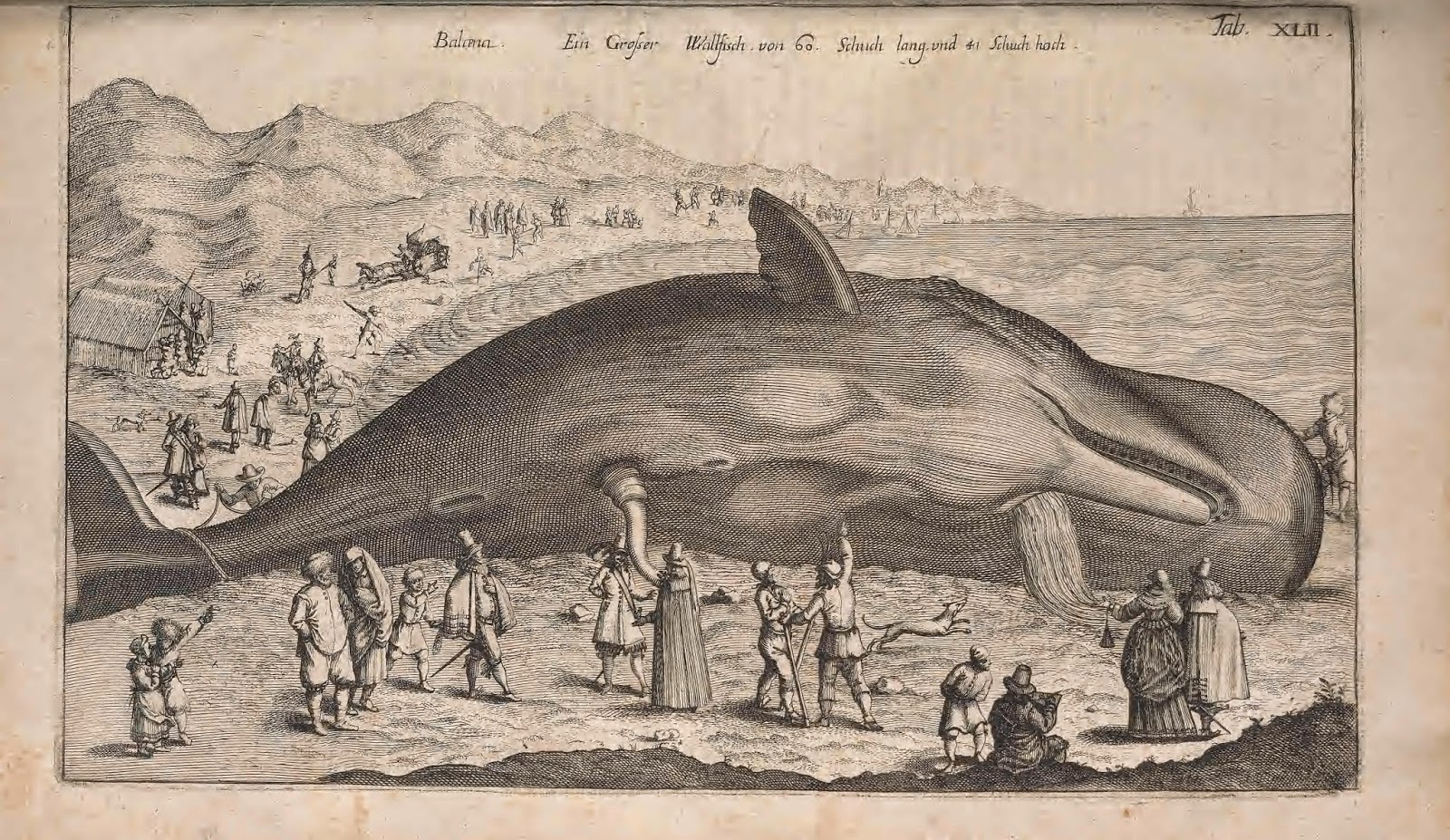
In the years following Linnaeus’ naming of the species, mystery and confusion surrounded the sperm whale, and over a dozen species names and multiple genera were published for the whale by the mid-1800s. Most of what information could be gleaned about the animal came from specimens that washed ashore, such as that depicted in Johann Jonstonus’ 17th century work Historiae naturalis de quadrupetibus libri, and from whaling expeditions.
View Full Size Image
Sperm Whale stranding. Jonstonus, Joannes. Historiae naturalis de quadrupetibus libri. pt. 2-6. 1650. http://biodiversitylibrary.org/page/44040300.

In the 18th, 19th, and early 20th centuries, whaling was an important industry, and the sperm whale, with its spermaceti organ full of valuable sperm oil, was a primary target for whalers.  Despite the threats posed by the industry to whale populations, whalers were perhaps in the best position to learn more about the species they hunted. These expeditions also offered naturalists excellent opportunities to study these cetaceans.

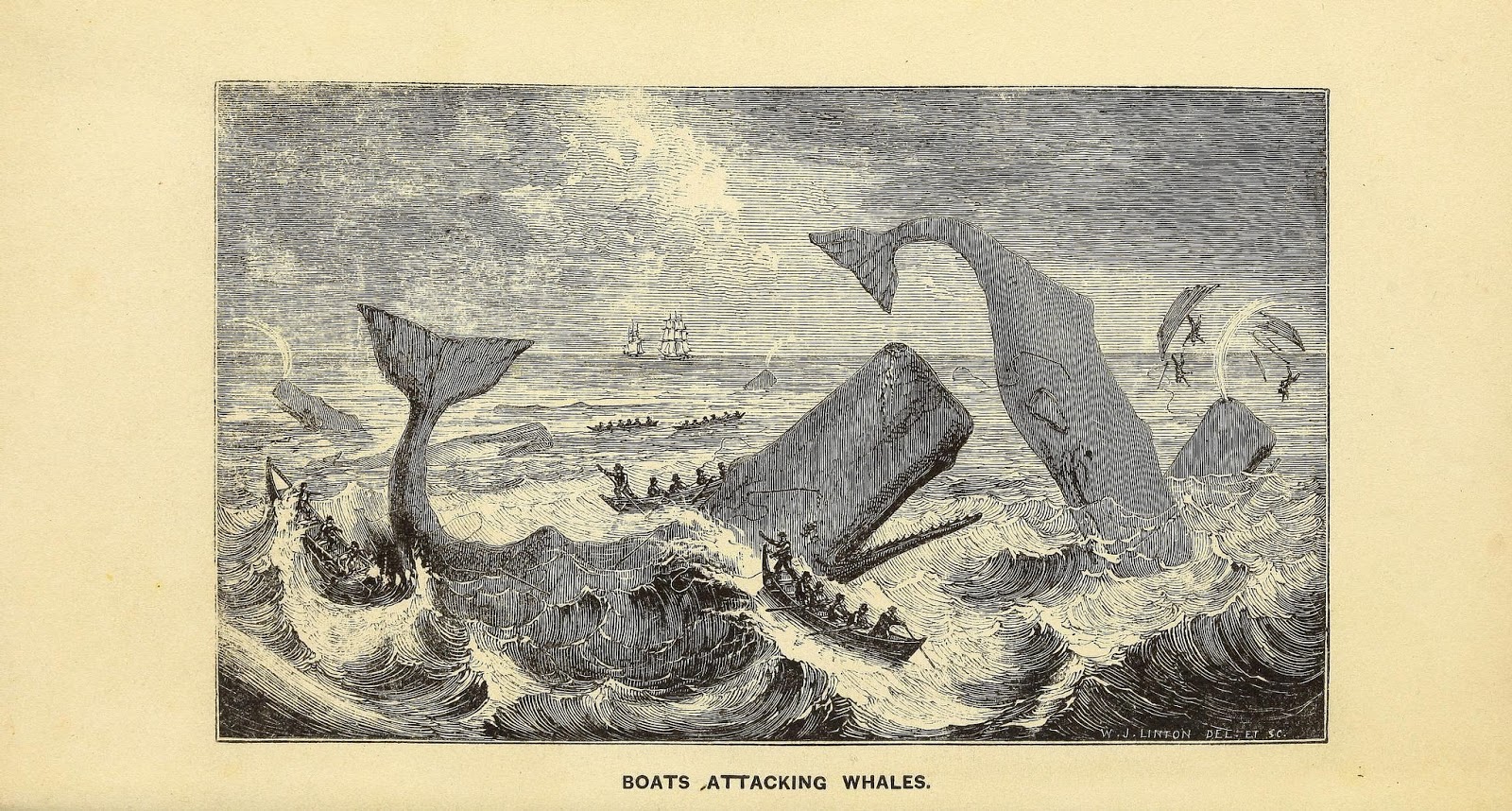
One such individual was Thomas Beale (1807-1849), a British surgeon who, in 1830, joined the London whaling ship Kent as the physician on an expedition to the South Seas. Through his keen observations during the expedition, Beale gathered much information about the sperm whale, and, upon his return to England, published a fifty-eight page booklet for subscribers in 1835 entitled A Few Observations on the Natural History of the Sperm Whale, with an account of the Rise and Progress of the Fishery, and of the Modes of Pursuing, Killing, and “Cutting In” that Animal, with a List of its Favourite Places of Resort. The booklet was so well received that Beale revised, expanded, and republished it in 1839 as The Natural History of the Sperm Whale. This work served as the primary source of what was known about sperm whales at the time, and the Penny Cyclopedia hailed “Mr. Beale…in his excellent work on the ‘Natural History of the Sperm Whale,’ has done more to elucidate its habits and form than any other writer.”
View Full Size Image
Beale, Thomas. The Natural History of the Sperm Whale. 1839. http://biodiversitylibrary.org/page/48976761.

Beale’s work was an important reference for Herman Melville, who acknowledged the book as a primary source of information for the cetological section of Moby-Dick; or, The Whale. Whaling provided additional inspiration for this work; the climax of Melville’s novel is based on the same events recounted within In the Heart of the Sea – the sinking of the Nantucket whaleship Essex. The crew that escaped the sinking of this ship spent three months at sea, covered 4,500 miles, and resorted to tragic lengths to stay alive. Of the 20 men who left the Essex, only 5 survived. Owen Chase, chief mate of the Essex, kept a journal of the events, which was later published as Narrative of the Most Extraordinary Shipwreck of the Whale-ship Essex, of Nantucket; which was Attacked and Finally Destroyed by a Large Spermaceti-whale, in the Pacific Ocean. Melville read Chase’s account of the event, and acknowledged its impact on his writing. The events were circulated within many natural history books, such as in this account within Johnson’s Household Book of Nature (1880).

While today there are only three extant species in the sperm whale family (the sperm whale and its relatives, the pygmy and dwarf sperm whales), their evolutionary history has seen many additional members. One of these, Albicetus oxymycterus, lived around 15 million years ago in the North Pacific Ocean, and now, thanks to research conducted by Dr. Nick Pyenson, curator of fossil marine mammals at the Smithsonian’s National Museum of Natural History, and Smithsonian research student Alex Boersma, we have a better understanding of this animal’s place in its family’s evolutionary history.
View Full Size Image
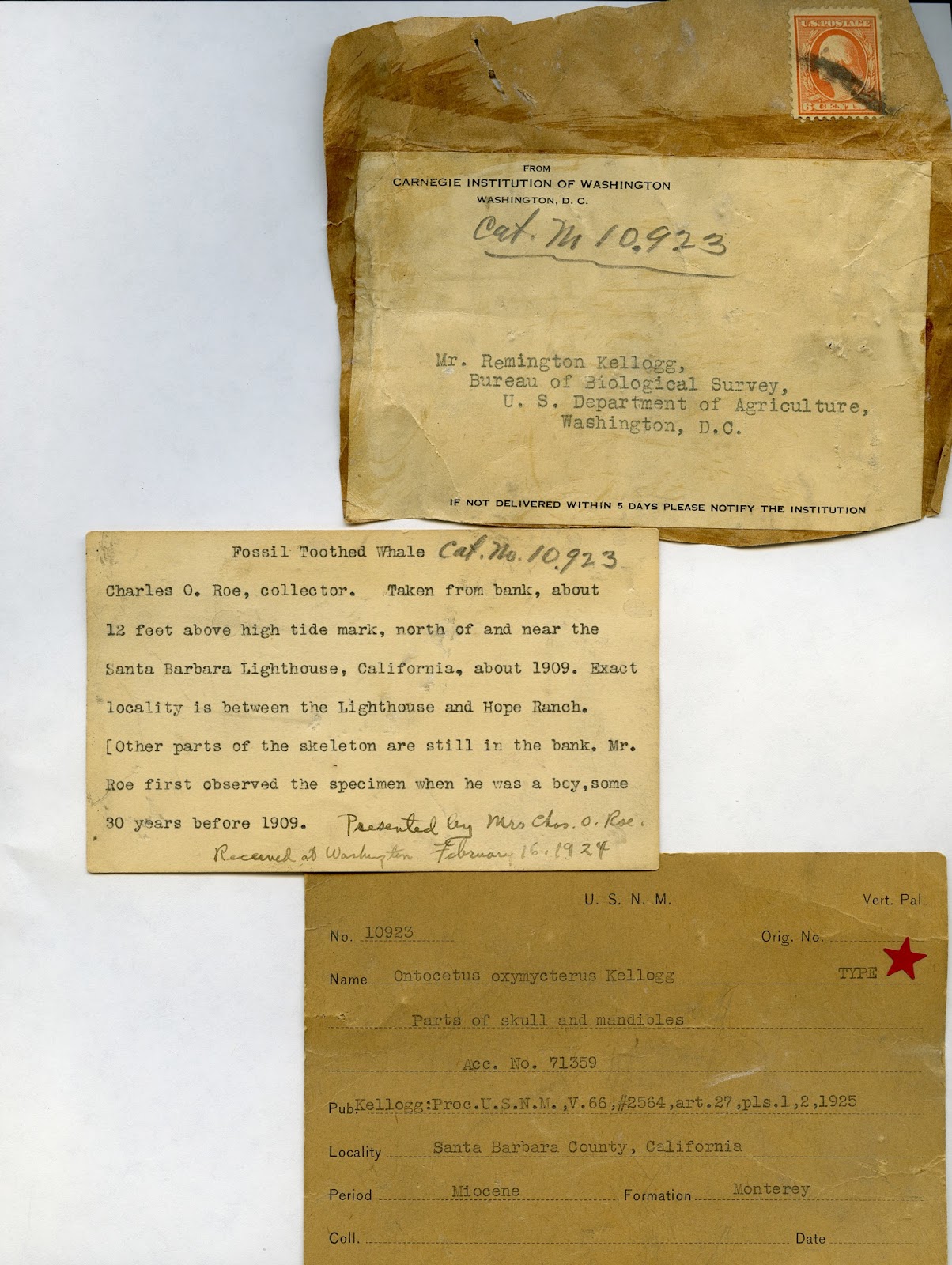
Archival specimen notes for type specimen for Albicetus oxymycterus.

Mr. Charles A. Roe collected the type specimen for Albicetus oxymycterus from the sea cliffs near the original Santa Barbara Lighthouse (known as the Santa Barbara Light) sometime around 1909. Archival typewritten notes at USNM indicate that Mr. Roe had “first observed the specimen when he was a boy, some 30 years before.” After Mr. Roe’s death, his wife presented the National Museum of Natural History (then the United States National Museum) with the specimen in 1924.
View Full Size Image
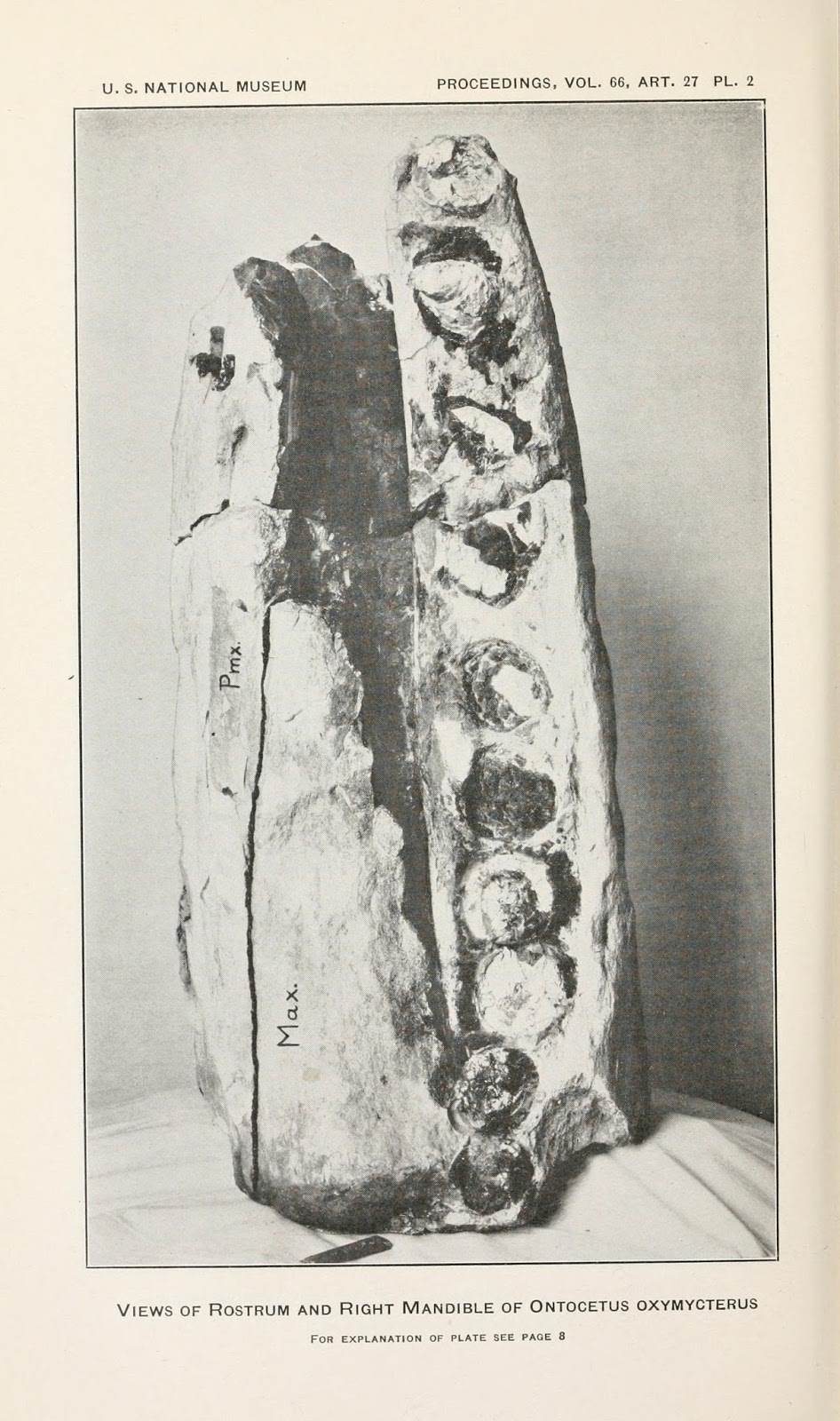
Albicetus oxymycterus specimen. Kellogg, Remington. Proceedings of the United States National Museum. v. 66 (1926). http://biodiversitylibrary.org/page/7739240.

At the time, well-known naturalist and paleontologist Remington Kellogg had an avid interest in this material (Kellogg would later become curator of vertebrate paleontology at USNM and make extensive contributions to the study of fossil marine mammals). Kellogg took it upon himself to describe the Santa Barbara specimen, and published his findings in 1925. He assigned the specimen to the genus Ontocetus, which was first named by Joseph Leidy on the basis on a large tooth found in the 19th century, which he thought belonged to a large marine mammal, and likely a sperm whale. Kellogg also thought this tooth, Ontocetus emmonsi, resembled the large dentition of his sperm whale specimen, which led him to place the Santa Barbara fossil as a new species in the genus Ontocetus. However, recent authors, weighing in favor of dissenting opinions about Ontocetus since the 19th century, have argued that the original tooth of Ontocetus emmonsi belongs not to a sperm whale, but to an ancient walrus.

In light of our improved understanding of the Ontocetus genus, Pyenson and Boersma re-evaluated the specimen and erected a new genus for it, Albicetus, or “white whale,” in homage to Melville’s Moby Dick.

“Since our specimen is most definitely an ancient sperm whale, we needed to give it a new and more appropriate genus name,” explained Pyenson. “While we don’t know what its skin color in life actually looked like, the color of the fossil is an ashen white. It only seemed appropriate to evoke Melville’s white sperm whale Moby Dick.”
View Full Size Image
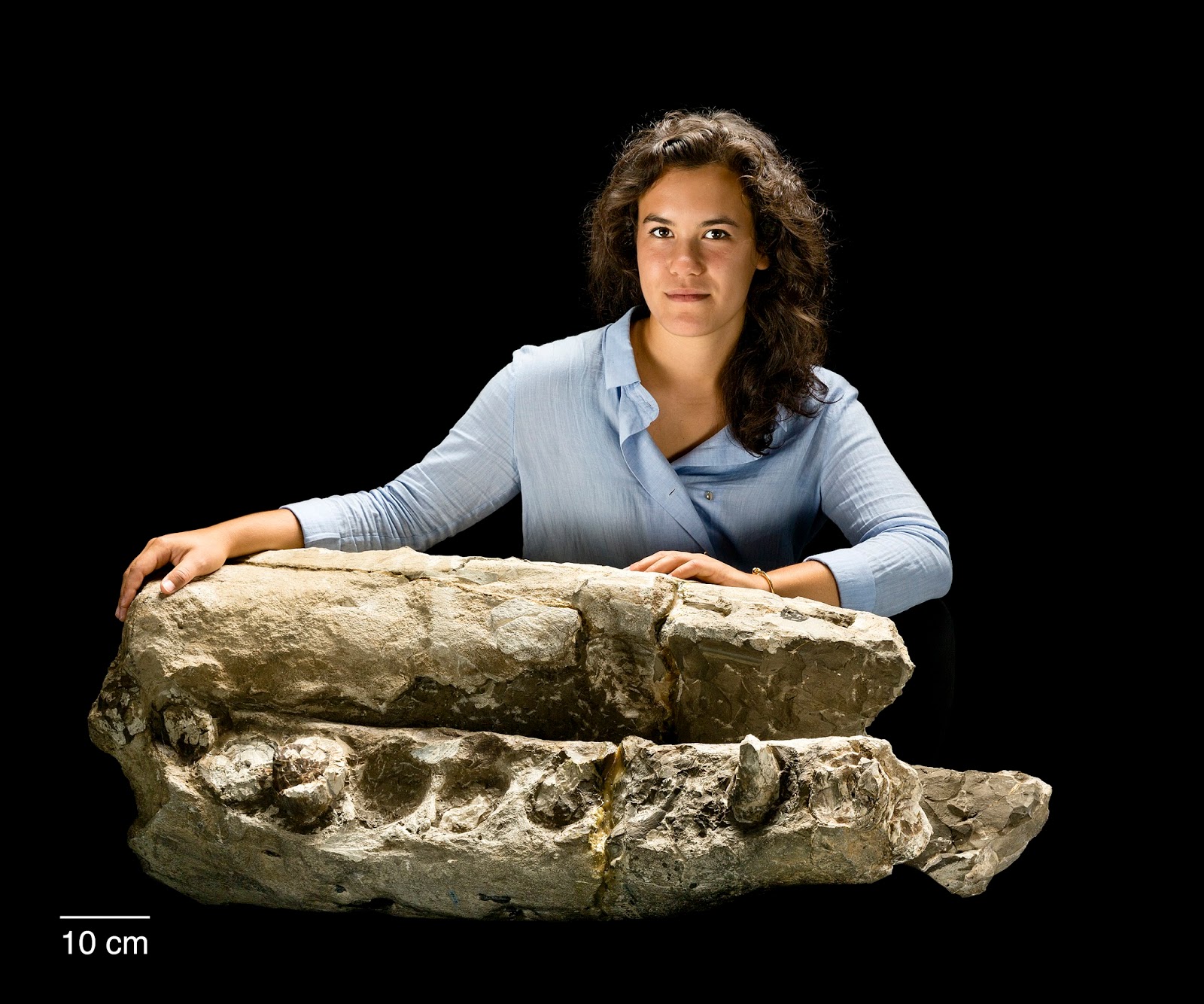
Alex Boersma with the NMNH Albicetus oxymycterus specimen. Photo Credit: James Di Loreto, NMNH Imaging.

Boersma and Pyenson published the name and their accompanying research about the fossil, which includes an estimation of the size of the whale and its place in the sperm whale evolutionary tree, today in the PLOS ONE article “Albicetus oxymycterus, a new generic name and redescription of a basal physeteroid (Mammalia, Cetacea) from the Miocene of California, and the evolution of body size in sperm whales.” The paper helps to resolve questions about how sperm whales have evolved into the singular creatures they are today, with insights on the increase in body size and changes in feeding strategies.

To accompany the redescription, Boersma and Pyenson created a 3-dimensional model of the specimen, available on the Smithsonian X 3D website (http://3d.si.edu). “In addition to making the specimen available for public viewing, the model was also necessary just for us to describe the specimen fully,” confesses Pyenson. “It weighs well over 300 pounds, taking four people just to slowly roll it over. Having the model was crucial for easy examination of the specimen from all angles for description and comparison.”

3D model of Albicetus oxymycterus from Smithsonian X 3D.

Thanks to Herman Melville, the White Whale is arguably one of the most recognizable figures in literary history. It is a figure with many identities. It is a harbinger of death; the personification of evil. It is a symbol of unattainable glory. But today, it is also something more. Today, the white whale is also Albicetus, a majestic, ancient, and complex creature that swam in the heart of the sea millions of years ago.

  • You can browse historic illustrations of the sperm whale in the BHL Flickr.
  • Browse publications about the sperm whale in our White Whale collection on BHL.

With Contributions By:

Nick Pyenson
Curator of Fossil Marine Mammals
Smithsonian National Museum of Natural History

Alex Boersma
Smithsonian Research Student
Smithsonian National Museum of Natural History
December 9, 2015by michelle.underhill
Blog Reel, Campaigns, Featured Books, Monsters Are Real

A Whale of a Tale…The Leviathan

The Devil Whale

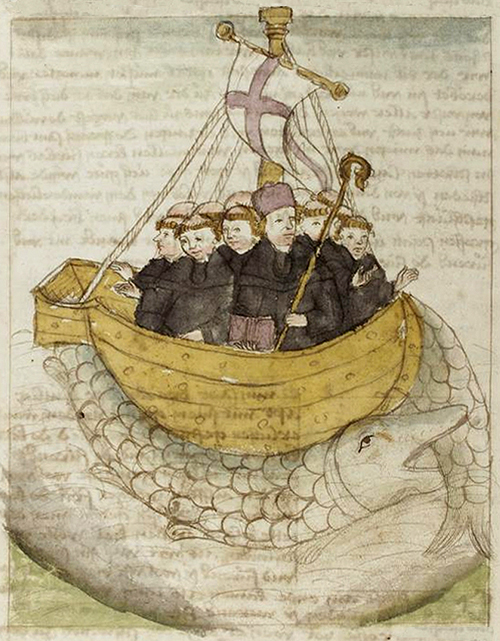
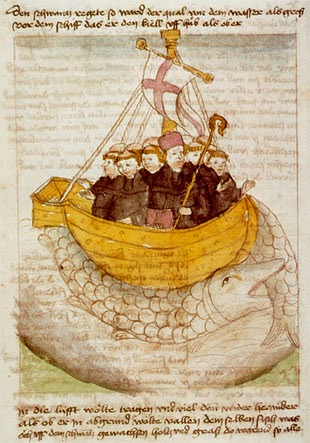
In the 6th century AD, St. Brendan, an Irish cleric, and eighteen other monks, sailed out from Ireland to cross the ocean. Amidst their journey, they came upon a black, treeless island and decided to make camp for the night. Several monks set up a cooking station and lit a fire. And then the island began to move. Terrified, the monks fled back to their boat, leaving the food and fire behind. St. Brandon urged them not to be afraid; it was simply the great fish Jasconius, “which laboreth night and day to put his tail in his mouth, but for greatness he may not” (Navigatio sancti Brendan abbatis, 9th century, translated from Latin).

View Full Size Image
St. Brendan atop Jasconius. Manuscriptum translationis germanicae (ca. 1460, Cod. Pal. Germ. 60, fol. 179v, Universitätsbibliothek Heidelberg). http://www.hs-augsburg.de/~harsch/Chronologia/Lspost10/Brendanus/bre_navi.jpg.

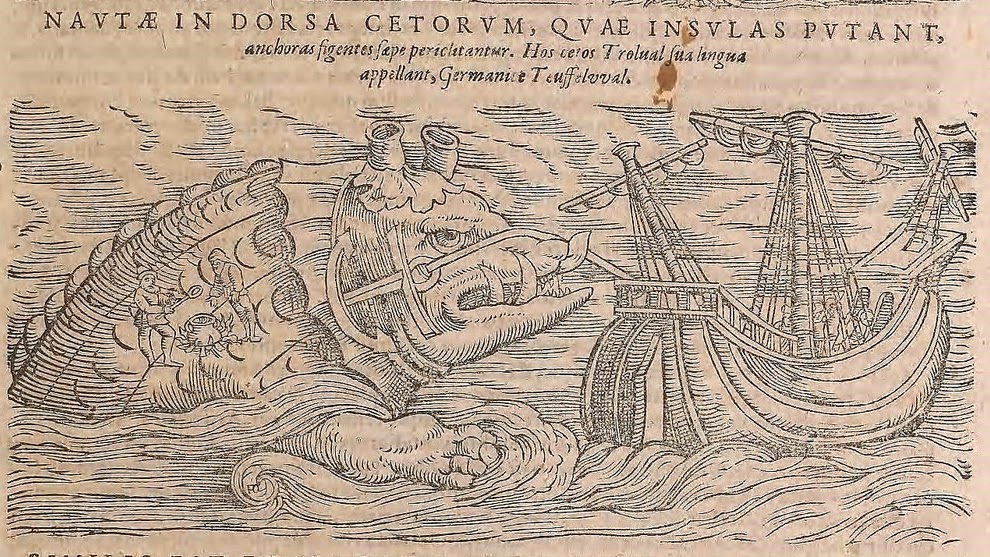
Gessner describes Jasconius by another name: the Trol whale or Devil Whale, which lies asleep in the water and is often mistaken for an island by hapless sailors. Gessner was likely inspired by Magnus, who claims that the whale’s skin is like sand, lending to its confusion with a beach. When the whale is disturbed by the sailors’ dinner fires, it sinks, causing such a whirpool that the ships themselves are often sunk.

View Full Size Image
The Devil Whale, complete with sailors trying to cook a meal on its back. Gessner, Conrad. Historia Animalium. 2nd Ed. 1604. http://biodiversitylibrary.org/page/42165750.

For centuries, men have imagined all manner of aquatic monsters. The ocean was a strange and foreign place, and even several hundred years ago, was very little explored. “If the very body of the ocean presented a fearsome aspect, with its dark, roiling waters, its threatening visage, and its intimidating vistas, its occupants were the quintessence of terror,” wrote marine biologist Richard Ellis in his book Monsters of the Sea. “The landlubbers’ only contact with the large creatures of the sea was at best sporadic and often completely incomprehensible” (Ellis, pgs. 193-194).

This sporadic contact spawned tales of horrible beasts. Quite often, these horrible beasts were, in truth, cetaceans.

The Sperm Whale: Chief Among the Leviathans

Even before sailors encountered whales in the ocean, washed up carcasses, sometimes badly mutilated, ignited a fear of the creatures of the deep. According to Ellis, “the sperm whale, with its mysterious habit of stranding on shallow beaches, was probably responsible for many of the legends and myths of sea monsters.” (pg. 194).

The record of sperm whale strandings is quite dramatic. Quite often, they are stranded en masse. For instance, in 1723, seventeen whales were stranded ashore the Elbe River in Germany. In 1784, thirty-one made landfall in Brittany. In 1888, sixteen washed up in Cape Canaveral, and in 1974, 72 were found on the coasts of New Zealand.

A variety of circumstances can result in a stranding, including rough weather, illness or age, difficulty giving birth, hunting mishaps, or even attempts to rescue another whale in distress.

View Full Size Image
Sperm Whale stranding. Jonstonus, Joannes. Historiae naturalis de quadrupetibus libri. pt. 2-6. 1650. http://biodiversitylibrary.org/page/44040300.

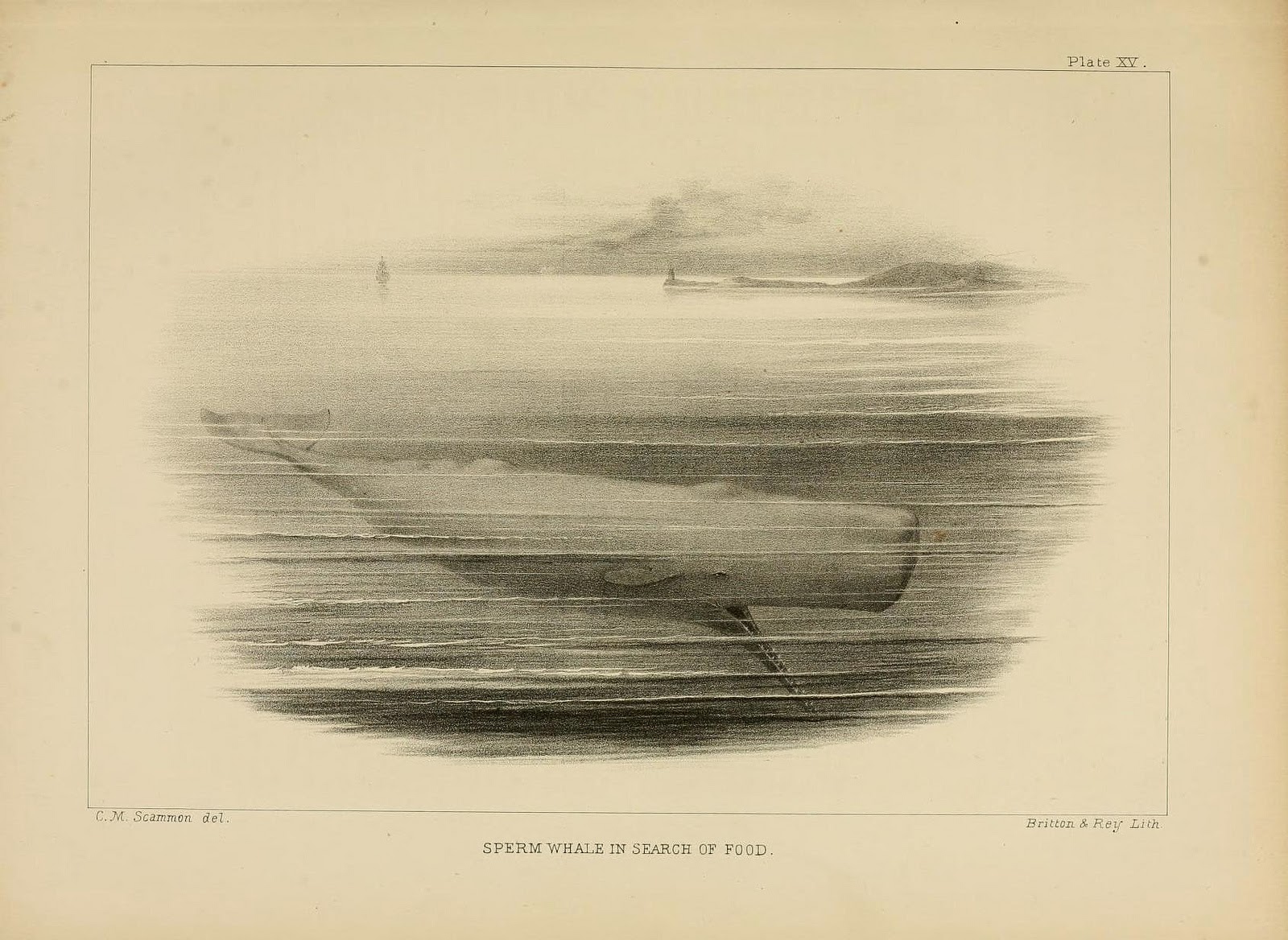
The sperm whale (Physeter macrocephalus) is a strange animal, even among whales. The largest toothed whale, and toothed predator, in the world, the sperm whale holds many records. It has the longest intestinal tract and largest brain in the animal kingdom. It also has the largest nose of any animal and cavities within its head hold reservoirs of liquid wax called Spermaceti. This behemoth can reach up to 67 feet long and weigh as much as 125,000 pounds!

View Full Size Image
A Sperm Whale in search of food. Scammon, C.M. The marine mammals of the north-western coast of North America. 1874. http://biodiversitylibrary.org/page/16226208.

A Whole Order of Leviathan Inspiration

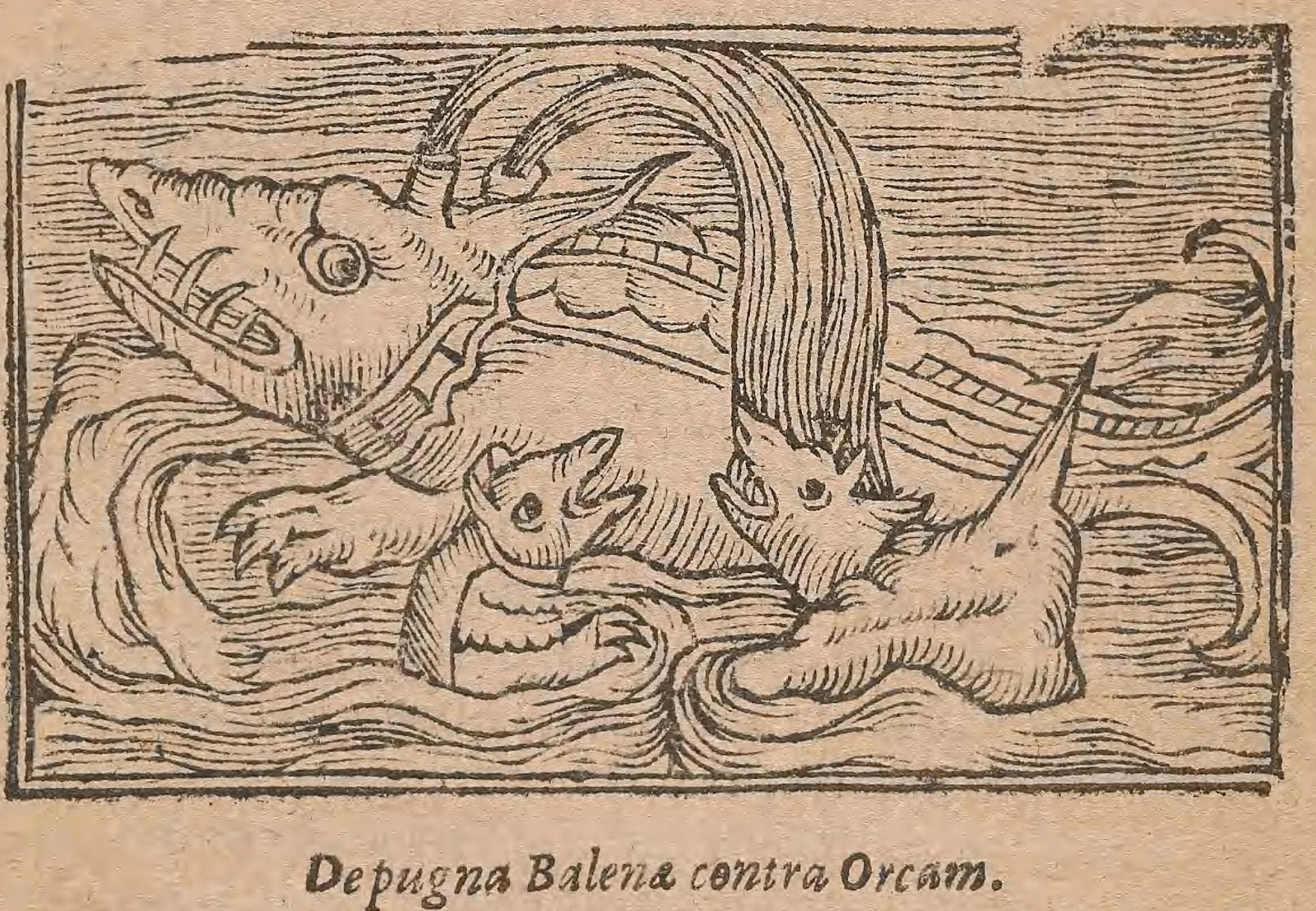
While their strange appearance and prolific beachings likely inspired many monster stories, sperm whales are not the only cetaceans that natural history writers had contact with. For instance, a blue whale – the largest animal to have ever lived – is documented as having come ashore as early as 1692, in Scotland. A 95-foot specimen was placed on exhibit in Europe in 1827, “further enhancing the image of the whale as a gigantic monster” (Ellis, pg. 197). Interactions with right whales, bowheads, baleens, and orcas also inspired Leviathan legends.

Whales From Hell

The range of monsters inspired by cetaceans is charmingly diverse, including many varieties in addition to the Devil Whale. Most are likely the result of an amalgamation of many species, and some (like the Devil Whale) may also have been shaped by religious undercurrents.

Pristers

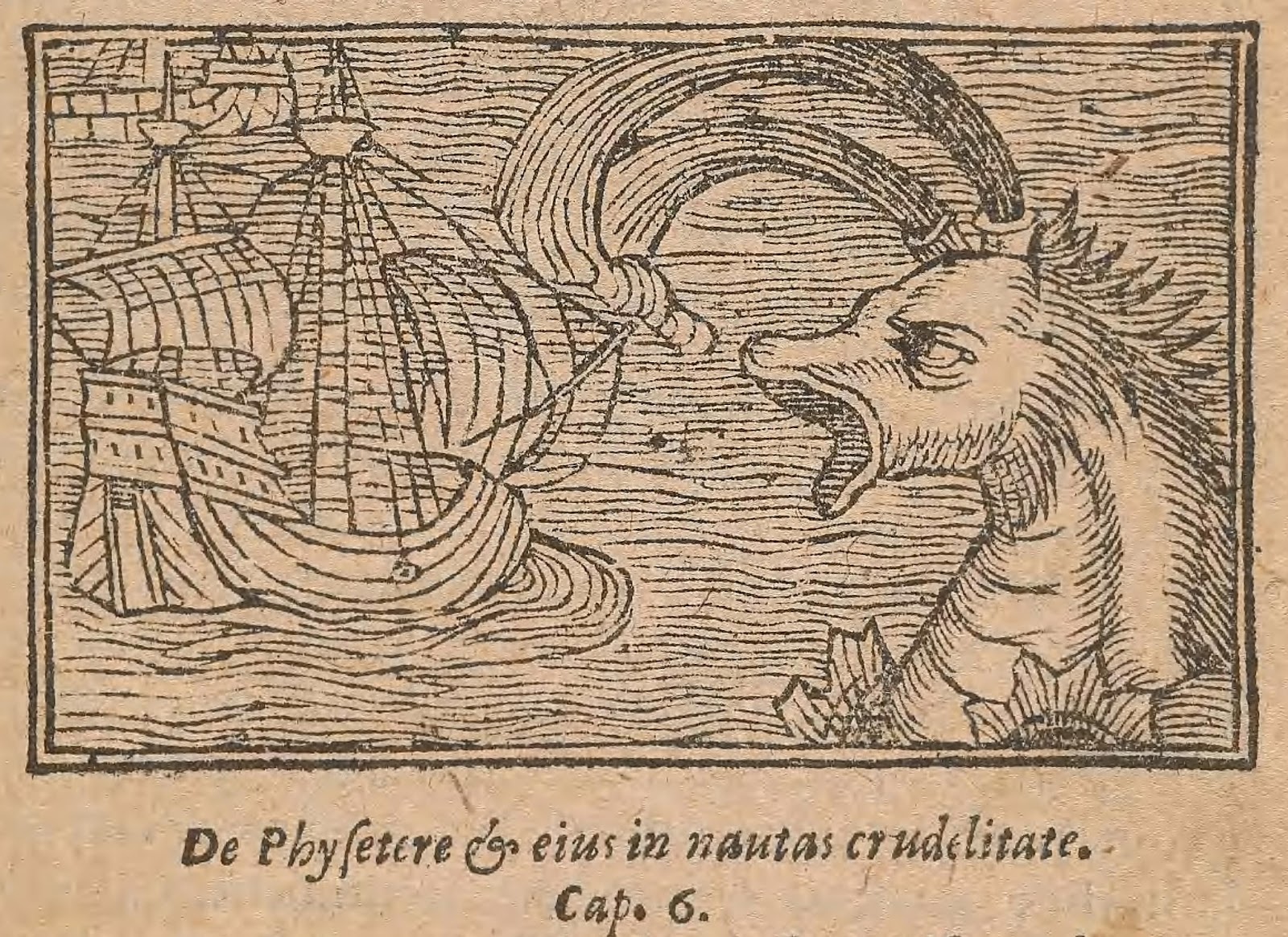
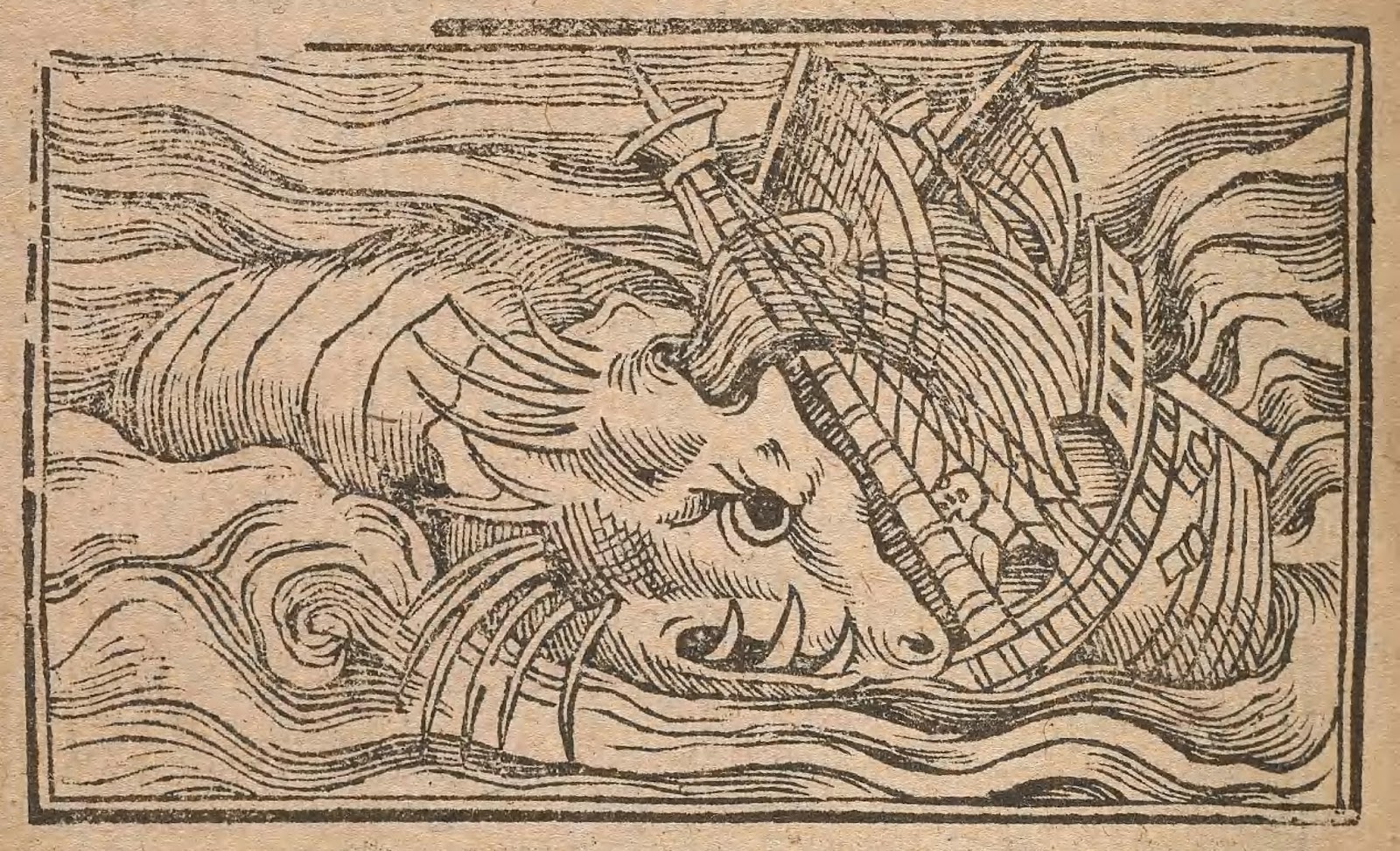
Pristers are found in multiple forms throughout Carta Marina and in many subsequent publications. Magnus actually identified these beasts as whales, describing them as “two hundred cubits long, and very cruel.”

View Full Size Image
Physeter, or Prister. Magnus, Olaus. Historiae de gentibus septentrionalibus. 1555. http://biodiversitylibrary.org/page/41862918.

The common feature among them is the presence of two blowholes, most often acting as water cannons drowning unlucky vessels. Magnus warns, “to the danger of Sea men, he will sometimes raise himself beyond the sail yards, and cast such floods of waters above his head, which he had sucked in, that with a cloud of them, he will often sink the strongest ships…Sometimes, not content to do hurt by water only…he will cruelly over throw the ship like any small vessel, striking it with his back, or tail.” If that isn’t bad enough, Magnus also claims that it has a mouth like a Lamprey, “whereby he sucks in his meat or water.”

View Full Size Image
Prister attacking a ship. Magnus, Olaus. Historiae de gentibus septentrionalibus. 1555. http://biodiversitylibrary.org/page/41862919.

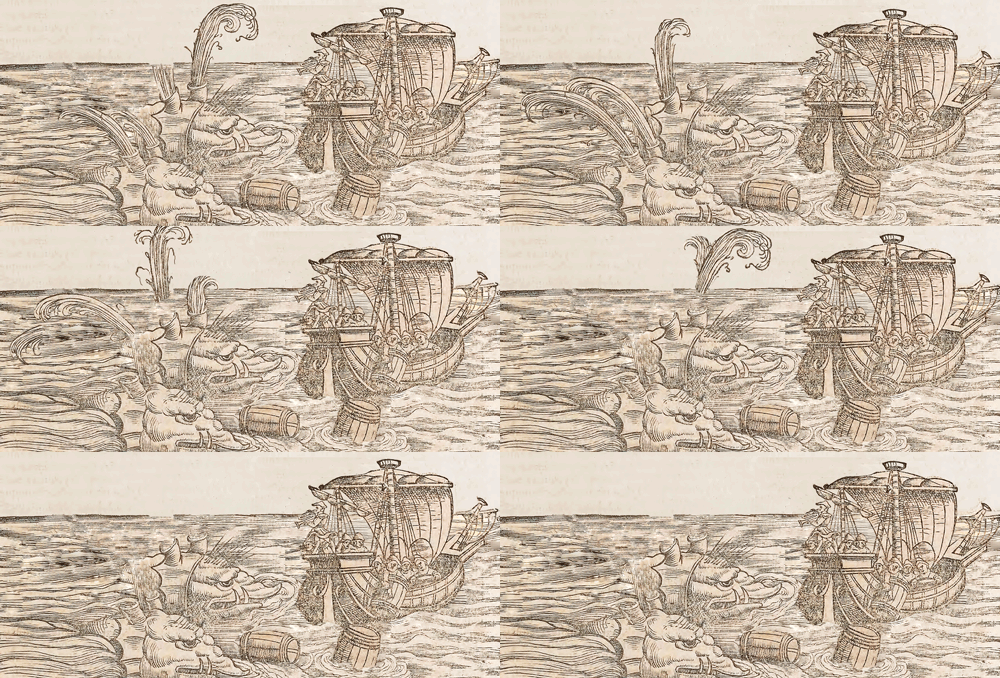
How can such a beast be defeated? Not by cannon-fire. Magnus warns that the beast’s layer of fat is too thick for such absurdities. Instead, try sounding a trumpet, which will startle the monster, or dump some empty barrels in the ocean, with which the creature will become distracted and stop to play.

View Full Size Image
The Prister, monsters actually identified as whales in historic publications, are reported to be mighty enough to sink the strongest ships. Cannon-fire was, according to Olaus Magnus, who published three versions of them in 1555, useless against these beasts. Instead, sailors should sound trumpets and throw barrels into the water to distract these monsters. See more fantastic historic monsters come to life on the Smithsonian Libraries’ Tumblr. GIF created by Richard Naples (Smithsonian Libraries), based on Gessner, Conrad. Historia Animalium. 2nd ed. 1604. http://biodiversitylibrary.org/page/42165750.

What species is this monster likely based on? Well, Baleen Whales do actually have two blowholes, and Magnus refers to the beasts as Physeter. The modern-day suberfamily including sperm whales is Physeteroidea.

The Ziphius

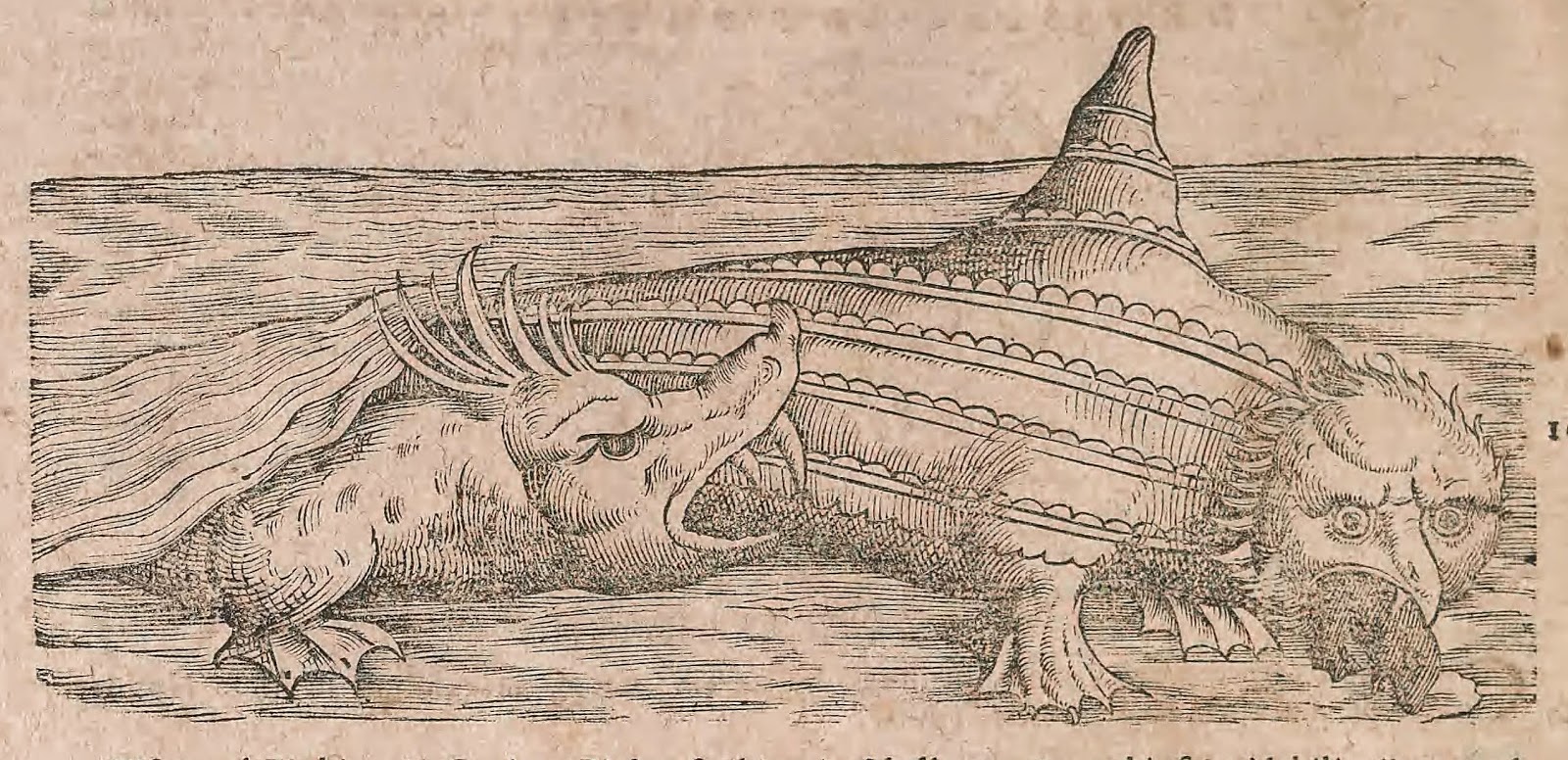
“The sword-fish is like no other, but in something it is like a whale. He hath as ugly a head as an Owl; his mouth is wondrous deep, as a vast pit, whereby he terrifies and drives away those that look into it. His eyes are horrible, his back Wedge-fashion, or elevated like a sword. His snout is pointed. These often enter upon the Northern Coasts as Thieves and hurtful Guests, that are always doing mischief to ships they meet, by boring holes in them, and sinking them.”

View Full Size Image
The Ziphius, after Magnus. Gessner, Conrad. Historia Animalium. 2nd Ed. 1604. http://biodiversitylibrary.org/page/42165841.

Thus Magnus describes the Ziphius (translation via John Ashton’s Curious Creatures in Zoology (1890)), whose name comes from the Greek xiphias, meaning sword (recall Magnus’ comparison of its fin to a sword). This bizarre, owl-headed creature is depicted with a seal in its jaws. This, and the shape of the fin, suggest that the monster may be based on an Orca. A Great White Shark has also been suggested.

And the porcupine-fish attacking the Ziphius? Jury’s still out on that one…

The Case for the Leviathan

We all know whales are real, and we know that they can grow to extraordinary sizes (the largest size on earth, in fact). They have even been documented to attack and sink ships (for instance, in 1820, the vessel Essex was sunk by a sperm whale), so those crews wishing to harpoon a whale has reason to be cautious.

View Full Size Image
Physeter, or Prister. Magnus, Olaus. Historiae de gentibus septentrionalibus. 1555. http://biodiversitylibrary.org/page/41862920.

Does the Leviathan exist? Yes. Even within the sixteenth century writings of Magnus and Gessner, Leviathan monsters such as Devil Whales and Pristers are identified as whales. However, are you likely to mistake a whale for an island and try to cook your dinner on it? Is a whale prone to kill a human simply for the fun of it? Probably not.

As is the case with all monsters inspired by real animals, limited – and sometimes dramatic (think witnessing a breaching near your boat for the first time, or stumbling upon the decomposing corpse of a sperm whale) – contact with these mammals fueled fear and sensationalism, resulting in harrowing tales of great beasts roaming the oceans.

But, in the end, a Leviathan, by any other name, is simply a whale (or perhaps an Orca) and most definitely not a monster.

  • Follow our blog and #bhlMonstersRreal on Twitter and Facebook all week to learn more about monsters and the animals that inspired them.
  • Browse historic illustrations of leviathans and their whale counterparts on Flickr.
  • Browse the books that portray these historic monsters in BHL.
  • Carve a Leviathan in your Halloween Pumpkin this year! Share your carvings with us on Facebook and Twitter!
  • See some of our favorite monsters come to life on the Smithsonian Libraries’ Tumblr!


References:

  • Ellis, Richard. Monsters of the Sea. New York: Alfred A. Knopp, Inc., 1994. Print.
  • Simon, Matt. “Kraken and Owl Whales: Take a Dip with History’s Most Terrifying Sea Monsters.” Wired. 13.09.13. Web. 20.10.14. http://www.wired.com/2013/09/carta-marina/#slideid-591797.
October 28, 2014by michelle.underhill

Help Support BHL

BHL's existence depends on the financial support of its patrons. Help us keep this free resource alive!

search

About BHL

The Biodiversity Heritage Library (BHL) is the world’s largest open access digital library for biodiversity literature and archives. BHL operates as a worldwide consortium of natural history, botanical, research, and national libraries working together to digitize the natural history literature held in their collections and make it freely available for open access as part of a global “biodiversity community.”

Join Our Mailing List

Sign up to receive the latest news, content highlights, and promotions.

Subscribe Now

Subscribe to Blog via Email

Enter your email address to subscribe to this blog and receive notifications of new posts by email.

Join 319 other subscribers

Subscribe to Blog Via RSS

Subscribe to the blog RSS feed to stay up-to-date on all the latest BHL posts.

Access RSS Feed

Inspiring Discovery through Free Access to Biodiversity Knowledge.

The Biodiversity Heritage Library makes it easier than ever for you to access the information you need to study and explore life on Earth…for free, anytime, anywhere.


ABOUT | HARMFUL CONTENT | PRIVACY | SITE MAP | TERMS OF USE