Biodiversity Heritage Library - Program news and collection highlights from BHL
  • Home
  • News
  • Featured Books
    • All Featured Books
    • Book of the Month Series
    • BHL at 20
  • User Stories
  • Campaigns
    • Fossil Stories
    • Garden Stories
    • Monsters Are Real
    • Page Frights
    • Her Natural History
    • Earth Optimism 2020
  • Tech Blog
  • Visit BHL
Home
News
Featured Books
    All Featured Books
    Book of the Month Series
    BHL at 20
User Stories
Campaigns
    Fossil Stories
    Garden Stories
    Monsters Are Real
    Page Frights
    Her Natural History
    Earth Optimism 2020
Tech Blog
Visit BHL
  • Home
  • News
  • Featured Books
    • All Featured Books
    • Book of the Month Series
    • BHL at 20
  • User Stories
  • Campaigns
    • Fossil Stories
    • Garden Stories
    • Monsters Are Real
    • Page Frights
    • Her Natural History
    • Earth Optimism 2020
  • Tech Blog
  • Visit BHL
Biodiversity Heritage Library - Program news and collection highlights from BHL
BHL News, Blog Reel, Tech Updates

Notice: Changes Coming to BHL API Methods on February 27, 2017

Effective February 27, 2017, the API methods GetPartEndNote and GetTitleEndNote will be removed. In addition, the BHL data exports that used the related format have already been removed.

The removed BHL API methods and data exports will soon be replaced by methods and exports that use the RIS format, which is supported by a wider range of bibliographic reference managers.

Thank you for your patience as we work to implement the RIS-based exports and API methods. If you have any questions, please submit them via our feedback form.

You can learn more about our developer tools and APIs here.

February 24, 2017by ulib-libraryjobs
Blog Reel

Avibase, The World Bird Database

View Full Size Image


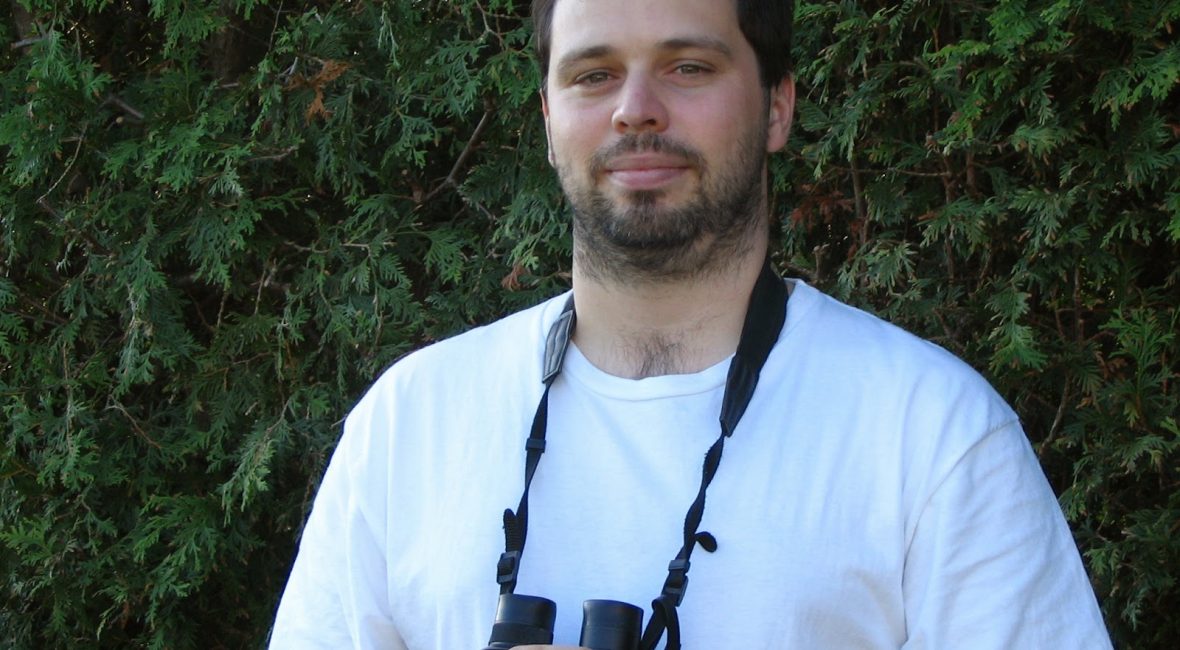
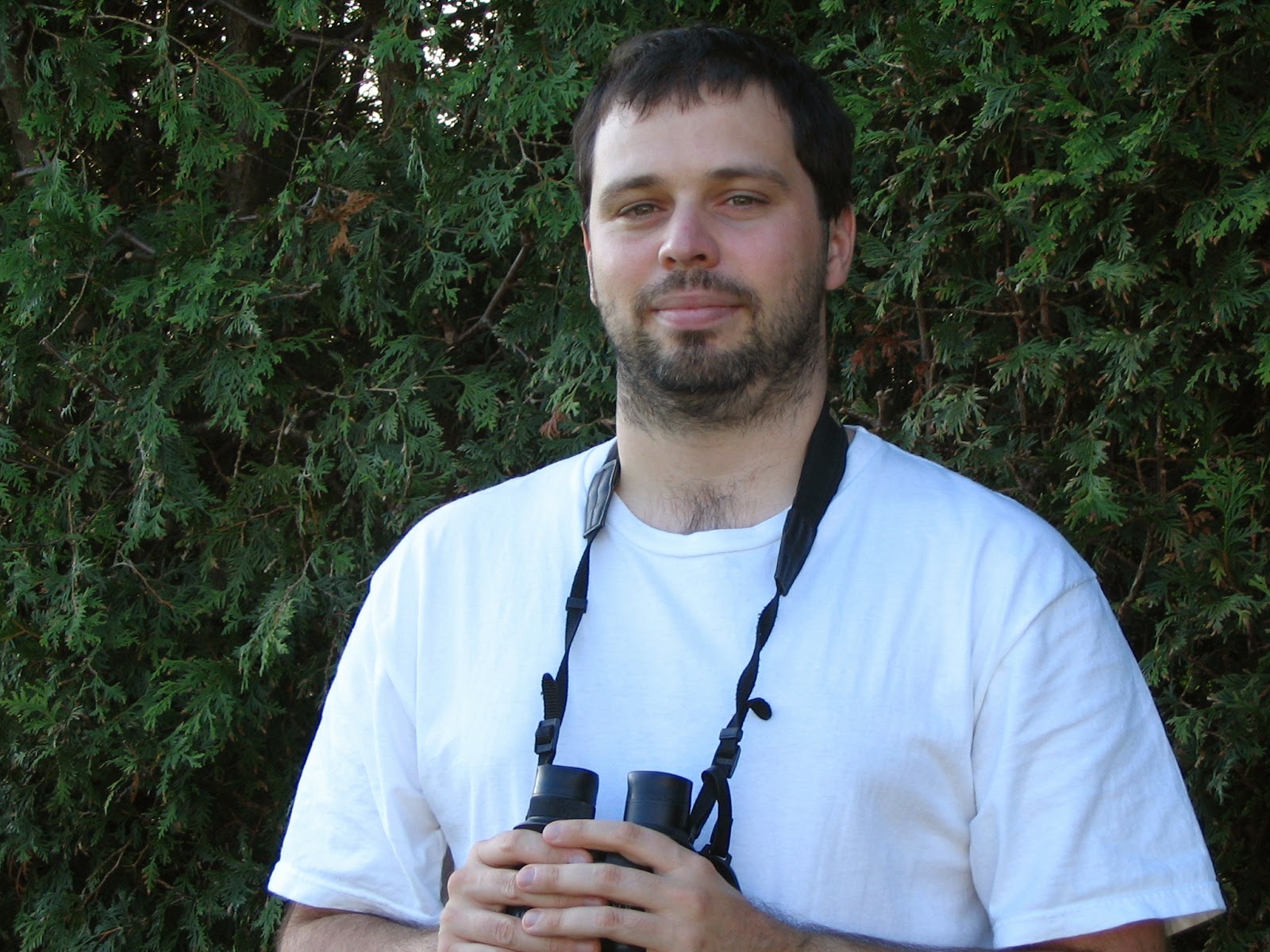
As part of our BHL & Our Users series, we recently interviewed Denis Lepage, Senior Scientist at the National Data Center, Bird Studies Canada and creator of Avibase, an impressive online resource on the birds of the world.  With over 12 million records, the database covers information on about 10,000 species and 22,000 subspecies of birds, including distribution, taxonomy, and synonyms in several languages.

Over the last 20 years, Lepage has devoted his energy and inspiration to building and managing this extensive resource. Denis recently contacted us to share the role BHL has played in making his work possible and we’re thrilled that he’s agreed to share it here with you as well.  Enjoy!

BHL & Our Users: Denis Lepage

What is your area of interest?

My interest in taxonomy for Avibase is primarily a personal endeavor.  One of my goals for Avibase is to organize all bird taxonomy, whether current or historical, so we can track how our understanding of taxonomic concepts and scientific names has evolved over time. Since it began, the database has grown to about 12 million records, and I have developed various approaches to address some of taxonomy’s unique challenges. These have recently been detailed in a paper published in the open access journal ZooKeys.

I am particularly interested in how the same scientific names are constantly being used for describing concepts that are actually representing different populations. Because of the rules of nomenclature, when a population is split into two or more species for instance, the original scientific name must remain with the one represented by the oldest specimen. Because of this, a scientific name may actually mean some very different things depending on who uses it or when it was used. The name Gallinula chloropus could mean a bird found in Europe, Asia, Africa, and Oceania but the birds found in the Americas could be alternatively called G. chloropus or G. galeata. If you naively looked at G. chloropus records on a global map, you would see a sudden and marked drop in sightings starting a few years ago in the Americas. You would probably eventually figure out that those have simply shifted to a different name, but the point is that this disorganizes things.
View Full Size Image
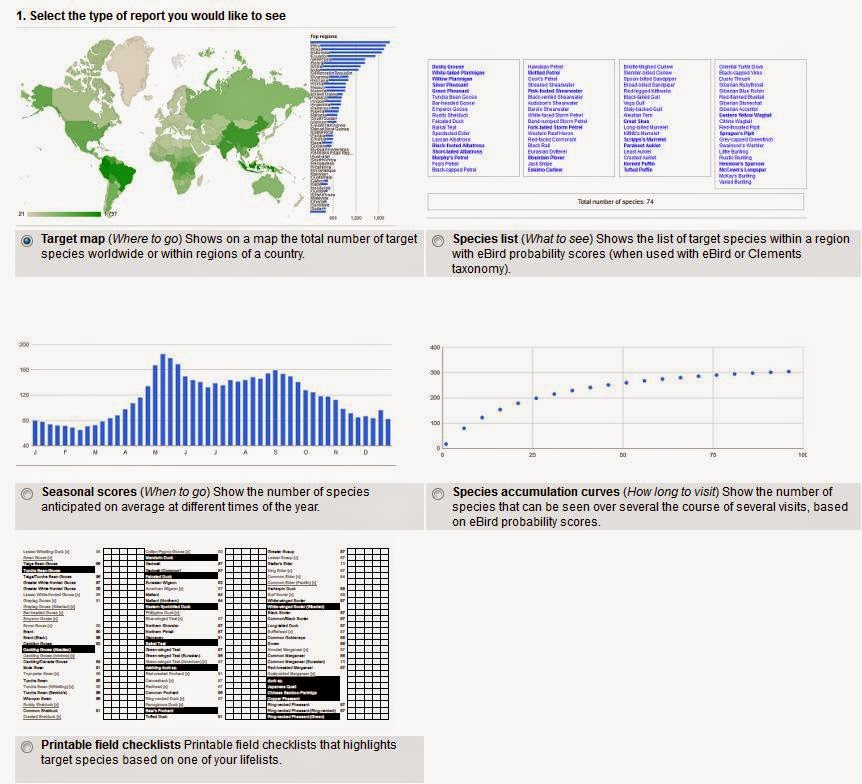
Screenshot of some of the reporting tools available in My Avibase

The problem is a lot more widespread than most people seem to realize, particularly as we start gathering vast amounts of data into large biodiversity inventories containing hundreds of millions of records. By my own estimate, less than half the world’s species of birds have been represented by a stable and consistent name over the last hundred years or so. In some cases, such as with Puffinus Iherminieri, a single scientific name has been used to describe up to 18 different concepts, which really only share being represented by a common type specimen. In the broader sense, the name Puffinus Iherminieri can be used to represent a large complex of about 16 species according to today’s understanding of taxonomy. Several of those are threatened species, so not being able to be precise about what a name means has real direct implications for things such as conservation. These difficulties are also compounded by several other challenges, such as name synonymy. While the rules of nomenclature were well designed to address the problems of changes in names and synonymy, they have completely ignored the issue of changes to the circumscription (what each name is used to represent).  The ZooKeys paper explains how I have addressed this problem in Avibase, and how this may be useful for other taxonomic groups.

In addition to that, Avibase also offers lots of resources for birdwatchers, including over 10,000 different checklists from all countries, states, and provinces, and many smaller islands around the world. Those are available in several taxonomies and providing common name synonyms in over 200 languages from Afrikaans to Zulu. There is an Avibase Flickr group to which nearly a thousand people contribute, and those are made available in the species pages, as well as in the form of illustrated checklists for any region of the world. I primarily designed Avibase with my own personal interests in mind as a birdwatcher, but I am very excited that so many people also find it useful. A relatively recent addition is the section called My Avibase, where people can maintain their life lists and generate cool reports that tell them where they can go next in their world adventures, and how many new species they can expect to see. By combining this with data from thousands of observers who contribute to eBird, I can also provide better estimates, for instance on which species they are most likely to find at different times of year, and more.

How long have you been in your field of study?

I started building the Avibase database just over 20 years ago, but it was launched as a web site around 2003. My original goal was mostly to create a personal database that contained all of the bird species and that I could use for tracking my own personal sightings. It then gradually evolved into something much bigger.

When did you first discover BHL?
A few years ago, through research for historical documents on archive.org and Google books.

What is your opinion of BHL and how has it impacted your research?

BHL provides access to historical documents on bird taxonomy that are often difficult for me to access otherwise, particularly outside of an academic environment. Being able to access digital copies of these documents at my leisure is extremely convenient.

How often do you use BHL?

Regularly, but this varies.  Over the last year, it has been several times per month.

How do you usually use BHL?

I generally download the whole PDFs for my own local use.

What are your favorite features / services on BHL?

Access to digitized copies of historical documents. Since I am not located in a university or a place where I can access a comprehensive library, this is invaluable. Even if I had such access, having these documents available online, with their content indexed and searchable from desk is incredibly convenient. For instance, I often come across old names that are no longer in use, and that I am trying to resolve their meaning.  Many of those names are only found in old historical documents (e.g., Hellmayr’s Catalog of the Birds of the Americas), and having them simply available a Google search away is incredibly powerful.

If you could change one thing about BHL, what would it be, or what developmental aspect would you like the BHL team to focus on next?

Part of what I have been trying to do is convert the content of some of these documents into structured database pieces. This is very challenging in many respects. It assumes that the optical character recognition (OCR) is efficient and accurate, and that the information can be relatively easily parsed into their individual components. In several instances, I have found that the individual books that had been used for scanning had many marking made by hand, and which often disrupted the OCR process. I think that working on copies that are as clean as possible would be a desirable and reasonable objective. Improving the OCR process itself would also be incredibly valuable, but these books are probably more challenging than your average publication. They often rely heavily on abbreviations, symbols, highly stylized fonts and of course contain words such as scientific names that are not found in standard dictionaries.

If you had to choose one title/item in BHL that has most impacted your research, or one item that you prefer above any other in BHL, what would it be and why?

So far, undoubtedly the volumes from the Peter’s Checklist of the Birds of the World. These represent a very important compendium of every bird in the world known at the time of publication and are used as the principal reference underlying most other subsequent global taxonomic effort. After a few years of manual labor by myself and a colleague, I am glad to say that we were able to convert major portions of the 16 volume series into a database that can be accessed openly here: http://avibase.bsc-eoc.org/peterschecklist.jsp. Efforts are underway to expand the database to include synonymy information that was also included in Peters’ checklist.

Thank you, Denis, for sharing your work on Avibase and how you use the Biodiversity Heritage Library!

August 21, 2014by brooksm
BHL News, Blog Reel

BHL and EOL team up for NESCent Research Sprint

View Full Size Image
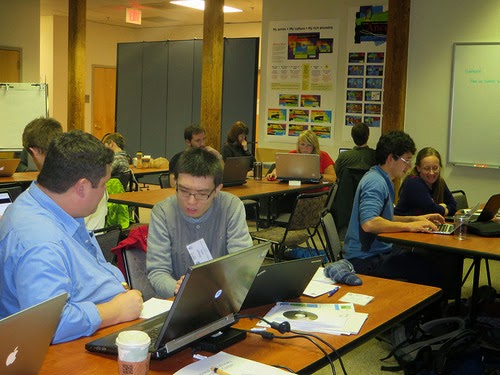
Research teams at the NESCent-EOL-BHL Research Sprint.
Photograph by Cyndy Parr.

In early February, the National Evolutionary Synthesis Center (NESCent) hosted the EOL-BHL Research Sprint. NESCent, based in Durham, NC, is a non-profit science center supporting research in the evolutionary sciences. NESCent emphasizes an interdisciplinary approach to research, and so the idea behind the Sprint was to put together teams of programmers and life scientists to expose each other to questions and ways of thinking that they might not necessarily consider in their normal work. Informaticians could bring programming and data skills to bear on questions that scientists may not have had the programming expertise to implement effectively, using BHL‘s and EOL‘s now considerable amount of freely available data. Scientists could identify questions based on the data to programmers that they might not have considered. Plus, the meeting was useful in identifying how well researchers could identify and retrieve the data they needed from the BHL text corpus. To this end, William Ulate, BHL Technical Director and John Mignault, a member of the BHL Technical Advisory Group attended the meeting.

The teams covered a wide variety of interesting topics from studying the color of butterflies based on extracting color information from images to studying changes in ontologies over time based on an analysis of the text in the BHL corpus (see http://bit.ly/1dnnhG0). Over the course of the sprint, the teams began data mining EOL and BHL for their data sets and started preliminary analyses of their data. Each day, groups met at the end of the day to share experiences and progress. By the end of the sprint, each of the teams were sharing plans for further collaboration and completing their analyses. Plans for publication and grants proposals based on sprint ideas were also discussed. In an open, collaborative spirit, members shared the materials freely via Google Drive.

We learned some interesting things about the way people approach the BHL data set. Many of the teams on the first day wanted to use the BHL application programming interface for bulk data retrieval. Several team members asked us how they could download “all of the text.” When we told them that this was impractical and would result in a great deal of unwanted data, they asked how they could retrieve data based on, for example taxa – I want to harvest all pages with names from this taxon (Chordata) or this common name (Vertebrate). Others wanted data restricted by location. We tried to assist them given their specific needs rather than their initial request for the whole data set (see http://bit.ly/1rvbut3). This raised useful questions as to how we can provide the data to researchers need in the ways they need it – should we offer ways to request bulk data downloads based on a specific set of criteria? Should we alter the API (http://www.biodiversitylibrary.org/api2/docs/docs.html) in order to make it possible to retrieve more closely focused data sets? As BHL becomes better known as a source of “Big Data” for the biodiversity community, we will need to evolve our access to that data in order to better meet the needs of our users.

We were also surprised to discover the popularity of the R statistical programming language among scientists. Many team members used R in their work, to such an extent that a short R group discussion was scheduled for one morning during the meeting. Scott Chamberlain of Simon Fraser University has created an R interface to the BHL API, available at http://bit.ly/1oAFKjI. It is always good to see BHL and its data used in new and interesting ways. Follow up further results from this Sprint at: http://blog.eol.org.

The Sprint was a valuable meeting for BHL: it exposed our valuable data to more scientists and informaticians, and it gave BHL staff useful feedback on the uses of the BHL data corpus and its value to researchers. We would like to thank EOL, NEScent and the Richard Lounsbery Foundation for the opportunity and their collaboration in making this event a success.

March 27, 2014by sayeedmd
BHL News, Blog Reel

BHL at Summer Teacher Institutes

This summer, the Library of Congress hosted five-day Summer Teacher Institutes in Washington, DC.  As part of the most recent Institute, BHL shared an exhibit table on Science and Technology with the Library of Congress on Tuesday, August 6, 2013.  Carolyn Sheffield, of the Smithsonian Institution, shared information on BHL and distributed stickers, pins, and BHL business cards—complete with gorgeous illustrations from BHL.  Dr. Tomoko Steen, Research Specialist and Camron Lee, Junior Fellow, both of the Science, Technology, and Business Division of the Library of Congress, shared the table, helping to spread the word about BHL as well as sharing amazing education resources compiled by their Division.

Attendees included 25 teachers from primary, secondary, undergraduate and graduate programs from across the country.   The majority of attendees had not heard of BHL before and were delighted to learn of the free resources that BHL makes available.  Many attendees expressed enthusiasm for the content, especially the images on Flickr, and many said that they were to share the information about BHL’s free resources with their colleagues at their schools.

View Full Size Image

August 19, 2013by sayeedmd
BHL News, Blog Reel

BHL Named a 2013 Computerworld Honors Program Laureate!

View Full Size Image
Image from: http://www.cwhonors.org/2013/honorsprogram2013.htm

IDG’s Computerworld Honors Program announced on March 19, 2013 The Biodiversity Heritage Library (BHL) as a 2013 Laureate. The annual award program honors visionary applications of information technology promoting positive social, economic and educational change.

“Technology continues to play a pivotal role in transforming how business and society functions. For the past 25 years the Computerworld Honors Program has had the privilege of celebrating innovative IT achievements,” said John Amato, vice president & publisher, Computerworld. “Computerworld is honored to recognize the outstanding accomplishments of the 2013 class of Laureates and to share their work. These projects demonstrate how IT can advance organizations’ ability to compete, innovate, communicate and prosper.”

“The BHL,” said Martin R. Kalfatovic, BHL Program Director, “has been a leader in the world of digital libraries since its founding in 2006. To have the collaborative and innovative nature of the now global partnership in the pursuit of an open and accessible resource for the literature of life recognized with this award is a tribute to the staff of the many institutions that have participated in the BHL program since its inception.”

The Computerworld Honors Program awards will be presented at the Gala Evening and Awards Ceremony on June 3, 2013 at the Andrew W. Mellon Auditorium in Washington, D.C.

About The Computerworld Honors Program

Founded by International Data Group (IDG) in 1988, The Computerworld Honors Program is governed by the not-for-profit Computerworld Information Technology Awards Foundation. Computerworld Honors is the longest running global program to honor individuals and organizations that use information technology to promote positive social, economic and educational change. Additional information about the program and a Global Archive of past Laureate case studies, as well as oral histories of Leadership Award recipients can be found at the Computerworld Honors website.

About Computerworld

Computerworld is the leading source of technology news and information for IT influencers, providing peer perspective, IT leadership and business results. Computerworld’s award-winning website, bi-weekly publication, focused conference series, custom solutions and custom research forms the hub of the world’s largest (40+ edition) global IT media network and provides opportunities for IT solutions providers to engage this audience. Computerworld leads the industry with an online audience of over 3.5 million unique, monthly visitors (Omniture, August 2012) and was recognized as the Best Website by ASBPE and TABPI in 2012. Computerworld is published by IDG Enterprise, a subsidiary of International Data Group (IDG), the world’s leading media, events and research company. Company information is available at http://www.idgenterprise.com/.

March 22, 2013by ulib-libraryjobs

Help Support BHL

BHL's existence depends on the financial support of its patrons. Help us keep this free resource alive!

search

About BHL

The Biodiversity Heritage Library (BHL) is the world’s largest open access digital library for biodiversity literature and archives. BHL operates as a worldwide consortium of natural history, botanical, research, and national libraries working together to digitize the natural history literature held in their collections and make it freely available for open access as part of a global “biodiversity community.”

Join Our Mailing List

Sign up to receive the latest news, content highlights, and promotions.

Subscribe Now

Subscribe to Blog via Email

Enter your email address to subscribe to this blog and receive notifications of new posts by email.

Join 319 other subscribers

Subscribe to Blog Via RSS

Subscribe to the blog RSS feed to stay up-to-date on all the latest BHL posts.

Access RSS Feed

Inspiring Discovery through Free Access to Biodiversity Knowledge.

The Biodiversity Heritage Library makes it easier than ever for you to access the information you need to study and explore life on Earth…for free, anytime, anywhere.


64+ Million Pages of
Biodiversity Literature Online.

EXPLORE

Tools and Services
to Transform Research.

EXPLORE

300,000+
Illustrations on Flickr.

EXPLORE

ABOUT | HARMFUL CONTENT | PRIVACY | SITE MAP | TERMS OF USE