 |
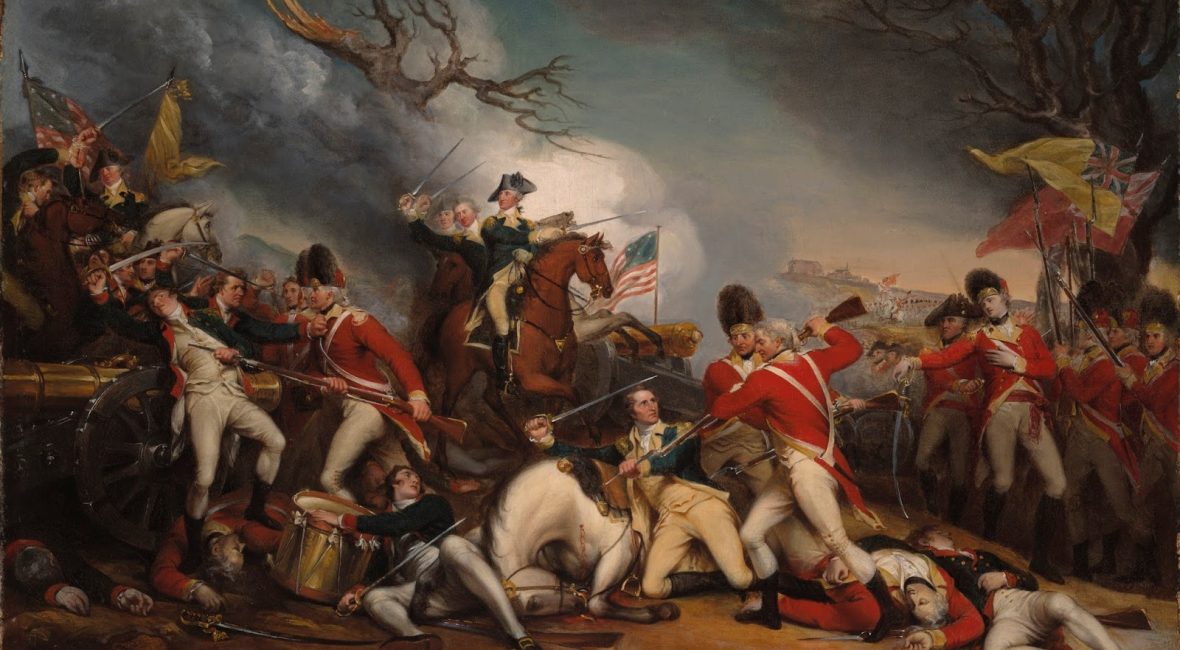
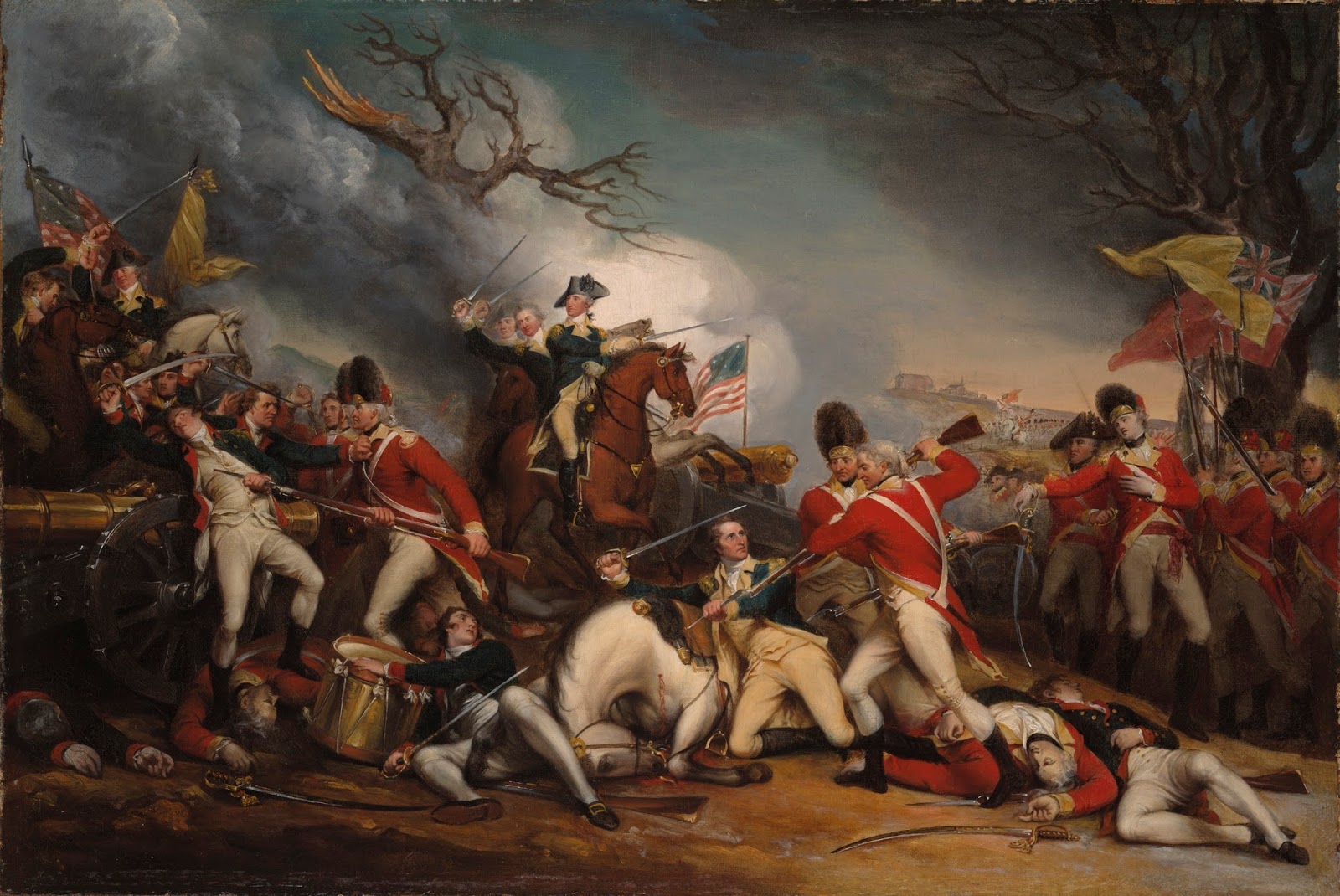
| The Death of General Mercer at the Battle of Princeton, January 3, 1777. By John Trumbull. Depicting the death of the American General Hugh Mercer at the Battle of Princeton on January 3, 1777 during the American Revolutionary War. Source: Wikimedia Commons. |
We all remember the Hessian mercenaries, those drunken, bayonet-wielding louts hired by George the Third to put down his rebellious American colonies. Every American schoolchild learns about these monsters, and how they suffered their come-uppance in Trenton in 1776, when their Christmas debauch came to an abrupt and bloody end in a battle their rum-blurred eyes never even saw coming.
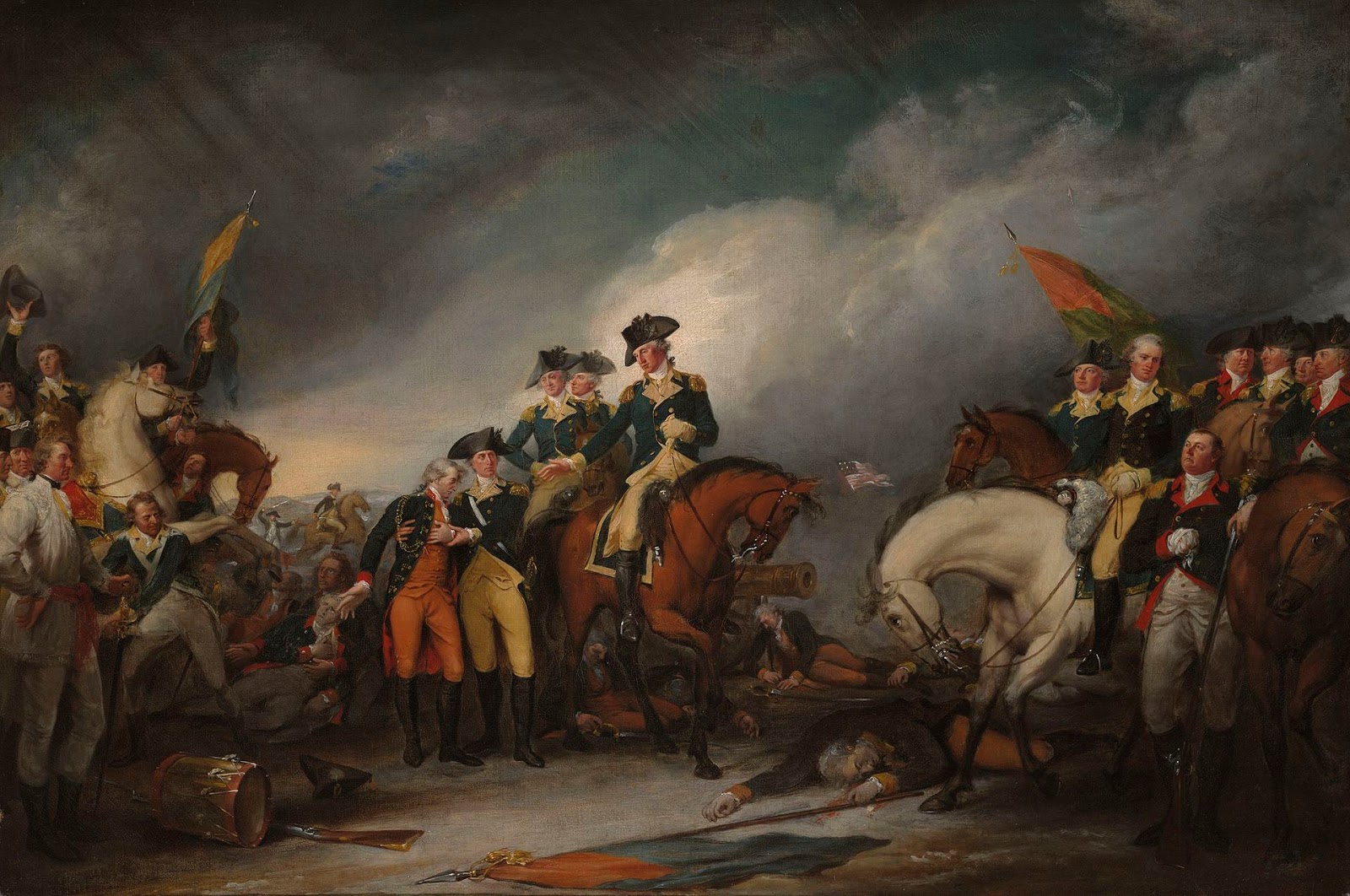 |
| The Capture of the Hessians at Trenton, December 26, 1776. By John Trumbull. Depicting the capture of the Hessian soldiers at the Battle of Trenton on the morning of December 26, 1776 during the American Revolutionary War. Source: Wikimedia Commons. |
For over 200 years, we’ve painted the German soldiers in America with a mighty broad brush. I’m sure that there were barbarians among them, but there were also educated men who spent their time on this side of the Atlantic studying this exotic continent and its inhabitants—when they weren’t drinking and fighting and skewering patriot children, that is.
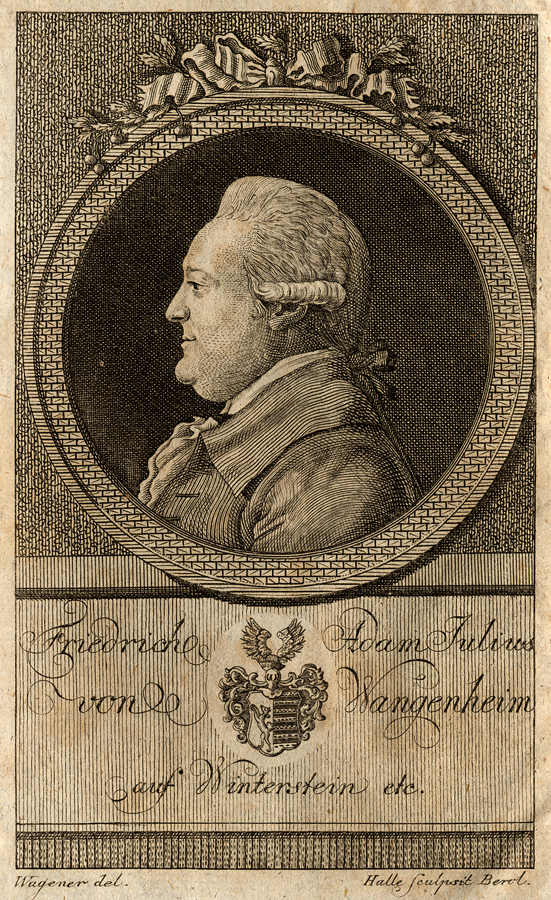 |
| Portrait of Baron Friedrich Adam Julius von Wangenheim. Frontispiece of volume 39 of the Öconomische Enzyklopädie of 1787. Source: http://www.kruenitz1.uni-trier.de/. |
The botanists among these scholarly soldiers are the best known today. Baron Friedrich Adam Julius von Wangenheim (1747/1749-1800), educated in forestry science in his native Saxony, arrived in New York in June 1777, and would eventually see combat on the British side at Brandywine and Charleston. When he wasn’t in battle, though, he wrote that:
“without neglecting my official duties, I spent every leisure hour in acquiring both a theoretical and a practical knowledge of the woody plants growing in that temperate region of North America.”
In May 1780, stationed in northern Manhattan, he completed his first book, A Description of Certain North American Trees and Shrubs, which appeared in print in 1781.
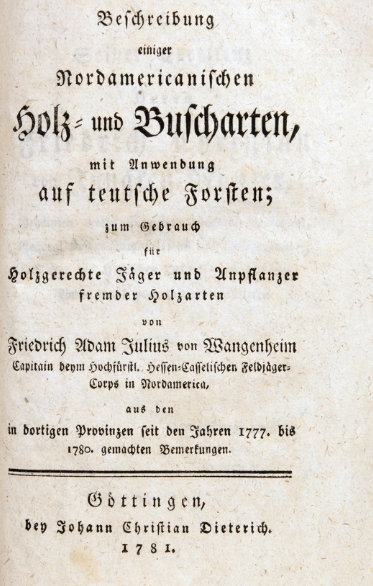 |
| Title page, A Description of Certain North American Trees and Shrubs by Baron Friedrich Adam Julius von Wangenheim. |
On returning to Europe in 1784, von Wangenheim expanded that work, which had covered 72 species, into a comprehensive treatise on the woody plants of North America and the possibility of transplanting them into German forests for timber and fuel.
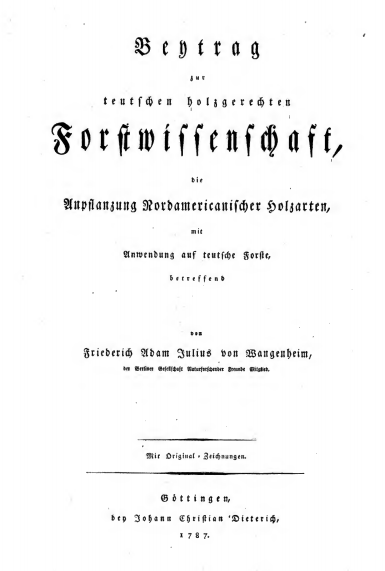 |
| Title page, Beytrag zur teutschen holzgerechten Forstwissenschaft, die Anpflanzung Nordamericanischer Holzarten mit Anwendung auf teutsche Forste. By Baron Friedrich Adam Julius von Wangenheim. |
These publications and a mass of articles and essays made von Wangenheim a name and earned him an appointment as chief forester of East Prussia. There he made his most important contribution to zoology, a thorough study of the European elk in Lithuania.
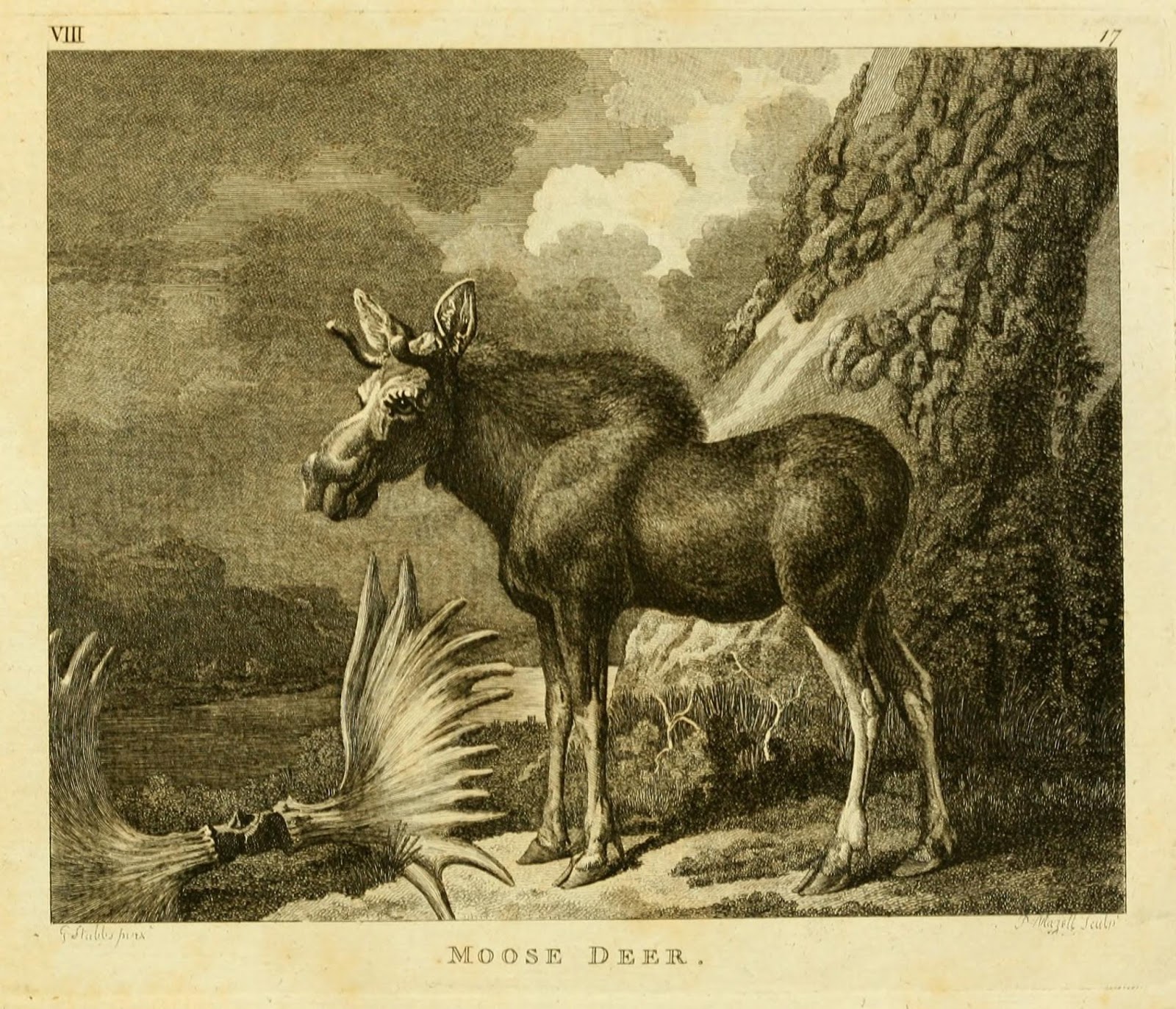 |
| The “moose deer” or European elk (Cervus alces). From Pennant, Thomas. Arctic zoology. v. 1 (1874). http://www.biodiversitylibrary.org/page/29568042. Digitized by Smithsonian Libraries. |
Von Wangenheim brought his American experience to bear in his account, noting in his practical way that the species is called the “moose deer” in the New World, where native Americans use its skin for clothing, gloves, moccasins, blankets, and tents.
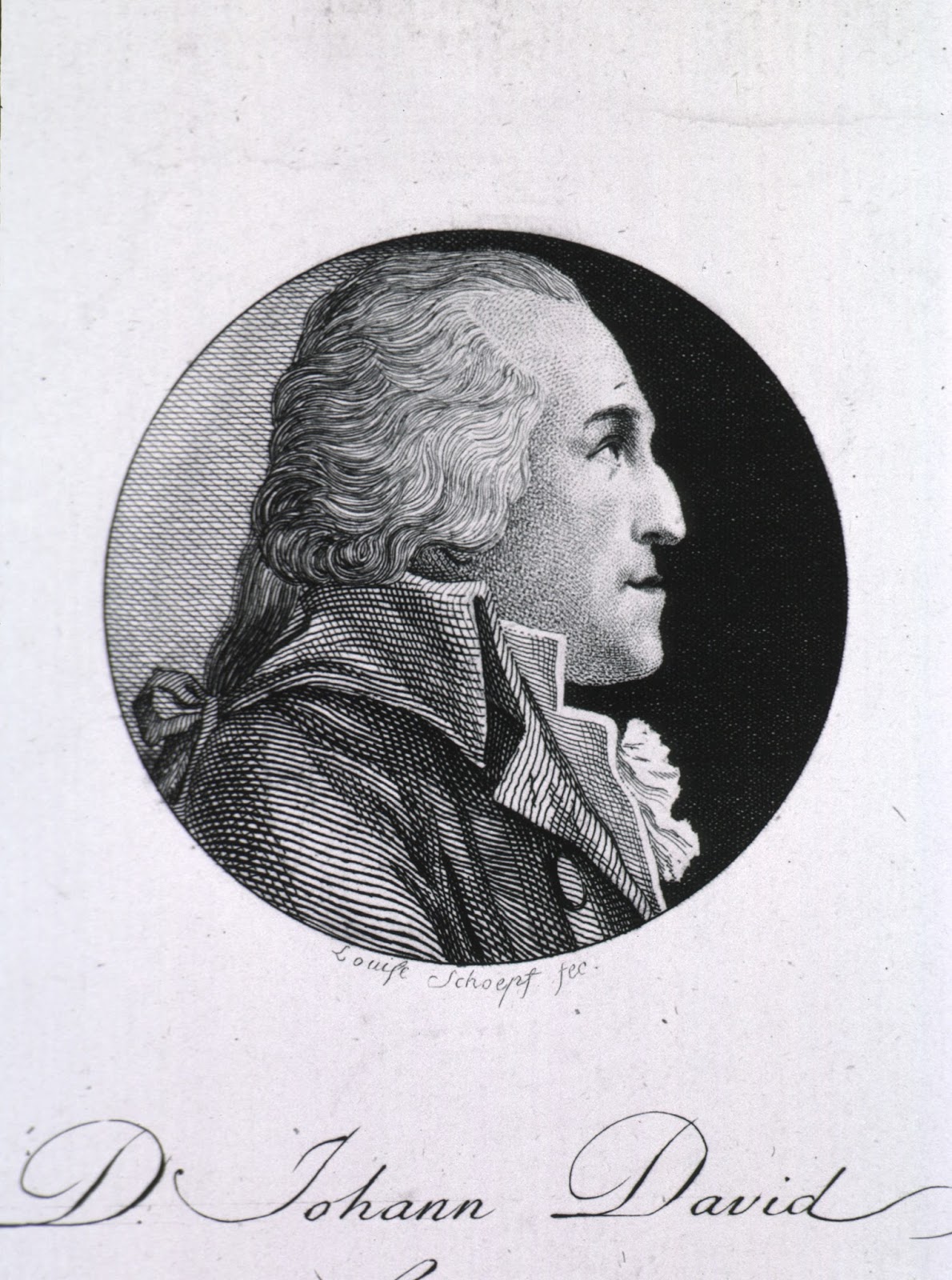 |
| Portrait of Johann David Schoepf. Source: U.S. National Library of Medicine. https://collections.nlm.nih.gov/catalog/nlm:nlmuid-101428527-img. |
More ambitious still, and less intensely focused on the economic use of the plants and animals around him, was Johann David Schoepf (1752-1800), field surgeon to one of the most notoriously bloodthirsty of the German regiments. Like von Wangenheim, Schoepf arrived in New York in June 1777. Once the war was over, inspired by the famous tours of Bartram and Catesby, Schoepf spent a year traveling west to Kentucky and south eventually to the Bahamas. Trained, like so many physicians of his day, in botany, Schoepf was naturally most interested in American plants and their medical uses; among the professional colleagues he most eagerly sought out were William Bartram and Henry Melchior Mühlenberg, but he also collected plant lore from native Americans, country doctors, and “old wives.”
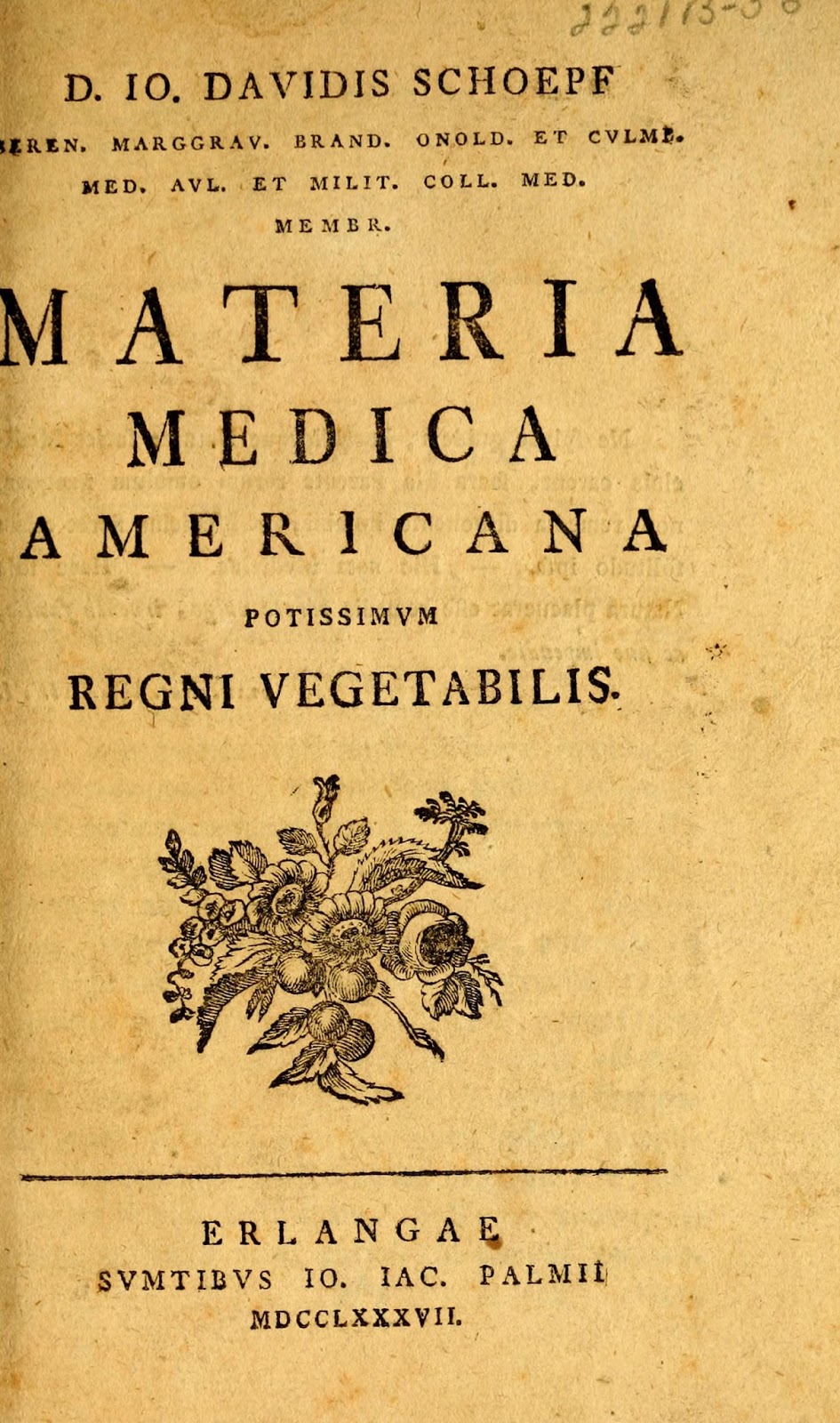 |
| Title page of Materia medica americana potissimvm regni vegetabilis. (1787). By Johann David Schöpf. http://www.biodiversitylibrary.org/page/16502307. Digitized by University of Pittsburgh Library System . |
Schoepf published his observations in 1787, in a comprehensive manual of the New World’s medicinal resources. Schoepf lists more than 350 plants, fungi, and lichens used in medicine, and ends his compendium with remarks on remedies derived from animal and mineral materials, ranging from human fat (an “obsolete, superstitious” practice) and dried rattlesnake flesh to amber and coal.
Today, Schoepf is most famous not for his pharmacopeia but for another book, the last he published before his early death in 1800. On his return to Europe in the summer of 1784, Schoepf took with him 64 live turtles, specimens that provided the basis for his Illustrated Natural History of the Turtles, published in Erlangen in 1792.
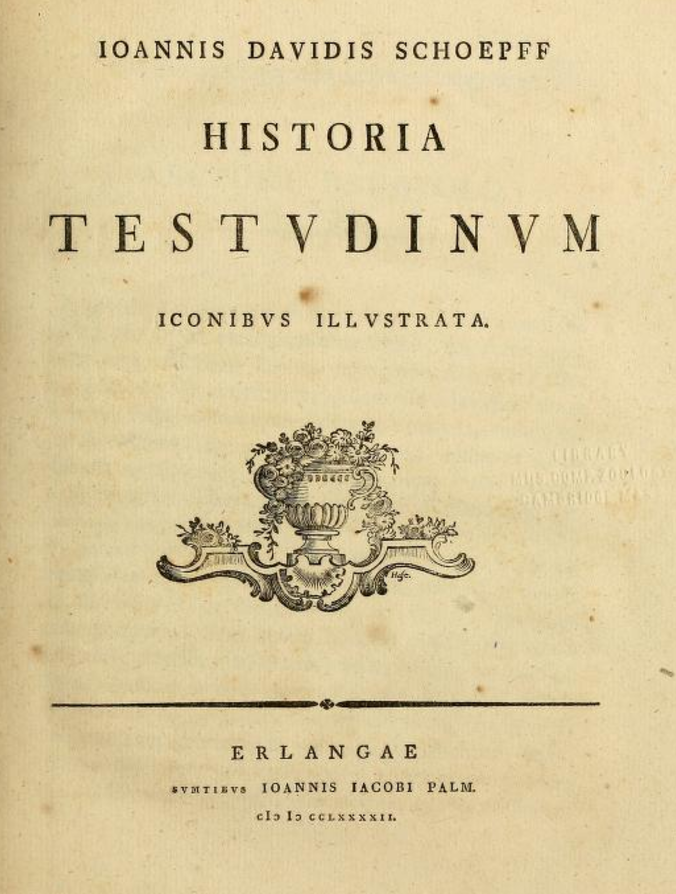 |
| Title page of Ioannis Davidis Schoepff Historia testvdinvm iconibvs illvstrata. (1792) (“Illustrated Natural History of Turtles”). By Johann David Schöpf. http://www.biodiversitylibrary.org/page/32540981. Digitized by Harvard University, Museum of Comparative Zoology, Ernst Mayr Library. |
Among the species he treated there was one he named Testudo terrapin; Schoepf based his description and plate on two shells he had collected on Long Island and on two others sent him by Mühlenberg (perhaps from the market in Philadelphia).
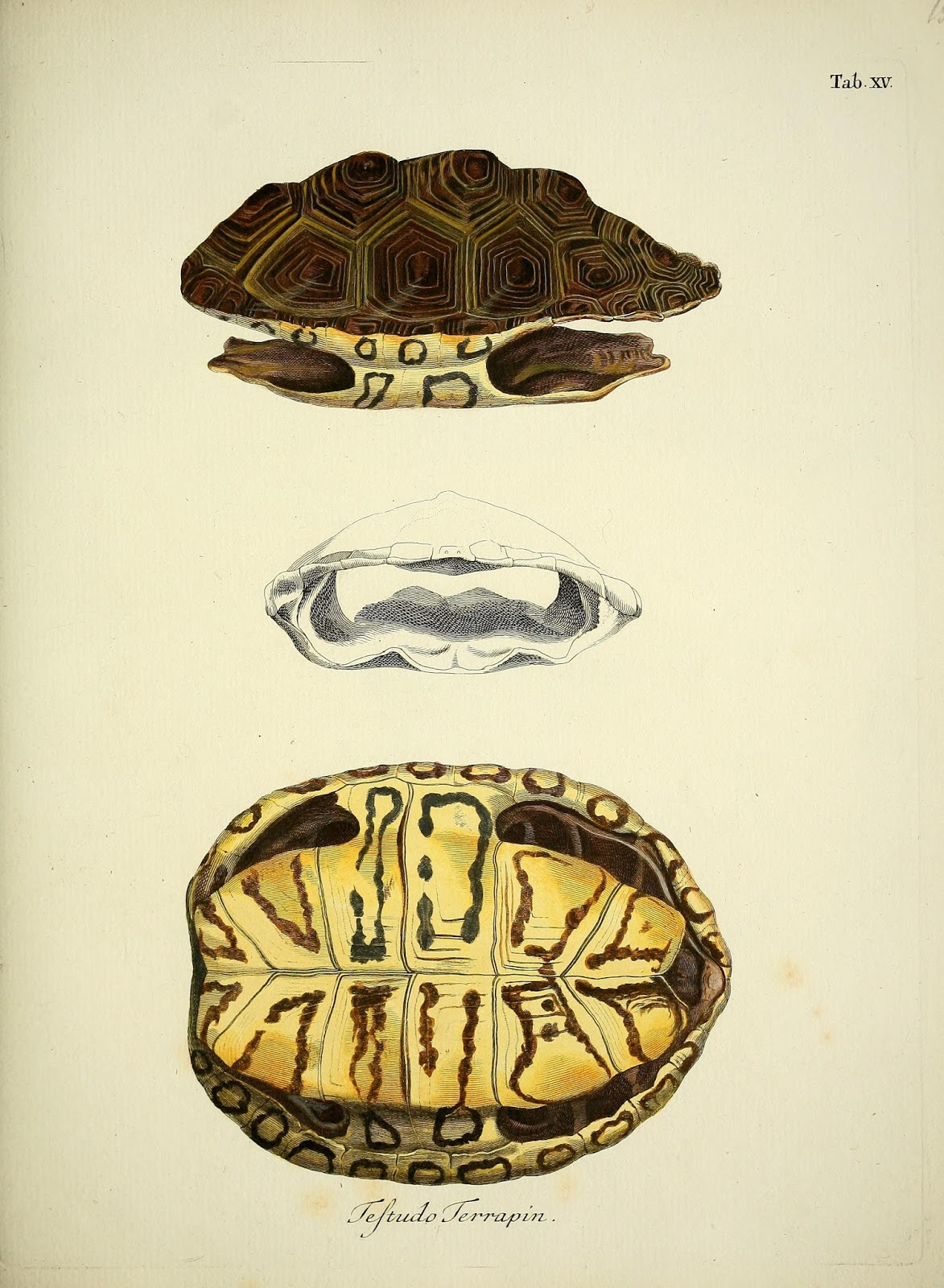 |
| Testudo terrapin. Naturgeschichte der Schildkröten. (1792-1801). By Johann David Schöpf. http://www.biodiversitylibrary.org/page/38925513. Digitized by Smithsonian Libraries. |
This was the first scientific description of the handsome species now known as the diamondback terrapin.
While von Wangenheim barely mentioned birds in his accounts of North American nature, Schoepf was more interested in things feathered. He found northern cardinals and blue grosbeaks in the Carolinas, and appears to have made close observations of turkey vultures, pointing out that the large, moist nostrils suggest that though “not proved, it is nevertheless likely” that they locate their aromatic prey by smell. Less credible is Schoepf’s claim that he and his companions encountered ivory-billed woodpeckers in eastern Pennsylvania.
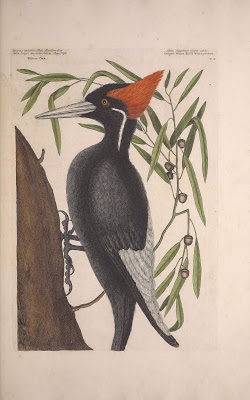 |
| Ivory-billed woodpecker (Campephilus principalis). Catesby, Mark. The Natural History of Carolina, Florida, and the Bahama Islands. Ed. 1, v. 1 (1729-1747). http://www.biodiversitylibrary.org/page/40753165. Digitized by Smithsonian Libraries. |
The occasional misidentification aside, early American ornithology suffered a significant loss when Schoepf entrusted to Jacob Rubsamen his manuscript containing “numerous and precisely written descriptions of almost all the birds” he had seen in America. Rubsamen, a German immigrant whose Virginia gunpowder mill had been destroyed by the British at the end of the war, was to have sent those pages on to Schoepf in Charleston, but they never arrived.
One “Hessian” soldier who did make a significant contribution to American ornithology will probably remain forever anonymous.
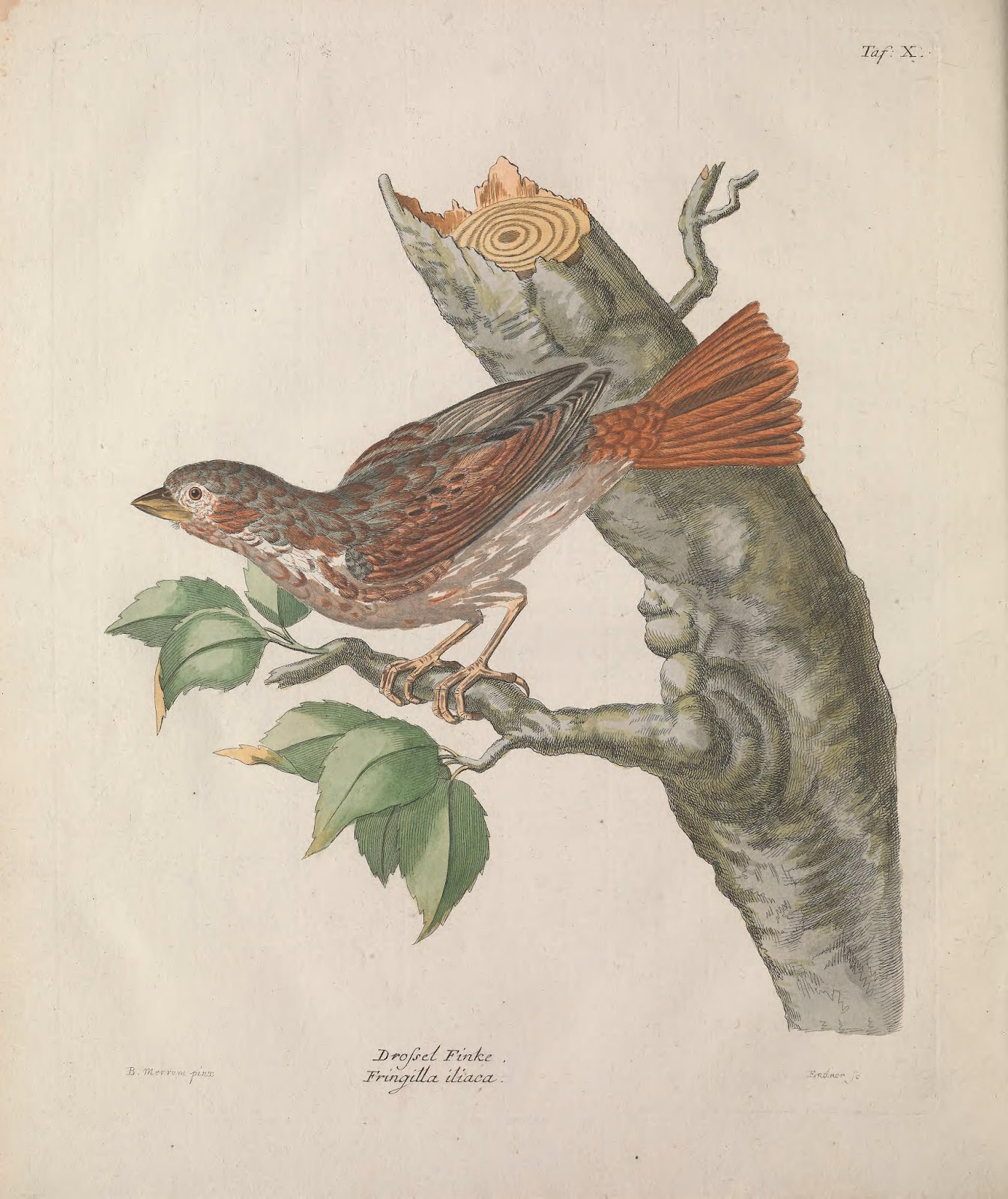 |
| Fringilla iliaca. Avium rariorum et minus cognitarum. (1786). By Merrem, Blasius. http://www.biodiversitylibrary.org/page/46489269. Digitized by Smithsonian Libraries. |
Sometime before 1786, this unknown naturalist shipped the preserved skin of a large and colorful bunting to Blasius Merrem, the first professor of zoology at the university of Marburg. Merrem recognized the specimen as the representative of a new species, which he named Fringilla iliaca for the heavy reddish chevrons marking its breast and side. Who knows how long science might have had to wait for a description of the red fox sparrow had George the Third not leaned on his teutonic cousins for help?
In February 1784, five months after the treaty ending the American Revolution was signed in Paris, the great Welsh litterateur Thomas Pennant regretted that the “fatal and humiliating hour” had not only “deprived Britain of power, strength, and glory,” but had “mortified” him into abruptly stopping work on what was to have been a new Natural History of North America. Horrified as he was at the historic turn of events, Pennant was nevertheless confident that “some native Naturalist” in the New World would complete the work that he had begun. Little did he know that some German soldiers fighting in America had been working alongside him all along.