

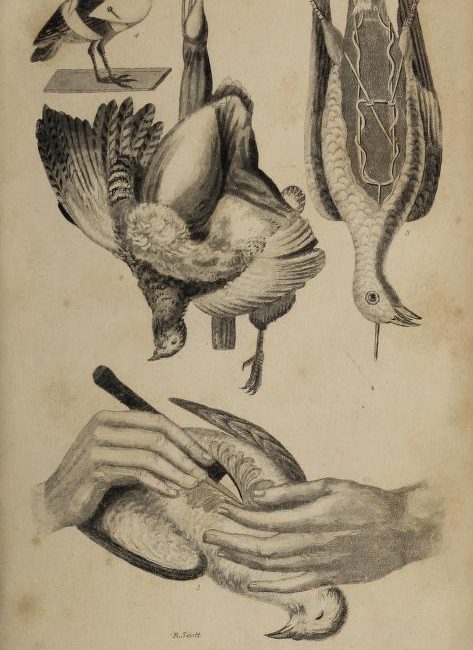
Natural history illustrations often aim to show life-like flora and fauna. Depictions of birds poised to take flight, fish swimming upstream, and mammals mid-stride are common in 18th and 19th century zoology and botany publications. What is lost in these often lavish illustrations is a certain truth about the way many naturalists interacted with their objects of study: many species of plant or animal were first encountered not in the wild, but in the display case, in the form of carefully prepared specimens.
One British naturalist, Captain Thomas Brown (1785-1862), made the practical observation that mounted animal specimens allowed naturalists to “contemplate, without dread, the most destructive and furious quadrupeds, and the most noxious reptiles.” It follows that many dangerous and rare species may not have been studied if not for taxidermy. Similarly, the building up of large and comprehensive natural history collections would not have been possible without a means of preserving specimens for the long term. As early collectors and naturalists quickly realized, proper taxidermy techniques were necessary to ensure that museum and cabinet collections did not degrade and disintegrate over time. Thus, a significant part of natural history is the rather unnatural history of taxidermy and specimen preparation.
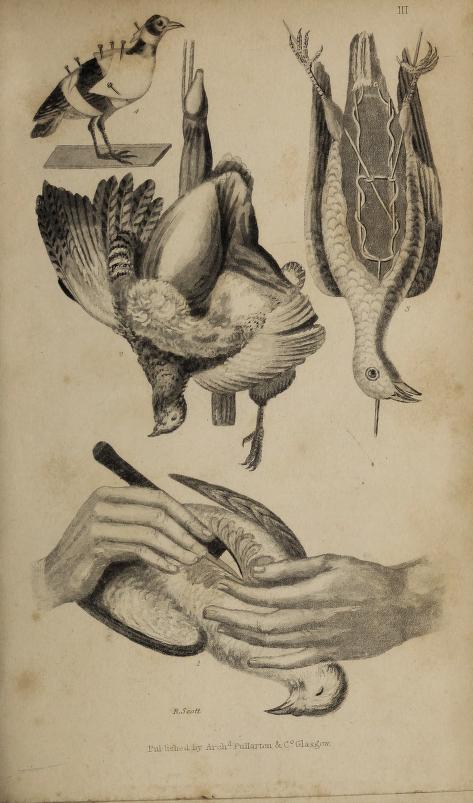
Plate III. Brown, Thomas. The Taxidermist’s Manual, or, The Art of Collecting, Preparing and Preserving Objects of Natural History. 1833. Contributed in BHL by The Thomas Fisher Rare Book Library, University of Toronto.
While elements of modern taxidermy can be traced back to ancient Egyptian embalming practices, taxidermy as a tool for the study of natural history did not come about until the mid-18th century. French entomologist René Antoine Ferchault de Réaumur’s treatise, ‘Divers means for preserving from corruption dead birds intended to be sent to remote countries, so that they may arrive there in good condition…‘, published in the Transactions of the Royal Society in 1748, is often cited as the first comprehensive discussion of the topic. However, Réaumur proposed techniques for preparing specimens for shipment only, not long-term preservation or display.
More comprehensive techniques developed in the 19th century into what many referred to as the ‘Art’ of taxidermy, and it was during this time that popular printed manuals on taxidermy proliferated. The Biodiversity Heritage Library currently includes over fifty examples of such manuals, published between 1799 and 1927.
Captain Thomas Brown, better known for his work in the field of conchology (the species of sea-snail Zebina browniania is named after him), published The Taxidermist’s Manual, or, The Art of Collecting, Preparing and Preserving Objects of Natural History in 1833. The work covers in rather gruesome detail the methods for skinning and preparing a range of mammals, fish and birds – including species as large as the elephant – as well as techniques for mounting smaller crustacea and insects. It includes “Mr. Waterton’s method for stuffing birds,” referring to the more famous naturalist Charles Waterton (1782-186), gives recipes for chemical compounds used in preservation, describes two methods for constructing false eyes out of enamel, and lists common prices for some of the supplies required. The manual also gives creative advice for mounting and positioning each species: sloths, for example, should always be mounted in an upright position, as they are seldom seen walking horizontally.
Brown’s general advice to the taxidermist is “copy nature whenever you have it in your power.”
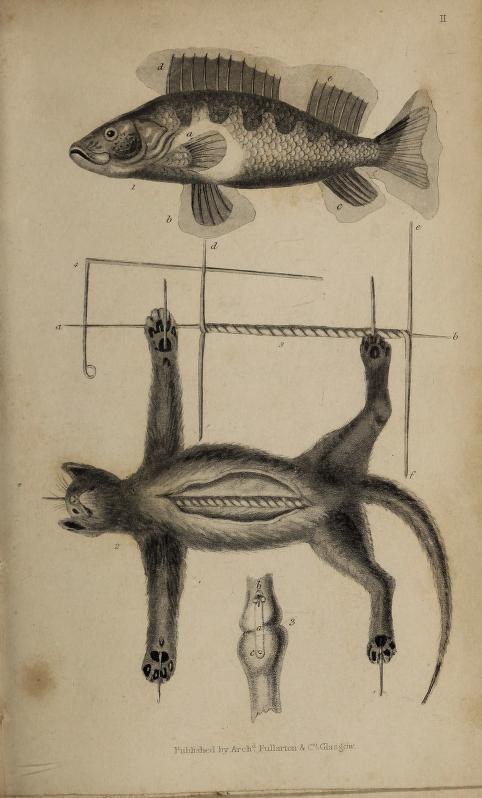
Plate II. Brown, Thomas. The Taxidermist’s Manual, or, The Art of Collecting, Preparing and Preserving Objects of Natural History. 1833. Contributed in BHL by The Thomas Fisher Rare Book Library, University of Toronto.
The text is illustrated by plates cut by Scottish engraver Robert Scott. In stark contrast to the life-like creatures often found in many illustrated natural history volumes, the animals here (including what appears to be a poor domestic cat) are very clearly dead, though they are still idealized. More macabre images may be found on plates four and five, which show the various surgical instruments – scalpels, mallets and pliers – used in the various stages of animal taxidermy. Perhaps the strangest inclusion, however, is a short appendix in which Brown describes a newly discovered French technique for preserving the human body.
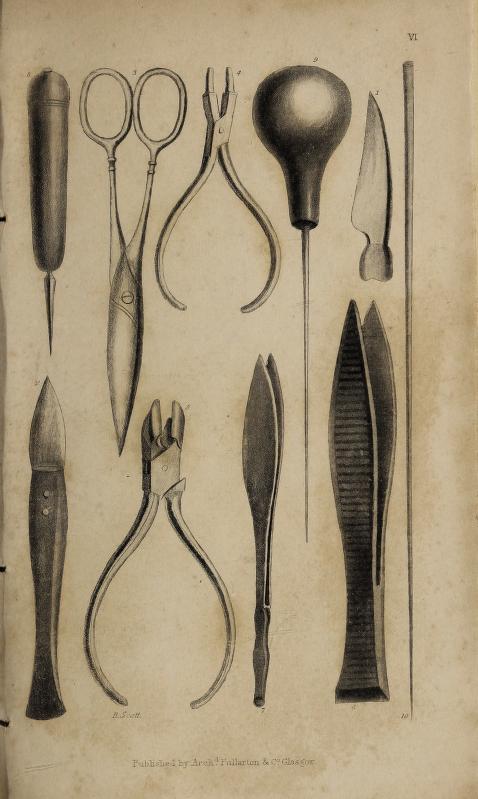
Plate VI. Brown, Thomas. The Taxidermist’s Manual, or, The Art of Collecting, Preparing and Preserving Objects of Natural History. 1833. Digitized by The Thomas Fisher Rare Book Library, University of Toronto.
Popular works like Thomas Brown’s Taxidermist’s manual reveal in morbid detail the unnatural materials and practices that coincided with the study of natural history – the arsenic, wire, stuffing, and false eyes that naturalists employed in their attempts to “avert the process of Time’s destroying hand.”
