Biodiversity Heritage Library - Program news and collection highlights from BHL
  • Home
  • News
  • Featured Books
    • All Featured Books
    • Book of the Month Series
    • BHL at 20
  • User Stories
  • Campaigns
    • Fossil Stories
    • Garden Stories
    • Monsters Are Real
    • Page Frights
    • Her Natural History
    • Earth Optimism 2020
  • Tech Blog
  • Visit BHL
Home
News
Featured Books
    All Featured Books
    Book of the Month Series
    BHL at 20
User Stories
Campaigns
    Fossil Stories
    Garden Stories
    Monsters Are Real
    Page Frights
    Her Natural History
    Earth Optimism 2020
Tech Blog
Visit BHL
  • Home
  • News
  • Featured Books
    • All Featured Books
    • Book of the Month Series
    • BHL at 20
  • User Stories
  • Campaigns
    • Fossil Stories
    • Garden Stories
    • Monsters Are Real
    • Page Frights
    • Her Natural History
    • Earth Optimism 2020
  • Tech Blog
  • Visit BHL
Biodiversity Heritage Library - Program news and collection highlights from BHL
BHL News, Blog Reel

Post Life & Literature: Themes and Outcomes

View Full Size ImageIf you happened to be living under a rock for the past two weeks and missed our blog posts, tweets, and posts on Facebook, you might have missed the fact that last week was the Life and Literature Conference, an event hosted by BHL with the express purpose of generating conversations about the priorities for biodiversity literature digitization, particularly as it pertains to BHL, for the next 4-5 years. The conference, which took place November 14-15, 2011, in Chicago, IL, brought together interested parties in a variety of disciplines, including science, education, informatics, and the humanities. Lively discussions and insightful presentations ensued both days, with dozens of live tweets (hashtag #lifelit) constantly streaming for those who could not participate in person.

The conference was divided into four panel discussions, followed on the second day by break-out sessions that allowed attendees to delve deeply into the various topics discussed during panel sessions, ultimately leading to an outline of the various areas deemed most important for BHL to focus on in the next 4-5 years. The four panel sessions included “Research, Informatics, and the Published Record;” “Publishers, Aggregators, and Authors – New Models and Access;” “Learning and Education;” and “Building Collaborative Networks for Science and the Humanities through Scientific Literature.” A synopsis of the four panels can be found on the Life and Literature site, as well as a list of each of the presenters and their biographies. Session presentations are being loaded to the BHL wiki and can be accessed on the Presentations page. Notes from the sessions can be found on the Life and Literature website. You can also view interviews of conference attendees on the website.

View Full Size ImageIn order to facilitate a discussion with the audience during panel and breakout sessions, BHL staff used an application called Titan Pad, which provides a collaborative environment that allows anyone to access a document to view, edit, or make comments in real time. There were Titan Pad pages for each of the panels and breakouts, and live notes, as well as live discussion, occurred via those avenues. These pages remain live, and we encourage anyone interested to continue the discussion in the weeks to come!

While many ideas and themes resulted from the discussion generated at the conference, perhaps the most recurring topic involved the connection between science and the humanities. Presentations by speakers at the Humanities panel highlighted some of the possible intersections between art and science, and each breakout session touched upon the various ways that BHL could partner with the humanities and make the biodiversity illustrations already in BHL more accessible. The BHL Flickr site, which currently houses more than 20,000 images, was a huge success, and attendees discussed additional ideas about how BHL could further promote its illustrations and engage the arts and humanities communities. Such ideas as specific image searching interfaces, image-specific collections, and collaborations with artist communities were discussed, and BHL staff outlined some art-related grant projects currently in the works.

The winner of the Life and Literature Code Challenge was also presented at the conference. The Code Challenge asked users to create applications that would use, disseminate, or display BHL data in new and meaningful ways. The winner? Ryan Schenk, with his application Synynyms. Synynyms works as a taxonomic name aggregator, finding all of the different names given to a species over the years and displaying the frequency of each name variety throughout history. The names are provided by the Encyclopedia of Life, and the publications come from, you guessed it, BHL! Congratulations to Ryan, and thanks for sharing such an awesome tool with us!

View Full Size ImageLast, but certainly not least, two new members of the BHL family were announced, Cornell University Library and the United States Geological Survey (USGS) Libraries. With these new members joining the fold the BHL consortium is now 14 members strong! Stay tuned for more information about BHL’s newest members to come in future posts.

The Life and Literature conference was also surrounded by a variety of other important BHL meetings, including a BHL Global Meeting (see previous post on the event), a BHL Staff meeting, and a meeting devoted to a discussion on the digitization of biodiversity literature in Africa. Watch for posts on the latter two meetings in the days to come.

As we think about the outcomes of the conference, we are excited to explore the possibilities for the future and inform our development through user feedback. For BHL to serve its purpose, it must meet the needs of its user community, and events like Life and Literature allow us to gather and assess those needs. However, if you couldn’t make it to Life and Literature, or if you did but still have more thoughts on BHL’s future, you can still share them! Contribute your ideas through our Titan Pad discussions, by submitting feedback to our website, or posting your ideas via twitter (@biodivlibrary) and Facebook! We’re waiting to hear from you, and thanks to everyone who made Life and Literature such an exciting and successful venture!

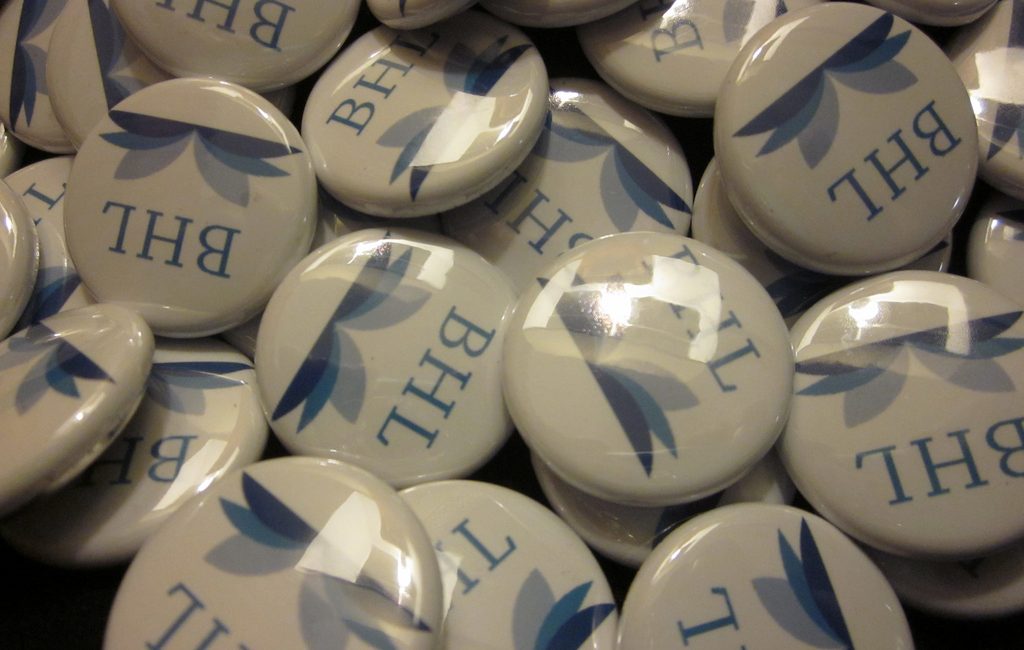
(Images: All images courtesy Martin Kalfatovic. Top: BHL Buttons presented at the Life and Literature Conference; Middle: George Dyson delivering the second plenary speech at Life and Literature; Bottom: SUE – the largest, most complete T-Rex skeleton ever discovered, on display at the Field Museum, the Life and Literature Conference venue)

November 22, 2011by Grace Costantino
BHL News, Blog Reel

What’s in a Logo? Our Users Speak

Several months ago, we introduced a new BHL logo, and to publicize the event, we published a blog post that detailed the various images that BHL Staff Members saw within the abstract lines of our new logo. At the end of the post, we asked our users to share their interpretations of the logo with us as well. Many of you did, and, as promised, we’re sharing those today. We send a special thanks to all of you who shared your thoughts with us, and if our logo inspires other ideas, don’t hesitate to share them by commenting on this blog, sending us a tweet (@BioDivLibrary), or posting on our Facebook wall.

View Full Size Image1) Water: Two users, Aloysius Horn and an anonymous user, left comments on our previous blog post indicating the logo looked like water/waves to them.

View Full Size Image2) Mountains: Via a comment left on a our blog, John told us that our new logo reminded him of mountains.


View Full Size Image3) Butterfly Wings: Sanlin replied, via Twitter, that our logo looked like the flapping wings of a butterfly.


View Full Size Image4) Humpback Whale Tail: Peter Desmet commented via our previous blog post that our logo is “obviously the tail of a humpback whale disappearing behind the waves.”


View Full Size Image5) Flower: An anonymous user on our blog suggested that the logo looks like the petals of a flower.


View Full Size Image6) Our final suggestion involved our former logo, which contained a double-helix and a butterfly. Matt Person (a BHL staff member at MBL-WHOI) told us via Twitter that, in the new logo, he envisioned “a great double helix about to emerge from the center of the logo with a butterfly darting about the top of it.”

October 25, 2011by michelle.underhill
Blog Reel, User Stories

BHL and our Users: Patrick Ives LaFollette

View Full Size Image We at BHL are anxious to find out how our collection and services affect the work of our users at an individual level. With this aspiration in mind, this week we begin a series, BHL and our Users, featuring our users and their testimonials regarding BHL’s impact on their lives and work. So, without further ado, meet Patrick Ives LaFollette, Research Associate in Malacology at the Natural History Museum of Los Angeles, and read what he has to say about how BHL has changed the way he works.

“I’ve had a life-long interest in marine Mollusca, bibliography, and computer technology. Though software development provided a living, my interest in natural history and affiliation with the Los Angeles Natural History Museum has continued uninterrupted to present. In 1995, when I resumed work on the Pyramidellidae, a large and neglected family of microscopic snails, it was evident to me that digital imaging and indexing would be the best method for managing the extensive and scattered literature. There has never been a published catalog or bibliography of the family, so work has to start “from scratch,” with Sherborn, Ruhoff, and Zoological Record. I scanned everything myself until the last few years, when some of the literature started to become available via the World Wide Web.

It’s difficult to say exactly when I first used the Biodiversity Heritage Library – early 2008, I think. The transition to BHL from other Internet sources was gradual until it reached “critical mass” – became the best first place look for titles – during 2009. BHL has since completely superseded other sources. Of the 3500 digital documents I’ve assembled so far, more than 2000 are from BHL. Perhaps two thousand papers are still needed, but most of these fall outside BHL’s scope.

I use BHL several hours a day, almost every day, have done for approaching two years. It is an invaluable resource. It has saved me thousands of travel miles to distant libraries, and thousands of hours locating, evaluating, and scanning the references. I can do this work from home, utilizing any free hour, day or night. This allows me to spend “museum days” working with specimens rather than chasing literature. Of greater importance are the many titles that have been imaged by BHL member libraries that are not in any California library.

For me, the most useful “value added” feature of BHL is the taxonomic index, more specifically the monthly text dump of the index. It meets a need peculiar to projects such as mine where the taxonomic groups are unrevised and poorly documented. Apart from the European species, pyramidellids are poorly known, so are not “verified” by the uBio name search. “Unverified” names are, however, included in the index dump. I have written programs that extract the pyramidellid names and related data from the index, oragnize it, and format a report. This report, which includes URLs for each item and page, allows me to efficiently sift through BHL holdings for potentially relevant papers. When a paper is identified, I download the volume’s page images and extract the article to my database. If not already there, I add the citation to my bibliography. Sherborn, Ruhoff, and Zoological Record index only new species descriptions. The secondary literature is not indexed. BHL indexing finds everything, including the numerous papers those sources ignore. Often, the “papers” found are literature reviews or notices, which may contribute to the bibliography, if not the database.

Thinking about what I would like to see BHL do in the future, number one (and two and three and…) are just to keep on doing what BHL has been doing so well: adding more journals and monographs to the archive, and filling in gaps in existing sets. I would not want BHL to do anything else if it required pulling resources away from the core mission, building the archive until its holdings approach completeness.

That said, I would like to see BHL add the staff and technical capacity necessary to include digitized works from sources beyond the Internet Archive workflow, to take advantage of the numerous institutional, library, society, organizational and individual digitizing projects and free access digital journals that are “out there.” I would also like to see BHL modify its mission statement to not just passively accept, but actively pursue permission to include post-1922 journals.

There is no one title in BHL that I can single out as having a significant impact on my research, nor any specific title to add that I have not already nominated for imaging. It is BHL itself, the totality of its content and execution, that has profoundly changed, and continues to impact my work.”

We sincerely thank Pat for his faithful use of our services and for taking the time to express how important BHL is to him. If you’re interested in highlighting the ways in which BHL is important to your work, don’t hesitate to contact us, either by commenting on this post, leaving us a message on our Facebook page, sending a tweet to @BioDivLibrary, or sending us feedback via our feedback form.
February 15, 2011by Grace Costantino

Help Support BHL

BHL's existence depends on the financial support of its patrons. Help us keep this free resource alive!

search

About BHL

The Biodiversity Heritage Library (BHL) is the world’s largest open access digital library for biodiversity literature and archives. BHL operates as a worldwide consortium of natural history, botanical, research, and national libraries working together to digitize the natural history literature held in their collections and make it freely available for open access as part of a global “biodiversity community.”

Join Our Mailing List

Sign up to receive the latest news, content highlights, and promotions.

Subscribe Now

Subscribe to Blog via Email

Enter your email address to subscribe to this blog and receive notifications of new posts by email.

Join 319 other subscribers

Subscribe to Blog Via RSS

Subscribe to the blog RSS feed to stay up-to-date on all the latest BHL posts.

Access RSS Feed

Inspiring Discovery through Free Access to Biodiversity Knowledge.

The Biodiversity Heritage Library makes it easier than ever for you to access the information you need to study and explore life on Earth…for free, anytime, anywhere.


64+ Million Pages of
Biodiversity Literature Online.

EXPLORE

Tools and Services
to Transform Research.

EXPLORE

300,000+
Illustrations on Flickr.

EXPLORE

ABOUT | HARMFUL CONTENT | PRIVACY | SITE MAP | TERMS OF USE