
Biodiversity Heritage Library - Program news and collection highlights from BHL
  • Home
  • News
  • Featured Books
    • All Featured Books
    • Book of the Month Series
    • BHL at 20
  • User Stories
  • Campaigns
    • Fossil Stories
    • Garden Stories
    • Monsters Are Real
    • Page Frights
    • Her Natural History
    • Earth Optimism 2020
  • Tech Blog
  • Visit BHL
Home
News
Featured Books
    All Featured Books
    Book of the Month Series
    BHL at 20
User Stories
Campaigns
    Fossil Stories
    Garden Stories
    Monsters Are Real
    Page Frights
    Her Natural History
    Earth Optimism 2020
Tech Blog
Visit BHL
  • Home
  • News
  • Featured Books
    • All Featured Books
    • Book of the Month Series
    • BHL at 20
  • User Stories
  • Campaigns
    • Fossil Stories
    • Garden Stories
    • Monsters Are Real
    • Page Frights
    • Her Natural History
    • Earth Optimism 2020
  • Tech Blog
  • Visit BHL
Biodiversity Heritage Library - Program news and collection highlights from BHL
Blog Reel, Campaigns, Featured Books

World Oceans Day through Books: The Truth about Terra Australis

This post is the second in our series leading up to the celebration of World Oceans Day on June 8. This series explores publications that represent important milestones in the progress of marine bioscience research and ocean exploration.

The Quest for Terra Australis: The Expeditions of James Cook

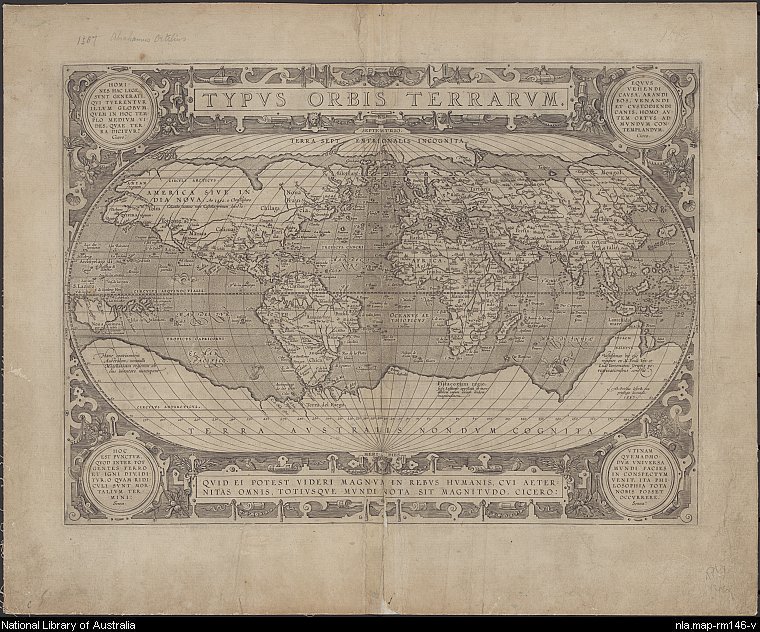
As far back as antiquity, Western scholars theorized the existence of a great southern continent that they called Terra Australis. While the continent found its way onto many early European maps, this presentation was not based on actual surveys but instead the hypothesis that landmasses in the Northern Hemisphere must be balanced by respective landmasses in the Southern. Depictions generally included a single landmass encompassing the South Pole and spreading far north to include Australia, New Zealand and, at its most extreme, even Tierra del Fuego.

View Full Size Image
Map showing imagined Terra Australis. Ortelius, Abraham, 1527-1598. Typus orbis terrarum. Quid ei potest videri magna in rebus cui alter nitas omnis, totiusque mundi nota sit mangitudo. Cicero [cartographic material] 1587. MAP RM 146. http://nla.gov.au/nla.map-rm146. National Library of Australia.

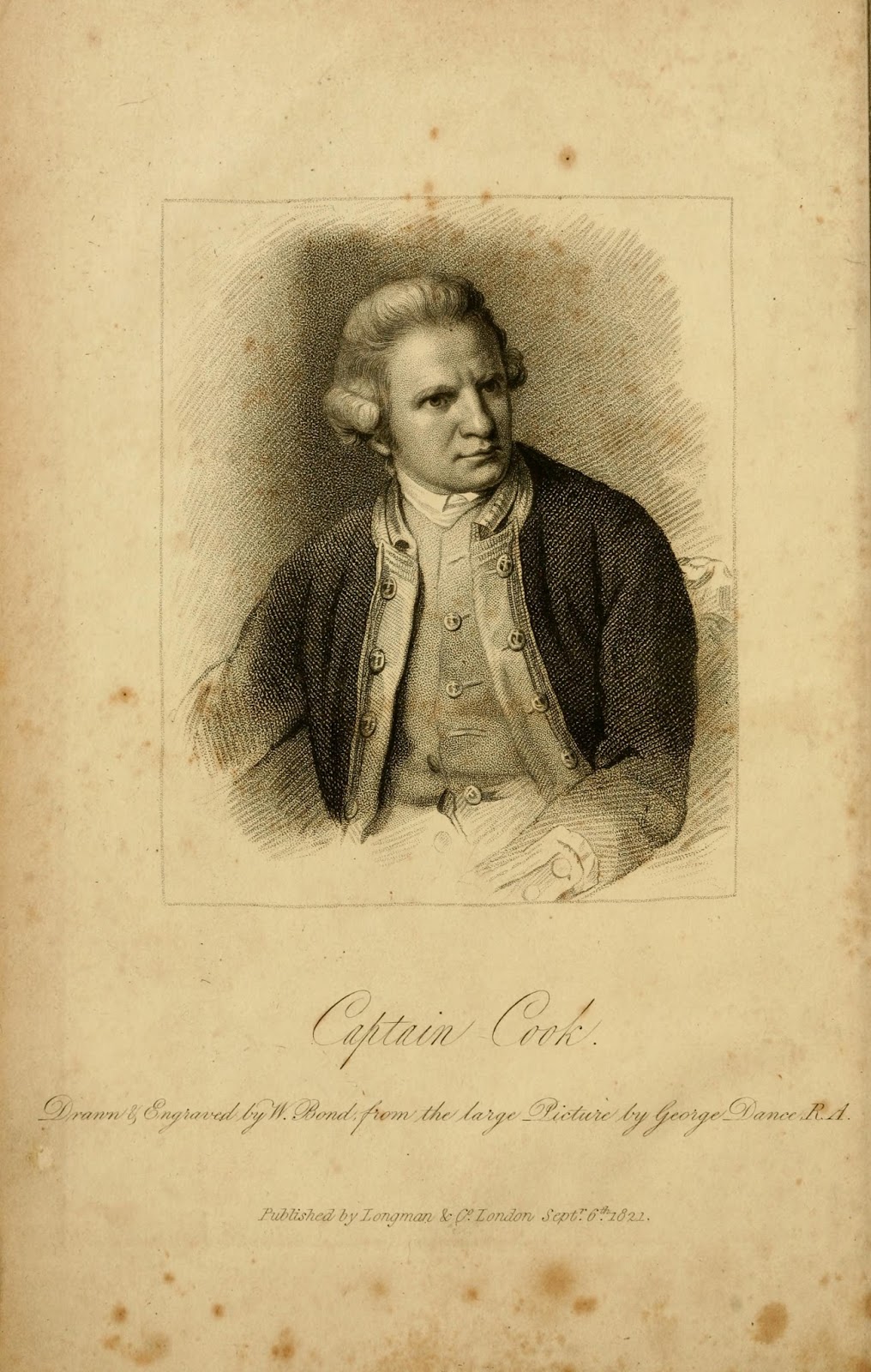
By the mid-18th century, some Europeans claimed to have seen this great southern continent, but details were scarce and verification virtually non-existent. The intrigue prompted the British Admiralty and Royal Society to direct Lieutenant James Cook, as part of a larger mission from 1768-71 to observe the transit of the planet Venus from Tahiti, to search for Terra Australis.
View Full Size Image
Portrait of James Cook. The three voyages of Captain James Cook round the world. v. 1. 1921. http://biodiversitylibrary.org/page/6227900.

In September 1769, Cook’s ship, the Endeavour, reached New Zealand, after which Cook spent six months circumnavigating the island to ultimately establish that it was not, as was commonly believed, part of the “southern continent.” From New Zealand, Cook and his crew sailed towards Australia, becoming the first recorded Europeans to reach the Australian east coast in April 1770. Sailing north, Cook charted over 5,000 miles of coastline and further demonstrated that Australia and New Guinea were not connected.

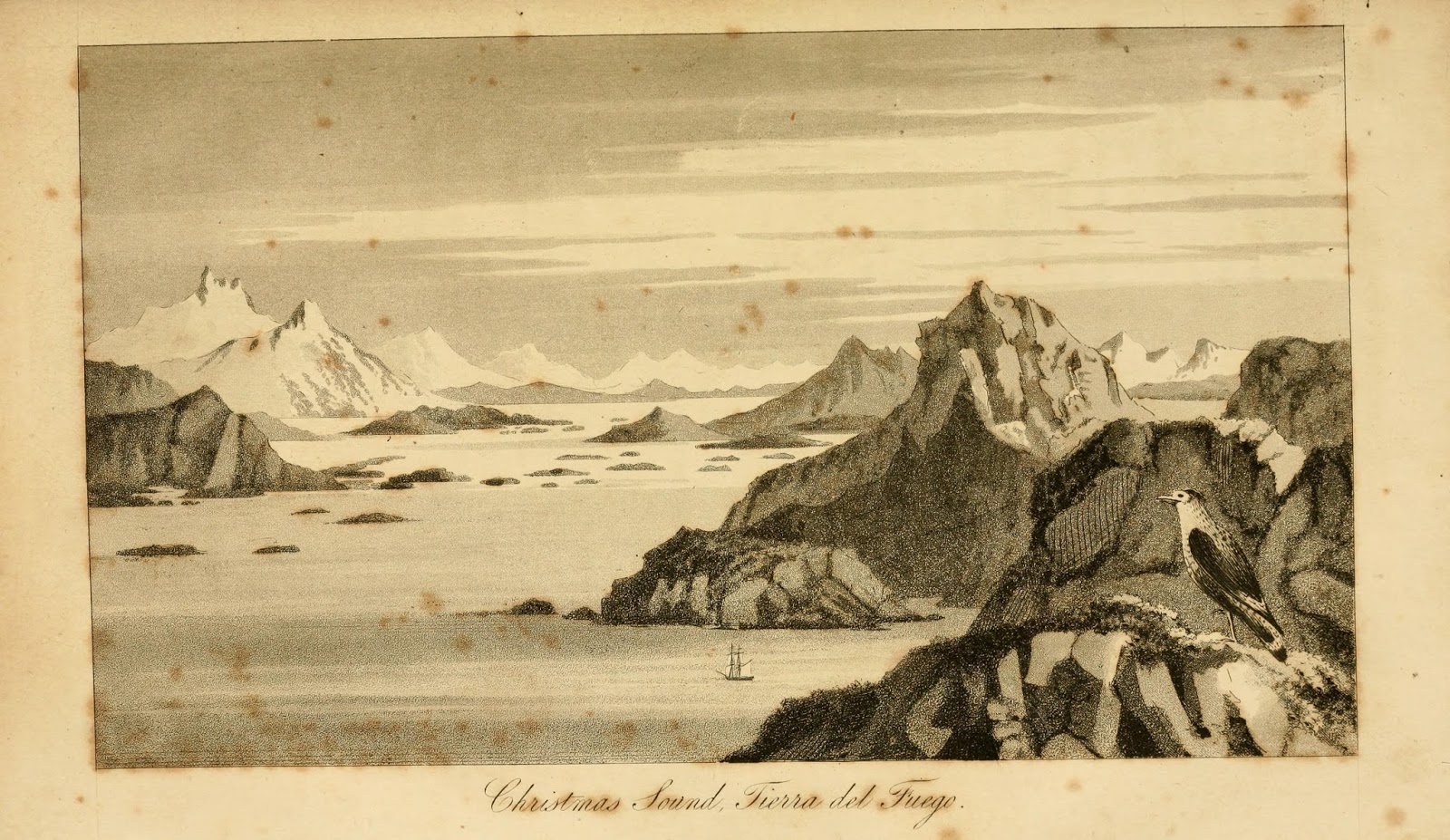
Cook went on to command two additional expeditions, the second of which (1772-75) brought Cook closer to the South Pole than any recorded previous navigator, finally disproved the existence of a large southern continent as expansive as the envisioned Terra Australis, demonstrated that chronometers were a practical means of determining longitude at sea, and laid the foundations for a modern map of the South Pacific, thus paving the way for future explorations in the area.
View Full Size Image
Cook, James. Christmas Sound, Tierra del Fuego. From Cook’s second voyage (1772-75). The three voyages of Captain James Cook round the world. v. 4. 1921. http://biodiversitylibrary.org/page/6258591.

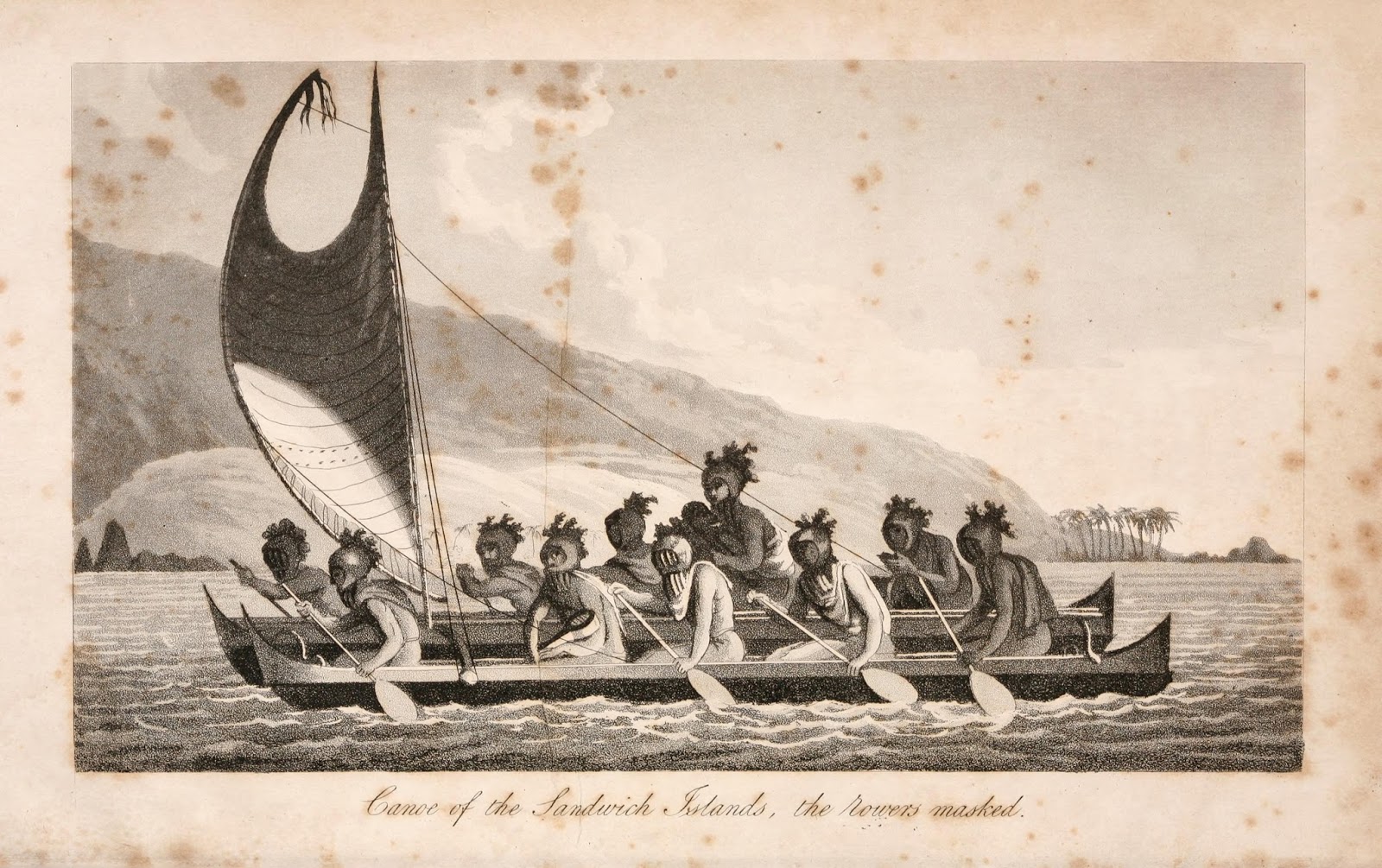
Cook’s third and final voyage (1776-80) attempted to discover the elusive northwest passage. Although he was unsuccessful, he did become the first recorded European to visit the Hawaiian Islands and charted the coast of northwest America. Tragically, Cook was killed on the return voyage during a confrontation on the Hawaiian Islands on 14 February 1779.
View Full Size Image
Canoe of the Sandwich (i.e. Hawaiian Islands). From Cook’s third voyage (1776-80). The three voyages of Captain James Cook round the world. v. 6. 1921. http://biodiversitylibrary.org/page/1803270.

Cook’s achievements did much to pave the way for future oceanic exploration, especially around Australia. He helped lift the veil of uncertainty surrounding “Terra Australis,” and helped to establish a viable method by which to more easily navigate the oceans (via a chronometer). Furthermore, by methodically enforcing cleanliness and ventilation on his ships and a balanced diet for his crew, he dramatically improved the living conditions and health of his crew and set new standards for future expeditions.

An account of Cook’s three voyages, taken in part from his journals, are available in the seven volumes of The Three Voyages of Captain James Cook around the World (1821).

Exploring Oceania: Voyage of the Astrolabe

Following Cook’s expedition, France and England vied intensely for southern possessions, resulting in many expeditions that expanded our knowledge of the oceans and marine life around Australia and New Zealand.

Early French expeditions to the region included the 1800-1804 cartographic survey of Australia’s coastline, under Nicolas Thomas Baudin, which resulted in the first published detailed chart of Australia, and the voyage of the Coquille from 1822-25, under the command of Louis Isidore Duperrey. Navigator Jules-Sébastien-César Dumont d’Urville served as second-in-command on the Coquille expedition, and just two months after its return, d’Urville requested a second voyage to the South Seas, this time with him in command.
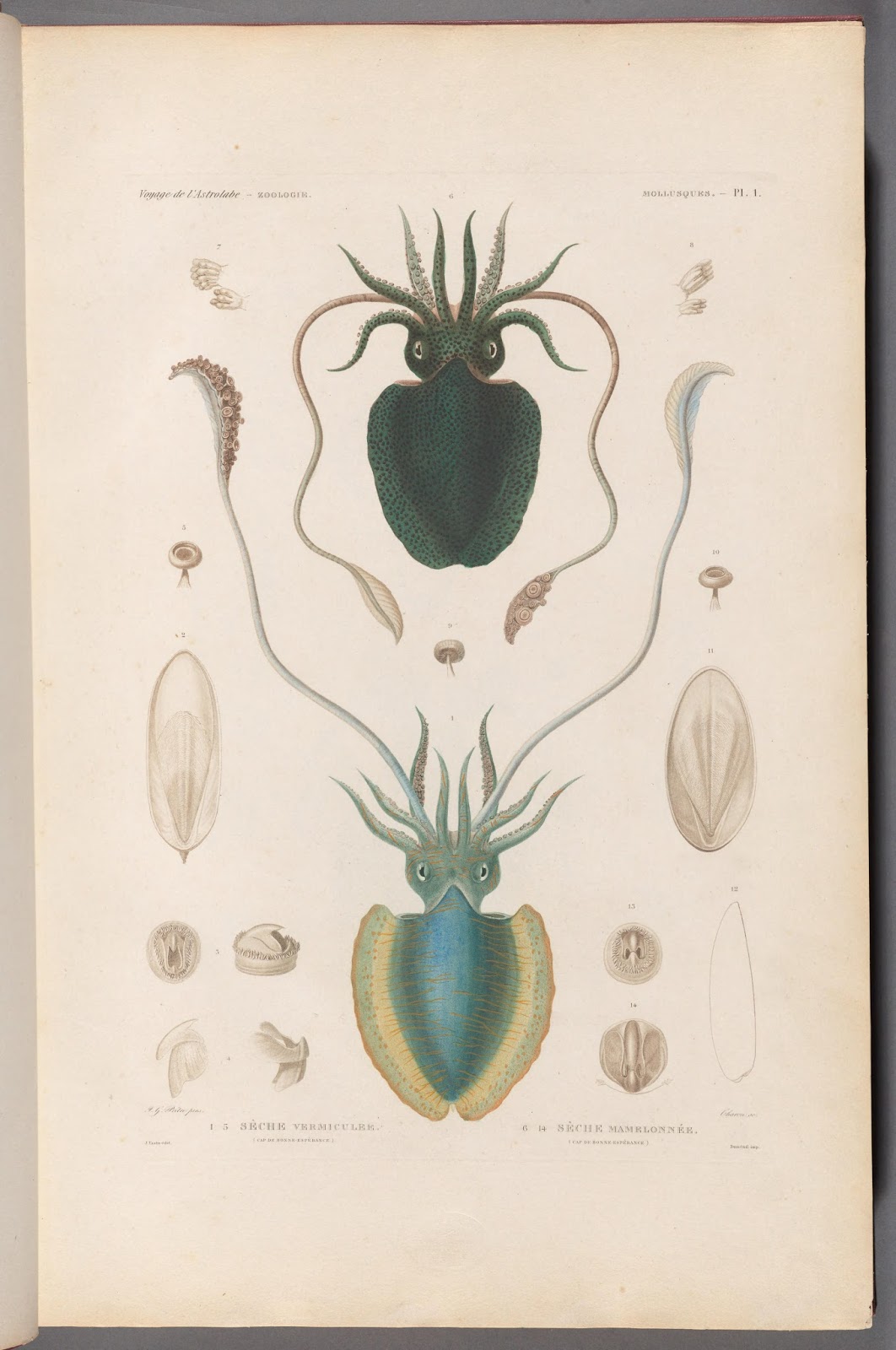
View Full Size Image
Cuttlefish. Dumont d’Urville, Jules-Sébastien-César. Voyage de la corvette l’Astrolabe : exécuté par ordre du roi, pendant les années 1826-1827-1828-1829. 1830-34. http://biodiversitylibrary.org/page/46298902.

In 1826, the Coquille, renamed the Astrolabe, set sail with a mission to chart the unknown regions of Oceania. This time, the expedition also included many worthy naturalists, including Pierre Adolphe Lesson, Jean René Constant Quoy, and Joseph Paul Gaimard. The expedition resulted in the discovery of many new-to-science species in Oceania, important ethnographic studies, and “the first tentative speculations as to how coral reefs and atolls could have formed in the middle of the deep tropical oceans” (Stiassny, 51). The expedition’s findings were published in a fourteen-volume series from 1830-34, entitled Voyage de la corvette l’Astrolabe.
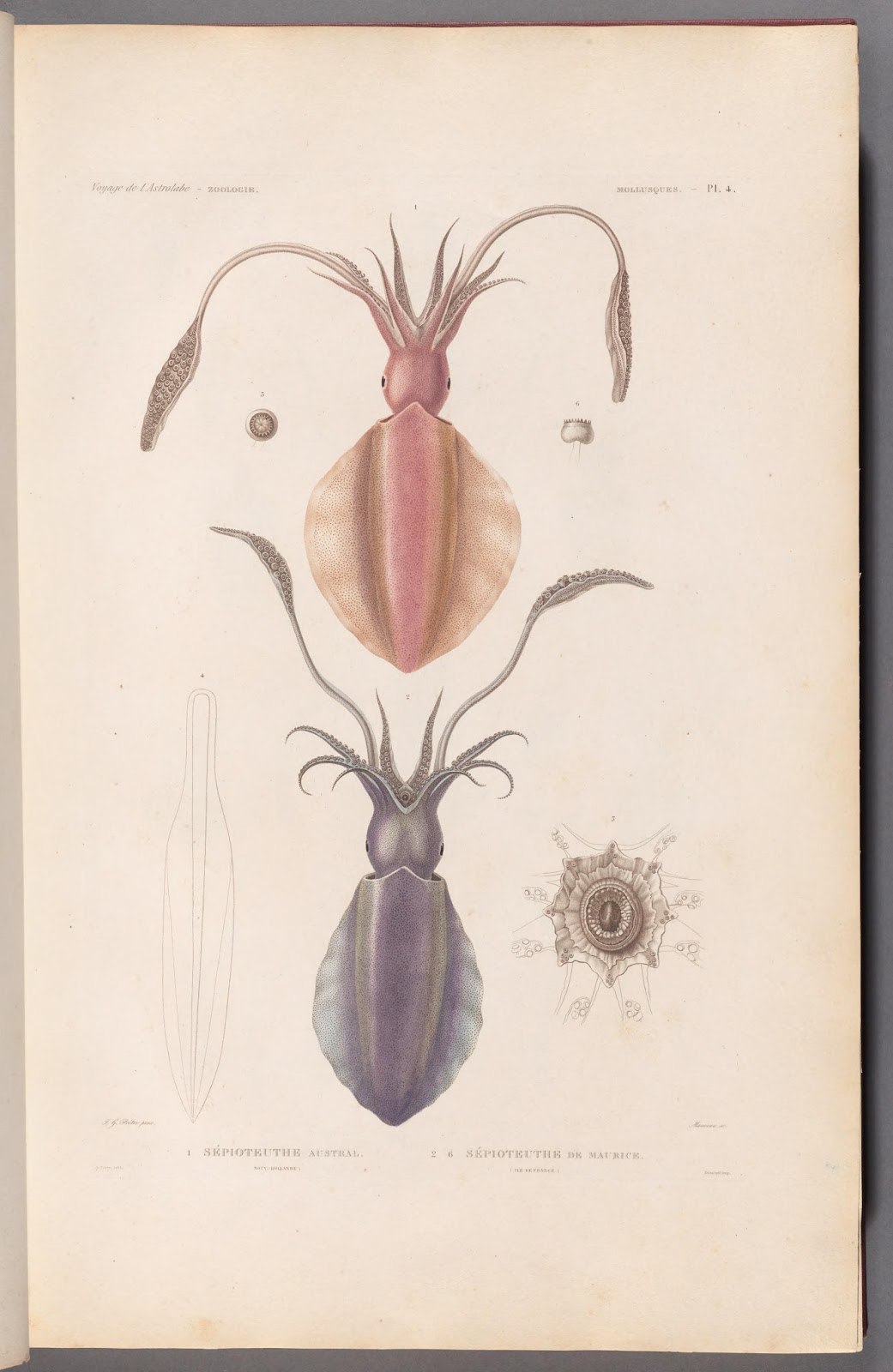
View Full Size Image
Reef Squids. Dumont d’Urville, Jules-Sébastien-César. Voyage de la corvette l’Astrolabe : exécuté par ordre du roi, pendant les années 1826-1827-1828-1829. 1830-34. http://biodiversitylibrary.org/page/46298896.

More World Oceans Day Resources

  • Follow us on Twitter, Facebook, and this blog all this week as we explore marine biodiversity and awesome related publications in BHL.
  • Check out some monumental publications in historic and present-day marine bioscience research in our BHL collection.
  • Browse a selection of marine biodiversity illustrations in Flickr and Pinterst
June 2, 2015by michelle.underhill
Blog Reel, Featured Books

Book of the Week: Darwin for Children

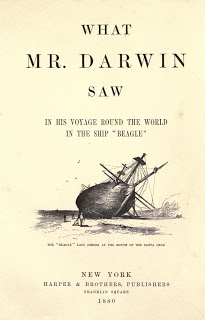
View Full Size ImageThe great scientific discoveries that have been made during the many incredible exploring expeditions throughout history have long interested both scientists and laymen alike, and perhaps none more so than the voyages undertaken by Charles Darwin himself on the H.M.S. Beagle. While the appeal of the narratives of these expeditions to adults may seem obvious, engaging children in such works is not always simple. The concern with “interest[ing] children in the study of natural history, and of physical and political geography”so that they might exhibit enthusiasm for nature throughout their lives is the chief concern of this week’s book of the week, What Mr. Darwin saw in his voyage round the world in the ship “Beagle” (1880), compiled from Darwin’s Journal of researches into the geology and natural history of the various countries visited by H. M. S. Beagle.

In a preface directed towards parents, the author writes,

“The compiler has thought it an advantage to connect stories about a great variety of animals with one person, and he an observer of such credibility and authority that little if anything that was learned of him would have to be unlearned. Mr. Darwin is, of course, pre-eminently such an observer. On the other hand, by carefully connecting these stories with the places on the earth’s surface where the animals were studied, a correct notion will be had of the distribution of the animal kingdom, with a corresponding insight into the geography of the globe in its broadest sense.”

What Mr. Darwin Saw is divided into four parts: Animals, Man (describing the people and cultures encountered on the voyage), Geography (describing the cities, rivers, mountains, valleys, plains, etc. seen on the expedition), and Nature (discussing the “grander terrestrial processes and phemonena” encountered). The original text comes from Darwin’s writings, though some small alterations have been made for the publication to take into account audience and overall organization. Since the changes are so minimal, the work is still attributed to Charles Darwin.

Before beginning the main narrative of What Mr. Darwin Saw, children are given a short biography of Charles Darwin and a description of the voyage of the H.M.S. Beagle. Children are then urged to test their own powers of observation by counting how many animals they can find in an accompanying woodcut by Thomas Bewick.

The description of the animals, people, geography and nature in the following sections of text are rich and inviting, as they are presented in a highly conversational tone produced from Darwin’s own observations. Children would be highly entertained to read Darwin’s description of the Guanaco, or Wild Llama’s, reactions around strange behavior in humans. They would likewise be thrilled to read of the dangerous encounter Darwin and his team experienced with an ice cliff, and their imaginations would be stimulated by Darwin’s description of the coral and coral architects around the visited lagoon islands. And while these writings may have been directed at children, they are nevertheless singularly engrossing for adults as well. So, whether child or adult, take a few minutes to look through Darwin’s narrative of the biodiversity, cultures and geography encountered on that monumental voyage of the H.M.S. Beagle.

This week’s book of the week, What Mr. Darwin saw in his voyage round the world in the ship “Beagle” (1880), by Charles Darwin, was contributed by the University of California Libraries.

September 22, 2010by michelle.underhill

Help Support BHL

BHL's existence depends on the financial support of its patrons. Help us keep this free resource alive!

search

About BHL

The Biodiversity Heritage Library (BHL) is the world’s largest open access digital library for biodiversity literature and archives. BHL operates as a worldwide consortium of natural history, botanical, research, and national libraries working together to digitize the natural history literature held in their collections and make it freely available for open access as part of a global “biodiversity community.”

Join Our Mailing List

Sign up to receive the latest news, content highlights, and promotions.

Subscribe Now

Subscribe to Blog via Email

Enter your email address to subscribe to this blog and receive notifications of new posts by email.

Join 319 other subscribers

Subscribe to Blog Via RSS

Subscribe to the blog RSS feed to stay up-to-date on all the latest BHL posts.

Access RSS Feed

Inspiring Discovery through Free Access to Biodiversity Knowledge.

The Biodiversity Heritage Library makes it easier than ever for you to access the information you need to study and explore life on Earth…for free, anytime, anywhere.


64+ Million Pages of
Biodiversity Literature Online.

EXPLORE

Tools and Services
to Transform Research.

EXPLORE

300,000+
Illustrations on Flickr.

EXPLORE

ABOUT | HARMFUL CONTENT | PRIVACY | SITE MAP | TERMS OF USE

