
Biodiversity Heritage Library - Program news and collection highlights from BHL
  • Home
  • News
  • Featured Books
    • All Featured Books
    • Book of the Month Series
    • BHL at 20
  • User Stories
  • Campaigns
    • Fossil Stories
    • Garden Stories
    • Monsters Are Real
    • Page Frights
    • Her Natural History
    • Earth Optimism 2020
  • Tech Blog
  • Visit BHL
Home
News
Featured Books
    All Featured Books
    Book of the Month Series
    BHL at 20
User Stories
Campaigns
    Fossil Stories
    Garden Stories
    Monsters Are Real
    Page Frights
    Her Natural History
    Earth Optimism 2020
Tech Blog
Visit BHL
  • Home
  • News
  • Featured Books
    • All Featured Books
    • Book of the Month Series
    • BHL at 20
  • User Stories
  • Campaigns
    • Fossil Stories
    • Garden Stories
    • Monsters Are Real
    • Page Frights
    • Her Natural History
    • Earth Optimism 2020
  • Tech Blog
  • Visit BHL
Biodiversity Heritage Library - Program news and collection highlights from BHL
Blog Reel, Featured Books

Book of the Week: Spiders, Spiders and More Spiders

View Full Size Image
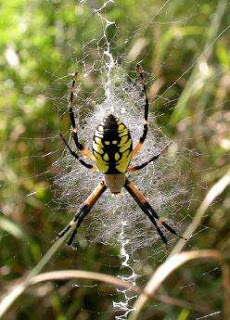
If you’ve been outside gardening lately, or even simply taking a closer look at the greenery around you, you probably noticed that you were not quite alone. Indeed, the coming of the warm weather also sparks the coming of a plethora of new life, among them insects and spiders. And if you live in the lower 48 states, Mexico or Central America, you may have seen one of the featured species on EOL – Argiope aurantia – the Black and Yellow Argiope.

Argiope aurantia is one of the “largest and most colorful orbweaving spiders from northeastern to southwestern North American.” As orbweavers, Argiope aurantia build spiral, wheel-shaped webs, the round shape of which gives this spider and those with similar webs their “orbweaver” name. The life expectancy of Argiope aurantia in temperate climates is a mere year, with life lasting from birth in the fall to the “first harsh frost in the following year.” In warmer climates and captivity, however, the outlook is slightly better for the females, which may live several years. Unfortunately for the males, they probably die after mating in their first year. Nevertheless, the conservation status for this species is good, as their commonality and widespread distribution currently ensures that they are in no danger of going extinct anytime soon.

Argiope aurantia is one of the many species of spiders and other invertebrates featured in this week’s book of the week, A Manual of the Common Invertebrate Animals, Exclusive of Insects, by Henry Sherring Pratt (1923), contributed by the Marine Biological Laboratory at the Woods Hole Oceanographic Institution. Within this volume, Argiope aurantia is described as,

“Body large and conspicuous, being often 25mm. long, with long legs; abdomen black and 2 bright yellow or orange bands underneath; cephalothorax gray above and yellow underneath; the web is sometimes 2 feet in diameter and has a zigzag band of silk across the middle; the male has a small, irregular web nearby; [found] in grass and bushes; in open fields, especially near water.”

Take a moment to look more closely at this colorful species on EOL and within this week’s book of the week. And if you’re out and about this summer, be sure to keep your eyes peeled for “zigzag bands of silk” in the grass and bushes, for you might just find that the spash of bright orange or yellow in the middle of the web is indeed Argiope aurantia, the Black and Yellow Argiope.

June 15, 2010by ulib-libraryjobs

Help Support BHL

BHL's existence depends on the financial support of its patrons. Help us keep this free resource alive!

search

About BHL

The Biodiversity Heritage Library (BHL) is the world’s largest open access digital library for biodiversity literature and archives. BHL operates as a worldwide consortium of natural history, botanical, research, and national libraries working together to digitize the natural history literature held in their collections and make it freely available for open access as part of a global “biodiversity community.”

Join Our Mailing List

Sign up to receive the latest news, content highlights, and promotions.

Subscribe Now

Subscribe to Blog via Email

Enter your email address to subscribe to this blog and receive notifications of new posts by email.

Join 319 other subscribers

Subscribe to Blog Via RSS

Subscribe to the blog RSS feed to stay up-to-date on all the latest BHL posts.

Access RSS Feed

Inspiring Discovery through Free Access to Biodiversity Knowledge.

The Biodiversity Heritage Library makes it easier than ever for you to access the information you need to study and explore life on Earth…for free, anytime, anywhere.


64+ Million Pages of
Biodiversity Literature Online.

EXPLORE

Tools and Services
to Transform Research.

EXPLORE

300,000+
Illustrations on Flickr.

EXPLORE

ABOUT | HARMFUL CONTENT | PRIVACY | SITE MAP | TERMS OF USE