

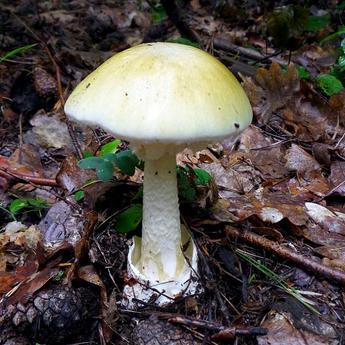
 It is one of the most poisonous of all known toadstools, and it is responsible for a majority of human deaths involving its type – mushrooms. It is the Amanita phalloides, more commonly known as the Death Cap. This innocent-looking fungi has been blamed for the deaths of Roman Emperor Claudius and Holy Roman Emperor Charles VI. It causes, often fatal, damage to the kidneys and liver, and there is no known antidote.
Amanita phalloides is widely distributed throughout Europe, particularly in the southern parts of the continent. However, with the cultivation of non-native species of oak, chestnut, and pine, the Death Cap has been accidentally introduced to other regions, including New Zealand, North America and South Africa.
The Death Cap is a topic of much discussion in this week’s book of the week, A Manual of Poisonous Plants: chiefly of eastern North America, with brief notes on economic and medicinal plants, and numerous illustrations (1910-11), by L. H. Pammel. The reader is warned in no uncertain terms about the danger this species poses to humans. Quoting a “Professor Peck,” the text reads:
“The Poison amanita is very variable in the color of the cap, and yet is so definite in its structural characters’ that only the most careless observer would be likely to confuse it with any other species. There is, however, a sort of deceptive character about it. It is very neat and attractive in its appearance and looks as if it might be good enough to eat. This appearance is fortified by the absence of any decidedly unpleasant odor or taste, but let him who would eat it beware, for probably there is not a more poisonous or dangerous species in our mycological flora. To eat it is to invite death.”
Take a closer look at this species within this week’s book of the week, and read more to find tips on how to identify this species and avoid misidentification that could prove, well, fatal. And, once you’re finished with Amanita phalloides, feel free to read on about more poisonous plants found throughout Eastern North America.
This week’s book of the week, A Manual of Poisonous Plants: chiefly of eastern North America, with brief notes on economic and medicinal plants, and numerous illustration (1910-11), by L. H. Pammel, was contributed by the New York Botanical Garden.
