

Biodiversity Heritage Library - Program news and collection highlights from BHL
  • Home
  • News
  • Featured Books
    • All Featured Books
    • Book of the Month Series
    • BHL at 20
  • User Stories
  • Campaigns
    • Fossil Stories
    • Garden Stories
    • Monsters Are Real
    • Page Frights
    • Her Natural History
    • Earth Optimism 2020
  • Tech Blog
  • Visit BHL
Home
News
Featured Books
    All Featured Books
    Book of the Month Series
    BHL at 20
User Stories
Campaigns
    Fossil Stories
    Garden Stories
    Monsters Are Real
    Page Frights
    Her Natural History
    Earth Optimism 2020
Tech Blog
Visit BHL
  • Home
  • News
  • Featured Books
    • All Featured Books
    • Book of the Month Series
    • BHL at 20
  • User Stories
  • Campaigns
    • Fossil Stories
    • Garden Stories
    • Monsters Are Real
    • Page Frights
    • Her Natural History
    • Earth Optimism 2020
  • Tech Blog
  • Visit BHL
Biodiversity Heritage Library - Program news and collection highlights from BHL
Blog Reel, Featured Books

Book of the Week: So You Saw Jaws and You Think You Know Sharks?

View Full Size Image
You would be hard-pressed to find someone today who has not seen the legendary Jaws movie. The movie defined a generation and solidified sharks as one of the most gruesome and dangerous killers on the planet. But such misconceptions are an injustice to this diverse, and often harmless, order of fish, some of which reach a mature length shorter than that of an average housecat.


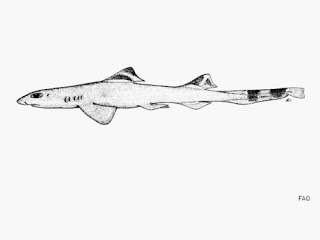
Case in point: Meet Eridacnis radcliffei, also known by the common name of the Pygmy Ribbontail Cat Shark, which, at 19-24 centimeters, is one of the smallest sharks in the world. Eridacnis radcliffei is a member of the Carcharhiniformes order, “typical” sharks characterized by “long mouths, two dorsal fins without spines, an anal fin, and the eyes over the mouth.” These sharks differ from sharks in other orders “in having movable lower eyelids.”


Occuring around continental and insular shelves, the Pygmy Ribbontail Cat Shark is found in the western Indo-Pacific from Tanzania to the Philippines. Its diet consists mostly of bony fishes, crustaceans and squid. This species is of minimal importance to the fishing industry, being sometimes caught in bottom trawls off the coast of the Philippines but not typically sold in the industry. They are currently listed as “Least Concern” by the IUCN.


This week’s book of the week, v. 24, n. 4 (1981) of Oceanus, contains a very interesting article by Leonard J. V. Compagno, entitled “Legend versus Reality: The Jaws Image and Shark Diversity.” In it, he tackles the widely-accepted conception that all sharks are behemoths that can be “typified by large and powerful species.” Such impressions have been encouraged by the advent of films such as Jaws and Deep Blue Sea, which represent sharks as monstrous goliaths capable of, should they so choose, swallowing humans whole.


Within this article, Compagno takes an objective look at the superorder of Selachimorpha – sharks – finding that, in the 296 shark species that he studied, only about 4% were more than 4 meters long. And our friend, the Pygmy Ribbontail Cat Shark, gets its moment in the spotlight on pages 15–16, were it is highlighted as one of the smallest shark species in the world.


Take a few moments to flip through Compagno’s article, possibly re-evaluating your conception of the shark as a giant killer to the beautifully diverse range of aquatic species that it is. And to learn even more about our highlighted species, the Pygmy Ribbontail Cat Shark, explore its page on the Encylopedia of Life.


This week’s book of the week, v. 24, no. 4 (1981) of Oceanus, was contributed by the MBL WHOI library.

January 6, 2011by ulib-libraryjobs

Help Support BHL

BHL's existence depends on the financial support of its patrons. Help us keep this free resource alive!

search

About BHL

The Biodiversity Heritage Library (BHL) is the world’s largest open access digital library for biodiversity literature and archives. BHL operates as a worldwide consortium of natural history, botanical, research, and national libraries working together to digitize the natural history literature held in their collections and make it freely available for open access as part of a global “biodiversity community.”

Join Our Mailing List

Sign up to receive the latest news, content highlights, and promotions.

Subscribe Now

Subscribe to Blog via Email

Enter your email address to subscribe to this blog and receive notifications of new posts by email.

Join 319 other subscribers

Subscribe to Blog Via RSS

Subscribe to the blog RSS feed to stay up-to-date on all the latest BHL posts.

Access RSS Feed

Inspiring Discovery through Free Access to Biodiversity Knowledge.

The Biodiversity Heritage Library makes it easier than ever for you to access the information you need to study and explore life on Earth…for free, anytime, anywhere.


64+ Million Pages of
Biodiversity Literature Online.

EXPLORE

Tools and Services
to Transform Research.

EXPLORE

300,000+
Illustrations on Flickr.

EXPLORE

ABOUT | HARMFUL CONTENT | PRIVACY | SITE MAP | TERMS OF USE