
Biodiversity Heritage Library - Program news and collection highlights from BHL
  • Home
  • News
  • Featured Books
    • All Featured Books
    • Book of the Month Series
    • BHL at 20
  • User Stories
  • Campaigns
    • Fossil Stories
    • Garden Stories
    • Monsters Are Real
    • Page Frights
    • Her Natural History
    • Earth Optimism 2020
  • Tech Blog
  • Visit BHL
Home
News
Featured Books
    All Featured Books
    Book of the Month Series
    BHL at 20
User Stories
Campaigns
    Fossil Stories
    Garden Stories
    Monsters Are Real
    Page Frights
    Her Natural History
    Earth Optimism 2020
Tech Blog
Visit BHL
  • Home
  • News
  • Featured Books
    • All Featured Books
    • Book of the Month Series
    • BHL at 20
  • User Stories
  • Campaigns
    • Fossil Stories
    • Garden Stories
    • Monsters Are Real
    • Page Frights
    • Her Natural History
    • Earth Optimism 2020
  • Tech Blog
  • Visit BHL
Biodiversity Heritage Library - Program news and collection highlights from BHL
Blog Reel, Featured Books

Book of the Week: Cabinet of Oriental Entomology

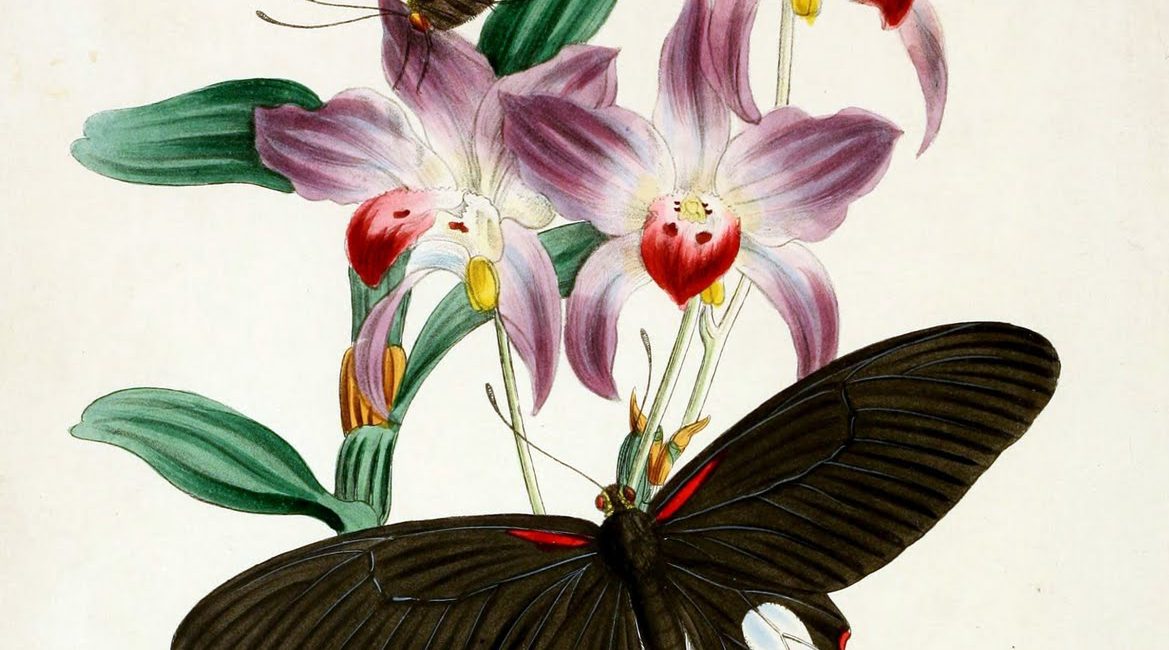
It’s bugs galore today as we feature the book The Cabinet of Oriental Entomology (1848), by J.O. Westwood. This delightful book is full of gorgeous illustrations of exotic insects. We’re picking out some of the illustrations that we particularly love and providing you with an excerpt of what the author had to say about the creatures shown. Enjoy!

View Full Size Image1) Papilio icarius

“Assam appears to be pre-eminently rich in the species of Papilio. A number of new species, from this region and the neighboring district of Sylhet, were figured in my ‘Arcana Entomologica,’ but none of them will bear comparison with the present insect, either for size or singularity of form, owing to the extraordinary elongation of the hind wings and the short dilated tails…Adopting the excellent system of nomenclature proposed with so much taste by Linnaeus, whereby the species of the modern genus Papilio were distinguished by the name of the famous heroes of antiquity, the present species…is named after Icarius, the son of Ebalus and Erigone; who, having been killed by some peasants of Greece, whose companions he had made drunk with wine, (a liquor till then unknown to them, and which from its effects they thought to be poison,) was transformed by Jupiter into a star, which was supposed by some persons to be identical with the celestial Bootes.”

2) Eucheirus macleaiiView Full Size Image
(Figure One: Male; Figure Two: Female)

“India and the adjacent islands offer to us a striking peculiarity in respect to the geographical distribution of the gigantic species of Lamellicorn beetles. Whilst the New World is inhabited by a great number of these fine insects…the tropical oriental regions can boast but of few; these however, are distinguished by their metallic or variegated appearance, of which their American brethren are destitute.”

View Full Size Image

3) Figure One: Saturnia simla

“The female of this fine species has the fore wings comparatively larger and less hooked than in the males…I trust that, in consequence of Captain Boys’ arrival in England, I shall be enabled, in a subsequent article, to communicate an account of the early states of this insect.”

Figure Two: Saturnia assama

View Full Size Image

4) Lower Figure: Actias maenae

“The accompanying figure of this very fine insect is copied from a specimen kindly communicated for representation by W.W. Saunders, Esq., F.L.S., which differs in some respects from Mr. Doubleday’s description of the species, recently published…This is certainly one of the finest of the recent additions to the list of oriental Lepidoptera; but I am informed that Dr. Boisduval possesses a species of this genus from Madagascar with much longer tails to the hind wings.”

Upper Figure: Leucophlebia lineata

“This beautiful insect appears to possess the characters of a distinct genus, in the classification of the exotic Nocturnal Heterocerous Lepidoptera; its elongated body and wings give it an analogy with some of the Sphingidae, as well as to some of the prominent moths, especially to Leiocampa Dictoea.”

View Full Size Image5) Figure One: Bacteria sarmentosa

“This species of walking-stick insect is longer than any which I have yet seen. It is represented of the natural size, but its full extent is here decreased by unnaturally bending back the fore legs (in order to bring them into the plates) which in the living insect are directed straight forwards…The insect described above is a female; I possess also another female, which I consider to belong to the same species, which is only 7 1/2 inches long, and agrees with it in all its characters, except that the 6th ventral segment has only a minute oval sulcated tubercule at its extremity.”

Figure Two: Bacteria virgea

“The proportions and general appearance of this insect indicate that it is most probably the male of the preceding. It is on this account that I have represented them both on one plate.”

Take some time to explore the other beautiful plates in this book. The insect world is certainly nothing if not colorful!

June 2, 2011by michelle.underhill

Help Support BHL

BHL's existence depends on the financial support of its patrons. Help us keep this free resource alive!

search

About BHL

The Biodiversity Heritage Library (BHL) is the world’s largest open access digital library for biodiversity literature and archives. BHL operates as a worldwide consortium of natural history, botanical, research, and national libraries working together to digitize the natural history literature held in their collections and make it freely available for open access as part of a global “biodiversity community.”

Join Our Mailing List

Sign up to receive the latest news, content highlights, and promotions.

Subscribe Now

Subscribe to Blog via Email

Enter your email address to subscribe to this blog and receive notifications of new posts by email.

Join 319 other subscribers

Subscribe to Blog Via RSS

Subscribe to the blog RSS feed to stay up-to-date on all the latest BHL posts.

Access RSS Feed

Inspiring Discovery through Free Access to Biodiversity Knowledge.

The Biodiversity Heritage Library makes it easier than ever for you to access the information you need to study and explore life on Earth…for free, anytime, anywhere.


64+ Million Pages of
Biodiversity Literature Online.

EXPLORE

Tools and Services
to Transform Research.

EXPLORE

300,000+
Illustrations on Flickr.

EXPLORE

ABOUT | HARMFUL CONTENT | PRIVACY | SITE MAP | TERMS OF USE