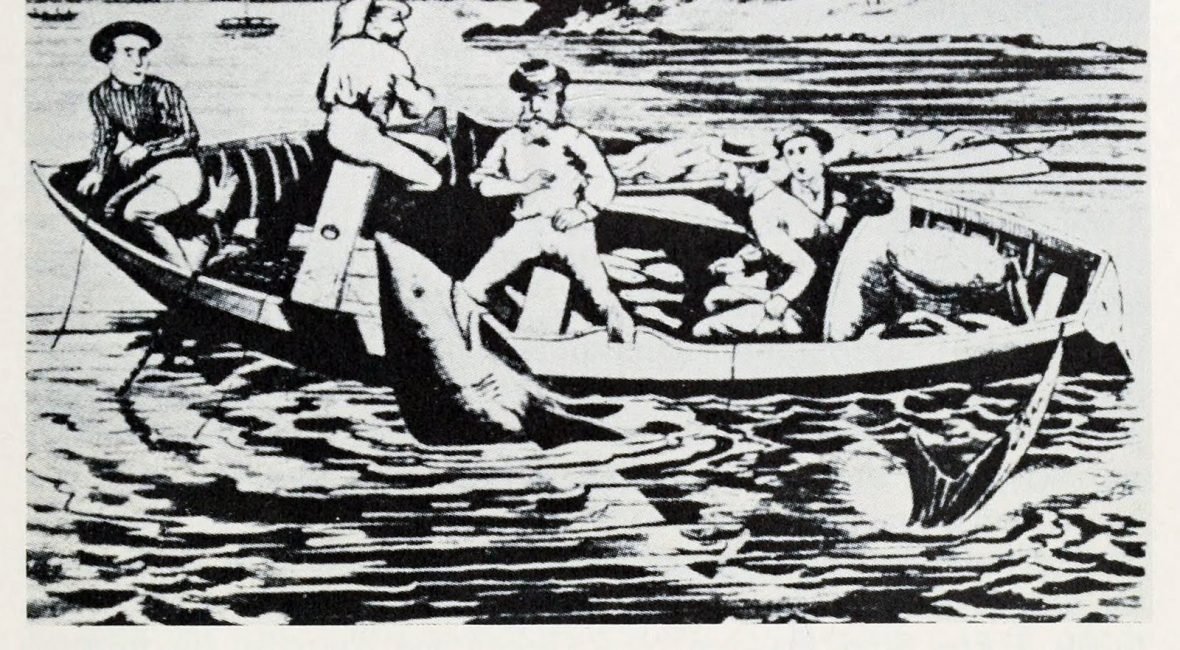
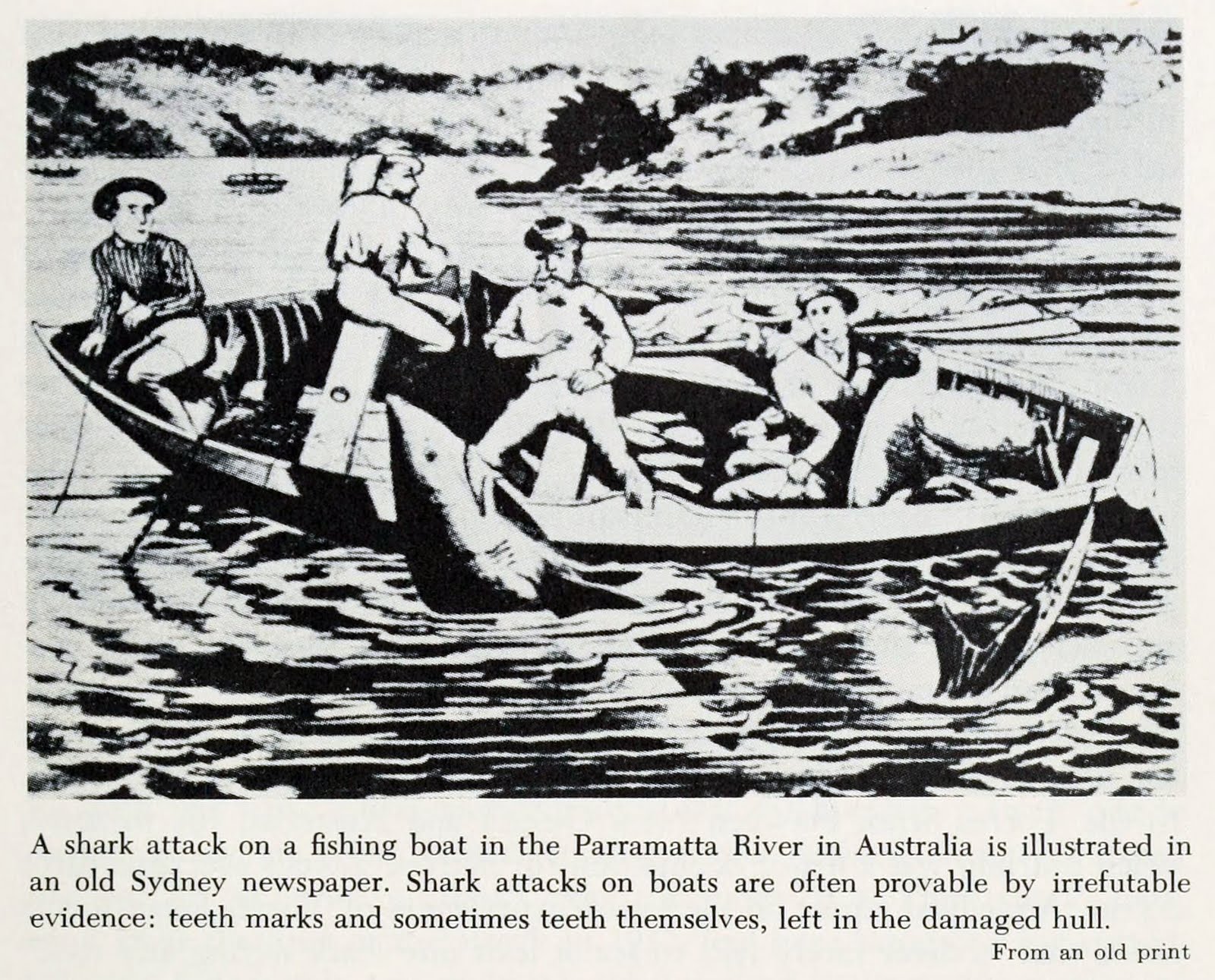
 You may have noticed, given all the frenzy about sharks this week on practically every nature-related news stream (and, for that matter, our own social media outlets if you follow us on Facebook or Twitter), it’s SHARK WEEK! So, you know what that means – we’re featuring sharks in our book of the week this week! Combing through the generous collection of books on sharks in BHL, our Collections Coordinator, Bianca Crowley, came across this tantalizing title: Shadows in the Sea (1963), by Harold W. McCormick. Turns out the “shadows” the title refers to are sharks, and we had our book of the week!
This book is full of fascinating, and sometimes gruesome, topics, such as shark attacks on people, sharks in mythology, the origin of sharks, and, of course, a guide to the shark species. It also contains some somewhat less conservation-friendly topics, such as shark fishing, sharks as food, and “shark treasures,” or “the products, other than food, obtained from sharks.” Reading through the book, we were particularly engrossed by content in two select topics – the riveting account of early shark attacks and the role sharks have played in myth and legend. Comprising too much material for a single post, we decided to do our book of the week post this week in two parts (Harry Potter style, you know). Part One, this post, focuses on the gripping shark attack accounts presented in the early chapters of the book. Part two will present the shark as an integral component of various myths and legends throughout the world. So, sit back and enjoy part one of our feature presentation!
“The Shadows Attack: Documented Attacks by Sharks on Men”
Our book begins as though the reader had just opened the first page of an early twentieth century novel, describing a serene oceanside resort in Beach Haven, New Jersey, and the enthusiastic anticipation of one young vacationer as he enjoys his first few blissful moments in the invigorating waters. Unfortunately, all is not well for our protagonist – 23-year old Charles Van Sant. As he strokes powerfully through the waves, an unseen antagonist stalks him.
“Directly behind him, knifing toward him straight and sure, was a gray shadow beneath a black fin that crested the water. They saw it from the beach. Bathers screamed, but the man did not hear their cries…He was still swimming excruciatingly slowly, unaware that he was hunted in a deadly chase.”
Former U.S. Olympic Team swimmer, Alexander Ott, who dove in to save the imperiled young man, was able to retrieve the shark’s victim from the waters after the shark had already attacked. Unfortunately, it was too late. As our story tells us,
“Ott managed to get Van Sant to shore, and there, on the warm sand, Van Sant’s life ebbed away. His legs had been horribly ravaged. He died that night from shock and loss of blood.”
The public was awed and alarmed by the story. “No one could remember a shark ever having killed a swimmer before…Experts said that there never had been an absolutely authenticated case of a shark attacking a swimmer anywhere in the world.” The chapter goes on to tell us of more early shark attacks, and the power with which they gripped the public. For instance, a separate attack, in which a Charles Bruder was killed, received more coverage in the New York papers than the 24 people that died of Polio that same day. As our book of the week asserts, “Such is the glamour and the terror of the shark!”
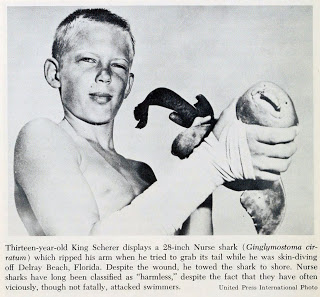
The frenzy that accompanied the birth of the “Shark Attack Era” was as might be expected. Soon, stories of lifeguards “battl[ing] 12-foot shark[s]” with oars and policemen emptying their clips at portentous shadows in the water filled the media. Fortunately, the mounting hysteria was calmed by the “sobering voice of academic authority,” which assured the public that sharks did not possess the unbridled power to rend a man limb from limb as rumors were claiming, and, given the number of swimmers in the water, attacks were extremely rare. Blind panic subsided considerably, swimmers re-entered the waters, and sharks, which had been an economic disaster for oceanside resorts, to some degree slowly became a captivating attraction. Of course, attacks still continued, and with each new attack, a fresh wave of panic erupted, requiring yet another scientific voice of reason to appease it and evoking more and more research regarding shark attacks.
The shark species with more documented attacks on humans than any other is the Great White. Made infamous by director Steven Spielberg in the cult classic Jaws, no other marine species has as much power to grip the heart in terror as this predator does. In the first half of the twentieth century, however, it was believed that this species posed a “negligible hazard”to humans as it was thought to be a tropical shark, uncommon in North American waters and rarely traveling inshore. In 1955, this perception changed. Decade after decade, another “Year of the Shark” emerged as various Great White attacks made headlines, particularly in California. The legend of the Great White as one of the greatest living killers was born.
While we are much more educated about sharks – and the circumstances around which attacks might happen – today, our bittersweet love affair with the topic lives on, as evidenced by the popularity of movies such as Jaws, Deep Blue Sea, and concepts like “Shark Week.” We know now that sharks are not the senseless, merciless killers that their reputations claim, but they nevertheless are powerful, majestic creatures quite capable of ending human life (just read the first two chapters of this book if you don’t believe us!). There will likely always be a side of us that sees the monster Jaws in the face of each shark we come across. Perhaps we are destined to forever watch the ocean’s surface in gruesome anticipation of seeing that ominous dark triangle break the peaceful surface. For, “The hazardous creatures of the sea are many, but there is one that man fears above all others – The Shark.”
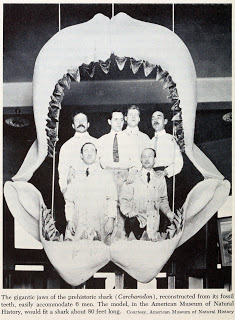
This week’s book of the week, Shadows in the Sea (1963), by Harold W. McCormick, was contributed by the MBL WHOI library. See more images from our book of the week in Flickr! There’s a particularly nice picture of six humans standing inside the jaws of the largest shark to ever live – the Megalodon (pictured above)!